
If you've ever promised a client a delivery date before confirming a single upstream variable, you already know where this goes. Custom linen furniture carries real timeline risk — and most of it lands on the designer's side, not the factory's. Understanding the decision chain before you place an order is the only way to protect your project and your client relationship.
Custom linen furniture follows a fixed sequential stage workflow that cannot be reordered; designers may hold open advance dialogue on specifications, logistics and special craftsmanship requirements before formal written order lock-in, yet each production phase can only launch after the prior stage receives signed written confirmation. The process moves in stages — down payment, sample production, designer approval, bulk production, QC, and shipping — and each stage starts only after the previous is confirmed in writing. Front-loading three locked parameters (dimensions, fabric, and finish details) before order placement is what keeps a 6–10 week timeline from becoming a 14-week standstill.

The process is manageable when you know its structure. The problems I see most often — and they repeat across projects — come from treating custom furniture like a retail purchase with a flexible window. It isn't. Below, I'll walk through every stage of our custom order process at Linen World, name who confirms what, and explain what happens when they don't.
What Must Be Locked Before You Place a Custom Furniture Order?
Many designers assume the order placement is the starting line. In our process, it isn't. The starting line is the moment three parameters are confirmed without ambiguity. If any one of these is unresolved at the time of order, the project does not actually start — it waits.
Before placing a custom linen upholstery1 order, three parameters must be fully confirmed: (1) frame dimensions and configuration, (2) fabric selection or COM sample submission with correct yardage, and (3) finish and leg details. These lock the sample specification. Any structural change after sample production begins a new sample cycle and resets the clock by 2–3 weeks minimum.
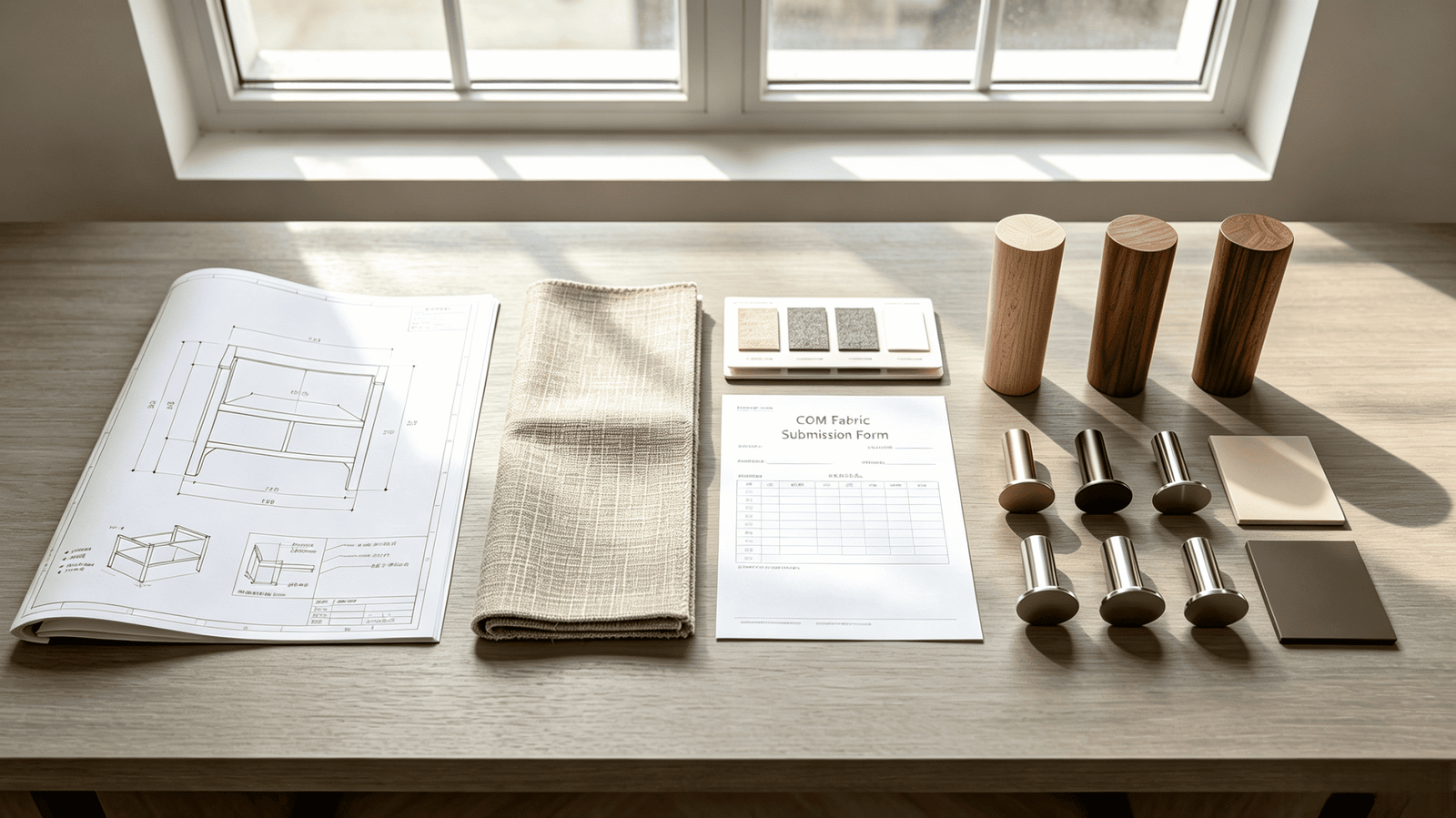
These three parameters are not bureaucratic formalities. Each one controls a downstream variable that cannot be reversed once production begins.
Parameter 1: Frame Dimensions and Configuration
This means the exact width, depth, seat height, arm style, back style, and any custom configuration — such as an L-shape, modular count, or daybed extension. "Similar to the reference image" is not a locked dimension. Vague briefs at this stage produce sample pieces that need structural revision, and structural revisions after sampling don't get absorbed quietly — they restart the sample cycle.
I ask designers to submit a dimensioned sketch or reference file with explicit callouts for every measurement that differs from our standard models. If your client hasn't confirmed the floor plan yet, this is the moment to pause. Locking dimensions before floor plan confirmation is the number-one source of structural revision requests I see.
Parameter 2: Fabric Selection or COM Submission
If you are selecting from our in-house linen range (200+ colorways, all made-to-order2), the fabric reference and colorway must be confirmed with a swatch sign-off before we schedule sample production. "Made-to-order" here means the fabric is prepared after order — it is not pulled from a warehouse shelf. This distinction matters when you are building a client timeline.
If you are supplying COM (Customer's Own Material), the fabric must physically arrive at our facility before we can schedule anything. More on COM in a dedicated section below — it deserves its own treatment because it is the single most common delay source in our custom projects.
Parameter 3: Finish and Leg Details
Wood finish tone, leg material (solid wood, metal, tapered, turned), and any exposed frame detailing need confirmation at this stage. These affect both sample production and bulk production sourcing. A change to leg finish after sampling typically requires a new leg sample, which adds time independently of the upholstery revision cycle.
What Does the Custom Furniture Timeline Actually Look Like?
Designers frequently ask me for "the lead time." I understand why — clients want a number. But a single number without a stage breakdown is how designers end up with wrong delivery promises. The timeline is a chain, and each link depends on the previous one closing.
In our custom linen furniture process, the realistic timeline from confirmed order to shipped goods is 50–65 days under normal conditions. That breaks down as: down payment receipt (triggers sample start), sample production (15–20 days), designer approval (variable — 3–10 days depending on revision rounds), bulk production (25–35 days)3, QC and packing (3–5 days), plus shipping transit. Each stage starts only after written confirmation of the previous.
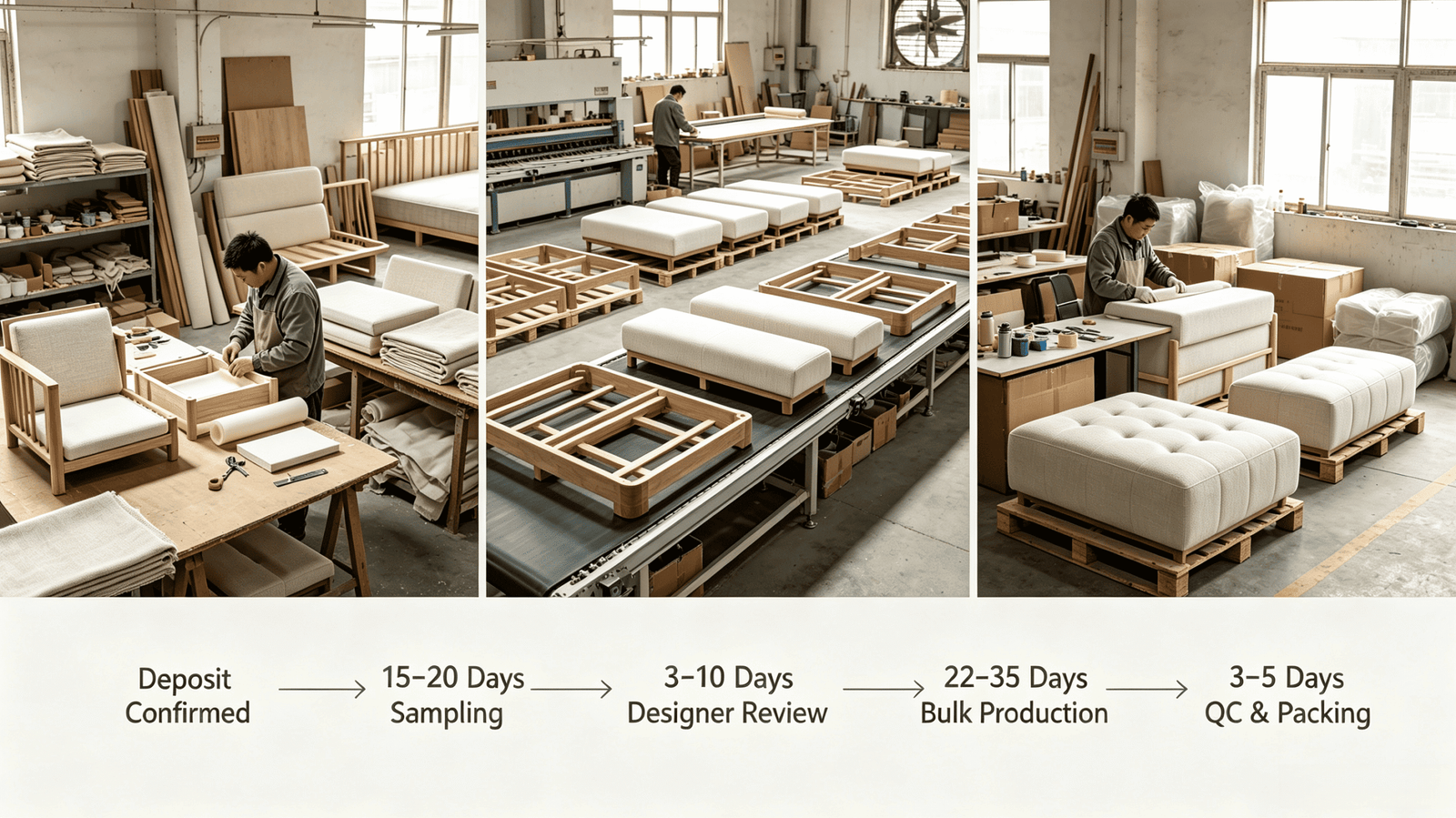
Here is the stage-by-stage breakdown with the real variables that determine where in each range your project lands.
Stage 1: Down Payment and Order Confirmation
Once all three parameters are locked and confirmed in writing, we invoice for the down payment (typically 50%). Production scheduling — including fabric preparation and frame sourcing — begins only after payment clears. This stage itself takes 1–3 business days depending on bank processing.
What pauses this stage: Unresolved dimensions, pending fabric swatch approval, or COM fabric not yet dispatched.
Stage 2: Sample Production (15–20 Days)
We build one physical sample to the confirmed specification. The 15-day end of this range applies to standard configurations with in-house fabric. The 20-day end applies to more complex configurations — modular sectionals, unusual arm profiles, or pieces requiring custom frame construction beyond our standard jigs.
During this stage, the designer is not idle. This is the window to confirm shipping logistics, review the production spec sheet we issue at sample start, and — if using COM — verify the fabric has arrived at our facility.
Stage 3: Designer Sample Approval (3–10 Days)
We send sample photos and, on request, video walkthroughs before the sample ships. For designers who want a physical sample review, we ship the sample for inspection. This adds transit time to the window but eliminates ambiguity.
The range here is entirely controlled by the designer's review speed and revision count:
- One round, no structural revisions: 3–5 days
- One round with minor adjustments (cushion fill, tufting depth, piping finish): 5–7 days and a revised sample image, no new sample cycle required
- Structural revision (arm height, seat depth, back configuration): New sample cycle begins — reset sample production clock by 15–20 days
I want to be direct about this: post-approval structural change requests are not adjustments. They are new orders at the sample stage. This is not a factory policy written to frustrate designers — it reflects the reality that frame construction is not reversible once completed4.
Stage 4: Bulk Production (25–35 Days)
Bulk production starts only after written sample approval. The variation in this range is driven by three variables:
| Variable | Lower End of Range | Upper End of Range |
|---|---|---|
| Order volume | 1–3 pieces | 8–15 pieces |
| Fabric preparation complexity | In-house standard linen | COM or special-order weave |
| Configuration complexity | Single sofa, standard shape | Sectional, modular, multiple SKUs |
For a typical designer order of 2–4 custom linen sofas or armchairs, 28–32 days is a realistic bulk production window.
Stage 5: QC and Packing (3–5 Days)
Every piece is inspected against the approved sample before packing. We document this with photo records and share the QC report with the designer before issuing the balance invoice. Packing for ocean freight adds 1–2 days to air freight packing due to crating requirements.
Stage 6: Shipping Transit
Ocean freight to the US East Coast runs 25–35 days from Foshan. West Coast runs 18–25 days. Air freight is 5–8 days.5 This is after the vessel or flight departs, not after QC sign-off.
Total realistic window to plan around: 75–100 days from confirmed order to domestic delivery, including ocean transit. Designers who quote 8 weeks to a client without accounting for transit are creating their own problem.
Why Is COM Fabric the Biggest Risk in Custom Linen Upholstery Orders?
COM sourcing feels like the designer's preferred way to achieve a precise specification. In practice, it is also the most reliable way to stall a project at the very first stage. I've seen it happen more than once, and the pattern is almost always the same.
COM (Customer's Own Material) fabric must physically arrive at our facility before sample production can be scheduled6. Required yardage for a standard two-seat linen sofa is typically 10–14 yards depending on pattern repeat and configuration7. If COM arrives late, short, or without a confirmed repeat measurement, sample production cannot begin — and the entire timeline waits.
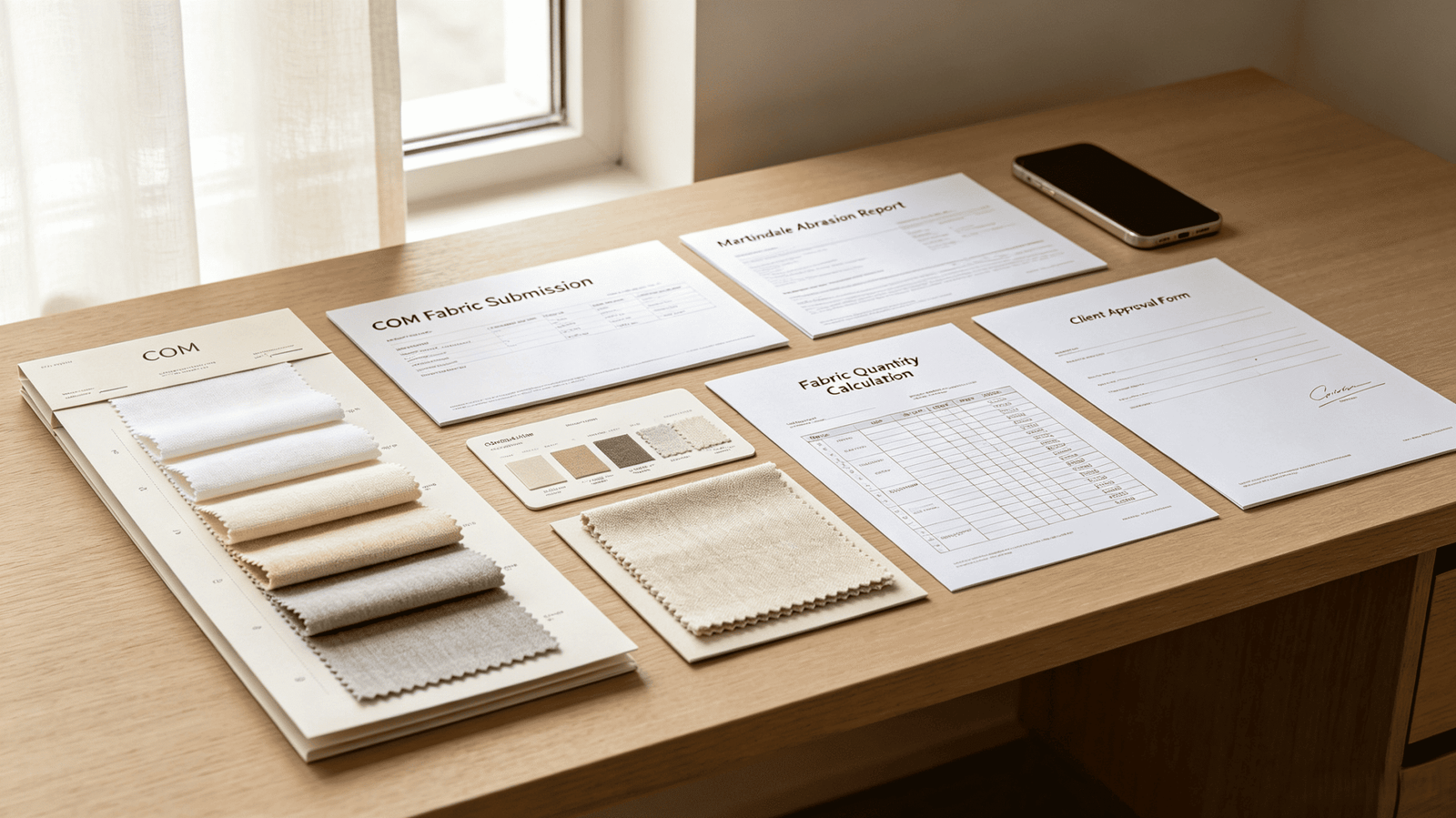
The Real Case: What a Late COM Shipment Actually Costs
A designer placed an order for three custom linen armchairs for a high-end residential project in California. All three parameters were confirmed on paper: dimensions were locked, leg finish was approved, and the COM fabric had been "dispatched." We invoiced and received the down payment.
The fabric arrived three weeks after the order was placed. Not because of a shipping delay — the designer had submitted the PO to their fabric supplier after placing our order, assuming the two timelines would run in parallel. They didn't. Our sample production couldn't begin until the fabric was in hand.
By the time we completed sampling and bulk production, the project had run five weeks past the designer's original client promise. The designer absorbed the client's frustration. The factory had done nothing wrong. The gap was in the assumption that "dispatched" and "arrived and confirmed" mean the same thing.
What Correct COM Submission Looks Like
To avoid the above, here is what we ask COM clients to confirm before we issue an order invoice:
- Fabric has been ordered from the supplier — not just selected
- Estimated dispatch date from the fabric supplier — so we can align our scheduling
- Tracking number issued — fabric is in transit
- Fabric arrives at our facility and passes inspection — correct yardage, no defects, repeat measurement confirmed
Only at step 4 do we schedule sample production. Designers who understand this build in a 2–3 week COM procurement window before placing the furniture order — or they place the furniture order only after the fabric has already shipped.
COM Yardage by Piece Type
Getting yardage wrong is the second most common COM issue. Short fabric delivery delays production further while additional yardage is sourced.
| Piece Type | Minimum COM Yardage (Plain Fabric) | With Pattern Repeat (Additional) |
|---|---|---|
| Linen armchair (standard) | 6–8 yards | +1–2 yards per repeat |
| Two-seat linen sofa | 10–12 yards | +2–3 yards |
| Three-seat linen sofa | 14–16 yards | +3–4 yards |
| Linen dining chair (per unit) | 2–3 yards | +0.5–1 yard |
These figures assume standard cushion configuration. Deep seats, tight backs, or tufted designs require more yardage. We provide a fabric quantity confirmation as part of our pre-order spec sheet — use it.
How Does the Made-to-Order Fabric Process Affect Timelines?
Designers who select from our 200+ linen colorways sometimes assume the fabric is pre-cut and waiting. It isn't, and the distinction affects how you communicate timelines to clients.
In our made-to-order process, every fabric colorway is prepared after order confirmation. We maintain only tiny sample rolls of popular neutral linen tones for swatch matching reference; no full pre-cut bulk fabric stock is stored for mass upholstery production, all upholstery yardage is woven and cut post formal order confirmation. Fabric preparation adds 5–8 days to the front of the sample production window and is already factored into the 15–20 day sample timeline — but only if the colorway is confirmed at order placement, not after.
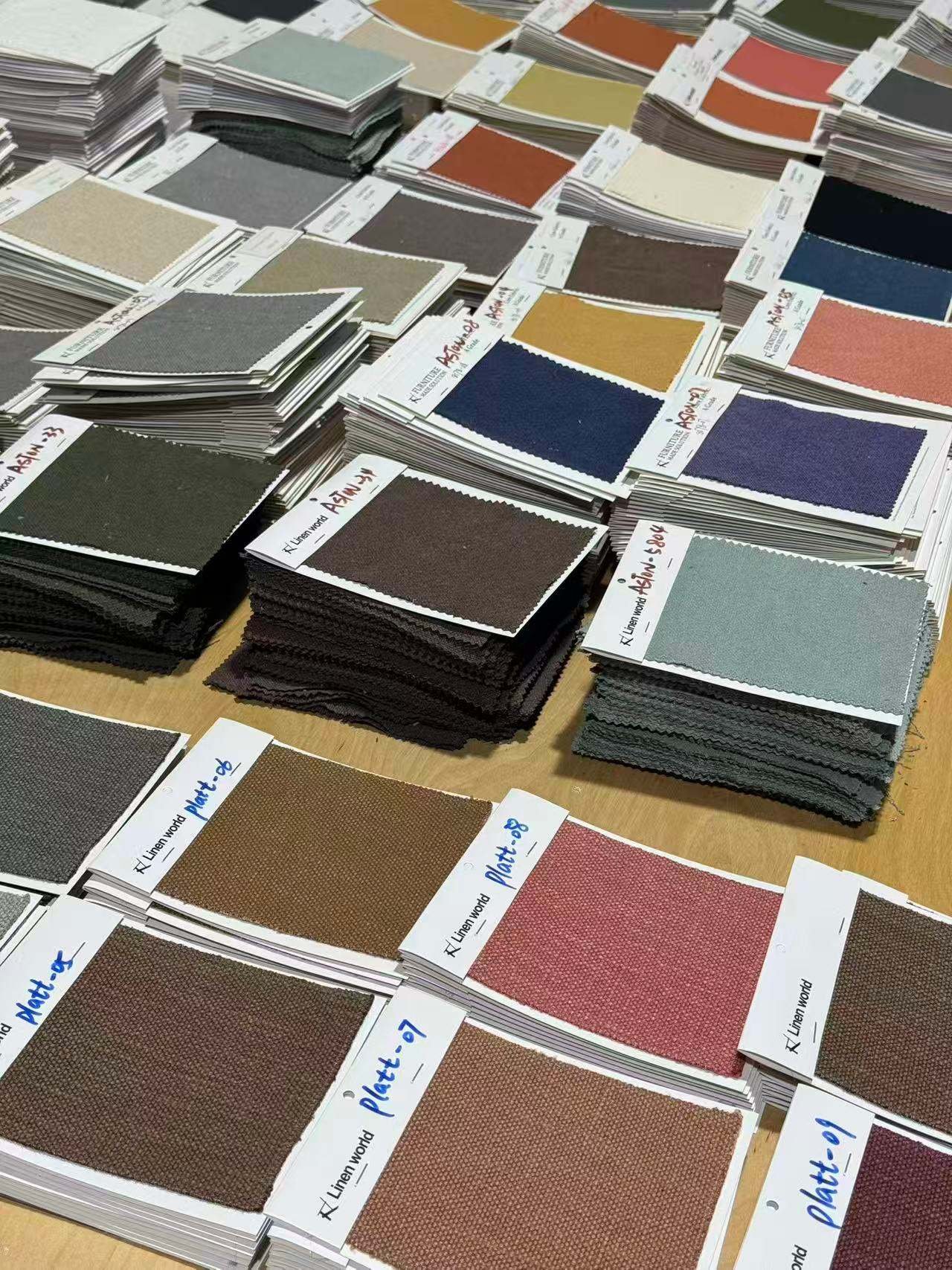
What "200 Colors" Actually Means for Your Project
The range exists to give designers genuine flexibility — natural undyed linen, warm sand tones, slate greys, deep navies, and everything between. But the word "available" means "can be prepared," not "on the shelf." When a designer tells their client that fabric is "available," the accurate version of that sentence is: "the colorway exists and will be prepared once we place the order."
This matters for two reasons:
- Timeline communication: If a client asks "can we change to a different color?" after order placement, the answer is yes — but only before fabric preparation begins. After that point, a colorway change requires reordering fabric, which adds 5–8 days and, if the sample has already been made in the original color, potentially restarts sampling.
- Swatch confirmation: We strongly recommend requesting a physical swatch before order placement. Screen color rendering varies significantly across monitors8. A swatch sign-off creates a shared reference that eliminates "the color looks different" disputes after production.
Frequently Asked Questions
Can I make changes to dimensions after the sample is approved?
No. Once a sample is approved in writing, bulk production is scheduled against that specification. Any structural dimension change — seat depth, arm height, back height — requires a new sample cycle. That adds 15–20 days to the production start. Minor non-structural adjustments (cushion fill firmness, piping color) can sometimes be accommodated without resampling, but must be confirmed with us in writing before bulk start.
How much deposit is required to start a custom linen furniture order?
We typically require a 50% deposit to begin production, with the balance due after QC sign-off and before shipment. COM orders follow the same structure, but production scheduling does not begin until both the deposit is received and the COM fabric is confirmed arrived at our facility.
What happens if my COM fabric arrives with a defect or short yardage?
We inspect all incoming COM fabric on arrival and issue a fabric inspection report. If the fabric fails inspection — defect, short yardage, or incorrect repeat — we notify you immediately with documentation. Production cannot proceed until replacement fabric arrives. This is why we ask for 10–15% overage on all COM submissions9.
Can I order a single custom piece, or is there a minimum order quantity?
We work with single-piece orders for sampling and small residential projects. There is no minimum unit requirement. Pricing and lead time are consistent whether you order one linen armchair or a full living room set, though larger orders may require coordination on production scheduling.
How do I know the finished piece will match the approved sample?
Our QC process compares each production piece directly against the approved sample specification. We document this with photographs across all measurable dimensions and share the QC report before issuing the balance invoice. If a discrepancy is found during QC, we resolve it before the piece ships — not after.
Conclusion
The custom linen furniture process is a decision chain, not a flexible order window. Three parameters must be locked before production begins — dimensions, fabric or COM submission, and finish details. The timeline runs in discrete stages, each triggered by the previous one closing. COM fabric arrival is the most common point of failure, and made-to-order colorways require confirmed swatch sign-off before production begins. Designers who front-load these decisions protect their client timelines. Designers who don't absorb delays that were entirely avoidable.
At Linen World https://linenworld.pro, our custom linen upholstery process is built to give designers in the US and European markets a direct factory path to high-end, handcrafted pieces — at a fraction of what equivalent custom work costs locally10. The process works when the inputs are right. If you are planning a project and want to walk through your specific requirements before placing an order, reach out to us directly. We will tell you exactly what needs to be confirmed and when.
"Linen", https://en.wikipedia.org/wiki/Linen. Linen, a textile made from the fibers of the flax plant (Linum usitatissimum), is characterized by high tensile strength, low elasticity, and a natural texture that makes it suitable for upholstery applications; its breathability and durability are frequently cited in textile references as advantages for furniture use. Evidence role: definition; source type: encyclopedia. Supports: Linen's material properties and suitability as an upholstery fabric. Scope note: Upholstery performance depends on weave density and finishing treatments; general fiber properties do not fully predict performance in specific furniture applications. ↩
"Linen Blend Fabric", https://linenworld.pro/fabric_type/linen-blend-fabric/. Operations management and supply chain literature describe made-to-order (MTO) production as a model in which manufacturing begins only upon receipt of a confirmed order, eliminating finished goods inventory but introducing lead time between order placement and production readiness. Evidence role: general_support; source type: research. Supports: Made-to-order production models in textile and furniture manufacturing, where materials are prepared after order confirmation rather than held as finished inventory. Scope note: The article's specific claim about fabric preparation timelines is factory-specific; general MTO literature supports the model description but not the precise day ranges cited. ↩
"Why Are Designers and Buyers Purchasing Furniture from China?", https://linenworld.pro/why-are-designers-and-buyers-purchasing-furniture-from-china/. Furniture industry analyses and trade publications indicate that custom upholstered furniture production lead times — excluding sampling and shipping — commonly range from four to eight weeks depending on order complexity, volume, and manufacturer capacity, with Chinese export manufacturers generally operating at the lower end of this range. Evidence role: general_support; source type: research. Supports: Typical production lead times for custom upholstered furniture in contract and residential manufacturing contexts. Scope note: Published lead time benchmarks vary widely by source, order type, and market segment; the figures cited in the article are factory-specific and may not be directly comparable to industry averages. ↩
"Elements of Designing Upholstered Furniture Sandwich ...", https://pmc.ncbi.nlm.nih.gov/articles/PMC9458000/. Furniture manufacturing literature describes upholstered frame construction as involving permanent joinery methods — including mortise-and-tenon, dowel, and glued corner block assemblies — that are not practically reversible once cured or assembled, making structural dimension changes after frame completion equivalent to new production. Evidence role: mechanism; source type: education. Supports: Furniture frame construction methods that make structural modifications impractical once assembly is complete. Scope note: Some frame components may be modifiable depending on construction method; the claim applies most directly to fully assembled and glued frames. ↩
"Latest Supply Chain and Freight Indicators", https://www.bts.gov/freight-indicators. Freight industry data and port authority records indicate ocean transit from major southern China ports (including Guangzhou/Nansha, proximate to Foshan) to US East Coast destinations typically ranges from 25–35 days, with West Coast routes averaging 18–25 days, subject to carrier, routing, and seasonal variation. Evidence role: statistic; source type: institution. Supports: Average ocean freight transit times from southern China ports to US East and West Coast ports. Scope note: Published transit benchmarks reflect averages across carriers and routes; actual times vary with port congestion, transshipment hubs, and seasonal demand. ↩
"Wholesale / Trade Account - Linen World | Handcrafted Bespoke ...", https://linenworld.pro/wholesale-trade-account/. Custom upholstery trade associations and manufacturing guidelines consistently specify that COM fabric must be received, inspected for yardage and defect, and confirmed at the production facility before scheduling can begin, as fabric availability is a prerequisite for sample construction. Evidence role: expert_consensus; source type: institution. Supports: Industry-standard requirement that COM fabric must be received and inspected before custom upholstery production can commence. Scope note: Specific protocols vary by manufacturer; this reflects general industry consensus rather than a universally codified standard. ↩
"Linen vs Cotton for Upholstered Furniture: Which One Actually ...", https://linenworld.pro/linen-vs-cotton-for-upholstered-furniture-which-one-actually-fits-your-project/. Interior design and upholstery trade references indicate that a standard two-seat sofa typically requires between 10 and 14 yards of plain fabric, with additional yardage required for pattern matching, deep seats, or tufted configurations. Evidence role: general_support; source type: education. Supports: Standard fabric yardage requirements for upholstering a two-seat sofa, including pattern repeat allowances. Scope note: Yardage requirements vary significantly by sofa profile, cushion count, and construction method; figures represent general industry estimates rather than universal specifications. ↩
"How to Order 1pc Furniture from Linen World: Step-by-Step ...", https://linenworld.pro/how-to-order-1pc-furniture-from-linen-world-step-by-step-guide-ddp-delivery/. Color science research and display technology literature document that uncalibrated consumer monitors exhibit significant variation in color gamut coverage, white point, and gamma response, resulting in perceptible differences in how the same digital color value is rendered across devices. Evidence role: mechanism; source type: research. Supports: Color rendering varies across uncalibrated consumer monitors due to differences in color gamut, white point, and gamma settings. Scope note: The degree of variation depends on display technology, calibration status, and ambient lighting; the claim applies most strongly to uncalibrated consumer-grade monitors. ↩
"Linen vs Cotton for Upholstered Furniture: Which One Actually ...", https://linenworld.pro/linen-vs-cotton-for-upholstered-furniture-which-one-actually-fits-your-project/. Upholstery trade and interior design procurement guidelines commonly recommend ordering 10–15% additional yardage above calculated requirements for COM submissions, accounting for potential fabric defects, cutting waste, and measurement discrepancies identified during factory inspection. Evidence role: expert_consensus; source type: institution. Supports: Industry-standard fabric overage recommendations for custom upholstery COM submissions to account for defects, cutting waste, and yardage discrepancies. Scope note: Recommended overage percentages vary by source and fabric type; patterned fabrics with large repeats may require higher overage than plain weaves. ↩
"the effect of furniture imports from china", https://www.usitc.gov/publications/332/working_papers/ecwp_2017-08-a-08-23-17_0.htm. Trade and industry data from sources including the US International Trade Commission and furniture industry analyses indicate that Chinese furniture manufacturing benefits from lower labor and material costs relative to US and European domestic production, contributing to significant price differentials for comparable custom upholstered pieces. Evidence role: general_support; source type: government. Supports: Manufacturing cost differentials between Chinese furniture production and domestic US or European custom furniture production. Scope note: Cost differentials are subject to exchange rates, tariff regimes, and shipping costs; the gap has narrowed in some segments as Chinese labor costs have risen. ↩


