
Sending a COM fabric overseas feels straightforward — until it isn't. Designers who skip the qualification stage discover, weeks later, that their timeline has collapsed and their client is waiting. If you're placing a COM order with a linen upholstery factory for the first time, what you prepare before the fabric ships determines everything that follows.
COM fabric (Customer's Own Material) allows interior designers to source fabric independently and send it directly to an upholstery factory for production. When working with a linen upholstery factory, COM fabric must pass a physical qualification process — covering weight, shrinkage, and structural integrity — before any sample or production cut begins. This full physical qualification testing workflow is a mandatory standard process for nearly all COM upholstery orders and will extend the overall project timeline; for tiny solid-fabric orders supplied with complete third-party upholstery performance certification, we may launch frame prefabrication in parallel during testing to partially offset lead time.
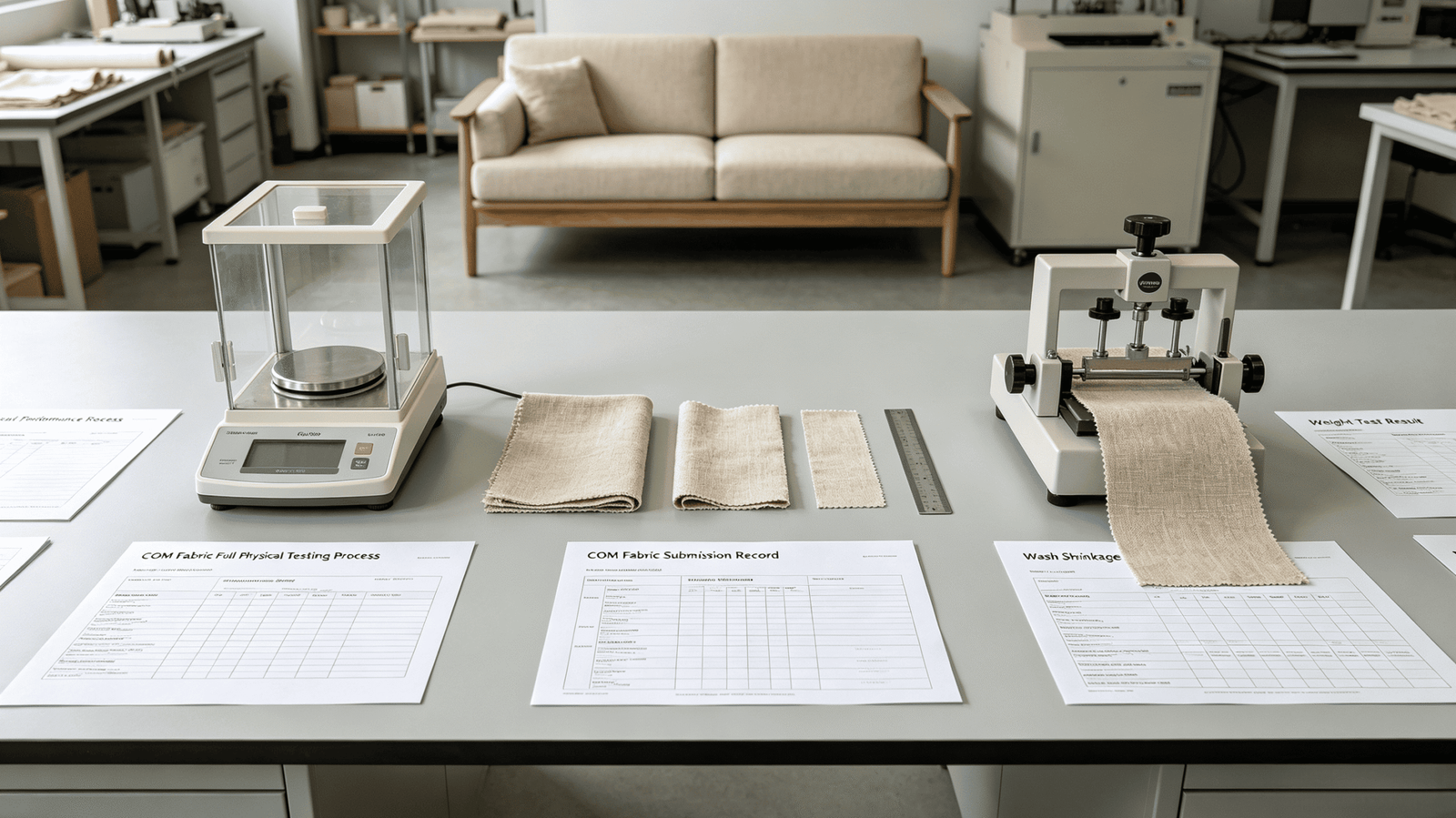
Understanding the COM workflow at a linen factory is different from understanding it at a domestic workroom. The stakes are higher, the communication chain is longer, and the physical variables are less forgiving. Below, I'll walk through every stage — from fabric qualification to final shipping — so you can plan with confidence.
What Actually Happens When We Receive Your COM Fabric?
Most designers assume that once the fabric arrives at our factory, production begins. That assumption is the single most common reason COM projects run late.
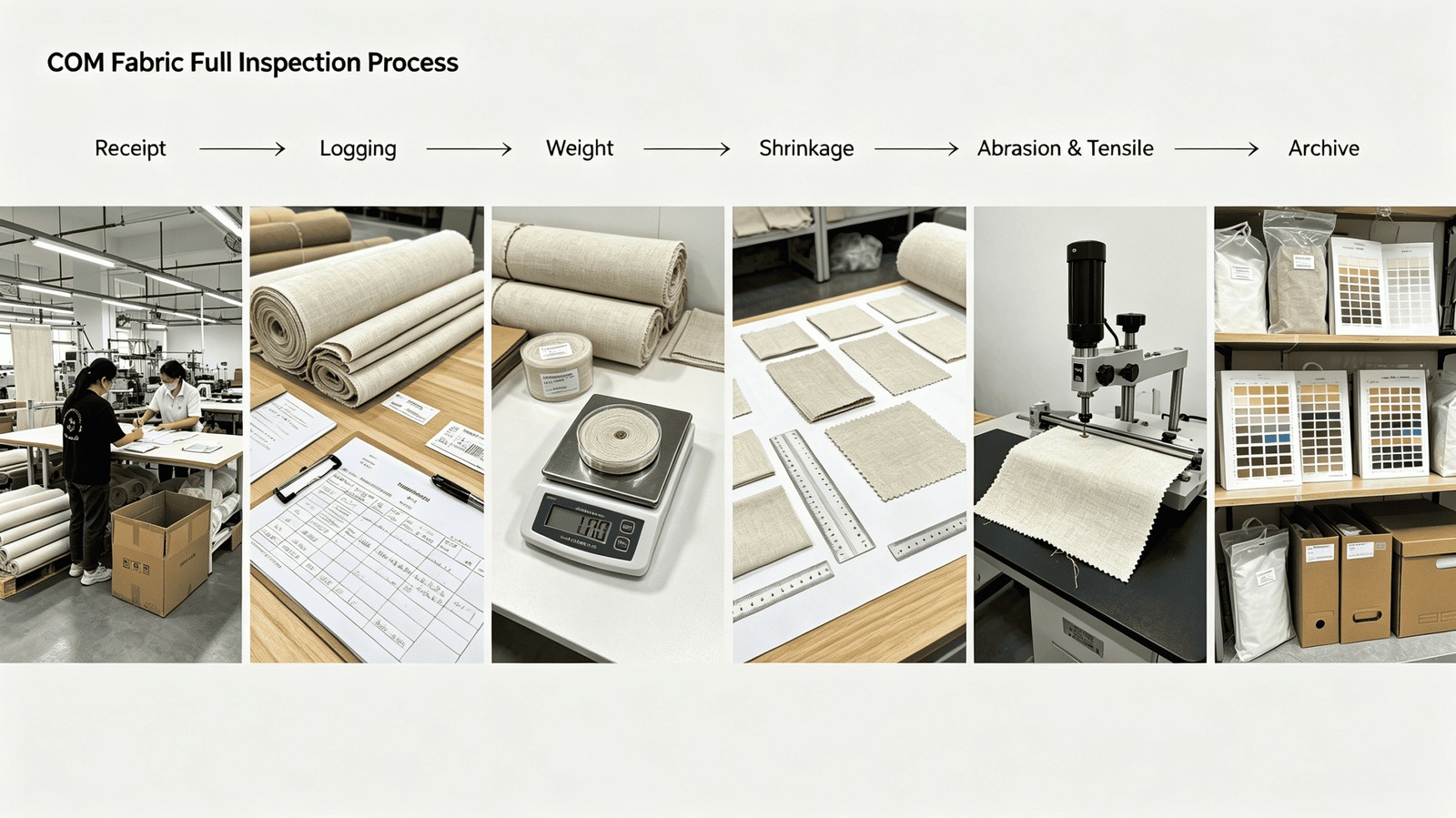
When a COM fabric arrives at our intake desk, the first question we ask is not "how many yards did we receive?" It's "does this fabric qualify for linen upholstery production?" That answer requires a physical test, not a visual inspection — and the test takes time.
The Qualification Step Most Designers Don't Know Exists
In our intake process, every COM fabric goes through a structured evaluation before a single sample cut is made. We are not testing to be difficult. We are testing because linen upholstery applies mechanical stress to fabric that most fabrics — even high-quality ones — haven't been evaluated for1.
Here's what that evaluation covers:
- Shrinkage testing. We apply moisture and tension conditions similar to those the fabric will experience during upholstery. Fabrics that haven't been pre-shrunk can distort after being stretched over a frame. On a linen sofa with tight upholstery tolerances, even a 3–5% shrinkage rate can cause visible deformation across seams2.
- Weight assessment. We generally look for fabrics in a range that provides enough body to hold upholstery tension without distorting, but the actual determination happens after we test your specific fabric — not from a spec sheet alone. A fabric that reads well on paper can behave differently in practice.
- Weave integrity under tension. Some woven fabrics — particularly open-weave linens or loosely constructed blends — pull apart at stress points like arm corners and seat edges. We test pull strength before committing to production.
- Surface finish compatibility. Certain pre-treatments (anti-stain coatings, fire retardants, or sizing agents) affect how fabric responds to cutting and hand-stitching. We flag these before they create problems mid-production.
What this means for your timeline: Fabric receipt does not equal production start. Budget 5–7 business days for physical testing before you see a sample quote or production confirmation. If the fabric fails any part of this evaluation, you'll need to re-source — and that resets your timeline entirely.
Why Linen Upholstery Is Less Forgiving Than Other Applications
Linen as a base material has a tight tolerance for variation. Our craftspeople work by hand, fitting fabric to frame with the kind of precision that makes high-end linen furniture worth its price. That same precision means a COM fabric with inconsistent weight, uneven shrinkage, or structural gaps will show its flaws in the finished piece.
Domestic workrooms handling COM for, say, drapery or loose cushion covers operate under very different physical conditions. The fabric never experiences the sustained tension that a fully upholstered sofa frame generates. Designers who have successfully sent COM to domestic workrooms sometimes underestimate what the linen upholstery environment demands. I've seen this cause genuine frustration — not because the designer made a careless choice, but because no one told them the goalposts were different.
What Is the Real Lead Time for a COM Linen Order?
The honest answer: longer than most designers plan for. The honest reason: most designers budget for production time only, and production is only one stage.
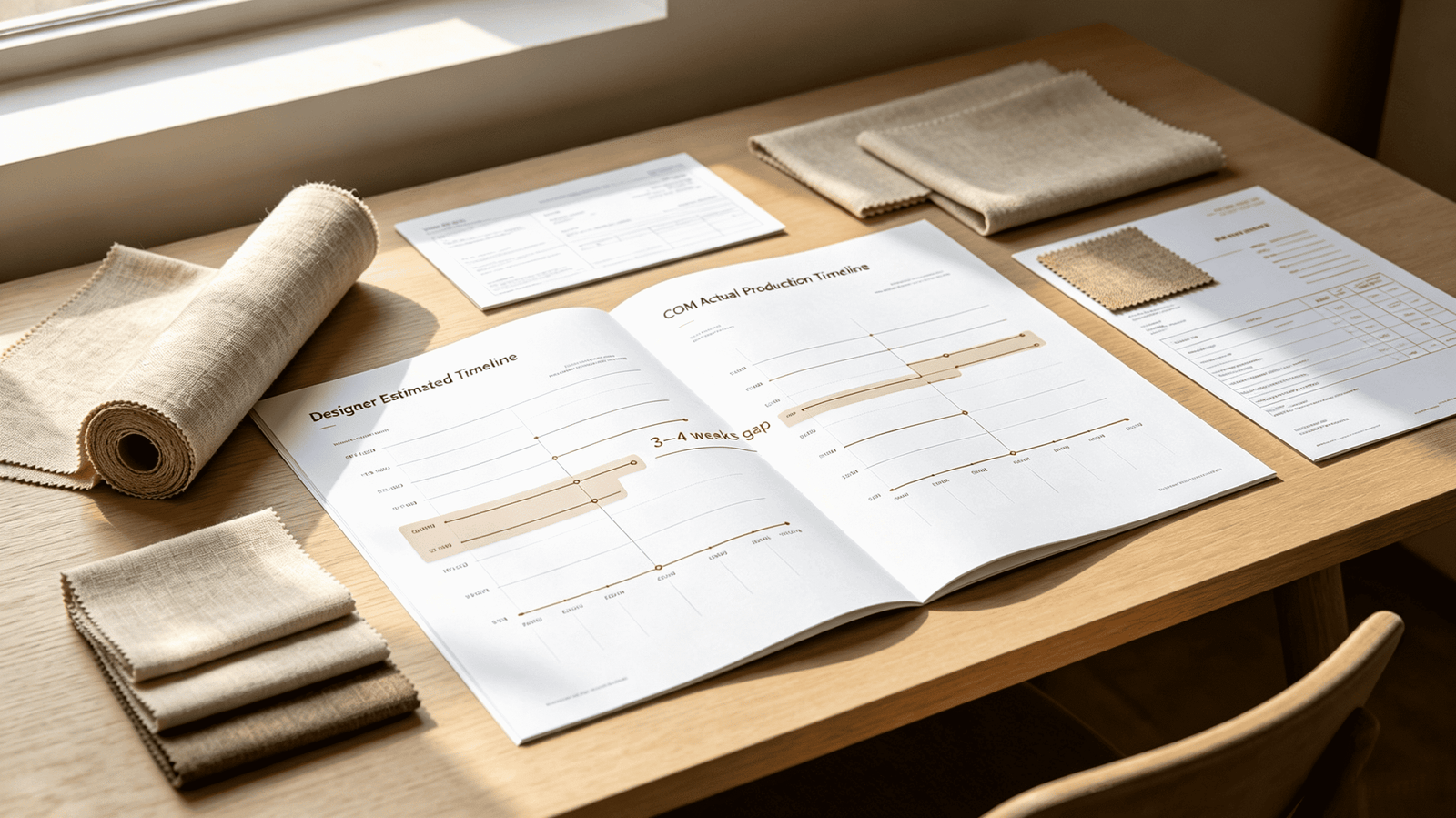
When we walk through a realistic COM project calendar with a designer, it often reveals a 3–4 week gap between what they budgeted and what the process actually requires.
Full Timeline Breakdown: Stage by Stage
Here is the complete sequence we walk through with every COM order:
| Stage | Description | Typical Duration |
|---|---|---|
| 1. Pre-shipment alignment | Designer shares fabric specs; factory reviews in principle | 2–5 business days |
| 2. Fabric transit | Designer ships COM fabric to our Foshan factory | 7–14 days (US to China, depending on carrier)3 |
| 3. Physical testing | Shrinkage, weight, weave integrity, finish compatibility | 5–7 business days |
| 4. Sample making | First sample cut and assembled for designer approval | 7–10 business days |
| 5. Sample shipping + approval | Sample ships to designer; designer reviews and approves | 7–10 days transit + review time |
| 6. Production | Full production run begins after written approval | 20–35 business days (varies by item and quantity) |
| 7. Final shipping | Finished pieces shipped from Foshan | 15–25 days (sea freight, standard)4 |
Total realistic window: 12–18 weeks from fabric ship date. That figure assumes no re-sampling, no fabric failure, and no revision requests. If any stage requires a revision, add 3–6 weeks.
The Stages Where Time Is Most Commonly Lost
Based on what I've seen across hundreds of COM projects, delays concentrate in three predictable places:
- Between stages 1 and 2 — the designer ships fabric without getting factory confirmation first. The factory then needs to reopen the evaluation conversation from scratch, or worse, holds the fabric in queue until the designer responds to intake questions.
- At stage 3 — the fabric fails testing. This is almost always preventable with pre-shipment communication. If we've reviewed your spec sheet before the fabric ships, we can flag likely issues in advance.
- At stage 5 — the designer delays sample approval. Every day of delay here pushes the production start date back one-for-one. I'd recommend setting a firm internal review deadline before the sample even ships.
What Should Designers Prepare Before Shipping COM Fabric?
This is the most actionable part of the entire COM process — and the part most designers skip entirely. Preparing properly before you ship is not about bureaucracy. It's about protecting your project timeline and your professional credibility with your client.
The pre-shipment stage is where we can catch most problems before they cost you weeks. Here is exactly what we ask designers to provide before fabric leaves their hands.
The COM Pre-Shipment Checklist
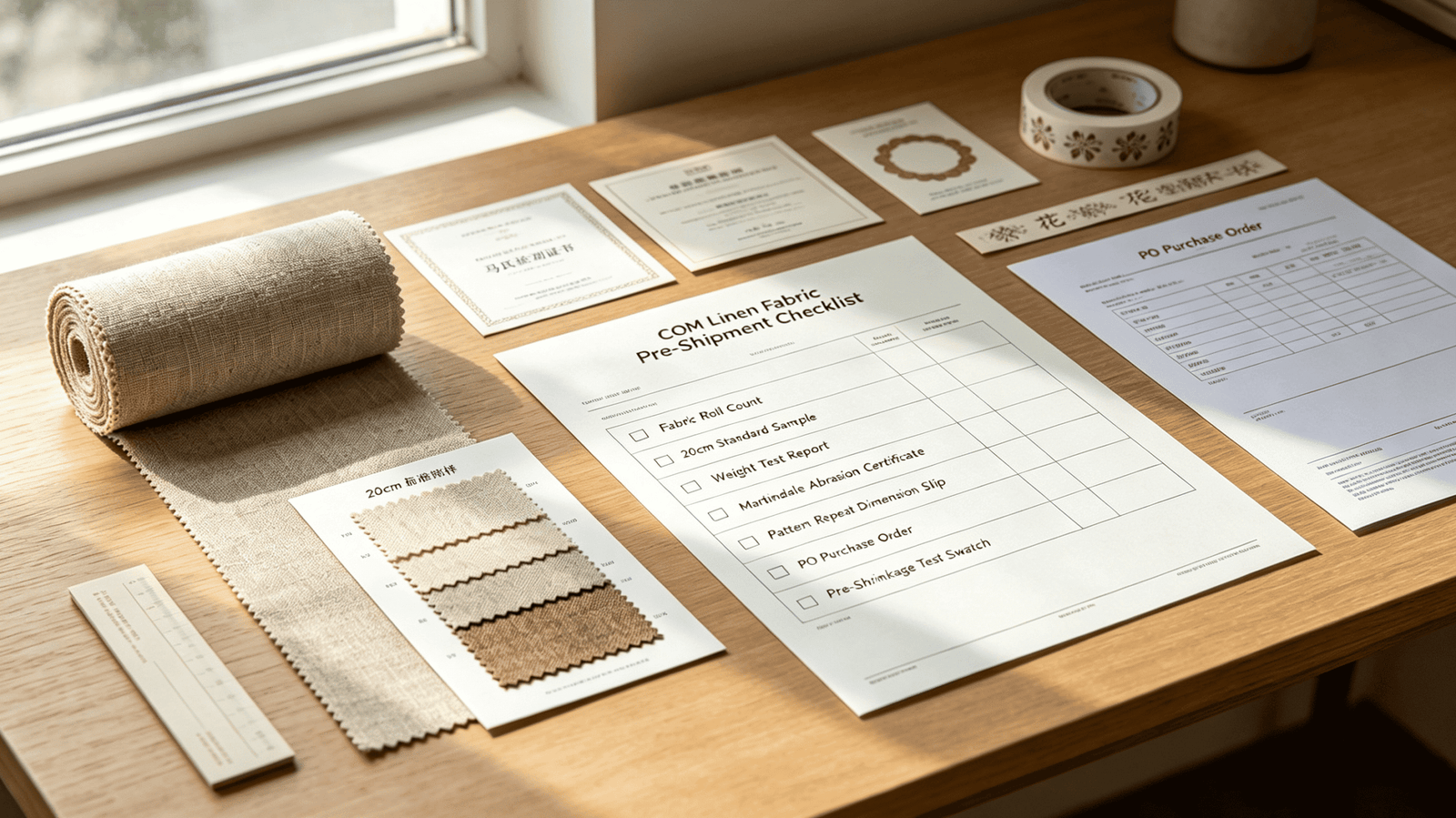
Send all of the following to your factory contact before the fabric ships. Do not ship based on verbal confirmation alone. Get written factory acknowledgment of your spec sheet before dropping the package.
✅ 1. Fabric Spec Sheet
Include all of the following in writing:
- Fiber content (e.g., 100% linen, linen-cotton blend, linen-polyester blend — percentages matter)
- Fabric weight in GSM (if your supplier cannot provide this, request a sample swatch first)
- Weave structure (plain weave, twill, herringbone, bouclé, etc.)
- Width of fabric bolt
- Any pre-treatments applied (pre-washing, pre-shrinking, anti-stain coating, fire retardant, sizing)
- Colorfast rating if available
- Country of origin and mill name if available
Why it matters: This is the document we use to make our preliminary assessment. It doesn't replace physical testing, but it tells us what we're receiving and allows us to flag likely issues before your fabric is in the air.
✅ 2. Yardage Calculation — Verified and Generous
Provide your calculated yardage with the following already accounted for:
- Pattern repeat — if your fabric has a repeat, add 15–25% depending on complexity5
- Upholstery waste — plan for 10–15% standard waste per piece6; more for complex shapes
- Testing allowance — we need approximately 1–2 yards for physical testing that cannot be returned to production use
- Re-sample buffer — if re-sampling is possible, having an extra 2–3 yards eliminates the risk of being short for round two
Insufficient COM yardage frequently halts full production runs for large sofa/sectional orders; for small single accent or dining chair pieces with minor fabric shortages, our cutting team can adjust layout nesting to minimize disruption without fully suspending all work. Re-ordering fabric from a US supplier, shipping it internationally, and re-testing can add 5–8 weeks. Ship more than you think you need.
✅ 3. Written Factory Confirmation Before You Ship
This step is non-negotiable. Before the fabric leaves your studio or your supplier's warehouse:
- Share your spec sheet with your factory contact
- Receive written acknowledgment that the spec appears within acceptable range for linen upholstery
- Clarify whether any pre-treatment or pre-shrinking is recommended before shipping
This confirmation does not guarantee the fabric will pass physical testing — only the test itself can do that. But it does mean you've avoided the most obvious mismatches before spending money on international freight.
✅ 4. Clear Order Specification Document
Include with your shipment (inside the package and sent digitally):
- Your company name and project name
- Piece(s) being upholstered (sofa, armchair, dining chairs, bed — with model reference if applicable)
- Fabric placement notes (e.g., "solid fabric, no directionality concern" or "match stripe across seat and back")
- Contact name and preferred communication method for test results
- Any deadline constraints your factory should know about
COM Fabrics We See Succeed — and Ones We See Struggle
Not all COM fabrics perform equally in our process. This is not about brand or price point. It's about how the fabric was constructed and whether it was designed for upholstery applications.
Fabrics that tend to qualify well:
- Pre-washed, pre-shrunk linen or linen-blend wovens
- Medium-weight fabrics with tight, consistent weave structure
- Fabrics from upholstery-grade lines (even if not specifically called "linen")
- Belgian pure linen and European-milled linen fabrics — these tend to behave predictably under tension7
Fabrics that frequently struggle:
- Open-weave or loosely constructed linens marketed for drapery or apparel8
- Lightweight fabrics that feel beautiful to the hand but lack structural body
- Fabrics with heavy topical finishes that stiffen the hand — these can crack or separate at fold lines during upholstery9
- Untreated natural linen with high initial shrinkage potential (very common in raw, undyed linens)10
I don't say this to discourage COM orders. I say it because knowing this before you select your fabric means you can make a better sourcing decision on the front end — and avoid a failed test on the back end.
Frequently Asked Questions
Can I send any fabric as COM to a linen upholstery factory?
No. COM fabric acceptance is conditional on physical testing. A factory may receive your fabric and still decline to produce if it fails shrinkage, weight, or structural integrity tests. Always share your fabric spec sheet with the factory before shipping and get written acknowledgment that the fabric appears suitable. This does not guarantee approval, but it catches obvious mismatches early.
How much extra fabric should I send for a COM linen sofa order?
Calculate your base yardage for the piece, then add 10–15% for upholstery waste, 1–2 yards for testing, and an additional 2–3 yards as a re-sample buffer if your timeline allows for a second round. Pattern repeats require a further 15–25% addition. Under-shipping yardage is one of the most common causes of mid-production delays.
How long does COM fabric testing take at your factory?
In our process, physical testing typically takes 5–7 business days from the date the fabric arrives at our Foshan facility. Testing covers shrinkage, weight assessment, weave integrity under tension, and surface finish compatibility. We notify the designer of results in writing before any sample cut proceeds.
What happens if my COM fabric fails testing?
If COM fabric fails physical qualification, we share detailed failure indicators. Three primary resolutions apply: re-sourcing new fabric, factory re-finishing/pre-shrinking by your mill, or switching to our stock linen range. Full timeline reset applies to re-sourcing or mill re-treatment requiring new fabric shipments; minor shrinkage defects may be resolved with on-site fabric conditioning without fully restarting the testing schedule.
Can your factory use my COM fabric alongside your standard linen options?
Yes. Some designers use COM fabric for a feature element — such as a primary body fabric — while selecting from our in-house range for contrast welting or accent panels. This hybrid approach is common and sometimes helps when a COM fabric has limited yardage. Discuss specifics with your factory contact before finalizing your order spec.
Conclusion
The COM fabric process at a linen upholstery factory is not a simple handoff — it's a multi-stage qualification and production workflow that rewards preparation and punishes assumptions. The designers who navigate it well are the ones who share spec sheets before shipping, calculate yardage generously, and build the full timeline11 — transit, testing, sampling, approval, production, and shipping — into their project schedule from day one.
At Linen World, we've supported COM orders for US interior designers across custom sofas, linen armchairs, dining chairs, and upholstered beds for over 13 years12. If you're preparing a COM order and want to confirm your fabric spec before it ships, reach out to our team directly. A 15-minute conversation at the right moment can protect 6–8 weeks of your project timeline.
"Abrasion Testing: Wyzenbeek & Martindale Compared | FibreGuard", https://fibreguard.com/sell/blog/abrasion-testing-for-performance-fabrics-explaining-martindale-and-wyzenbeek. Standards bodies including ASTM International and ISO publish upholstery-specific fabric performance tests — such as ASTM D4157 (abrasion resistance) and ISO 12947 (Martindale method) — that assess tensile strength, seam slippage, and abrasion resistance under conditions specific to furniture upholstery, distinguishing these requirements from those applied to drapery or apparel textiles. Evidence role: mechanism; source type: institution. Supports: The distinct mechanical demands placed on fabrics in upholstery applications compared to other textile end uses. Scope note: These standards address surface durability and seam performance rather than the full range of frame-tension stresses described in the article; the cited tests provide partial rather than comprehensive support for the mechanical stress claim. ↩
"How to Calculate Fabric Shrinkage | Sanjay Chowdhury - LinkedIn", https://www.linkedin.com/posts/sanjay-chowdhury-39b124217_how-to-calculate-fabric-shrinkage-step-1-activity-7335522121038630912-Ul5K. Industry textile testing standards, such as those published by ASTM International or the Association for Contract Textiles, define acceptable shrinkage tolerances for upholstery fabrics, with values above approximately 3% commonly flagged as problematic for fitted applications. Evidence role: statistic; source type: institution. Supports: Acceptable shrinkage thresholds for upholstery-grade fabrics and the consequences of exceeding them. Scope note: Specific tolerance thresholds may vary by fabric construction and end-use application; a direct citation to a published standard would be more authoritative than a general industry reference. ↩
"A Breakdown of China to USA Shipping Time - Dimerco", https://dimerco.com/blog-post/a-breakdown-of-china-to-usa-shipping-time/. Major international carriers including FedEx, UPS, and DHL publish estimated transit times for US-to-China shipments, generally ranging from 3–5 business days for express air freight to 10–14 days for economy or deferred air services. Evidence role: statistic; source type: other. Supports: Typical transit durations for commercial shipments from the United States to China via major international carriers. Scope note: Actual transit times vary by origin city, service level, customs clearance delays, and carrier capacity; published estimates represent standard conditions and may not reflect peak-season or disruption scenarios. ↩
"A Breakdown of China to USA Shipping Time - Dimerco", https://dimerco.com/blog-post/a-breakdown-of-china-to-usa-shipping-time/. Ocean freight from major southern China ports such as Guangzhou or Nansha to US West Coast ports typically ranges from 14–18 days, with US East Coast destinations adding approximately 5–10 additional days depending on routing. Evidence role: statistic; source type: other. Supports: Standard ocean freight transit times from southern China ports to US destinations. Scope note: Transit times are subject to port congestion, carrier scheduling, and customs processing variability; figures represent standard commercial estimates and not guaranteed delivery windows. ↩
"Calculating Fabric Yardage for Your Upholstery or Drapery Project", https://www.foliofabrics.com/blogs/inspo/fabric-calculator?srsltid=AfmBOooS5uhiLOVcZ3F8CJ0YUk9ESAF3mYpDmcJUylwyi72ZeiChMRRv. Interior design and upholstery trade references commonly recommend adding between 15% and 30% to base yardage calculations when working with patterned fabrics, with the upper range applied to large or complex repeats requiring precise alignment across multiple panels. Evidence role: general_support; source type: education. Supports: Standard yardage addition percentages recommended for pattern-matched upholstery fabric. Scope note: Recommended allowances vary across sources and depend on repeat size, piece geometry, and workroom practice; the figures cited represent general guidance rather than a single authoritative standard. ↩
"Textiles: Material-Specific Data | US EPA", https://www.epa.gov/facts-and-figures-about-materials-waste-and-recycling/textiles-material-specific-data. Upholstery trade education resources and workroom guides generally cite cutting waste in the range of 10–20% of net yardage, depending on piece complexity, fabric width, and the presence of pattern matching requirements. Evidence role: statistic; source type: education. Supports: Typical fabric waste percentages in custom upholstery cutting and production. Scope note: Waste percentages are highly variable based on piece geometry and production method; the 10–15% figure represents a commonly cited midrange estimate rather than a universally validated standard. ↩
"Linen Upholstery Fabric: Pros and Cons | The Stated Home Blog", https://blog.thestatedhome.com/linen-upholstery-fabric-pros-cons/. The Confederation of European Linen and Hemp (CELC) and its Masters of Linen certification program document quality and traceability standards for European-origin linen, which industry practitioners associate with consistent fiber length, weave density, and dimensional stability. Evidence role: general_support; source type: institution. Supports: Quality and consistency characteristics associated with European-certified linen fabrics, particularly those from Belgium. Scope note: Certification standards address fiber origin and processing traceability rather than directly measuring upholstery performance under mechanical tension; the behavioral claim remains based on practitioner experience rather than controlled testing data. ↩
"The Influence of the Upholstery Textiles Structure on Their ... - PMC", https://pmc.ncbi.nlm.nih.gov/articles/PMC12654245/. The Association for Contract Textiles and similar trade bodies define upholstery-grade fabrics by minimum performance thresholds — including thread count, tensile strength, and seam slippage resistance — that are generally higher than those required for drapery or apparel applications, reflecting the sustained mechanical loads imposed by furniture use. Evidence role: definition; source type: institution. Supports: Structural differences between upholstery-grade and drapery-grade linen fabrics and their respective performance requirements. Scope note: Specific weave density thresholds distinguishing upholstery from drapery linen are not universally standardized across all certifying bodies; the performance gap described is well-recognized in trade practice but not always codified in a single published specification. ↩
"Advances in Anti-Wrinkle Finishing Agent for Natural Fabrics - PMC", https://pmc.ncbi.nlm.nih.gov/articles/PMC12899052/. Textile science literature documents that certain topical finishes — including fluorocarbon-based stain repellents and resin-based sizing agents — can reduce fabric flexibility and increase stiffness, which may contribute to finish cracking or fiber separation at repeated fold or stress points in fitted applications. Evidence role: mechanism; source type: research. Supports: How topical chemical finishes affect fabric flexibility and the risk of cracking or delamination at stress points. Scope note: Research on finish-related cracking is more extensively documented for coated technical textiles than for decorative upholstery fabrics; direct experimental evidence specific to linen upholstery fold-line failure is limited in the published literature. ↩
"The hygroscopic behavior of plant fibers: a review - PMC - NIH", https://pmc.ncbi.nlm.nih.gov/articles/PMC3982556/. Linen (flax) fiber is highly hygroscopic, capable of absorbing up to 20% of its weight in moisture, which causes fiber swelling and fabric shrinkage; untreated or undyed linens that have not undergone wet finishing processes retain greater shrinkage potential than pre-washed or pre-shrunk equivalents. Evidence role: mechanism; source type: research. Supports: The hygroscopic properties of linen fiber that contribute to dimensional instability in untreated or undyed fabric. Scope note: Shrinkage behavior varies with weave construction, yarn twist, and finishing history; published moisture absorption figures for flax fiber describe the raw material rather than finished fabric performance under upholstery-specific conditions. ↩
"[PDF] Drivers of Delays in Procurement of Infrastructure Projects", https://openknowledge.worldbank.org/bitstreams/62234fde-fbe8-4e31-a93d-51aab47e0634/download. Supply chain management research consistently identifies incomplete or late specification communication as a leading cause of production delays in international contract manufacturing, with pre-production documentation alignment associated with measurable reductions in rework, material waste, and schedule overruns. Evidence role: general_support; source type: research. Supports: The role of pre-production specification alignment and communication in reducing delays in international manufacturing projects. Scope note: Published supply chain research addresses manufacturing broadly rather than custom upholstery specifically; the application of general findings to COM fabric projects is contextually supported but not directly demonstrated in the literature. ↩
"Linen World | Handcrafted Bespoke Pure Linen Sofas ...", https://linenworld.pro/. Trade organizations such as the American Society of Interior Designers (ASID) and the International Furnishings and Design Association (IFDA) publish guidance on COM procurement that corroborates the general framework of pre-shipment specification review, physical fabric testing, and staged approval workflows as recognized best practices in the industry. Evidence role: general_support; source type: institution. Supports: Whether the COM qualification and testing workflow described is consistent with standard practice at international upholstery manufacturers. Scope note: Publicly available trade guidance on COM processes is often general in scope; the specific testing durations and qualification criteria described in the article reflect this factory's internal procedures and may differ from those at other manufacturers. ↩


