
A dining chair guide should prevent an expensive mistake: ordering beautiful chairs that do not fit the table, room, household, or project schedule. That mistake can disrupt circulation, reduce comfort, and create maintenance problems.1 I recommend treating dining chairs as part of a complete system before comparing silhouettes, linen colors, or decorative details.
The right upholstered dining chair fits the dining table, room proportions, expected meal duration, household maintenance needs, budget, and delivery plan. I first verify dimensions and clearance, then evaluate seat support, frame and upholstery construction, linen suitability, customization requirements, and supplier terms. Style should refine the decision rather than lead it.

I have participated directly in upholstered dining chair development at our Foshan furniture factory and discussed customization with European and American designers and homeowners. Those conversations have taught me that small, practical details often determine whether an attractive chair succeeds after delivery.
How Should a Dining Chair Guide Account for the Table and Room?
A dining chair can look correctly proportioned in a product image yet fail beneath the actual table. Thick aprons, low rails, pedestal bases, armrests, and limited circulation space can create conflicts. I therefore begin every dining chair guide evaluation with the table and room rather than the chair alone.
I treat the dining table and chairs as one coordinated system. I verify the tabletop height, lowest under-table obstruction, seat height, arm height, chair width, required quantity, base position, and circulation space. I also compare visual mass and make a scaled layout or physical mock-up before approving a custom dining chair.

Measure the usable space, not just the table height
Many buyers send me only the overall table height. That measurement is useful, but it does not reveal the space that a chair can actually occupy. A table may have a deep apron, structural rails, a projecting edge, or a sculptural base that reduces legroom.
I ask for a dimensional drawing whenever possible. If a drawing is unavailable, I request clear photographs and the following measurements:
- Finished tabletop height
- Height from the floor to the lowest apron or rail
- Distance between table legs
- Position and footprint of a pedestal base
- Tabletop thickness
- Overhang beyond the apron or base
- Distance from the table edge to walls or nearby furniture
- Any floor vents, radiators, doors, or cabinetry that affect circulation
I do not rely on one universal gap between the seat and tabletop. Seat compression, apron depth, user height, and arm placement can all change the practical fit. Designers should verify application-specific dimensions through drawings, samples, or a qualified space planner.
Check arm clearance before choosing carvers
Dining armchairs often create more conflicts than side chairs. The published overall chair height does not show whether an arm will slide beneath the tabletop or collide with the apron. I ask for the arm height at its highest point and the exact under-table clearance.
Armchairs can still work when they do not tuck fully under the table, but that result must be intentional. A chair that remains partially outside the table footprint requires more room behind it. It can also change the visual balance of a narrow dining area.
Plan quantity and circulation together
A buyer should not calculate chair quantity by dividing the table length by a chair width.2 That method ignores the space between chairs, the usable area between legs, and the movement needed to sit down.
I use a scaled furniture plan to review the complete arrangement. Approximate planning allowances from local design practice can be useful as an early reference, but they are not universal specifications. The project team should verify all clearances against the users, building requirements, and room conditions.
| Planning question | What I verify | Common risk |
|---|---|---|
| Will the chair tuck under? | Seat, arm, apron, and base dimensions | Arms or back hit the table |
| How many chairs fit? | Usable table edge and leg positions | Guests feel crowded |
| Can someone sit comfortably? | Legroom and base interference | Knees contact rails or pedestal |
| Can people walk behind? | Chair pull-out area and circulation path | Blocked route when chairs are occupied |
| Does the set look balanced? | Chair mass, table thickness, and room scale | Chairs overwhelm the table |
For an important project, I recommend marking the table and chair footprints on the floor with low-tack tape. A cardboard profile can also reveal an arm or apron conflict.3 This simple exercise often provides more useful information than a product rendering alone.
How Does This Dining Chair Guide Define Comfort?
Softness can attract attention in a showroom, but softness alone does not define dining comfort. A deeply yielding seat may feel pleasant for a few minutes yet provide inadequate support during a long meal.4 I define comfort around the dining task, the users, and the intended duration.
A comfortable dining chair combines appropriate seat height and depth with stable support, a suitable back angle, balanced filling, and secure construction. I evaluate how long people will sit, how often the chair will be used, whether diners need an upright posture, and how the cushion changes under load rather than selecting the thickest cushion.

Define the expected dining experience
I start by asking how the room will be used. A breakfast area used for short daily meals has different needs from a formal dining room where guests may sit for several hours. A dining chair used as an occasional desk chair also requires different support.
Useful questions include:
- Will the chairs be used every day or mainly for entertaining?
- How long does a typical meal last?
- Will children or older family members use them?
- Do users prefer an upright or relaxed sitting position?
- Will the chairs need to move frequently?
- Does the client expect a tailored seat or a more casual, cushioned look?
- Will the chair be used for working, reading, or meetings?
These answers influence the seat profile, foam or filling balance, back angle, arm design, and overall weight. No single filling specification can answer all of them.
Evaluate the seat as a layered system
During product development, I evaluate more than the visible cushion. The user experiences the complete seat system, which may include a frame, support platform, webbing or springs, foam layers, fiber wrapping, and upholstery.5
Each component affects the result:
| Component | What I assess | Possible trade-off |
|---|---|---|
| Frame geometry | Seat angle, depth, and structural support | A stylish profile may restrict posture |
| Base support | Stability and load distribution | Different support systems create different seat sensations |
| Foam or filling | Initial feel and recovery | Very soft filling may feel less supportive |
| Fiber wrap | Surface softness and appearance | A relaxed surface may need more maintenance |
| Upholstery tension | Tailoring and movement | Excess tension or looseness can affect appearance |
| Back construction | Lumbar contact and upper-back support | A dramatic angle may not suit upright dining |
I do not claim that one foam density, spring type, or frame material is always superior. Performance depends on the complete construction, component quality, dimensions, workmanship, and intended use. Buyers should request material specifications and confirm whether those specifications apply to the actual production order.
Use a sample when comfort is project-critical
Comfort is partly subjective. A drawing cannot fully communicate seat compression, back contact, edge pressure, or how easily a user can rise from the chair. For a substantial order, I recommend evaluating a production sample or approved prototype.
The reviewer should test the chair in realistic conditions:
- Place it at a table with the same relevant dimensions.
- Sit through a typical meal duration rather than a few seconds.
- Ask users of different heights to evaluate it.
- Check whether the front edge creates pressure behind the knees.
- Observe whether the back supports an appropriate dining posture.
- Confirm whether the arms restrict entry or movement.
- Review upholstery recovery after the user stands.
I present these steps as practical factory-side judgment, not as laboratory testing or ergonomic certification. Projects with accessibility, healthcare, hospitality, or special ergonomic requirements should involve an appropriately qualified professional.
How Should a Dining Chair Guide Approach Linen Upholstery?
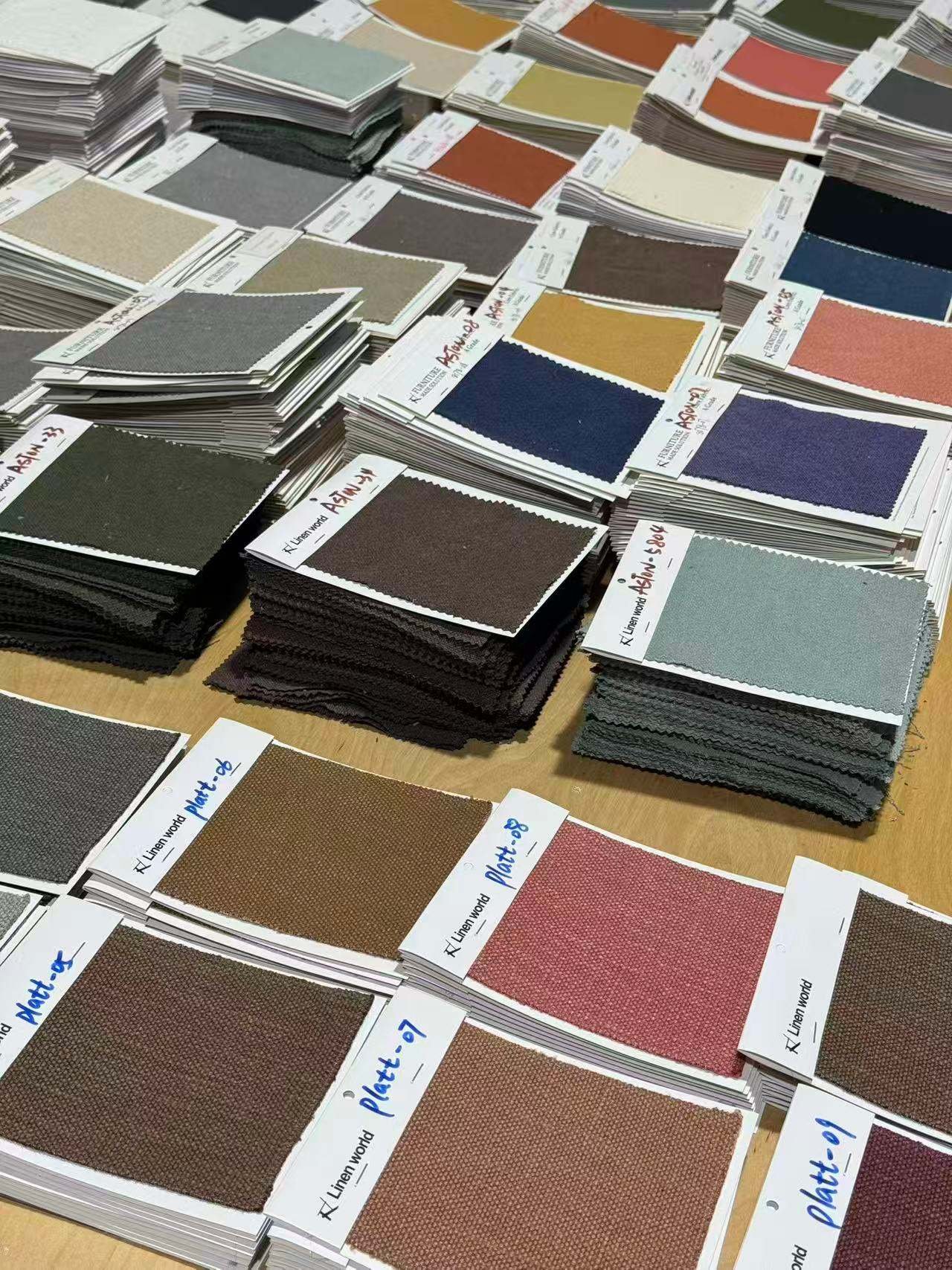
Natural linen creates the relaxed, tactile appearance that many premium interiors need. However, a pale fabric selected only from an online image can become a maintenance problem in a busy household. I match linen to the actual users, stain exposure, care expectations, lighting, and desired visual character.
I choose linen upholstery by balancing fiber content, weave, color, texture, backing, finish, care instructions, and expected use. Natural linen offers distinctive texture and breathable comfort, but it is not automatically stain-proof or maintenance-free.6 Households with children, pets, or frequent entertaining should examine samples and confirm cleanability before ordering.
Start with household reality
I often discuss color first with designers, but I quickly move the conversation toward usage. A quiet formal dining room can accept different maintenance expectations from a kitchen dining area used three times a day.
The fabric brief should address:
- Frequency of meals and entertaining
- Presence of children or pets
- Likely exposure to wine, coffee, oils, and sauces
- Direct sunlight and window orientation
- Household cleaning habits
- Desired level of natural slubs and tonal variation
- Preference for a crisp, tailored look or a relaxed appearance
- Willingness to accept wrinkles, creasing, and patina
Natural linen has characteristics that many clients value. The yarn can produce visible texture and subtle variation.7 Those features contribute to linen’s character, but they should not be confused with flawless visual uniformity.
Compare more than the color number
Our made-to-order work offers access to more than 200 linen fabric colors, but a broad palette does not eliminate the need for sampling. Screens, studio lighting, and digital compression can all distort color.8 The same neutral may appear cool in north-facing daylight and warm under evening lighting.9
I recommend reviewing a physical cutting or larger memo in the project space. A designer should examine it:
- In morning and evening light
- Next to the dining tabletop
- Beside flooring and wall finishes
- Under the planned artificial lighting
- Both flat and wrapped over a rounded edge
A larger sample can also show the scale of the weave more accurately. Very small swatches may hide color variation or textural movement.
Ask for fabric documentation
A responsible dining chair guide should not assume that every fabric marketed as linen has the same composition or performance. Buyers should request and verify the supplier’s current documentation.
Relevant questions include:
- What is the declared fiber composition?
- Is the fabric pure linen or a blend?
- Does it have a backing or applied finish?
- What cleaning method does the fabric supplier recommend?
- Does the color have special care restrictions?
- Is the fabric intended for upholstery?
- Are any abrasion, colorfastness, pilling, or flammability results available?
- Which test method and version apply?
- Does the documentation correspond to the exact color and production lot?
Test results should be treated as supplier documents that require verification. A reported laboratory value does not guarantee performance in every household because spills, sunlight, cleaning products, seam placement, and maintenance practices vary.10
Consider COM fabric carefully
Customer’s own material, commonly called COM, can help a designer coordinate dining chairs with an established scheme. However, COM introduces technical and scheduling questions.
I review the fabric width, usable width, repeat, direction, elasticity, backing, defects, and required pattern placement. A stripe or large repeat may require additional yardage.11 A fabric that frays easily or stretches excessively may also require a different upholstery approach.
Before production, both parties should confirm:
- The required quantity and allowance
- The shipping destination for the fabric
- Responsibility for customs or inbound freight
- Face side and pattern direction
- Cutting approval for prominent motifs
- Treatment of flaws or shortages
- Whether leftover fabric must be returned
- How COM may affect the warranty or lead time
I prefer to inspect COM before final production approval. That review cannot guarantee performance, but it can identify obvious handling and upholstery risks early.
How Does This Dining Chair Guide Compare Construction and Suppliers?
A low quotation can become expensive when it excludes the correct fabric, customization, packaging, delivery, or approval process. A premium-looking image can also hide construction details that matter after installation. I compare the total project fit rather than ranking suppliers by unit price alone.
I compare dining chair suppliers through an itemized project specification covering dimensions, frame and upholstery construction, fabric, finish, quantity, sampling, quality control, packaging, lead time, delivery terms, and after-sales responsibilities. I only compare prices after confirming that each quotation covers an equivalent product, service scope, and commercial risk.

Build one specification for every supplier
A fair supplier comparison needs a consistent brief. Otherwise, one quotation may include pure linen while another uses a blend. One supplier may quote an existing chair size, while another includes structural modification and a pre-production sample.
I recommend creating a chair schedule with the following fields:
| Specification area | Information to confirm |
|---|---|
| Dimensions | Width, depth, height, seat height, seat depth, and arm height |
| Table relationship | Apron clearance, base position, and required tuck-under |
| Frame | Material description, joinery approach, and finish |
| Seat system | Support method, filling layers, and intended seat feel |
| Upholstery | Fabric code, composition, color, direction, and seam details |
| Customization | Dimensional, finish, comfort, or detailing changes |
| Quantity | Side chairs, armchairs, and any spare units |
| Approval | Drawing, finish sample, fabric cutting, or prototype |
| Quality control | Inspection scope, tolerances, and reporting method |
| Packaging | Individual protection, carton, crate, or other export packaging |
| Schedule | Sampling time, production time, and dispatch window |
| Delivery | Incoterm, destination, duties, handling, and installation |
| After-sales | Claim process, evidence requirements, and remedy terms |
The buyer should also confirm the drawing revision that controls production. Small changes to seat height, arm profile, or leg finish can become difficult to resolve once frames have entered production.
Review customization as an engineering change
Customization can help a chair work with a specific table and interior, but every change can affect other details. A wider seat may change the number of chairs that fit along the table. A higher cushion may alter the back proportion. A lower arm may require a different frame shape. A different fabric may change seam behavior or visual fullness.
At our Foshan factory, I have seen how apparently minor requests lead to linked product-development decisions. My role is to identify those connections before production, not to promise that every visual request can be implemented without compromise.
I divide changes into three groups:
- Aesthetic changes: fabric, color, piping, stitching, or finish
- Dimensional changes: width, depth, seat height, or arm height
- Construction changes: frame geometry, support, filling, or upholstery method
Aesthetic changes are often simpler, although fabric behavior can still affect the result. Dimensional and construction changes usually need closer technical review. For application-specific structural decisions, buyers should request supplier drawings and, when appropriate, seek qualified professional evaluation.
Compare the total landed and installed cost
The chair price is only one part of the project cost. Freight, duties, customs clearance, inspection, storage, final-mile delivery, installation, and replacement risk may affect the final figure.12
Our factory context may offer a meaningful cost advantage compared with some local custom purchasing routes, but any claimed saving should be verified through an apples-to-apples quotation. I would not use a percentage saving as a substitute for comparing materials, workmanship, services, and terms.
A useful commercial comparison includes:
- Product and customization price
- Sample or prototype fees
- Fabric and COM costs
- Export packaging
- Inspection costs
- International freight
- Insurance
- Duties and taxes
- Customs or brokerage fees
- Storage and demurrage exposure
- Final-mile delivery
- Installation or unpacking
- Spare chair provision
- Potential replacement logistics
Verify quality before shipment
Photos are helpful, but they should follow an agreed inspection checklist. I suggest confirming the inspection standard during order approval rather than after production.
A chair inspection may cover:
- Overall dimensions against the approved drawing
- Stability on a suitable level reference surface
- Fabric code, color, and orientation
- Visible marks, weaving flaws, or contamination
- Seam alignment and piping consistency
- Upholstery symmetry and surface appearance
- Leg color and finish consistency
- Hardware installation, where relevant
- Carton labeling and protective packaging
- Quantity and spare components
I do not present a factory inspection as a certification or a substitute for independent expertise. A buyer can appoint a qualified third-party inspector when project value, distance, or risk justifies that step. Any required certification, test report, or compliance document should be checked for scope, validity, issuing party, and connection to the actual order.
Frequently Asked Questions
How much space should I leave between a dining chair seat and the tabletop?
I do not use one universal clearance because tabletop thickness, aprons, seat compression, user dimensions, and armrests vary. I measure from the finished floor to the compressed seating position and compare it with the lowest obstruction. I recommend testing a chair or mock-up at the actual table before approval.
Are upholstered dining armchairs better than side chairs?
Armchairs are not automatically better. They can provide lateral support and a more substantial appearance, but they also require additional width and may not fit under the table. I often use armchairs at the table ends and side chairs along the sides, subject to clearance and circulation checks.
Is pure linen practical for dining chairs?
Pure linen can work well when its appearance and care requirements match the household. However, natural linen is not stain-proof or maintenance-free. I recommend checking the fabric supplier’s care instructions, reviewing a physical sample, and considering the likely exposure to food, pets, children, sunlight, and frequent cleaning.
Should I order a sample chair before placing a large order?
I recommend a sample or prototype when comfort, customization, table clearance, or finish matching is critical. A sample allows the project team to assess seat feel, dimensions, fabric behavior, and visual proportion. The buyer should document approved details because a prototype only helps when it becomes a clear production reference.
What information should I send to a custom dining chair manufacturer?
I suggest sending table drawings, room plans, chair quantity, target dimensions, reference images, fabric requirements, finish preferences, delivery location, and required completion date. The brief should also explain household use and comfort expectations. Better project information allows the manufacturer to identify fit, construction, and scheduling risks earlier.
Conclusion
This dining chair guide begins with fit and risk rather than appearance. I first treat the chairs, table, and room as one system. I then evaluate task-specific comfort, linen suitability, construction, customization, quality control, and total delivered cost. Physical samples, approved drawings, verified documents, and clear commercial terms can reduce avoidable surprises.
Linen World has 13 years of experience developing made-to-order linen furniture in Foshan, with more than 200 fabric colors and COM support. Contact us with your table dimensions, room plan, quantity, fabric brief, and timeline, and I can help you evaluate a custom linen dining chair specification for your project. https://linenworld.pro
"Space Planning Fundamentals Every Designer Must Know", https://www.idi.edu/blog/space-planning-fundamentals-interior-design. Interior space-planning guidance identifies chair pull-out zones, occupied-chair space, and unobstructed circulation routes as relevant to the usability of dining areas. Evidence role: general_support; source type: education. Supports: Space-planning and ergonomic guidance showing that furniture dimensions, pull-out space, and circulation routes affect access and comfort.. Scope note: Such guidance supports the circulation and usability concerns generally but does not establish the maintenance consequences of every chair-selection error. ↩
"Width Of Dining Table", https://face.meei.harvard.edu/width-of-dining-table. Anthropometric planning references calculate dining capacity using more than nominal chair width, including lateral spacing, table supports, and the space required for users to enter and leave their seats. Evidence role: mechanism; source type: education. Supports: Anthropometric or space-planning guidance explaining how personal width, spacing between diners, table supports, and access requirements affect seating capacity.. Scope note: Recommended dimensions vary by jurisdiction, user population, and dining context, so they should be treated as planning ranges rather than universal requirements. ↩
"An Immersive Virtual Reality Mock-Up for Design Review of ...", https://www.academia.edu/18108303/An_Immersive_Virtual_Reality_Mock_Up_for_Design_Review_of_Hospital_Patient_Rooms. Design research recognizes full-scale mock-ups as a means of evaluating spatial relationships and identifying fit or usability problems that may be difficult to judge from drawings alone. Evidence role: general_support; source type: research. Supports: Research or educational guidance describing full-scale mock-ups and physical prototypes as tools for evaluating spatial relationships and identifying design conflicts.. Scope note: This evidence supports mock-ups as a general validation method; it does not directly compare cardboard chair profiles with product renderings in dining-room projects. ↩
"Chair Development on the Basis of Body Pressure Distribution—A ...", https://www.academia.edu/145766240/Chair_Development_on_the_Basis_of_Body_Pressure_Distribution_A_Research_Effort. Seating studies indicate that perceived comfort depends on pressure distribution, postural support, cushion properties, and exposure time rather than softness alone. Evidence role: mechanism; source type: paper. Supports: Experimental findings on how cushion stiffness, pressure distribution, posture, and sitting duration influence perceived comfort and support.. Scope note: Most controlled seating studies concern office, automotive, or laboratory seats, so their findings provide ergonomic context rather than direct proof for every dining-chair design. ↩
"how to - upholster", https://sanweb.lib.msu.edu/DMC/Ag.%20Ext.%202007-Chelsie/PDF/e952.pdf. Technical upholstery references describe the seat as a layered assembly in which the frame and suspension carry loads while cushioning, padding, and cover tension shape pressure distribution, recovery, and surface appearance. Evidence role: mechanism; source type: education. Supports: Technical upholstery guidance explaining the functions of frames, suspension systems, cushioning, padding, and cover materials in an upholstered seat.. ↩
"Burn Test Results", https://4h.uada.edu/staff/curriculum-hub/textile%20booklet.pdf. Textile references characterize flax linen as an absorbent, textured cellulosic fabric and note that its serviceability and stain response depend on weave, finishing, use, and cleaning practices. Evidence role: general_support; source type: education. Supports: Textile-science information on linen's moisture absorption, tactile structure, wrinkling behavior, and cleaning or stain-care requirements.. Scope note: Fiber-level properties do not establish the performance of a specific upholstery fabric, which may be blended, backed, coated, or otherwise finished. ↩
"linen and linen manufactures", http://www2.cs.arizona.edu/patterns/weaving/articles/wt_linen.pdf. Studies of flax fibers and linen yarns describe variability in fiber length, fineness, and yarn evenness that can appear as slubs or subtle surface variation in woven cloth. Evidence role: mechanism; source type: paper. Supports: Research on flax-fiber morphology and yarn irregularity that explains characteristic variation in linen surfaces.. Scope note: Visible irregularity is also affected by spinning quality, weave, dyeing, and finishing, so not every variation can be attributed solely to the natural fiber. ↩
"Color Management – Imaging Center - Campus Offices", https://campus.collegeforcreativestudies.edu/imaging-center/tag/color-management/. Color-management standards explain that displayed color is device- and viewing-condition dependent, with monitor calibration, image processing, ambient illumination, and source lighting all capable of changing perceived color. Evidence role: mechanism; source type: institution. Supports: Color-science guidance on device-dependent display color, illumination, calibration, and viewing conditions.. Scope note: Compression does not necessarily create a visible color shift in every image; its effect depends on the format, compression level, and image content. ↩
"Background and Guidance for Using the ANSI/IES TM-30 ...", https://www.energy.gov/sites/default/files/2022-04/ssl-royer-leukos-tm-30-tutorial-2022.pdf. Color science establishes that perceived object color depends partly on the illuminant's spectral power distribution, so the same textile may appear different under daylight and evening artificial light. Evidence role: mechanism; source type: institution. Supports: Color-science evidence that object color depends on the spectral composition of the illuminant and can vary between daylight and artificial lighting.. Scope note: The direction and magnitude of the shift cannot be predicted from orientation labels alone because glazing, reflected room colors, lamp spectra, and the fabric's reflectance also matter. ↩
"Quantitative Assessment of Woven Fabric Surface Changes ...", https://pmc.ncbi.nlm.nih.gov/articles/PMC12348827/. Textile standards report performance under defined specimens, apparatus, and conditioning procedures; results therefore characterize behavior under the stated test conditions rather than guarantee service life in every installation. Evidence role: expert_consensus; source type: institution. Supports: Standards documentation explaining that textile tests measure performance under specified conditions and must not be interpreted as guarantees under all end-use conditions.. Scope note: Validated tests remain useful for comparing materials when the method, specimen, and intended end use are appropriate. ↩
"Easy Fabric Calculator for Cushions + FREE Yardage!", https://dev.mabts.edu/fabric-calculator-for-cushions/. Upholstery-estimating guidance adds allowances for patterned fabrics because repeats must be aligned across adjacent components and unusable portions may remain between correctly positioned cuts. Evidence role: mechanism; source type: education. Supports: Upholstery-estimating guidance showing that matching repeats across panels and aligning prominent motifs requires cutting allowances and can increase material usage.. Scope note: The additional quantity depends on repeat dimensions, furniture geometry, railroad direction, motif placement, and the cutting plan. ↩
"Duty - Cost Insurance and Freight (CIF) - help.CBP.gov", https://www.help.cbp.gov/s/article/Article1126. Government trade guidance defines landed cost as extending beyond the purchase price to applicable transportation, insurance, duties, taxes, customs charges, and related handling expenses. Evidence role: definition; source type: government. Supports: Official import guidance defining landed cost and identifying freight, insurance, duties, taxes, customs fees, and downstream handling as potential cost components.. Scope note: Installation, storage, demurrage, and replacement exposure are project-specific and may not be included in every formal landed-cost definition. ↩


