
There is a common assumption that buying furniture from China means buying cheap, mass-produced pieces. That assumption is costing designers real project opportunities.
Purchasing furniture from China gives designers and buyers access to made-to-order, high-end custom upholstery — including sofas, armchairs, beds, and dining chairs — at a budget efficiency that is difficult to match locally. Based on our factory experience, buyers in North America and Europe often save 40–60% compared to local high-end custom sourcing1.
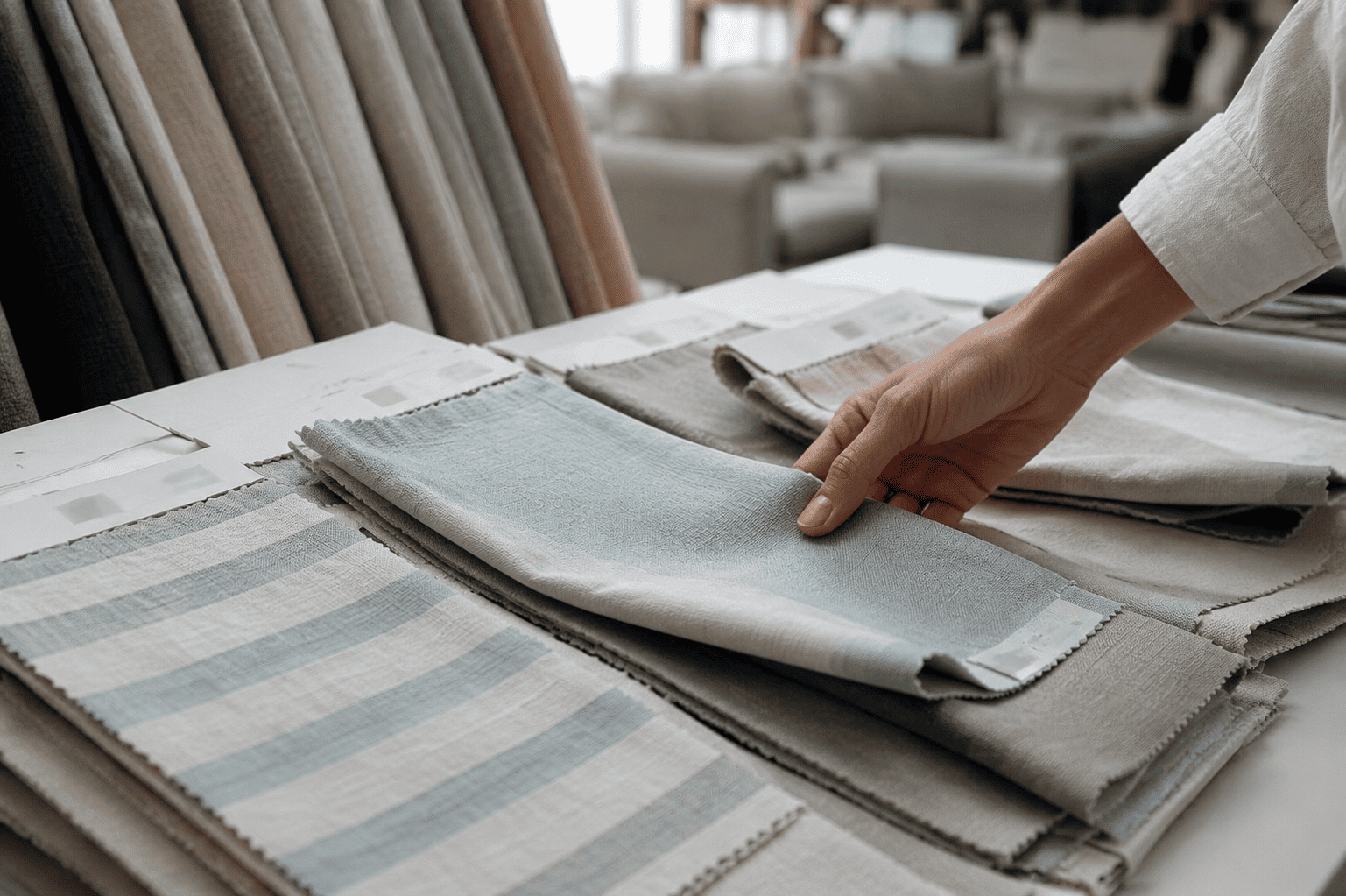
The decision to source furniture from China is rarely simple. Designers and buyers want to know whether a factory can actually meet their design requirements, handle small project quantities, and deliver without creating more problems than the cost savings solve. Those are fair questions. I run a linen upholstery furniture factory in Foshan, China, and I work directly with designers and buyers in the US, UK, and Australia. What I share here comes from real inquiries, real quotations, and real projects — not marketing claims. Let me walk through the actual reasons why sourcing from China works for high-end custom furniture projects.
Is a Full Container Really Required to Order Custom Furniture from China?
One of the first things I hear from designers who contact us for the first time is a hesitation about minimum order quantity. Many assume that buying from China requires a full container. That assumption stops a lot of projects before they even start.
No, a full container is not required2. Many factories, including ours, work on a project-by-project basis. A designer can order the exact quantity needed for a specific project — whether that is two sofas, six dining chairs, or a mixed set of pieces for a single villa.
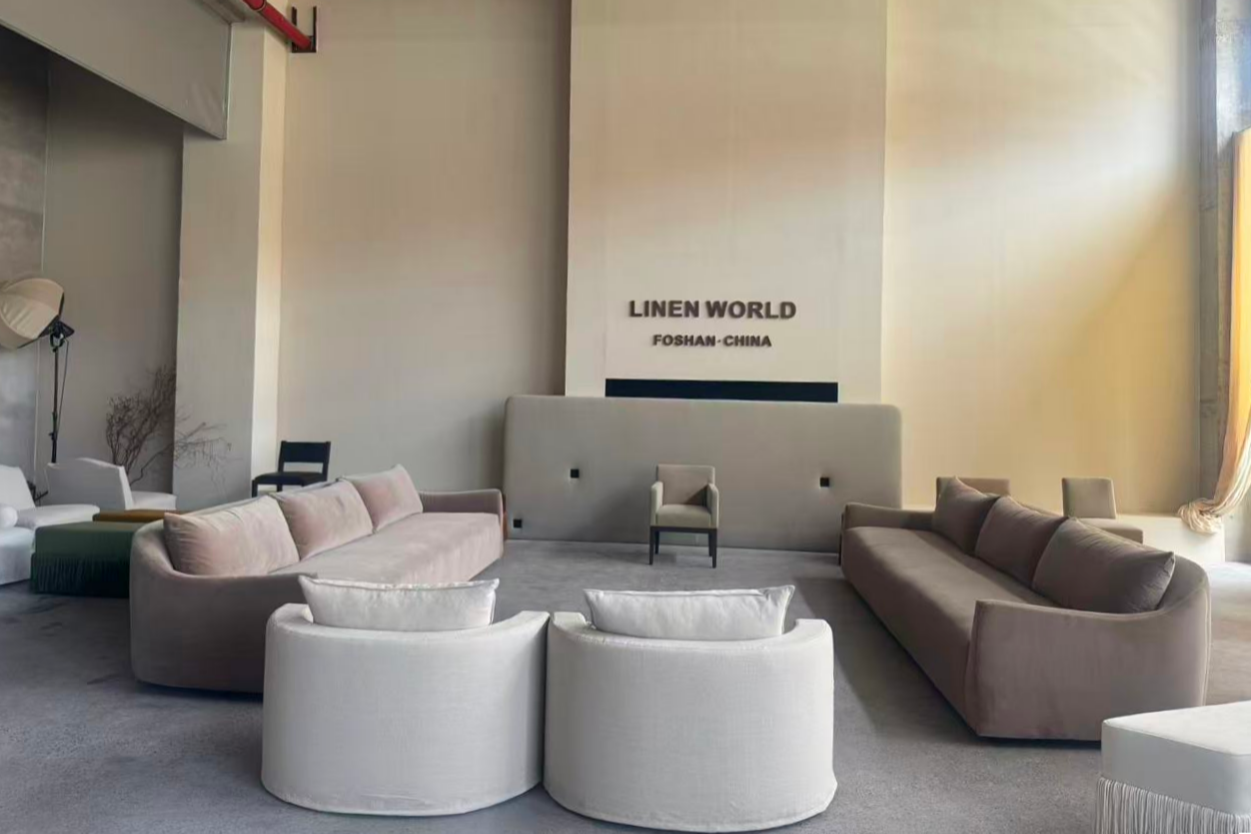
I remember an inquiry from a designer based in Australia. She was working on a residential villa project and wanted custom linen sofas and armchairs. Her first message asked whether we had a container minimum. When I told her we work by project quantity, her reply was direct: that changes things entirely.
That moment is not unusual. The container minimum assumption is one of the most common barriers I see in first-contact conversations with overseas designers. Once that barrier is removed, the conversation shifts to what actually matters: design requirements, fabric selection, sizing, and delivery.
How Project-Based Ordering Actually Works
When a designer sends us a project brief, the conversation starts with the pieces needed and their design specifications — not a volume target. Here is how the process typically runs from our side:
| Stage | What Happens |
|---|---|
| Initial inquiry | Designer shares project scope, piece types, and quantity |
| Quotation | We quote per piece based on size, fabric, and construction |
| Fabric selection | Designer selects from 200+ linen colors or sends COM fabric |
| Sample review | We produce a sample or reference photos for approval |
| Production | Made-to-order production begins after deposit |
| Packaging & export | Pieces are packed for export and shipped DDP to destination |
The process is built around the project, not around filling a container. For designers working on high-end residential or villa projects, this matters. A project may call for three custom armchairs in a specific linen tone that matches the wall finish. That is exactly the kind of order we handle.
One practical note: project-based ordering does not mean there is no minimum at all. For most factories, including ours, there is a per-piece minimum that affects pricing and production scheduling. The key point is that this minimum is set at the piece level, not at the container level.
Can Chinese Furniture Really Be High-End? What About Quality?
This is the most important question for designers who work with high-net-worth clients. The concern is real. Not every factory in China is suitable for high-end custom work. I will say that directly. But the category of "Chinese furniture" is broad, and dismissing it entirely means missing access to factories that are built specifically for custom, high-quality upholstery production.
Yes, China has factories that produce high-end custom upholstery furniture3. The key is knowing which factories specialize in handcrafted, made-to-order production with quality controls aligned to export markets. Our factory, for example, has 13 years of experience producing linen upholstery furniture for designers in the US, UK, and Australia.
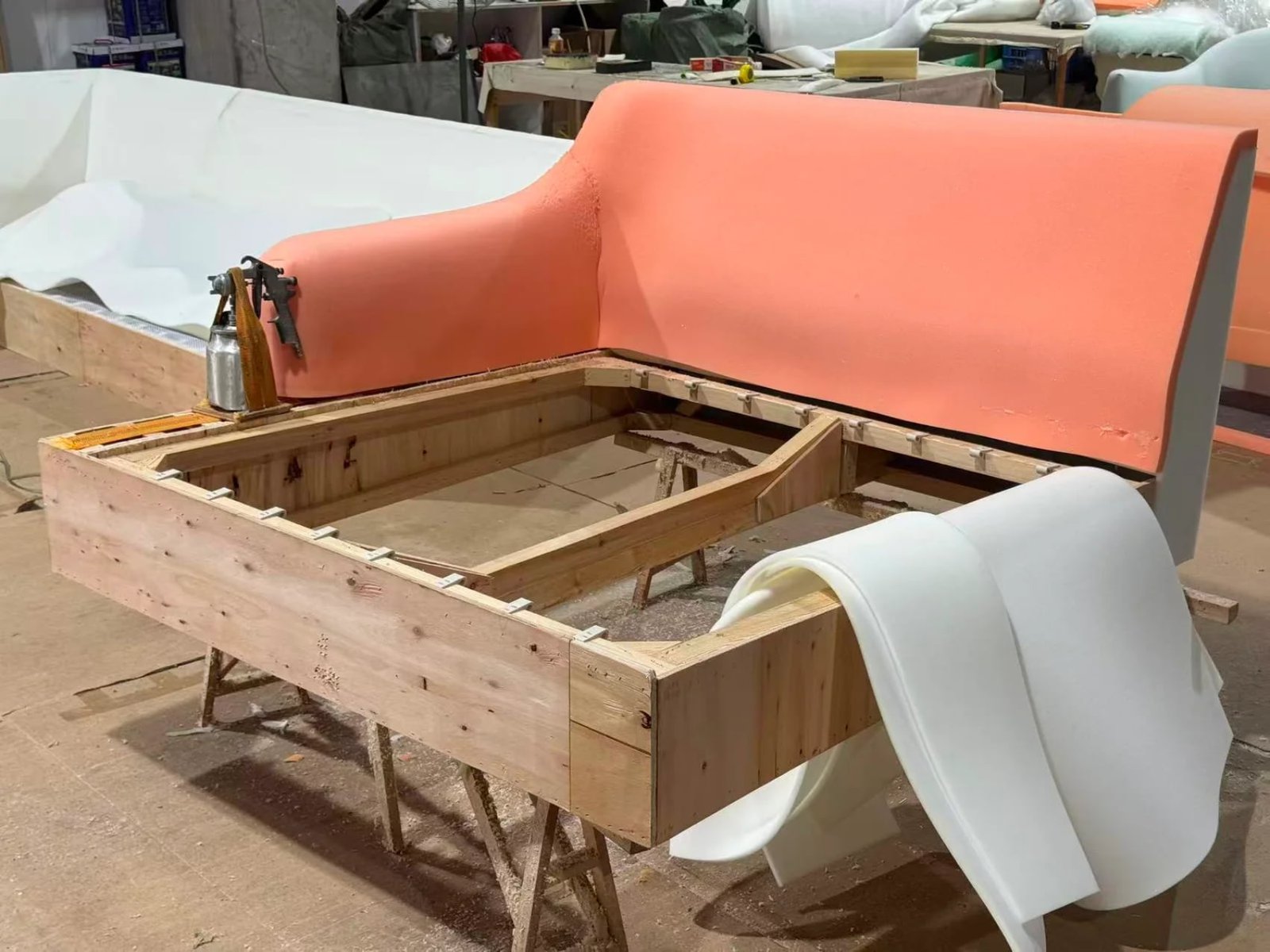
The reference point I use when talking to designers is not a mass-market furniture retailer. The reference point is factories and brands like Blasco, or high-end custom upholstery studios in California. Our production is built to compete at that level, at a cost that reflects the difference between operating in Foshan versus operating in Los Angeles or London.
What "High-End" Means in a Production Context
High-end is not just a fabric or a price point. It is a set of production choices that affect how the finished piece looks, feels, and lasts. Here is how we think about it on the factory side:
| Production Element | What It Means for the Designer |
|---|---|
| Frame construction | Solid hardwood frames affect durability and structural feel4 |
| Suspension system | Spring or webbing systems affect seat comfort and shape retention5 |
| Filling materials | High-density foam and fiber combinations affect how the piece sits6 |
| Linen fabric quality | Belgian pure linen has a specific hand feel and drape that cheaper substitutes do not replicate7 |
| Handcraft finishing | Tight seams, consistent piping, and clean tufting require skilled labor |
| COM fabric support | Designer can send their own fabric for upholstery if preferred |
When a designer is building a high-end interior for a villa client, every one of these elements is visible in the finished room. A sofa that uses a lower-grade linen or inconsistent hand-stitching reads differently than one that does not. We work with Belgium pure linen as our primary fabric, and we support COM fabric for designers who have a specific material already specified in their scheme.
The 200+ color range we carry exists because designers working on luxury residential projects need to match a palette, not choose from a limited stock list. A linen sofa in warm stone is a different design decision than one in soft sage or natural undyed linen. Both need to be available as made-to-order options.
How Much Can a Designer Actually Save by Sourcing from China?
Budget is always part of the conversation. But how the savings are framed matters. Sourcing from China is not about buying the cheapest furniture. It is about getting the budget to go further on a high-end project without stepping down in quality.
Based on our experience with overseas clients, designers and buyers who source custom linen upholstery furniture from our factory typically spend 40–60% less than they would sourcing comparable custom pieces locally in North America or Europe. This is a budget efficiency advantage, not a quality reduction.
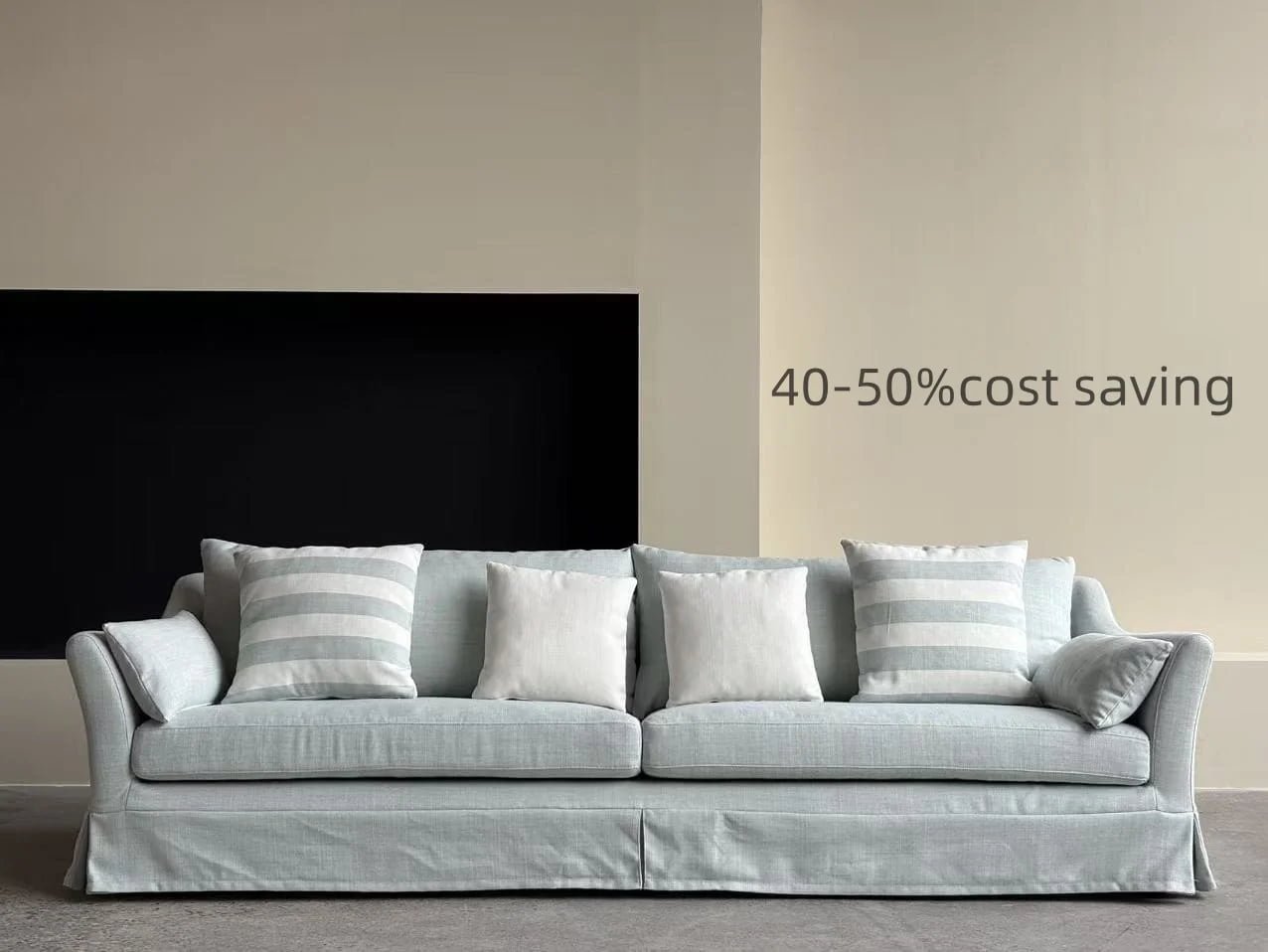
That 40–60% figure comes from real conversations and quotations with designers in the US and UK who have shared their local pricing as a reference point. It is not a guaranteed number for every project. The actual saving depends on the specific pieces, the fabric chosen, the quantity ordered, and the delivery terms. But the range is consistent enough across our experience to be a useful planning figure.
Where the Budget Efficiency Comes From
The cost difference is not the result of cutting corners. It comes from structural differences between operating a production facility in Foshan versus running a custom upholstery studio in a high-cost Western city. Here is a direct breakdown:
| Cost Driver | China (Foshan) | Local (US/Europe) |
|---|---|---|
| Skilled labor | Lower cost per hour, high availability of upholstery craftspeople8 | Higher labor cost, limited pool of skilled upholstery workers |
| Material sourcing | Direct access to fabric and component supply chains9 | Imported materials plus local markup |
| Factory overhead | Lower real estate and operating costs | Higher fixed costs built into pricing |
| MOQ flexibility | Project-based ordering possible | Often structured around larger minimums |
| Export experience | Built-in for overseas markets | Not always applicable |
For a designer managing a project budget for a high-end residential client, this difference is material. It can mean the difference between staying within budget on upholstery while keeping the tile, lighting, and custom millwork at the intended level — versus making trade-offs that compromise the overall scheme.
One thing I tell designers directly: the savings work best when the project scope is clear upfront. A clear brief — piece types, dimensions, fabric, and delivery address — allows us to give an accurate quotation. Projects that change significantly mid-production can affect both cost and timeline.
Does Sourcing from China Create Too Much Logistics Complexity?
Logistics is a real concern, not a trivial one. Overseas designers who have never imported furniture before often worry about shipping damage, customs clearance, unexpected costs, and whether the pieces will actually arrive at the project site in usable condition.
DDP (Delivered Duty Paid) door-to-door service reduces the logistics complexity10 for overseas buyers by covering shipping, customs duties, and delivery to the final address11. This means a designer in the US or UK receives the furniture at the project location without managing import paperwork or coordinating multiple freight parties.
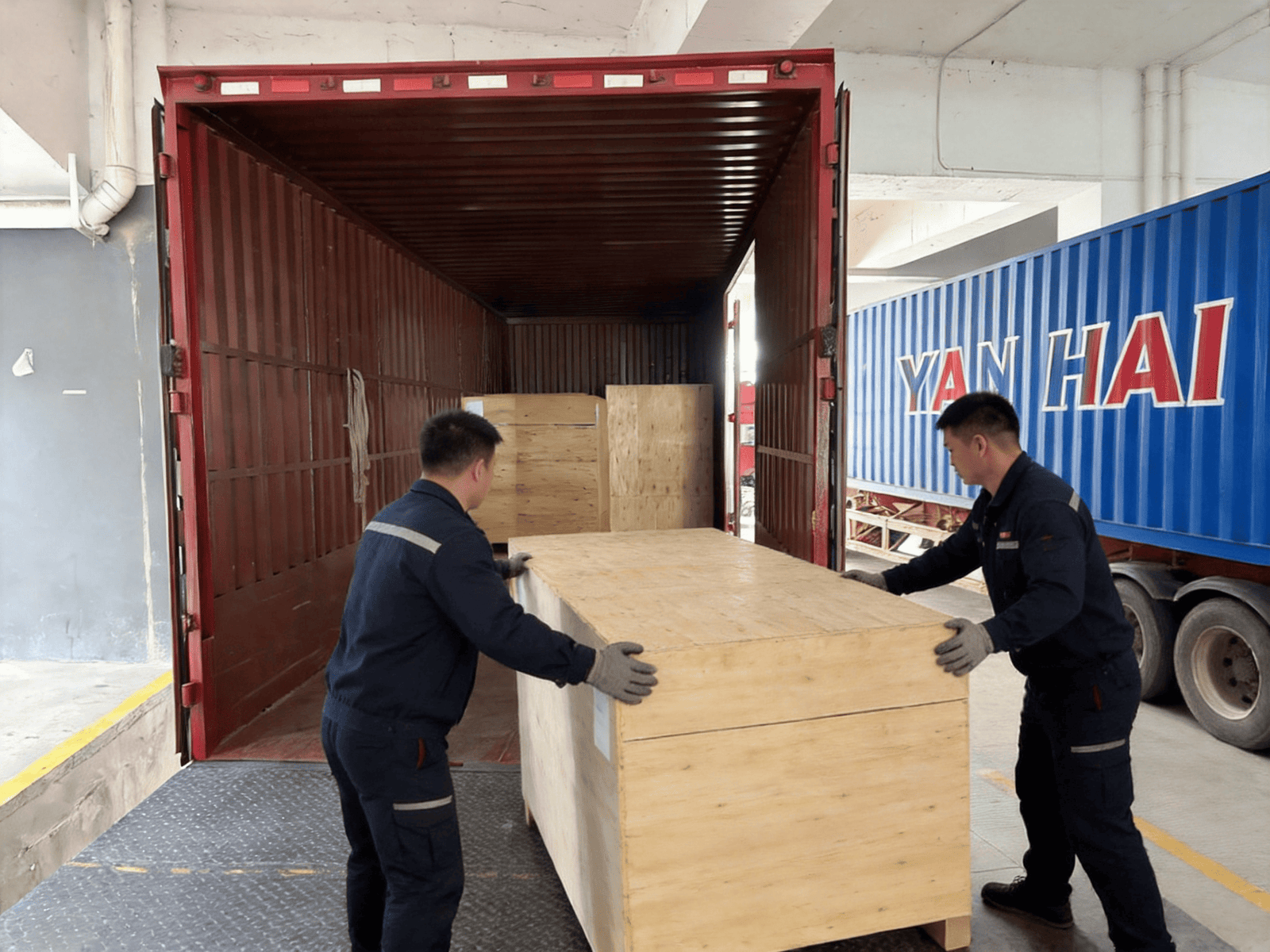
I want to be clear about what DDP means in practice. It means we coordinate the export from Foshan, the freight to the destination country, customs clearance at the destination port, and last-mile delivery to the project address. The designer does not need to manage a freight forwarder, a customs broker, and a local delivery company separately.
What DDP Covers and What Designers Still Need to Think About
DDP simplifies the process, but it does not eliminate every consideration. Here is what it covers and what still requires the designer's attention:
| Item | Covered by DDP | Designer Still Manages |
|---|---|---|
| Export from China | ✓ | |
| Ocean or air freight | ✓ | |
| Destination customs | ✓ | |
| Duties and import taxes | ✓ | |
| Last-mile delivery | ✓ (to project address) | |
| On-site installation | ✓ | |
| Damage claims on delivery | Handled with factory | Requires inspection at delivery |
| Project timeline | ✓ Designer manages overall project schedule |
Packaging is part of how we control delivery risk. Each piece is packed for export transit — wrapped, protected, and crated where necessary.12 Damage during shipping is not something we treat as an afterthought. It is a cost and a relationship problem that we have a direct interest in avoiding.
For first-time importers, the DDP model removes enough friction that the logistics barrier is no longer the reason not to proceed. The decision then comes back to where it should be: design fit, quality, customization,Buying furniture from China makes sense for designers and buyers who need custom, high-end upholstery at better budget efficiency — with project-based quantities, 200+ fabric options, and door-to-door delivery that removes sourcing friction.
If you are an interior designer in the US, UK or Australia sourcing custom high-end linen upholstery for luxury villa residential projects, our 13-year professional custom factory in Foshan provides free furniture construction quality consultation, physical certified Belgian linen swatch kits, full technical custom shop drawing design before order confirmation. We offer project-based small-batch ordering, kiln-dried hardwood frames, 8-way hand-tied spring suspension and layered high-resilience foam sofas, with full dimension customization and COM fabric support. Reach out via WhatsApp to request fabric samples or full furniture specification support.https://linenworld.pro
"Upholsterers - Bureau of Labor Statistics", https://www.bls.gov/oes/2023/may/oes516093.htm. Official labor-cost statistics for manufacturing and upholstery-related occupations show substantial wage differences between China and higher-cost North American or European markets, supporting labor cost as a plausible contributor to lower custom furniture prices; the data do not independently verify the article’s specific 40–60% savings range for individual projects. Evidence role: statistic; source type: government. Supports: Official wage or labor-cost data comparing China with North America and Europe can support the cost-differential mechanism behind lower custom furniture pricing.. Scope note: Contextual support only; the exact savings percentage remains a supplier-specific claim. ↩
"[PDF] BEFORE THE FEDERAL MARITIME COMMISSION", https://www2.fmc.gov/readingroom/documents/68305. Standard logistics references define less-than-container-load shipping as ocean freight in which smaller consignments are consolidated with other cargo in a shared container, supporting the feasibility of international shipments that do not fill a full container; this does not establish any particular factory’s minimum order policy. Evidence role: definition; source type: institution. Supports: A neutral logistics source should define less-than-container-load shipping and explain that goods from multiple shippers can share one container.. Scope note: Supports shipping feasibility, not supplier-specific MOQ practices. ↩
"Hardwood Use in China's Wood Furniture Industry: A Small Sample ...", https://vtechworks.lib.vt.edu/handle/10919/45046. Trade and industry studies identify China as a major global producer and exporter of furniture, including upholstered seating, which supports the broader point that the country has a diverse manufacturing base beyond low-cost mass production; such data do not verify the workmanship level of any individual factory. Evidence role: general_support; source type: research. Supports: Industry or trade data should show that China has a large, export-oriented furniture sector including upholstered seating and higher-value furniture categories.. Scope note: Contextual support only; factory-level quality must be verified separately. ↩
"Elements of Designing Upholstered Furniture Sandwich Frames ...", https://pmc.ncbi.nlm.nih.gov/articles/PMC9458000/. Furniture-construction guidance from educational sources explains that frame material and joinery are central to the strength and durability of upholstered furniture, supporting the claim that solid hardwood frames affect structural performance. Evidence role: mechanism; source type: education. Supports: An educational source should explain how frame material and joinery contribute to the durability and rigidity of upholstered furniture.. ↩
"[PDF] UPHOLSTERED FURNITURE - Michigan State University", https://archive.lib.msu.edu/DMC/Ag.%20Ext.%202007-Chelsie/PDF/e503.pdf. Furniture-construction references describe springs and webbing as structural support systems that influence seating resilience, comfort, and long-term shape retention, supporting the article’s production-quality claim. Evidence role: mechanism; source type: education. Supports: A furniture construction or ergonomics source should connect suspension systems with seat support, comfort, and durability.. ↩
"the effect of overall density on the mechanical properties of flexible ...", https://www.academia.edu/27966919/THE_EFFECT_OF_OVERALL_DENSITY_ON_THE_MECHANICAL_PROPERTIES_OF_FLEXIBLE_POLYURETHANE_FOAM. Materials and seating-comfort studies report that polyurethane foam density, compression properties, and layered filling composition affect cushion support, resilience, and perceived comfort, supporting the claim that filling choices change how upholstered furniture sits. Evidence role: mechanism; source type: paper. Supports: A peer-reviewed or technical source should show that foam density and cushion composition influence compression, resilience, and seating comfort.. ↩
"Linen Most Useful: Perspectives on Structure, Chemistry, and ... - PMC", https://pmc.ncbi.nlm.nih.gov/articles/PMC4403609/. Textile-science references describe linen, derived from flax, as having distinctive handle, moisture behavior, stiffness, and drape characteristics compared with many synthetic or blended fabrics, supporting the material distinction in the article; the source may not specifically prove superiority of Belgian-origin linen. Evidence role: mechanism; source type: education. Supports: A textile science source should describe linen’s fiber properties, handle, drape, and differences from synthetic or blended substitutes.. Scope note: Supports linen properties generally, not necessarily the exact qualities of every Belgian linen product. ↩
"Upholsterers - Bureau of Labor Statistics", https://www.bls.gov/oes/2022/may/oes516093.htm. Government and international labor statistics document materially different manufacturing labor costs across China, the United States, and Europe, while furniture-cluster studies describe concentrated specialized labor pools in Chinese production regions; these sources support the cost mechanism but not the exact staffing conditions at a specific supplier. Evidence role: statistic; source type: government. Supports: Labor statistics and industry studies can support differences in manufacturing wages and the presence of specialized labor in furniture-production regions.. Scope note: Does not directly prove the workforce availability of the article’s factory. ↩
"[PDF] The Chinese Apparel Cluster in Guangdong", https://www.isc.hbs.edu/Documents/resources/courses/moc-course-at-harvard/pdf/student-projects/Chinese_Apparel_Cluster_2006.pdf. Studies of Chinese manufacturing clusters describe dense networks of textile, component, and furniture producers, supporting the article’s claim that proximity to suppliers can reduce sourcing friction and input costs; the evidence is sector-level rather than proof of any one factory’s purchasing terms. Evidence role: mechanism; source type: research. Supports: A research or institutional source should describe China’s textile and furniture manufacturing clusters and their upstream supplier networks.. Scope note: Contextual support at industry or regional level. ↩
"Know Your Incoterms - International Trade Administration", https://www.trade.gov/know-your-incoterms. The International Chamber of Commerce’s Incoterms rules define Delivered Duty Paid as requiring the seller to deliver goods to the named destination cleared for import, with applicable duties and taxes paid, supporting the claim that DDP can simplify logistics for the buyer. Evidence role: definition; source type: institution. Supports: An Incoterms source should define DDP and explain the seller’s responsibility for delivery, import clearance, and duties.. ↩
"Know Your Incoterms - International Trade Administration", https://www.trade.gov/know-your-incoterms. Incoterms guidance describes Delivered Duty Paid as the rule under which the seller assumes responsibility for transport to the named place of destination and for import clearance, duties, and taxes, supporting the article’s explanation of what DDP covers. Evidence role: definition; source type: institution. Supports: A formal Incoterms reference should support that DDP places maximum delivery and import-duty obligations on the seller.. ↩
"[PDF] Load Securement and Packaging Methods to Reduce Risk of ...", https://repository.rit.edu/cgi/viewcontent.cgi?article=1008&context=japr. Transport-packaging standards and testing protocols emphasize protective packaging, cushioning, and crating to reduce damage from vibration, compression, and handling during distribution, supporting the article’s claim that export packing is a risk-control measure; this does not verify the adequacy of any specific shipment’s packaging. Evidence role: mechanism; source type: institution. Supports: Transport-packaging standards or research should explain how protective packaging and crating reduce damage during handling and shipment.. Scope note: Supports the general packaging mechanism, not the performance of the article’s factory packaging. ↩


