Ordering one piece of linen furniture from a factory overseas sounds complicated. Most people worry about hidden costs, unclear delivery terms, and getting something that looks nothing like what they expected.
You can order a single piece of furniture from Linen World. The process works best when your request matches an existing standard model in a standard size. Once we confirm the product, fabric, and your delivery address details, we can provide a DDP quotation that covers your estimated landed cost1.
We handle one-piece inquiries from homeowners and interior designers in the US, Europe, Canada, and Australia on a regular basis. The questions we get are almost always the same: Can I really order just one piece? What does DDP actually cover? How do I pick a fabric without seeing it in person? This guide walks through the full process, step by step, so you know exactly what to expect before you send your first message.
Is a 1pc Order Actually Possible at Linen World?
A lot of factory websites say "minimum order quantity: 1" and leave it at that. That creates confusion fast.
Yes, a single-piece order is possible at Linen World. But it means one piece from our existing standard models, in an available standard size. It is not an open-ended custom development request. If your project requires changes to dimensions, style, construction, or specific reference-image reproduction, that falls under our custom order program, which has a USD 5,000 minimum.
This distinction matters more than most buyers expect, and we want to be clear about it upfront.
What counts as a standard 1pc order
A standard 1pc order means you choose a model we already produce, in a size we already make, and you select a fabric from our available options. Think of it like choosing a configuration from a set menu. The product exists. The construction is set. You are choosing the fabric and the size from what is available.
| Order Type | What It Means | Minimum |
|---|---|---|
| Standard 1pc order | Existing model, existing size, available fabric | 1 piece |
| Custom order | Changed dimensions, new style, reference-image reproduction, special construction | USD 5,000 |
| COM fabric order | Customer's own fabric used on a standard or custom model | Confirm separately |
What triggers the custom order threshold
We get inquiries that say "just one small change" very often. In our experience, even small changes — a sofa that is 10 cm shorter, a chair with a slightly different back angle, or a bed that reproduces a reference photo — require custom pattern development, new material planning, and production adjustments.2 These are not minor modifications. They require the full custom development process, which is why the USD 5,000 threshold exists. It is not a price barrier for its own sake. It reflects the real cost of developing something new from scratch.
If you are unsure whether your request is standard or custom, the simplest thing to do is send us the model you are interested in, your required size, and a note about any changes you are considering. We will tell you directly which category it falls into.
What Information Do We Need Before We Can Quote?
This is the most common place where the process slows down. We receive inquiries that say something like "I want a linen sofa shipped to California — how much does it cost?" We cannot give a useful number from that alone.
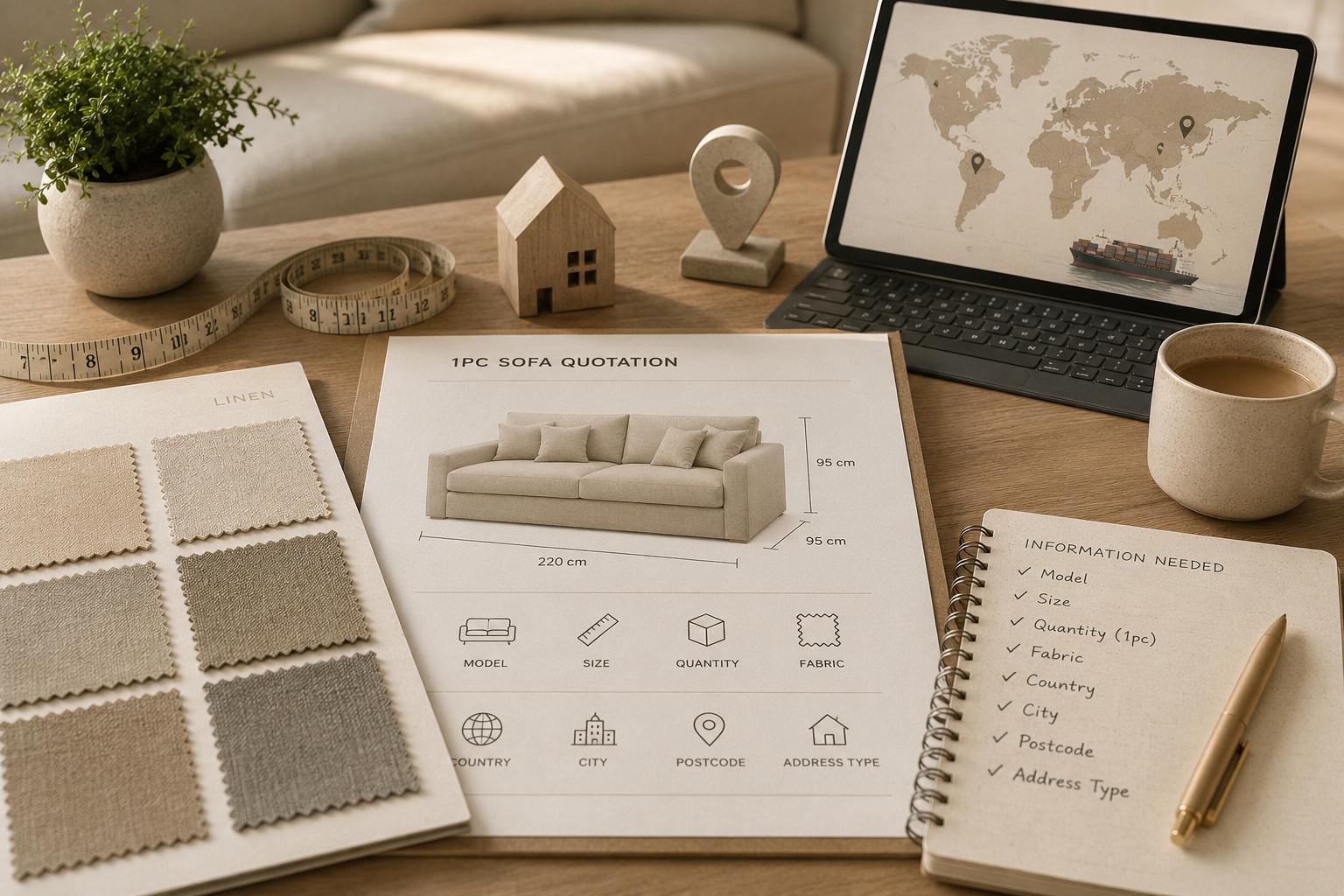
Before Linen World can provide a product price and a DDP delivery estimate, we need: the product model, your preferred standard size, quantity, fabric preference, destination country, city, postcode, and address type (residential or commercial). Without these details, any number we give you would not be reliable.
Here is why each detail matters.
Why every field in your inquiry matters
Product model and size tell us which production specification applies and whether your request is standard or custom. Without this, we are guessing.
Quantity affects per-unit shipping cost. One armchair ships differently than one three-seat sofa.
Fabric preference determines material lead time. Some fabrics ship from stock. Others are ordered specifically for your project.
Destination details are where many buyers stop at just the country. But freight costs and DDP scope depend on the city, postcode, and whether the address is a house, apartment building, or commercial space.3
| Information Required | Why It Matters |
|---|---|
| Product model | Confirms standard vs. custom |
| Standard size | Sets production specification |
| Quantity | Affects shipping cost per unit |
| Fabric preference | Determines material availability |
| Destination country + city + postcode | Required for freight estimate |
| Address type (residential / commercial) | Affects final-mile delivery scope |
We ask for all of this before we quote because we want to give you a number you can actually plan around — not a number that changes three times as the details come in.
What Does DDP Delivery Actually Cover?
DDP is one of the most misunderstood terms in overseas furniture buying. Some buyers assume it means delivery to their living room with assembly included. That is not what DDP means, and we want to be clear about what is and is not included.
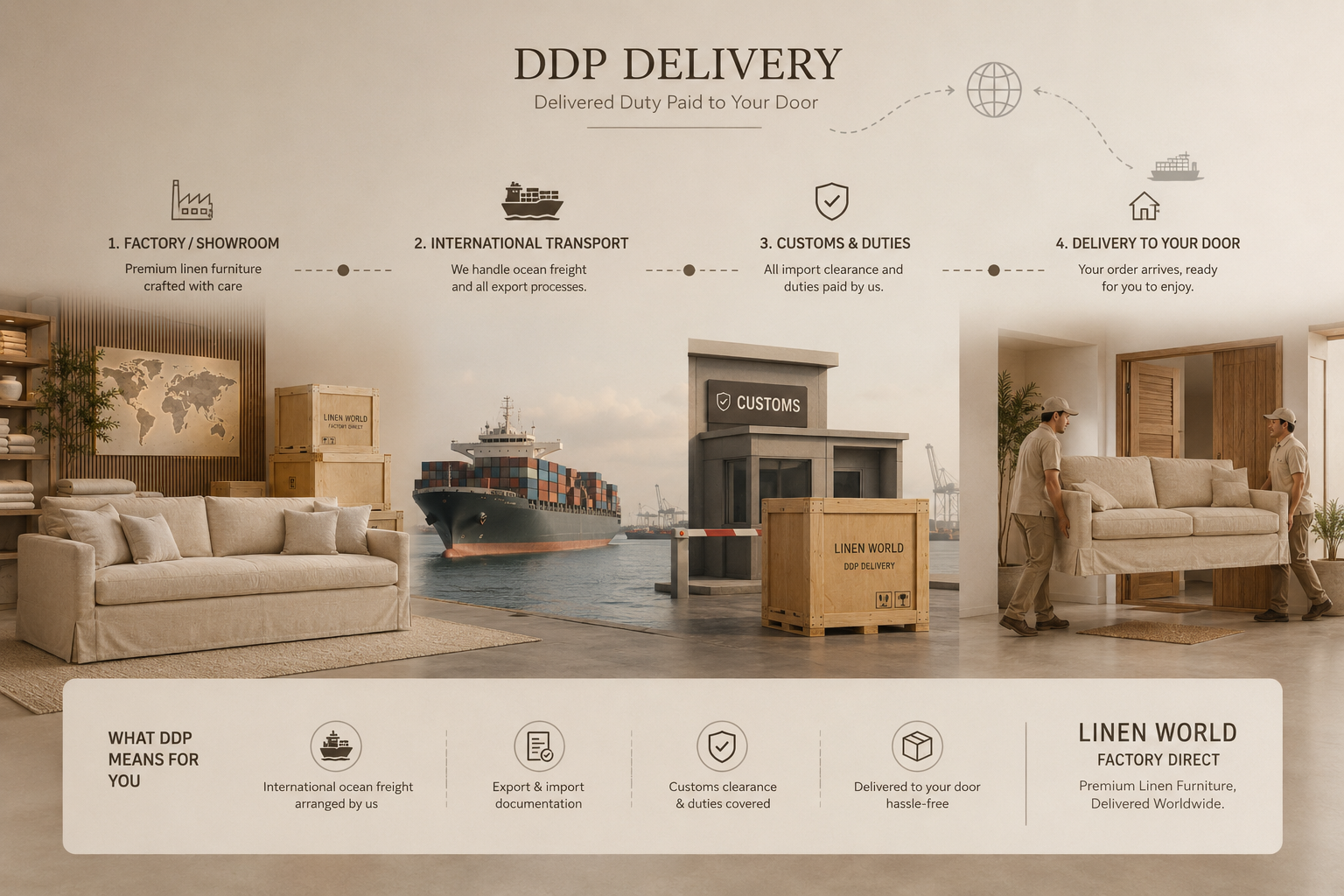
DDP (Delivered Duty Paid)4 means Linen World arranges international freight to your destination country and handles customs clearance on your behalf5. Within the confirmed quotation, duties and taxes are factored in6. What is not automatically included: inside delivery, stair carry, upper-floor delivery, assembly, packaging removal, or access involving special equipment.7
We use DDP because it simplifies landed-cost planning for buyers. Instead of coordinating your own freight forwarder, customs broker, and import duties, you receive one confirmed number that covers the product and the delivery to your address area. That said, the exact scope of what is included at the final-mile stage depends on your specific address and must be confirmed when we quote.
What DDP simplifies — and what it does not replace
The main benefit of DDP for our buyers is cost predictability. You are not dealing with surprise import duties or freight add-ons after the product has already shipped. The cost we confirm before production is the cost you plan around.
| Delivery Element | Typically Included in DDP Quote | Must Be Confirmed Separately |
|---|---|---|
| International freight | ✓ | — |
| Customs clearance | ✓ | — |
| Duties and taxes (estimated) | ✓ within quotation | Final amounts subject to customs8 |
| Delivery to address area | ✓ within confirmed scope | Depends on address type |
| Inside delivery | — | Confirm before order |
| Stair carry / upper floor | — | Confirm before order |
| Assembly | — | Not included |
| Packaging removal | — | Not included |
One thing we always say to buyers: DDP makes the process cleaner, but it is not a guarantee that a large sofa will arrive assembled in your living room. If inside delivery or stair access matters for your address, tell us before we finalize the quotation. We can check what is available in your area and confirm it clearly.
How Do You Choose a Fabric Without Seeing It in Person?
Fabric choice is the part of the process where buyers feel the most uncertain. Linen photographs differently in different lighting.9 Screen color rendering varies by device.10 A fabric that looks warm and natural on a monitor can look cool and flat in a north-facing room.
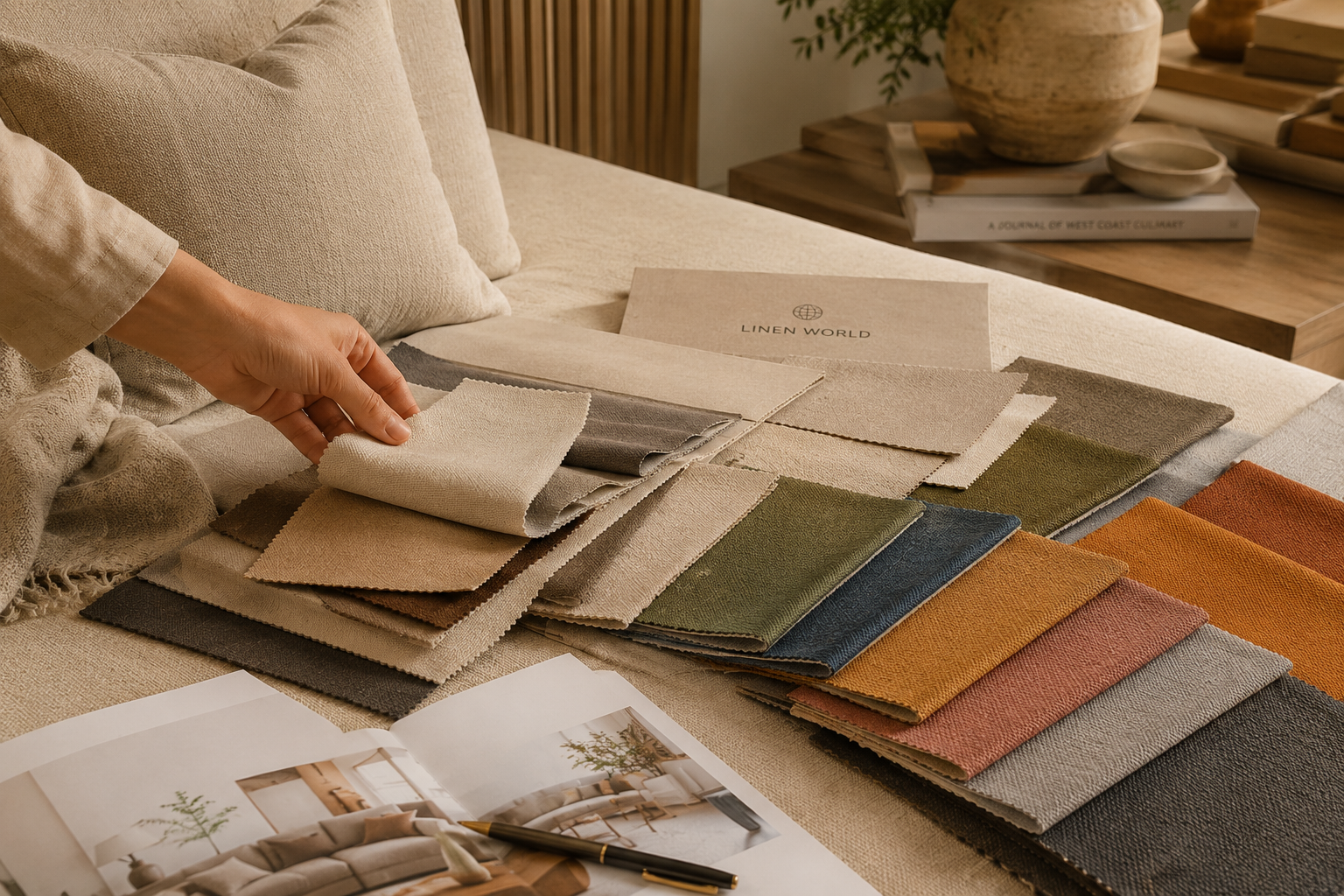
We recommend requesting physical fabric swatches before you confirm your order. Check the swatches under your actual room lighting — both natural daylight and artificial evening light.11 This is the most reliable way to confirm that the fabric color and texture match your space before production begins.
We carry 200+ linen fabric colors across our range. That is a real advantage for designers and homeowners who need a specific tone to complete a room scheme. But the number of options also means the selection process deserves care.
How the fabric confirmation process works
When you contact us, we can identify swatches that match your general direction — warm neutral, cool grey, deep navy, natural undyed, and so on. We then send physical swatches to your address. You check them in your space. You confirm your selection. That confirmation is part of the order process, and production does not begin until final details — including fabric — are confirmed alongside payment.
| Fabric Confirmation Step | What Happens |
|---|---|
| Initial inquiry | Share your color direction or reference |
| Swatch selection | We identify closest options from 200+ range |
| Swatch dispatch | Physical swatches sent to your address |
| On-site review | Check under actual room lighting conditions |
| Final confirmation | Fabric confirmed alongside order payment |
| Production start | Begins after full confirmation |
We also support COM (Customer's Own Material) orders. If you have a specific fabric from another supplier that you want us to use, we can work with that. COM requirements — including fabric quantity, technical specifications, and shipping to our factory — need to be confirmed before the order is placed.
After production is complete, we typically share finished-product photos or a short video before the piece ships. This gives you a chance to see the actual product before it leaves our factory.
What Is the Full Process from First Contact to Delivery?
Now that we have covered the key decision points, here is how the full process looks from start to finish.
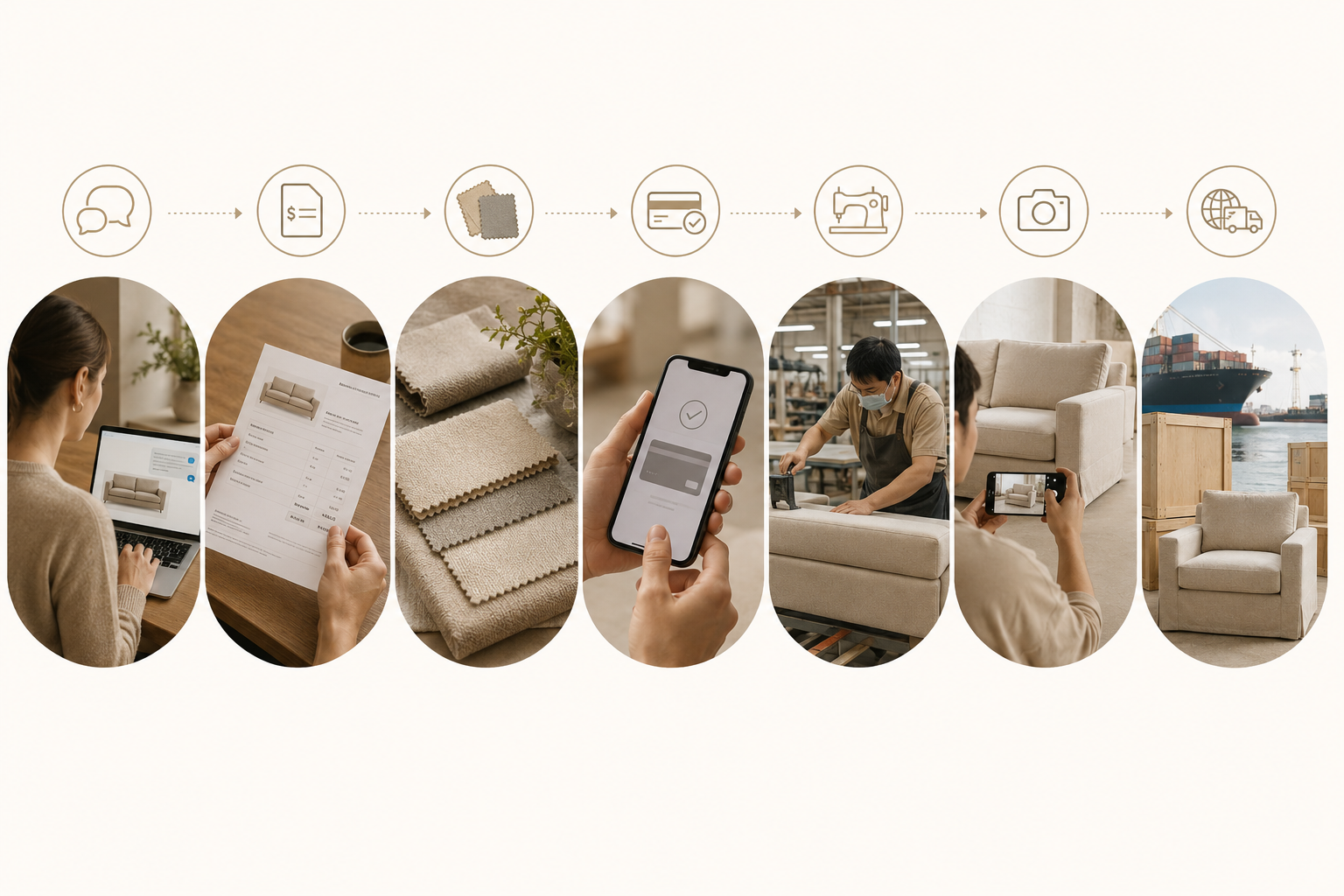
The standard process for a 1pc order at Linen World runs from initial inquiry through quotation, fabric confirmation, payment, production, quality check, and DDP delivery. Each stage is confirmed before the next begins. Production time is usually 30–45 days after order confirmation, and shipping time varies by destination.
Here is the full sequence.
Step-by-step order process
Step 1: Send your inquiry with complete details Product model, standard size, quantity, fabric direction, destination country, city, postcode, address type. The more complete your inquiry, the faster we can respond with a useful quotation.
Step 2: Receive product price and DDP delivery estimate We confirm whether your request is standard or custom. If standard, we provide a product price and a DDP delivery estimate based on your address details.
Step 3: Request and review fabric swatches We send physical swatches. You review them under your room lighting and confirm your selection.
Step 4: Order confirmation and payment Final details — product, size, fabric, delivery address, DDP scope — are confirmed. Payment is made. Production is scheduled.
Step 5: Production Production usually takes approximately 30–45 days after order confirmation. This is subject to current production scheduling and material availability.
Step 6: Quality check and pre-shipment photos When production is complete, we carry out a quality check. Finished-product photos or a video may be shared before shipping when applicable.
Step 7: DDP shipping and delivery The piece ships under DDP terms as confirmed in your quotation. Estimated transit time varies by destination. We provide tracking updates during transit.
| Stage | Approximate Timeframe |
|---|---|
| Quotation response | Usually within 1–2 business days |
| Swatch dispatch and review | Depends on postal service to your location |
| Production | Usually 30–45 days after confirmation |
| International freight | Varies by destination (confirm when quoting) |
| Total lead time | Confirm with your specific quotation |
We do not present these as guaranteed delivery dates. Timelines are approximate and subject to final confirmation at the time of your order.
Conclusion
Ordering one piece from Linen World is straightforward when your request matches a standard model. Send us your product model, size, quantity, fabric preference, and full destination details — including postcode and address type — and we will provide a clear DDP quotation to get started.
"DDP Incoterms: Delivery Duty Paid Guide [UPDATED 2025]", https://www.tradefinanceglobal.com/incoterms/ddp-delivery-duty-paid/. Incoterms guidance defines Delivered Duty Paid as a rule under which the seller bears responsibility for delivering goods to a named destination after import clearance and for paying applicable duties and taxes, supporting the use of DDP as a basis for estimating landed cost. Evidence role: definition; source type: institution. Supports: The source should define Delivered Duty Paid and explain that the seller is responsible for delivery to the named destination, import clearance, duties, and taxes under the rule.. Scope note: This supports the meaning of DDP generally, not the accuracy of any specific Linen World quotation. ↩
"Production planning of a furniture manufacturing company ... - PMC", https://pmc.ncbi.nlm.nih.gov/articles/PMC8202929/. Research on product customization and furniture manufacturing describes how design changes can require engineering, pattern revision, material planning, and process adjustments, providing contextual support for treating small dimensional or style changes as custom development. Evidence role: mechanism; source type: paper. Supports: The source should explain that product customization can require design engineering, pattern changes, material planning, tooling, or production-process adjustments.. Scope note: This supports the production rationale generally, not Linen World's specific USD 5,000 custom-order threshold. ↩
"A study on the influential factors of the last mile delivery projects ...", https://pmc.ncbi.nlm.nih.gov/articles/PMC8435763/. Studies of last-mile logistics identify destination location, delivery density, access constraints, and service level as cost drivers, providing contextual support for requesting city, postcode, and address-type information before quoting freight. Evidence role: mechanism; source type: paper. Supports: The source should explain that last-mile delivery costs are influenced by location, delivery density, access conditions, and service requirements.. Scope note: This supports the general cost drivers, not the exact DDP scope available at a particular address. ↩
"Know Your Incoterms - International Trade Administration", https://www.trade.gov/know-your-incoterms. Authoritative Incoterms materials identify DDP as the abbreviation for Delivered Duty Paid, a recognized international trade rule allocating delivery, import-clearance, duty, and tax responsibilities. Evidence role: definition; source type: institution. Supports: The source should confirm that DDP means Delivered Duty Paid and is one of the Incoterms rules used in international trade.. ↩
"Know Your Incoterms - International Trade Administration", https://www.trade.gov/know-your-incoterms. Incoterms explanations of Delivered Duty Paid state that the seller is responsible for clearing the goods for import at the destination, supporting the article's description of customs clearance being handled by the seller. Evidence role: definition; source type: institution. Supports: The source should state that DDP places import clearance responsibility on the seller rather than the buyer.. Scope note: This supports the standard Incoterms allocation; individual quotations may modify operational details. ↩
"Know Your Incoterms - International Trade Administration", https://www.trade.gov/know-your-incoterms. Delivered Duty Paid is generally described as the Incoterms rule under which the seller bears import duties and taxes, supporting the statement that such charges are included or factored into a DDP quotation. Evidence role: definition; source type: institution. Supports: The source should confirm that under DDP the seller bears import duties and taxes associated with bringing goods to the named destination.. Scope note: This does not verify the final amount of duties or taxes assessed by customs authorities. ↩
"Know Your Incoterms - International Trade Administration", https://www.trade.gov/know-your-incoterms. Incoterms commentary explains that DDP allocates international delivery, clearance, duty, and tax responsibilities but does not by itself provide optional destination services such as in-home placement, assembly, or packaging removal. Evidence role: definition; source type: institution. Supports: The source should explain the boundary of Incoterms DDP obligations, especially that unloading or additional destination services are not automatically included unless contracted.. Scope note: This supports the trade-term boundary; a seller may separately contract for extra delivery services. ↩
"Internet Purchases - U.S. Customs and Border Protection", https://www.cbp.gov/trade/basic-import-export/internet-purchases. Customs-agency guidance explains that import duties and taxes are assessed according to factors such as tariff classification, customs value, origin, and applicable rates, supporting the qualification that quoted amounts may remain subject to customs determination. Evidence role: mechanism; source type: government. Supports: The source should explain that customs agencies assess duties and taxes based on classification, valuation, origin, and applicable import rules.. Scope note: This supports the general customs-assessment mechanism, not a specific country's treatment of a particular furniture shipment. ↩
"Color appearance shifts depending on surface roughness ... - PMC", https://pmc.ncbi.nlm.nih.gov/articles/PMC8789860/. Color-science research shows that perceived color appearance varies with illumination and viewing conditions, providing contextual support for the observation that linen may photograph differently under different lighting. Evidence role: mechanism; source type: research. Supports: The source should show that perceived color appearance depends on illumination and viewing conditions, including for materials such as textiles.. Scope note: This supports the general optical mechanism, not every linen fabric or photograph. ↩
"NIST Calibration Facility for Display Colorimeters", https://www.nist.gov/publications/nist-calibration-facility-display-colorimeters-0. Color-management literature explains that display devices can render colors differently because of variations in hardware, calibration, profiles, and settings, supporting caution when judging fabric color from screen images alone. Evidence role: mechanism; source type: research. Supports: The source should explain that displays can reproduce color differently depending on device characteristics, calibration, color profiles, and viewing settings.. Scope note: This supports device-related color variation generally, not the appearance of a specific Linen World product image. ↩
"Why Colors Look Different in a Lightbox vs. Natural Daylight", https://www.metrodyeing.com/color-perception-lightbox-vs-natural-daylight/. Textile color-evaluation guidance discusses the effects of illuminants and metamerism, supporting the practice of reviewing fabric swatches under both daylight and the artificial lighting expected in the final room. Evidence role: mechanism; source type: institution. Supports: The source should explain that textile colors can appear differently under different illuminants and that evaluating samples under relevant lighting reduces mismatch risk.. Scope note: This supports the rationale for swatch review, not a guarantee that the finished upholstered piece will appear identical in all conditions. ↩