There's a choice that looks simple on the surface. You're selecting fabric for a custom sofa or armchair. Linen and cotton both feel natural, both look clean, and both come in neutral tones. Then you make the call — and six months later, something is off.
Linen and cotton deliver drastically different texture and long-term performance, so they cannot be freely interchanged for most high-end custom upholstery projects. Linen features an open weave, lower heat retention and unique natural slub texture that standard cotton cannot match in inherent fiber performance, even with texture finishing treatments. For custom high-ticket pieces in warm climates or design-led natural-material interiors, linen is the higher-performing choice.
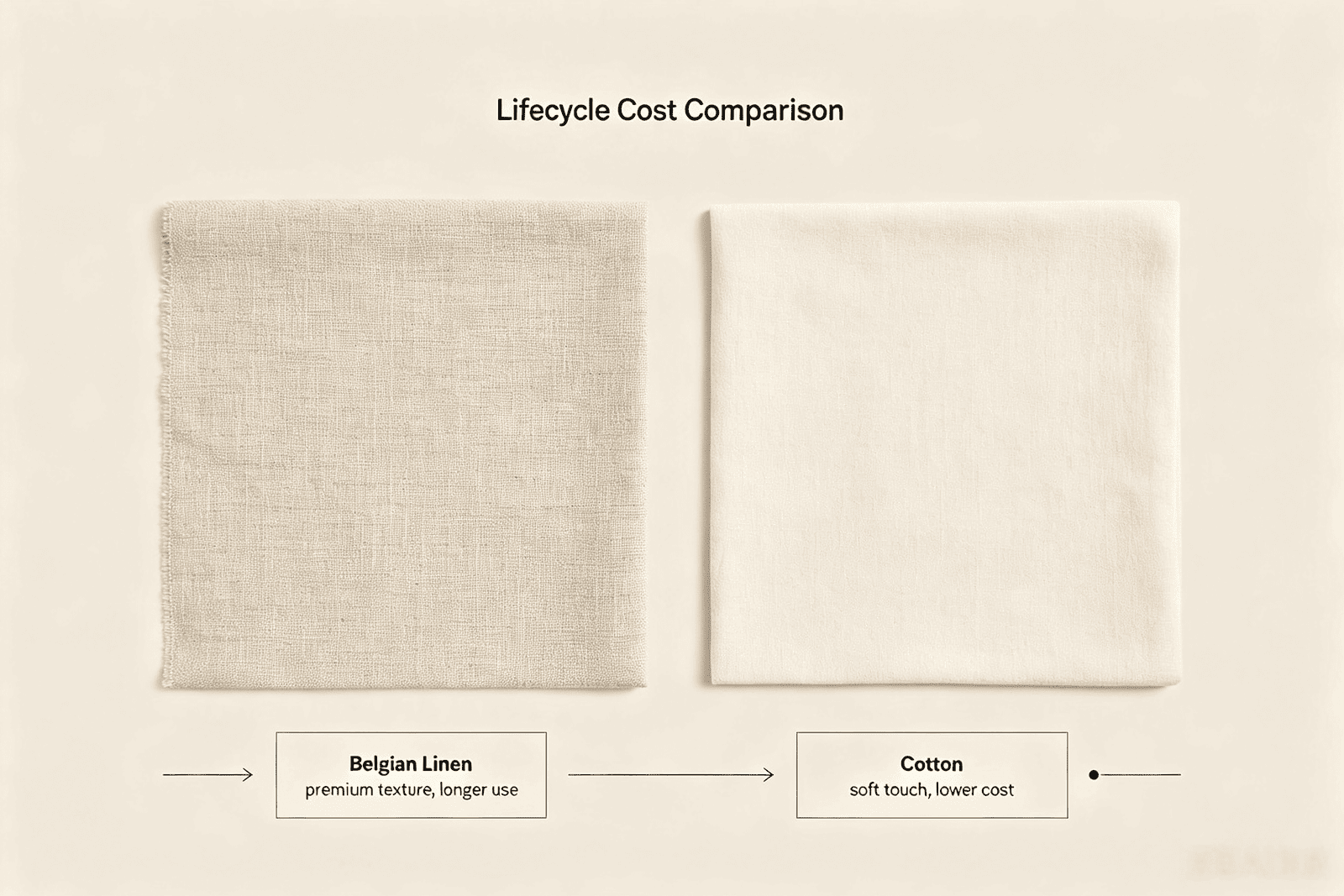
The problem is that most buyers make this decision by touch alone — and linen and cotton feel similar enough that touch is not a reliable filter. That's not a taste problem. That's a spec communication problem. And on a custom upholstery order, the cost of the wrong call is not a return — it's a full reupholstery. I want to walk through exactly where linen earns its premium, where cotton is the smarter tool, and what to look at on a fabric card before you commit.
Why Do Linen and Cotton Feel So Similar — and Why Does That Matter?
Most people handle a linen swatch and a cotton swatch and come away unsure which is which. That's not unusual. It's actually one of the most common moments we see in the color selection stage with designers and buyers working through custom orders.
Linen and cotton feel similar because both are natural cellulose fibers with soft surfaces1. The difference shows up in weave structure, yarn texture, and thermal behavior — properties that don't register by touch alone but show clearly on a labeled spec card.
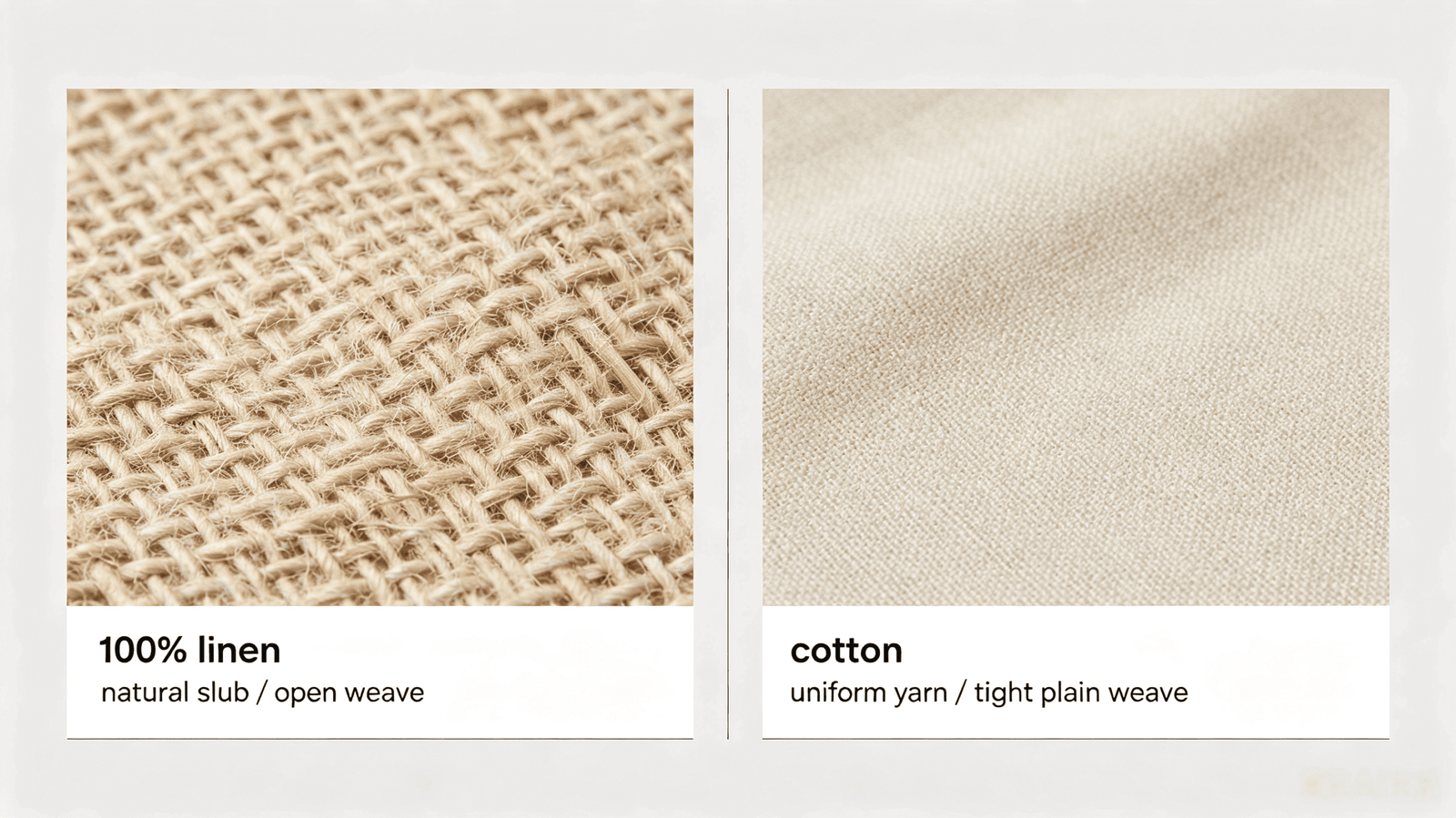
This is where most selection processes break down early. A buyer holds two swatches, decides they prefer the color, and moves on. The weave type, the gsm, and the yarn composition percentage go unread — or aren't even on the card. That's a missed step, and on a bespoke piece, it's the step that determines whether the fabric performs the way the design needs it to.
What the Spec Card Is Actually Telling You
When we send swatch cards for custom orders, every card carries three labeled fields: fabric composition (including percentage), gsm weight, and weave construction. These three together tell you more than any touch test.
| Spec | What It Means for Upholstery |
|---|---|
| Composition (e.g., 100% linen vs 55% linen / 45% cotton) | Determines breathability, texture variation, and wrinkling tendency |
| GSM (grams per square meter)2 | Indicates fabric weight and how it will drape and hold shape on the frame |
| Weave construction (plain, herringbone, slub) | Affects surface texture, visual depth, and how the fabric reads from a distance |
Pure linen and linen-cotton blends are listed differently for a reason. A blend reduces cost and tends to wrinkle less. But it also reduces the open-weave breathability and the natural yarn irregularity that gives pure linen its texture. Buyers who under-specify here often end up with a fabric that reads closer to cotton than linen in the final piece — and in a design scheme built around natural material texture, that gap is visible.
This is the variable that gets skipped most often in the selection process. If you're sourcing a blend, know the ratio. If the card doesn't list it, ask.
When Does Linen Actually Outperform Cotton on Upholstered Furniture?
Cotton is not a bad fabric choice. I want to be clear about that. The argument here is not that linen is universally better. The argument is that linen outperforms cotton in specific, nameable conditions — and those conditions come up frequently in the kinds of projects we work on with US and European designers.
Linen outperforms cotton for upholstery in three specific conditions: warm or year-round air-conditioned climates where skin contact comfort matters, natural-material design schemes where texture is structural to the visual concept, and high-ticket custom pieces where fabric performance must hold over years without reupholstery.
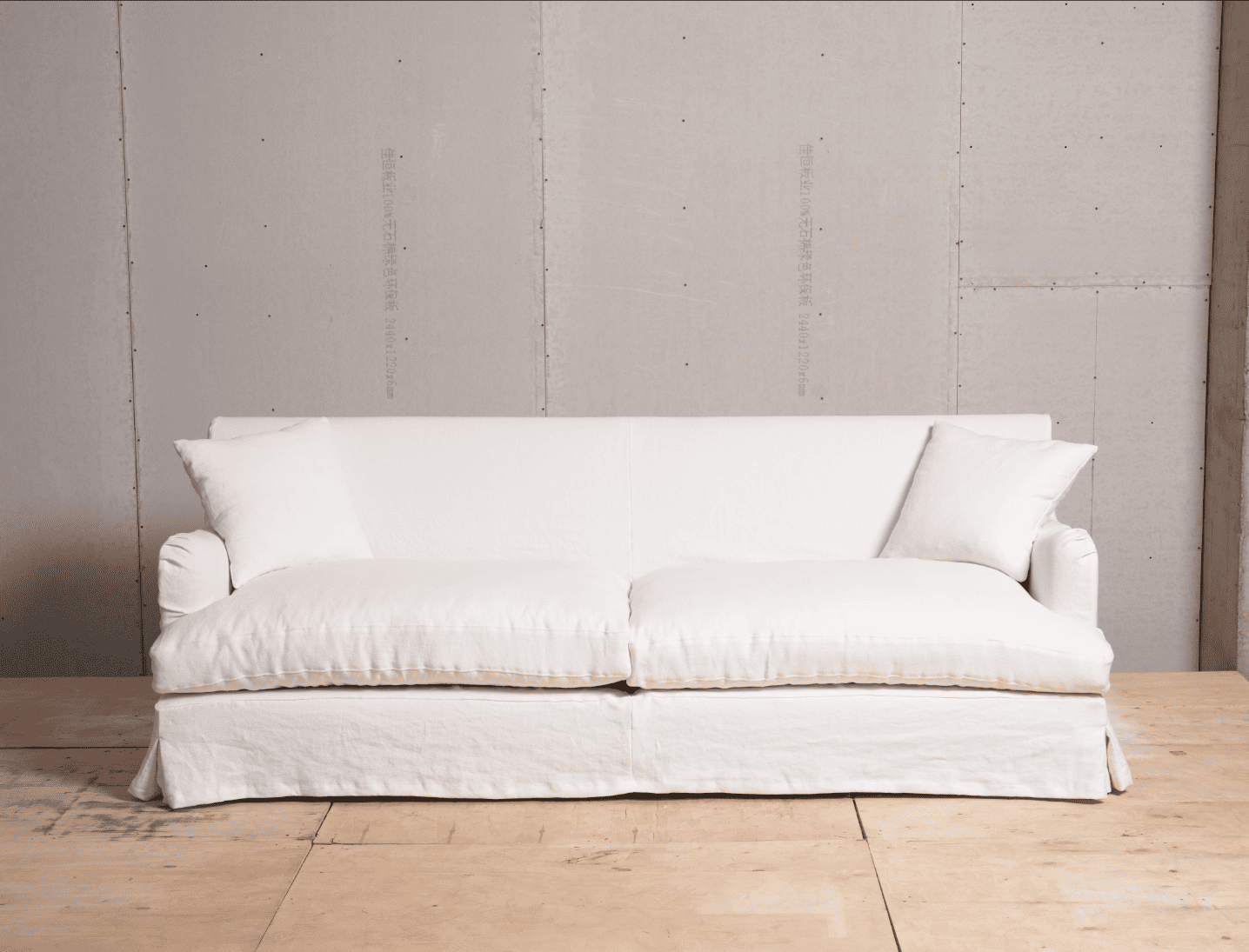
The performance gap is real, but it's conditional. Understanding the conditions helps you use the spec decision the way it's meant to be used — as a scene-fit call, not a brand preference.
Breaking Down the Three Conditions Where Linen Wins
Condition 1: Climate and Contact Comfort
Linen has lower thermal retention than cotton. On a warm day or in a room that runs warm despite air conditioning, linen's surface stays cooler to the touch. This is not a marketing claim — it comes from the fiber's open weave structure and the way it conducts heat away from the body rather than holding it. In climates like Southern California, Florida, or the Mediterranean, this difference is felt year-round.
Cotton holds warmth more. For colder climates or rooms that run cold, that quality is actually useful. But for a buyer in a warm climate who will live on that sofa in summer, linen's cooler contact feel is a real-world performance advantage.
Condition 2: Design Language and Visual Texture
| Design Scheme Type | Linen | Cotton |
|---|---|---|
| Extreme minimalist with natural hard finishes (stone, oak, raw plaster) | Strong fit — texture variation supports visual language | Weak fit — reads flat against textured hard finishes |
| Traditional or formal interiors | Neutral — depends on specific weave | Strong fit — clean, even surface reads as polished |
| Coastal or relaxed natural interiors | Strong fit | Moderate fit |
| High-contrast, graphic interiors | Neutral | Neutral |
Linen's yarn irregularity — the natural slub texture that runs through pure linen fabric — is not a flaw. In a design scheme built around natural materials, that texture is part of the visual system. It holds tonal harmony with stone floors, white oak joinery, and raw plaster walls in a way that cotton's flat, even surface doesn't. When designers working on full-room natural material schemes specify linen, they're not choosing it for softness — they're choosing it because the texture carries a visual weight that cotton cannot replicate.
Condition 3: Lock-In Cost and Long-Term Performance
This is the most underweighted factor in the selection process. A custom upholstered sofa or armchair is not a returnable item3. If the fabric is wrong — the wrong texture, the wrong breathability, the wrong visual weight — the fix is a full reupholstery job. That's not a small cost.
Linen, when it's pure or near-pure Belgian linen at a solid gsm, is a durable fabric. It becomes softer with use without losing structural integrity. It holds color well. For a piece that is meant to last eight to twelve years in a high-use living room4, linen's long-term performance reduces the probability of that reupholstery call. Cotton upholstery fabrics at lower gsm weights can pill, flatten, and lose surface texture faster5 — particularly in high-contact areas like seat cushion fronts and armrests.
The decision is not just about what looks good on day one. It's about what still looks right in year four.
Pure Linen vs Linen-Cotton Blends: The Variable Most Buyers Skip
This is the question that comes up most in our selection stage conversations, and it's the one that gets the least attention in generic fabric guides. Pure linen and linen-cotton blends are not the same product. They're priced differently, they behave differently, and they deliver different results in the final piece.
Pure linen (100% linen, ideally Belgian-sourced6) delivers maximum breathability, natural texture variation, and long-term durability. Linen-cotton blends reduce cost and wrinkling tendency but give up a measurable portion of the texture and breathability advantage that makes linen the right tool in the first place.
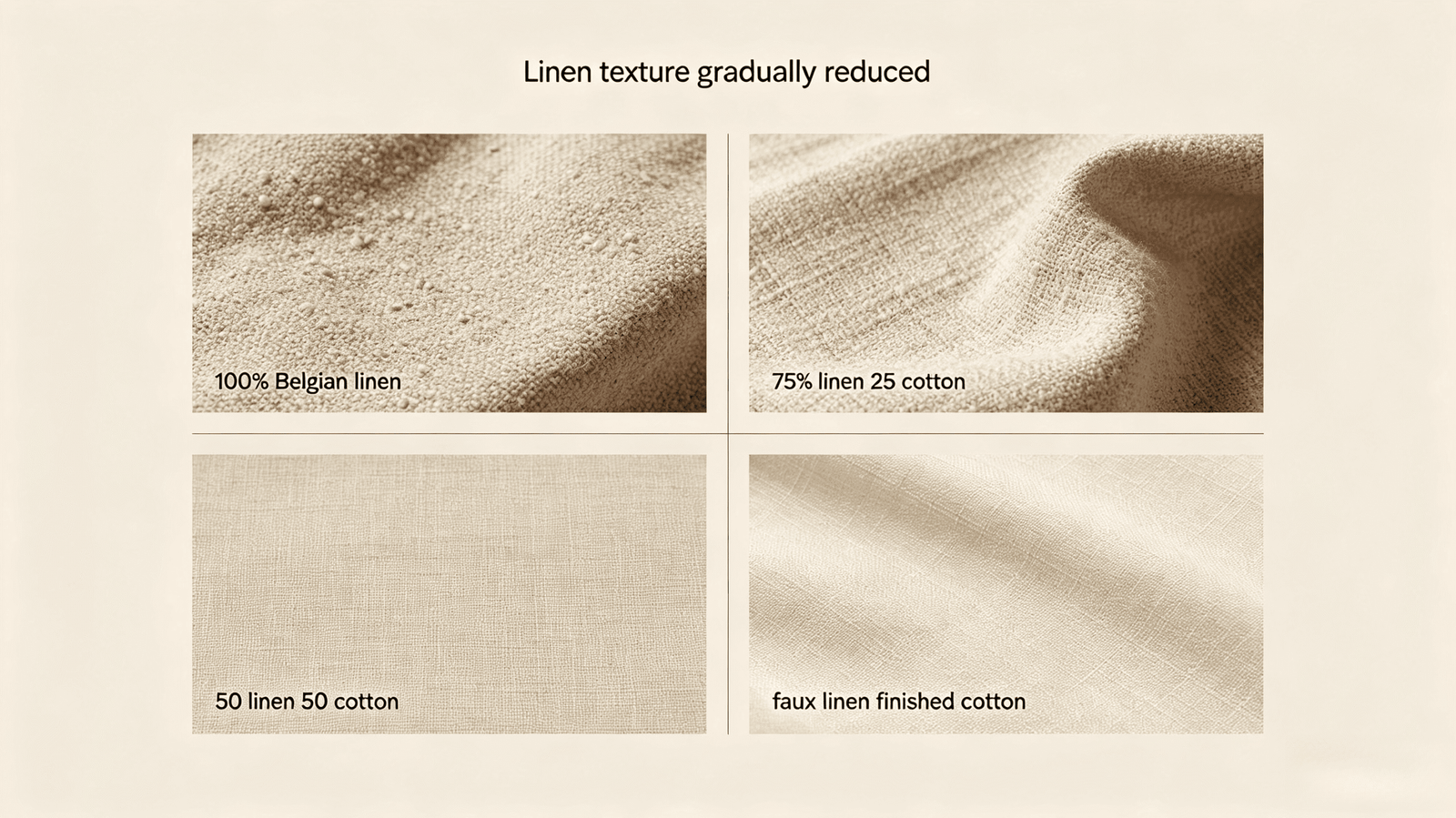
The wrinkle behavior difference is real and worth addressing directly. Pure linen wrinkles more than blends. On upholstered furniture — particularly on cushion surfaces — this is mostly managed by fabric weight (gsm) and how the fabric is cut and fitted. High GSM pure linen on well-tailored frames significantly reduces creasing under daily use, though subtle compression wrinkles will still appear after regular seating. A loosely fitted piece in a lightweight pure linen will show more. The blend resolves this by introducing cotton's tighter fiber structure, but that same tighter structure reduces the open-weave breathability and dulls the slub texture.
How to Read the Composition Label
| Composition | What You Get | What You Give Up |
|---|---|---|
| 100% pure linen (Belgian) | Maximum breathability, full slub texture, highest durability | Higher price, slightly more wrinkle-prone |
| 70–80% linen / 20–30% cotton | Reduced wrinkling, slightly lower cost | Partial loss of texture depth and breathability |
| 50–55% linen / 45–50% cotton | Budget-friendly, easy care, minimal wrinkling | Looks and behaves closer to cotton than linen |
| Cotton with linen-look finish | Lowest cost | No linen performance properties — purely aesthetic |
The last row is worth flagging. Some suppliers sell cotton fabrics with a brushed or textured finish that visually resembles linen7. These are cotton fabrics. They carry none of linen's thermal or structural performance properties. If the composition label reads 100% cotton, the weave style doesn't change what the fiber does.
In our experience, designers who are building a natural-material design scheme almost always want pure linen or a high-linen blend — 70% or above. The texture and performance gap below that threshold becomes visible in the finished piece, particularly in direct comparison with natural hard finishes in the same room.
How Should You Actually Make This Decision?
The question is not "is linen better than cotton?" The question is "does this project have the conditions where linen earns its price?"
If your project is in a warm climate, uses natural-material hard finishes, or involves a high-ticket custom piece that must perform for years without reupholstery — linen is the right call. If those conditions are absent, cotton is a competent and cost-effective choice.
Walk through these three questions before you commit to a fabric:
A Simple Decision Framework for Fabric Selection
Question 1: What is the climate and use pattern?
Year-round warmth, high-use seating, and direct skin contact favor linen. Cold climates with low-use formal seating can go either way.
Question 2: What is the design language of the space?
| Design Brief | Recommended Fabric Direction |
|---|---|
| Natural materials, minimal ornamentation, neutral palette | Pure linen or high-linen blend |
| Traditional, formal, or highly polished aesthetic | Cotton or linen-cotton blend |
| Coastal, relaxed, or organic modern | Pure linen |
| Eclectic or high-contrast graphic | Either — color and weave weight matter more than fiber type |
Question 3: What is the cost of a wrong decision?
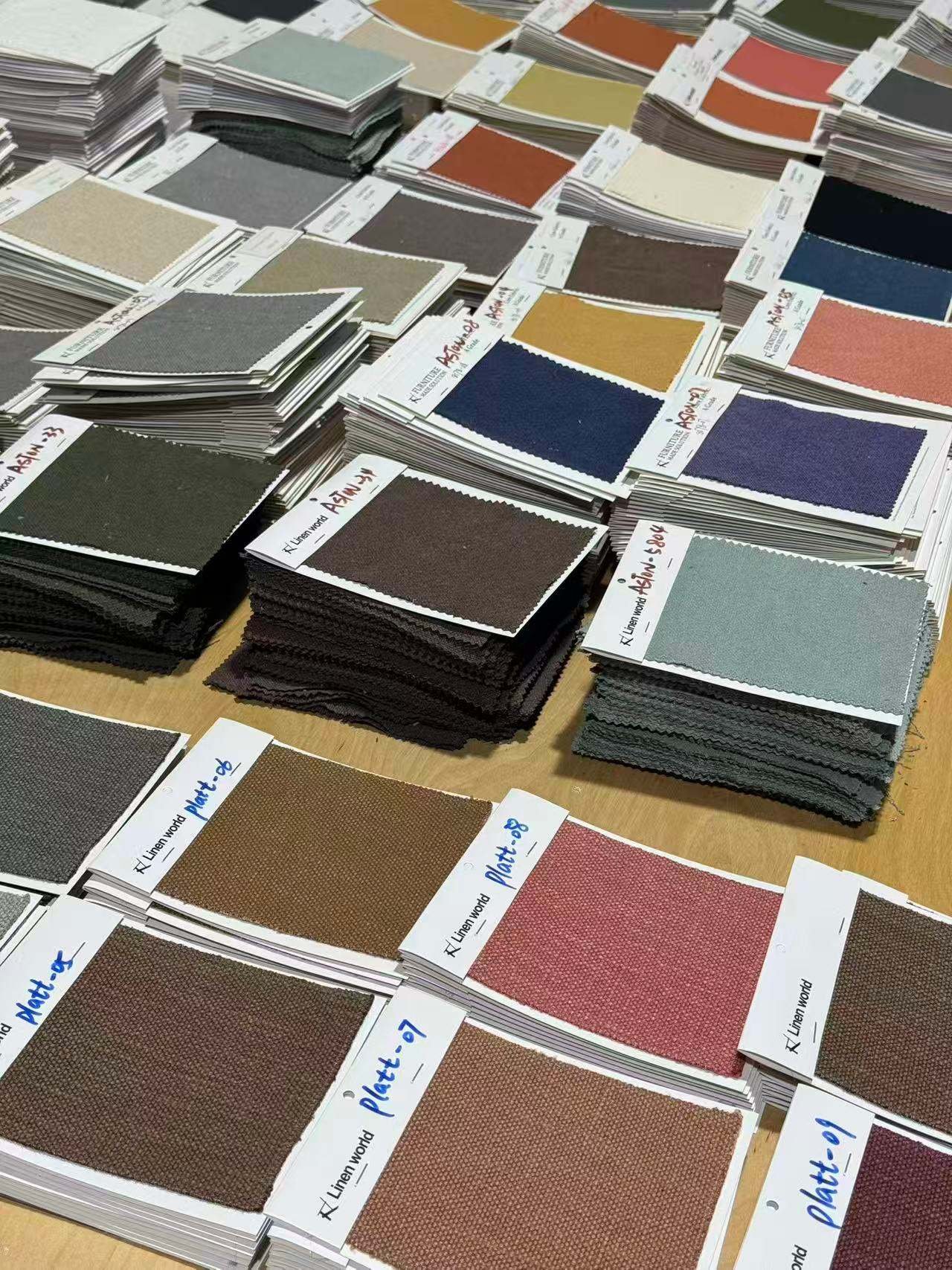
For a bespoke, high-ticket piece — a full sofa, a pair of armchairs, a custom upholstered bed — the lock-in cost is high. Slow down on the spec step. Request fabric cards with labeled composition, gsm, and weave. Order physical swatches and test them in the room's light conditions before committing.
For lower-ticket pieces or items that will be recovered on a known timeline, the calculus is different. Cotton may be the more efficient choice.
This framework is not a checklist that produces one right answer. It's a structure for thinking about the decision the way the decision actually works — as a fit problem, not a preference problem.
Conclusion
Linen earns its premium in specific conditions: warm climates, natural-material design schemes, and high-ticket custom pieces where fabric performance must hold for years. Outside those conditions, cotton is a smart and capable choice. Read the spec card, know the composition percentage, and match the fabric to the scene — not to a general ranking of which fiber is better.
If you’re an interior designer sourcing custom upholstery furniture for US residential projects, our 13-year Foshan factory stocks authentic Belgian pure linen, linen-cotton blends and premium cotton fabrics with full labeled spec cards (composition, GSM & weave). We provide free physical fabric swatches to test texture and color under your room lighting before production. Message us via WhatsApp to request fabric catalogs, factory virtual tours or customized sofa quotations.https://linenworld.pro
"Natural cellulose fibers from switchgrass with tensile properties ...", https://pubmed.ncbi.nlm.nih.gov/17221888/. Linen, derived from the flax plant (Linum usitatissimum), and cotton, derived from the Gossypium genus, are both classified as natural cellulose fibers, a categorization that accounts for their broadly similar tactile properties and care requirements. Evidence role: definition; source type: encyclopedia. Supports: That both linen and cotton are classified as natural cellulose fibers derived from plant sources. ↩
"Understanding Fabric Weights - Core Fabrics", https://corefabricstore.com/blogs/tips-and-resources/fabric-weights-blog?srsltid=AfmBOorMer7rtYIuBFl61n_N_hCIscG8EphZimC3aGeyaKvcz_lMDvDg. Grams per square meter (GSM) is the internationally recognized unit for expressing fabric areal density, standardized under ISO 3801 for woven fabrics; in upholstery applications, GSM is used as a proxy indicator of fabric body, drape behavior, and resistance to deformation under sustained load. Evidence role: definition; source type: institution. Supports: That grams per square meter (GSM) is a standardized metric for measuring fabric weight used across the textile industry. ↩
"Refund Policies | State of California - Department of Justice - CA.gov", https://oag.ca.gov/consumers/general/refunds. Consumer protection frameworks in both the United States and European Union generally recognize that custom-made or bespoke goods — items manufactured to a buyer's specific requirements — are exempt from standard statutory return and cancellation rights, placing the burden of specification accuracy on the buyer prior to order confirmation. Evidence role: general_support; source type: government. Supports: That custom-made or bespoke goods are generally exempt from standard return rights, making pre-purchase specification accuracy critical. Scope note: Specific return rights vary by jurisdiction and individual retailer contract terms; this general principle does not constitute legal advice applicable to all purchasing contexts. ↩
"Comprehensive life cycle assessment of 25 furniture pieces across ...", https://pmc.ncbi.nlm.nih.gov/articles/PMC12015272/. Consumer research and furniture industry lifecycle assessments generally estimate the functional lifespan of upholstered seating at between seven and fifteen years depending on use intensity, construction quality, and maintenance, with eight to twelve years cited as a representative range for well-constructed pieces in regular household use. Evidence role: statistic; source type: research. Supports: That upholstered seating furniture has an expected functional lifespan in the range of eight to twelve years under regular household use. Scope note: Lifespan estimates vary considerably across studies and are sensitive to differences in construction quality, use patterns, and the definition of functional end-of-life; the cited range should be understood as indicative rather than prescriptive. ↩
"Fabric Abrasion Testing - TVF Inc.", https://www.tvfinc.com/article/fabric-abrasion-testing/. Abrasion resistance testing, commonly measured via the Martindale method in upholstery fabric evaluation, has shown that linen-based fabrics generally outperform equivalent-weight cotton fabrics in rub-cycle endurance, with lower-gsm cotton constructions showing earlier onset of pilling and surface flattening. Evidence role: general_support; source type: research. Supports: That cotton upholstery fabrics, particularly at lower weights, exhibit greater susceptibility to surface degradation under repeated abrasion than linen. Scope note: Performance outcomes vary significantly by weave construction and finishing treatment; gsm alone is not a complete predictor of abrasion resistance across all fabric types. ↩
"Belgian Linen - Wikipedia", https://en.wikipedia.org/wiki/Belgian_Linen. Belgium, and the broader Flanders region, has been recognized as a center of high-quality linen production since the medieval period, with the regional climate and soil conditions of the Lys River valley considered particularly suited to flax retting, a processing stage that significantly affects final fiber quality. Evidence role: historical_context; source type: institution. Supports: That Belgium has a historically established reputation for high-quality linen production linked to regional flax cultivation and processing expertise. Scope note: Geographic origin alone does not guarantee fabric quality in contemporary supply chains; certification schemes such as Masters of Linen provide more reliable provenance verification than country of origin labeling. ↩
"Threads of Ingenuity: Linen - How it's Made and its Origins - LSU", https://www.lsu.edu/rurallife/newsletter/2021/linen.php. Textile finishing techniques including mechanical embossing, slub yarn incorporation, and surface brushing are documented methods used to impart a linen-like visual texture to cotton fabrics; such treatments affect surface aesthetics only and do not alter the thermal conductivity, air permeability, or tensile properties characteristic of flax-derived linen fiber. Evidence role: general_support; source type: research. Supports: That textile finishing processes can alter the surface appearance of cotton fabrics to approximate the visual texture of linen without changing the fiber's underlying performance properties. Scope note: The prevalence of such practices in the upholstery fabric market specifically is not well quantified in published literature; the claim is supported by general textile finishing science rather than upholstery market data. ↩


