
Villa furniture sourcing can become expensive when attractive products fail to match the rooms, users, or project schedule. A wrong seat depth, unclear fabric specification, or late approval can lead to discomfort, rework, and unexpected costs. I recommend treating sourcing as a structured risk-management process rather than a search for style or the lowest price.
A reliable villa furniture sourcing process starts by defining the space, users, comfort expectations, materials, budget, approval stages, and delivery constraints. Buyers should then issue the same specifications to every supplier, evaluate samples before production, and document quality requirements. This approach makes quotations comparable and reduces omissions, changes, delays, and unsuitable purchases.1

This guide presents a whole-villa sourcing framework, but I limit the technical discussion to the category we work with directly: linen-upholstered sofas, armchairs, beds, and dining chairs. For case goods, lighting, stone, and other categories, I focus only on general coordination principles.
How Should I Build a Whole-Villa Furniture Sourcing Framework?
A villa can contain dozens of furniture types across formal, private, and outdoor spaces. If I evaluate each item independently, I may overlook scale conflicts, inconsistent specifications, budget imbalances, and approval dependencies. A whole-villa framework helps me manage those connections before individual products enter production.2
I build a villa furniture sourcing framework by dividing the project into rooms, user needs, furniture categories, technical specifications, budgets, approval dates, and installation dependencies. I then identify which items carry the greatest comfort, quality, or schedule risk. This creates one coordinated plan while allowing specialists to evaluate each product category properly.

Start With a Room-by-Room Schedule
I recommend creating a furniture schedule before requesting quotations. The schedule does not need to contain every technical detail at the beginning. However, it should establish the project’s overall scope and expose missing information.
A practical schedule can include:
- Room name and floor
- Furniture item and quantity
- Preliminary dimensions
- Intended users
- Expected usage frequency
- Preferred material or finish
- Comfort priority
- Target budget range
- Required sample or drawing
- Approval deadline
- Target completion date
- Installation constraints
- Responsible decision-maker
In our project communication, I find that the responsible decision-maker is especially important. A designer may approve proportions, while a homeowner may need to approve comfort and fabric feel. If the project does not distinguish these decisions, approvals can arrive late or conflict with one another.3
Group Items by Risk, Not Only by Room
I also classify furniture according to sourcing risk. A decorative side table and a made-to-order linen sofa should not follow the same approval process. The sofa involves body support, upholstery behavior, filling, dimensions, fabric consumption, and daily maintenance. It usually requires more detailed confirmation.
| Risk level | Typical sourcing characteristics | Suggested control |
|---|---|---|
| Lower | Standard dimensions, limited customization, low comfort dependency | Specification and finish approval |
| Medium | Custom dimensions or finishes, moderate daily use | Drawing, finish sample, and inspection plan |
| Higher | Custom upholstery, intensive use, subjective comfort, expensive materials | Drawing, fabric sample, prototype or controlled sample, staged approvals |
| Project-critical | Long production lead time or installation dependency | Early technical confirmation and schedule monitoring |
This table is a planning tool rather than a universal classification. Each project team should adjust it according to the design, budget, supplier capabilities, and intended use.
Coordinate Categories Without Assuming One Supplier Can Do Everything
A whole-villa plan does not mean that one factory should automatically produce every item. Different product categories may require different materials, equipment, engineering knowledge, and quality-control methods.
For categories outside our direct linen upholstery experience, I recommend that buyers:
- Identify the relevant specialist supplier.
- Request category-specific drawings and samples.
- Confirm interfaces with surrounding furniture and finishes.
- Verify applicable documents, test reports, and certifications.
- Engage qualified professionals for structural, electrical, fire, or regulatory decisions.
The purpose of the framework is coordination, not unsupported standardization. I use it to keep dimensions, materials, colors, budgets, and timing aligned while allowing each supplier to be assessed within its actual field of competence.
What Should I Define Before Starting Villa Furniture Sourcing?
A product can look correct in a rendering and still perform poorly in daily life. A sofa may overwhelm the room, block circulation, or feel too deep for its users. Before I discuss colors or prices, I first translate the design intent and living habits into measurable requirements.
Before starting villa furniture sourcing, I define room dimensions, circulation space, furniture proportions, intended users, frequency of use, sitting or sleeping habits, comfort expectations, maintenance needs, budget priorities, and approval deadlines. These requirements allow suppliers to recommend or manufacture furniture that suits both the visual concept and actual daily use.

Record the Space, Not Just the Desired Product
A statement such as “I need a three-seat linen sofa” is not a complete sourcing brief. The supplier also needs to understand where the sofa will sit and how people will use the surrounding space.
I recommend recording:
- Wall lengths and ceiling heights
- Door, elevator, stair, and corridor dimensions
- Window positions and sill heights
- Electrical outlets and floor boxes
- Rugs and nearby tables
- Required circulation clearances
- Viewing distance from a television or fireplace
- Architectural features that affect placement
- Finished floor levels and skirting details
The project team should verify site measurements through an appropriate professional. A furniture factory can review supplied dimensions, but it should not be expected to certify site conditions that it has not measured.
Access dimensions also matter. A sofa that fits the living room may not pass through the entrance, stair landing, or elevator.4 Depending on the project, the design may need removable legs, detachable arms, modular construction, or another access solution. The manufacturer should confirm whether those changes affect appearance, stability, assembly, or price.
Define Who Will Use the Furniture
I treat comfort as a project requirement rather than a vague product feature. Different users can have very different responses to the same seat.
The sourcing brief should clarify:
- Approximate user height range
- Preferred upright or relaxed sitting position
- Need for firm or soft support
- Whether users like to curl up or lie down
- Whether older family members need easier seat access
- Whether children or pets will use the furniture
- Whether the space is formal, casual, or mixed-use
- Whether the furniture will be used occasionally or every day
Seat depth illustrates why these details matter. A deep seat may suit relaxed lounging, but a shorter user may need loose back cushions or additional support to sit upright.5 A higher seat can be easier for some users to leave, while a low profile may support a particular visual concept.6 Neither option is universally superior.
Turn Comfort Language Into Specifications
Words such as “luxurious,” “soft,” and “hotel comfort” are open to interpretation. I try to convert those words into details that a supplier can discuss and sample.
| General request | Questions I would clarify |
|---|---|
| Soft sofa | Should the user sink in noticeably? How much recovery is expected? |
| Firm support | Is the preference upright, resilient, or simply not overly soft? |
| Deep lounge seat | What seat depth and back-cushion arrangement suit the users? |
| Casual appearance | Are wrinkles, relaxed covers, and natural variation acceptable? |
| Easy maintenance | What cleaning routine and level of visible wear are acceptable? |
Based on the sampling and production stages we participate in, I see specification clarity as one of the strongest controls against disappointment. A supplier cannot reliably reproduce a comfort expectation that remains only an adjective.
How Should I Evaluate Linen for Villa Furniture Sourcing?
Linen is often chosen for its natural texture and relaxed appearance, but those qualities also create practical questions. If I select it by color alone, the result may not match the expected hand feel, maintenance routine, or visual consistency. The fabric decision must reflect how and where the furniture will be used.
I evaluate linen upholstery by checking fiber composition, weave, weight, hand feel, texture, color variation, backing, care expectations, and suitability for the intended room. I also confirm whether the buyer accepts natural slubs, wrinkles, and tonal differences. Physical samples should be reviewed under the project’s actual or comparable lighting before approval.
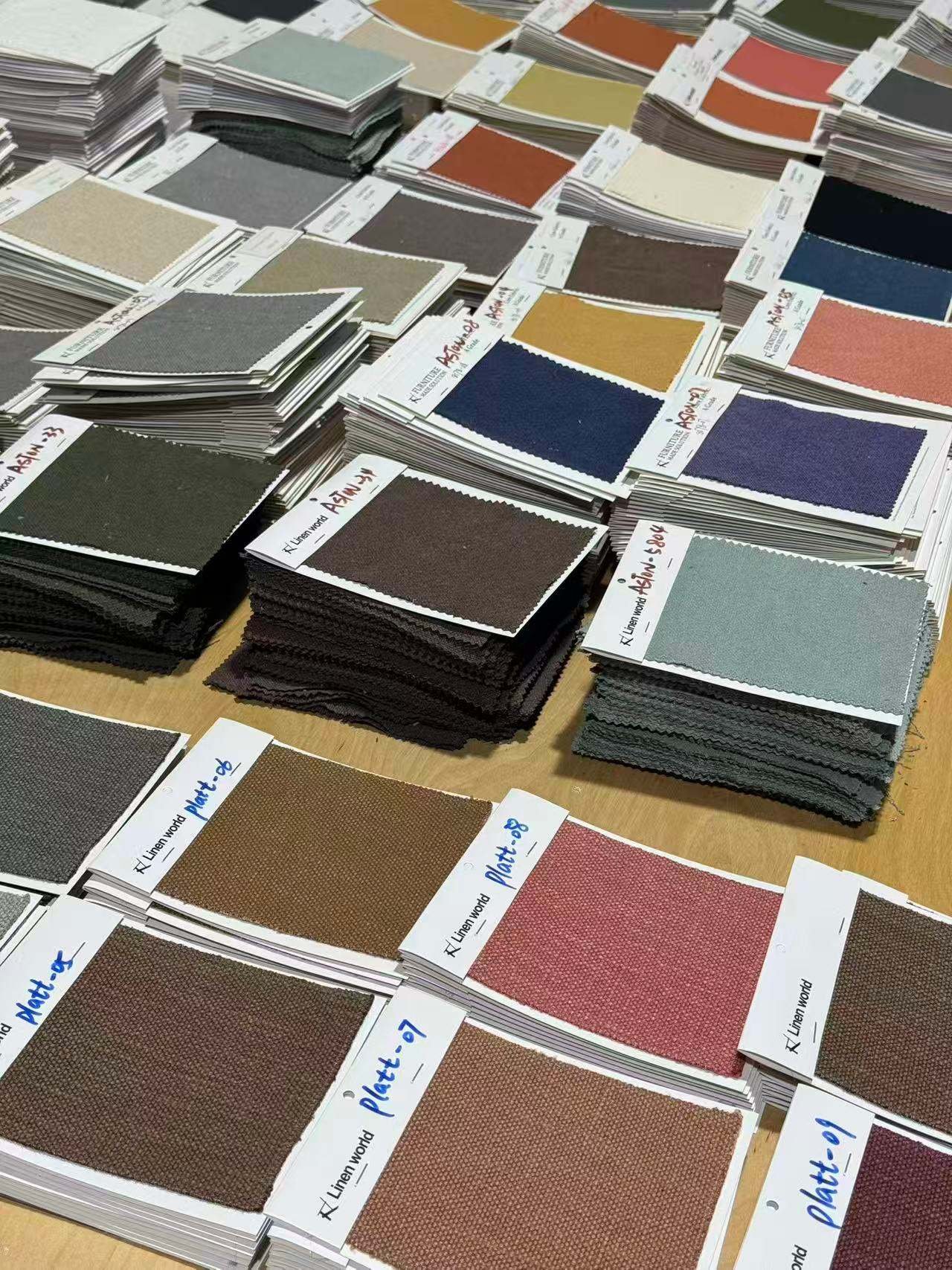
Treat Linen as a Performance and Appearance Decision
Pure linen, linen blends, and fabrics marketed with a linen-like appearance do not behave identically.7 I therefore ask suppliers to identify the fabric composition rather than relying on a general product name.
The project team should consider:
- Fiber composition: Is the fabric pure linen or a blend?
- Hand feel: Does it feel crisp, dry, soft, or heavily finished?
- Visual texture: Is the weave fine, pronounced, or irregular?
- Weight and body: Does it suit the intended upholstery construction?
- Color behavior: Does the tone change under natural and artificial light?
- Natural variation: Are slubs and subtle irregularities acceptable?
- Wrinkling: Does the design allow a relaxed appearance?
- Maintenance: Can the homeowner follow the recommended care method?
- Usage environment: Is the furniture formal, casual, daily-use, or occasional?
- Fabric treatment: Has the fabric received a finish that affects feel or care?
I do not assume that a heavier fabric is automatically better or that a higher price guarantees suitability. The fabric must work with the furniture’s form, seam design, cushion construction, and expected use.
Review Real Samples Before Committing
Digital images are useful for shortlisting, but screens cannot accurately communicate hand feel, weave, or exact color.8 Lighting conditions and screen calibration can also alter the appearance.
I recommend a staged fabric approval process:
- Review digital references to narrow the selection.
- Request physical swatches in the shortlisted colors.
- View the swatches in daylight and planned artificial lighting.
- Place the material beside flooring, curtains, wall finishes, and wood samples.
- Confirm the exact fabric code, color code, and approved sample.
- Keep a signed or otherwise traceable control sample.
- Reconfirm availability before production begins.
For large projects, the buyer may also need a larger cutting rather than a small swatch. A small sample can hide the overall rhythm of a weave or color variation.
I treat the approved physical sample as a reference point, but I also clarify the acceptable tolerance for natural material variation.9 Exact visual uniformity may conflict with the character that made the buyer choose linen in the first place.
Ask for Relevant Evidence Without Overinterpreting It
Some projects require information about abrasion, colorfastness, pilling, flammability, chemical content, or other performance characteristics. Requirements vary by market, application, and contract.
I recommend that buyers:
- State the destination market and intended application.
- Ask which test method applies to each reported result.
- Check whether the report identifies the exact fabric.10
- Confirm the issuing laboratory and report date.
- Verify certificates or reports directly when necessary.
- Consult a qualified professional about regulatory suitability.
A test report is a document to review, not a substitute for technical judgment. I do not recommend making compliance decisions from a supplier’s verbal assurance or from an unrelated fabric certificate.
COM, or customer’s own material, can also be workable. However, the factory should inspect the fabric’s width, usable quantity, direction, defects, repeat, backing, and upholstery suitability before accepting production responsibility.
How Can I Compare Villa Furniture Suppliers and Quotations Fairly?
Furniture quotations often appear comparable even when they include different materials, dimensions, fillings, packaging, samples, or quality-control steps. If I compare only the final unit price, I may reward the least complete quotation. The better method is to give every supplier the same brief and identify every exclusion.
I compare villa furniture suppliers by issuing one specification package and reviewing each response against the same scope. The comparison should cover dimensions, upholstery, filling, construction, comfort, samples, drawings, tolerances, packaging, production timing, payment terms, quality checks, and exclusions. I also assess communication quality and the supplier’s ability to clarify risks before production.

Build a Comparable Request for Quotation
A useful request for quotation, or RFQ, should be detailed enough to prevent suppliers from filling gaps with different assumptions.
For linen-upholstered furniture, I include:
- Product reference image or design drawing
- Overall dimensions
- Seat height and seat depth
- Arm and back dimensions
- Fabric supplier, code, composition, and color
- Fabric application direction
- Cushion and filling expectations
- Removable or fixed cover requirements
- Visible seam and piping details
- Leg material, finish, and height
- Quantity by product and fabric
- Labeling and packaging needs
- Drawing and sample requirements
- Inspection and approval points
- Target production schedule
- Delivery term or Incoterm, where relevant
- Installation or assembly expectations
- Clear list of items that the supplier must exclude or price separately
A designer may not know every internal construction detail at the RFQ stage. In that case, I ask suppliers to state their proposed construction clearly. This allows the project team to compare the proposals rather than assume that every factory uses the same method.
Compare Total Scope, Not Headline Price
I recommend using a bid comparison table.
| Comparison point | Supplier A | Supplier B | Supplier C |
|---|---|---|---|
| Exact dimensions included | |||
| Approved fabric included | |||
| Fabric consumption stated | |||
| Filling proposal documented | |||
| Prototype or sample cost | |||
| Drawing approval included | |||
| Packaging specification | |||
| Production timing | |||
| Inspection access | |||
| Exclusions listed | |||
| Payment terms | |||
| Quotation validity |
The lowest quotation may omit sampling, use a different fabric allowance, assume simpler packaging, or exclude a required finish. It may still be a valid offer, but the project team needs to understand the difference.
Overseas sourcing can sometimes create a lower factory price than local custom production. However, I would not present a percentage saving as guaranteed. Buyers need to calculate samples, revisions, quality inspection, packaging, freight, duties, taxes, storage, installation, financing, and the cost of correcting defects.11 Currency changes and order volume can also affect the result.
Evaluate Communication as a Quality-Control Signal
A supplier’s questions can reveal more than a polished sales presentation. In our project communication, I pay attention to whether the supplier asks about:
- Intended users and comfort
- Access restrictions
- Fabric behavior
- Drawing inconsistencies
- Missing dimensions
- Approval responsibilities
- Material availability
- Production dependencies
- Acceptable variation
- Inspection timing
A supplier that identifies ambiguity early may reduce risk later. However, communication alone does not prove manufacturing quality. Buyers should also inspect samples, review production capability, verify documents, and use qualified third-party inspection when appropriate.
How Should Villa Furniture Sourcing Control Samples and Production?
Custom furniture can drift away from the original design when approvals remain informal. A dimension may change, a fabric may be substituted, or a comfort adjustment may not reach the production team. I reduce this risk by creating approval gates and keeping one current record of the confirmed specification.12
Villa furniture sourcing should control production through approved drawings, physical material samples, prototypes where justified, written change records, pre-production confirmation, in-process checks, and final inspection. Each approval should identify the product, revision, date, and decision-maker. Production should begin only after the required specifications and commercial changes have been confirmed.

Choose the Right Level of Sampling
Not every product requires a complete prototype. Sampling should reflect the order value, degree of customization, comfort risk, and consequences of an error.
Possible approval tools include:
- Technical drawing: Confirms overall dimensions, proportions, and key details.
- Material sample: Confirms fabric, wood finish, metal finish, or other visible material.
- Detail sample: Confirms stitching, piping, tufting, or a difficult junction.
- Cushion or comfort sample: Helps the buyer discuss support and softness.
- Full prototype: Allows review of appearance, dimensions, construction, and comfort.
- Pre-production sample: Establishes a controlled reference before the main order.
For a repeated custom sofa across several rooms, a full prototype may be justified. For a small quantity of dining chairs based on an established factory model, drawings and finish samples may be sufficient. I base the decision on risk rather than habit.
Create a Written Approval Matrix
A simple approval matrix reduces confusion.
| Approval item | Reviewer | Required evidence | Approval deadline |
|---|---|---|---|
| Overall dimensions | Designer | Revised drawing | Before sampling |
| Comfort | Designer and homeowner | Prototype or agreed sample | Before production |
| Linen fabric | Designer or homeowner | Physical labeled swatch | Before fabric order |
| Visible finishes | Designer | Control sample | Before production |
| Packaging | Buyer or project manager | Packing specification | Before completion |
| Final quality | Buyer or inspector | Inspection report | Before release |
The actual reviewers will vary. The important point is that each decision has an owner.
I also recommend controlling revisions. A message such as “make the seat slightly softer” is not enough. The supplier should document what will change, how the sample will differ, whether the change affects dimensions or appearance, and whether the price or schedule will change.
Inspect Against Approved Requirements
Final inspection should not rely on a general impression of quality. The checklist should connect directly to the approved specification.
For linen-upholstered furniture, an inspection can review:
- Product quantity and identification
- Overall and critical dimensions
- Fabric code and color
- Fabric direction and placement
- Visible marks, stains, or damage
- Seam alignment and stitching
- Cushion fit and appearance
- Leg finish and installation
- Stability and basic function
- Removable components
- Labels and hardware
- Packaging and carton markings
Qualified inspectors or technical professionals should define application-specific tests and acceptance methods. The project team should also agree on tolerances before inspection. Without an agreed tolerance, a minor variation can become a subjective dispute.
Frequently Asked Questions
When should I begin villa furniture sourcing?
I recommend beginning during design development, once room layouts and key dimensions are reasonably stable. Custom upholstery needs time for requirement clarification, quotation, fabric selection, drawings, sampling, approvals, production, and inspection. Starting early also gives the design team more time to resolve access, proportion, and material conflicts.
Should I buy all villa furniture from one supplier?
I would not choose one supplier solely for convenience. A single supplier may simplify communication, but buyers should verify capability for every included category. I recommend comparing specialist knowledge, samples, manufacturing scope, quality controls, and commercial terms before deciding whether to consolidate or divide the order.
Is pure linen always the best upholstery choice?
Pure linen is not automatically the best option for every room. I evaluate its texture, hand feel, wrinkling, maintenance expectations, and suitability for the intended use. A blend may fit some performance or care priorities better. Buyers should review labeled physical samples and relevant test documents before approval.
How can I compare custom sofa comfort between suppliers?
I first define seat height, usable seat depth, sitting posture, support preference, and acceptable softness. I then ask each supplier to document its proposed cushion construction. For higher-risk orders, I recommend reviewing a prototype or controlled comfort sample rather than relying only on words such as “soft” or “luxurious.”
What documents should I request from a villa furniture supplier?
I usually request a detailed quotation, specification sheet, drawings, material samples, production schedule, payment terms, packaging details, and a list of exclusions. Where the project requires test reports or certifications, buyers should confirm that the documents apply to the exact material or product and verify them when necessary.
Conclusion
Successful villa furniture sourcing depends on translating design intent into specifications that suppliers can quote, sample, manufacture, and inspect. I recommend starting with the space and users, then defining comfort, linen performance, budget priorities, approvals, and timing. Buyers should compare equivalent scopes rather than unit prices and verify samples and documents before production.
At Linen World in Foshan, we support designers and homeowners with made-to-order linen sofas, armchairs, beds, and dining chairs. Contact us to discuss your drawings, linen options, COM fabric, sampling needs, and project specifications.https://linenworld.pro
"Procurement of Goods", https://thedocs.worldbank.org/en/doc/198281599055339370-0290022013/render/SBDProcurementofGoodsmar2013.pdf. Institutional procurement guidance supports the use of common technical specifications and predefined evaluation criteria to make supplier offers more comparable and to reduce ambiguity; however, such guidance does not quantify the reduction in delays or unsuitable purchases for villa furniture specifically. Evidence role: general_support; source type: institution. Supports: Standardized solicitation requirements and evaluation criteria allow bids to be assessed on a common basis and reduce ambiguity in procurement scope.. Scope note: The support comes from general procurement practice rather than controlled research on residential furniture projects. ↩
"Interface management--an organization theory approach to ...", https://www.pmi.org/learning/library/interface-management-theory-approach-pm-5729. Project-management frameworks treat dependencies, interfaces, responsibilities, and milestone planning as core coordination controls; this supports the proposed whole-project framework, although it is contextual evidence rather than direct validation of a villa-furniture method. Evidence role: general_support; source type: institution. Supports: Project-management frameworks recognize that identifying dependencies, interfaces, responsibilities, and milestones before execution supports coordinated delivery.. Scope note: General project-management principles do not establish that this particular framework is optimal for every villa project. ↩
"How to make better, faster project decisions", https://www.pmi.org/learning/library/better-faster-project-decisions-9651. Project-governance research identifies clear roles and decision authority as mechanisms for reducing ambiguity and coordination failure; it supports the risk described here but does not show that unclear responsibility will invariably delay a furniture approval. Evidence role: mechanism; source type: research. Supports: Clear allocation of roles and decision authority reduces ambiguity about who reviews, approves, and remains accountable for project decisions.. Scope note: The evidence establishes a general governance mechanism, not a deterministic outcome in every sourcing project. ↩
"Interior Design Guidelines", https://health.ucdavis.edu/media-resources/facilities/documents/pdfs/design-guidelines-standards/ucdh-facility-design-guidelines-interior-design-v1-240501.pdf. Interior-planning guidance notes that furniture delivery depends on clear openings, corridor and landing geometry, elevator dimensions, and turning space along the access route, not solely on the dimensions of the destination room. Evidence role: general_support; source type: education. Supports: Interior-planning guidance distinguishes the dimensions of a destination space from the clear dimensions and turning constraints along the route used to move furniture into it.. ↩
"Chair Size Design Based on User Height - PMC - NIH", https://pmc.ncbi.nlm.nih.gov/articles/PMC9944090/. Anthropometric seating research relates seat depth to buttock-popliteal length and indicates that an overly deep seat can prevent smaller users from using the backrest while maintaining a supported posture; loose cushions are one possible accommodation, not a universally tested remedy. Evidence role: mechanism; source type: paper. Supports: Ergonomic studies relate appropriate seat depth to buttock-popliteal length and explain that excessive depth can interfere with backrest use or place pressure behind the knees.. Scope note: The ergonomic relationship is supported directly, but the specific effectiveness of loose back cushions depends on their dimensions and construction. ↩
"When older adults face the chair-rise challenge. A study of ...", https://pubmed.ncbi.nlm.nih.gov/8418126/. Sit-to-stand studies generally find that lower seats increase lower-limb demands, while higher seats can make rising easier for some users; the benefit varies with stature, strength, mobility, and the availability of arm support. Evidence role: mechanism; source type: paper. Supports: Biomechanical and rehabilitation studies examine how seat height affects joint loading, momentum, and the effort required during sit-to-stand movement.. Scope note: The relationship is user-dependent and does not establish one ideal seat height for all occupants. ↩
"Fiber Content Determination of Linen/Viscose Blends ...", https://bioresources.cnr.ncsu.edu/wp-content/uploads/2020/03/BioRes_15_2_3006_Huang_Yu_Study_Fiber_Content_Linen_Viscose_Blends_NIR_Spectra_16736.pdf. Textile-science references attribute characteristic moisture, strength, extensibility, and crease-recovery behavior to flax fibers and explain that blends combine properties of their constituent fibers; actual upholstery performance also depends on yarn, weave, finishing, and construction. Evidence role: mechanism; source type: education. Supports: Textile references describe characteristic properties of flax fibers and explain that blending fibers changes the resulting fabric's performance and handling.. Scope note: Fiber composition alone cannot predict the performance of a finished upholstery fabric. ↩
"Accurate color measurement methods for medical displays", https://tsapps.nist.gov/publication/get_pdf.cfm?pub_id=32609. Color-management research shows that the appearance of an image varies with display calibration, device gamut, rendering, and viewing conditions, so an on-screen sample cannot guarantee an exact match to a physical textile; visual images also provide no direct evidence of hand feel. Evidence role: mechanism; source type: research. Supports: Color science explains that displayed color depends on device characteristics, calibration, color management, and ambient viewing conditions, while images do not reproduce tactile properties.. ↩
"Linen Clothes for Women Near Me: Style & Sustainable Finds", https://imba.missouri.edu/linen-clothes-for-women-near-me-3201422449.html. Textile references describe linen yarn and cloth as capable of characteristic irregularities arising from flax-fiber and yarn structure, supporting the need to distinguish accepted natural variation from manufacturing defects; they do not prescribe a universal visual tolerance. Evidence role: definition; source type: encyclopedia. Supports: References on linen describe the irregular thickness or slub-like texture associated with flax yarn and the visual variation it can produce in woven cloth.. Scope note: Acceptable tolerances remain contract- and product-specific. ↩
"ISO/IEC 17025:2017, Section 7.8 - Reporting of Results", https://www.nist.gov/document/sop-1-calibration-certificate-eval-app-b-c-20190506pdf. Laboratory competence frameworks such as ISO/IEC 17025 require reports to identify the tested item and the method used sufficiently for the results to be interpreted, supporting verification that a textile report applies to the exact fabric under consideration. Evidence role: expert_consensus; source type: institution. Supports: Laboratory competence standards require test items and reported results to be identified sufficiently to avoid confusion and permit appropriate interpretation.. ↩
"Determine Total Export Price", https://www.trade.gov/determine-total-export-price. Government import guidance defines landed cost as extending beyond the supplier's price to include freight, insurance, duties, taxes, and related import charges; revision, inspection, storage, installation, financing, and defect costs may also be relevant but vary by contract and project. Evidence role: definition; source type: government. Supports: Government trade guidance explains that the cost of imported goods can include transportation, insurance, customs duties, taxes, brokerage, and other charges beyond the supplier's invoice price.. Scope note: Official landed-cost definitions directly support import-related charges, while several project-specific cost categories require case-by-case calculation. ↩
"6.5 Configuration Management", https://www.nasa.gov/reference/6-5-configuration-management/. Configuration-management guidance supports the use of an approved baseline, controlled revisions, recorded authorization, and a clearly identifiable current specification to prevent obsolete or unapproved requirements from being used; its application to custom furniture is an adaptation of a broader engineering-control method. Evidence role: mechanism; source type: government. Supports: Configuration-management guidance uses approved baselines, revision identification, change authorization, and status accounting to keep production aligned with current requirements.. Scope note: The cited framework is general engineering guidance rather than furniture-specific outcome evidence. ↩


