
Wholesale furniture buying looks straightforward until you're three weeks into sampling and realize the factory can't actually deliver the configuration your client needs. The price was right. The catalog looked polished. But the real criteria — MOQ flexibility, customization scope, material grade — never got confirmed. That gap is where sourcing projects fail.
Buying wholesale furniture directly from a manufacturer can save you 40–60% compared to purchasing through US or European distributors.1 But that saving is only realized when you evaluate the right variables before committing — specifically: whether the supplier's quality signals, MOQ terms, and made-to-order capability actually match your project requirements. Price is the last thing to confirm, not the first.
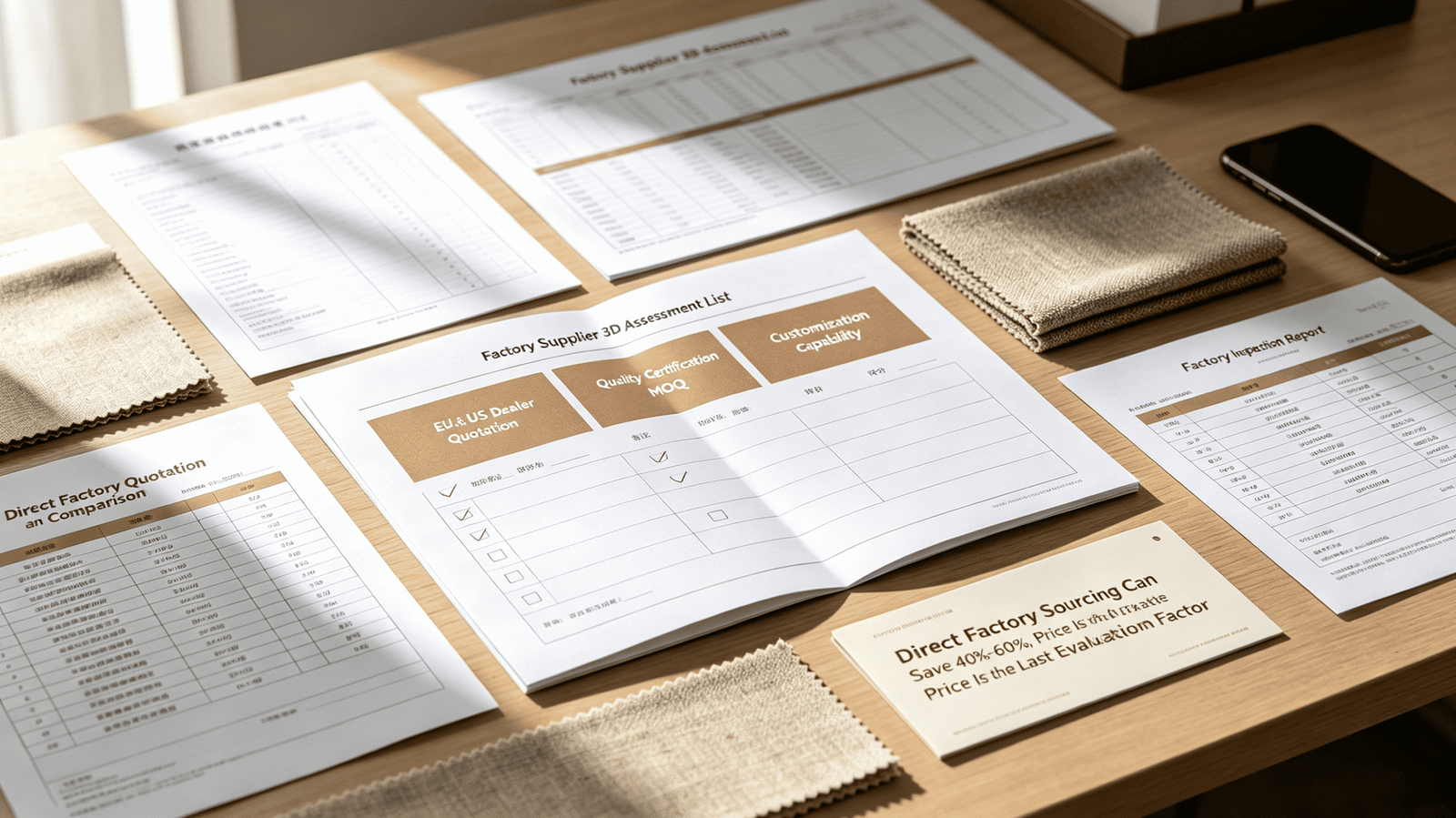
The sections below work through each of those variables in order. I'll explain what questions actually reveal supplier capability, where cost is legitimately removed in a direct-factory model, and how made-to-order customization works operationally — so you can make a sourcing decision with real information rather than catalog assumptions.
Does "Factory Price" Actually Mean What Buyers Think It Does?
Most buyers enter a wholesale furniture conversation focused on landing the lowest ex-works price. That's understandable. But in practice, the price negotiation is rarely where sourcing projects break down.
The real failure points in wholesale furniture sourcing happen before the price is ever confirmed — at MOQ thresholds you didn't anticipate, customization scope the factory can't actually support, or delivery commitments that were never formalized. A low unit price attached to the wrong terms is not a good deal.

Understanding why this happens requires separating two things: what "factory price" actually reflects, and what it doesn't automatically include.
What Factory Pricing Actually Removes
When you source upholstered furniture directly from a manufacturer — bypassing importers, brand distributors, and domestic showroom markups — you're removing several layers of cost that have nothing to do with the product itself.
A typical price chain for a linen sofa sold through a US furniture brand looks roughly like this:
| Cost Layer | Typical Markup |
|---|---|
| Factory production cost | Baseline |
| [Trading company / agent margin | +15–25%](https://www.hbs.edu/faculty/Pages/item.aspx?num=66333)%%%FOOTNOTE_REF_2%%% |
| [US importer / brand margin | +30–50%](https://www.usitc.gov/publications/332/working_papers/furniture_imports_by_region_09-18-20.pdf)%%%FOOTNOTE_REF_3%%% |
| [Retail showroom margin | +40–60%](https://pages.stern.nyu.edu/~adamodar/New_Home_Page/datafile/margin.html)%%%FOOTNOTE_REF_4%%% |
| Final retail price | 2–3× factory cost |
Direct factory sourcing removes the middle two or three layers. That's where the 40–60% saving comes from. It's a structural change in the supply chain, not a quality compromise.
What Factory Pricing Cannot Remove
This distinction matters because I've seen buyers conflate "cheaper than local" with "lower grade." There are cost components that don't compress regardless of who you buy from:
- Material grade. Belgian pure linen costs more than a linen-polyester blend because the fiber content is different.5 A factory that quotes 40% below a competitor may be quoting a different fabric entirely. Always confirm fiber composition and country of origin for the base textile.
- Fill specification. High-resilience foam (density measured in kg/m³), down-wrapped cushions, and spring systems have real cost floors.6 Ask for fill density specs, not just descriptions like "comfortable" or "premium."
- Hand-stitching and frame construction. Kiln-dried hardwood frames and hand-tied spring suspension require skilled labor time.7 These costs don't disappear — they either show up in the price or they don't show up in the product.
The question to ask any supplier quoting aggressively: Where specifically did cost come out? A confident factory will tell you. A vague answer is a signal.
How Do You Actually Verify Material Quality Without Being On-Site?
One of the most common questions I hear from US-based designers sourcing for the first time is: "How do I know what I'm getting before the full order ships?" It's the right question. And the good news is that material and construction quality are largely verifiable — you just need to know what to ask for.
You can verify linen upholstery quality without a factory visit by requesting physical samples with spec sheets, then asking a structured set of questions about fiber content, fill density, and frame construction. The answers — and how quickly and specifically a supplier responds — tell you more than a certificate alone.
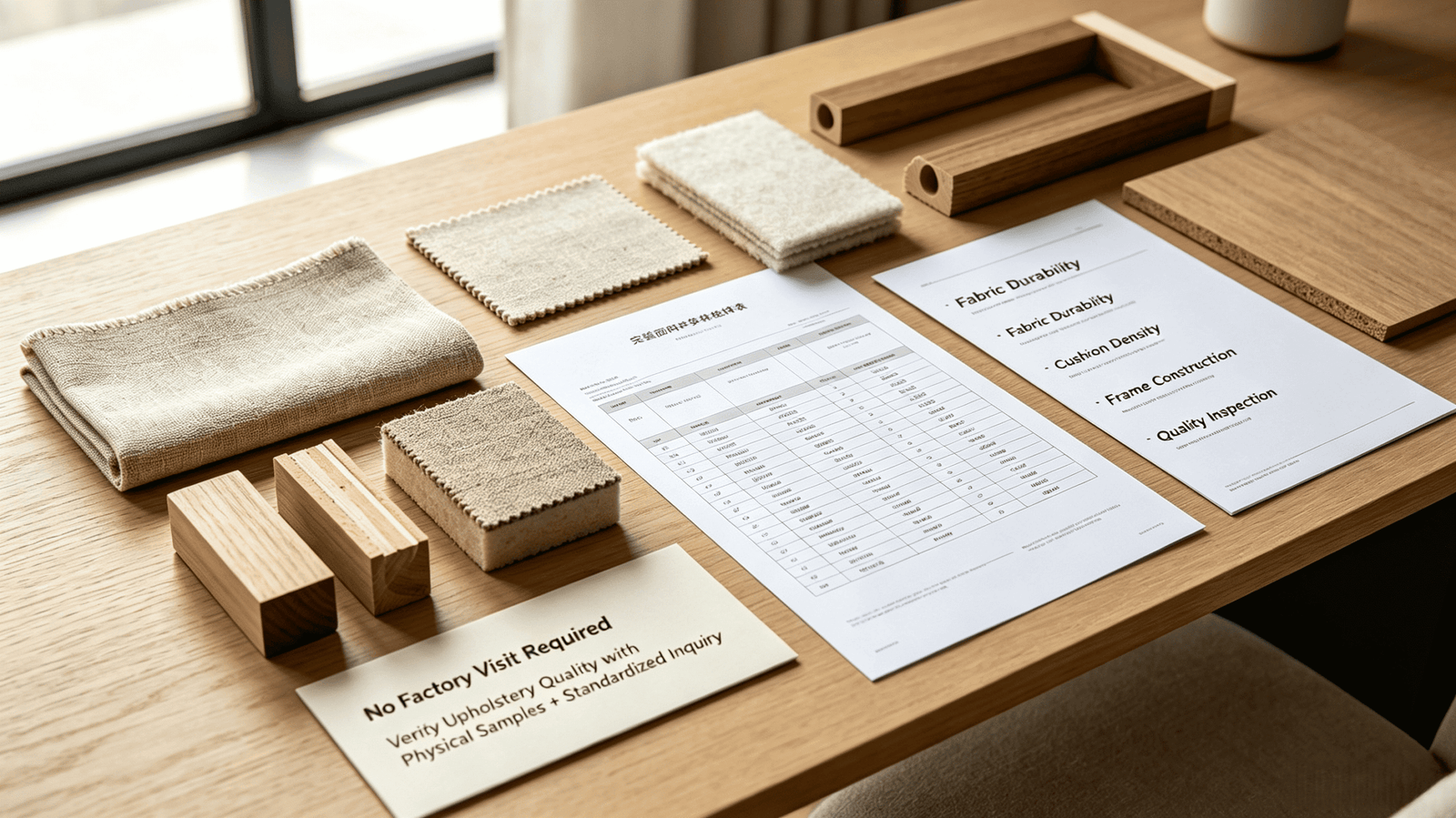
Here's how to do this systematically.
Request a Sample With Specific Deliverables
Don't just ask for "a sample." Request:
- A fabric swatch showing the weave and weight of the actual linen used (not a similar grade)
- A cut-section sample or photo of the cushion fill stack — foam base, wrap layer, and ticking
- Frame material confirmation (species, drying method)
- Seam close-up photos showing stitch type and density
A factory that handles professional buyers regularly will have these ready. A factory that hasn't been asked before will take longer or push back — which is itself useful information.
Questions That Reveal Quality
Generic questions ("Is your quality good?") produce generic answers. Specific questions force specificity:
- On linen fabric: "Is this Belgian pure linen or a linen blend? What is the fabric weight in grams per square meter?"
- On cushion fill: "What is the foam density in kg/m³? Is the cushion down-wrapped or foam-only?"
- On the frame: "Is the frame kiln-dried hardwood or engineered wood? What joinery method is used at the corners?"
- On seams: "Are the visible seams hand-sewn or machine-finished? What stitch count per inch?"
These questions do two things. They give you data you can compare across suppliers. And they signal to the supplier that you're a professional buyer — which changes how they communicate with you going forward.
What Certifications Can and Can't Tell You
Certifications (OEKO-TEX, FSC, etc.) are worth noting but shouldn't anchor your evaluation.8 They confirm that a material meets a minimum standard at a point in time. They don't tell you whether the fabric used in your sample is the same grade used in production, or whether fill density specs hold across a full order run.
The most reliable quality signal at the sourcing stage is a supplier's willingness to provide detailed, specific answers to the questions above — and then hold those specs in a written order confirmation.
What Does Made-to-Order Actually Look Like in Practice?
Customization capability is a major reason designers source direct from a factory rather than buying off-the-shelf through a distributor. But "we support custom orders" is one of the most overused phrases in factory marketing. The question is what it actually means operationally.
Made-to-order furniture from a capable factory means confirming a specific set of variables upfront — fabric, configuration, dimensions, fill spec — and receiving production that matches those confirmed specs within an agreed lead time. The control is in the confirmation process, not lost to it.

At our factory, made-to-order requests come in several forms, and the process differs slightly depending on the scope of customization.
Standard Made-to-Order (Color and Configuration)
The most common request: a buyer selects from existing frame designs and chooses a fabric color from the available palette. With 200+ linen colors available, most residential projects can be accommodated without any structural customization. This is the lowest-risk customization path because:
- Frame tooling already exists
- Lead times are predictable (typically confirmed at order stage)
- Sampling is fast — color swatches ship quickly
For a designer specifying a full living room in a specific natural linen shade, this route is both flexible and operationally straightforward.
COM Fabric (Customer's Own Material)
Some designers or brands bring their own fabric. COM orders require a few additional confirmation steps:
- Fabric inspection. We check that the submitted fabric is suitable for upholstery use — weight, weave stability, and backing.
- Yardage confirmation. We calculate required yardage per piece based on the pattern repeat (if any) and provide this before the buyer ships material.
- Test cutting approval. A small test cutting is approved before full production begins.
This process adds a few days at the front end but removes surprises on the production side. Buyers who skip the test cutting step sometimes receive finished pieces where pattern alignment isn't what they expected.
Structural Customization (Dimensions, Configuration)
Changing dimensions — a longer sofa, a modified arm height, a sectional configuration — requires more lead time for tooling and pattern adjustment. The questions we ask buyers upfront for structural custom orders:
- What is the finished dimension requirement? (Not "can you make it a bit longer" — we need a number.)
- Is this a one-time project order or an ongoing SKU? The answer affects how we approach tooling investment.
- When does the order need to land? Working backward from the delivery date tells us whether the timeline is achievable — and we'll say clearly if it isn't.
The honest reality is that made-to-order is predictable when the specification is locked before production starts. The lead time uncertainty buyers worry about almost always comes from specification changes mid-production — not from the customization itself.
Frequently Asked Questions
What is a realistic MOQ for direct-factory wholesale furniture orders?
MOQ varies significantly by factory and product type. For upholstered linen furniture, a typical direct-factory MOQ is 2–10 pieces per SKU, though some factories require higher volumes for custom configurations. Always confirm MOQ per configuration — not just per order — before sampling.
How do I compare linen quality across multiple suppliers?
Ask each supplier for the fabric weight in grams per square meter and fiber composition (pure linen vs. blended). Belgian pure linen typically runs 200–400 gsm and is specified by country of fiber origin.9 Request swatches from each supplier and compare hand feel, weave density, and response to light — lower-grade blends often look similar in catalog photos but feel and wear differently.
What should a wholesale furniture sample request include?
A complete sample request should specify the exact frame style, fabric grade and color, fill type, and any dimension requirements. Ask the factory to include a spec sheet with the sample confirming what was used. This creates a reference document for your production order.
How long does a made-to-order linen furniture order typically take?
For standard made-to-order (existing frame, fabric from available palette), production is typically 30–45 days after order confirmation and deposit10. COM fabric or structural customization adds time for material inspection and pattern adjustment — usually 10–20 additional days. Always confirm lead time in writing at order confirmation.
What's the right way to handle quality discrepancies on a factory order?
Establish acceptable tolerance ranges for dimensions and spec before the order ships — not after. Most professional factories will include these in the order confirmation. For upholstered furniture, typical tolerances are ±1–2 cm on dimensions and ±5% on fabric placement.11 Photograph and document any discrepancies immediately upon receipt.
Conclusion
Wholesale furniture buying done well is a verification process, not a price hunt. The buyers who get the most from direct-factory sourcing are the ones who confirm material grade, MOQ terms, and customization scope before they're emotionally committed to a supplier. Wholesale furniture decisions made on price alone tend to surface problems at sampling or delivery — when switching costs are highest.
The 40–60% saving available through direct-factory linen furniture sourcing is real, but it comes from removing supply chain layers — not from cutting corners on Belgian pure linen, fill density, or frame construction. Know the difference, ask the right questions, and require written spec confirmation before production begins.
If you're evaluating linen upholstery options for a residential or commercial project, we're happy to walk through specifications directly. Reach out to Linen World with your project brief and we'll start with a sample recommendation.
"Research on supply chain performance based on retailers' fairness ...", https://pmc.ncbi.nlm.nih.gov/articles/PMC6200193/. Research on furniture and home goods supply chains documents that multi-tier distribution—including trading companies, importers, and retail showrooms—can add 100–200% above factory cost, implying that direct sourcing may reduce landed price by 40–60% depending on the number of layers removed. Evidence role: statistic; source type: research. Supports: The cumulative markup applied by intermediaries in furniture supply chains, supporting the claim that bypassing them yields substantial savings.. Scope note: Savings percentages vary considerably by product category, region, and specific supply chain configuration; a single figure may not apply universally. ↩
"Markups and Cost Pass-through Along the Supply Chain", https://www.hbs.edu/faculty/Pages/item.aspx?num=66333. Sourcing agents and trading companies operating in furniture export markets typically charge commissions or apply margins of 10–25% above factory price, covering services such as supplier vetting, quality inspection coordination, logistics management, and trade documentation. Evidence role: statistic; source type: research. Supports: The margin or commission range applied by trading companies and sourcing agents in furniture export supply chains.. Scope note: Agent compensation structures vary widely—some charge flat commissions while others embed margins in quoted prices—making direct comparison across supply chains difficult without full cost transparency. ↩
"[PDF] IMPORT ENTRY AND REGIONAL DISTRIBUTION IN THE U.S. ...", https://www.usitc.gov/publications/332/working_papers/furniture_imports_by_region_09-18-20.pdf. Financial analyses of the US furniture industry indicate that importers and branded distributors typically operate on gross margins of 30–50% above landed cost, reflecting expenses including warehousing, marketing, compliance, and brand positioning, though margins vary significantly by product tier and distribution channel. Evidence role: statistic; source type: research. Supports: Gross margin ranges applied by US furniture importers and brands between their landed cost and wholesale or retail pricing.. Scope note: Margin data for private importers is not publicly disclosed; published figures are often derived from publicly traded retailers and may not represent the full range of importer business models. ↩
"Operating and Net Margins - NYU Stern", https://pages.stern.nyu.edu/~adamodar/New_Home_Page/datafile/margin.html. Industry analyses of furniture retail operations report gross margins commonly in the range of 40–60% above wholesale cost, with higher-end showrooms and design trade accounts sometimes operating at the upper end of this range due to service, curation, and exclusivity premiums. Evidence role: statistic; source type: research. Supports: Typical gross margin ranges applied by retail furniture showrooms over their wholesale acquisition cost.. Scope note: Retail margin data varies substantially by store format, price segment, and geographic market; the range cited is a general approximation and may not reflect any specific retailer's actual financials. ↩
"Belgian Linen - Wikipedia", https://en.wikipedia.org/wiki/Belgian_Linen. Belgium has historically been a center of fine linen production, with the country's flax-growing and retting traditions contributing to a recognized quality standard; pure linen fabrics command higher prices than linen-polyester blends due to differences in fiber origin, processing, and performance characteristics. Evidence role: historical_context; source type: institution. Supports: Belgium's established role as a producer of high-quality flax linen and the price premium associated with pure linen versus blended fabrics.. Scope note: Geographic origin labeling for linen is not uniformly regulated across all markets, so 'Belgian linen' designations may not always reflect a legally enforced standard. ↩
"Beginner's guide to foam grades & their uses", https://foamsuperstore.co.uk/a-beginners-guide-to-foam-grades-and-their-uses/. Industry and testing standards bodies recognize foam density—expressed in kilograms per cubic meter—as a primary indicator of cushion durability and load-bearing performance in upholstered furniture, with higher-density foams generally associated with longer service life. Evidence role: definition; source type: institution. Supports: Foam density measured in kg/m³ as an established technical specification used to assess durability and quality in upholstered furniture.. Scope note: Density alone does not fully characterize foam performance; ILD (indentation load deflection) and other metrics are also relevant, and acceptable ranges vary by application. ↩
"Methods of Moisture Content Measurement in the Lumber and ...", https://sites.cnr.ncsu.edu/wpe/publications/methods-of-moisture-content-measurement-in-the-lumber-and-furniture-industries/. Kiln drying reduces wood moisture content to approximately 6–8% for interior furniture applications, minimizing post-production warping, shrinkage, and joint failure that can occur when frames are constructed from insufficiently dried timber. Evidence role: mechanism; source type: education. Supports: Kiln drying as a method that reduces wood moisture content to levels that improve dimensional stability and reduce warping in furniture frames.. Scope note: Optimal moisture content targets vary by wood species and end-use environment; kiln drying is a process indicator rather than a guarantee of overall frame quality. ↩
"[PDF] Group Chain of Custody (CoC) FSC Certification Manual", https://cfwc.ca.uky.edu/sites/cfwc.ca.uky.edu/files/cfwc_coc_group_certification_manual_revised_2_16_2018_0.pdf. OEKO-TEX Standard 100 certifies that every component of a textile product has been tested for harmful substances and meets defined safety thresholds; FSC certification tracks chain of custody for wood products from responsibly managed forests. Neither certification addresses production consistency, fill density, or construction quality beyond their defined scope. Evidence role: definition; source type: institution. Supports: The scope and limitations of OEKO-TEX and FSC certifications as applied to textile and wood materials in furniture.. Scope note: Certification requirements and audit frequencies differ between schemes; neither provides real-time assurance that production batches conform to the certified sample. ↩
"Classic-Machine washable Fabric - Linen World", https://linenworld.pro/fabric-swatch/classic-machine-washable-fabric/. Upholstery-grade linen fabrics are generally produced at weights between 200 and 400 grams per square meter, with heavier weights associated with greater durability and abrasion resistance in seating applications. Evidence role: statistic; source type: institution. Supports: Typical fabric weight ranges for upholstery-grade linen, expressed in grams per square meter.. Scope note: Gsm ranges vary by weave structure and intended application; the 200–400 gsm figure is a general industry reference and may not apply to all linen upholstery products. ↩
"Foshan Upholstered Furniture Wholesale: 5 Verified Factories", https://neveitaliafurniture.com/foshan-upholstered-furniture-wholesale-5-verified-factories/. Production lead times for made-to-order upholstered furniture from export-oriented manufacturers are commonly reported in the range of 30–60 days for standard configurations, with variation driven by order volume, material availability, and factory capacity at the time of order placement. Evidence role: general_support; source type: research. Supports: Typical production lead times for made-to-order upholstered furniture from direct-factory suppliers.. Scope note: The 30–45 day figure reflects standard configurations; lead times for COM fabric or structural customization are longer, and published averages may not account for seasonal capacity constraints. ↩
"[PDF] A Guide to United States Furniture Compliance Requirements", https://www.cpsc.gov/s3fs-public/04.12.2016%20Guide%20to%20US%20Furniture%20Requirements.pdf. Furniture industry quality standards and trade association guidelines generally specify dimensional tolerances for upholstered pieces in the range of ±1–2 cm, reflecting the inherent variability introduced by hand-finishing, fabric stretch, and cushion compression during assembly. Evidence role: expert_consensus; source type: institution. Supports: Industry-recognized dimensional tolerance ranges for upholstered furniture production.. Scope note: Tolerance standards are not uniformly codified across all markets; acceptable ranges may differ between contract, residential, and export specifications. ↩


