
Opening a Trade Account with an overseas linen upholstery factory sounds like it adds complexity to an already full project load. Most designers I speak with aren't skeptical about the savings — 40–60% compared to sourcing locally is easy to verify1. What stalls them is not knowing what the process actually looks like, or whether the factory on the other end will hold things together once an order is live.
A Linen World Trade Account is a verified professional account for interior designers, design firms, and trade buyers that unlocks trade pricing, priority production scheduling, COM fabric support, and a dedicated project contact. The application requires basic business credentials, typically takes 1–3 business days to review, and costs nothing to open. Once approved, designers can place made-to-order linen upholstery — sofas, armchairs, beds, dining chairs2 — with full access to 200+ fabric colors and custom specification support.

The pricing benefit is real, but it is table stakes. What I want to walk through in this guide is what a Trade Account actually unlocks for your project workflow — specifically the five points where international orders tend to break down, and how the account structure addresses each one. If you are managing residential projects for high-net-worth clients3 and need custom linen upholstery to land on time and on-spec, this is the detail that matters.
What Does Trade Pricing Actually Mean for Your Project Budget?
Most designers I talk to already know overseas sourcing saves money in principle. The question is whether the savings survive the ordering process — or get quietly eaten by miscommunication, revision rounds, and unexpected charges.
Trade pricing at Linen World typically represents a 40–60% reduction compared to purchasing equivalent custom linen upholstery from domestic US sources or European brands at retail or near-retail rates. This margin is real and consistent because we are the manufacturer, not a middleman. There is no distributor layer between your specification and the workshop.
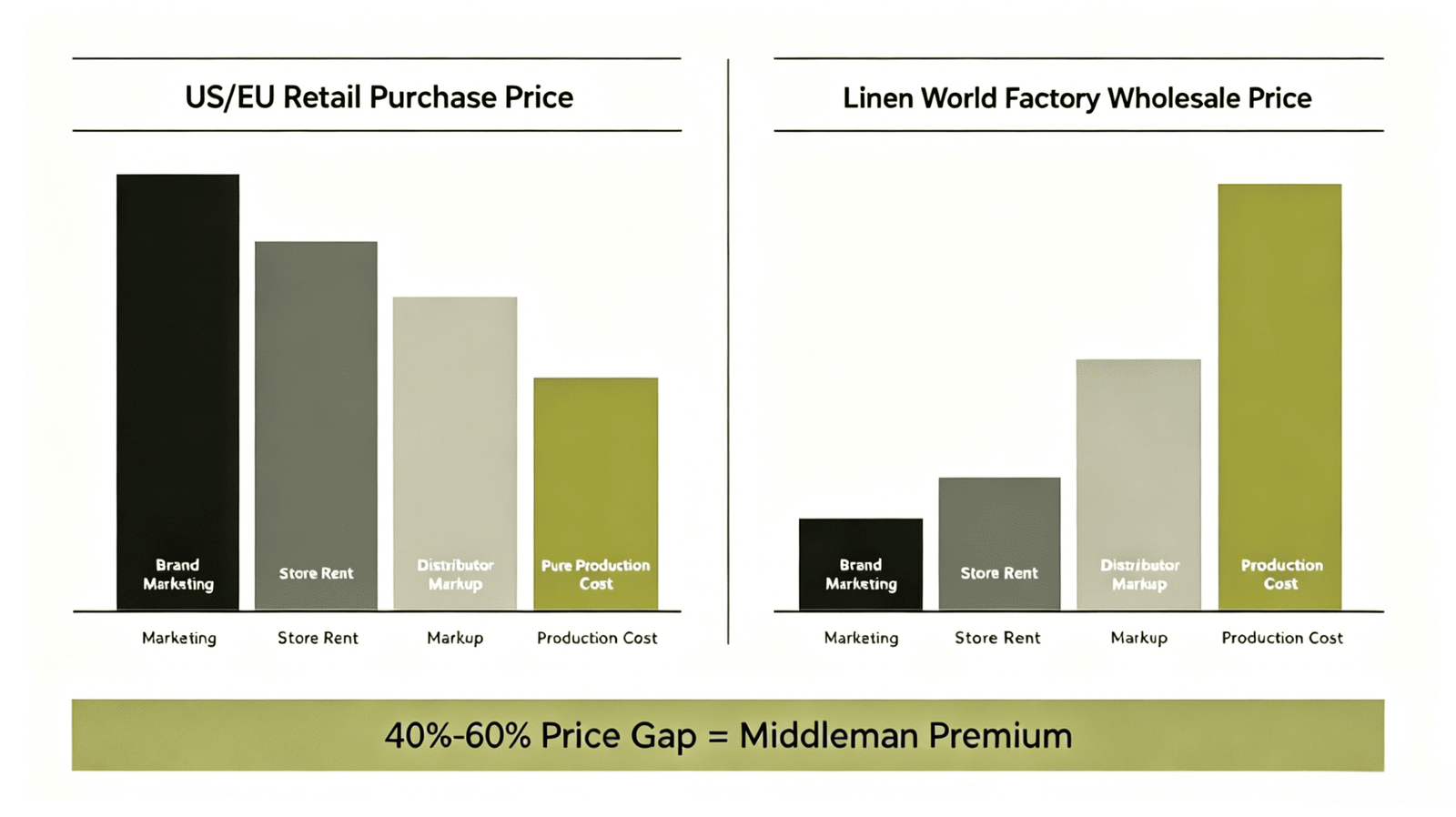
How Trade Pricing Is Structured
The savings come from three places:
- Factory-direct manufacturing. We produce in Foshan4. The 13 years we have been doing this means the production workflow is stable5, not experimental. There is no premium layered on for brand positioning.
- Made-to-order at scale. Because Trade Account orders are batched efficiently through our production schedule, you are not paying a small-run penalty on custom pieces.
- No middleman margin. Our benchmark is brands like Blasco and California's high-end custom workrooms. The product category is the same. The cost structure is fundamentally different.
What the Savings Do Not Cover
I want to be direct about this: trade pricing does not eliminate freight, import duties, or any applicable customs fees on your end. These vary by order and destination and are your responsibility to account for in project budgets. When designers ask me for a landed-cost estimate, I always recommend building in a freight line separately rather than assuming it folds into the product price.
The right comparison point is: trade price + shipping + duties vs. local custom workroom quote6. Even with those additions, the gap is substantial — typically still 30–50% in the designer's favor depending on the order size and destination.
Why This Matters for Client Conversations
Designers managing projects for high-net-worth clients are not usually fighting over furniture line items. The value of the savings is that it creates budget flexibility elsewhere in the project — or it allows the designer to specify better materials without asking the client for a revision. That is the real professional benefit, and it is worth naming clearly in your own client presentations.
How Does Priority Scheduling Protect Your Project Timeline?
Late furniture is one of the most client-visible problems in a residential project7. Everything else can be managed quietly. A sofa that arrives three weeks after handover is not quiet.
Trade Account orders are generally allocated higher priority in our production queue and scheduled before small ad-hoc single-piece inquiries; large full-container non-trade bulk orders may be balanced alongside mid-size trade account projects based on factory monthly capacity planning. For most Trade Account orders, the production lead time runs 8–12 weeks from order confirmation, depending on the specification complexity and current queue depth. I will be honest: we do not quote a fixed number because it shifts, and I would rather give you a range I can stand behind than a headline number I have to walk back.

Why Standard Lead Times Are Unpredictable — and What Priority Scheduling Changes
Factories without a structured trade pipeline handle designer orders the same way they handle any inquiry: first available production slot, no advance coordination, no project context. What this means in practice is that a designer submitting an order in a busy quarter gets slotted behind other work with no visibility into where their pieces stand.
Priority scheduling changes two things:
- Queue position. Trade Account orders are placed ahead of ad hoc inquiries. When production capacity is tight, this is where lead time differences are actually created.
- Advance coordination. Because we know a Trade Account order is coming from a designer managing a client deadline, we can communicate proactively about slot availability before the order is confirmed — not after.
How to Use This in Project Planning
Designers often ask me: when should I submit the order to hit a specific installation date? My honest answer is: submit earlier than you think you need to, and confirm the production slot at the time of order, not the time of inquiry. An inquiry is not a reservation. An order confirmation with deposit is.
For projects with fixed handover dates, I recommend:
- Identify your installation target date
- Work backward 12–14 weeks minimum (accounting for freight)
- Submit your Trade Account order no later than that date
- Flag the installation date explicitly in the order notes so our project team can track it
This is the kind of coordination that the Trade Account makes possible. It is not something we can do for anonymous one-off orders.
How Does COM Fabric and Color Customization Actually Work?
Designers often read "COM supported" and "200+ colors" as marketing copy. I understand why. These phrases appear on a lot of factory websites without explanation of what they actually require from the designer, or what the factory actually does with the information.
Here is what the process looks like in practice.
COM (Customer's Own Material) means you source and ship your specified fabric to our Foshan factory8, and we upholster the piece in that fabric. The 200+ color option means you select from our existing linen fabric range — Belgian pure linen9 — in your chosen colorway, and we manufacture to that specification. Both paths are supported under the Trade Account.
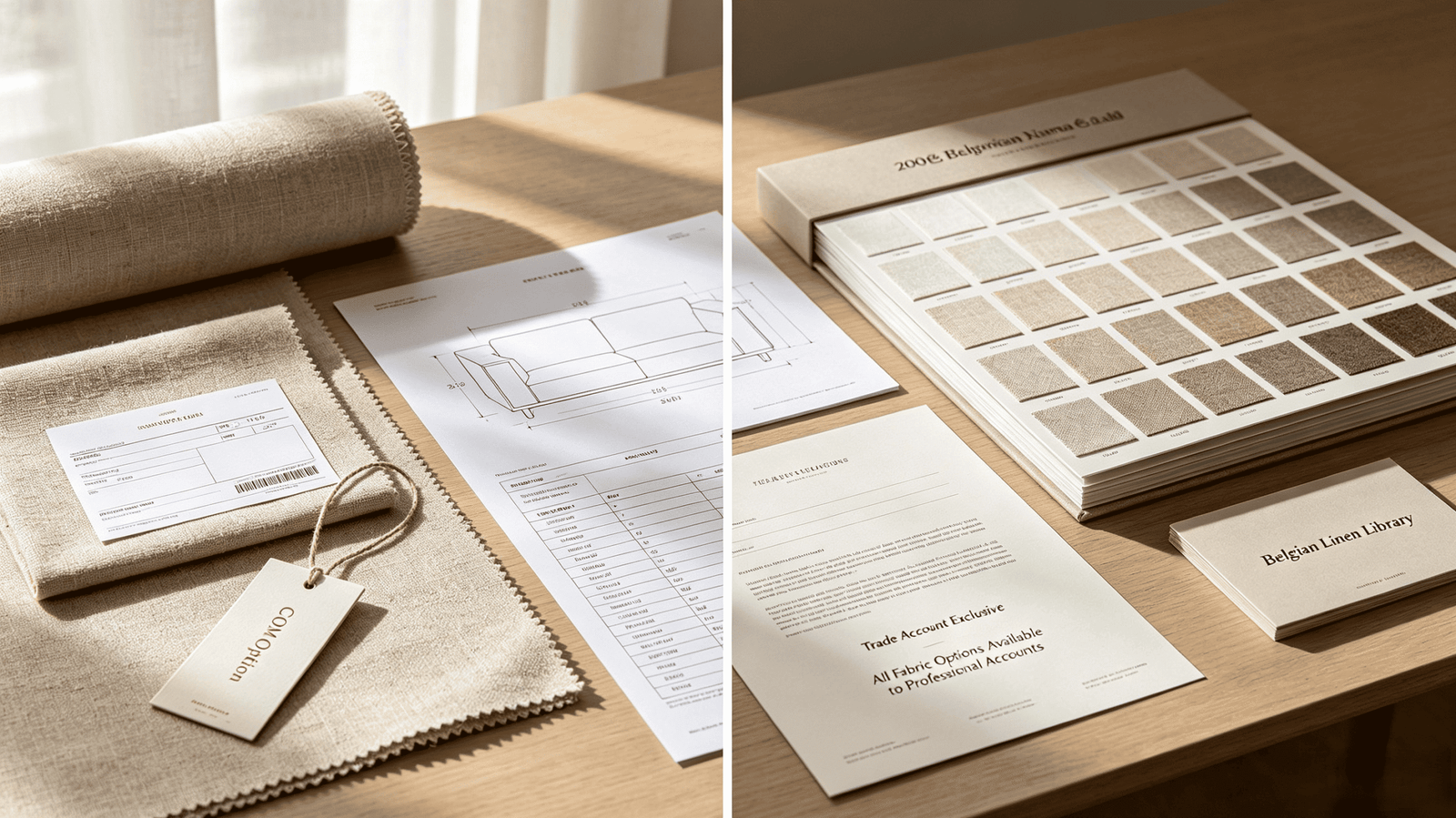
The COM Process, Step by Step
When a designer brings a COM fabric to us:
- Share the fabric specification before ordering. Send us the fabric content, weight, width, and any care or construction notes. We review it for upholstery suitability and flag any concerns before you ship anything.
- Ship the fabric to our Foshan facility. We confirm receipt, inspect the yardage, and calculate actual yield against the piece specification. If there is a yardage shortfall, we tell you before cutting — not after.
- Confirm the cut plan. For directional fabrics or patterns, we confirm the cut orientation with you before production begins. This is a step designers often tell me they have had skipped by other factories, which is how pattern misalignments happen10.
- Production proceeds under standard Trade Account priority. We document the COM intake and include it in your project file so any mid-production questions have a clear reference point.
Selecting From Our 200+ Linen Colors
For designers using our fabric range, the process is simpler but the confirmation step is just as important. We send physical swatches on request — screen color is not reliable enough for a client-facing specification11. Designers often ask us to send 3–5 swatches from a mood board reference, and we work from there to narrow the selection.
Once you confirm a colorway, that selection is locked to your order and documented. If a color is temporarily out of stock in a fabric weight, we tell you before confirming the order, not mid-production.
Why This Matters Beyond Product Specs
The reason I go into this level of detail is that customization only delivers value if the communication around it is tight. I have seen projects where COM fabric arrived without a yardage calculation, cut without pattern confirmation, and the designer found out at delivery. That is not a product quality failure — it is a process failure. The Trade Account structure exists specifically to prevent that, because it gives your order a project file and a point of contact who can catch those gaps.
What Does Dedicated Client Service Mean in Practice?
"Dedicated client service" is one of those phrases that can mean anything or nothing. Let me be specific about what it means for Trade Account holders at Linen World.
When your Trade Account is approved, your orders are handled by a specific member of our sales and project team — not routed through a generic inbox. That person is responsible for your order from confirmation through delivery, and they are the one you contact when something needs clarifying mid-production.

What "Dedicated Contact" Actually Covers
Designers often ask me what happens if a specification question comes up after production has started. Here is the honest answer: it depends on the stage of production, and your contact will tell you that directly. Some changes are possible early in the build. Some are not. What the dedicated contact ensures is that you get a real answer quickly, not a holding message.
Specifically, your project contact handles:
- Pre-order spec review. Before you confirm, we review dimensions, fabric, and construction details. This is where we catch conflicts between your design intent and what the piece can structurally accommodate.
- Order confirmation and production tracking. You receive confirmation when your order enters production and an update when it ships. We do not wait for you to chase us.
- COM fabric intake coordination. As described above, your contact manages the COM receipt and confirms before cutting.
- Freight and export documentation. We prepare standard export documents. For specific customs requirements, we coordinate with your freight forwarder directly if needed.
- Post-delivery follow-up. If something arrives with a concern, your contact is the first call — not a customer service queue.
What It Does Not Mean
I want to set realistic expectations: dedicated contact does not mean 24-hour response at any time zone. Our team operates on China Standard Time (CST, UTC+8)12. For US-based designers, this means responses typically arrive the following morning your time. For urgent project questions, we ask that you flag urgency explicitly in your message so it is prioritized accordingly.
How Do You Open a Linen World Trade Account?
The application process is designed to be straightforward. The purpose of verification is to confirm you are a working trade professional — not to create a barrier.
Here is what the process looks like:
Step 1: Submit Your Credentials
You will need to provide:
- Your business name and website (or portfolio/Instagram for design practices without a formal site)
- A brief description of your practice — the types of projects you work on and your typical client profile
- Contact information for the person managing orders
We do not require tax ID submission at this stage, though US designers with a resale certificate are welcome to include it.
Step 2: Review (1–3 Business Days)
A member of our team reviews the application and may follow up with a short question if anything needs clarifying. We are not looking for a minimum order commitment or a formal contract at this stage.
Step 3: Approval and Account Setup
Once approved, you receive confirmation with your trade pricing structure and the contact details for your assigned project liaison. From this point, you can request swatches, submit specifications, and begin coordinating your first order.
Step 4: First Order Coordination
We recommend starting with a project where the timeline allows for the full 8–12 week production window. This gives you a clear run through the process without deadline pressure, and it gives your project contact a chance to understand your specification preferences before a more time-sensitive project comes up.
Frequently Asked Questions
Is there a minimum order requirement to maintain a Trade Account?
There is no enforced annual minimum to keep the account active. However, Trade Accounts are intended for working design professionals placing project-based orders. There is no mandatory annual order volume to retain your Trade Account. We classify accounts as long-term inactive after 12 consecutive months with no swatch requests or order activity, and will send a gentle follow-up email to confirm if your design practice still requires trade access; the account will remain intact without deactivation during this check.
Can I see physical fabric samples before committing to a color or fabric?
Yes, and we recommend it. Screen representation of linen colorways is not reliable for client-facing presentations. Request a swatch set through your project contact, and we will send samples from the relevant part of our range. Swatch requests are part of the standard pre-order process for Trade Account holders.
What happens if a piece arrives with a defect or does not match the specification?
Contact your project liaison directly with photographs and a description of the issue. Our QC process checks dimensions, fabric alignment, and finish before shipping — but if something passes QC and still arrives wrong, we take responsibility for investigating and resolving it. The mechanism for what happens next (remake, credit, or other resolution) depends on the nature of the issue and is handled case by case.
Do you support COM fabrics from US-based fabric suppliers?
Yes. COM fabric from any supplier is accepted as long as it meets basic upholstery suitability criteria for the piece being made. We review the fabric spec before you ship to confirm suitability — this step protects both your project and the fabric itself.
Can a Trade Account be used by a design firm with multiple project managers?
Yes. We can accommodate multiple contacts under a single firm account. Let us know during the application how your team is structured and we will set up the account accordingly.
Conclusion
Opening a Linen World Trade Account removes the five friction points that cause designers to stall before placing their first international order: process opacity, pricing uncertainty, timeline risk, customization complexity, and post-order communication breakdowns. Trade pricing gives you 40–60% in margin versus local sourcing. Priority scheduling protects your handover dates. COM support and 200+ fabric colors mean your scheme lands as designed. And a dedicated project contact means someone on our side is accountable to your project from start to delivery.
The Trade Account is not a loyalty program or a bulk discount arrangement — it is the infrastructure that makes custom linen upholstery a reliable tool in your project workflow rather than a gamble. If you are managing residential projects for high-net-worth clients and linen furniture is in your specification range, the account is worth opening before you need it, not after.
If you run an interior design studio sourcing custom Belgian linen furniture for US & EU luxury residential clients, our free Linen World https://linenworld.pro Trade Account unlocks factory-direct discounted pricing, priority production queue allocation, full COM fabric pre-inspection support and a permanent dedicated project contact with no annual minimum order requirement. We supply free physical linen swatch packs, full landed cost breakdown calculation and shared multi-manager account access for design firms. Message our trade team via WhatsApp to submit your business info for 1–3 day account review or request fabric color samples instantly.
"Can AI Source Furniture for Interior Designers? The Honest Answer", https://monaverse.com/blog/ai-furniture-sourcing-interior-design. Research on global furniture supply chains documents that factory-direct procurement from major manufacturing hubs can reduce per-unit costs significantly relative to domestic retail channels, owing to the elimination of distributor and importer margins; however, specific percentage ranges vary by product category, order volume, and destination market. Evidence role: general_support; source type: research. Supports: That factory-direct overseas manufacturing can yield substantial cost reductions compared to domestic retail or near-retail custom furniture sourcing. Scope note: General supply chain studies may not isolate custom upholstery specifically or account for freight and duty costs that partially offset savings ↩
"Linen Blend Fabric", https://linenworld.pro/fabric_type/linen-blend-fabric/. Operations and supply chain literature distinguishes made-to-order (MTO) production from make-to-stock (MTS) models: in MTO systems, production is initiated by a customer order rather than demand forecasts, which eliminates finished-goods inventory costs but introduces lead time between order and delivery; this model is common in custom upholstery where specification variability makes stock production impractical. Evidence role: definition; source type: research. Supports: That made-to-order manufacturing is a distinct production model in which items are produced only upon receipt of a confirmed order, contrasting with stock production, and that this model has specific implications for lead times, minimum order quantities, and per-unit cost structures. Scope note: Academic treatment of MTO production is typically generalized across industries and may not address the specific economics of custom upholstered furniture manufacturing ↩
"A Better Way of Understanding the US Consumer - Federal Reserve", https://www.federalreserve.gov/econres/notes/feds-notes/a-better-way-of-understanding-the-u-s-consumer-decomposing-retail-spending-by-household-income-20241011.html. Market research on the luxury interior design sector indicates that high-net-worth residential clients represent a disproportionate share of custom furniture and bespoke upholstery expenditure, with this segment demonstrating relative price inelasticity and elevated emphasis on specification precision and project management quality. Evidence role: statistic; source type: research. Supports: That the luxury and high-net-worth residential interior design segment is a substantial and growing market with distinct procurement characteristics. Scope note: Market sizing figures vary significantly across research providers and methodologies; specific statistics should be verified against primary sources for any client-facing use ↩
"Chinese furniture - Wikipedia", https://en.wikipedia.org/wiki/Chinese_furniture. Foshan, located in Guangdong Province, is widely recognized as one of China's principal furniture manufacturing clusters, with a concentration of factories producing upholstered goods, case goods, and related products for both domestic and export markets. Evidence role: historical_context; source type: encyclopedia. Supports: That Foshan, Guangdong is a globally significant furniture manufacturing center with established production infrastructure. Scope note: General geographic and industrial descriptions do not verify the quality or practices of any individual manufacturer operating within the region ↩
"Bridging reliability and operations management for superior system ...", https://pmc.ncbi.nlm.nih.gov/articles/PMC9990580/. Operations management research suggests that manufacturing firms accumulate process-specific knowledge over time — sometimes termed organizational learning or the learning curve effect — which is associated with reduced defect rates and more predictable production outcomes; however, this relationship is not deterministic and depends on whether process improvements are systematically retained. Evidence role: general_support; source type: research. Supports: That longer-established manufacturing firms tend to exhibit more stable production processes, partly due to accumulated process knowledge, workforce experience, and supply chain relationships. Scope note: General findings on organizational learning do not constitute verification of any specific manufacturer's quality or reliability, and tenure alone is not a sufficient quality indicator ↩
"How to Estimate Total Landed Cost Before Importing- Clearit USA", https://clearitusa.com/total-landed-cost-before-importing/. The US International Trade Commission and US Customs and Border Protection publish harmonized tariff schedules that govern duty rates on imported upholstered furniture; these rates, combined with freight costs, determine the actual landed cost differential between overseas and domestic sourcing. Evidence role: mechanism; source type: government. Supports: The structure of landed cost calculations for imported upholstered furniture, including applicable US import duty rates that would affect the net savings figure. Scope note: Published tariff rates establish the cost structure but do not independently verify the 30–50% net savings range claimed, which depends on domestic workroom pricing not addressed in government sources ↩
"When Interior Design Projects Break Down Mid-Way - Studio Designer", https://www.studiodesigner.com/the-work-of-design/when-interior-design-projects-break-down-mid-way/. Industry surveys conducted by professional organizations such as the American Society of Interior Designers (ASID) have documented supply chain and lead time management as persistent operational concerns for residential design practitioners. Evidence role: expert_consensus; source type: institution. Supports: That furniture procurement delays are a frequently cited operational challenge in residential interior design project management. Scope note: Available survey data may reflect broader supply chain disruption periods rather than baseline conditions, and may not isolate furniture delivery specifically from other procurement categories ↩
"Interior Design Upholstery and Soft Goods Production | Phoenix ...", https://www.phoenixcollege.edu/degrees-certificates/visual-and-performing-arts/interior-design-upholstery-and-soft-goods-production-5074-ccl. COM, or Customer's Own Material, is a recognized trade practice in the upholstery and custom furniture industry, documented in trade association guidelines and design school curricula, in which the specifying designer or buyer procures and ships fabric independently to the manufacturer rather than selecting from the manufacturer's standard offerings. Evidence role: definition; source type: institution. Supports: That COM is an established and widely used practice in the furniture and upholstery trade, whereby designers or buyers supply fabric directly to a manufacturer for use in custom pieces. Scope note: Definitions and procedural norms for COM vary across manufacturers and regions; no single authoritative standard governs all aspects of the practice ↩
"Belgian Linen - Wikipedia", https://en.wikipedia.org/wiki/Belgian_Linen. Belgium has a centuries-long history of flax cultivation and linen production, and Belgian linen is widely regarded within the textile industry as a benchmark for quality in terms of fiber fineness, weave consistency, and durability, a reputation reflected in its continued use as a reference standard in upholstery and home textile markets. Evidence role: historical_context; source type: encyclopedia. Supports: That Belgian linen carries a recognized reputation for quality within the global textile trade, rooted in the historical flax-growing and linen-weaving traditions of the region. Scope note: Reputational claims about regional textile origins do not constitute independent verification of the quality of any specific product manufactured using fabric described as Belgian linen ↩
"Study on the Influence of Selected Fabrics and Stitching ... - PMC - NIH", https://pmc.ncbi.nlm.nih.gov/articles/PMC9181807/. Industry quality standards for upholstered furniture, including those referenced by trade bodies such as the Furniture Industry Research Association (FIRA), identify fabric pattern matching and cut orientation as controlled production variables; failure to confirm cut plans for directional or patterned fabrics prior to production is a recognized cause of alignment defects. Evidence role: mechanism; source type: institution. Supports: That pattern alignment in upholstered furniture is a recognized quality criterion requiring deliberate cut planning, and that misalignment constitutes a documented defect category in upholstery manufacturing. Scope note: Specific quality standard citations should be verified directly with the relevant trade body, as standards are periodically revised and vary by market ↩
"Consistency and Standardization of Color in Medical Imaging - PMC", https://pmc.ncbi.nlm.nih.gov/articles/PMC4305059/. Color science research documents that digital displays reproduce color through additive RGB emission, which differs fundamentally from the subtractive and reflective properties of physical textiles; factors including monitor calibration, ambient lighting, and metamerism mean that screen-rendered color cannot reliably substitute for physical sample matching in professional specification contexts. Evidence role: mechanism; source type: research. Supports: That digital display rendering of color is subject to technical limitations — including monitor calibration variation, metamerism, and the absence of tactile and light-interaction properties — that make it insufficient for precise textile color specification. Scope note: Research on color accuracy is typically conducted in controlled conditions and may not directly address the specific workflow of interior design fabric specification ↩
"UTC offset - Wikipedia", https://en.wikipedia.org/wiki/UTC_offset. China Standard Time (CST) is set at UTC+8 and is observed uniformly across the People's Republic of China without regional variation or daylight saving time adjustment; this places it 12 to 15 hours ahead of US Eastern Time depending on the US daylight saving period, meaning business hours overlap minimally between the two regions. Evidence role: definition; source type: encyclopedia. Supports: That China Standard Time operates at UTC+8, creating a gap of 12–15 hours relative to US time zones depending on daylight saving time, which materially affects same-day communication between US designers and China-based manufacturers. Scope note: Time zone data is factual and stable; the operational implication for response times depends on individual team schedules not addressed in reference sources ↩


