Most people assume a removable cover means easy maintenance. Pull it off, toss it in the wash, done. But if your sofa cover is made from natural linen, that assumption can permanently ruin it — and the damage usually happens on the very first wash.
A removable linen sofa cover gives you the freedom to clean it properly — but only if you understand how linen actually behaves. Belgian linen shrinks when heat meets wet fiber, distorts when dried incorrectly, and degrades under the wrong detergent. This guide walks you through exactly what to do — and what never to do — so your cover comes out clean, fitted, and undamaged every time.
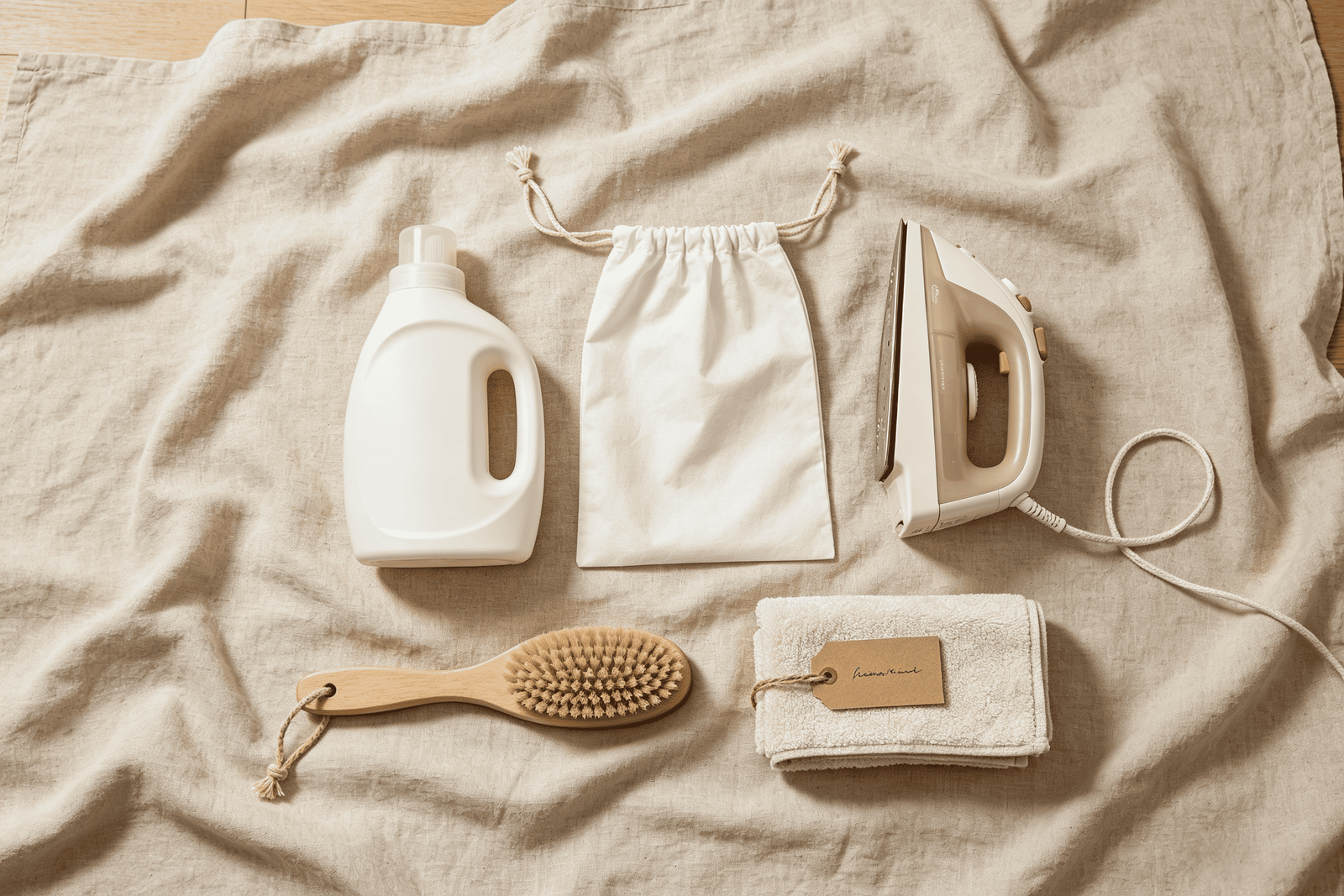
The good news is that once you understand the mechanics behind linen's behavior, the care routine becomes completely manageable. The sections below break down each stage — from washing to drying to refit — and explain the why behind every step.
Why Does Linen Behave Differently from Other Sofa Fabrics?
You already know linen is a natural fiber. But knowing that doesn't tell you why it shrinks, or why your cotton-blend throw pillow survives the dryer just fine while a linen cover does not.
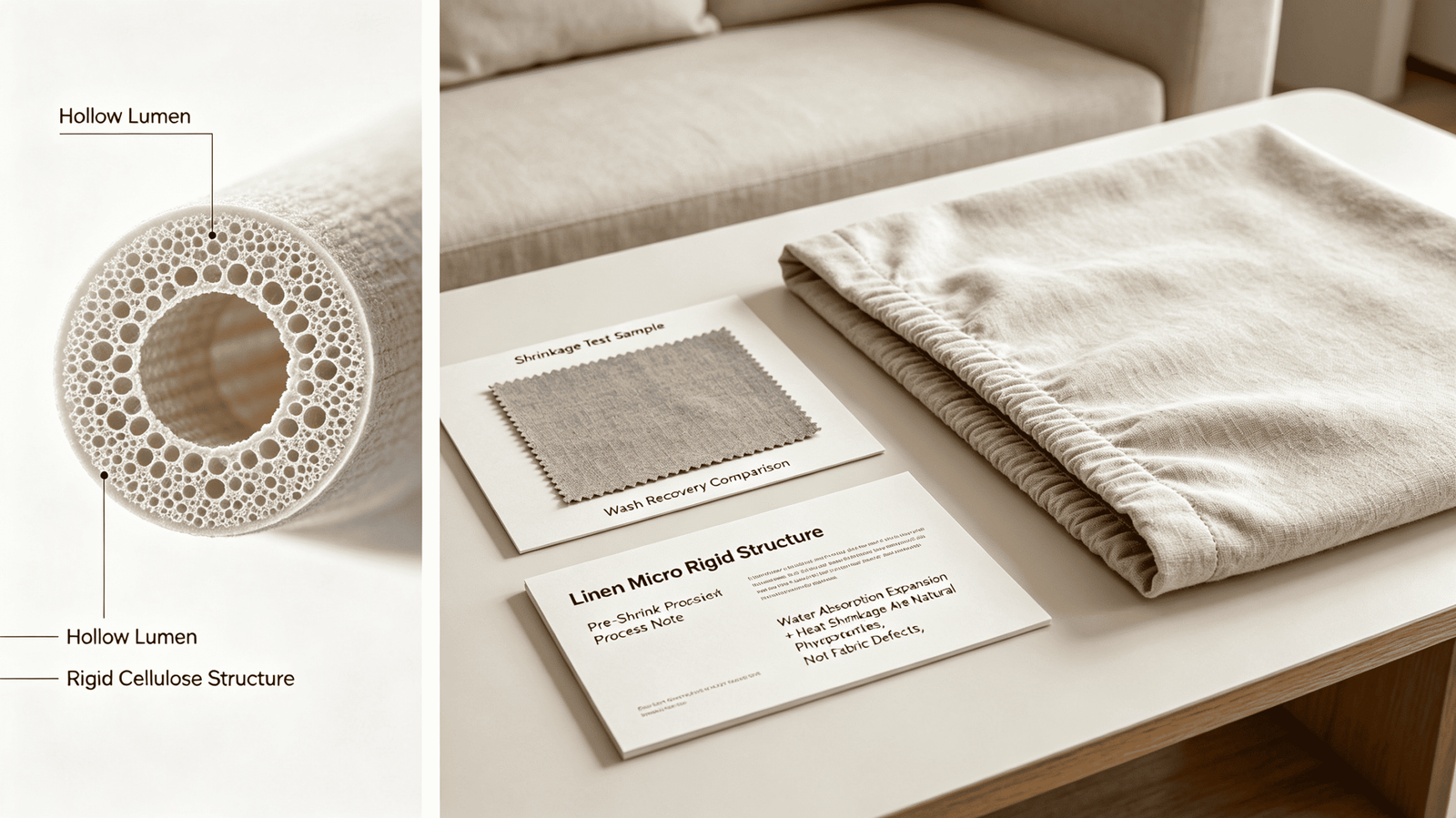
Linen fiber is structurally rigid at a microscopic level1. It absorbs water quickly, swells along the fiber length, and then contracts under heat. That contraction is not a defect — it is simply what the fiber does. Understanding this prevents the mistake of blaming the product when the problem was the process.
The fiber mechanics behind linen shrinkage
Linen comes from the flax plant. The cellulose fibers are long, dense, and naturally low in elasticity. When water penetrates the fiber bundle, individual strands swell laterally2. When heat is then applied — from a dryer, a hot rinse cycle, or even direct sunlight while damp — the fibers contract lengthwise.
This is a two-stage process:
- Wet swelling — the fiber absorbs water and expands
- Thermal contraction — heat drives the moisture out and the fiber shortens3
The result is dimensional change in the finished fabric. How much change depends on several variables: the fabric weight, the weave density, how the cover was cut and sewn, and whether the fabric was pre-washed before production.
At our factory, we pre-wash linen fabric before cutting and sewing every cover. This pre-treatment stabilizes the fiber and significantly reduces the risk of post-purchase shrinkage. But it does not eliminate the risk entirely — especially if the cover is later exposed to high heat or aggressive agitation.
What this means for your washing routine
- Avoid hot water completely. Even a warm rinse cycle creates enough thermal stress to cause dimensional change in linen.
- Gentle agitation matters. A normal wash cycle spins and tumbles fabric at a pace that strains the weave structure. A delicate cycle with reduced spin speed treats the fiber far more kindly.
- Cold water, low spin, short cycle — these are not optional preferences. For linen covers, they are the baseline.
Different linen covers behave differently depending on fabric weight and construction. A heavier, denser weave has more dimensional stability than a lighter slub linen. When in doubt, treat your specific cover as the more delicate of the two.
What Detergent Should You Use on a Linen Sofa Cover?
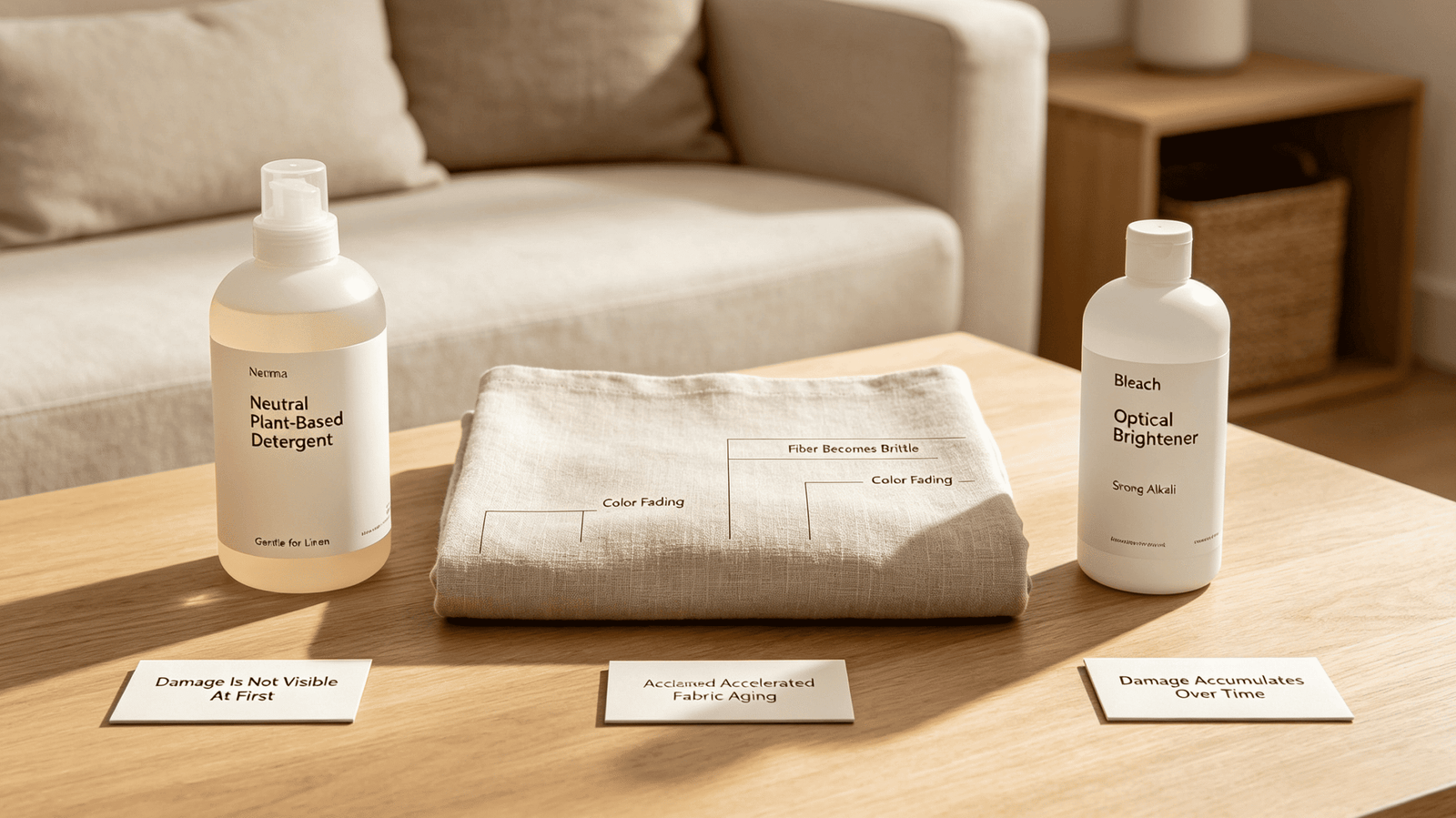
Detergent choice is something most care guides treat as a footnote. It should not be. The wrong product does not just remove a stain — it degrades the fiber itself, accelerates color loss, and shortens the usable life of the cover by years.
Using the wrong detergent on a natural linen cover is one of the most common causes of premature failure we hear about from customers after the fact. The damage is often invisible at first, then cumulative.
What to avoid — and why
Bleach-based detergents and stain removers
Chlorine bleach and oxygen bleach both work by breaking down molecular bonds4. On synthetic stains, that is useful. On linen fiber, it is destructive. The same reaction that lifts a stain attacks the cellulose structure of the fiber itself, weakening individual strands and causing micro-fractures that are not visible until the fabric begins to pill, thin, or discolor.
On undyed or naturally pigmented linen — which includes most greige, oatmeal, and warm neutral tones — bleach causes irreversible color shift. What looked like gentle brightening in the first wash becomes a patchy, uneven fade by the third.
Enzyme-heavy detergents
Many standard laundry detergents contain biological enzymes (protease, amylase, lipase) designed to break down protein and fat-based stains5. These work aggressively on natural fibers, including linen, because linen itself is a plant-based cellulose structure that enzyme activity can degrade over time. Repeated use accelerates fiber breakdown even at the correct wash temperature.
What to use instead
Look for:
- pH-neutral liquid detergents — labeled as "gentle," "delicate," or "wool and silk safe"
- Non-biological formulations — these do not contain active enzymes
- Low-foam detergents — excessive suds require longer rinse cycles, which increases exposure time in water
Use a small amount. Over-dosing detergent does not make the cover cleaner — it leaves residue in the weave that attracts dirt faster between washes.
How Often Should You Wash a Removable Linen Sofa Cover?
This is where most care guides fail their readers. They either give an arbitrary schedule ("wash every three months") or no schedule at all. Neither is useful. The correct answer depends on how the sofa is actually used.
Over-washing is a genuine risk with natural linen. Every wash cycle — even a properly executed one — creates some level of mechanical stress on the fiber. The goal is to wash when genuinely necessary, and to reduce the frequency through smart daily maintenance.
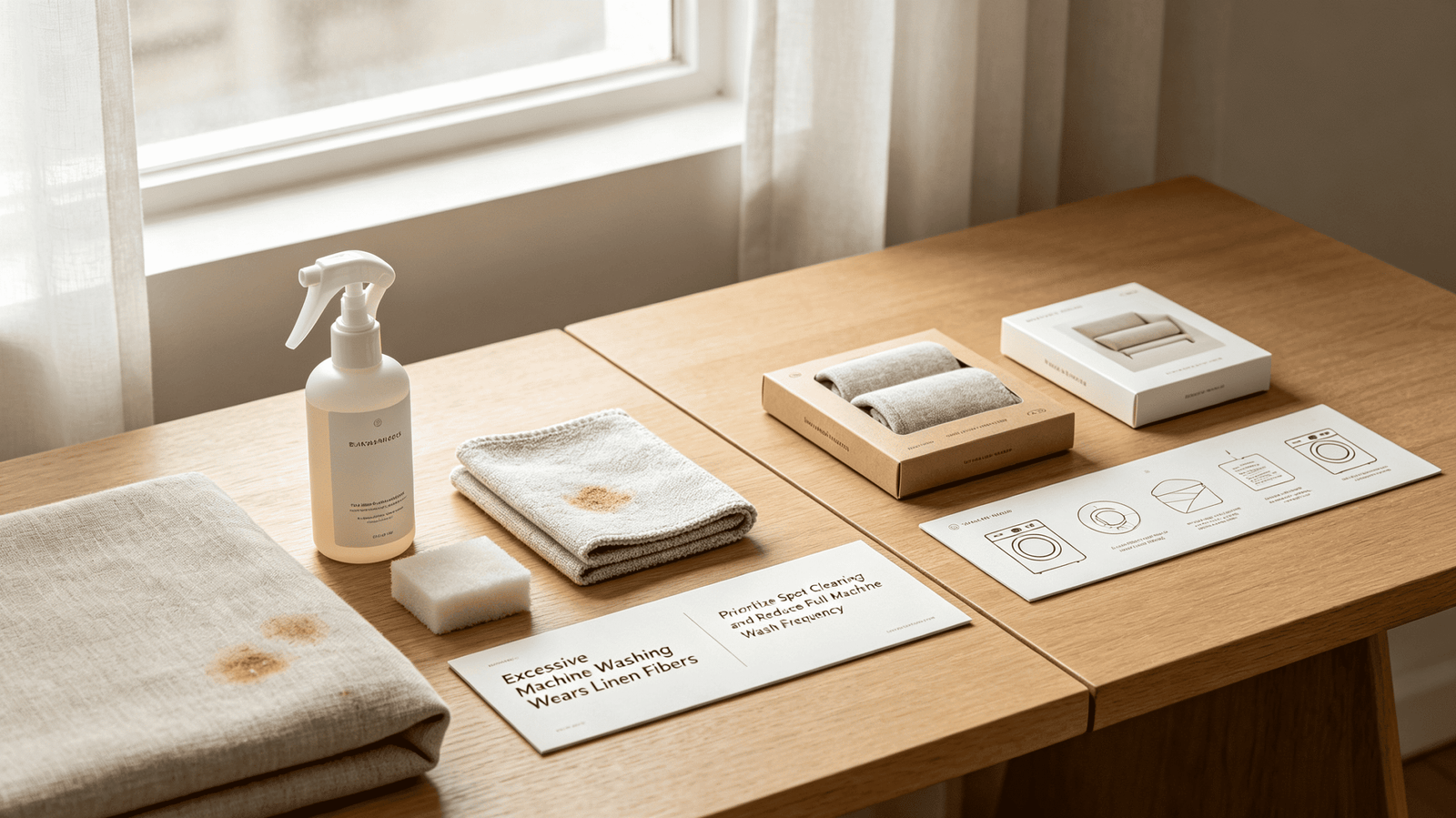
A tiered maintenance system
Rather than following a calendar, use a decision-based approach:
Tier 1 — Daily or weekly maintenance (no washing required)
- Brush the surface lightly with a soft upholstery brush to remove dust, pet hair, and loose debris. This alone prevents most surface buildup.
- Air the cover regularly. Linen is naturally breathable and odor-resistant6. Airing in indirect light, not direct sun, refreshes the fabric without any water or chemicals.
- Flip cushion covers if your configuration allows — even wear extends the life of the fabric.
Tier 2 — Spot treatment (targeted, no full wash)
For minor spills, fresh stains, or localized marks:
- Blot immediately with a clean, dry cloth — do not rub.
- Dampen a separate cloth with cool water and blot the area from the outside of the stain inward.
- If needed, apply a small amount of pH-neutral detergent solution to the cloth (not directly to the fabric) and blot gently.
- Allow to air dry completely before assessing the result.
Spot treatment extends the time between full washes significantly. In my experience talking with customers — and based on what our after-sales team hears most often — households that develop a consistent spot-care habit typically go much longer between full washes without any noticeable difference in cleanliness.
Tier 3 — Full machine wash (only when genuinely needed)
Indicators that a full wash is warranted:
- Overall surface dullness or grime that spot treatment cannot address
- Persistent odors that airing does not resolve
- Visible uniform soiling across large sections of the cover
| Usage Level | Suggested Full Wash Frequency |
|---|---|
| Light use (1–2 adults, no pets) | Every 6–12 months |
| Moderate use (family, occasional pets) | Every 3–6 months |
| Heavy use (children, indoor pets, frequent guests) | Every 6–8 weeks, with consistent spot care in between |
These are decision guidelines, not rigid schedules. Your specific fabric weight and construction will affect how frequently a full wash is appropriate.
How Do You Dry and Refit a Linen Sofa Cover Without Distorting It?
Most guides spend all their attention on the wash. The drying and refit stage is where we most commonly see covers fail — and where most of the permanent damage actually occurs.
A linen sofa cover that survives the wash cycle can still be permanently distorted if it is dried twisted, hung incorrectly, or forced back onto the frame while fully dry.
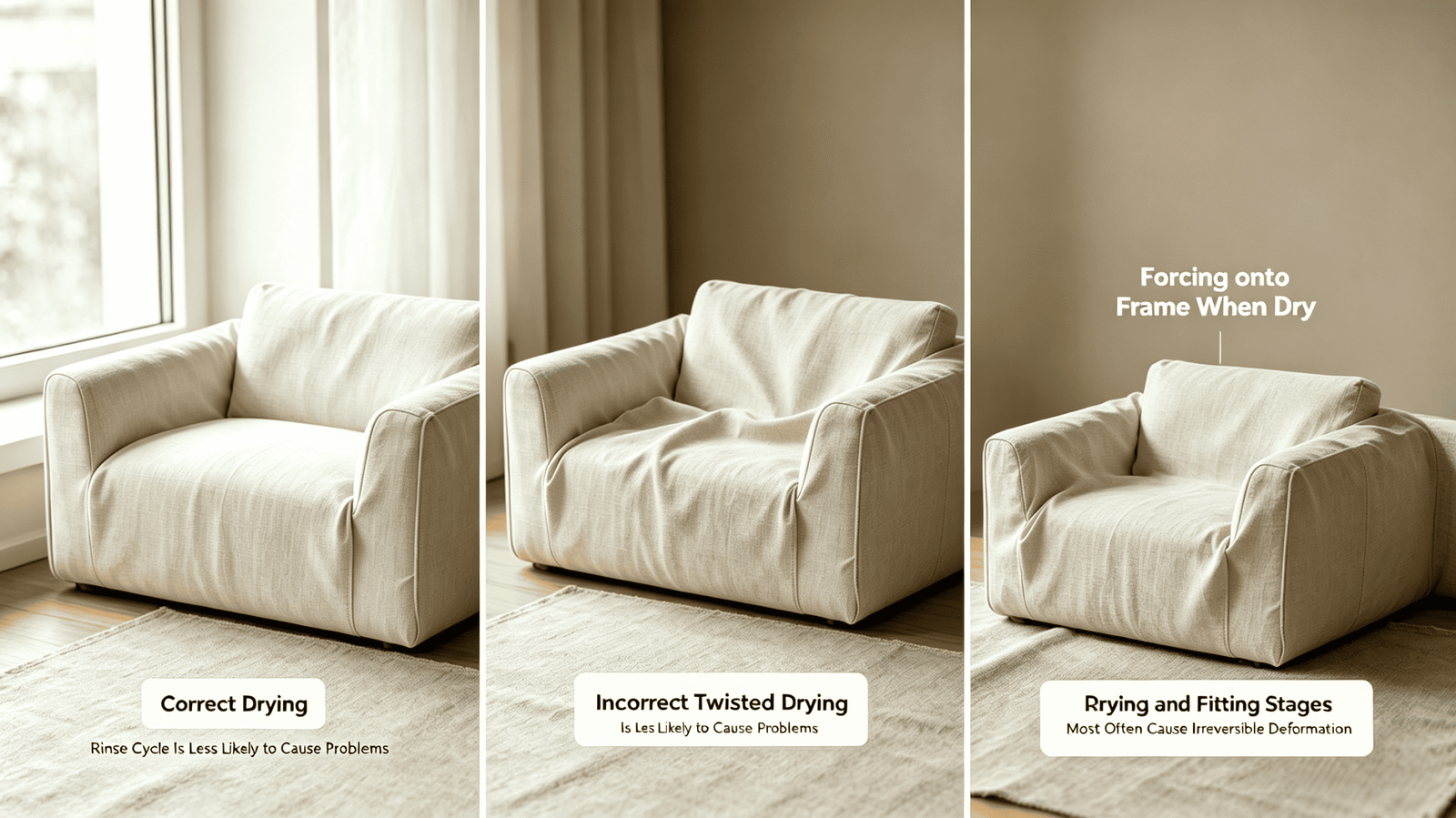
Never use a tumble dryer
This bears repeating plainly: do not tumble dry a linen sofa cover. The combination of heat and mechanical tumbling creates exactly the conditions — thermal contraction plus directional stress — that cause irreversible distortion and shrinkage.
This is not about the cover being fragile. It is about the physics of the fiber. A tumble dryer is designed to move fabric in all directions simultaneously while applying heat7. For linen, that process locks the fiber into a contracted, misshapen state.
The correct drying process — step by step
- Remove the cover from the machine promptly. Do not leave it sitting in the drum.
- Gently shake the cover out. This begins to realign the weave before any drying occurs.
- Reshape the cover by hand while it is still damp. This is the most critical step. Pull seams straight, smooth panels flat, and align corners. Damp linen is still pliable — dry linen is not8.
- Lay flat to dry if possible, or hang over a wide drying rack so the weight is evenly distributed. Never hang by a single corner or edge — this creates directional stress as gravity pulls the damp fabric.
- Avoid direct sunlight during drying. UV exposure accelerates color fading in natural linen9, particularly on undyed and light neutral tones.
- Begin refitting the cover before it is fully dry — at roughly 80–90% dry. Linen has just enough remaining flexibility at this stage to ease back over the sofa frame correctly. Attempting to refit a bone-dry, slightly shrunken cover by force risks seam damage.
Why refitting before full dry matters
This is the insight most care guides miss entirely. Even a properly washed cover will feel slightly tighter when fully dry compared to when it came off the sofa. Refitting while still slightly damp allows the fabric to conform back to the frame naturally as the final moisture evaporates in place. The result is a smooth, properly fitted cover — not a strained, lumpy one.
Frequently Asked Questions
Can I iron my linen sofa cover to remove wrinkles?
Yes, but only with precautions. Use a steam iron on a medium-low linen setting, and iron while the fabric is still slightly damp. Always iron on the reverse side of the cover to avoid flattening the natural texture of the weave. Do not press heavily on decorative seams or piping.
My linen cover looks pilled after washing — what went wrong?
Pilling on linen is almost always caused by high agitation10 — either too fast a spin speed, the wrong wash cycle, or rubbing against other items in the machine. Wash linen covers alone or with similarly lightweight items, and always use the gentle or delicate cycle setting.
How do I handle a linen sofa cover that has already shrunk slightly?
If the shrinkage is minor, dampen the cover evenly with cool water, stretch it gently back to shape by hand, and refit it over the sofa frame while still damp. Allow it to dry on the frame. For significant shrinkage, professional wet-finishing by a textile cleaner may partially restore dimensions11, but results vary.
Is dry cleaning a safe alternative for linen sofa covers?
For heavily soiled covers or covers where the care label explicitly advises dry cleaning only, professional dry cleaning is a reasonable option. It avoids the water-related risks entirely. That said, solvent-based dry cleaning has its own limitations for natural fibers12 — discuss the fabric composition with the cleaner before proceeding.
Will linen sofa covers fade over time even with proper care?
Some natural fading over years of use is characteristic of genuine linen, particularly on undyed or naturally pigmented tones. This is generally considered part of the material's aesthetic character. You can slow the process by avoiding direct sunlight exposure during drying, limiting UV exposure in the room, and using the correct detergent.
Conclusion
Removable sofa cover care for linen is not complicated — but it is specific. The core principle is this: linen fiber has predictable behavior under heat, agitation, and harsh chemistry. Respecting that behavior at every stage — washing, detergent selection, drying, and refit — protects your investment and keeps the cover looking its best for years.
To summarize the key points:
- Always wash cold, on a delicate cycle, with a pH-neutral, non-biological detergent
- Never tumble dry — reshape by hand while damp and dry flat or on an even rack
- Refit before fully dry to allow the fabric to conform back to the frame naturally
- Reduce wash frequency through daily brushing, airing, and targeted spot treatment
- Avoid bleach and enzyme-heavy detergents — they degrade the fiber from the inside out
If you are considering a linen sofa with removable covers and want to understand what you are actually buying — fabric weight, construction, pre-treatment — feel free to reach out to our team at Linen World https://linenworld.pro. Thirteen years of production experience means we can answer the questions most retailers cannot.
"Mechanical property enhancement of flax fibers via supercritical fluid ...", https://pmc.ncbi.nlm.nih.gov/articles/PMC11322329/. Flax fibers exhibit high cellulose crystallinity and low lateral flexibility at the microscopic level, characteristics that influence their dimensional stability when exposed to moisture and heat. Evidence role: mechanism; source type: research. Supports: the microscopic structural characteristics of linen/flax fibers. Scope note: This describes general fiber structure rather than specifically addressing rigidity in the context of washing behavior ↩
"Swelling of cellulosic fibers in aqueous systems - BioResources", https://bioresources.cnr.ncsu.edu/resources/swelling-of-cellulosic-fibers-in-aqueous-systems-a-review-of-chemical-and-mechanistic-factors/. Cellulosic fibers including flax undergo hygroscopic swelling when moisture penetrates the fiber structure, with dimensional changes occurring primarily in the lateral direction due to the orientation of cellulose chains. Evidence role: mechanism; source type: research. Supports: the hygroscopic swelling behavior of cellulosic fibers when exposed to water. ↩
"Hornification in commercial chemical pulps: Dependence on drying ...", https://bioresources.cnr.ncsu.edu/resources/hornification-in-commercial-chemical-pulps-dependence-on-drying-temperature/. Heat-induced drying of cellulosic textiles can cause fiber contraction as hydrogen bonds reform in a more compact configuration during moisture removal, resulting in fabric shrinkage. Evidence role: mechanism; source type: research. Supports: the relationship between heat, moisture removal, and dimensional change in cellulosic textile fibers. Scope note: This describes general cellulosic behavior; specific contraction rates vary by fiber type, weave, and finishing treatments ↩
"Environmentally Friendly Bleaching Process of the Cellulose Fibres ...", https://pmc.ncbi.nlm.nih.gov/articles/PMC10972073/. Both chlorine and oxygen-based bleaches oxidize cellulose through free radical mechanisms, cleaving glycosidic bonds in the polymer chain and reducing the degree of polymerization, which weakens fiber tensile strength. Evidence role: mechanism; source type: research. Supports: the chemical mechanism by which bleaching agents affect cellulosic fiber structures. ↩
"A Case Study with Dual-Purpose Pineapple Plant toward ... - PMC", https://pmc.ncbi.nlm.nih.gov/articles/PMC12409528/. While protease, amylase, and lipase target protein, starch, and lipid substrates respectively, some detergent formulations contain cellulase enzymes that deliberately modify cellulose fiber surfaces; repeated exposure to any enzymatic detergent can affect natural fiber integrity through mechanical action and pH effects. Evidence role: mechanism; source type: research. Supports: the interaction between laundry enzymes and cellulosic textile fibers. Scope note: The primary enzymes listed (protease, amylase, lipase) do not directly target cellulose; cellulase would be the relevant enzyme for cellulosic fiber degradation ↩
"Moisture Vapor Permeability and Thermal Wear Comfort of ... - PMC", https://pmc.ncbi.nlm.nih.gov/articles/PMC8539243/. Linen exhibits high moisture vapor transmission rates due to its hollow fiber structure and demonstrates some natural antimicrobial activity, properties that contribute to odor resistance compared to synthetic textiles. Evidence role: general_support; source type: research. Supports: the moisture management and antimicrobial characteristics of linen textiles. Scope note: Antimicrobial effects are modest and do not eliminate the need for regular cleaning in high-use applications ↩
"Elucidating the hornification mechanism of cellulosic fibers during ...", https://pubmed.ncbi.nlm.nih.gov/35483847/. Tumble drying subjects textiles to simultaneous thermal stress and multidirectional mechanical forces, which in cellulosic fabrics can cause irreversible shrinkage through fiber relaxation, yarn contraction, and structural rearrangement of the fabric geometry. Evidence role: mechanism; source type: research. Supports: the combined effects of heat and mechanical agitation on textile dimensional stability during tumble drying. ↩
"[PDF] The planoflex, a simple device for evaluating the pliability of fabrics", https://nvlpubs.nist.gov/nistpubs/jres/27/jresv27n5p469_A1b.pdf. Water acts as a plasticizer in cellulosic materials, disrupting hydrogen bonds between cellulose chains and increasing fiber flexibility; as moisture content decreases during drying, these bonds reform and the material becomes increasingly rigid. Evidence role: mechanism; source type: research. Supports: the plasticizing effect of moisture on cellulosic fiber flexibility. ↩
"[PDF] A Treatment to Reduce Fading and Degradation of Textiles", https://digitalcommons.unl.edu/cgi/viewcontent.cgi?article=1015&context=textiles_facpub. UV radiation causes photodegradation of cellulosic fibers through oxidative reactions that break cellulose chains and degrade chromophores, resulting in both yellowing of undyed fabrics and fading of dyed textiles. Evidence role: mechanism; source type: research. Supports: the effect of ultraviolet radiation on cellulosic textile color stability and fiber degradation. ↩
"Pilling in man-made cellulosic fabrics, part 1 - Academia.edu", https://www.academia.edu/90657886/Pilling_in_man_made_cellulosic_fabrics_part_1_Assessment_of_pilling_formation_methods. Pilling occurs when mechanical abrasion causes fiber breakage and entanglement at the fabric surface; in cellulosic textiles, excessive agitation during laundering accelerates this process by creating fiber fragments that tangle into visible pills. Evidence role: mechanism; source type: research. Supports: the relationship between mechanical agitation and pill formation in textile fabrics. Scope note: Linen's long staple fibers typically resist pilling better than short-staple cellulosics; when pilling occurs, it often indicates fiber damage from other causes in addition to agitation ↩
"[PDF] relaxation shrinkage", https://www2.cs.arizona.edu/patterns/weaving/books/lds_fof_12.pdf. Wet-finishing processes can partially restore dimensions in shrunken cellulosic textiles through controlled moisture application and mechanical tension, though results depend on the degree of shrinkage and whether structural changes in the weave have occurred. Evidence role: general_support; source type: education. Supports: professional textile finishing techniques for dimensional adjustment. Scope note: Success rates vary significantly based on fabric construction, shrinkage severity, and the specific finishing techniques employed ↩
"Control of Exposure to Perchloroethylene in Commercial Dry ... - CDC", https://www.cdc.gov/niosh/engcontrols/ecd/detail13.html. While dry cleaning avoids water-related shrinkage risks in cellulosic textiles, petroleum-based solvents may not effectively remove water-soluble soils and can potentially affect fabric hand and finish treatments; professional cleaners must select appropriate solvents and techniques based on fiber content and soil type. Evidence role: general_support; source type: education. Supports: the considerations and limitations of solvent-based dry cleaning for natural cellulosic textiles. ↩


