Choosing the wrong sofa cushion fill is how a $4,000 linen sofa turns into a $4,000 mistake. Most buyers don't find out until 14 months later.
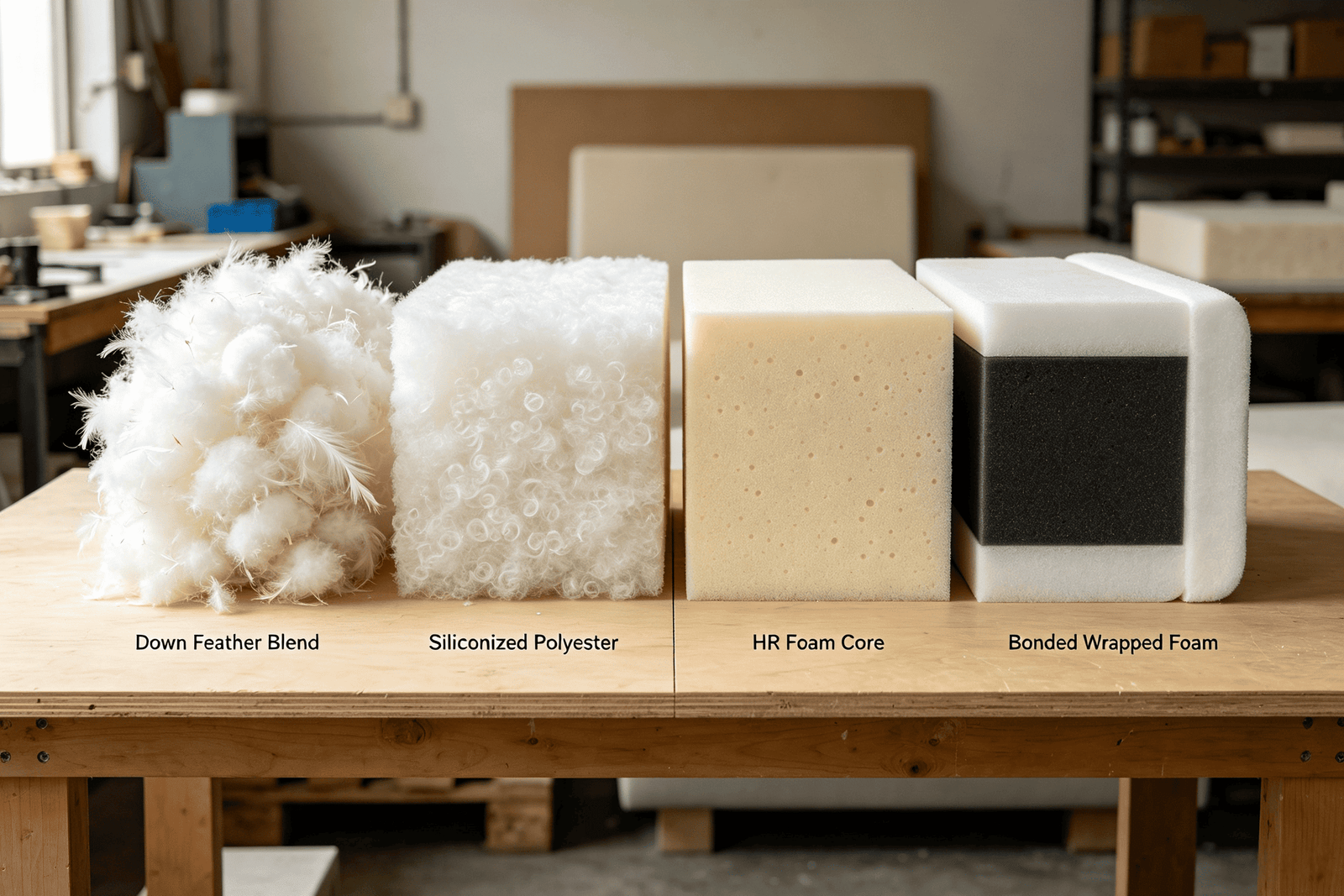
Sofa cushion fills fall into four main categories: down and feather blends, down alternative (polyester fiber), foam cores, and wrapped foam (foam core surrounded by a fiber or down layer). Each performs differently based on use frequency, climate, and the fabric it pairs with. There is no single best option — only the right match for your project.
We've been making linen sofas in Foshan for 13 years. A large share of our clients are US and EU interior designers specifying custom pieces for high-end residential projects. The fill question comes up on almost every order — and the same mismatches keep appearing. This article is written from that pattern, not from a materials lab.
Is Down Always the Best Fill for a Linen Sofa?
Down feels like the obvious premium choice. But we've watched expensive sofas disappoint clients who chose down without thinking about how the sofa would actually be used.
Down fill — specifically clusters rated at 600 fill power or above, with a 90/10 down-to-feather ratio1 — delivers the softest, most luxurious feel available. But it requires regular fluffing, does not hold a firm seat shape, and performs poorly in humid climates unless the casing is tightly woven. It is best matched to formal living rooms with moderate use.
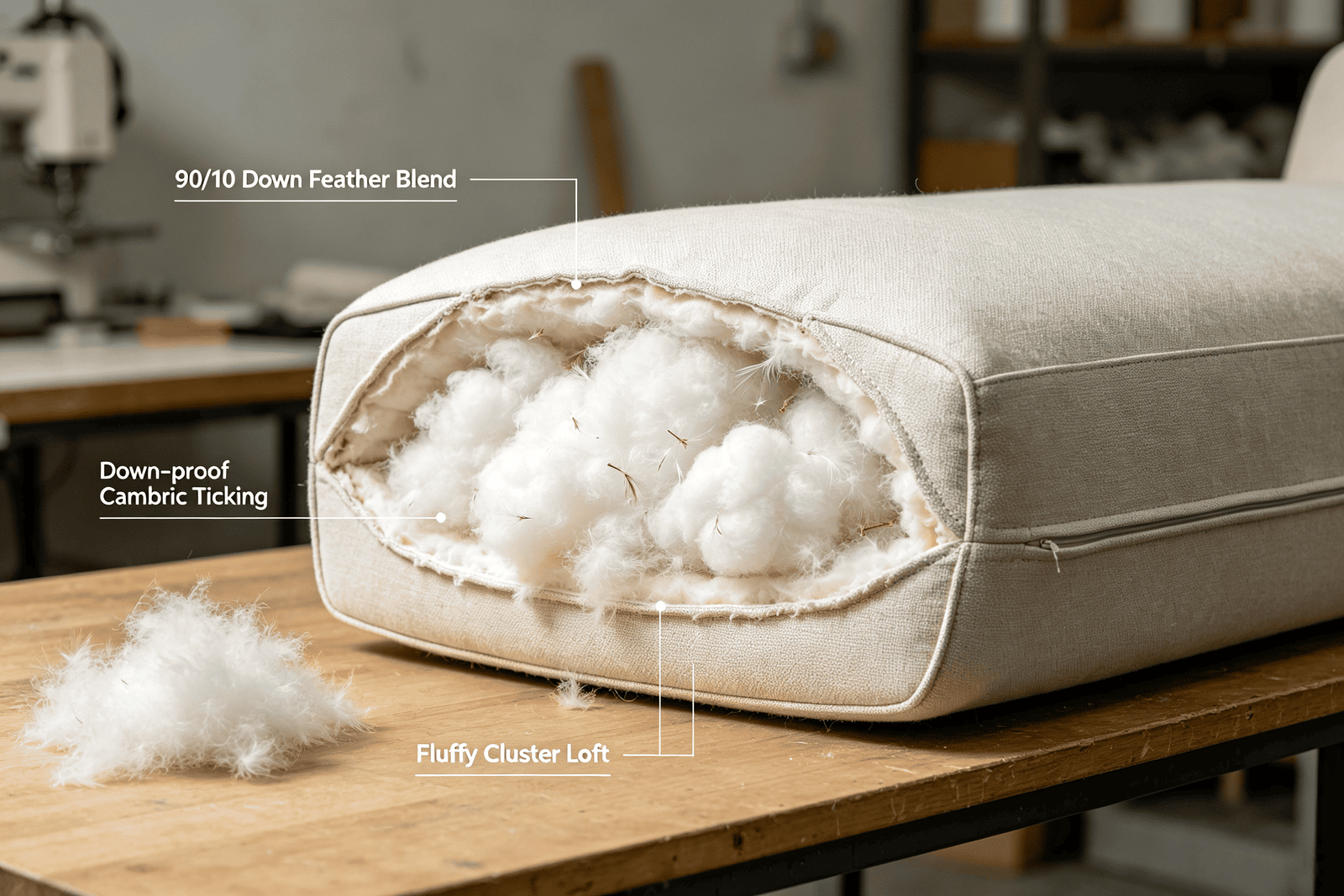
Here is what the spec sheet doesn't always tell you. Fill power measures how much space one ounce of down occupies2 — higher fill power means more loft and better recovery. A 550 fill power blend and an 800 fill power blend are both labeled "down," but they feel completely different after six months of use. Cluster percentage matters too. Pure down clusters are round and trap air. Feather content adds weight and reduces recovery. A 90/10 ratio means 90% down clusters and 10% feathers. Many suppliers sell 70/30 or lower blends at prices that suggest something better.
The casing also matters in a way most buyers never think to ask about. Down migrates. If the ticking fabric — the inner casing around the fill — has a loose weave, you will eventually see and feel quill ends poking through. For linen-covered cushions in particular, where the outer fabric is breathable and natural, the inner casing must be a down-proof fabric. We use a cambric-weave cotton ticking on all our down cushion builds3 for exactly this reason.
| Spec to Check | What to Ask Your Supplier |
|---|---|
| Fill power | Minimum 600FP for daily use, 700+ for formal/display |
| Cluster ratio | Ask for the exact down-to-feather percentage |
| Casing fabric | Should be down-proof ticking, not standard cotton |
| Humidity suitability | Down needs low-humidity rooms or sealed storage |
One more honest point: down is not ideal for families with young children or high-traffic rooms4. It looks beautiful. It does not hold a structured seat shape under heavy or uneven use. If your client wants that sink-in feel but also uses the sofa daily, the wrapped core construction we cover below is usually the better call.
What Is Down Alternative and When Does It Actually Make Sense?
Down alternative has a reputation problem. It gets associated with budget furniture. That reputation is not accurate, and it causes buyers to over-specify down when down alternative would perform better.
Down alternative fill is a polyester fiber cluster designed to mimic down's loft and softness without animal content or moisture sensitivity. Modern versions — specifically gel-fiber or siliconized hollow-fiber fills — offer comparable hand-feel to mid-grade down, better shape retention in humid environments, and easier maintenance. They are appropriate for high-end projects where performance and hypoallergenic requirements matter5.
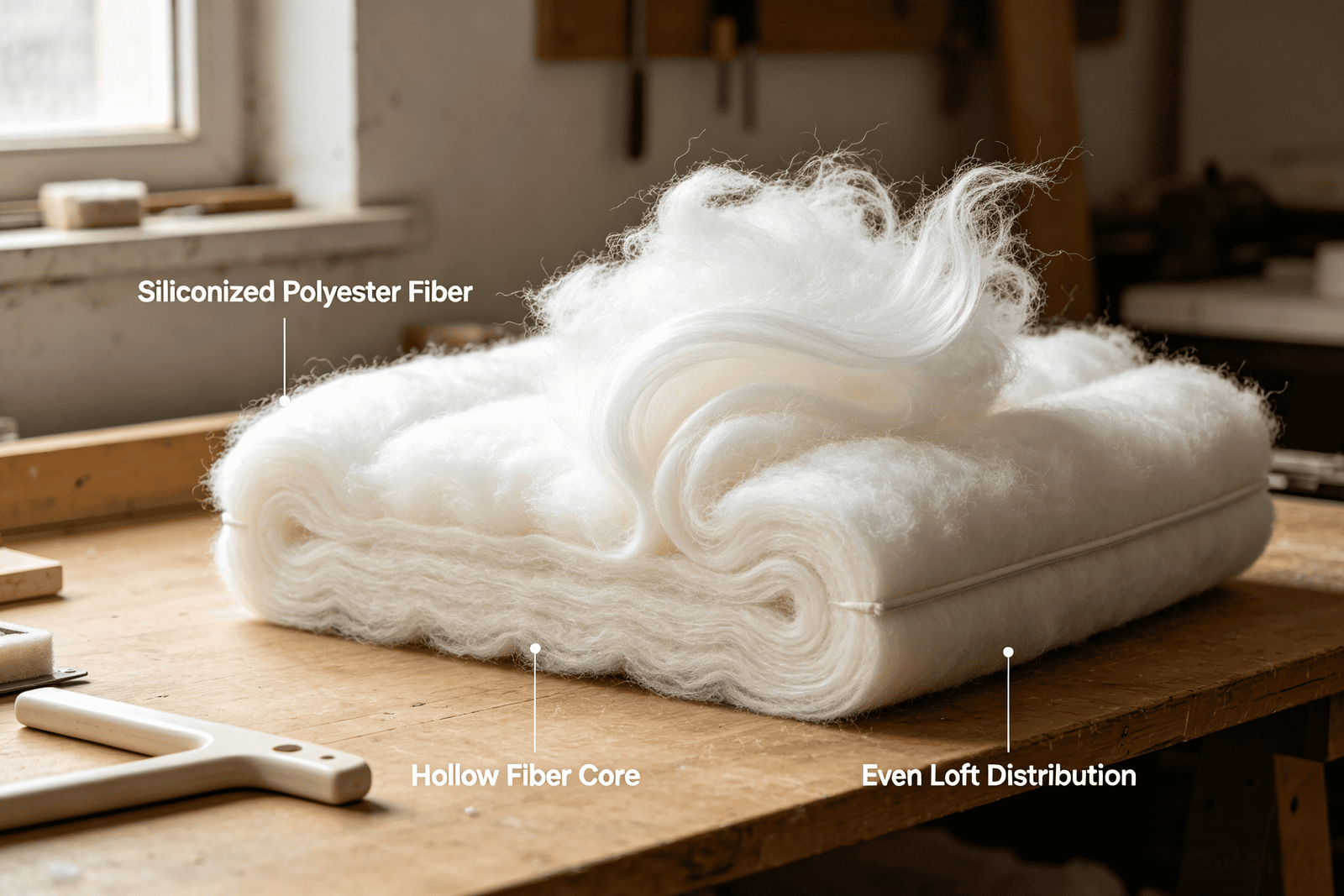
The misleading part is that "down alternative" covers a wide range of actual materials. Cheap polyester fiber clumps and flattens within a year. High-grade siliconized hollow-fiber fill maintains its loft through repeated compression6. We've had clients receive what was spec'd as premium down alternative from another supplier and find flat, matted cushions within eight months. When we asked them to send photos of the fill, it was clearly a low-grade fiber blend, not the siliconized clusters they had paid for.
What to verify before you approve a spec:
Fiber Type
Ask specifically whether the fill is siliconized hollow fiber or standard virgin polyester fiber. These are not the same product. Siliconized fiber has a slippery coating that allows fibers to move against each other, which is what gives it recovery. Standard polyester fiber does not have this, and it mats permanently under load.
Fill Weight Per Cushion
A 24-inch seat cushion filled with down alternative should typically contain between 400 and 600 grams of fill, depending on desired firmness. Suppliers who underfill cushions to cut cost produce a sofa that looks acceptable in a showroom photo but collapses in use. Ask for the fill weight per unit on your spec sheet and hold your supplier to it.
Appropriate Use Cases
| Project Type | Down Alternative Suitability |
|---|---|
| High-humidity climate (Florida, coastal EU) | Strong match — no moisture sensitivity |
| Client with allergies | Strong match — no animal content |
| Daily family use sofa | Good match — more resilient than down under heavy use |
| Formal low-use living room | Acceptable, but down will feel more luxurious at delivery |
| Hotel or rental property | Strong match — easier maintenance, longer shape retention |
We use down alternative on roughly 40% of our custom orders. For US clients in the South and coastal markets, it is often the correct specification — not a cost-cutting decision, but a performance decision.
How Does Foam Core Construction Affect How a Linen Sofa Feels?
Foam is the fill category where the most technical confusion happens. Not all foam is the same, and the density and ILD rating on a spec sheet determine whether your sofa feels structured or stiff.
Foam core cushions use high-resilience (HR) polyurethane foam as the primary fill7. The two numbers that matter are density (measured in kg/m³ or lbs/ft³) and ILD (Indentation Load Deflection), which measures firmness8. A well-specified HR foam core — typically 35–45 kg/m³ density with an ILD of 28–359 — holds its shape for years and suits clients who prefer a firm, structured seat.
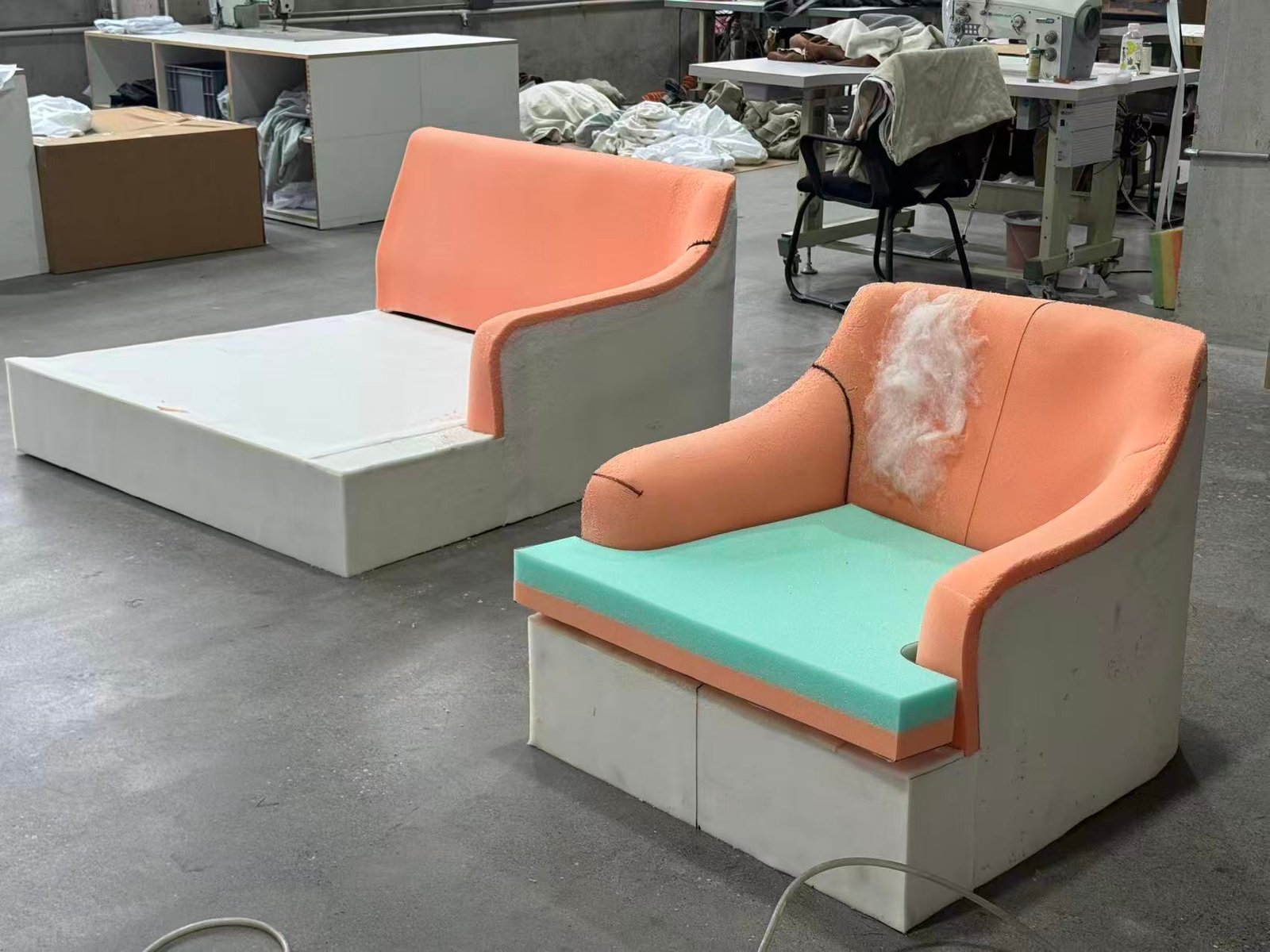
Here is the problem we see frequently. A buyer requests a "firm cushion" without specifying density or ILD. The supplier uses whatever foam is available — sometimes a low-density foam at 18–20 kg/m³ — and the cushion feels fine at delivery but compresses permanently within a year. Low-density foam does not recover. Once it takes a body impression, it keeps it.
Foam Density vs. ILD — What Each Number Means
Designers sometimes confuse density with firmness. They are measuring different things.
- Density measures the mass of foam per unit volume. Higher density means more material per cubic meter, which translates to durability and shape retention over time. A 35 kg/m³ foam will outlast an 18 kg/m³ foam by years.
- ILD measures how many pounds of force it takes to compress the foam by 25%. Higher ILD means a firmer feel. A 25 ILD foam feels soft and gives easily. A 40 ILD foam feels firm and supportive.
| Foam Spec | What It Means in Practice |
|---|---|
| Density below 25 kg/m³ | Will compress permanently — avoid for seat cushions |
| Density 35–45 kg/m³ | Appropriate for residential seating |
| ILD 25–30 | Soft-medium feel, suits lounge and relaxed seating |
| ILD 30–38 | Firm-medium, suits structured and formal seating |
| ILD above 40 | Very firm — appropriate for dining bench cushions, not deep seats |
Foam also interacts directly with linen cover fabric. A stiff, high-ILD foam core under a tightly woven linen upholstery produces a sofa that looks tailored but feels like sitting on a wooden bench after an hour. We adjust ILD recommendations based on the specific linen fabric weight our clients select — this is exactly the kind of system-level thinking a factory can offer that a materials supplier cannot.
What Is a Wrapped Core Cushion and Why Do So Many Designers Request It?
The wrapped core is the construction that comes up most often in our inquiry conversations with US interior designers. It is also the most misunderstood in terms of what it actually is.
A wrapped core cushion combines a foam core with a surrounding layer of fiber or down, enclosed inside the casing. The foam provides shape retention and structural support. The outer fiber or down layer softens the feel and removes the hard-edge sensation of a bare foam cushion. This construction is the most common specification for high-end residential linen sofas in our production.
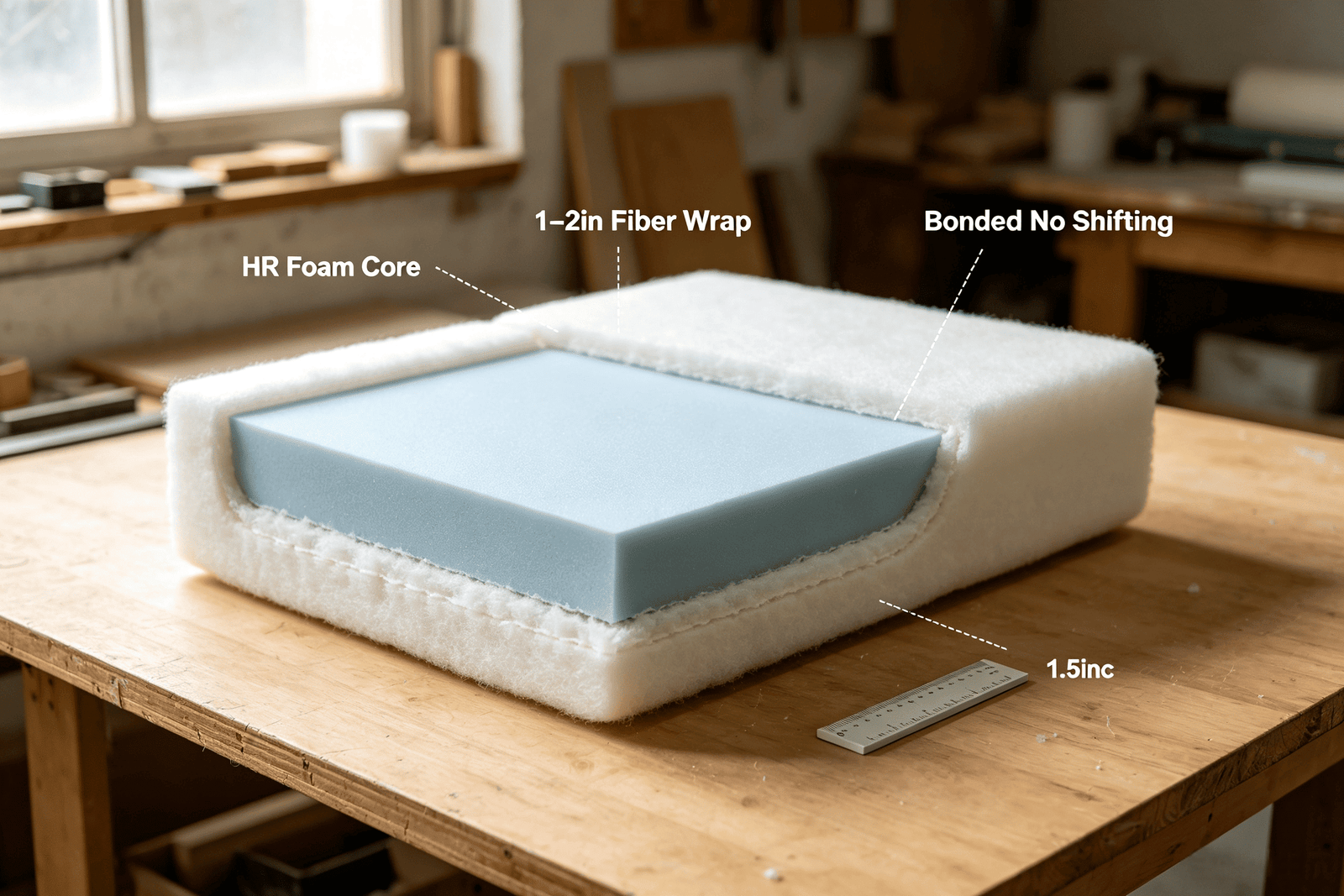
The reason designers request this so often is that it solves two competing problems at once. Their clients want the sofa to hold its shape and not require constant re-fluffing. But they also don't want a cushion that feels like a park bench. A well-built wrapped core achieves both. The foam holds the silhouette. The wrap layer — typically a 1–2 inch layer of siliconized fiber or a down/feather blend — gives the surface a softer, more natural feel on contact.
What Makes a Wrapped Core Well-Built
Not all wrapped cores are built the same way. The variables that determine quality are the foam spec underneath, the thickness and type of the wrap layer, and how securely the wrap is attached to the foam.
A common failure mode we see in low-cost wrapped core cushions: the fiber wrap is not bonded or quilted to the foam core. Over time, the wrap migrates inside the casing. One side of the cushion becomes overstuffed and lumpy. The other side shows the hard edge of the foam directly. The sofa looks like it has collapsed asymmetrically even though the foam itself is fine.
At our factory, we bond the wrap layer to the foam before casing. It adds a step to production, but it is the only way to guarantee the cushion holds its shape through real use.
| Wrapped Core Variable | What to Specify |
|---|---|
| Foam core density | 35–45 kg/m³ HR foam minimum |
| Foam ILD | Match to seating purpose (see foam table above) |
| Wrap layer material | Siliconized fiber or down/feather blend |
| Wrap thickness | 1–2 inches for seat cushions, 1 inch for back cushions |
| Wrap attachment | Bonded or quilted to foam — not loose |
| Casing fabric | Zippered inner casing for maintenance access |
One detail that rarely appears on spec sheets but matters a great deal: whether the cushion has an inner zippered casing. Without one, the fill cannot be adjusted, redistributed, or replaced without cutting the linen cover. We include inner casings on all wrapped core and down cushion builds as a standard practice. It protects the linen cover and gives the end client a maintenance option that extends the sofa's life significantly.
How Do You Match Fill to Your Specific Linen Fabric?
This is the question most fill guides skip. They treat fill selection as a standalone decision. It is not. The fill and the fabric are a system, and mismatching them causes problems that neither component would cause on its own.
Fill and fabric must be selected together. A heavy, firm foam core under a tightly woven medium-weight linen produces a stiff, over-structured result. A loose polyester fiber fill under a lightweight linen will sag and distort the cushion silhouette within months. The fabric weight, weave density, and stretch behavior all affect how the fill performs inside the casing.
We work with over 200 linen fabric options in our production. After 13 years of building custom linen sofas, we have direct experience with how different fills perform under different fabric constructions. Here is how we think about the matching logic.
Fabric Weight and Fill Firmness
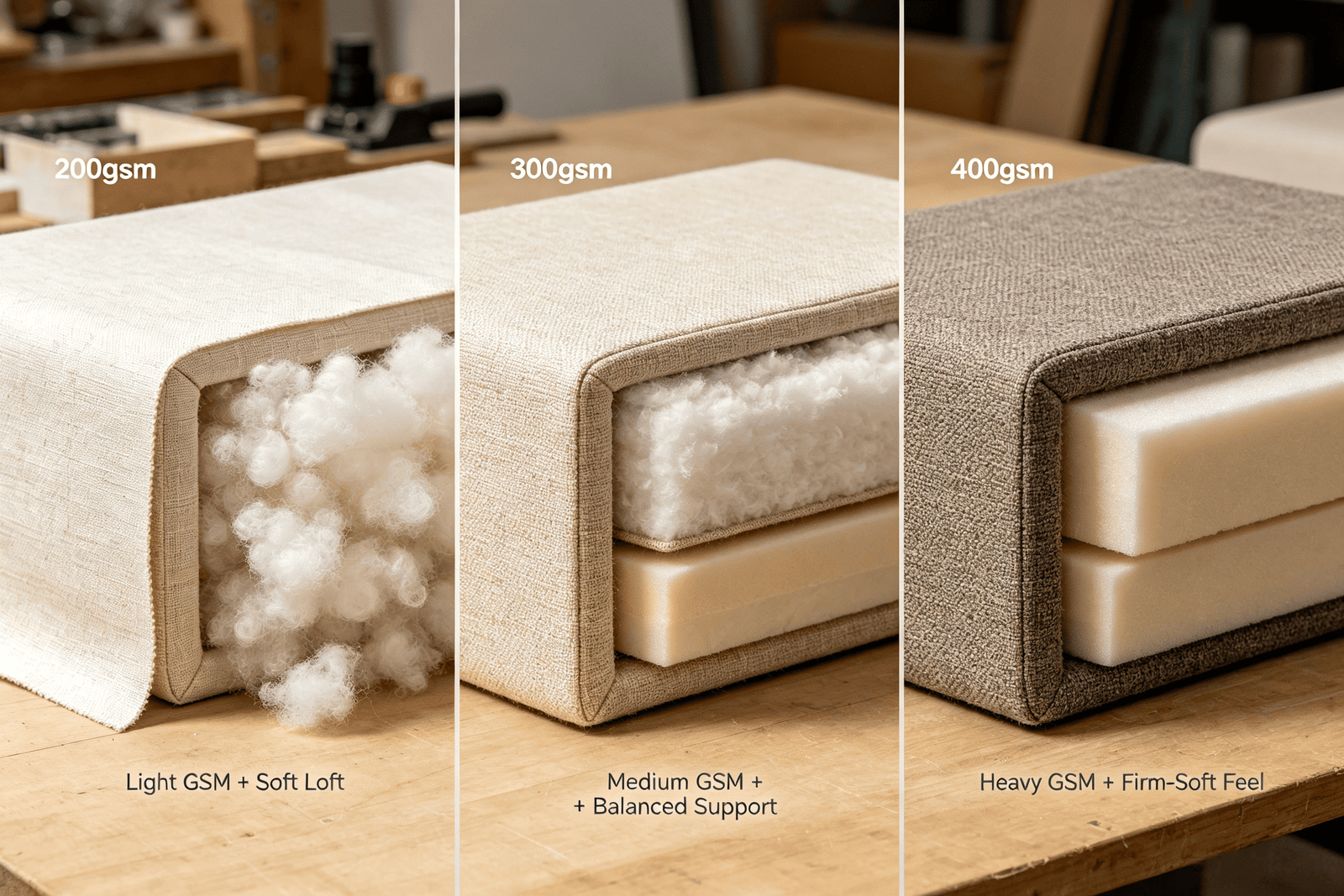
Lighter linen fabrics — around 200–250 gsm10 — are more supple and drape more naturally over a cushion. They also reveal every variation in the fill underneath. If the fill has any lumpiness, uneven density, or migration, a lightweight linen will show it immediately. For this reason, we recommend wrapped core or high-grade down builds under lightweight linens, where fill consistency is tightly controlled.
Heavier linen fabrics — 300–400 gsm — are more forgiving of minor fill irregularities. But they add structural stiffness to the cushion system on their own. Pairing a heavy linen with a high-ILD foam core produces a cushion that is noticeably hard in use. For heavy linen fabric, we typically recommend a lower ILD foam — or switch to a wrapped core with a generous fiber wrap — to compensate for the fabric's own stiffness.
| Linen Fabric Weight | Recommended Fill Construction |
|---|---|
| 200–250 gsm (lightweight) | Down 90/10 or bonded wrapped core with siliconized fiber wrap |
| 260–320 gsm (medium weight) | Wrapped core with HR foam 35–40 kg/m³, ILD 28–35 |
| 330–400 gsm (heavy weight) | Wrapped core with softer ILD (25–30) or down alternative wrap |
Weave Density and Migration Risk
A loosely woven linen — including some natural slub linens that designers love for their texture — has gaps in the weave large enough for down clusters or fiber to work through over time11. This is not a hypothetical problem. We've seen it in production reviews. For any linen with visible texture or open weave, we add an inner liner fabric between the fill casing and the outer cover to eliminate migration risk entirely.
This is a factory-level decision that a buyer specifying remotely from a fabric sample alone would never think to flag. It is one of the reasons we ask clients to share their fabric spec, not just their fill preference, before we confirm a cushion construction.
Conclusion
Cushion fill is a system decision, not a product ranking. Match the fill to your fabric, your use case, and your client's climate — and verify every spec in writing before you order.
We help designers specify cushion construction before they commit to an order — not after a problem shows up at delivery. If you're working on a project with a linen sofa specification and want to talk through fill options, send us your project details. We'll tell you exactly what we'd build and why. https://linenworld.pro
"Fill power - Wikipedia", https://en.wikipedia.org/wiki/Fill_power. Fill power is an industry-standard measure of down loft, expressed as the cubic inches occupied by one ounce of down; higher values indicate greater resilience and insulating capacity, with grading conventions established by textile and bedding standards bodies. Evidence role: definition; source type: institution. Supports: What fill power measures, how it is rated, and what ratios distinguish quality grades of down fill. Scope note: Most published fill power standards originate in bedding and apparel contexts; direct equivalents for upholstery cushion specifications may not be formally codified in the same way. ↩
"Fill power - Wikipedia", https://en.wikipedia.org/wiki/Fill_power. Fill power is conventionally defined as the number of cubic inches occupied by one ounce of down under a standardized load, with testing protocols maintained by organizations such as the International Down and Feather Laboratory (IDFL) and referenced in IDFB standards. Evidence role: definition; source type: institution. Supports: The standard definition and measurement methodology for fill power in down products. Scope note: Published test standards primarily address apparel and bedding; their direct applicability to upholstery fill specifications should be confirmed with a relevant trade body. ↩
"About Down Proof Fabric - Plumeria Bay", https://www.plumeriabay.com/info/downproof-fabric.aspx?srsltid=AfmBOoplAaKLKt-FsPnujkz8nwPLy3hcXYMYQoZKkk9QssP0AhO01XCF. Cambric is a finely woven plain-weave fabric, historically produced in linen or cotton, characterized by a high thread count that reduces porosity; its use as a down-proof ticking material is a long-established practice in bedding and upholstery manufacturing. Evidence role: definition; source type: encyclopedia. Supports: That cambric is a tightly woven fabric historically used as a down-proof casing material due to its weave density. ↩
"Best Sofa Seat Cushions: Foam, Wraps & Buying Guide", https://whataroom.com/blogs/home-garden/best-seat-cushions-for-your-couch?srsltid=AfmBOopcIgPVNrEKjWZkIjihUn81vxcPGQYtU-XXGJwNcedP6iKPNd3V. Comparative assessments of upholstery fill materials note that loose down and feather fills require regular redistribution to maintain seat profile and are generally considered less suitable than foam-core constructions for high-frequency use environments. Evidence role: general_support; source type: research. Supports: That down fill lacks the structural resilience needed to maintain seat shape under frequent or heavy use compared to foam-based alternatives. Scope note: Formal comparative durability studies on sofa cushion fills are limited in the published literature; this claim is primarily supported by trade and industry sources rather than peer-reviewed research. ↩
"Dust Mite Allergy - StatPearls - NCBI Bookshelf - NIH", https://www.ncbi.nlm.nih.gov/books/NBK560718/. Research on bedding-related allergies indicates that sensitization attributed to feather products is frequently mediated by dust mite allergens harbored within down fill rather than by down proteins alone; synthetic polyester fills reduce this allergen reservoir, supporting their use in allergy-sensitive environments. Evidence role: mechanism; source type: paper. Supports: That reactions attributed to down bedding and fill are often caused by dust mite allergens or feather proteins, and that synthetic polyester alternatives reduce exposure to these allergens. Scope note: Clinical evidence is primarily drawn from bedding studies; direct research on allergen exposure from upholstered furniture cushion fills is limited. ↩
"Hollow PSF has better loft, recovery and warmth retention property ...", https://www.facebook.com/groups/1586848594936062/posts/3852528368368062/. Silicone finishing applied to hollow polyester fibers reduces inter-fiber friction, enabling greater fiber mobility under load and improved loft recovery after compression, a mechanism documented in textile fiber finishing literature. Evidence role: mechanism; source type: paper. Supports: That silicone coating on hollow polyester fibers reduces inter-fiber friction and improves compression recovery relative to uncoated polyester fiber. Scope note: Published research on this mechanism is more abundant in apparel and bedding contexts than in upholstery cushion applications specifically. ↩
"Polyurethane foam - Wikipedia", https://en.wikipedia.org/wiki/Polyurethane_foam. High-resilience (HR) polyurethane foam is defined by a ball rebound resilience of 60% or greater under ASTM D3574 Test H, distinguishing it from conventional foam by superior recovery after compression and longer service life in seating applications. Evidence role: definition; source type: institution. Supports: The technical definition of high-resilience (HR) polyurethane foam and how it differs from conventional polyurethane foam in seating applications. ↩
"Indentation force-deflection - Wikipedia", https://en.wikipedia.org/wiki/Indentation_force-deflection. Foam density and Indentation Load Deflection (ILD) are distinct physical properties of polyurethane foam; ILD is measured under ASTM D3574 Test B1, which quantifies the force in pounds required to compress a foam sample by 25% of its original thickness. Evidence role: definition; source type: institution. Supports: The standard definitions of foam density and ILD as distinct physical properties used to specify polyurethane foam for seating applications. ↩
"Foam Density Range: Understanding and Applying Values", https://www.foambymail.com/blog/foam-density-range-understanding-and-applying-values/?srsltid=AfmBOopProG0Ax3c774leJexHi79ORpWn74Ynh8v4tGz8MKQnXPfdx3Y. Industry guidance from furniture and foam trade associations generally places acceptable seat cushion foam density for residential applications in the range of 1.8–2.5 lb/ft³ (approximately 29–40 kg/m³), with ILD values varying by intended seating firmness. Evidence role: expert_consensus; source type: institution. Supports: Accepted density and ILD ranges for high-resilience polyurethane foam used in residential upholstered seating. Scope note: Specific numerical thresholds vary across sources and manufacturers; the ranges cited in the article reflect one manufacturer's practice and may differ from other published guidelines. ↩
"Understanding Fabric Weights - Core Fabrics", https://corefabricstore.com/blogs/tips-and-resources/fabric-weights-blog?srsltid=AfmBOoqsIhTVyqc990Fhe6NVCfNdB7jayUZ6lQTzK0brRkHeIclifV-D. Fabric weight expressed in grams per square meter (gsm) is a standard metric in textile specification; upholstery fabric classifications by weight are referenced in trade standards from bodies such as the Association for Contract Textiles (ACT), though specific gsm thresholds vary by source. Evidence role: definition; source type: institution. Supports: That fabric weight measured in grams per square meter (gsm) is a standard classification metric for upholstery textiles, with recognized ranges distinguishing lightweight from medium and heavyweight constructions. Scope note: The specific gsm ranges cited in the article reflect the manufacturer's internal classification; published industry standards may use different boundary values. ↩
"Comparison of Measured and Calculated Porosity Parameters of ...", https://pmc.ncbi.nlm.nih.gov/articles/PMC10890284/. Textile research on down-proof fabrics establishes that fill migration is governed by fabric porosity, which is a function of thread count, yarn diameter, and weave structure; fabrics with lower thread counts or open weave constructions such as slub weaves provide insufficient barrier to down cluster migration. Evidence role: mechanism; source type: paper. Supports: That fabric weave density and thread count determine resistance to fill migration, with lower thread counts and open weave structures permitting down clusters and fiber to pass through. Scope note: Published studies focus primarily on bedding ticking fabrics; equivalent porosity thresholds for decorative upholstery fabrics used as outer covers are not formally standardized in the same literature. ↩


