
Most curved sofa mistakes happen before the fabric is chosen. They happen at the floor plan stage, when the wrong questions are being asked.
A curved sofa works when the radius, orientation, and upholstery material match the spatial logic of the room — not just the aesthetic direction. Get those three variables right, and the sofa defines the layout. Get them wrong, and it blocks it.
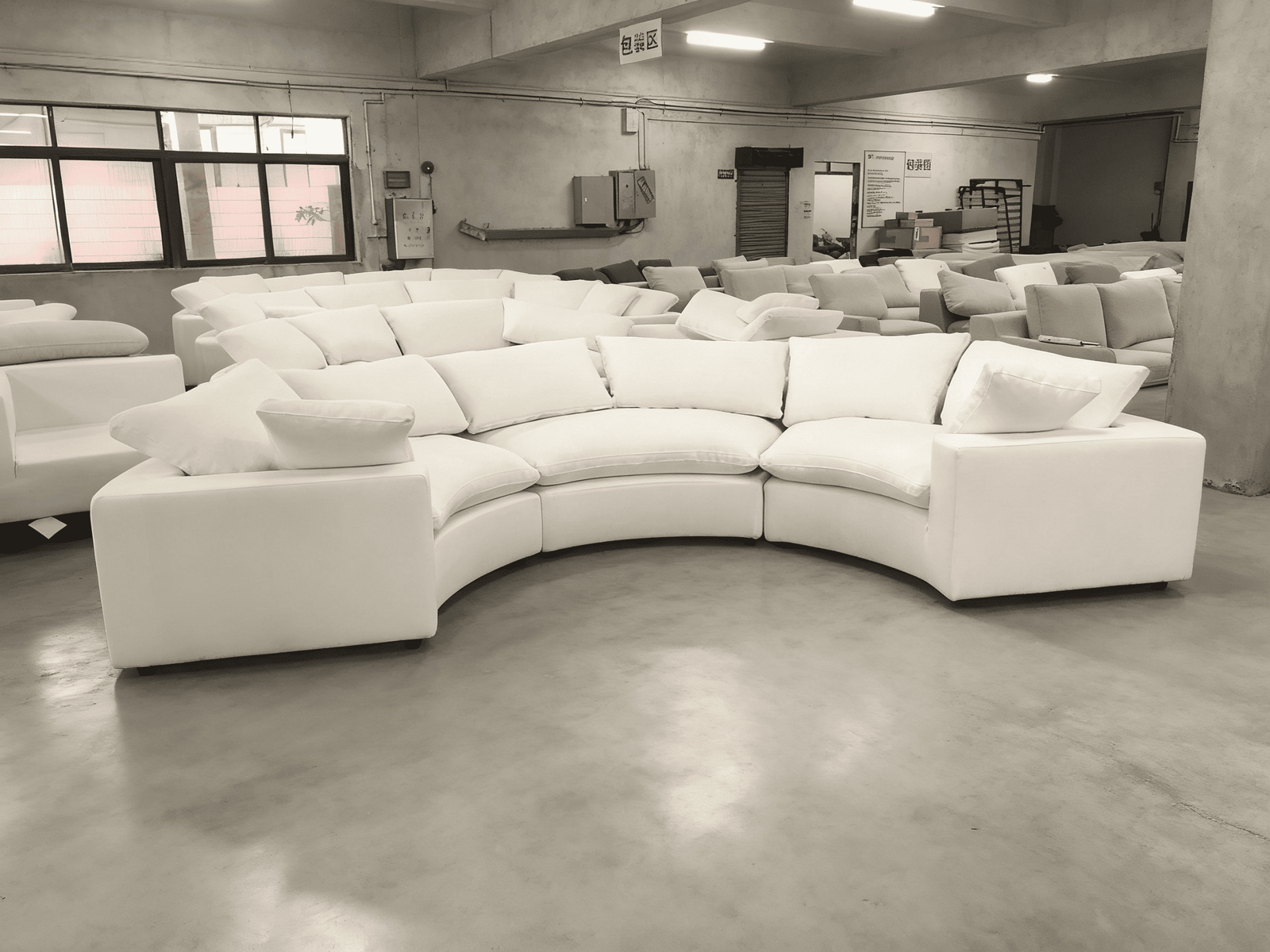
Designers we've worked with here at Linen World ask about curved sofas in two situations. The first is a confident brief — the client wants the curve, the room is large, and the question is just about execution. The second is harder: the room is unconventional, the client is interested but cautious, and the designer needs to know whether curved is actually going to work before they commit to the spec. This guide is written for the second situation. It covers the decisions that actually determine whether a curved sofa succeeds in a space — starting with the one most designers get wrong first.
Is Room Size Really the Reason to Reject a Curved Sofa?
Designers often eliminate curved sofas early when a room is under a certain square footage. The assumption is that the form takes up too much space. But that assumption costs projects a good solution.
The real variable is not square footage — it's floor plan shape and traffic path. A correctly scaled curved sofa in a smaller room can anchor the seating zone, reduce the need for additional pieces, and create a defined social area without consuming more floor space than a rectangular sofa would.
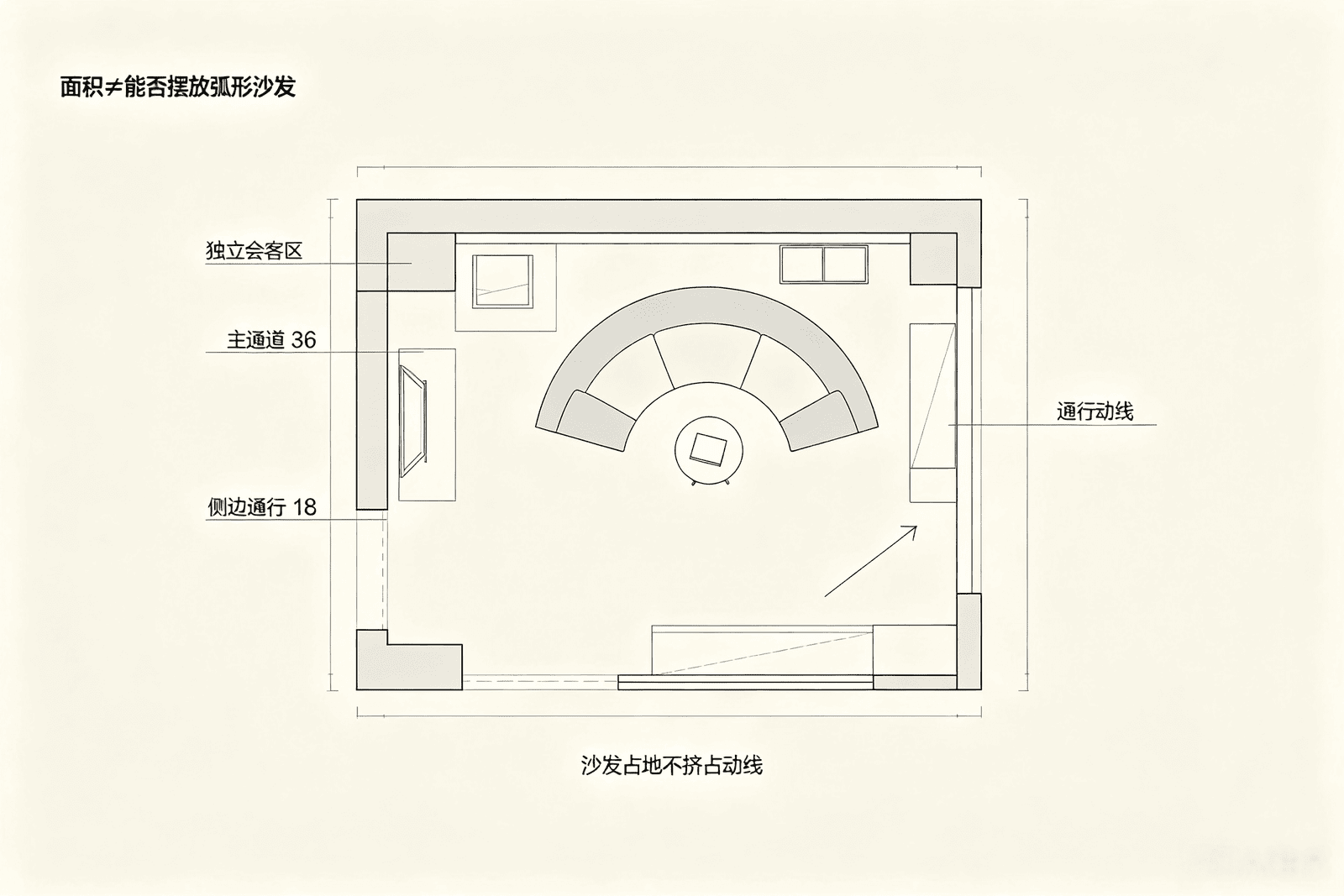
The mistake is treating square footage as a proxy for spatial complexity. It isn't. A 400 sqft open-plan studio and a 400 sqft square room are completely different problems.1 One has a traffic path running through the center; the other has natural wall zones. A curved sofa placed with its back to the flow in the studio can do something a rectangular sofa cannot — it signals the boundary of the seating area without using a physical barrier.2
What to Measure Instead of Total Square Footage
| Variable | Why It Matters |
|---|---|
| Primary traffic path width | Curved back profiles can narrow or widen perceived passage depending on orientation |
| Seating zone depth | A shallow zone may need a tighter radius to avoid the sofa reading as oversized |
| Anchor wall or window line | The curve's concave face should face the room's visual anchor in most plans3 |
| Secondary furniture requirements | A well-placed curved sofa often removes the need for one additional accent chair |
The designers we've worked with who had success with curved sofas in smaller rooms shared one approach: they drew the traffic path first and placed the sofa second. The curve followed function. When that order is reversed — when the curve is placed because it looks right in plan view — the delivery result is unpredictable.
Why Does a Curved Sofa Sometimes Feel Like It Blocks the Room?
This is the complaint that comes up most often in spec conversations: the curved sofa looked right in the rendering, but at delivery it closes off the space. The room feels smaller and harder to move through. That's a configuration problem, not a category problem.
Curved sofas block flow when they are oriented the same way a rectangular sofa would be. The logic is different. A curved sofa's radius and the direction its concave face points determine whether it opens a layout or shuts it down. Orientation is the primary control.
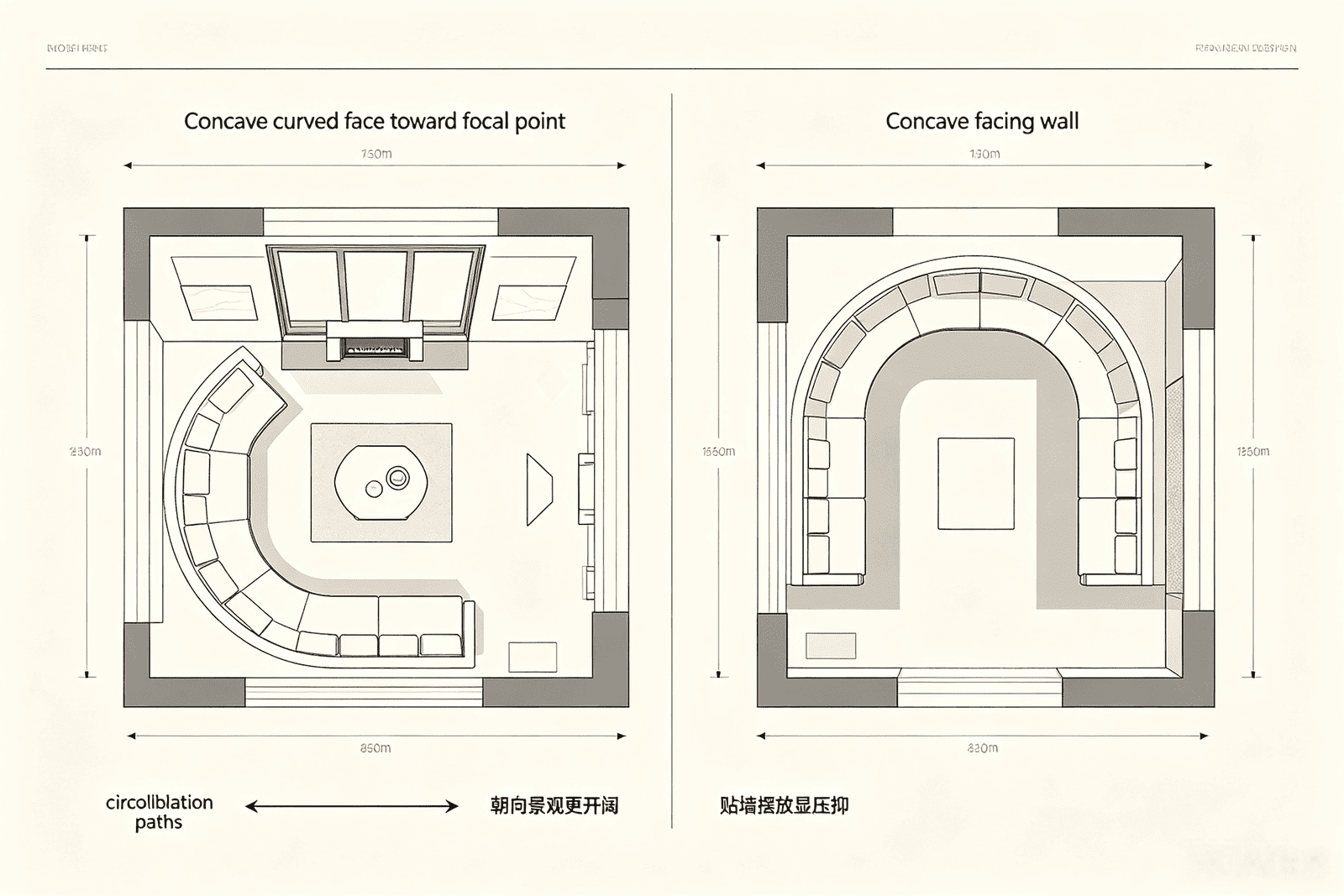
Rectangular sofas are positioned relative to walls. Curved sofas are positioned relative to sight lines and movement paths. The concave face of a curved sofa pulls people toward it.4 If that face is pointed toward a wall or a corner, it pulls the visual energy in the wrong direction. If it faces the room's main gathering point — a fireplace, a view window, a dining area — it draws the room together.
Three Orientation Patterns and Their Spatial Effects
Concave facing inward toward a gathering point This is the most common successful configuration. The curve wraps the seating zone and defines it without closing it. People moving through the room can read the boundary clearly and navigate around it. This works in open-plan living areas where the sofa needs to separate the living zone from a kitchen or dining area without using a wall.
Concave facing a window or view This works in rooms where the view is the dominant feature. The sofa becomes a framing device. The risk here is that it pushes all traffic to the perimeter, which can feel awkward if the room is narrow. In projects we've produced for coastal properties with wide-format windows, this orientation has been used successfully — but it requires enough depth behind the sofa to allow passage.
Concave facing outward or toward a wallThis configuration rarely delivers balanced spatial flow. The prominent convex rear tends to dominate the room’s center, creating an enclosed seating zone and making the sofa visually bulkier than its actual measurements. If a designer finds that a curved sofa "doesn't work" in a room, this is usually the configuration being used.
Does Upholstery Material Actually Change How a Curved Sofa Reads in a Space?
It does — more than most material selection conversations acknowledge. The same curved form in different fabrics can read as heavy and formal, or light and livable. That difference affects whether the sofa fits the visual character of a high-end residential interior.
Curved sofas in leather or velvet carry visual weight. The same form in natural linen reads lighter, softer, and more compatible with the organic and minimalist interiors that most high-net-worth residential clients are commissioning right now5. This is a material argument, not just a style preference.
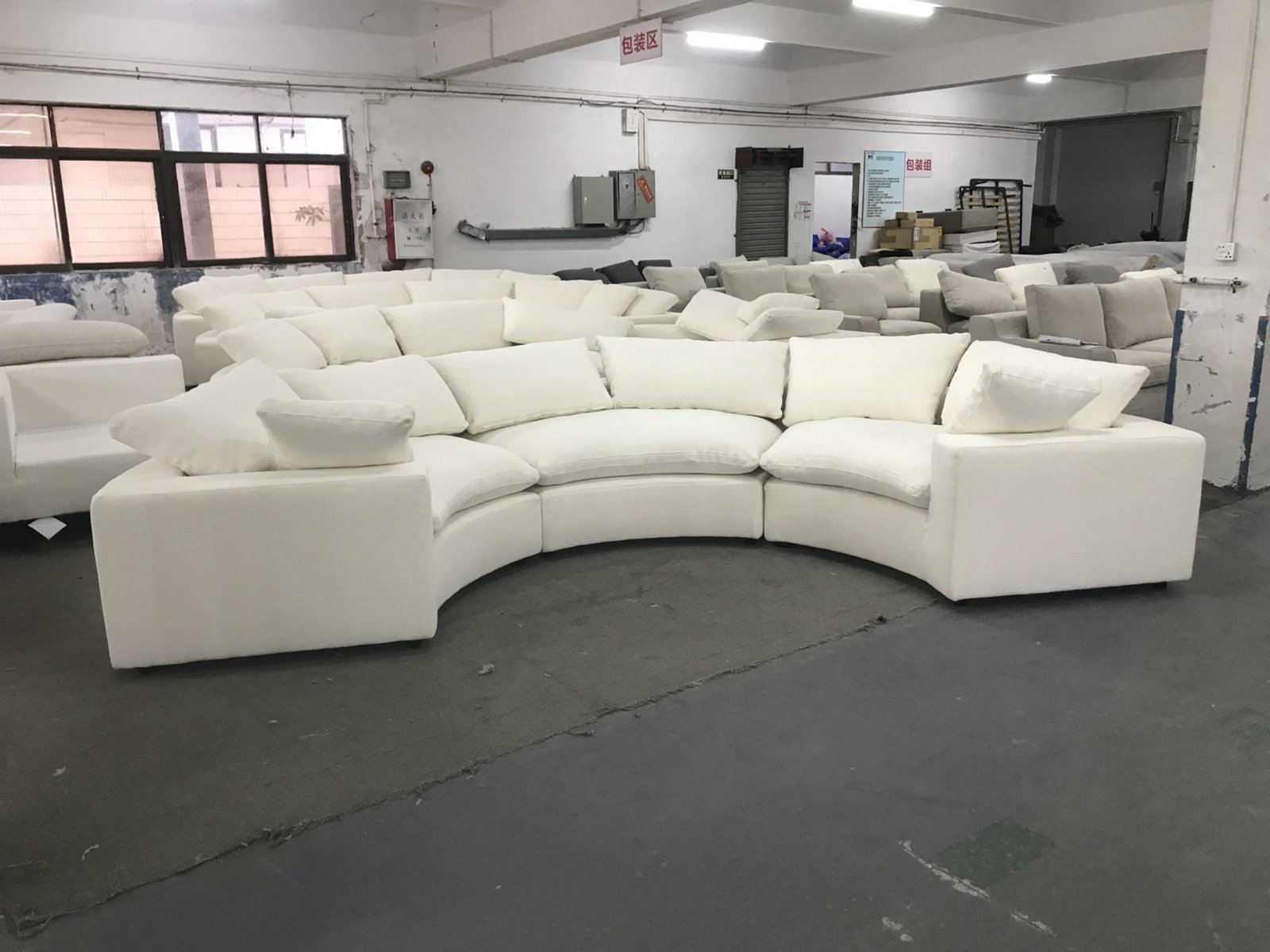
The reason linen changes the equation is textural. Leather and velvet have high surface reflectivity — they catch light in a way that makes the form's volume obvious. Linen absorbs and diffuses light.6 The curve's silhouette is still present, but the mass reads as softer. In a room with natural wood, stone, or plaster surfaces — which is the dominant material palette in the projects we're producing for right now — a linen curved sofa sits inside that material logic7. A velvet curved sofa sits on top of it.
How Fabric Category Affects Perceived Scale
| Fabric Type | Light Behavior | Perceived Weight | Best Room Context |
|---|---|---|---|
| Natural linen | Diffuse, matte | Light, casual, organic | Organic minimalist, Japandi, coastal |
| Velvet | High reflectivity | Heavy, formal | Maximalist, jewel-tone interiors |
| Leather | Specular | Structured, substantial | Industrial, contemporary, masculine |
| Performance weave | Neutral | Medium | Family spaces, high-traffic areas |
There is also a practical durability argument for linen in residential projects. Belgium pure linen — which is the primary fabric we work with — wears well, softens with use rather than degrading, and ages in a way that clients describe as intentional rather than worn.8 For a high-cost custom piece that a client will live with for ten to fifteen years9, that aging behavior matters. Velvet flattens unevenly. Leather cracks at joints.10 Linen features a more uniform, predictable aging profile compared to standard velvet and entry-level leather upholstery.
What Happens When the Standard Curved Sofa Sizes Don't Fit the Floor Plan?
This is where a lot of curved sofa specs fall apart. A designer identifies the right form, the right fabric direction, and the right orientation — and then finds that the available showroom sizes don't match the room. The radius is too tight or too open. The length crowds the traffic path by six inches. The project stalls.
Made-to-order curved sofas solve the sizing problem that showroom constraints create. At comparable quality to domestic production and 40–50% lower cost, custom curved sofas built to exact floor plan dimensions are accessible for the projects where standard sizing doesn't work.
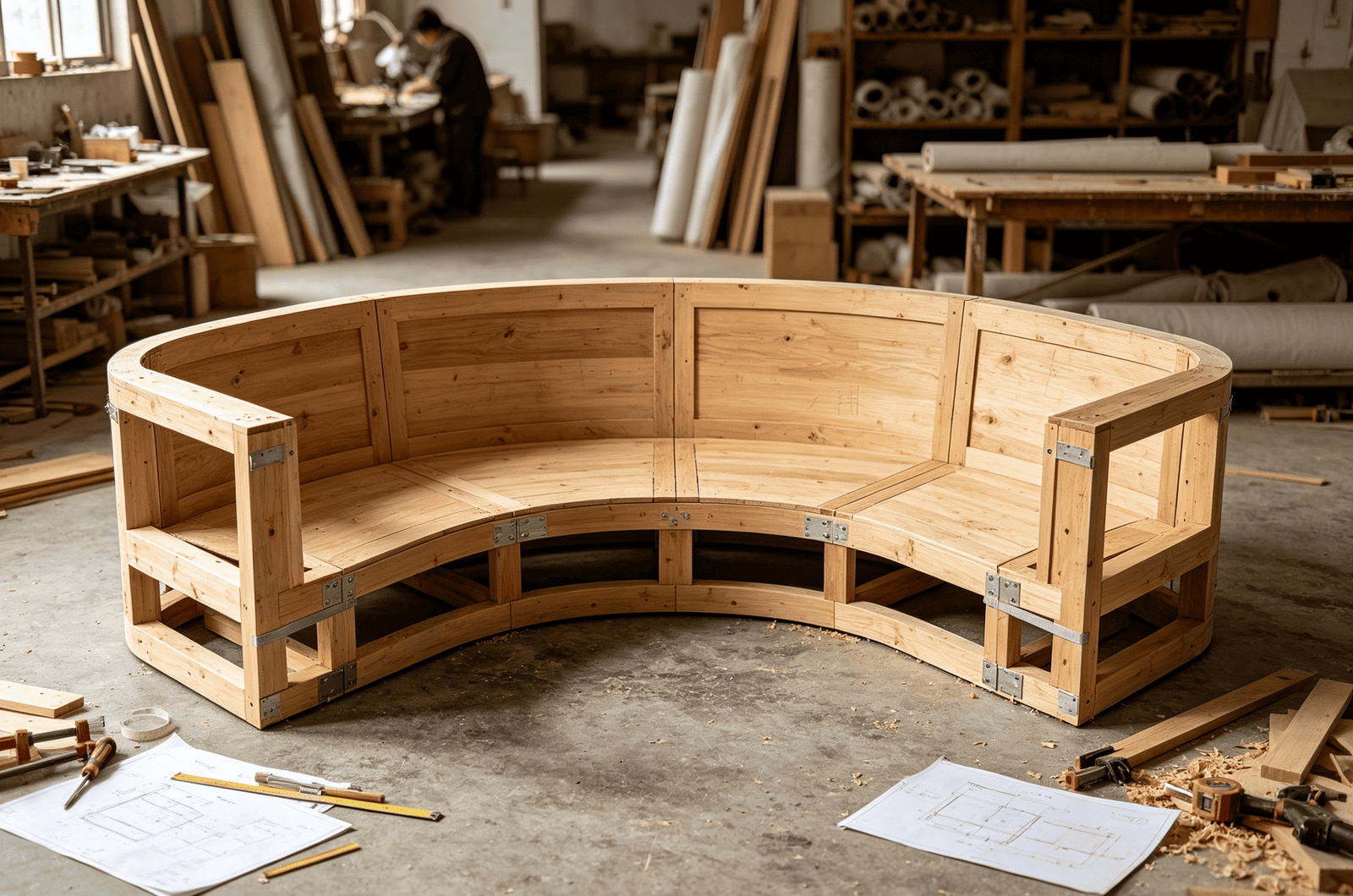
Designers we've worked with who first approached us for a custom spec were often surprised that the process was straightforward. The lead time is longer than off-the-shelf — that's real, and it needs to be planned into the project timeline. But the result is a sofa built to the exact radius, seat depth, and overall length the floor plan requires. For atypical rooms — and most of the high-end residential projects we see are atypical in some way11 — that precision is the difference between a spec that works and one that looks like a compromise.
What Custom Specification Actually Controls
| Specification Variable | What It Affects |
|---|---|
| Overall arc length | Whether the sofa fits the seating zone without crowding traffic paths |
| Radius tightness | How enclosed or open the seating area feels |
| Seat depth | Whether the sofa reads as lounge-scale or upright and conversational |
| Leg height and profile | Visual weight, ease of cleaning, compatibility with rug level |
| Fabric selection (200+ linen colorways) | Final visual tone, room integration, client preference |
The cost argument is worth stating plainly. For a project where a designer is already looking at domestic custom options in the $8,000–$15,000+ range for a curved sofa, a made-to-order piece from our production line — in the same quality bracket, with full fabric customization — typically comes in at 40–60% below that12. That gap is significant enough to affect how a project budget is allocated. We don't position this as a budget option. We position it as the same quality decision, made at a more rational price point.
Conclusion
Curved sofa styling succeeds when spatial logic, orientation, and material choice are treated as one connected decision — not three separate ones handled in sequence.
If you’re an interior designer sourcing custom curved linen sofas for US luxury residential projects, our 13-year Foshan workshop offers fully customizable arc radius, seat depth and 200+ Belgian linen colorways. We provide free floor plan layout suggestions based on your room dimensions.Contact us via WhatsApp to request fabric swatches, factory virtual tours or custom project quotations.https://linenworld.pro
"The effects of floor plan representations on preferences for apartments", https://pmc.ncbi.nlm.nih.gov/articles/PMC9418650/. Architectural space planning literature distinguishes between area and configuration as independent spatial variables, noting that plan geometry — including aspect ratio, circulation path structure, and zone adjacency — determines functional layout constraints independently of total floor area. Evidence role: general_support; source type: education. Supports: Room configuration and plan geometry are distinct spatial variables from total floor area and have independent effects on furniture placement and circulation planning.. Scope note: Most space planning literature addresses commercial or multi-unit residential contexts; direct empirical studies comparing plan shape effects on furniture placement in single-room residential settings are limited. ↩
"How to Design the Perfect Open plan Living Space - Davidson London", https://www.davidsonlondon.com/how-to-design-the-perfect-open-plan-living-space/. Research on open-plan residential layouts has examined how furniture arrangement communicates spatial boundaries and influences movement patterns, supporting the principle that form and orientation can substitute for physical partitions in zone definition. Evidence role: general_support; source type: research. Supports: Furniture placement and form can define spatial zones in open-plan environments without physical barriers.. Scope note: Most spatial planning literature addresses furniture placement generally rather than curved versus rectilinear forms specifically. ↩
"How To Arrange Your (Big Or Small) Living Room & 10+ ... - YouTube",
. Interior design and space planning curricula consistently identify orientation toward a room's focal point — such as a fireplace, window, or architectural feature — as a primary principle governing seating arrangement, with furniture form and concavity used to reinforce rather than contradict that directional logic. Evidence role: expert_consensus; source type: education. Supports: Interior design guidelines recommend orienting seating toward the room's primary focal point or visual anchor as a foundational furniture arrangement principle.. Scope note: Formal empirical validation of this principle as a universal rule is limited; it reflects professional consensus and pedagogical convention rather than controlled experimental findings. ↩"Form and Function in Information for Visual Perception - PMC - NIH", https://pmc.ncbi.nlm.nih.gov/articles/PMC8728782/. Environmental psychology research on spatial affordances and form perception suggests that concave surfaces are associated with enclosure and invitation, influencing occupant orientation and movement within a space. Evidence role: mechanism; source type: research. Supports: Curved and concave architectural or furniture forms influence perceived affordance and directional pull in spatial environments.. Scope note: Direct experimental evidence specifically comparing concave versus convex sofa orientations and their effect on room navigation is limited; broader architectural perception studies provide contextual rather than direct support. ↩
"Luxury Interior Design Market Research Report 2034 - Dataintelo", https://dataintelo.com/report/luxury-interior-design-market. Design industry trend reports and luxury market analyses have identified organic minimalism — characterized by natural materials, muted palettes, and restrained form — as a dominant commissioning direction in premium residential interiors during the early-to-mid 2020s. Evidence role: general_support; source type: institution. Supports: Organic minimalism and related natural-material aesthetics have been identified as leading style preferences among high-net-worth residential interior design clients in recent years.. Scope note: Trend characterizations in design industry reports are often based on editorial observation and practitioner surveys rather than statistically representative sampling of client commissioning behavior. ↩
"Optical properties (bidirectional reflection distribution functions) of ...", https://pubmed.ncbi.nlm.nih.gov/18286094/. Textile science literature documents that fabric surface structure determines light interaction: smooth or pile surfaces such as velvet and leather exhibit higher specular reflectance, while loosely woven natural fibers such as linen produce diffuse scattering, affecting the perceived luminosity and visual mass of upholstered objects. Evidence role: mechanism; source type: research. Supports: Textile materials differ in surface reflectance characteristics, with woven natural fibers such as linen exhibiting more diffuse light scattering compared to smooth or pile fabrics such as leather and velvet.. Scope note: Quantitative photometric comparisons of upholstery fabrics in interior lighting conditions are sparse; most textile optical research focuses on industrial or apparel applications rather than furniture perception. ↩
"[PDF] Sustainable Materials in High-End Residential Interior Design", https://digitalcommons.usu.edu/cgi/viewcontent.cgi?article=1674&context=honors. Industry trend analyses and design forecasting reports from professional interior design associations have identified a sustained preference for natural, tactile material palettes — including stone, timber, and mineral plaster — in premium residential interiors across the early 2020s. Evidence role: general_support; source type: institution. Supports: Natural and tactile materials including wood, stone, and plaster have been identified as dominant in contemporary high-end residential interior design trends.. Scope note: Design trend reports vary in methodology and sample scope; regional market variation means that material preferences in one geography may not reflect global high-net-worth residential commissioning patterns. ↩
"The Ultimate Upholstery Fabric Guide: Fibres to Finishes…", https://fibreguard.com/upholstery-fabric. Textile science literature characterizes linen as one of the strongest natural fibers, with abrasion resistance and a fiber structure that softens through mechanical use without significant degradation, contrasting with velvet pile flattening and leather surface cracking at stress points. Evidence role: general_support; source type: research. Supports: Linen fiber has documented durability characteristics including high tensile strength and a softening aging profile that distinguishes it from pile and animal-hide upholstery materials.. Scope note: Comparative long-term upholstery wear studies under residential use conditions are limited; most durability data derives from standardized laboratory abrasion tests rather than in-situ aging observations. ↩
"Comprehensive life cycle assessment of 25 furniture pieces across ...", https://pmc.ncbi.nlm.nih.gov/articles/PMC12015272/. Consumer product durability guidelines and furniture industry standards generally cite a lifespan of approximately seven to fifteen years for upholstered seating, with higher-quality construction and materials associated with the upper end of that range. Evidence role: statistic; source type: institution. Supports: Quality upholstered sofas have an expected residential lifespan in the range of ten to fifteen years under normal use conditions.. Scope note: Lifespan estimates vary widely by construction quality, use intensity, and maintenance; the ten-to-fifteen-year figure represents a general industry benchmark rather than a controlled empirical measurement. ↩
"Velvet Sofa Fabric Durability: Wear, Pilling & Fading Resistance Guide", https://www.hnleading.com/how-resistant-is-sofa-velvet-upholstery-fabric/. Industry upholstery testing standards and textile evaluation literature identify pile compression and uneven wear as characteristic failure modes for velvet fabrics under sustained load, while leather degradation studies document cracking and delamination at high-flex zones such as seat and arm joints. Evidence role: general_support; source type: institution. Supports: Velvet pile fabrics are susceptible to uneven crushing under repeated pressure, and leather upholstery is prone to cracking at flexion points over time.. Scope note: Failure timelines vary substantially by fabric grade, backing construction, and use intensity; general material failure modes may not apply uniformly across all product quality levels. ↩
"Third Floor Plans - Custom Home & Community Design", https://www.thirdfloorplans.com/. Architectural research on custom residential construction documents that high-value bespoke homes frequently incorporate non-standard room proportions, irregular plan geometries, and client-specific spatial programs that diverge from the dimensional assumptions embedded in mass-market furniture sizing. Evidence role: general_support; source type: research. Supports: High-end and custom residential construction is associated with non-standard spatial configurations that reduce the applicability of standardized furniture dimensions.. Scope note: Systematic quantitative data on the prevalence of atypical floor plans specifically within the luxury residential segment is limited; this characterization is supported by qualitative architectural literature rather than large-scale survey evidence. ↩
"The Effect of Furniture Imports from China on Employment in U.S. ...", https://www.usitc.gov/publications/332/working_papers/ecwp_2017-08-a-08-23-17_0.htm. Trade economics research on furniture manufacturing documents substantial labor cost differentials between domestic and offshore production, with studies noting that custom upholstered goods sourced from major furniture-exporting regions can carry significantly lower landed costs than equivalent domestic custom production, though the precise differential depends on material specification, logistics, and tariff conditions. Evidence role: general_support; source type: research. Supports: Significant cost differentials exist between domestically produced custom upholstered furniture and equivalent pieces manufactured in lower-labor-cost production regions.. Scope note: The 40–60% figure cited is specific to one supplier's pricing and cannot be generalized; actual cost differentials vary by product complexity, material sourcing, shipping costs, and applicable import duties. ↩


