Linen slipcovers look beautiful — until the first wash. Most owners ruin them not through neglect, but by following the wrong logic for the wrong fabric.
Washing a linen slipcover safely comes down to four rules: machine wash at or below 30°C on a gentle cycle, remove while still slightly damp, reshape on the sofa, and iron at medium-low heat only. Follow these four steps and a Belgium pure linen slipcover will hold its fit and color for years.
Customers ask us this question more than almost any other. After 13 years of producing Belgium pure linen upholstery, I have seen the same mistakes repeat — and I have seen good slipcovers get pulled out of shape after a single wash cycle. The problem is almost never the fabric. It is the care logic people bring to it. Linen is not cotton. It does not behave like cotton, and treating it like cotton is where the damage starts. The next four sections break down each rule, explain why it exists, and show you what actually happens inside the fiber when the rule is ignored.
Why Does Temperature Matter So Much When Washing Linen?
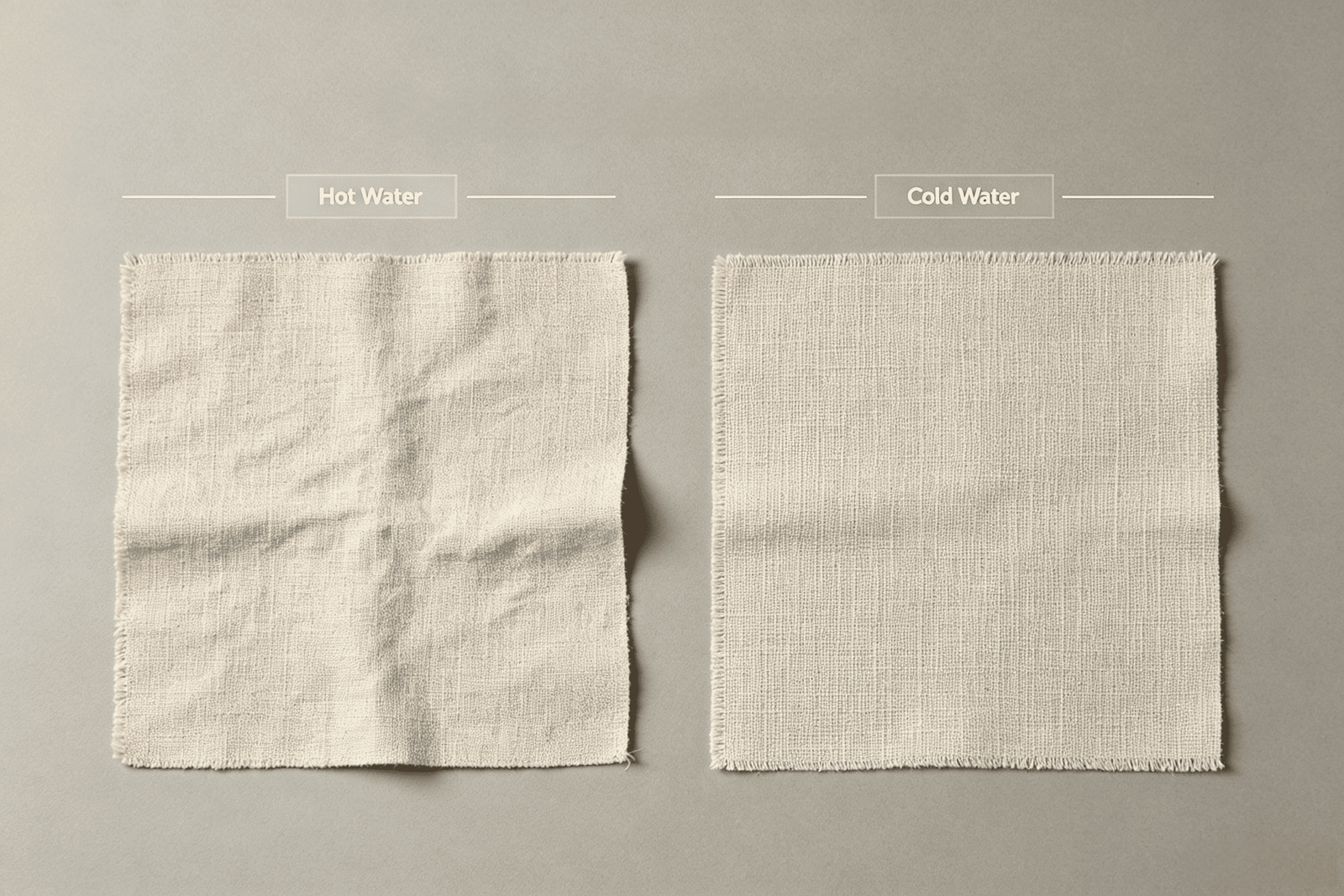
Every year, we hear from customers who say their slipcover no longer fits after the first wash. The slipcover went in looking fine. It came out two inches shorter on every side. The sofa is now half-exposed, and the owner assumes the product is defective.
The issue is almost always heat. Belgium pure linen fiber contracts sharply when exposed to water above 30°C, and unlike synthetic fibers, it does not relax back into its original shape once the heat is removed1. A single high-temperature wash cycle can cause enough dimensional change to make re-fitting impossible2.
Linen is made from the stem of the flax plant3. The fiber structure is dense and strong — which is part of what gives Belgium pure linen its characteristic weight and drape. But that same density means the fibers are tightly packed with very little elasticity. Cotton fibers have a natural crimp that allows them to absorb some movement from heat. Linen does not.4
Here is what happens at a fiber level when linen meets high heat in the wash:
| Wash Temperature | Fiber Behavior | Expected Outcome |
|---|---|---|
| Below 30°C | Fibers absorb water slowly, minimal contraction | Safe. Shape holds. |
| 30°C–40°C | Mild contraction begins, partial recovery possible | Risky. Some distortion likely. |
| Above 40°C | Rapid, irreversible contraction across the weave | Severe shrinkage. Re-fitting usually not possible. |
The practical instruction is simple: set your machine to a cool or cold gentle cycle, and confirm the temperature display reads 30°C or lower before you start. Do not assume "delicate" or "hand wash" mode means cool — some machines still heat those cycles. Check the setting directly.
One more point worth making: linen-cotton blends are more forgiving at slightly higher temperatures because the cotton content adds elasticity. The rules in this article are scoped specifically to 100% Belgium pure linen. Blended fabrics behave differently, and care instructions for blends should not be imported back onto pure linen.
What Is the Half-Dry Trick, and Why Does It Work?
Getting the wash temperature right is step one. What you do after the cycle ends matters just as much — and most people skip this entirely.
Remove the slipcover from the machine while it is still slightly damp — not soaking wet, but not fully dry either. Put it back on the sofa frame immediately, smooth it into position by hand, and let it finish drying in place. The residual moisture keeps the fibers pliable long enough to reshape around the frame.
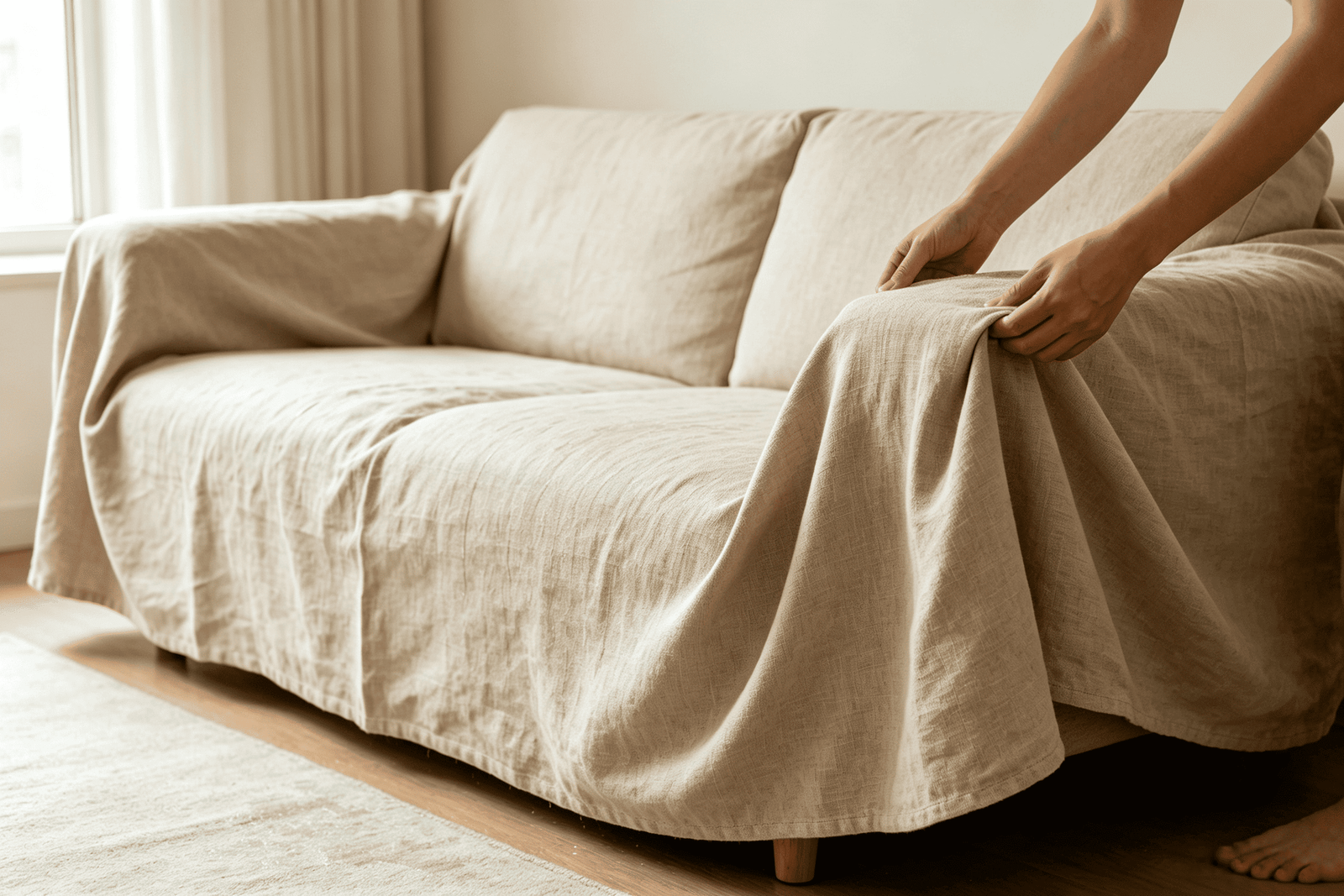
This is the single step that separates a slipcover that fits perfectly after washing from one that comes out stiff, bunched, or distorted. Here is the logic behind it.
Linen fibers are hygroscopic — they absorb and release moisture as conditions change5. When the slipcover is damp, the fibers are in a temporarily softened state. This is the window where physical shaping is possible. Once the fabric fully dries, the fibers lock back into whatever position they dried in. If the slipcover dried in a pile on the machine drum, it locks into that shape. If it dried stretched across a sofa frame, it locks into that shape instead.
What "Slightly Damp" Actually Means
There is a practical question here: how damp is slightly damp? The target is a state where the fabric feels cool and slightly heavy to the touch, but no water transfers to your hand when you press down. If water drips when you lift it, let it air for another 10 to 15 minutes before putting it on the sofa.
If You Cannot Reshape Immediately
If you need to let the slipcover sit before reshaping, lay it completely flat on a clean surface — do not fold it or bunch it. Folding while damp creates crease lines that set into the fabric as it dries, and those lines are difficult to remove later even with ironing.
The Alternative: Flat Drying
For slipcover panels that are small enough, flat drying on a towel-covered surface works as an alternative. Smooth the panel into its intended shape, check all four edges are aligned, and leave it undisturbed until dry. The result is the same as reshaping on the sofa — the fibers dry in a flat, even position.
What does not work is machine drying on heat. The tumbling action and heat combine to create exactly the same problem as a high-temperature wash: irreversible contraction and distortion6. If your slipcover needs to dry faster, use a fan on a cool setting pointed at the fabric while it is already on the sofa frame or laid flat.
Is the Uneven Color in My Linen Slipcover a Defect?
This question comes up regularly, and it causes real confusion. A customer receives a Belgium pure linen slipcover, installs it, and notices that the color is not completely uniform — some areas look slightly different in tone under natural light. The assumption is often that the dye is uneven, or that the fabric has already started fading.
This is not a defect. Belgium pure linen has natural variation in fiber thickness and density across the weave. These differences cause the fabric to absorb dye at slightly different rates in different areas. The result is subtle tonal variation that is intrinsic to the material — it is one of the visible characteristics of high-quality natural linen.
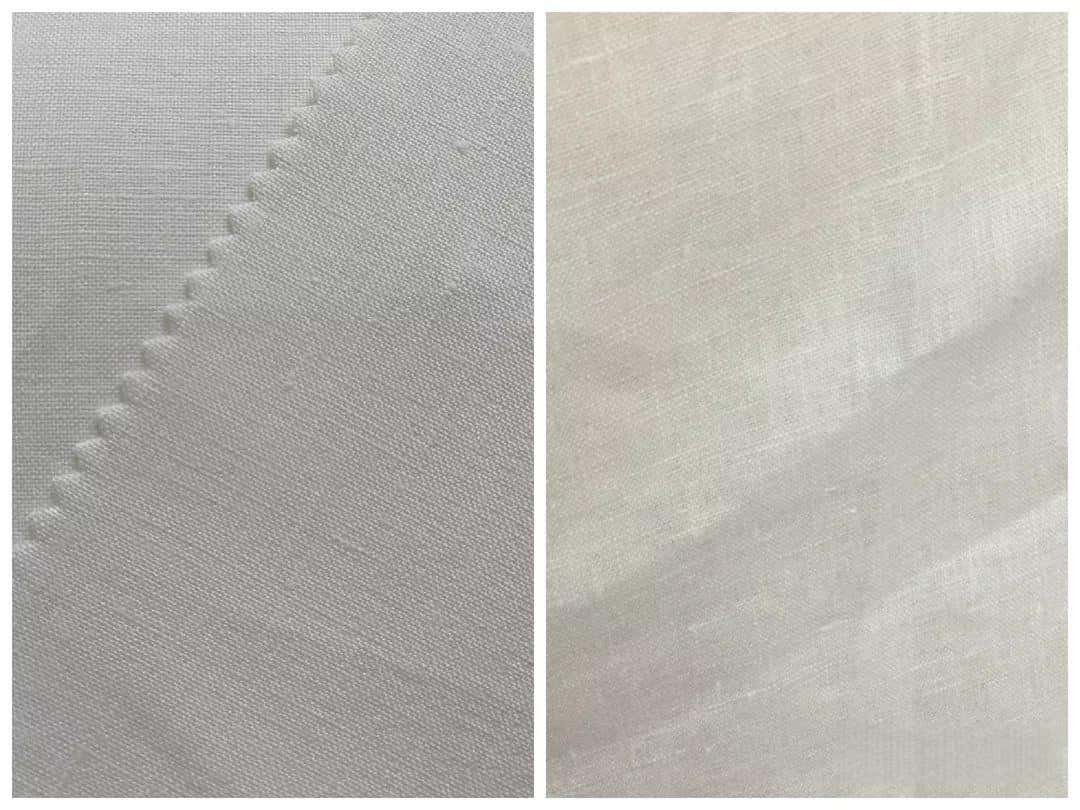
Understanding why this happens requires a short look at how Belgium pure linen is produced. Flax fibers are natural — they come from a plant, and no two bundles of plant fiber are identical7. Even within a single roll of fabric, there are minor differences in fiber diameter and weave density from one area to the next. When the fabric is dyed, these differences mean that some areas accept color slightly more or less deeply than others.
How to Distinguish Natural Variation from Actual Fading
Natural variation and actual fading look different. The table below outlines the key differences:
| Characteristic | Natural Fiber Variation | Actual Fading or Dye Problem |
|---|---|---|
| When it appears | Present from the start, before any washing | Develops gradually after washing or sun exposure |
| Pattern | Irregular, distributed across the weave | Often concentrated in areas of direct light or friction |
| Consistency | Stays the same over time | Gets more pronounced with each wash or sun cycle |
| Feel | No change in texture | Sometimes accompanied by surface wear or roughness |
Belgium pure linen also has more stable natural dye uptake than linen-cotton blends — this is one of the characteristics that distinguishes it from lower-density alternatives8. The color variation you see is a signature of the material, not a sign that something went wrong in production or in your care routine.
If you are seeing actual color change that worsens after each wash, check the wash temperature first. Heat damage can cause the fiber surface to break down in a way that releases dye faster than normal. But if the variation was there from the start and has not changed, it is the fabric expressing its natural character.
Is Dry Cleaning or High-Heat Ironing a Safer Option for Linen?
Some linen slipcover owners decide that machine washing feels too risky, and they look for a "safer" alternative. Dry cleaning and high-heat ironing are the two most common substitutes people try. Neither is a safe option, and the reasoning matters.
Dry cleaning solvents work by dissolving oils and residues, but they also strip the natural waxes that give linen fiber its structure and softness9. Over time, dry cleaning degrades Belgium pure linen at a fiber level and causes the fabric to become brittle and lose its drape. High-heat ironing causes localized scorching and fiber damage for the same reason as high-temperature washing — the fiber contracts under heat and does not recover.
Why Dry Cleaning Damages Linen
Dry cleaning is designed primarily for fibers that cannot tolerate water — wool, silk, some structured weaves10. Linen's relationship with water is different. Linen is a cellulose fiber, and water is its natural processing medium11. The problem with washing linen is not the water itself — it is the temperature and mechanical action of the water. Dry cleaning sidesteps both of those risks, but it introduces a different one: chemical solvent contact with a fiber that was never built to absorb and release solvents safely.
Based on our production experience with Belgium pure linen, repeated dry cleaning produces a gradual stiffening of the fabric that cannot be reversed. The fabric loses its characteristic soft drape, and the fiber surface begins to look dull rather than showing the subtle sheen that is typical of quality linen.
Ironing: The Right Approach
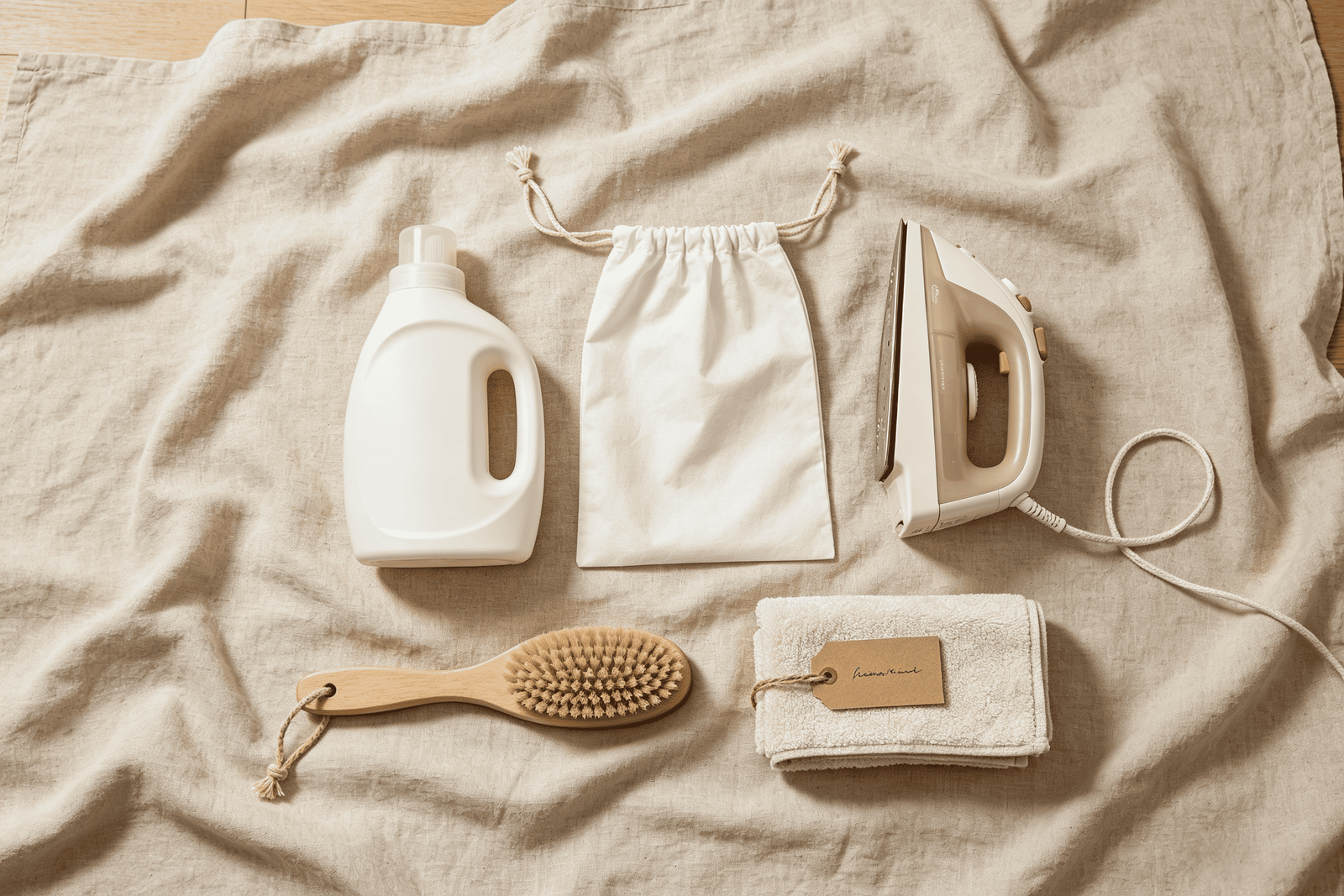
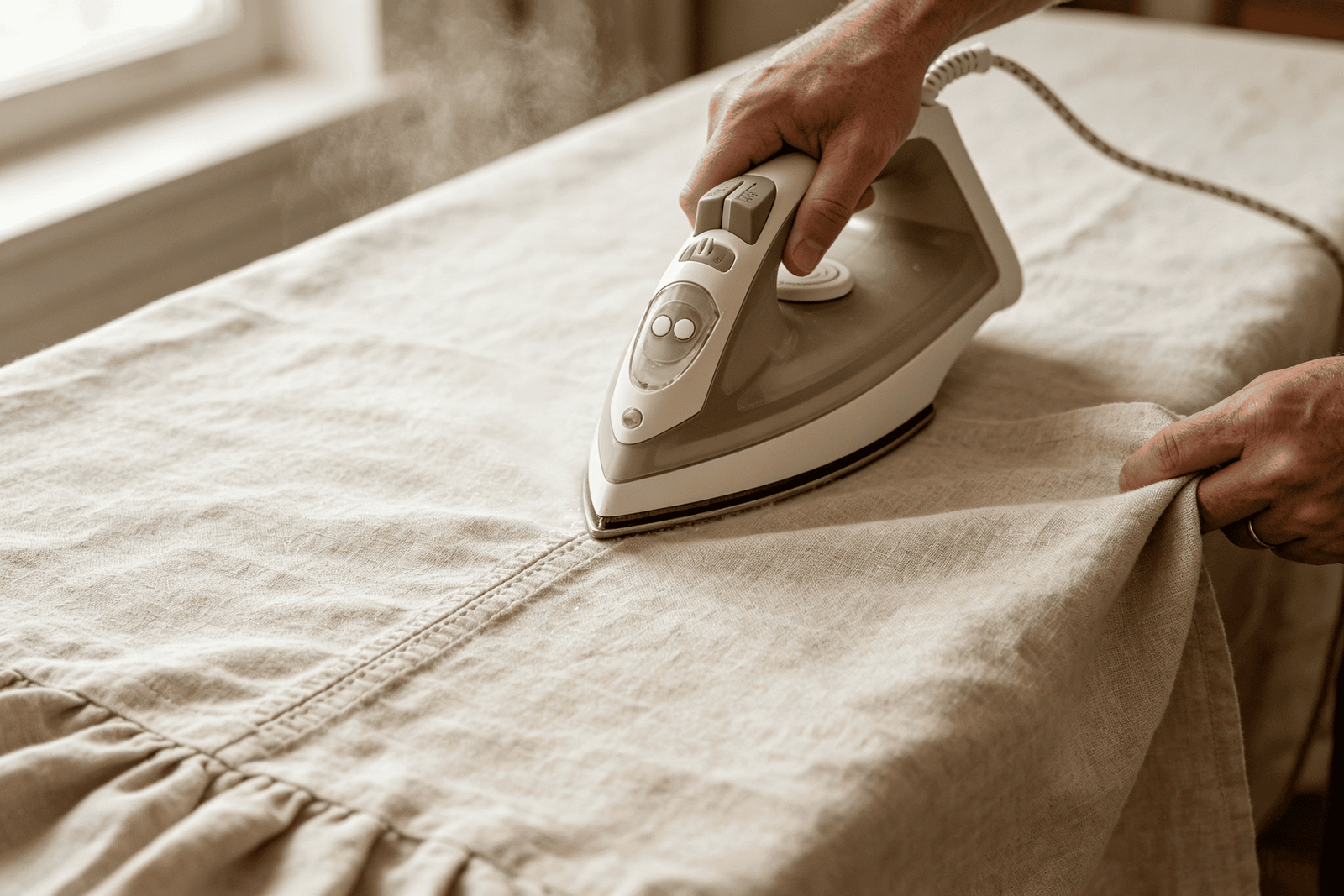
Ironing linen is safe, but only within the right temperature range. The correct setting is medium-low heat — on most irons, this corresponds to the two-dot symbol, or a setting labeled for silk or linen on older machines12. Check your iron's label guide if you are unsure.
| Iron Setting | Dot Symbol | Safe for Belgium Pure Linen? |
|---|---|---|
| Low | 1 dot (up to 110°C) | Yes, but minimal effect on creases |
| Medium-low | 2 dots (up to 150°C) | Yes — recommended setting |
| Medium-high | 3 dots (up to 200°C) | No — risk of fiber damage and scorching |
| High | Cotton/linen max | No — direct damage to pure linen |
The best time to iron a linen slipcover is when it is still slightly damp — either just after reshaping on the sofa frame, or by using a spray bottle to lightly mist the fabric before ironing. Damp fibers respond to medium heat quickly and smoothly. Ironing completely dry linen requires more passes and higher temptation to increase the heat, which is where damage happens.
Iron in the direction of the weave where possible, and use the weight of the iron rather than pressing hard. Linen does not need aggressive pressure — it needs even, moderate contact heat applied steadily.
Conclusion
Linen slipcovers are not difficult to care for once you understand the fiber logic. Wash cool, reshape while damp, accept natural color variation, and keep heat tools moderate — that is the full picture.
If you are still deciding whether a Belgium pure linen slipcover fits your life, the answer is almost certainly yes. We produce made-to-order linen sofas and slipcovers with 200+ color options, and we work with homeowners and designers across the US who want the look of high-end natural linen without the complexity they were afraid of. https://linenworld.pro
"Industrial washing conditions as factor that influence the cellulose ...", https://pmc.ncbi.nlm.nih.gov/articles/PMC10374651/. Research on cellulose fiber behavior under thermal and aqueous stress documents that flax-based linen exhibits limited elastic recovery compared to cotton, with dimensional changes becoming largely permanent above certain temperature thresholds during wet processing. Evidence role: mechanism; source type: paper. Supports: That linen (flax) cellulose fibers undergo irreversible dimensional contraction when exposed to elevated wash temperatures due to their low elasticity and dense fiber structure. Scope note: Direct experimental data on the precise 30°C threshold for irreversibility may not be available in published literature; sources may address broader temperature ranges or industrial processing conditions rather than domestic washing. ↩
"Does Linen Shrink? Explained - Son de Flor", https://sondeflor.com/blogs/all-about-linen/does-linen-shrink?srsltid=AfmBOorITz2trXrQVWhgSZjwilJXoE5Gqwb2q1WLQK17Cbht1ve7-3aQ. Textile testing standards and published studies on woven linen fabrics report shrinkage values of 3–8% or more after a single hot wash cycle, depending on weave construction and finishing; such dimensional changes are sufficient to cause fit failure in form-fitted upholstery applications. Evidence role: statistic; source type: research. Supports: That linen fabric can undergo significant and irreversible dimensional shrinkage in a single high-temperature wash, with shrinkage rates potentially exceeding several percent. Scope note: Reported shrinkage values vary considerably by fabric construction, finishing treatment, and test method; figures cited here are indicative ranges rather than values specific to upholstery-weight Belgium pure linen. ↩
"Flax - Wikipedia", https://en.wikipedia.org/wiki/Flax. Linen is classified as a bast fiber obtained from the phloem of the flax plant (Linum usitatissimum), with fiber extraction involving retting and scutching of the plant stem (Encyclopædia Britannica, 'Linen'). Evidence role: definition; source type: encyclopedia. Supports: That linen is a bast fiber extracted from the stem of the flax plant (Linum usitatissimum). ↩
"Linen Most Useful: Perspectives on Structure, Chemistry, and ... - PMC", https://pmc.ncbi.nlm.nih.gov/articles/PMC4403609/. Textile science references describe cotton fibers as having a natural convolution or crimp arising from their ribbon-like cross-section, which contributes to cohesion and some elastic recovery, whereas flax fibers are polygonal and relatively inelastic in structure (see, e.g., Morton & Hearle, *Physical Properties of Textile Fibres*). Evidence role: mechanism; source type: encyclopedia. Supports: That cotton fibers have a characteristic helical crimp or convolution in their structure that contributes to elasticity, while linen (flax) fibers are smoother and more rigid in cross-section. Scope note: General fiber morphology sources may not directly address the practical consequence of this structural difference for domestic washing outcomes. ↩
"Investigation of the Properties of Linen Fibers and Dressings - PMC", https://pmc.ncbi.nlm.nih.gov/articles/PMC9501175/. Linen derived from flax is documented as a hygroscopic cellulose fiber with a moisture regain of approximately 10–12% under standard conditions, a property that affects its dimensional behavior during and after wet processing. Evidence role: definition; source type: research. Supports: That linen (flax) fibers are hygroscopic and exhibit measurable moisture regain, absorbing and releasing water vapor in response to ambient humidity and wetness. Scope note: Sources typically report moisture regain under standardized laboratory conditions; the practical implication for reshaping during home drying is an extrapolation from this property rather than a directly studied outcome. ↩
"Dimensional stability (fabric) - Wikipedia", https://en.wikipedia.org/wiki/Dimensional_stability_(fabric). Textile research on fabric dimensional stability indicates that tumble drying at elevated temperatures subjects cellulose fibers to simultaneous thermal and mechanical stress, producing shrinkage and surface distortion comparable to or exceeding that caused by high-temperature wet washing in some fabric constructions. Evidence role: mechanism; source type: research. Supports: That tumble drying linen at elevated temperatures causes dimensional shrinkage and distortion through the combined effect of heat and mechanical agitation on cellulose fiber structure. Scope note: Studies comparing tumble drying and hot washing outcomes specifically for upholstery-weight linen are limited; findings from apparel-weight linen or cotton may not translate directly. ↩
"Linen Most Useful: Perspectives on Structure, Chemistry, and ... - PMC", https://pmc.ncbi.nlm.nih.gov/articles/PMC4403609/. Studies on flax fiber characterization document significant variability in fiber diameter (typically 10–25 µm) and cell wall composition within single plant stems and across harvests, which is known to produce differential dye uptake and tonal variation in finished linen textiles. Evidence role: mechanism; source type: paper. Supports: That natural flax fibers vary in diameter, cell wall thickness, and composition within and between batches, leading to differential dye absorption across a woven fabric. Scope note: Research on fiber variability is often conducted in the context of composite materials or industrial processing rather than decorative dye uniformity specifically. ↩
"Analyzing different functional and dyeing performance of natural ...", https://pmc.ncbi.nlm.nih.gov/articles/PMC11616555/. In linen-cotton blend fabrics, the differing dye affinity and uptake kinetics of cellulosic cotton versus bast linen fibers can produce unlevel dyeing effects; 100% linen fabrics dyed under uniform conditions avoid this inter-fiber differential, though intra-fiber variability inherent to flax remains. Evidence role: mechanism; source type: paper. Supports: That the presence of cotton fiber in linen-cotton blends introduces differential dye uptake between the two fiber types, potentially reducing color uniformity compared to 100% linen fabric. Scope note: The claim of greater dye stability in pure linen versus blends depends on ↩
"Dry cleaning - Wikipedia", https://en.wikipedia.org/wiki/Dry_cleaning. Flax fibers contain a small percentage of natural waxes (typically 1.5–1.7% by weight) that contribute to surface properties and handle; organic solvents used in dry cleaning are known to be effective at dissolving lipophilic compounds, raising the possibility of wax removal with repeated treatment. Evidence role: mechanism; source type: paper. Supports: That flax/linen fibers contain natural waxes as part of their chemical composition, and that organic solvents used in dry cleaning can remove these waxes, affecting fiber properties. Scope note: Direct experimental studies specifically measuring wax loss and resulting stiffness in linen after repeated dry cleaning cycles may be limited; the mechanism is inferred from general solvent chemistry and fiber composition data. ↩
"Dry cleaning - Wikipedia", https://en.wikipedia.org/wiki/Dry_cleaning. Dry cleaning, which uses non-aqueous solvents to remove soiling, is conventionally indicated for protein-based fibers (wool, silk) and structured garments that lose shape or shrink when wetted, rather than for cellulosic fibers such as linen and cotton, which are processed industrially with water (Encyclopædia Britannica, 'Dry Cleaning'). Evidence role: historical_context; source type: encyclopedia. Supports: That dry cleaning processes were developed primarily to clean textiles that are damaged by water, including protein fibers such as wool and silk. ↩
"The Influence of the Chemical Composition of Flax and Hemp Fibers ...", https://pmc.ncbi.nlm.nih.gov/articles/PMC10935324/. Linen fiber consists predominantly of cellulose (approximately 70–80% by dry weight), classifying it among the natural cellulosic fibers alongside cotton and jute, for which water-based wet processing is the conventional treatment medium in textile manufacturing. Evidence role: definition; source type: paper. Supports: That linen is composed primarily of cellulose and is therefore chemically compatible with aqueous (water-based) processing. ↩
"Laundry symbol - Wikipedia", https://en.wikipedia.org/wiki/Laundry_symbol. Under ISO 3758 (Textiles — Care labelling code using symbols), the two-dot ironing symbol indicates a maximum iron temperature of 150°C at the sole plate, which is the standard recommended setting for linen and similar natural fibers. Evidence role: definition; source type: institution. Supports: That the two-dot ironing symbol in international textile care labeling corresponds to a maximum sole-plate temperature of 150°C, suitable for linen. Scope note: Actual iron sole-plate temperatures may vary by manufacturer calibration; the ISO symbol indicates a maximum rather than a precise target temperature. ↩


