
Choosing the wrong fill for a custom linen sofa is not a minor comfort issue. It is a structural mistake that costs you shape, feel, and longevity — before the sofa even gets used.
Sofa cushion fill falls into two main categories: seat cushions and back cushions. Seat cushions typically use high-density foam, sometimes wrapped in fiber or down, for long-term shape retention. Back cushions often use down or down-alternative for a relaxed, lived-in feel. The right choice depends on your use case, not just your softness preference.
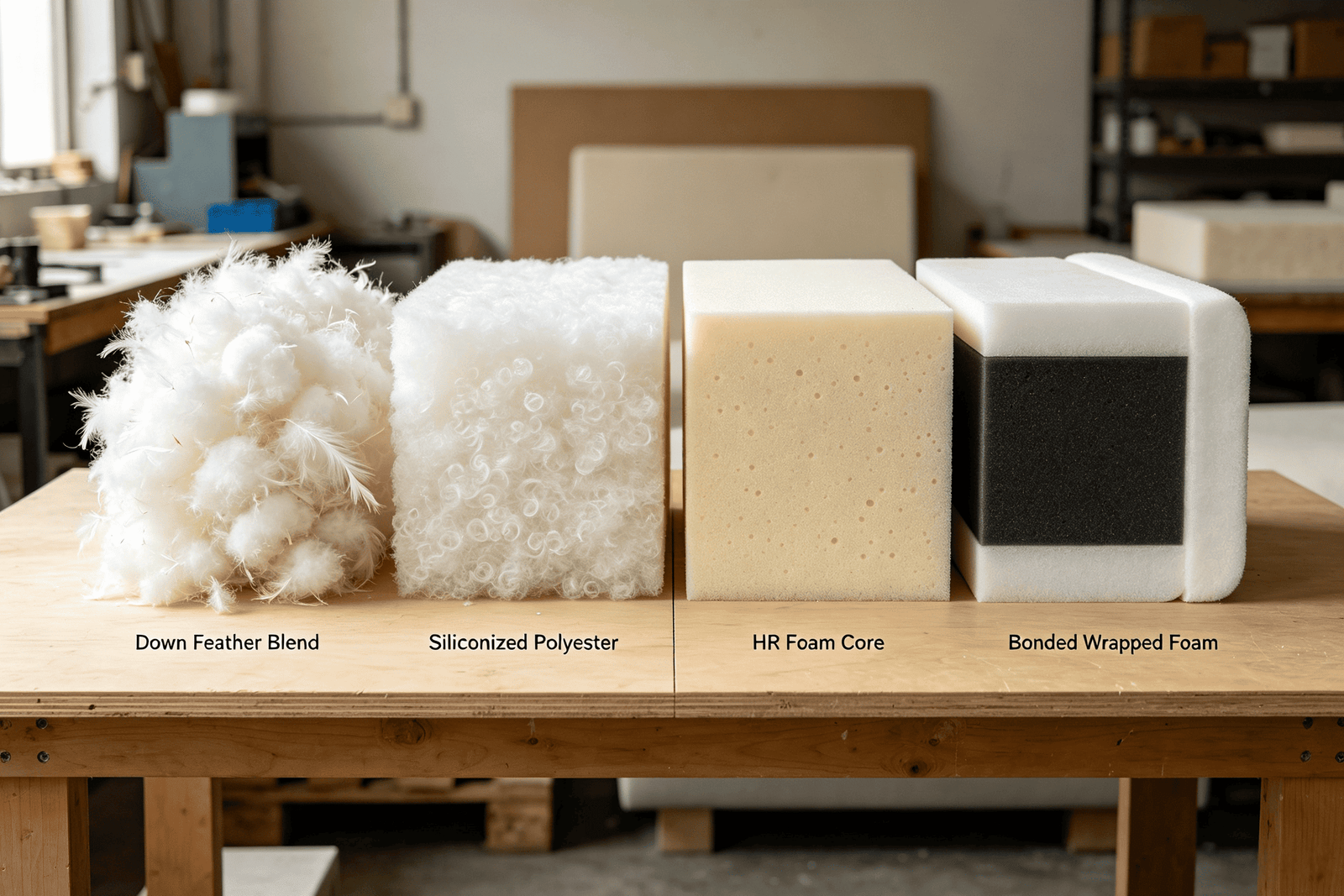
I work on the production side of a linen furniture factory in Foshan. We have been making custom linen sofas for US and European clients for 13 years. The fill questions I hear most often from interior designers are not about softness. They are about what holds up, what looks right in a high-end linen piece, and what their clients will not call them about in year two. That is exactly what this guide is for.
Is High-Density Foam Really Better for Seat Cushions?
Most clients assume seat cushion fill is a comfort choice. It is not. It is a structural decision that affects how long the sofa holds its shape.
High-density foam in seat cushions directly determines shape retention over time. A cushion with low-density foam may feel fine in the showroom but loses its profile within one to two years of regular use1. Density rating — measured in kg/m³ — is the number that matters most when evaluating seat cushion quality2.
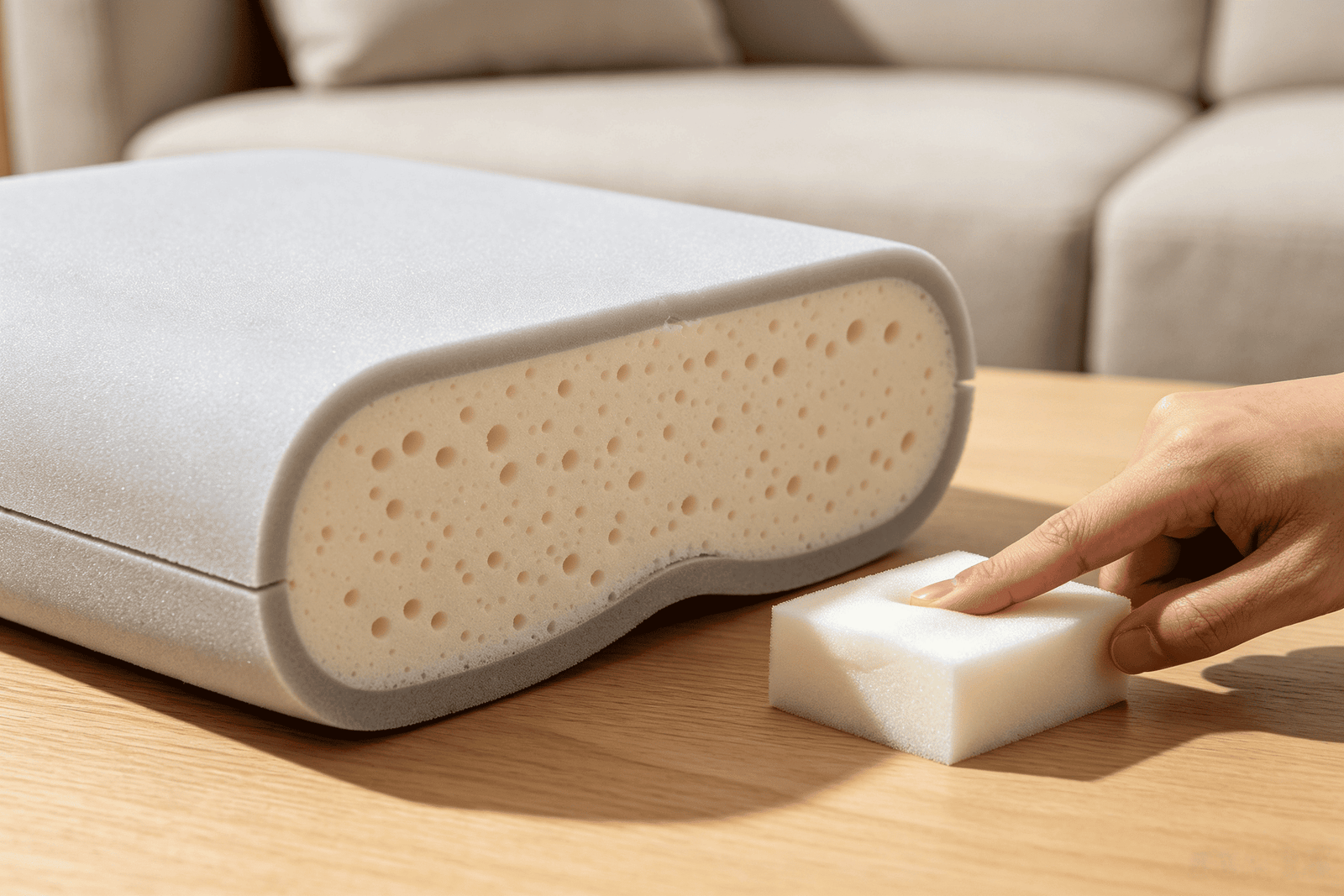
What Foam Density Actually Means in Practice
In our production process, we use high-density foam as the core of every seat cushion in our custom linen sofa builds3. The density rating is not a luxury upgrade. It is the baseline requirement for a made-to-order piece where the fabric has already been cut to a specific cushion volume.
When the foam core inside a seat cushion compresses over time, the fabric does not compress with it. The linen cover was cut to fit a specific volume. If the foam shrinks in profile, the cover goes slack. You see it as wrinkling, sagging, or a cushion that tilts forward when someone sits. That is not a fabric problem. It is a fill problem.
Here is what foam density means across different use contexts:
| Foam Density (approx.) | Expected Performance | Best Suited For |
|---|---|---|
| Low density | Loses profile within 1–2 years of daily use | Budget-tier pieces, occasional use seating |
| Medium density | Moderate shape retention, moderate compression | Mid-range production sofas, secondary seating |
| High density | Retains seat profile for years under regular use | Custom linen sofas, primary seating, designer projects |
Note: Verify exact kg/m³ specs with our production team before using these figures in client documentation.
Clients we work with often ask whether they can upgrade the foam density mid-order to save money earlier in the process. The answer is that changing foam density is not cost-neutral. The cushion volume changes. The fabric has already been cut4. Proportional relationships between fabric tension, cushion height, and frame fit all shift. This is especially true in a made-to-order linen piece. Catching fill decisions early is not about preference. It is about not having to recut fabric or rebuild cushion cores after production has started.
Are Down-Filled Back Cushions Worth It for a Linen Sofa?
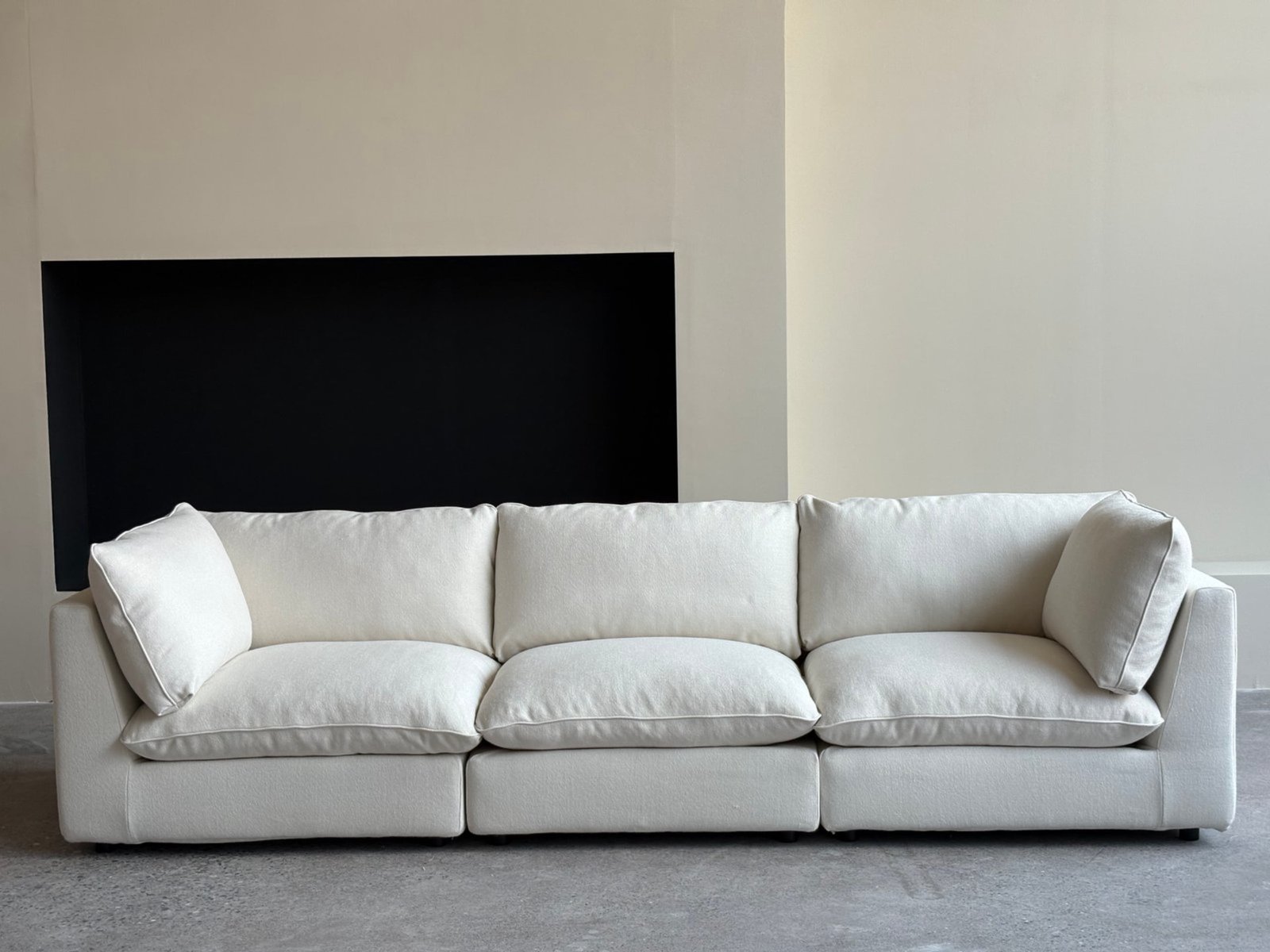
Down back cushions are one of the defining features of high-end linen furniture5. They give the sofa its relaxed, lived-in look. But they come with a real maintenance expectation that not every client is prepared for.
Down and down-alternative back cushions deliver the soft, full silhouette that high-end linen sofas are known for. They require regular refluffing to maintain loft and lose structure faster than foam-filled backs. Clients who understand this upfront stay satisfied. Clients who don't are often surprised.
What Happens to Down Over Time — and How to Set Client Expectations
Down back cushions flatten with use. This is not a defect. It is the nature of the material. The clusters of fill compress under weight and gravity, and the cushion loses its loft. Refluffing redistributes the fill and restores volume. Most down-filled back cushions on a well-used sofa need refluffing every few days to maintain a full appearance.
For clients who want a sofa that looks styled at all times with no maintenance, down-filled backs are the wrong choice. For clients who want a sofa that looks naturally relaxed and beautiful, down is often the right choice — as long as they know what they are signing up for.
Here is a direct comparison of back cushion fill types:
| Fill Type | Visual Result | Maintenance Required | Structure Over Time |
|---|---|---|---|
| Pure down | Full, relaxed, high-end loft | Refluff frequently | Loses loft with use |
| Down-alternative | Similar look to down, slightly more consistent | Refluff regularly | More stable than down |
| [Foam-wrapped in fiber | More structured look, less relaxed | Low maintenance | Holds shape longer](https://stampshomefurniture.com/blogs/furniture-guide/what-sofa-cushion-filling-lasts-longest-foam-vs-down-vs-fiber-explained?srsltid=AfmBOoptTAVaVIHTWZlEV5Jba0fQ84B_DRF3d6S4M6hLWllhEke4qvEB)%%%FOOTNOTE_REF_6%%% |
In our production process, we work with clients and their designers to specify back cushion fill based on the design goal, not just the price point. A structured interior project where the sofa needs to photograph well with minimal on-site preparation calls for a different spec than a residence where the client wants maximum comfort and is happy to maintain it.
Down-alternative fill is a good middle point for clients who want the look of down without the highest maintenance commitment7. It performs better in humid climates8 and is often used in our orders for clients who want the linen aesthetic without pure down upkeep.
What we tell every client specifying down backs: the loft you see in the product photo is the loft right after the cushion is fluffed9. Daily life softens it. That is part of the appeal — but it needs to be a choice, not a surprise.
Does "Standard Fill" Mean the Same Thing From Every Factory?
It does not. This is one of the most important things to understand when comparing quotes from different suppliers.
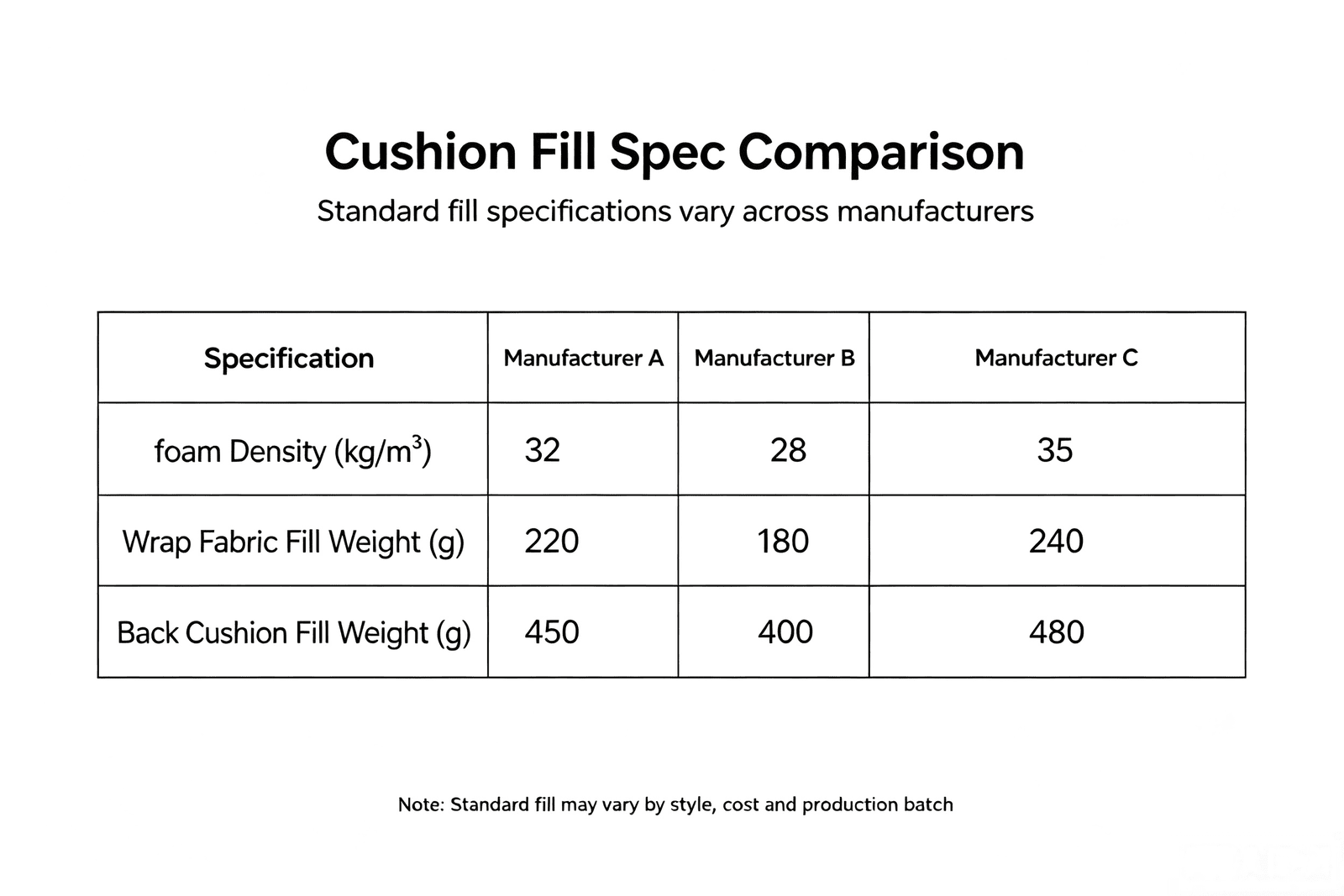
"Standard fill" is not a universal industry benchmark. Different factories use different foam densities and fiber-wrap ratios under the same product description. When evaluating a supplier's fill quality, ask for foam density in kg/m³ and fill weight — not just fill "type."
Why Fill Descriptions Don't Tell You What You're Actually Getting
When a client receives three quotes for a custom linen sofa and all three say "high-resilience foam seat cushion with fiber wrap," those three sofas may feel and perform very differently in practice. The label is not the spec. The density number is the spec.
What to ask any supplier when reviewing fill:
| Question to Ask | Why It Matters |
|---|---|
| What is the foam density in kg/m³? | This directly predicts seat shape retention over time |
| What is the fiber wrap weight per cushion? | Affects initial feel and how quickly the cover looks slack |
| Is the foam core solid or layered? | Layered cores can shift and create uneven surface feel10 |
| What fill weight is used in back cushions? | Determines initial loft and how quickly it flattens |
| Does fill spec change between sofa models? | Know if the floor sample matches what gets shipped |
Note: Confirm these specific data points with our production team before presenting them in a client specification document.
Clients we work with often come to us after a previous order where the sofa looked right in photos but arrived with cushions that sat noticeably flatter than expected. In most cases, the issue was not visible from the outside. It was a fill density mismatch between what was described and what was used.
I am not suggesting that lower-density foam or hollow fiber fill are always wrong choices. In some production contexts and market tiers, they are completely appropriate. The problem is when a buyer is quoted one thing and receives another because the vocabulary is loose. Asking for the actual density number removes that ambiguity. Suppliers who use quality fill will give you the number. Suppliers who don't will change the subject.11
At Linen World, we specify fill with the same level of detail we put into fabric selection. For our made-to-order custom linen sofas, the fill spec is set at the order stage and documented. Clients can request changes before production starts, but they need to understand that fill type and foam density affect fabric cut, cushion volume, and frame fit — so the earlier those decisions are locked, the cleaner the production run.
Conclusion
Sofa cushion fill is a structural decision. Choose the right foam density for seat cushions, set honest expectations for down backs, and always ask for density numbers — not just fill type names.
If you’re an interior designer sourcing custom linen sofas for US & European residential projects, our 13-year Foshan workshop offers fully documented cushion fill specs with exact foam density and fill weight data. We provide flexible seat/back fill combinations to match different client use cases and regional climates. Reach us via WhatsApp to request fill specification sheets, linen fabric swatches or factory virtual tours for your upcoming custom sofa projects.https://linenworld.pro
"Cushion 101 - MadeRight CA", https://maderightca.com/pages/cushion-101?srsltid=AfmBOoof_07cYEfj0JsoaaJTTK39IPeXgdGNA-F91gcjFmGeyKu7id7F. Studies on polyurethane foam fatigue testing, such as those conducted under ASTM D3574 protocols, document compression set and loss of height in foam specimens subjected to repeated loading cycles, providing a basis for estimating in-use lifespan by density grade. Evidence role: statistic; source type: research. Supports: Rate of compression fatigue and shape loss in low-density polyurethane foam under repeated loading conditions. Scope note: Laboratory fatigue tests use standardized loading cycles that may not directly replicate the variability of real-world residential seating use patterns. ↩
"Foam Types for Seats and Cushions", https://www.foambymail.com/foam-types-for-seats-and-cushions.html?srsltid=AfmBOoqDXXeTrX3RufxX1zXbBmIXhAykk8ZYsuWRi5FwwCC13fmApdyo. Industry testing frameworks such as ASTM D3574 define foam density alongside indentation force deflection as primary characterization metrics, with density specifically associated with material mass per unit volume and long-term durability rather than initial comfort feel. Evidence role: definition; source type: institution. Supports: The role of foam density as a key indicator of durability and structural performance in upholstered seating. Scope note: Density alone does not fully determine cushion performance; ILD and cell structure also contribute, so the claim that density is the single most important metric is a simplification of multi-variable foam specification. ↩
"Everything You Should Know About Cushion Foam Density", https://www.woodstockoutlet.com/content/blogs/cushion-foam-density/?srsltid=AfmBOooacEsPLxew4UGUk_rjgB_xJR8p94CAhqyTujIpkrvPWHGBlOiF. Trade standards bodies such as BIFMA and national furniture testing frameworks specify minimum foam density and performance thresholds for contract and residential seating, with higher-density grades generally required for pieces designated as primary or heavy-use seating. Evidence role: expert_consensus; source type: institution. Supports: Industry-recognized foam density thresholds for quality upholstered seating intended for primary residential use. Scope note: Specific density thresholds vary across standards bodies and national markets; the claim that high-density foam is a universal baseline for custom linen sofas reflects a quality-tier positioning rather than a single codified standard. ↩
"Everything You Should Know About Cushion Foam Density", https://www.woodstockoutlet.com/content/blogs/cushion-foam-density/?srsltid=AfmBOoounsyCcDUUi-nkYRTfFwfqLsb1KFXWIX4uK9jJfZ1LzaEV3anZ. Polyurethane foam engineering literature establishes that foams of differing density exhibit different compression deflection curves under equivalent loads, meaning that substituting a higher- or lower-density foam of the same nominal dimensions will produce a different seated height and surface profile, altering the fit of a pre-cut fabric cover. Evidence role: mechanism; source type: research. Supports: The relationship between foam density, compression behavior, and the resulting dimensional profile of an upholstered cushion under load. Scope note: The magnitude of dimensional change depends on the specific density difference and the ILD of the foams compared; minor density substitutions may produce negligible dimensional change, while the article implies all density changes require recutting. ↩
"Furniture Study Talk, The Pursuit of Comfort: Upholstery in America",
. The use of down and feather fill in upholstered furniture has historical roots in European luxury furnishing traditions, where the material's softness and loft were associated with quality craftsmanship; this association has persisted in contemporary high-end furniture marketing and specification practice. Evidence role: historical_context; source type: encyclopedia. Supports: The historical and market association between down or feather fill and premium upholstered furniture. Scope note: The designation of down as a marker of high-end furniture is a market convention rather than a technical standard, and its prevalence varies across regional markets and design movements. ↩"What Sofa Cushion Filling Lasts Longest? Foam vs Down vs Fiber ...", https://stampshomefurniture.com/blogs/furniture-guide/what-sofa-cushion-filling-lasts-longest-foam-vs-down-vs-fiber-explained?srsltid=AfmBOoptTAVaVIHTWZlEV5Jba0fQ84B_DRF3d6S4M6hLWllhEke4qvEB. Foam compression fatigue studies consistently show that rigid foam cores maintain dimensional stability under cyclic loading far better than loose fibrous fills, supporting the claim that foam-wrapped constructions exhibit lower shape change over time compared to down or fiber-only back cushions. Evidence role: general_support; source type: research. Supports: The superior shape retention of foam-cored cushion constructions relative to loose-fill alternatives under repeated compression. Scope note: Most available compression fatigue data pertains to seat cushion loading conditions; back cushion loading patterns differ in magnitude and direction, and direct comparative studies on back cushion fill types are not widely published. ↩
"Down vs. Down Alternative Fill - The Company Store", https://www.thecompanystore.com/down-versus-down-alternative-fill.html. Material science literature on fiberfill and down clusters indicates that synthetic polyester alternatives exhibit more consistent loft recovery after compression due to their engineered fiber crimp, whereas natural down clusters are more susceptible to permanent deformation from moisture and repeated loading. Evidence role: mechanism; source type: research. Supports: Differences in loft retention and compression recovery between natural down and synthetic down-alternative fills in cushion applications. Scope note: Direct comparative studies specifically on upholstery back cushion applications are limited; most available data derives from bedding and outerwear insulation research, which may not fully translate to furniture use conditions. ↩
"Down feather - Wikipedia", https://en.wikipedia.org/wiki/Down_feather. Research on down insulation materials documents that natural down clusters lose significant loft when wet or exposed to sustained high humidity due to the hygroscopic nature of the keratin protein structure, whereas synthetic polyester fibers are hydrophobic and maintain loft under similar moisture conditions. Evidence role: mechanism; source type: research. Supports: The effect of moisture and humidity on the loft and structural integrity of natural down fill compared to synthetic alternatives. Scope note: Most humidity-performance research on down is conducted in the context of outdoor apparel insulation rather than indoor upholstered furniture, and the degree of humidity exposure in residential settings may differ substantially from tested conditions. ↩
"The Role of Digital Photography in E-commerce | RMCAD", https://www.rmcad.edu/blog/the-role-of-digital-photography-in-e-commerce/. Consumer research on furniture purchasing decisions has documented a recurring expectation gap between product imagery and delivered appearance, with soft-fill upholstery among the categories most frequently cited in post-purchase dissatisfaction related to visual presentation. Evidence role: general_support; source type: other. Supports: The gap between staged product photography and the resting appearance of down-filled upholstery in everyday use. Scope note: Systematic published research specifically on down cushion photography staging practices in the furniture industry is limited; the claim is well-supported anecdotally but lacks a direct empirical citation. ↩
"Enhanced comfort and biomechanical performance of ejection seat ...", https://pmc.ncbi.nlm.nih.gov/articles/PMC13057320/. Upholstery engineering literature notes that multi-layer foam constructions require adequate bonding between layers to prevent lateral displacement under shear forces generated during normal seating use; unbonded layers are documented to migrate within fabric enclosures, producing surface irregularities. Evidence role: mechanism; source type: research. Supports: The tendency of unbonded or loosely bonded multi-layer foam assemblies to shift relative to one another under repeated compressive loading. Scope note: The degree of shifting depends heavily on whether layers are adhesive-bonded, the cover tightness, and the foam grades used; the claim applies most directly to loosely assembled rather than properly bonded layered constructions. ↩
"Investigation of indoor noise pollution level and air ... - BioResources", https://bioresources.cnr.ncsu.edu/resources/investigation-of-indoor-noise-pollution-level-and-air-quality-of-furniture-manufacturers/. Procurement guidance from furniture industry trade associations and quality assurance frameworks generally identifies willingness to provide verifiable material specifications as a marker of supplier reliability, noting that vague or evasive responses to specification requests are a recognized risk indicator in sourcing audits. Evidence role: general_support; source type: institution. Supports: The role of material specification transparency as an indicator of supplier quality and accountability in furniture manufacturing. Scope note: This claim reflects practitioner heuristics and trade guidance rather than empirical research; no published study directly measures the correlation between foam density disclosure willingness and actual product quality outcomes. ↩


