You've been sold "Belgian linen" before. The label looked right. The price felt premium. Then the fabric arrived — and something was off.
Authentic Belgian linen relies on both verified Flanders flax origin and wet-spun manufacturing standards; material performance metrics are the most reliable way to judge quality beyond simple origin labeling. Those properties include longer fiber length, tighter weave structure, lower pilling risk, and a distinct dry hand feel1. If a fabric fails to display these core performance traits, the "Belgian linen" label carries little credible quality reference value for high-end upholstery projects.
This guide is written from the production floor, not the marketing department. Over 13 years of sourcing, inspecting, and fabricating with Belgian linen, I have seen what the real material looks like when it arrives — and I have seen what gets passed off as the real thing. If you are specifying Belgian linen upholstery for a high-end residential project, you need a way to verify what you are buying. That is what this guide gives you.
What Actually Makes Belgian Linen Different From Other Linen?
Most designers know Belgian linen has a good reputation. Far fewer know why — and that gap is exactly where substitution happens.
Belgian linen performs differently because the flax grown in the Flanders region produces longer, finer fibers than most other flax-growing regions2. Those longer fibers allow for a tighter, more consistent yarn when wet-spun, which is the traditional spinning method still used by Belgian mills3. The result is a fabric with fewer surface breaks, lower pilling likelihood, and a more even drape over time.
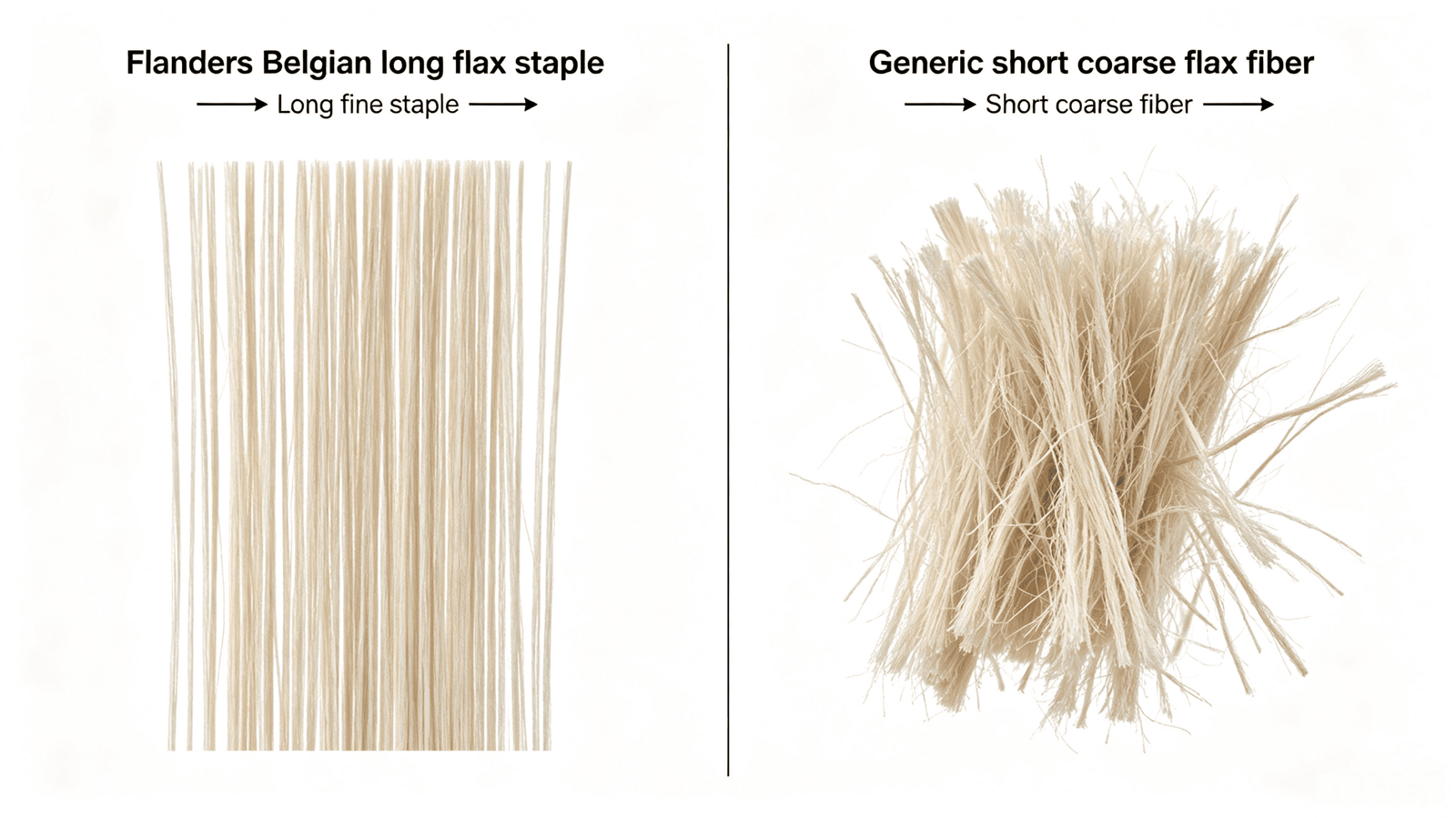
Let me break this down in practical terms, because the distinction between wet-spinning and dry-spinning is not just a production footnote — it changes what the fabric does on a piece of furniture.
Wet-Spinning vs. Dry-Spinning: Why It Matters for Upholstery
| Property | Wet-Spun Belgian Linen | Dry-Spun or Blended Linen |
|---|---|---|
| Yarn surface | Smooth, consistent | More irregular, prone to fuzzing |
| Tensile strength | Higher | Lower, varies by blend |
| Pilling over time | Low | Moderate to high depending on weave |
| Hand feel | Dry, slightly crisp initially | Can feel either limp or rough |
| Drape on upholstery | Holds shape, softens with use | May stretch unevenly under tension |
When a designer tells me a previous linen project pilled within a year, my first question is always: was it wet-spun? In most cases, the answer is no — or the supplier didn't know. The fabric was labeled "linen," possibly even "European linen," but the spinning method and fiber source were never verified.
This is not an abstract quality difference. It is a direct predictor of how the fabric will perform on a sofa arm, a dining chair seat, or a bed headboard five years after installation.
How Do You Identify Real Belgian Linen Before You Buy It?
The problem with authentication at the sourcing stage is that most designers are not in a position to run fiber tests. You are working from samples, swatches, and supplier claims. So the question becomes: what can you actually check?
There are four practical visual and manual test signals we use for fabric incoming inspection; nearly all can be assessed without professional laboratory testing under normal upholstery-weight fabric conditions. Thread count consistency, behavior under raking light, selvedge edge quality, and moisture response. Together, they give a strong indication of whether a fabric is genuine wet-spun Belgian linen or a substitute.
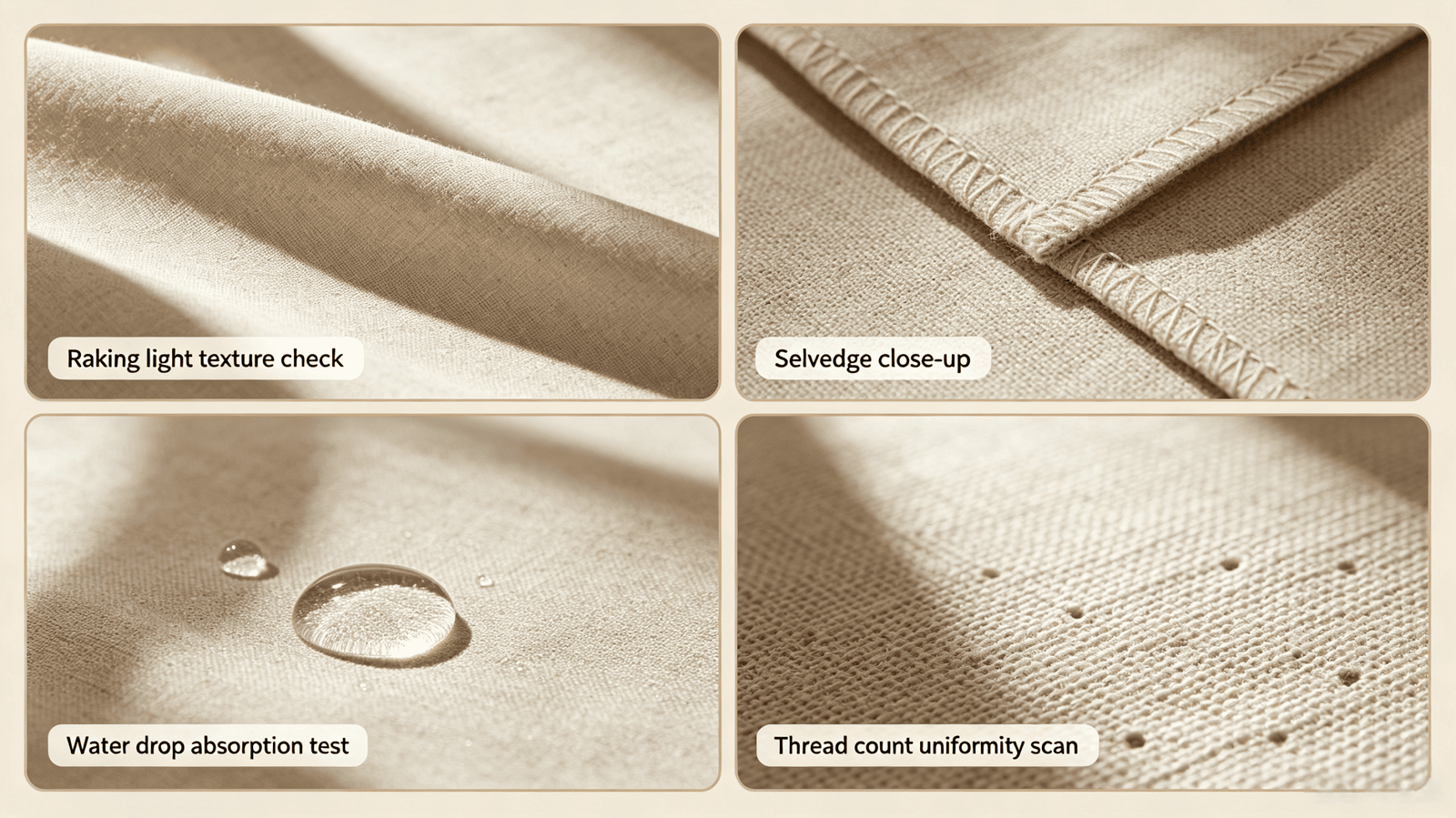
Here is how to apply each check in a showroom or when evaluating samples from a supplier.
The Four-Point Inspection Checklist
1. Thread Count Consistency
Hold the fabric up to a direct light source and look at the weave grid. In authentic Belgian linen, the threads are evenly spaced — the gaps between warp and weft threads are regular, and there are no obvious thick-thin variations within a single bolt4. In blended or lower-quality linen, you will see uneven thread density: some areas tighter, some looser. This unevenness causes stress concentration in upholstery, meaning the fabric wears out faster at the inconsistent points.
2. Absence of Synthetic Sheen Under Raking Light
Take the fabric swatch and hold it at about 15 degrees to a strong light source — a window works well. Authentic linen has a matte surface with a slight natural luster that comes from the fiber itself. If you see a consistent, even sheen across the surface, there is likely a polyester or viscose blend in the yarn. Real Belgian linen does not look flat, but it does not look plastic either. The sheen is irregular and comes from the fiber structure, not a surface finish.
3. Selvedge Edge Texture
The selvedge — the finished edge of a fabric bolt — tells you a lot about how the fabric was produced. In genuine Belgian linen, the selvedge is firm, slightly raised, and shows the same yarn structure as the body of the fabric. In cheaper or blended alternatives, the selvedge is often softer, sometimes with a different weave pattern, or finished with a coating that hides the underlying yarn quality. Ask your supplier to include a selvedge edge in any sample they send. If they cannot, or if the selvedge looks inconsistent with the body, treat that as a flag.
4. Moisture Response
This is the easiest test you can do. Sprinkle a few drops of water on the fabric. Belgian linen absorbs moisture quickly and evenly — the water spreads outward in a relatively uniform radius5 and darkens the fabric slightly. A blended fabric with synthetic content will resist the water at first, and the absorption will be patchy or slower. Pure linen also dries faster than blends because of its natural wicking structure. This test takes about 60 seconds and is more reliable than any label.
If a supplier tells you authentication is only possible through official certification, ask them to provide the Masters of Linen or OEKO-TEX documentation6. These certifications are worth requesting from your supplier and reviewing directly — do not accept a verbal reference to certification as a substitute for the document itself.
Is Belgian Linen Actually Hard to Maintain, or Is That a Spec Problem?
I hear this concern regularly from designers who have had a bad experience: "Belgian linen looks beautiful in the showroom and then causes complaints from clients six months later." I understand the hesitation. But in almost every case I have traced back, the problem was not the fabric — it was where and how it was used.
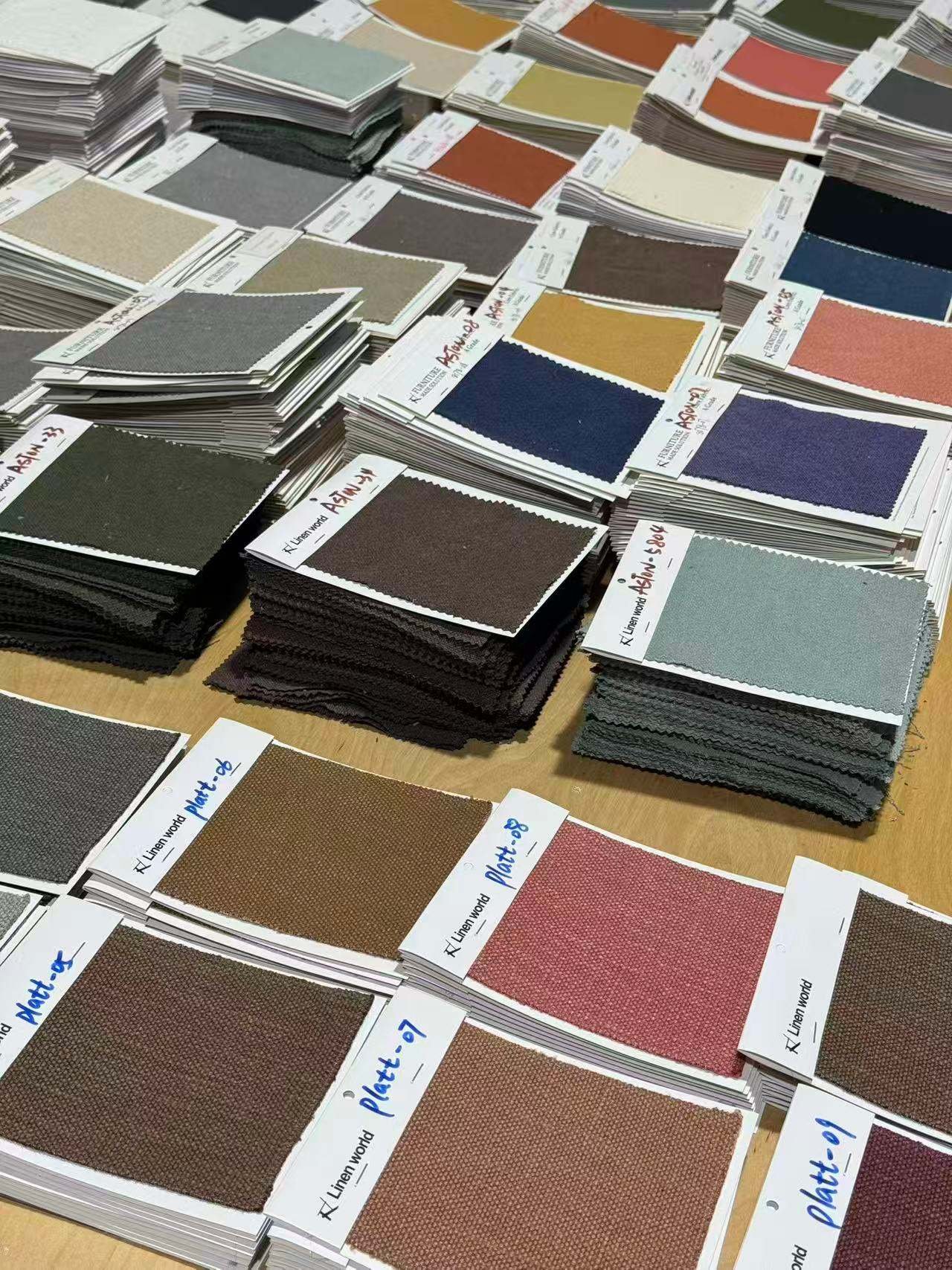
Belgian linen underperforms when the wrong weight or weave density is specified for the application. A loose-weave linen that works beautifully on a headboard will pill and deform on a high-contact seat cushion within months. The maintenance problem most designers attribute to linen is actually a weight-and-weave mismatch problem.
Let me be direct about the real trade-offs before I get to the selection logic.
What Belgian Linen Actually Does Over Time
Wrinkling: Belgian linen wrinkles. This is not a defect — it is a property of the fiber7. On a sofa, this means the seat and back cushion covers will show compression creases after use. For most high-end residential clients, this reads as character. For clients who want a tailored, crease-free look at all times, linen is the wrong specification regardless of quality. This is a conversation to have before the project, not after.
Initial stiffness: Fresh Belgian linen feels noticeably stiffer than aged linen or cotton blends. It softens with use and washing8. For upholstery that will see regular use, this is not a long-term problem — but for display pieces or low-traffic items, the initial stiffness can be surprising for clients who expected a softer handle from the start.
Fading: Belgian linen fades in direct sunlight. This is consistent across all natural fibers9. For rooms with significant UV exposure, a fabric treatment or window management plan should be part of the spec — not an afterthought.
Matching Fabric Weight to Application
| Application | Recommended Weight | Weave Density | Why |
|---|---|---|---|
| Sofa seat cushion | 400–500 gsm | High (tight weave) | High contact and abrasion resistance required |
| Sofa back cushion | 300–400 gsm | Medium | Lower contact, but needs to hold shape |
| Armchair seat | 400–500 gsm | High | Similar to sofa seat — do not downgrade here |
| Headboard | 250–350 gsm | Medium to loose | Low contact, drape and appearance primary |
| [Dining chair seat | 450–550 gsm | Very high | Highest abrasion application](https://fabriculture.store/blogs/news/fabric-weight-chart-gsm-guide?srsltid=AfmBOoq7QRuvLfyWEUYNxcilaZWABmFIpUa3DS0IDs3YrXBxS1-nFY7f)%%%FOOTNOTE_REF_10%%% — never use a loose weave |
| Decorative pillow | 200–300 gsm | Loose acceptable | Low stress, visual application |
When designers working with us have flagged maintenance issues from previous projects, this chart is usually where we find the problem. A dining chair that was specified with a headboard-weight linen. A sofa seat done in a loosely woven fabric that looked stunning as a swatch and failed under daily use. The correction is not to switch materials — it is to specify correctly the first time.
Can You Source Genuine Belgian Linen Upholstery From China Without Compromising Quality?
This is the question most designers do not think to ask — and it is the one that changes the procurement math entirely.
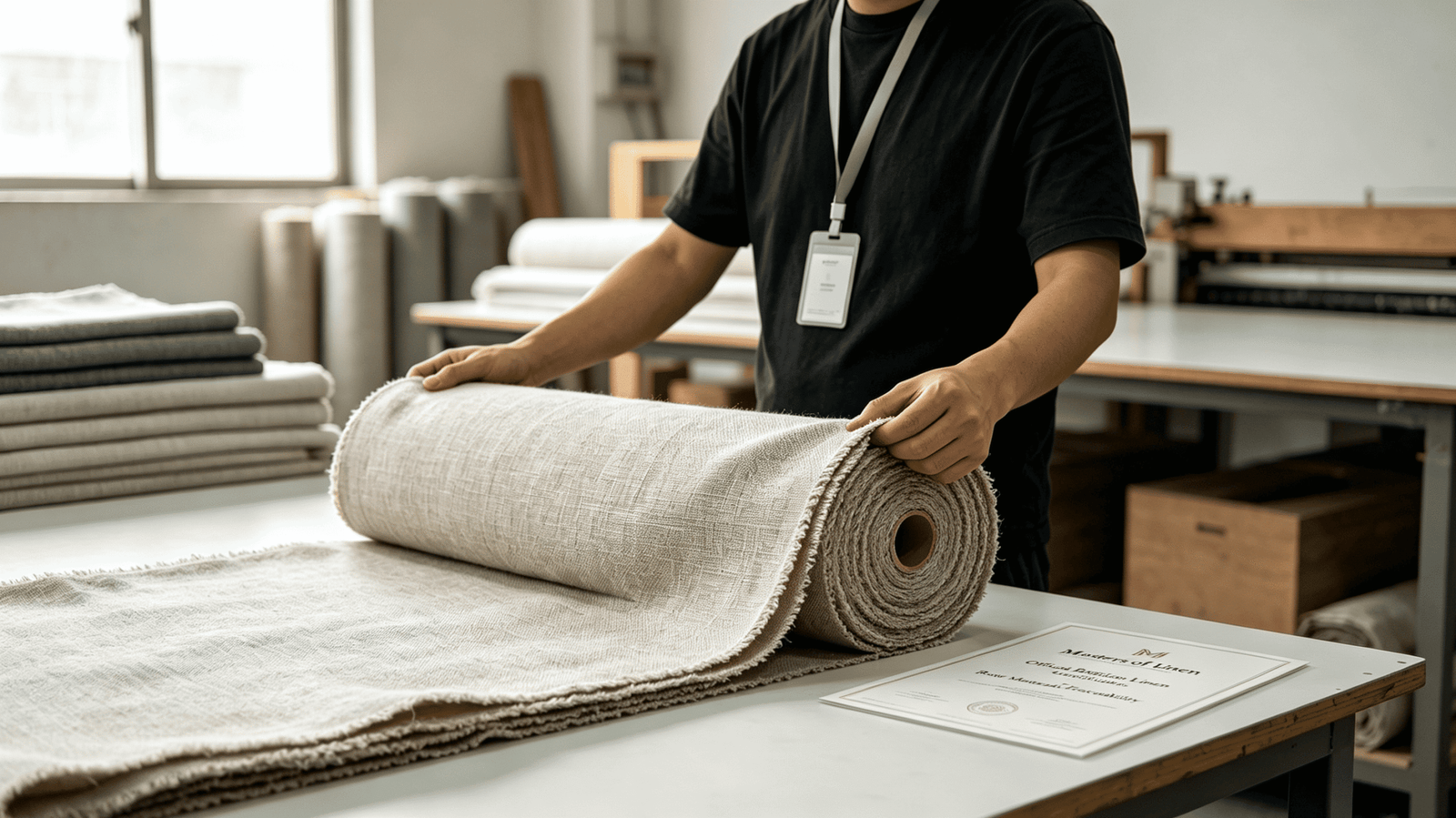
Belgian linen fabric is sourced, verified, and shipped into manufacturing facilities in multiple countries — including China. A Foshan-based custom furniture manufacturer working directly with Belgian linen fabric can produce the same specification at 40–60% less than equivalent work in Europe or the US11. The fabric supply chain is the same. What changes is the labor cost and overhead structure.
I want to address the skepticism directly, because it is reasonable.
What "Same Supply Chain" Actually Means
Belgian linen fabric is milled in Belgium. It is then sold to manufacturers globally — in the UK, in the US, in Italy, and in China12. A furniture manufacturer in California buying Belgian linen fabric and a manufacturer in Foshan buying Belgian linen fabric are both working from fabric that left the same Belgian mills. The difference is not the material origin — it is everything that happens after the fabric arrives.
The questions a designer should ask a China-based manufacturer are the same questions they would ask any manufacturer:
| Question | What a Credible Manufacturer Can Provide |
|---|---|
| Where does your linen fabric come from? | Specific mill name or region, ideally with documentation |
| Can I see your incoming quality check process? | Photos or video of fabric inspection on arrival |
| What weight and weave options do you stock? | A specific range with gsm specs, not just "various options" |
| Do you support COM fabric? | Yes or no — and what the process looks like |
| What is your lead time for custom orders? | A specific window, not "it depends" |
In our production experience at Linen World, we work with designers who have never sourced from China before, and the first conversation is almost always about verification. That is the right instinct. Ask for specifics. Ask to see the fabric before production begins. Ask what happens if the material does not match the approved sample.
A manufacturer who cannot answer these questions specifically is not a manufacturer you want to work with — regardless of where they are located.
What Custom Fabrication in China Actually Gives You
For designers specifying a high-end residential project, the practical benefit is not just cost. It is access to customization that most Western manufacturers price out of reach.
- 200+ linen color options available for made-to-order production
- Full COM (customer's own material) support if you want to specify a fabric the manufacturer does not stock
- Custom dimensions to fit bespoke room layouts
- Lead times that are competitive with US custom workrooms for most order sizes
The 40–60% cost saving is real. But the more significant point for most designers is this: it makes custom Belgian linen upholstery a viable specification for more projects, not just the largest budgets.
Conclusion
Belgian linen is a verifiable material standard. Know the four inspection signals, match the weight to the application, and treat custom China-based sourcing as a legitimate procurement path — not a compromise.
If you’re an interior designer specifying authentic Belgian linen upholstery for US high-end residential projects, our 13-year Foshan factory imports Belgian linen with full Masters of Linen & OEKO-TEX documentation available for every batch. We provide free fabric swatches and pre-production inspection confirmation for all custom sofa orders. Message us via Email:hello@linenworld.pro to request linen color cards, factory virtual tours or customized project quotations.
"The Influence of Finishing on the Pilling Resistance of Linen/Silk ...", https://pmc.ncbi.nlm.nih.gov/articles/PMC8619160/. Textile research on staple fiber length and fabric performance has established that longer fiber staple length reduces the number of fiber ends protruding from yarn surfaces, which is the primary mechanism of pilling formation; fabrics produced from longer staple fibers therefore exhibit lower pilling rates under standardized abrasion testing. Evidence role: mechanism; source type: research. Supports: That longer staple fiber length in linen correlates with reduced pilling tendency and more consistent yarn structure. Scope note: The specific claim that these properties are uniquely or definitively associated with Belgian-origin linen rather than other long-staple linen sources requires comparative regional fiber testing data ↩
"Linen Most Useful: Perspectives on Structure, Chemistry, and ... - PMC", https://pmc.ncbi.nlm.nih.gov/articles/PMC4403609/. Research on Linum usitatissimum cultivation has documented that soil composition, climate, and traditional retting practices in the Flanders region contribute to longer, finer fiber staple length compared to flax grown in other European and Asian producing regions. Evidence role: mechanism; source type: research. Supports: That flax cultivated in the Flanders region yields longer staple fibers than flax grown in other major producing regions. Scope note: Most agronomic studies address fiber quality in aggregate rather than isolating Flanders specifically against all competing regions ↩
"Comparison of microstructural evolution differences during dry-jet ...", https://pmc.ncbi.nlm.nih.gov/articles/PMC12297439/. Textile science literature describes wet-spinning as a process in which flax rovings pass through a hot water bath before drafting, which softens the pectin binding fibers and allows finer, more uniform yarn formation with reduced surface hairiness compared to dry-spun equivalents. Evidence role: mechanism; source type: research. Supports: That wet-spinning of flax fibers produces smoother, stronger yarn with fewer surface irregularities compared to dry-spinning. Scope note: Documentation specifically confirming current prevalence of wet-spinning among Belgian mills as opposed to historical practice may require industry trade sources ↩
"Sewing Thread Quality Inspection Guide | PDF - Scribd", https://www.scribd.com/document/932195167/QM-3. Standard textile quality assessment protocols, including those referenced in ISO and ASTM fabric testing standards, include visual and instrumental evaluation of thread density uniformity as an indicator of weaving consistency and yarn quality; uneven thread spacing is associated with stress concentration points that reduce fabric durability under tension. Evidence role: general_support; source type: institution. Supports: That thread spacing uniformity is a recognized indicator of yarn and weave quality in woven textiles. Scope note: Thread count consistency is a general quality indicator for woven fabrics and is not specific to Belgian linen authentication; high thread uniformity can be achieved in non-Belgian linen and some synthetic weaves ↩
"Linen Most Useful: Perspectives on Structure, Chemistry, and ... - PMC", https://pmc.ncbi.nlm.nih.gov/articles/PMC4403609/. Cellulosic fibers including flax linen exhibit high moisture regain values (approximately 10–12% under standard conditions) attributable to hydroxyl groups in the cellulose polymer chain, whereas polyester fibers have moisture regain values below 0.5%, producing measurably different absorption behavior in simple water-drop tests. Evidence role: mechanism; source type: research. Supports: That linen fibers absorb moisture rapidly due to their hygroscopic cellulosic structure, in contrast to synthetic fibers such as polyester which have low moisture regain. Scope note: The uniformity of absorption spread as a specific authentication signal for Belgian versus non-Belgian linen has not been independently validated in published textile testing literature ↩
"Masters of LINEN™ Certification - New standard | ALLIANCE", https://allianceflaxlinenhemp.eu/en/masters-of-linen-certification. The Masters of Linen label, administered by the European Confederation of Flax and Hemp (CELC), certifies that linen products are grown, retted, and processed entirely within Western Europe, providing supply-chain traceability from field to finished fabric. Evidence role: definition; source type: institution. Supports: That Masters of Linen is an administered certification program verifying the European origin and traceability of linen products. Scope note: Masters of Linen certification addresses geographic and processing origin but does not independently certify fiber length or weave density specifications ↩
"[PDF] Performance Properties in Fibers and Fabrics - District 2 4-H", https://d24-h.tamu.edu/files/2023/02/D2D-Performance-Properties-in-Fibers-and-Fabrics-Copy.pdf. Textile science literature attributes linen's pronounced wrinkling behavior to the low elastic recovery of flax cellulose fibers; unlike wool or synthetic fibers with significant elastic return, flax fibers have limited ability to recover from compressive deformation, resulting in persistent crease formation under normal use conditions. Evidence role: mechanism; source type: research. Supports: That linen's tendency to wrinkle is a structural consequence of its fiber composition, specifically its low elastic recovery compared to other textile fibers. ↩
"Linen Most Useful: Perspectives on Structure, Chemistry, and ... - PMC", https://pmc.ncbi.nlm.nih.gov/articles/PMC4403609/. The initial stiffness of linen fabric is attributed in part to residual pectin and hemicellulose in the flax fiber cell wall; repeated washing and mechanical flexing progressively disrupt these binding compounds and reduce inter-fiber friction, resulting in the characteristic softening of linen fabric with use. Evidence role: mechanism; source type: research. Supports: That linen fabric stiffness decreases with repeated washing and mechanical use due to changes in the fiber's pectin and hemicellulose content. ↩
"Synergy between Sunlight, Titanium Dioxide, and Microbes ... - PMC", https://pmc.ncbi.nlm.nih.gov/articles/PMC9535896/. Studies on textile photodegradation document that cellulosic fibers including linen and cotton undergo chain scission and chromophore formation under UV irradiation, resulting in yellowing and loss of dye fastness; the rate varies by fiber type, dye class, and UV intensity. Evidence role: general_support; source type: research. Supports: That linen and other natural cellulosic fibers are susceptible to photodegradation and color fading under prolonged UV exposure. Scope note: The claim that fading is 'consistent across all natural fibers' is an oversimplification; wool and silk exhibit different UV degradation mechanisms and rates than cellulosic fibers ↩
"Fabric Weight Chart: The Complete GSM Guide for ... - Fabriculture", https://fabriculture.store/blogs/news/fabric-weight-chart-gsm-guide?srsltid=AfmBOoq7QRuvLfyWEUYNxcilaZWABmFIpUa3DS0IDs3YrXBxS1-nFY7f. Textile industry guidance on upholstery specification, including standards referenced by bodies such as the Association for Contract Textiles, correlates fabric weight and abrasion resistance ratings (commonly measured via Martindale or Wyzenbeek testing) with end-use application categories, with high-contact seating surfaces requiring higher performance thresholds. Evidence role: general_support; source type: institution. Supports: That upholstery fabric weight and weave density should be matched to application-specific abrasion demands, with seating surfaces requiring heavier, denser constructions. Scope note: The specific gsm ranges cited in the article represent the author's practical guidelines rather than a published industry standard; actual requirements vary by fiber type and weave construction ↩
"The Effect of Furniture Imports from China on Employment in U.S. ...", https://www.usitc.gov/publications/332/working_papers/ecwp_2017-08-a-08-23-17_0.htm. Industry analyses of global furniture manufacturing have documented substantial labor cost differentials between Chinese production centers such as Foshan and equivalent facilities in the United States and Western Europe, with Chinese manufacturing labor costs reported at a fraction of Western rates, contributing to overall unit cost reductions across custom furniture categories. Evidence role: statistic; source type: research. Supports: That labor and overhead cost differentials between Chinese and Western furniture manufacturers produce significant unit cost savings for equivalent custom upholstery production. Scope note: The specific 40–60% figure cited in the article is not independently verified here; actual savings vary by product complexity, material sourcing, shipping costs, and tariff conditions ↩
"Belgian Linen - Wikipedia", https://en.wikipedia.org/wiki/Belgian_Linen. Trade data from the European Confederation of Flax and Hemp (CELC) and Eurostat document significant export volumes of Belgian and Western European linen fabric to manufacturing destinations across Asia, North America, and other regions, supporting the characterization of linen fabric as a globally traded commodity sourced from European mills. Evidence role: general_support; source type: institution. Supports: That Belgian and Western European linen fabric is exported to manufacturers in multiple global markets including Asia. Scope note: Export statistics confirm global distribution of European linen fabric but do not verify that specific Chinese manufacturers are sourcing from Belgian mills rather than other European or non-European linen producers ↩


