
Most designers I talk to use "organic modern" as a mood board label. But when a project hits the sourcing stage, the label stops working — and the wrong sofa ends up in the wrong room.
Organic modern furniture is defined by two non-negotiable criteria: natural materials (primarily linen, solid wood, and stone) and restrained, uncluttered silhouettes1.Pieces featuring heavy synthetic blends, overly voluminous cushions or prominent decorative hardware generally fail to align with organic modern’s core material and silhouette standards, even if they look cohesive in mood board photos.
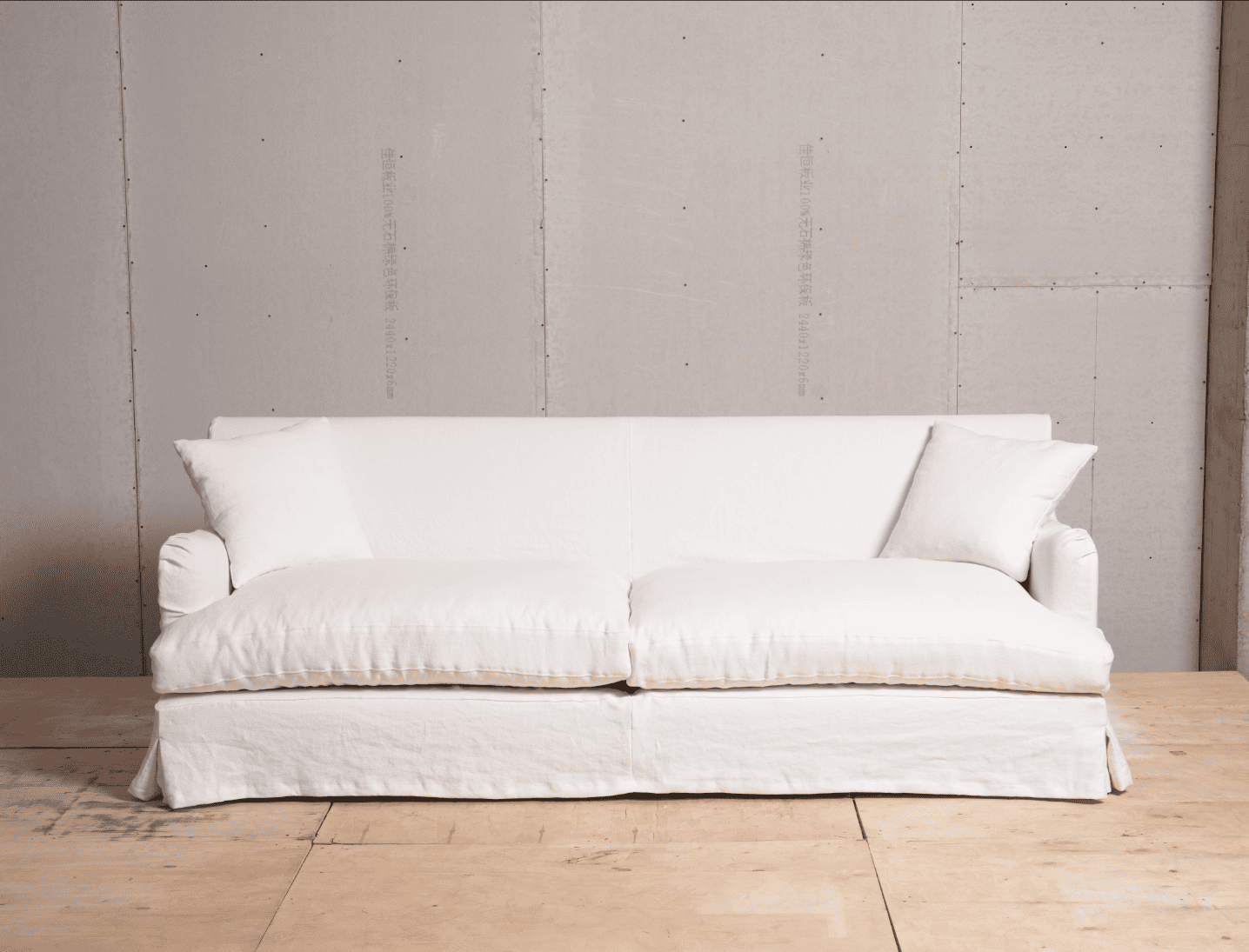
I've been manufacturing linen upholstery furniture in Foshan for 13 years2. In that time, I've had hundreds of sourcing conversations with US-based interior designers. The same question comes up at every stage: how do I know this piece actually fits the project? This post is my attempt to answer that question directly — from material selection through to custom delivery.
Is Linen Actually the Right Fabric for Organic Modern, or Just the Most Popular One?
Designers ask me this more than any other fabric question. The honest answer is that linen earns its place — but only if you're using the right grade of it.
Belgian pure linen outperforms blended alternatives in long-term residential use because the fiber structure resists pilling, holds color consistency over time, and develops a texture that reads as intentional patina rather than wear3. Blends start to look tired. Pure linen starts to look considered.
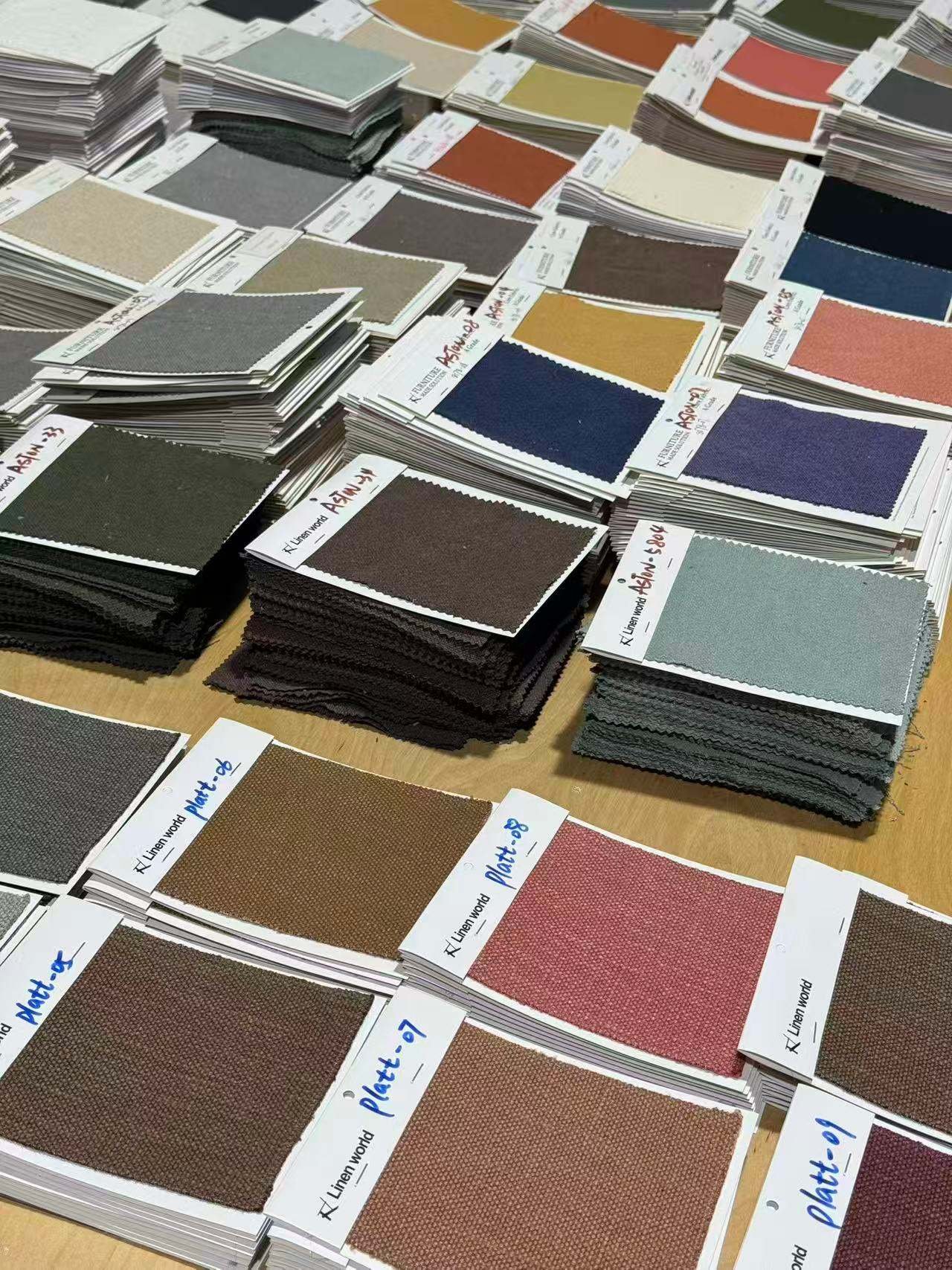
The substitution mistake I see most often is a designer specifying linen at the concept stage, then accepting a linen-cotton or linen-polyester blend at the sourcing stage because it's cheaper or easier to find4. By the time the furniture is installed, the material story has already changed — and so has the feel of the room.
Why the fiber content decision matters before the frame decision
When designers contact us during a project, they often have the silhouette locked and the fabric still open. That's actually the right order. The frame is the structure; the fabric is the surface the client will touch, sit against, and look at every day5. Getting that sequence wrong creates a correction that's expensive at the delivery stage.
Here's how I think about the fabric decision in organic modern specification:
| Fabric Type | Visual Texture | Long-Term Performance | Organic Modern Fit |
|---|---|---|---|
| Belgian pure linen | Natural slub, matte | Develops patina, resists pilling | Strong fit |
| Linen-cotton blend | Smoother, softer | May pill, color can shift | Partial fit |
| Linen-polyester blend | Uniform, less character | Holds shape but reads synthetic | Weak fit |
| Performance velvet | Rich, directional | Durable but formal | Not organic modern |
The designers who have specified Belgian pure linen across multiple projects consistently tell us the same thing: clients notice the material in a way they don't notice performance fabric. That's the point. Organic modern furniture is supposed to hold attention at the material level, not just at the silhouette level.
It's also worth naming the maintenance concern directly. Linen is not fragile. Pure linen upholstery in a well-constructed sofa handles residential use without special treatment. What it doesn't do well is disguise poor construction — if the frame or cushion build is wrong, the linen will show it. That's a quality control argument, not a fabric limitation.
How Do You Verify That a Sofa Silhouette Actually Qualifies as Organic Modern?
This is the question that separates a sourcing decision from a mood board decision. Organic modern silhouettes have specific formal qualities — and they can be checked before you place an order.
An organic modern sofa silhouette is defined by low profiles, straight or gently curved lines with no sharp ornamentation, exposed natural wood legs, and cushion volumes that look resolved rather than oversized. If one or more of these key silhouette elements are removed or heavily replaced, the furniture will tend to shift away from organic modern into other interior style categories.
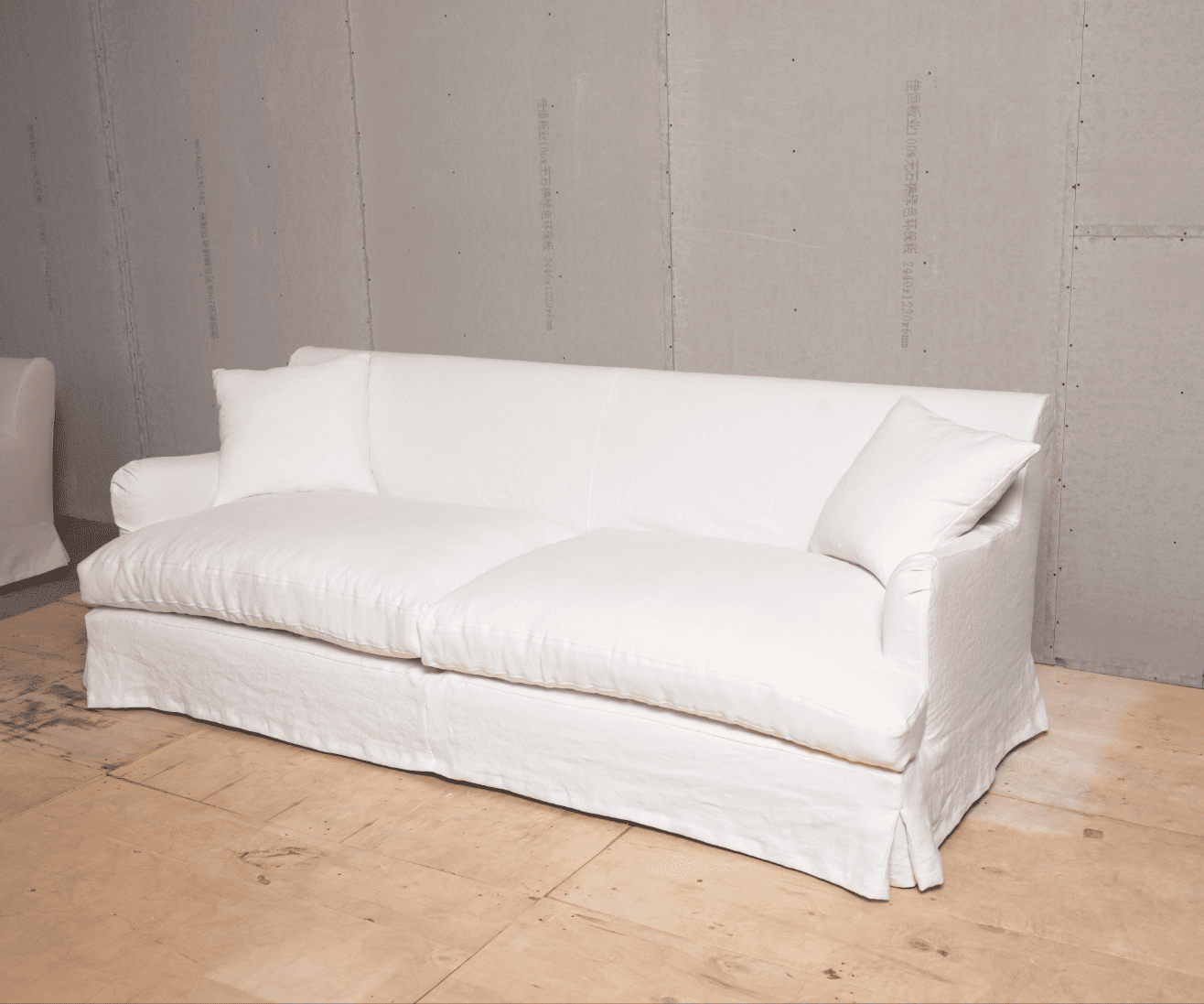
When I look at the inquiry photos designers send us, the silhouette mistakes fall into a small number of patterns. Cushions that are too thick relative to the frame depth. Legs that are stained or lacquered instead of naturally finished. Arms that taper when they should be flat, or the reverse. These are not judgment calls — they're measurable against the formal logic of the style.
Breaking down the silhouette elements that matter
The clearest way I can explain this is by separating the four formal components of an organic modern sofa and describing what the correct resolution looks like for each:
Frame proportion. The seat height should sit lower than a conventional sofa — typically in the 16–18 inch range6. This creates the visual weight-to-ground relationship that reads as grounded and calm rather than elevated and formal. A frame that sits too high loses the organic modern proportion immediately.
Arm resolution. Flat track arms or low-profile curved arms are correct. Rolled arms, flared arms, or any arm profile that calls attention to itself is not. The arm should look like a logical continuation of the frame, not a separate design decision.
Leg material and finish. Solid wood, naturally finished or lightly oiled, is the correct answer. Tapered legs in walnut or oak work7. Metal legs in black or brass shift the piece toward a different style register8. Generic plastic and low-grade resin legs generally break the organic material logic and rarely work well within organic modern layouts.
Cushion volume. The cushion fill and construction should produce a shape that holds without being rigid. Oversize cushions make the piece look casual rather than resolved. Flat, under-filled cushions make it look inexpensive. The right volume is the one that reads as considered — like the designer decided on this exact proportion and stopped.
In the projects we've worked on, getting all four of these elements right in one piece is where a lot of off-the-shelf furniture fails. The frame might be correct but the legs are wrong. The cushions might be perfect but the arm profile breaks the silhouette. This is why custom specification matters at this level — you need to be able to hold each element to the standard independently.
Can a Foshan Factory Actually Execute Organic Modern to the Level a US Designer Requires?
This is the real question behind most of the sourcing conversations I have. I understand why designers ask it, and I'm not going to pretend the skepticism isn't earned.
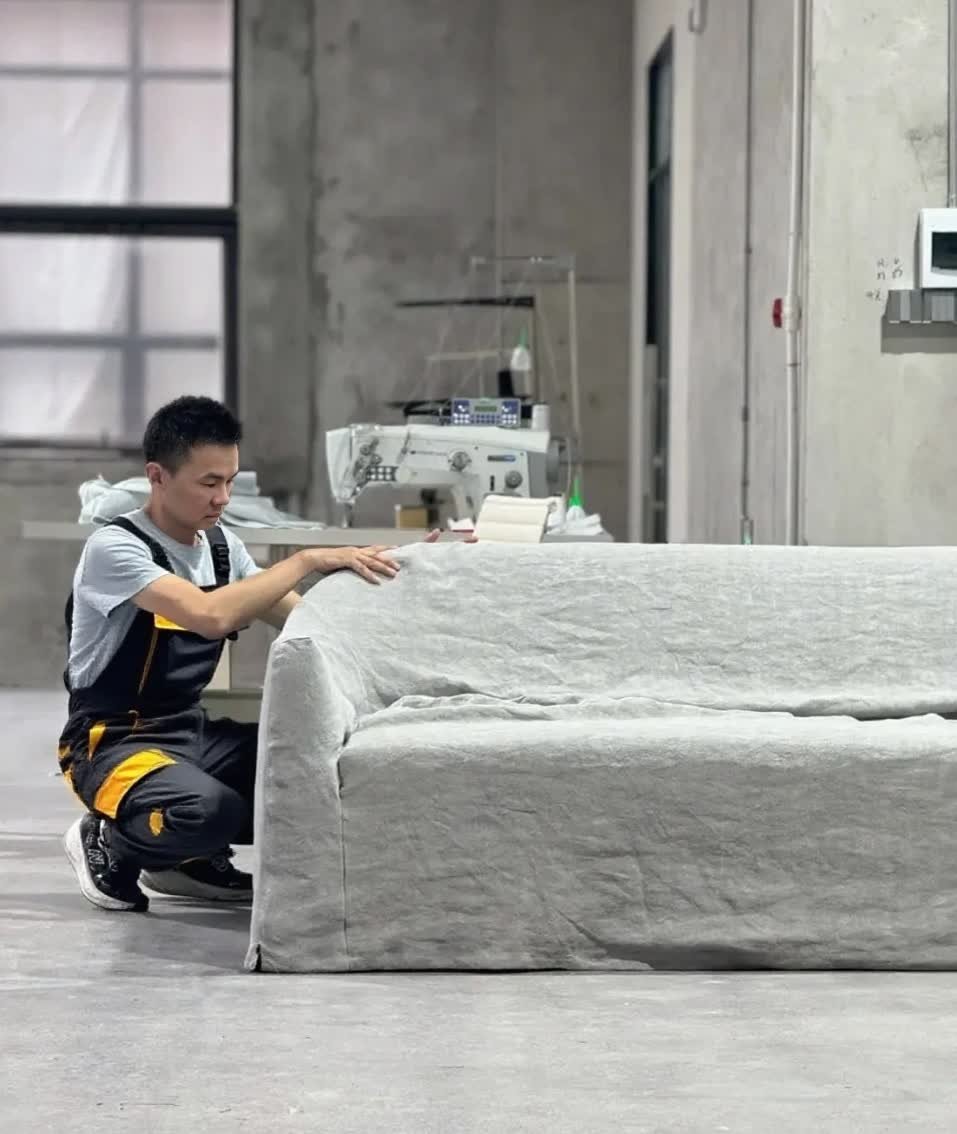
A Foshan factory with demonstrated hand-finishing capability, COM fabric acceptance, and a made-to-order workflow that covers 200+ color specifications can execute organic modern furniture to the same design standard as a California custom studio — at 40–60% lower cost9. The risk is not capability. The risk is finding the right factory.
The cost difference is real. A sofa that a California studio prices at $8,000–$12,000 in Belgian pure linen, with custom dimensions and a COM option, sits at $3,500–$5,500 at our factory with the same specification. That gap funds other decisions in a project — or simply makes the margin work for the designer's client.
But I deliberately haven't opened with that number. The number only means something after you understand what the production actually covers.
What production depth actually looks like at this level
I want to be specific here, because "high quality" is a phrase that means nothing in a sourcing conversation.
Hand-finishing. The joints on our frames are hand-checked and glued at every connection point. The upholstery is hand-tacked at the corners and pull points, not stapled to a consistent line10. This is visible in the finished piece if you know where to look — the way the fabric sits at the arm corners, the way the back cushion aligns to the frame. Machine-finished pieces have a uniform quality that reads as competent. Hand-finished pieces have a resolved quality that reads as considered.
COM acceptance. We accept client-supplied fabric for all upholstery pieces. This is table-stakes for project delivery at the design level, but a surprising number of factories in this category don't offer it cleanly — there are yardage minimums, handling fees, or quality disclaimers that create friction at the spec stage. We work directly from the designer's yardage calculation and cut to the specification.
200+ color made-to-order. For designers who are specifying against a palette, not just a category, this matters. Organic modern color is precise — warm whites, natural greiges, stone, sage, and dusty blue are all correct; stark white, navy, or saturated colors are not11. The ability to order a sofa in a specific muted linen colorway, to spec, without a minimum order requirement, is what allows a design concept to land exactly as drawn.
A composited example from a recent project type: a designer working on a California villa needed three sofas, two armchairs, and four dining chairs in a single linen colorway — a warm natural greige that sat between their wall plaster and the stone floor. They had a COM swatch from their selected Belgian linen supplier. We matched the frame specification to their existing furniture drawings, accepted the COM fabric, confirmed the colorway across all seven pieces, and delivered to a freight forwarder within the lead time. The risk they were managing — color inconsistency across pieces, frame deviation from drawing, fabric handling errors — was addressed at the specification stage, not discovered at delivery.
That's the workflow that makes the cost difference meaningful. Not the number itself.
Conclusion
Organic modern furniture is a material and form standard, not a trend. If you're specifying at that level, the sourcing decision should be held to the same standard — verified fabric, verified silhouette, and a production partner who can execute to spec.
If you’re an interior designer sourcing bespoke organic modern linen furniture for US high-end residential projects, our 13-year Foshan workshop offers full custom silhouette adjustment, COM fabric service and over 200 muted Belgian linen colorways. We provide free style specification check and layout advice based on your project drawings. Reach us via WhatsApp to request fabric swatches, factory virtual tours or customized quotations.https://linenworld.pro
"Design Style Feature | 7 Key Features of the Organic Modern Style", https://www.scoutandnimble.com/blog/organic-modern-style-interior-design?srsltid=AfmBOoqW_h46jM44WEScQHoFJ_DSn8u744bimQFr5sGVkjz3TqRe0H14. Design reference sources describe organic modernism as a tendency within mid-to-late twentieth century and contemporary interior design that combines modernist formal restraint with natural, tactile materials, drawing on influences including Scandinavian functionalism and the organic architecture of figures such as Alvar Aalto. Evidence role: definition; source type: encyclopedia. Supports: That organic modern as a design category is characterized by natural materials and simplified, nature-influenced forms. Scope note: Organic modern is an informal trade and design industry label rather than a codified style movement; definitions vary across sources and no single authoritative standard exists. ↩
"Three days at the Louvre: How China took over the global furniture ...",
. Foshan, Guangdong Province, is recognized by trade and industry sources as one of China's principal furniture manufacturing and export hubs, with a concentration of upholstery, case goods, and component suppliers that supports vertically integrated production at scale. Evidence role: historical_context; source type: institution. Supports: That Foshan, Guangdong is a major global center for furniture manufacturing and export. Scope note: Aggregate industry data on Foshan's furniture sector is more readily available than segment-specific data on upholstered residential furniture; the city's general manufacturing significance contextualizes but does not directly validate individual factory capability claims. ↩"The Influence of Finishing on the Pilling Resistance of Linen/Silk ...", https://pmc.ncbi.nlm.nih.gov/articles/PMC8619160/. Research on bast fiber properties indicates that flax-derived linen exhibits high tensile strength and low elasticity, characteristics associated with reduced pilling and sustained surface integrity under repeated mechanical stress, though direct comparative studies on upholstery-grade blends under residential conditions remain limited. Evidence role: mechanism; source type: research. Supports: That linen's natural fiber structure contributes to its durability and resistance to pilling compared to synthetic blends. Scope note: Most fiber performance studies focus on apparel or industrial textiles; direct upholstery-specific comparative data between pure linen and blends is sparse in peer-reviewed literature. ↩
"Linen vs linen blends : r/sewing - Reddit", https://www.reddit.com/r/sewing/comments/1dffugx/linen_vs_linen_blends/. Market analyses of the upholstery fabric sector indicate that linen-blend fabrics constitute a larger share of commercial supply than pure linen grades, reflecting lower production costs and broader mill availability, which creates conditions for specification drift during sourcing. Evidence role: general_support; source type: institution. Supports: That linen blends are more widely available and lower in cost than pure linen, creating substitution pressure during procurement. Scope note: Specific data on designer substitution behavior is not widely published; the claim reflects a plausible market dynamic supported by supply-side pricing data rather than documented sourcing practice surveys. ↩
"Perceptual imagery of soft sofa fabrics based on visual-tactile ...", https://bioresources.cnr.ncsu.edu/resources/perceptual-imagery-of-soft-sofa-fabrics-based-on-visual-tactile-evaluation/. Human factors and environmental psychology research indicates that tactile properties of seating surfaces — including texture, temperature, and compliance — are among the primary sensory inputs through which users evaluate furniture comfort and material quality, supporting the prioritization of fabric specification in residential design. Evidence role: mechanism; source type: research. Supports: That fabric surface is a primary sensory interface in upholstered furniture, significantly influencing user perception and satisfaction. Scope note: Research in this area tends to focus on comfort and ergonomics broadly; studies specifically addressing fabric specification decision-making in interior design practice are limited. ↩
"Sofa Depth Guide: Ergonomic Standards for Office Comfort", https://eurekaergonomic.com/blogs/eureka-ergonomic-blog/sofa-depth-ergonomic-standards-office-lounges?srsltid=AfmBOoori2SERz0Vm9ZOv_S8wGe7zKLK7r1KTPhF-VRrwq_bGLKExk0V. Furniture ergonomics guidelines and interior design reference texts generally cite standard residential sofa seat heights in the range of 17–21 inches, with lower-profile contemporary designs falling toward or below the 17-inch threshold. Evidence role: definition; source type: education. Supports: That conventional sofa seat heights typically exceed 18 inches, making 16–18 inches a meaningfully lower profile. Scope note: Seat height standards vary by source and region; the 16–18 inch range cited for organic modern is a stylistic convention rather than an industry-standardized specification. ↩
"Danish Modern Furniture 1930–2016: The Rise, Decline ... - West 86th", https://west86th.bgc.bard.edu/bookreviews/danish-modern-furniture-1930-2016-the-rise-decline-and-re-emergence-of-a-cultural-market-category/. Walnut and oak have been predominant hardwoods in Scandinavian and American organic modern furniture traditions since the mid-twentieth century, valued for their grain character and compatibility with oil and wax finishes that preserve natural surface texture, as documented in design histories of the period. Evidence role: historical_context; source type: encyclopedia. Supports: That walnut and oak with natural oil finishes are associated with the organic and Scandinavian modern design traditions from which organic modern draws. Scope note: The designation of these species as definitionally correct for contemporary organic modern is a stylistic convention; the historical association supports the claim contextually rather than prescriptively. ↩
"TIEOU Metal Table Legs 28 Inch Heavy Duty T Shape Metal Desk ...", https://www.amazon.com/Height-Industrial-Furniture-Dining-Console/dp/B083569XRW. Design style taxonomies associate black powder-coated metal legs with industrial and contemporary modern aesthetics, and brass hardware with mid-century modern revival, both of which prioritize manufactured material expression in contrast to the natural material emphasis characteristic of organic modern. Evidence role: definition; source type: encyclopedia. Supports: That black and brass metal legs are characteristic of industrial modern and mid-century modern styles respectively, distinguishing them from organic modern's natural material palette. Scope note: Style boundaries in contemporary interior design are fluid and contested; the association of metal legs with non-organic-modern styles reflects prevailing trade convention rather than a formally codified distinction. ↩
"The Effect of Furniture Imports from China on Employment in U.S. ...", https://www.usitc.gov/publications/332/working_papers/ecwp_2017-08-a-08-23-17_0.htm. Trade and industry analyses of the US–China furniture supply chain consistently document significant cost differentials attributable to lower labor costs, vertically integrated material supply, and manufacturing scale in production centers such as Foshan, Guangdong, though precise percentage ranges vary by product category and specification level. Evidence role: statistic; source type: institution. Supports: That Chinese furniture manufacturing costs are substantially lower than equivalent US custom production due to labor and supply chain differences. Scope note: Published cost-differential figures are typically aggregate or category-level; the specific 40–60% range cited here is not independently verified for high-specification upholstered furniture and may reflect favorable conditions not universally applicable. ↩
"IS AN ELECTRIC STAPLE GUN WORTH IT? | FaceliftInteriors",
. Traditional upholstery craft literature and furniture construction references distinguish hand-tacking — which allows tension adjustment at individual pull points — from machine stapling, noting that hand methods permit greater control over fabric alignment and stress distribution, particularly at corners and curved surfaces. Evidence role: expert_consensus; source type: education. Supports: That traditional hand-tacking and hand-glued joinery are associated with higher durability and finish quality in upholstered furniture construction compared to machine stapling. Scope note: Comparative performance data between hand and machine upholstery methods under standardized conditions is not widely published; the quality distinction is supported by craft consensus and trade practice rather than controlled empirical study. ↩"Biophilic Design: Integrating Nature Into Modern Interiors - RMCAD", https://www.rmcad.edu/blog/biophilic-design-integrating-nature-into-modern-interiors/. Research on biophilic design and nature-connected interior environments consistently identifies low-saturation, warm-neutral color palettes — including whites, greiges, and muted greens — as characteristic of spaces designed to evoke natural settings, aligning with the color conventions described for organic modern. Evidence role: expert_consensus; source type: research. Supports: That organic modern and biophilic interior design aesthetics are associated with muted, nature-derived color palettes rather than saturated or high-contrast colors. Scope note: Biophilic design research addresses psychological and environmental outcomes rather than style categorization; the color palette described is a design convention rather than an empirically validated standard. ↩


