
I have seen too many designers and homeowners regret their linen bedroom purchases. They picked pieces that looked perfect in photos but arrived with stiff fabric, mismatched furniture sizes, or colors that clashed with their vision. The bedroom felt incomplete, and the budget was already spent.
The best linen bedroom ideas focus on three decisions: choosing Belgium pure linen over blends for lasting softness and texture, combining bed-armchair-bench pieces in a unified color palette, and using made-to-order options when your design needs specific dimensions or fabrics that ready-made collections cannot match.
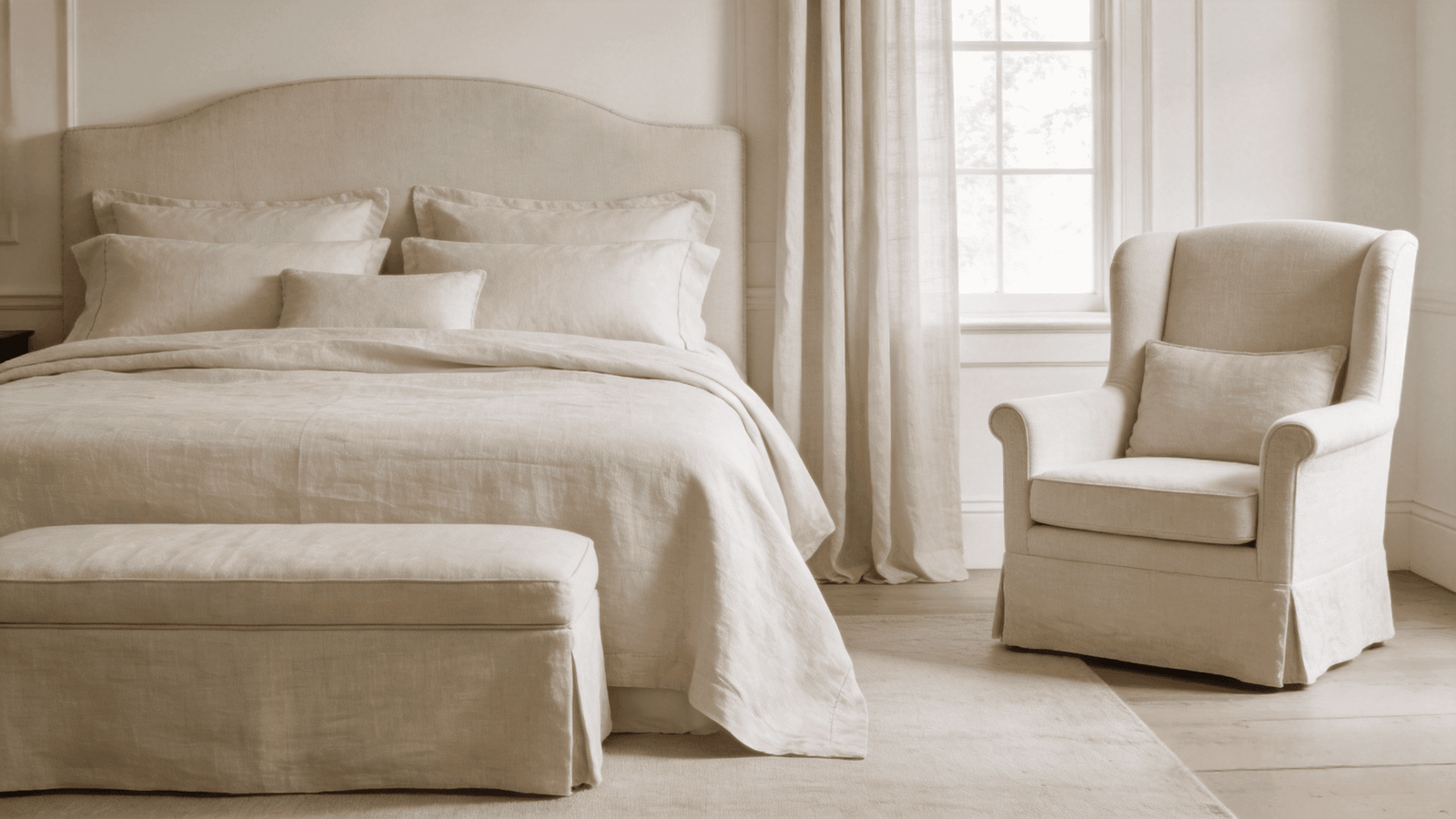
Most articles show you pretty bedroom photos and call it "ideas." But when you actually need to buy furniture for a client's project or your own home, you face real questions: How do I know if this linen is high quality? Will this bed work with that armchair? Should I wait for custom pieces or buy from stock? Let me walk you through the decisions that actually matter.
How Do You Choose Quality Linen That Will Last in a Bedroom?
Many suppliers call their fabric "linen" when it is actually a cotton-linen blend or low-grade flax. You cannot tell from a website photo. But the difference shows up fast after delivery and becomes obvious after six months of use.
Pure Belgium linen uses long-staple flax fibers that create a smooth, durable fabric with natural luster. Blends or short-fiber linen feel rough, wrinkle irregularly, and lose shape faster. Check the fiber content label and ask for fabric samples before committing to bedroom furniture that will be touched and sat on daily.
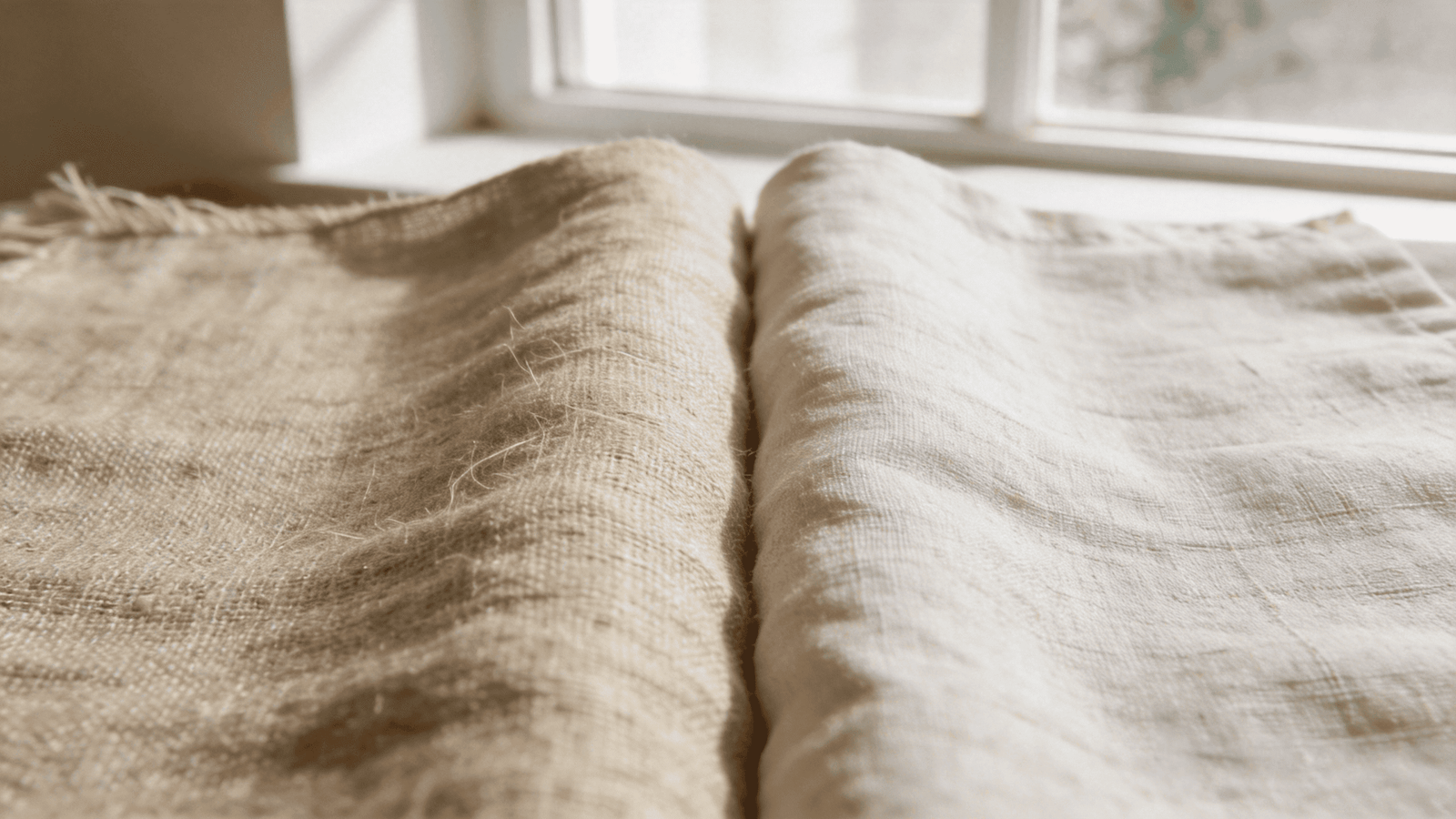
I work with designers who have compared fabric samples from different factories. When they put Belgium pure linen next to a standard blend, they see the difference immediately. The pure linen drapes better on a bed frame, reflects light more softly, and feels cooler to touch. Blends often feel stiff or almost cottony.
Here is what changes over time:
| Fabric Type | Initial Feel | After 6 Months | After 2 Years |
|---|---|---|---|
| Belgium Pure Linen | Soft with slight texture | Softer, natural patina develops | Maintains structure, aged elegance |
| Cotton-Linen Blend | Smooth but flat | Pills in high-contact areas | Loses shape, fabric thins |
| Low-Grade Linen | Rough, uneven | Wrinkles set permanently | Frays at seams, color fades |
You also need to consider thread count and weave density, but these matter less than fiber quality1. A tight weave in pure linen will outlast a loose weave in blends2. When a supplier offers 200+ linen colors, ask if all colors use the same base fabric. Some factories use different linen grades for different price points, which means your custom sofa and bed might not match in texture even if the color looks similar.
For bedroom furniture, durability matters more than in a guest room chair. Your client will sit on the bed edge daily, lean against the armchair, and use the bench for dressing. Low-quality linen will show wear patterns within the first year3. Belgium linen develops a softer hand feel but maintains its structure4.
What Furniture Pieces Actually Create a Complete Linen Bedroom?
Buying just a linen bed does not give you a linen bedroom. I see this mistake often. A designer orders a beautiful upholstered bed, delivers it to the client, and then realizes the room feels unfinished. The bed sits alone, and the client asks what comes next.
A complete linen bedroom combines three core pieces: the upholstered bed as the focal point, a linen armchair for a reading corner or dressing area, and a bench or ottoman at the foot of the bed for function and visual balance. This combination gives the room depth and makes the linen aesthetic feel intentional rather than accidental.
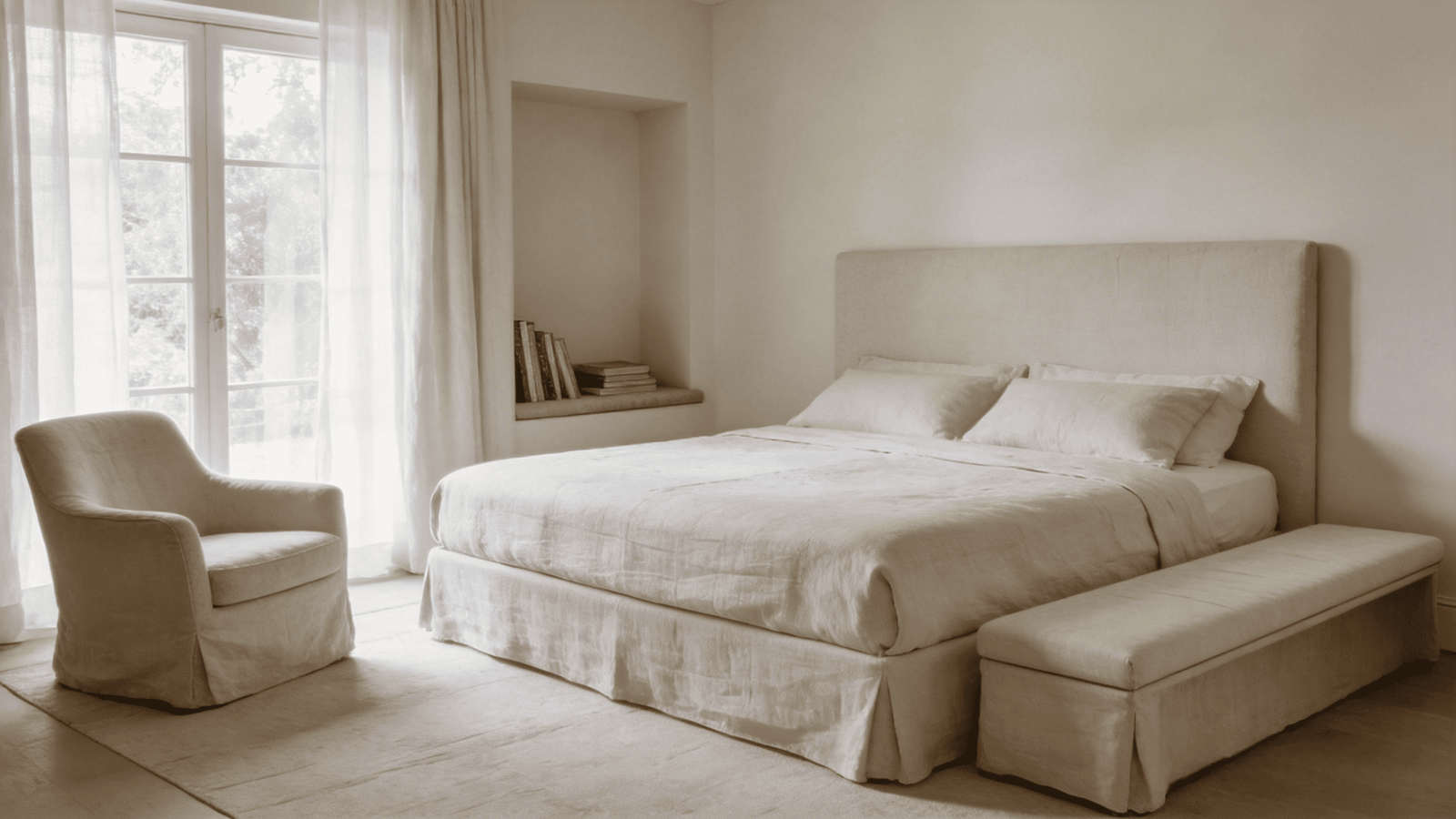
The logic is not about filling space. Each piece serves a real function and contributes to the visual flow. An armchair creates a second activity zone so the room is not just for sleeping. A bench gives a place to lay out clothes or sit while putting on shoes, and it visually grounds the bed. Without these elements, a linen bed looks like a single purchase rather than a designed space.
Color coordination is where many projects fail. You cannot assume "natural linen" means the same color across different furniture pieces or suppliers. I have seen designers order a bed in "oat" from one brand and an armchair in "natural" from another, expecting them to match. They arrive in different undertones. One pulls warm, the other cool. The room looks disjointed.
Here is how to approach color matching:
| Approach | When It Works | Risk |
|---|---|---|
| Same supplier, same fabric | All pieces ordered together | Limited style options within one supplier |
| Same supplier, coordinated palette | Supplier offers curated color groups | Still need to verify fabric samples match |
| Multiple suppliers, custom fabric | You provide COM (customer's own material) | Requires fabric sourcing and extra coordination |
| Multiple suppliers, "matching" stock colors | Quick delivery, lower cost | High chance of mismatch, cannot return upholstered furniture |
If you order from our made-to-order system, you can select the same fabric code for all pieces. This guarantees color consistency because all furniture is upholstered from the same fabric roll. If you use COM, you need to order enough yardage to cover all pieces at once. Dye lots vary, so buying fabric in two separate orders can result in slight color differences5.
The furniture scale also needs balance. A king-size bed with a small armchair looks off. A bench should be proportional to the bed width. I worked on a project where the designer ordered a 72-inch wide bed and a 24-inch bench. The bench looked like an afterthought. We remade it at 48 inches, and the room came together. This is the kind of adjustment you can make with made-to-order but not with stock pieces.
Should You Choose Ready-Made or Made-to-Order Linen Bedroom Furniture?
This is not about customization for its own sake. It is about whether ready-made pieces can actually deliver your design or if you need to specify exact requirements to make the project work.
Choose ready-made linen furniture when the stock dimensions, fabric options, and style details match your design plan exactly, and the project timeline allows for potential mismatches or reorders. Choose made-to-order when your design requires specific measurements to fit the room layout, a particular fabric that stock pieces do not offer, or modifications like different leg styles, cushion firmness, or arm heights that affect function and visual proportion.
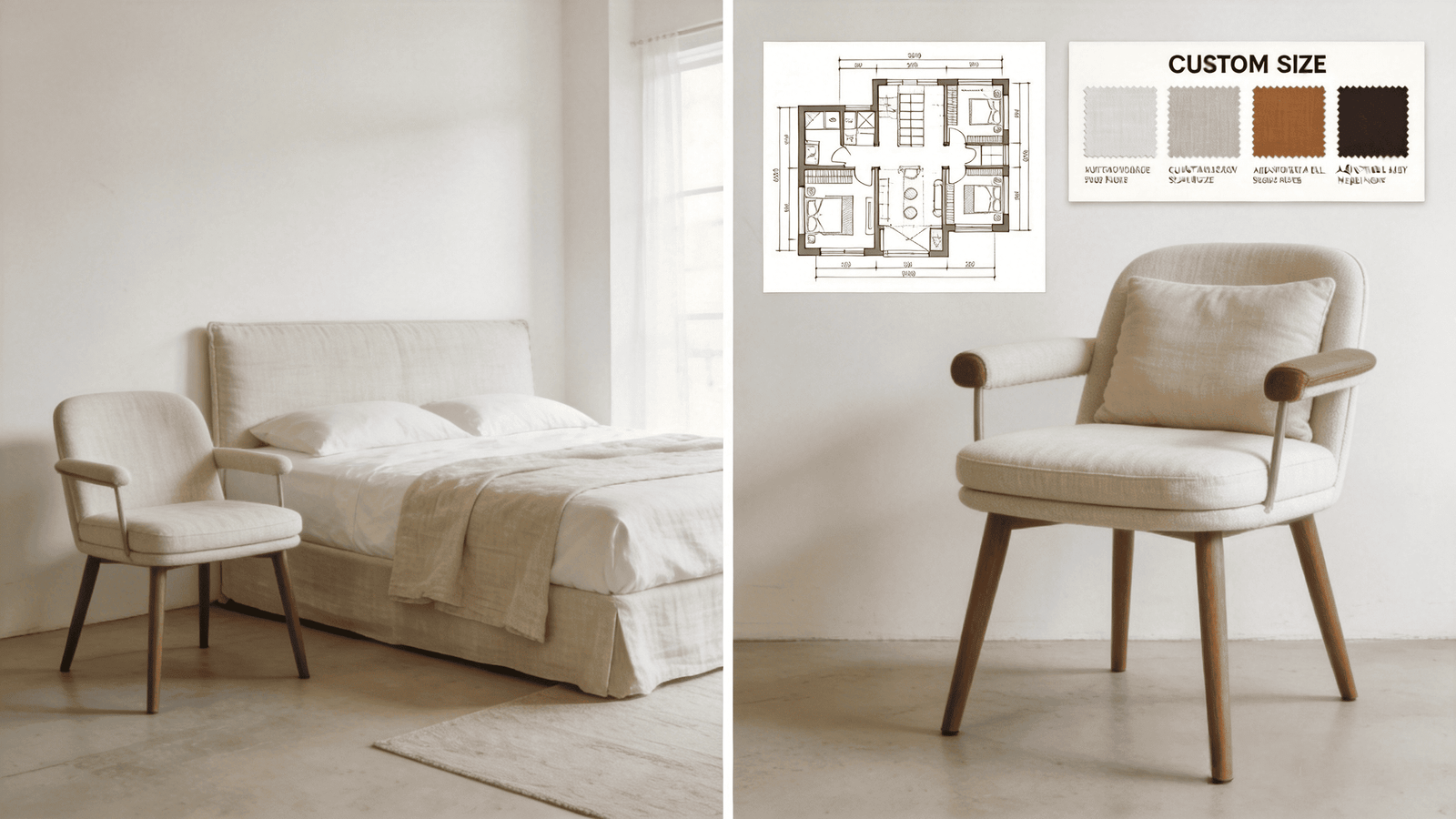
Let me be clear about the trade-offs. Ready-made furniture ships faster, usually within 2-4 weeks6. Made-to-order takes 6-10 weeks depending on the supplier and current production queue7. If your project timeline is tight and you can work within the constraints of stock options, ready-made makes sense.
But ready-made only works if the constraints fit. I have talked to designers who needed a bed with a higher headboard to balance a room with tall ceilings. Stock options maxed out at 48 inches. They needed 60 inches. Or they found a bed they liked but the client wanted a softer seat cushion than the standard firmness. Or the bed frame was perfect but came in only five colors, and none matched the room's existing palette.
Made-to-order solves these problems, but it requires planning:
| Design Requirement | Ready-Made Constraint | Made-to-Order Solution |
|---|---|---|
| Bed must fit under sloped ceiling | Stock headboard too tall | Custom headboard height specified to exact ceiling clearance |
| Client needs firmer back support | Stock cushion uses standard foam | Specify high-density foam or spring system |
| Room has specific color from architect's palette | Stock offers 5-10 colors | Choose from 200+ fabric colors or provide COM |
| Armchair must fit narrow space beside window | Stock width 32 inches, space is 28 inches | Reduce arm width and overall dimensions |
The cost difference is not as large as many people assume. Ready-made linen bedroom furniture from high-end US or European brands often costs 40-60% more than ordering directly from a factory like ours, even when we make pieces to custom specifications. The price gap comes from supply chain markup, not customization fees.
However, made-to-order does lock you into decisions earlier in the project. You need to finalize fabric, dimensions, and details before production starts. Changes mid-production are difficult or impossible. Ready-made lets you see the piece first, but you cannot return upholstered furniture once delivered if it does not work in the space8.
I worked with a designer who ordered a ready-made linen bed for a client's master bedroom. The bed arrived, and the headboard was too low for the wall proportion. The designer called us to make a matching custom headboard at the right height. The client paid for the original bed they could not return, plus the custom headboard. If they had started with made-to-order, they would have specified the correct height from the beginning and saved both time and budget.
How Do You Plan a Linen Bedroom Project Timeline and Budget?
Most designers and homeowners underestimate how long it takes to get linen bedroom furniture right. They assume ordering is quick, and everything arrives ready to install. Then they hit delays because fabric samples took two weeks to ship, the client changed their mind on color, or the stock piece they wanted was backordered.
Plan your timeline by working backward from the client's move-in date: allow 2-3 weeks for fabric samples and decision-making, 6-10 weeks for made-to-order production, 3-4 weeks for ocean shipping if ordering internationally, and 1-2 weeks buffer for customs and delivery coordination. For budget, expect to pay 40-60% less ordering from a direct factory versus local high-end retailers, but factor in shipping and any import duties.
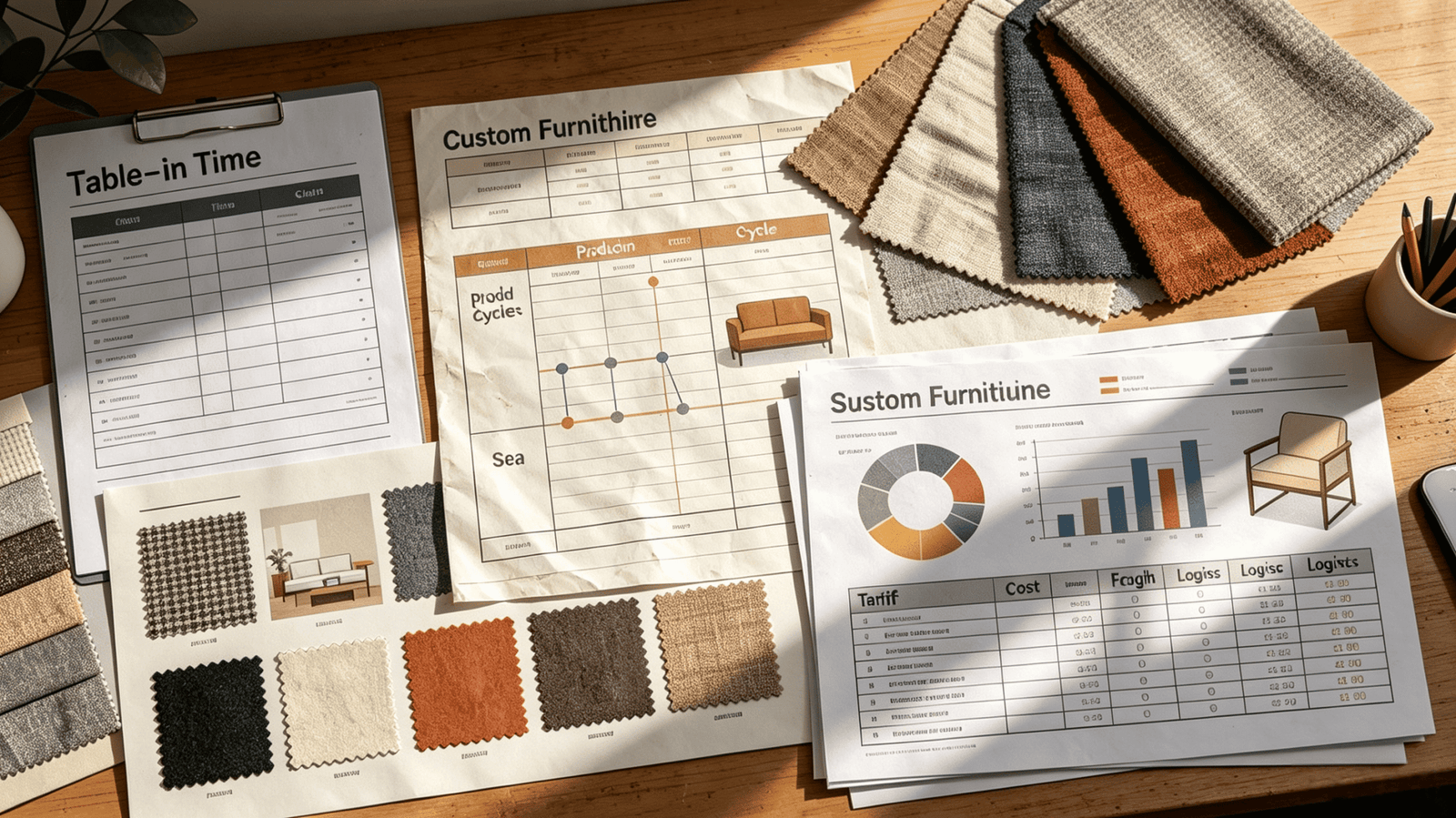
I see projects fail when designers do not account for the sample phase. Viewing fabric on a screen is not enough. Linen looks different under various lighting, and texture cannot be judged from photos. Order physical samples of your top 3-5 fabric choices. This adds time but prevents expensive mistakes.
Here is a realistic timeline for a complete linen bedroom order:
| Phase | Duration | What Happens |
|---|---|---|
| Sample request and review | 2-3 weeks | Factory ships samples, designer and client review in actual room lighting |
| Design finalization | 1 week | Confirm dimensions, fabric, details; approve drawings if custom |
| Production | 6-10 weeks | Furniture is built, upholstered, quality checked |
| Shipping (international) | 3-4 weeks | Ocean freight, customs clearance |
| Local delivery and install | 1 week | White glove delivery, placement, inspection |
| Total | 13-19 weeks | About 3-4.5 months from first contact to installed furniture |
If you choose ready-made stock, cut the production time to 2-4 weeks, reducing total timeline to 8-12 weeks. But you sacrifice the ability to adjust anything.
On budget, I will give you real numbers. Mid-to-high-end US boutique furniture retailers price Belgium linen king beds in the $4,000–$7,000 range, with premium designer labels commanding higher price points above this bracket. A matching armchair runs $2,500-$4,000. A bench is $1,200-$2,000. The complete set is $7,700-$13,000. Ordering the same pieces made-to-order from our factory, you would pay approximately $4,600-$7,800 for the full set including shipping. The savings are $3,100-$5,200.
Those savings assume you order a reasonable quantity. One piece usually does not make sense because shipping costs stay similar whether you ship one item or three. The cost advantage increases when you order full bedroom sets or furnish multiple rooms in the same project.
Import duties depend on your country. In the US, upholstered furniture typically faces a 0-5% duty rate9 depending on classification. Factor this into your budget. Also account for potential storage fees if the furniture arrives before the client is ready to receive it.
Conclusion
Creating a linen bedroom that looks intentional and lasts requires choosing pure Belgium linen, combining coordinated furniture pieces, and deciding between ready-made and made-to-order based on your real design constraints and timeline, not assumptions about speed or cost.
If you are an interior designer sourcing high-end Belgian linen bedroom sets (upholstered bed, armchair, end-of-bed bench) for US residential luxury projects, our 13-year Foshan factory supplies full made-to-order customization on headboard height, arm width, cushion density and fabric shades, with consistent dye-lot matching for all matching furniture pieces. We provide free physical linen swatches, free room layout dimension consultation and full DDP shipping cost calculation. Message us via WhatsApp to request fabric catalogs, full bedroom set quotations or long-term fabric abrasion reference samples.https://linenworld.pro
"Weave structures of polyester fabric affect the tensile strength ... - PMC", https://pmc.ncbi.nlm.nih.gov/articles/PMC11756394/. Textile engineering literature indicates that raw fiber quality significantly influences fabric durability and performance, though the relative contribution of fiber characteristics versus construction parameters like thread count varies by intended use and wear patterns. Evidence role: expert_consensus; source type: research. Supports: the relative importance of fiber quality versus construction parameters in textile performance. Scope note: Research may not provide a definitive ranking applicable to all linen applications, particularly upholstery versus bedding ↩
"Quantitative Assessment of Woven Fabric Surface Changes During ...", https://pmc.ncbi.nlm.nih.gov/articles/PMC12348827/. Textile durability research demonstrates that weave density significantly affects fabric abrasion resistance and longevity, with tighter weaves generally performing better in wear testing, though direct comparisons between pure linen and blends must account for multiple variables including fiber quality, yarn construction, and finishing treatments. Evidence role: general_support; source type: research. Supports: the relationship between weave density and fabric durability. Scope note: Controlled studies may not perfectly replicate real-world furniture upholstery wear patterns over multi-year periods ↩
"Accelerated aging - Wikipedia", https://en.wikipedia.org/wiki/Accelerated_aging. Upholstery durability testing standards use accelerated wear methods to predict fabric lifespan, with lower-quality textiles showing measurable degradation at lower cycle counts, though translating laboratory test results to specific real-world timeframes like 'one year' depends on actual usage intensity and patterns. Evidence role: general_support; source type: research. Supports: the relationship between fabric quality and visible wear development. Scope note: Standardized testing may not accurately predict performance in specific residential bedroom furniture applications ↩
"Investigation of the Properties of Linen Fibers and Dressings - PMC", https://pmc.ncbi.nlm.nih.gov/articles/PMC9501175/. Textile research on linen aging indicates that repeated use and laundering can soften the fabric hand through mechanical action on fiber surfaces while the inherent strength of flax fibers helps maintain dimensional stability, though the rate and extent of softening varies with fabric construction and care methods. Evidence role: mechanism; source type: research. Supports: the changes in linen fabric properties with use and washing. Scope note: Studies may not specifically address Belgium linen or long-term upholstery applications versus bedding or apparel ↩
"Dye lot - Wikipedia", https://en.wikipedia.org/wiki/Dye_lot. Textile manufacturing documentation confirms that dye lot variation occurs due to differences in dye batch chemistry, processing conditions, and raw material characteristics, making color matching across production runs a recognized quality control challenge in the industry. Evidence role: general_support; source type: education. Supports: the phenomenon of dye lot variation in textile manufacturing. ↩
"5-6 weeks for an order to get from production to distribution????", https://www.reddit.com/r/interiordefine/comments/1ewcrwo/56_weeks_for_an_order_to_get_from_production_to/. Furniture industry reports indicate that in-stock items typically ship within 2-4 weeks, though actual delivery times vary significantly by retailer, inventory management practices, and regional logistics infrastructure. Evidence role: general_support; source type: other. Supports: typical delivery timeframes for in-stock furniture. Scope note: Industry averages may not reflect current supply chain disruptions or specific product categories like upholstered furniture ↩
"Furniture Lead Times: Why Does it Take So Long?", https://tracymorrisdesign.com/furniture-lead-times-why-does-it-take-so-long/. Furniture manufacturing industry data suggests that custom upholstered pieces typically require 6-12 weeks for production, with variation based on workshop capacity, design complexity, and material availability, though individual manufacturers may operate on different schedules. Evidence role: general_support; source type: other. Supports: typical production timeframes for custom upholstered furniture. Scope note: Production times are highly variable and depend on specific manufacturer capabilities and order volume ↩
"Buying furniture in Connecticut - CT.gov", https://portal.ct.gov/dcp/knowledge-base/articles/consumer-topics/furniture-sales/buying-furniture-in-connecticut. Furniture retail industry practices commonly restrict or prohibit returns of upholstered items due to hygiene concerns and customization factors, though specific policies vary by retailer and jurisdiction, with consumer protection laws in some regions providing limited return rights even for custom goods. Evidence role: general_support; source type: other. Supports: typical return policies for upholstered furniture in retail. Scope note: Return policies are retailer-specific and may be affected by local consumer protection regulations ↩
"9403.60.80 - Harmonized Tariff Schedule", https://hts.usitc.gov/search?query=9403.60.80. The US Harmonized Tariff Schedule lists various duty rates for upholstered furniture depending on specific classification, materials, and country of origin, with rates typically ranging from duty-free to approximately 5%, though specific rates require precise HTS code determination and consideration of any applicable trade agreements. Evidence role: statistic; source type: government. Supports: US import duty rates for upholstered furniture. Scope note: Actual duty rates depend on detailed product classification and may be affected by trade policy changes or country-specific tariffs ↩


