
Most buyers approach an upholstered bed the wrong way. They spend hours choosing a headboard silhouette and fabric swatch, then discover — months after delivery — that the frame flexes, the foam has compressed, or the fabric pills under light use. You're not buying a decorative object. You're buying a structural piece that has to perform every single night for a decade or more.
An upholstered bed is a bed frame wrapped in padded fabric — typically linen, velvet, boucle, or performance weave — over an internal structure of wood or metal. The right choice depends on four variables most buyers never evaluate: frame construction, foam specification, fabric performance, and dimensional fit. Get all four right and the piece holds up beautifully. Miss one and no amount of good styling saves it.
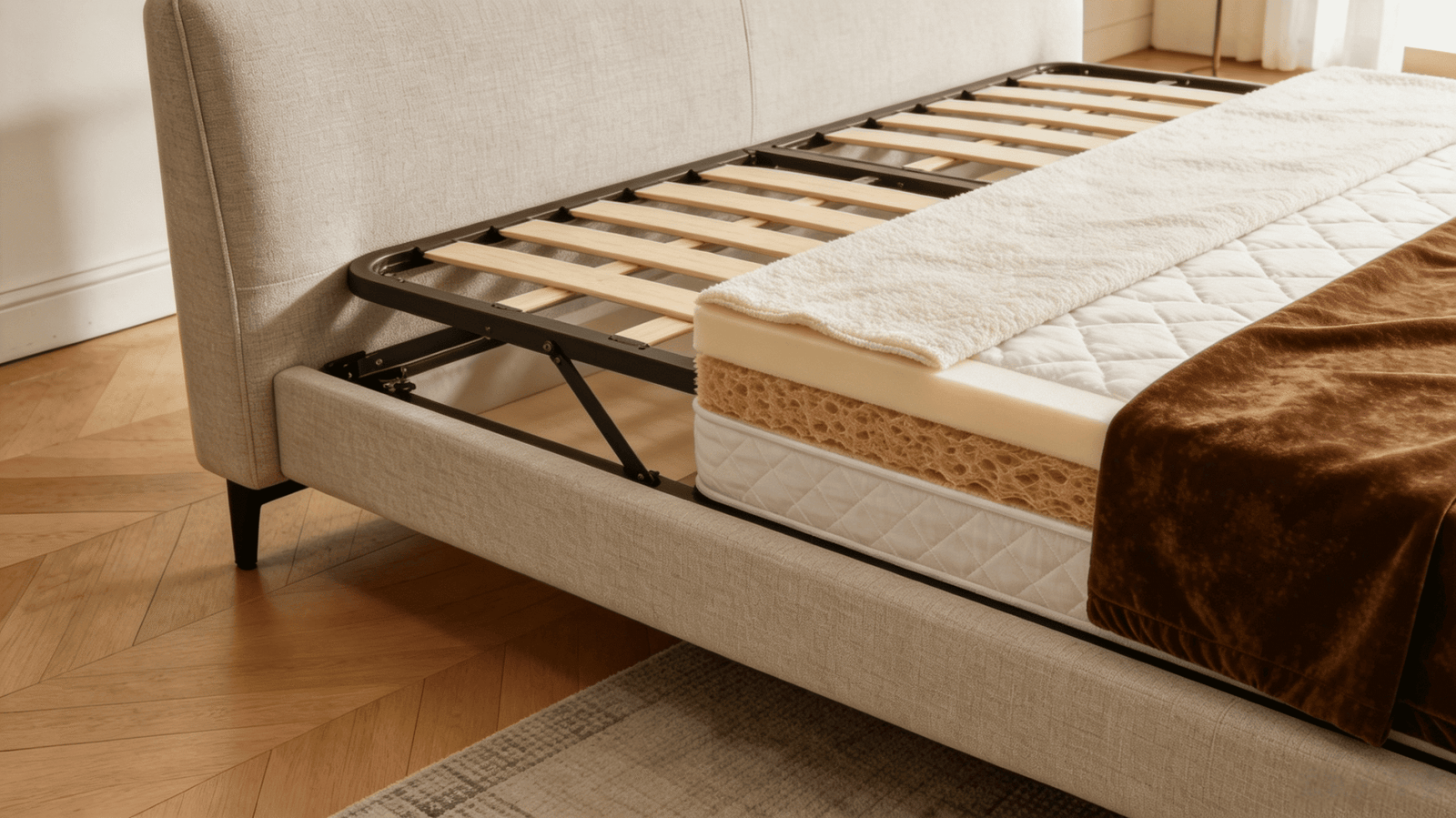
The sections below break each variable into a practical decision framework. I'll also cover custom ordering realities — what actually affects lead time, what information you need to provide upfront, and where most specification errors happen.
What's Actually Inside an Upholstered Bed Frame — and Why Does It Matter?
Buyers consistently focus on what they can see and touch at point of purchase. The headboard fabric, the button tufting, the leg finish. None of those details predict how the bed performs over time. The structural variables do — and they're all hidden.
Frame material is the single most important construction variable in an upholstered bed. Solid kiln-dried hardwood (typically poplar, rubberwood, or beech) resists warping and holds fasteners long-term1. Engineered wood (MDF, particle board) is cheaper to produce but degrades faster under load and moisture cycling — joints loosen, and the frame begins to shift2. Ask specifically: what species, and is it kiln-dried?
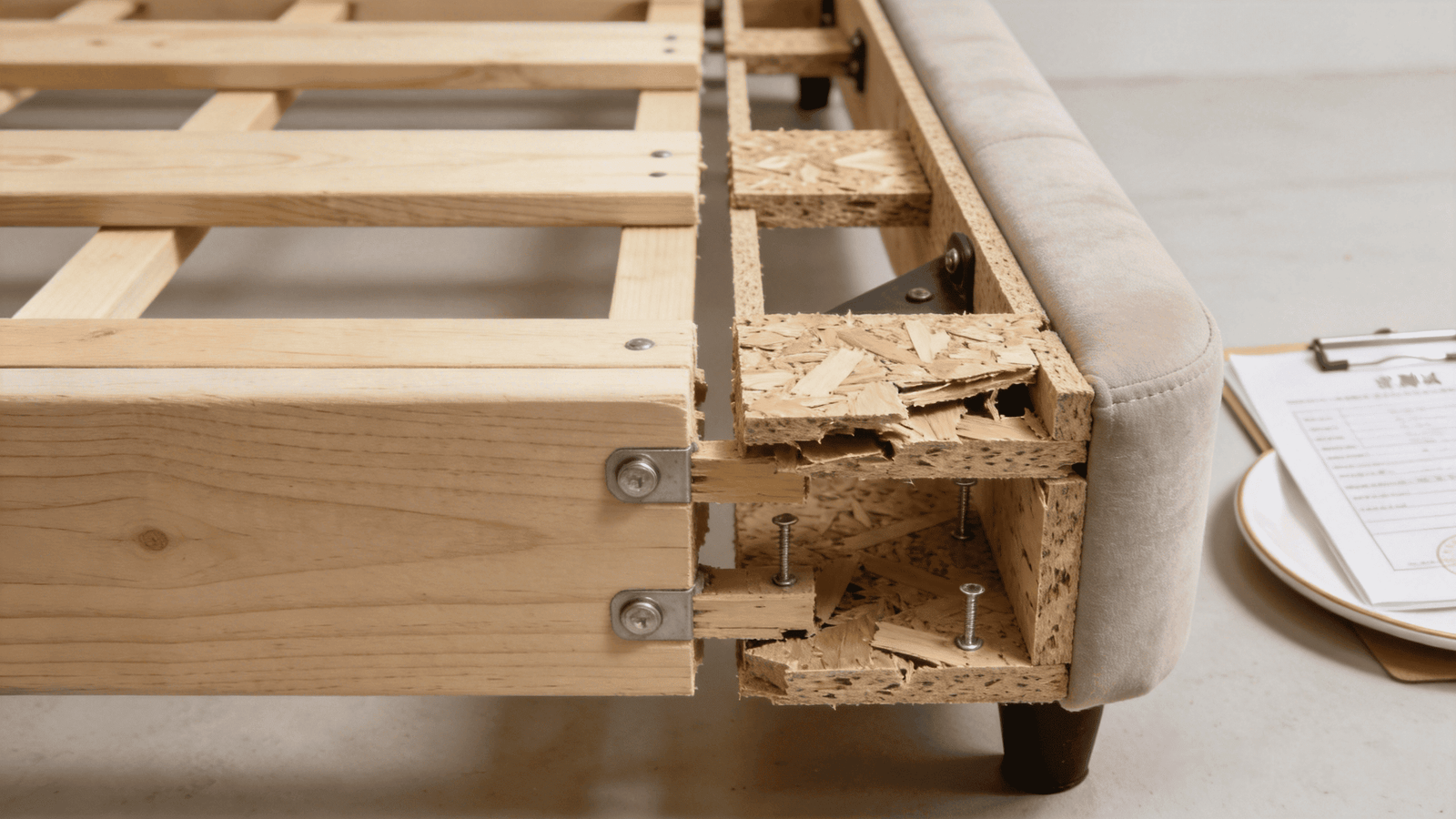
In production, we see this issue surface most clearly with platform beds where the side rails carry significant lateral stress. A solid wood frame with mortise-and-tenon or metal bracket reinforcement at the corners will stay rigid for years. A particle board frame with stapled butt joints typically starts showing movement within 12–18 months of regular use3.
Frame Material Comparison
| Frame Type | Typical Lifespan | Joint Integrity Over Time | Moisture Resistance | Common Price Range |
|---|---|---|---|---|
| Solid kiln-dried hardwood | 10–20+ years | High | Good | Higher |
| Engineered wood (MDF/plywood) | 5–10 years | Moderate | Fair | Mid |
| Particle board | 3–7 years | Low | Poor | Lower |
| Metal (steel tube) | 10–15+ years | Very high | Excellent | Mid–High |
The Foam Question Nobody Asks
Headboard and side panel padding is almost always foam — but foam density varies enormously. The relevant specification is density rating, measured in kg/m³ (or lb/ft³ in US spec sheets).
- Low-density foam (under 30 kg/m³): Compresses quickly, loses shape within 1–2 years. Headboards start feeling hard and uneven.
- Medium-density foam (30–40 kg/m³): Suitable for decorative panels with light leaning use.
- High-density foam (40–55 kg/m³): Appropriate for a headboard that gets daily use — sitting up in bed, leaning against it to read or watch TV.
I've had clients come back after their first order specifically requesting a foam upgrade on reorders because they noticed compression at the reading position after one winter. It's a preventable issue. Ask for the foam density grade in writing before you order.
What to Ask Any Supplier Before Ordering
- What is the frame material, and is it kiln-dried?
- What joint method is used at the corners (mortise-and-tenon, metal bracket, dowel, or staple)?
- What is the foam density grade on the headboard panels?
- Is the foundation platform slat-supported or solid — and what is the maximum weight rating?
How Do Different Upholstery Fabrics Perform on a Bed?
Fabric choice is where buyers make the most emotionally-driven and least analytically-supported decisions. Linen, velvet, boucle, and performance weaves all look convincing in a showroom or product photo. They age, clean, and wear in very different ways.
Linen outperforms most alternatives on breathability, UV stability, and long-term texture — it softens with use rather than degrading4. Velvet and boucle are visually rich but trap dust, snag more easily, and require professional cleaning for anything beyond surface dust. Performance fabrics (solution-dyed acrylics, coated weaves) are the most stain-resistant but can feel synthetic in high-touch zones. Fabric selection should match the room's use intensity, not just its aesthetic direction.
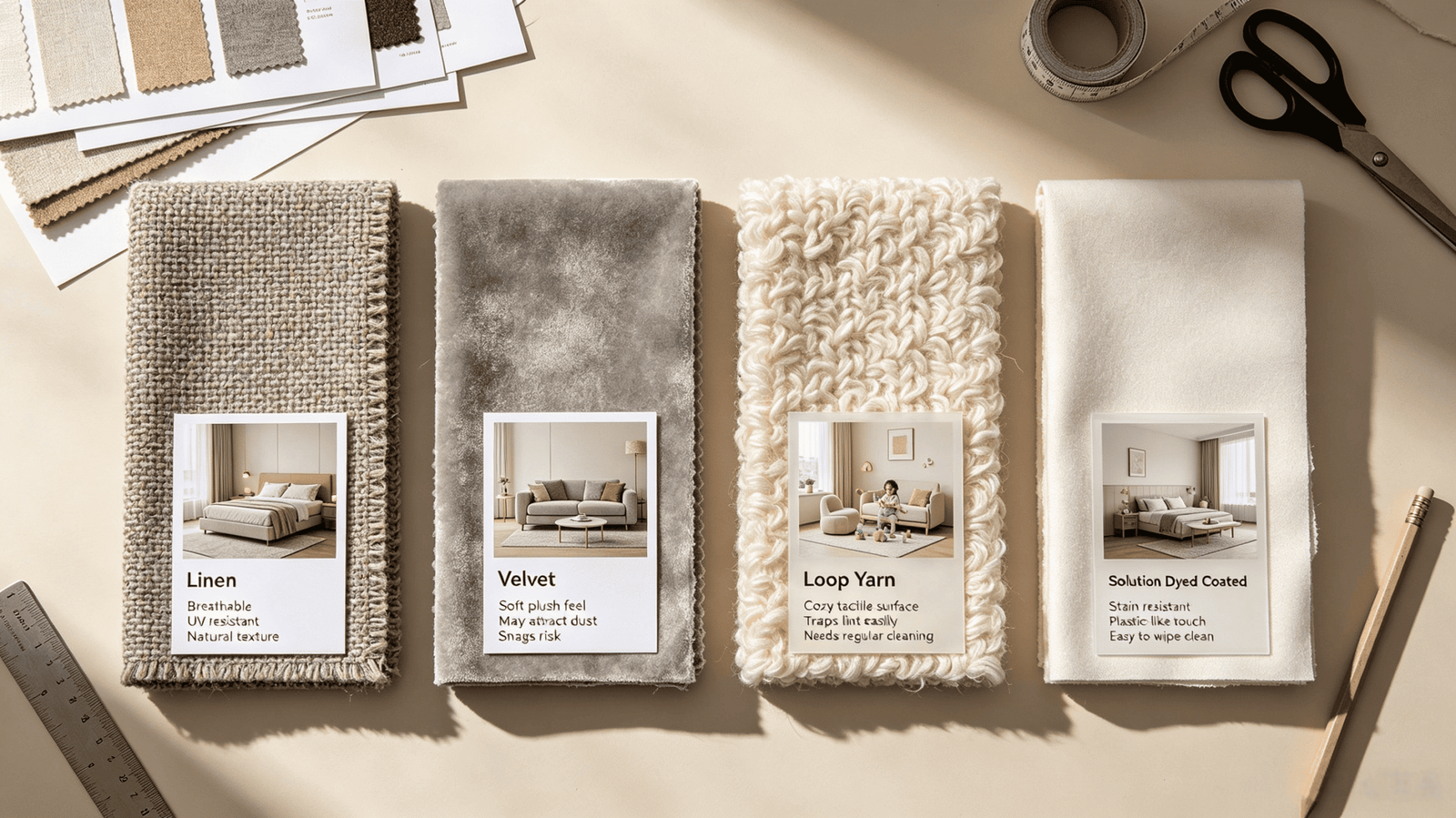
Here's what I tell designers when they're specifying for a client who has children, pets, or a habit of eating breakfast in bed versus a guest suite that gets used four times a year: those are completely different briefs, and they point toward completely different fabric choices.
Linen: When It's the Right Call
Pure Belgian linen (or high-grade European linen blends) earns its price5 in the following scenarios:
- High-contact headboards where the fabric is touched and leaned against daily. Linen's tight weave and natural fiber strength mean it holds up to friction better than velvet or most boucle constructions.
- Warm climates or poorly ventilated rooms. Linen's breathability reduces heat retention at the headboard — a real comfort factor that synthetic-backed fabrics can't replicate6.
- Long-horizon interiors. Linen ages gracefully. The color softens, the texture develops character. Clients who've had linen upholstered beds for five or more years often describe the fabric as looking better than new.
- Neutral palette interiors. Linen's natural texture adds visual depth to white, warm grey, and sand palettes without competing with other materials in the room.
When Linen Isn't the First Choice
- Heavy moisture exposure. Linen absorbs liquid faster than performance fabrics. A headboard in a bathroom-adjacent master suite with high humidity, or a household with young children who eat in bed, is a more demanding environment. A solution-dyed acrylic or a Crypton-treated weave handles spills and repeated spot-cleaning better.
- Maximum visual drama. If the client's brief is a jewel-box bedroom where the bed is the focal object, velvet in a deep jewel tone delivers an effect that linen — beautiful as it is — can't match.
- Very tight maintenance regimes. Linen needs dry or low-moisture cleaning. If the household cleaner's default is a wet cloth and commercial spray, a performance fabric will survive that treatment more reliably.
Fabric Performance Quick-Reference
| Fabric | Breathability | Durability (Rub Count) | Cleaning Method | Ages With Character? | Best Use Case |
|---|---|---|---|---|---|
| Pure linen | Excellent | 25,000–40,000+ | Dry clean / gentle dry | Yes | Daily-use headboards, warm rooms |
| Linen blend | Good | 20,000–35,000 | Dry or light damp | Yes | General residential |
| Velvet | Poor | 30,000+ (cut pile) | Dry clean | Moderate | Guest suites, low-traffic |
| Boucle | Moderate | 15,000–25,000 | Dry clean only | Moderate | Low-contact decorative |
| Performance weave | Good | 50,000–100,000+ | Spot clean / damp | No — wears flat | Family homes, high humidity |
A note on rub counts: A rub count (Martindale or Wyzenbeek) measures abrasion resistance. For a headboard, 25,000+ is generally adequate for residential use7. For side rails or a footboard with frequent contact, 40,000+ is a safer specification.
How Do You Get the Sizing Right for an Upholstered Bed?
Sizing errors are the most preventable delivery problem in upholstered furniture — and they still happen constantly. I've seen full king beds arrive in rooms where the clearance between the footboard and the closet door was measured against the mattress footprint, not the frame.
An upholstered bed's actual footprint extends beyond the mattress on all sides. Side rail width adds 2–4 inches per side. Footboard thickness adds 4–8 inches at the foot. Headboard height must be calculated against ceiling height, wall panel height, and any sconce or artwork positioning. Measure the frame dimensions, not the mattress size — they are not the same number.
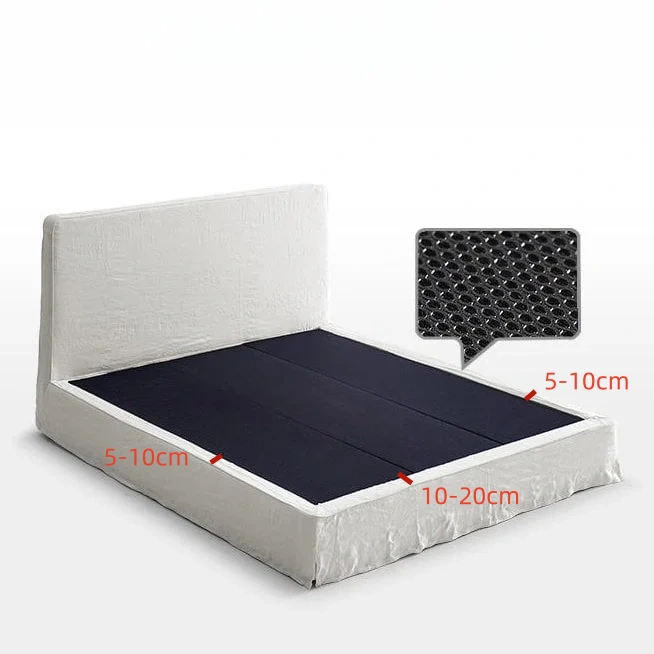
Here's the full checklist I recommend before any upholstered bed is ordered — custom or ready-made.
Room Clearance Checklist
- Wall-to-wall width: Minimum 24 inches of clearance on each side of the frame (not the mattress) for walking comfort. 30 inches is preferred.
- Foot clearance: Measure from the footboard's outer face to the nearest door swing, dresser, or TV unit. Account for a footboard that may protrude 6–10 inches beyond the mattress end.
- Ceiling height vs. headboard height: A 60-inch headboard reads very differently in a room with 9-foot ceilings versus 8-foot ceilings. In rooms under 8.5 feet, a headboard above 55 inches starts to feel oppressive8.
- Sconce and outlet positions: Wall-mounted reading lights need to align with pillow height, not headboard mid-point. Get the exact headboard height and calculate sconce position before the electrician rough-ins.
Mattress Fit Tolerance
Most upholstered bed frames are built to accept a standard mattress with 0.5–1 inch of tolerance on each side. A snug fit prevents mattress migration. A gap larger than 1.5 inches looks unfinished and can create a catch point for bedding.
If you're ordering a custom frame, provide the exact mattress dimensions from the manufacturer's spec sheet — not the nominal size. A "king" mattress from one manufacturer may be 76 × 80 inches while another runs 76.5 × 80.5. That half-inch matters in a made-to-measure frame.
What Does Custom Actually Mean — and What Affects Lead Time?
The two most common fears around custom upholstered beds are cost unpredictability and timeline uncertainty. Both are real risks — but only when the buyer doesn't understand what variables actually drive them.
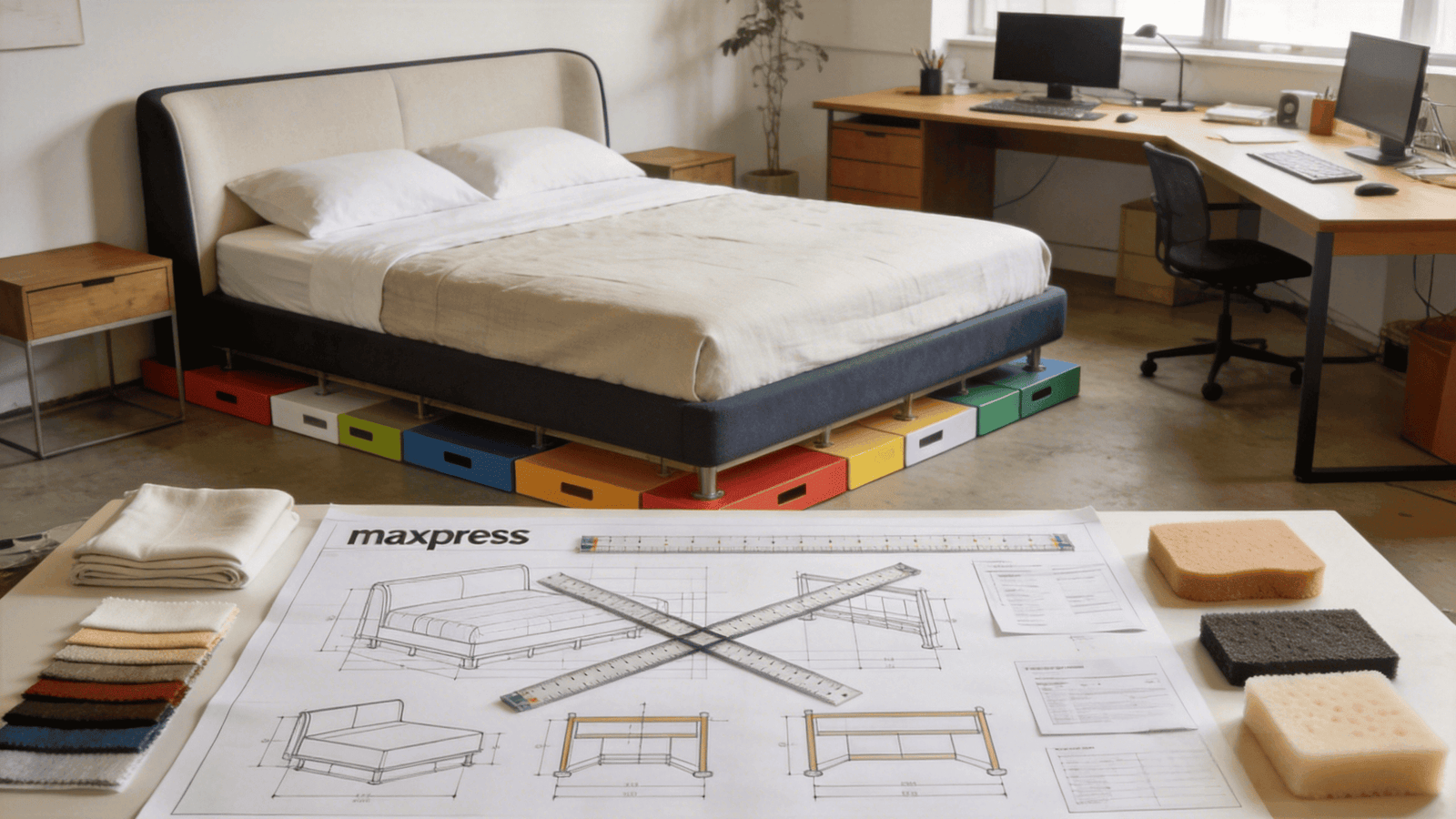
A custom upholstered bed order requires five pieces of confirmed information before production can begin: mattress dimensions, frame finish (legs/base), fabric selection with colorway, foam specification, and headboard height/silhouette. Missing any one of these creates a hold that adds days or weeks to the timeline — not the factory's production speed. Lead time is primarily driven by fabric availability and confirmation completeness, not manufacturing complexity.
What Actually Affects Production Timeline
1. Fabric availability In-house stock fabrics (for us, that's 200+ linen colorways held in Foshan) can go into production within 1–2 days of order confirmation. COM fabric (customer's own material) adds the shipping window to our facility, plus a quality check before cutting. That typically adds 5–10 business days minimum.
2. Silhouette complexity A straight channel-tufted headboard or a clean knife-edge panel is straightforward to produce. Deep diamond tufting, curved arched headboards, or integrated storage bases involve more cutting stages and fitting time. These aren't prohibitive — but a buyer specifying them should expect 3–5 additional production days.
3. Order confirmation completeness This is the most underestimated delay factor. A revision to fabric selection after cutting has begun typically resets the fabric portion of production entirely. I recommend designers submit a complete specification sheet — dimensions, fabric, foam grade, leg finish — before signing off on the order, not iteratively.
Typical Production Windows
| Order Type | Typical Production Time (from confirmed spec) |
|---|---|
| Standard size, in-stock fabric | 15–20 business days |
| Custom size, in-stock fabric | 18–25 business days |
| Standard size, COM fabric | 20–30 business days (after COM arrives) |
| Custom size, COM fabric, complex silhouette | 28–40 business days |
These windows reflect production time only. Add freight transit (typically 25–35 days for ocean freight to US East Coast, 30–40 days to Europe) when planning project schedules.
What to Submit for a Clean Custom Order
- Confirmed mattress brand and exact dimensions (not nominal size)
- Fabric name, colorway, and batch reference (or COM shipping address and ETA)
- Headboard height from floor (not from mattress surface)
- Leg material and finish
- Foam density preference (if specifying above standard)
- Delivery address and any building access constraints (elevator dimensions, stairwell width)
Frequently Asked Questions
How do I clean a linen upholstered bed headboard?
Dry-brush surface dust weekly with a soft-bristle brush. For spot cleaning, use a barely damp white cloth with mild soap — blot, never rub. Avoid soaking linen; excess moisture can cause watermarks or fiber distortion. For deep cleaning, professional dry cleaning is recommended. Never use enzyme-based or bleach-containing cleaners on natural linen.
What foam density should I request for an upholstered headboard?
For a headboard used daily — leaning, reading, sitting up in bed — request a minimum density of 40 kg/m³. For purely decorative panels with minimal contact, 30–35 kg/m³ is acceptable. Ask your supplier to confirm the density grade in writing; vague descriptions like "high-resilience foam" are not a substitute for a specific number.
Can I use my existing mattress with a new custom frame?
Yes, but measure your mattress exactly — width, length, and height — from the manufacturer's spec sheet, not a measuring tape. Mattresses compress and expand, and nominal sizes (queen, king) vary by manufacturer. Provide the precise dimensions when specifying a custom frame to ensure correct fit and prevent gaps or tight binding at the side rails.
Is a platform base better than a slatted base for an upholstered bed?
Slatted bases (slats spaced no more than 3 inches apart) offer better airflow to the mattress, which reduces moisture buildup — important for foam and hybrid mattresses9. Solid platforms can trap heat and humidity. For most residential applications, a slatted base with a hardwood center support beam is the more practical specification.
What's the difference between COM fabric and in-house fabric options?
COM (Customer's Own Material) means you supply the fabric directly — from a preferred vendor, a material already specified in your design scheme, or a fabric the manufacturer doesn't carry. It gives maximum design control but requires you to ship the fabric to the factory before production begins, and adds lead time. In-house fabric options (like our 200 linen colorways) are pre-stocked and require no additional shipping, which means production starts faster.
Conclusion
An upholstered bed is a long-term structural investment, not a styling decision. The variables that determine whether it holds up — frame material, joint construction, foam density, and fabric performance — are all invisible at point of purchase. So is the sizing mismatch that only surfaces on delivery day. This guide exists to give you a concrete evaluation framework: ask for frame species and joint type, specify foam density by number, match fabric to actual use intensity rather than aesthetics alone, and submit a complete specification before production begins rather than iterating mid-order.
Whether you're sourcing a single statement piece for a client or specifying upholstered beds across a full residential project, the right questions protect your budget and your timeline. At Linen World, we've spent 13 years building made-to-order upholstered beds for designers and high-end homeowners across the US and Europe — with 200+ linen colorways, COM support, and direct factory pricing that runs 40–60% below comparable retail. Contact us for a specification consultation or sample request. https://linenworld.pro
"Review on Wood Deformation and Cracking during Moisture Loss", https://pmc.ncbi.nlm.nih.gov/articles/PMC10422486/. Research on wood drying processes documents that kiln-drying reduces equilibrium moisture content, limiting post-manufacture dimensional movement and improving joint integrity in structural applications; direct data on upholstered bed frames specifically is limited, and findings from structural timber studies may not translate proportionally to furniture-scale components. Evidence role: mechanism; source type: research. Supports: That kiln-drying reduces residual moisture in wood, improving dimensional stability and resistance to warping in finished furniture frames. Scope note: Most wood-drying research addresses structural timber or flooring rather than furniture-scale components; extrapolation to bed frames is contextual ↩
"Repeated humidity cycling's effect on physical properties of three ...", https://bioresources.cnr.ncsu.edu/resources/repeated-humidity-cyclings-effect-on-physical-properties-of-three-kinds-of-wood-based-panels/. Studies on wood-based panel products have documented that particleboard and MDF show lower screw-withdrawal resistance and greater susceptibility to strength loss under cyclic moisture exposure than solid hardwood, supporting claims about joint loosening over time; however, most such studies test standardized specimens rather than assembled furniture frames under real-use conditions. Evidence role: mechanism; source type: research. Supports: That particleboard and MDF exhibit reduced fastener-holding strength and accelerated degradation under repeated loading and humidity fluctuation compared to solid wood. Scope note: Laboratory specimen results may not directly predict performance timelines in assembled furniture under residential use patterns ↩
"Design issues of innovative furniture fasteners for wood-based boards", https://bioresources.cnr.ncsu.edu/resources/design-issues-of-innovative-furniture-fasteners-for-wood-based-boards/. Materials testing literature on wood-based panel furniture indicates that stapled butt joints in particleboard substrates are among the weakest joint configurations under repeated lateral loading; the 12–18 month timeline cited in the article appears to reflect practitioner observation rather than controlled durability testing, and no peer-reviewed study directly confirming this specific interval was identified. Evidence role: general_support; source type: research. Supports: That furniture frames constructed from particleboard with stapled joints exhibit measurable structural degradation within a relatively short period of regular use. Scope note: The specific 12–18 month figure is not corroborated by published durability studies and should be treated as an experiential estimate rather than a tested benchmark ↩
"[PDF] The Ultraviolet Protection Factor of Naturally-pigmented Cotton", https://digitalcommons.unl.edu/cgi/viewcontent.cgi?article=1000&context=textiles_facpub. Textile lightfastness is standardized under ISO 105-B02 (xenon arc) and AATCC 16 test methods; published comparisons of natural and synthetic fibers indicate that linen's cellulosic structure provides moderate-to-good UV resistance, though solution-dyed synthetic fibers such as acrylic typically achieve higher lightfastness ratings under standardized testing; the article's claim of linen's UV superiority over 'most alternatives' is partially supported but requires qualification against high-performance synthetics. Evidence role: general_support; source type: research. Supports: That linen fabric demonstrates competitive lightfastness performance, resisting UV-induced color fading and fiber degradation relative to many synthetic and other natural fiber alternatives. Scope note: Lightfastness performance depends heavily on dye type and application method, not fiber alone; undyed or naturally pigmented linen may perform differently from dyed linen in UV exposure tests ↩
"Belgian Linen - Wikipedia", https://en.wikipedia.org/wiki/Belgian_Linen. The Confédération Européenne du Lin et du Chanvre (CELC) and its Masters of Linen certification program document quality and traceability standards for European flax linen, providing institutional support for the distinction between European-origin linen and lower-grade alternatives; however, 'Belgian linen' as a marketing term is not uniformly regulated, and fiber quality varies by producer. Evidence role: definition; source type: institution. Supports: That linen produced from European-grown flax, particularly from Belgium and France, is associated with established quality standards and fiber characteristics recognized by the textile industry. Scope note: European linen quality designations are associated with origin and certification programs but do not guarantee uniform performance across all products marketed under these labels ↩
"Moisture Vapor Permeability and Thermal Wear Comfort of ... - PMC", https://pmc.ncbi.nlm.nih.gov/articles/PMC8539243/. Textile science research on flax-derived linen documents that the fiber's hollow core and hydrophilic surface facilitate moisture transport and thermal regulation, resulting in measurably higher air permeability than many synthetic weaves under standardized testing conditions; the specific claim about headboard heat retention is a contextual application of these general fiber properties rather than a result from upholstered furniture testing. Evidence role: mechanism; source type: research. Supports: That linen fabric, due to the hollow structure of flax fibers and their moisture-wicking properties, exhibits higher breathability and lower heat retention than many synthetic textile alternatives. Scope note: Breathability data for linen typically derives from apparel or bedding textile studies; performance on a padded, foam-backed headboard panel may differ from fabric-only test conditions ↩
"The Different Abrasion Tests Martindale. Wyzenbeek. Sounds like ...", https://www.instagram.com/reel/DRhG_G9DrFh/. The Association for Contract Textiles (ACT) and ASTM International publish performance guidelines for upholstery fabrics that include abrasion resistance thresholds; ACT guidelines generally classify fabrics achieving 15,000 Wyzenbeek double rubs as suitable for light residential use and 30,000+ for heavy residential use, providing institutional grounding for the article's 25,000+ recommendation, though Martindale and Wyzenbeek results are not directly interchangeable. Evidence role: definition; source type: institution. Supports: That industry standards bodies define minimum rub count thresholds for residential upholstery applications, with 25,000–30,000 Martindale cycles commonly cited as the residential benchmark. Scope note: Martindale and Wyzenbeek test methods use different abradants and motions and produce non-equivalent results; direct numerical comparison between the two systems requires conversion factors ↩
"The Effect of Furnishing on Perceived Spatial Dimensions and ...", https://pmc.ncbi.nlm.nih.gov/articles/PMC4237397/. Interior design education literature and proportion guidelines, including those taught in accredited programs and published by organizations such as the American Society of Interior Designers (ASID), address the relationship between furniture scale and ceiling height as a foundational spatial principle; the specific 55-inch threshold cited in the article reflects applied practitioner judgment rather than a codified standard, and perceptual responses to scale vary by room width, lighting, and individual viewer. Evidence role: general_support; source type: education. Supports: That established interior design proportion principles relate furniture height to ceiling height, with oversized vertical elements in low-ceiling rooms creating a visually compressed or oppressive effect. Scope note: The 55-inch figure is a practitioner heuristic rather than an empirically tested perceptual threshold; no controlled study directly validating this specific measurement was identified ↩
"Best Foundation for Memory Foam Mattress: Support & Setup Guide", https://viscosoft.com/blogs/dream-journal/best-foundation-for-a-memory-foam-mattress?srsltid=AfmBOorvLcJzUeUZ-h6dHz2aVvOyHD7NGH9uL_1ZBhQubQQX4lmNOHH_. Major foam and hybrid mattress manufacturers, including those certified under CertiPUR-US and similar programs, commonly specify maximum slat spacing in their warranty and foundation requirements documentation, typically ranging from 2 to 3 inches, to ensure adequate support distribution and airflow; the article's 3-inch figure aligns with common manufacturer guidance, though specific requirements vary by mattress construction and brand. Evidence role: general_support; source type: institution. Supports: That mattress manufacturers recommend maximum slat spacing limits to ensure adequate support and ventilation, with many foam and hybrid mattress warranties specifying slat spacing requirements. Scope note: Slat spacing requirements are set by individual mattress manufacturers rather than a single universal standard; the 3-inch figure may not satisfy all manufacturer warranties ↩


