
Choosing an upholstered dining chair for a high-end residential project looks straightforward — until the chairs arrive and the client calls three months later. The real problem isn't taste. It's that the variables determining whether a chair lasts five years or fifteen are almost entirely invisible in product photography, and most suppliers won't volunteer them unprompted.
The short answer: evaluating an upholstered dining chair well means assessing four separate dimensions — fabric category relative to actual use intensity, internal construction relative to the price point, customization timeline relative to project schedule, and proportion relative to the specific table. Each dimension requires direct supplier interrogation, not visual judgment. If a chair has critical flaws in any of the four core evaluation dimensions such as structural failure, unsuitable fabric for family lifestyle or mismatched table proportion, it will likely lead to client dissatisfaction; minor cosmetic imperfections can often be adjusted through interior matching without negative feedback.
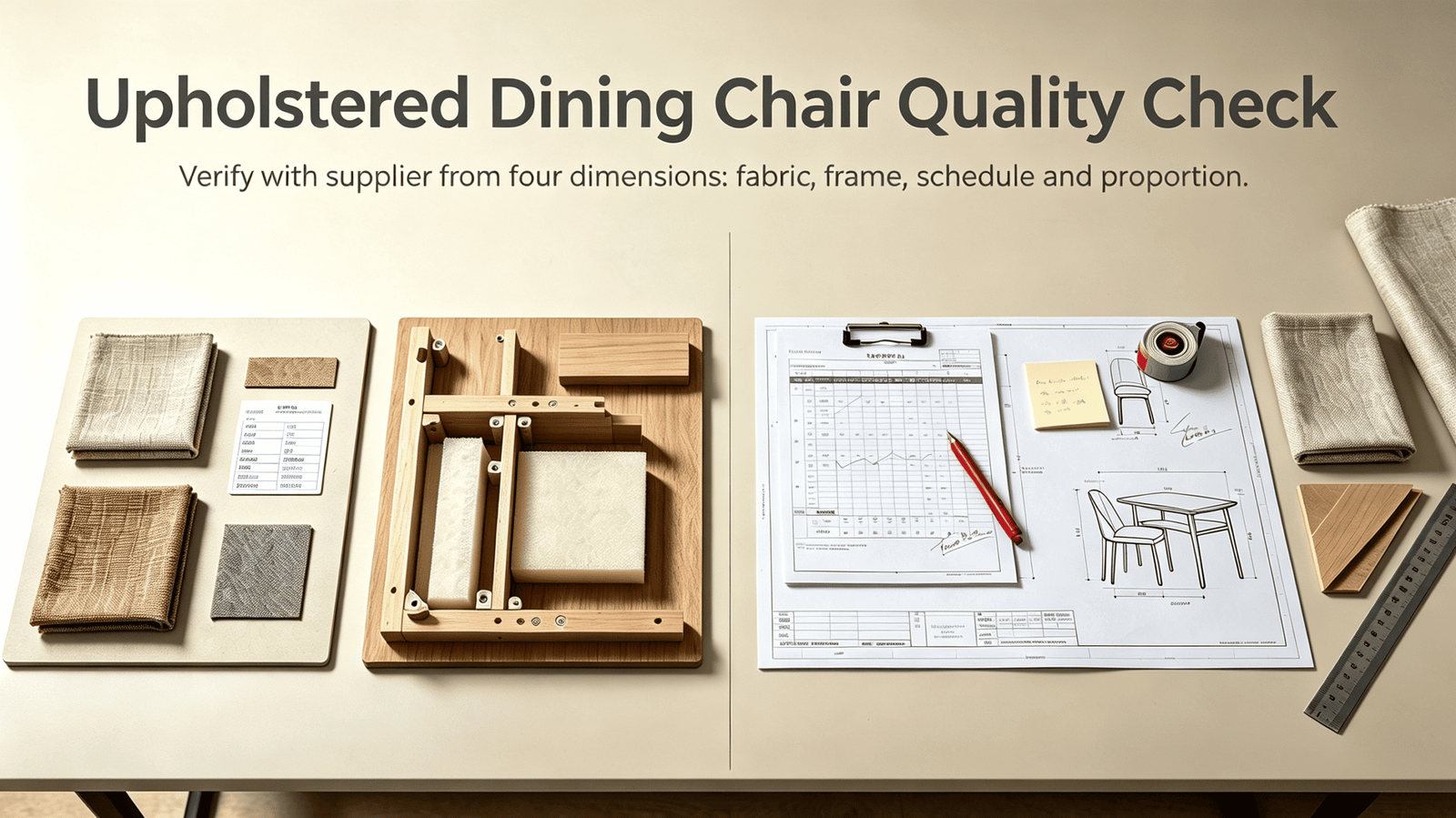
Most designers I talk to have a story about a chair they specified that looked exactly right in the render and came back wrong in reality — wrong in feel, wrong in wear, wrong in timing. This guide is a framework for asking better questions before that happens, applicable to any supplier you're evaluating.
Does Fabric Category Actually Determine Long-Term Dining Performance?
Fabric selection in a dining context is routinely treated as a color and texture decision. It isn't. It's a maintenance reality decision — and getting it wrong means your client is managing stains, pilling, or structural degradation within two years.
The right fabric category for an upholstered dining chair depends almost entirely on the household's actual use intensity: how often the dining room is used, whether children are present, how the client tolerates visible wear, and how they're willing to maintain the chairs. There is no universally superior option. The specification question is always conditional.
How Does Linen Perform in a Dining Environment?
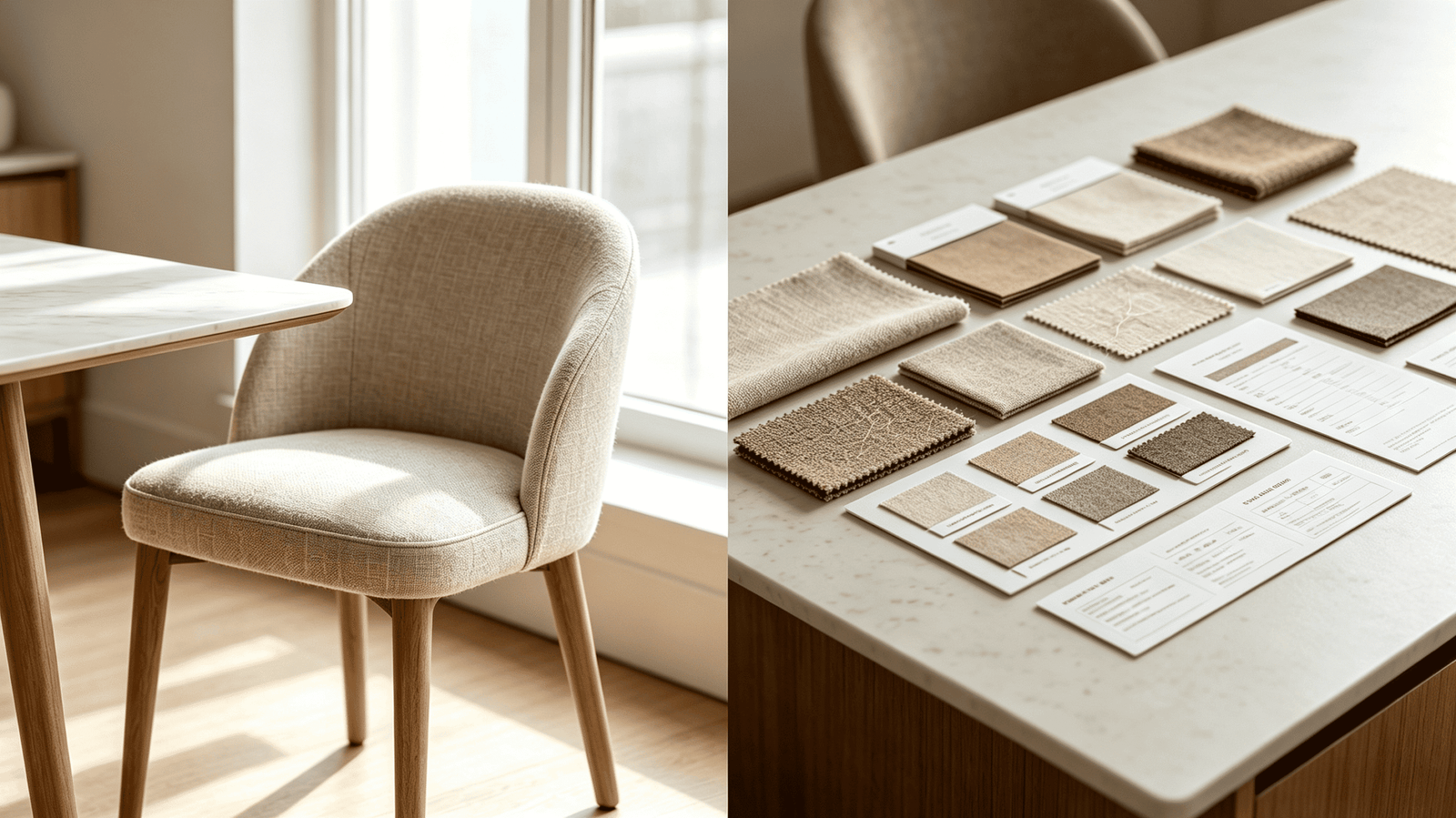
Linen — particularly Belgium pure linen with a tight weave and high thread density — performs differently from most other natural fabrics in a dining context. The fiber is naturally moisture-wicking, which matters when you consider heat from body contact, spilled liquids, and the humidity that builds around an active dining table.1 The fiber structure doesn't trap food particles the same way pile fabrics do, which makes surface cleaning more manageable.
That said, the performance gap between linen products is substantial. When we source Belgium pure linen for production, thread density and yarn efficiency are the first things we assess — because a loose-weave linen will abrade and distort under repeated dining-load stress far faster than a tightly woven one. The visual difference between a high-density and a low-density linen is nearly imperceptible in a showroom. Under two years of dining use, it becomes obvious.
What to ask any supplier:
- What is the thread count or weave density of this linen?
- Is this 100% linen, or a linen blend? What is the blend ratio?
- Has this fabric been pre-washed or sanforized to control shrinkage?
- What is the recommended cleaning method, and have you tested it in production?
How Do Other Fabric Categories Stack Up for Dining Use?
The honest answer is that no fabric category is universally better or worse — only more or less appropriate for specific use conditions.
| Fabric Category | Strength in Dining Context | Weakness in Dining Context | Best-Fit Household Profile |
|---|---|---|---|
| Belgium pure linen (high-density) | Breathable, ages with character, cleanable | Susceptible to direct liquid saturation if untreated | Sophisticated adult households, moderate use |
| Performance velvet | Rich visual depth, some are highly cleanable | Pile crushing under prolonged seat pressure, traps crumbs | Low-traffic formal dining rooms |
| Faux leather / PU | Very easy to wipe clean | Cold tactile quality, can peel at seams over time | Families with young children, high spill frequency |
| Cotton blend | Budget-accessible, wide color range | Lower abrasion resistance than linen | Temporary installs, rental properties |
| COM (customer's own material) | Complete creative control | Performance depends entirely on the fabric chosen | Custom projects with specified fabric already selected |
The table above summarizes 13 years of real production cases and client usage feedback, rather than standardized laboratory controlled test data. It can serve as a reliable practical reference for communicating material selection with suppliers, instead of an absolute industry performance standard.
What Internal Construction Actually Separates a $300 Chair from a $1,200 Chair?
This is where most purchasing decisions quietly go wrong. Two upholstered dining chairs can be photographed to look nearly identical. One will structurally fatigue within three years. The other will still feel firm and square after ten. The difference is almost never in the upholstery — it's in what's underneath it.
A designer who evaluates chairs primarily on surface presentation is making a risk decision without knowing it.
What Frame Materials Should You Be Asking About?
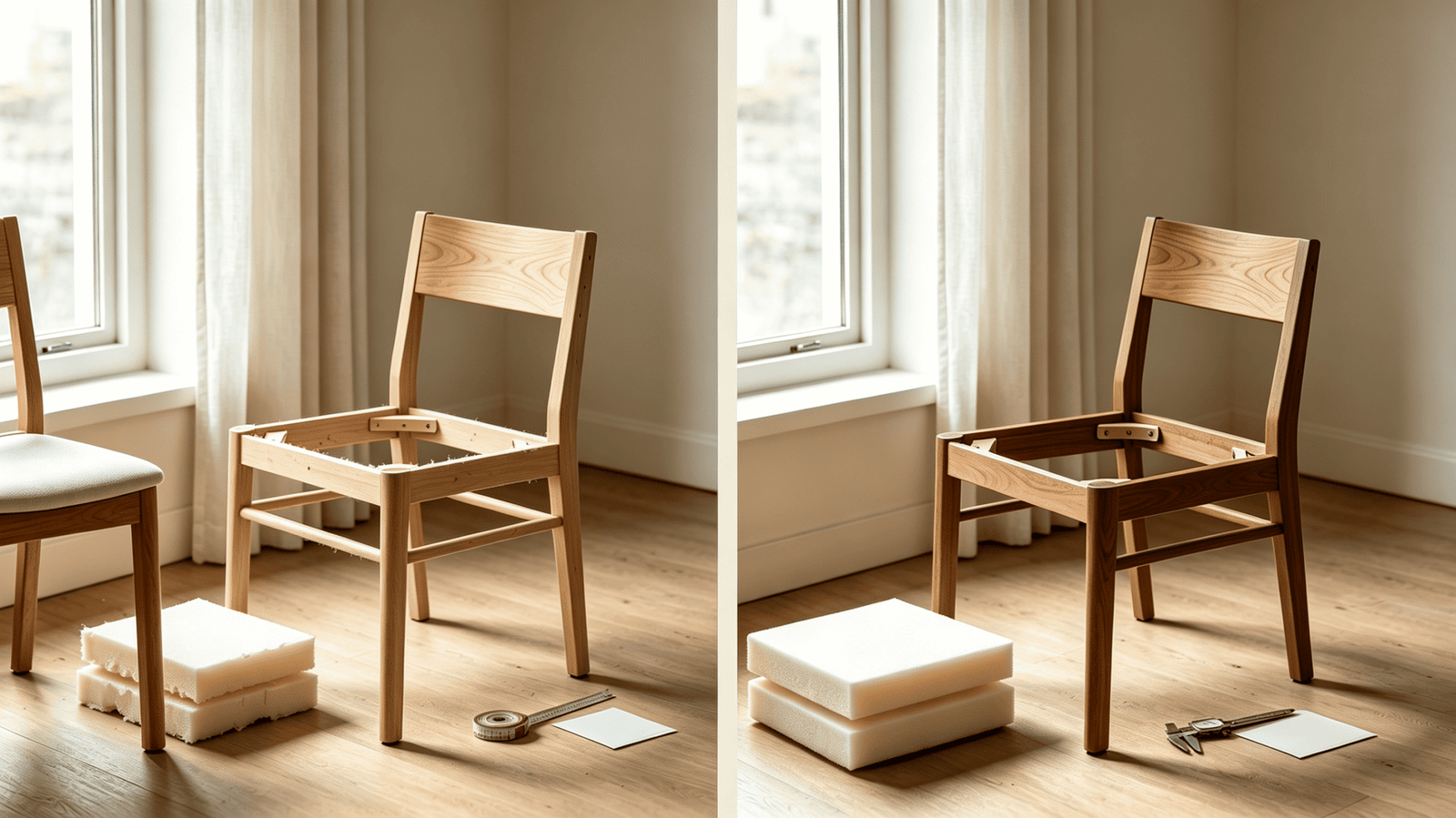
The frame is the long-term structural bet of the chair. Once it fails — joints loosen, members crack, or twist under lateral load — no reupholstery will fix it.
Solid hardwood (beech, oak, rubberwood) remains the benchmark for joinery longevity in dining chairs because wood glue joints hold under the specific stress pattern of dining use: people pushing back on rear legs, leaning sideways, and sitting in non-centered positions. The species matters. Ask specifically — "hardwood frame" can mean many things.
Engineered wood (MDF, plywood composites) performs adequately under controlled load but is more vulnerable to moisture-related swelling and to joint failure under dynamic stress. It's commonly used in mid-tier production to reduce cost. It isn't automatically a dealbreaker — but it should be priced accordingly and disclosed.
Metal frames offer a different structural profile: excellent dimensional stability, no moisture sensitivity, but different failure modes — weld points can crack under fatigue, and once they do, repair is difficult.
When we produce chairs, the framing decision drives everything else in the production timeline and cost structure. A question I'd always ask a supplier: "What species is the hardwood, and how are the joints reinforced?" If the answer is vague, treat that as a signal.
How Do Fill and Spring Systems Affect Long-Term Comfort?
Seat comfort is the component that changes most visibly over time. A chair that feels excellent at delivery and collapses within 18 months almost always traces to two things: foam density and whether any spring system exists beneath it.
Foam density is typically measured in kg/m³. High-resilience foam used in quality seating generally runs considerably denser than the sponge used in budget production. The number matters less than the pattern of use — a chair used every day for dinner needs meaningfully denser foam than a formal dining chair used twice a month. Ask your supplier what foam density they're specifying for the intended use frequency.
Spring systems — sinuous springs or 8-way hand-tied — distribute seat load over a wider base and dramatically extend the comfort lifespan of the seat. Many chairs at accessible price points use a flat wooden platform with foam only. That's not always wrong, but it needs to be a conscious decision.
A useful question sequence for any supplier:
- What is the foam density (kg/m³) used for this chair's seat pad?
- Is there a spring system under the seat? If so, what type?
- What is the expected compression lifespan of this foam at daily use?
- What does the back cushion use — same foam, different fill, or loose fill?
How Should You Actually Plan a Custom Upholstered Dining Chair Timeline?
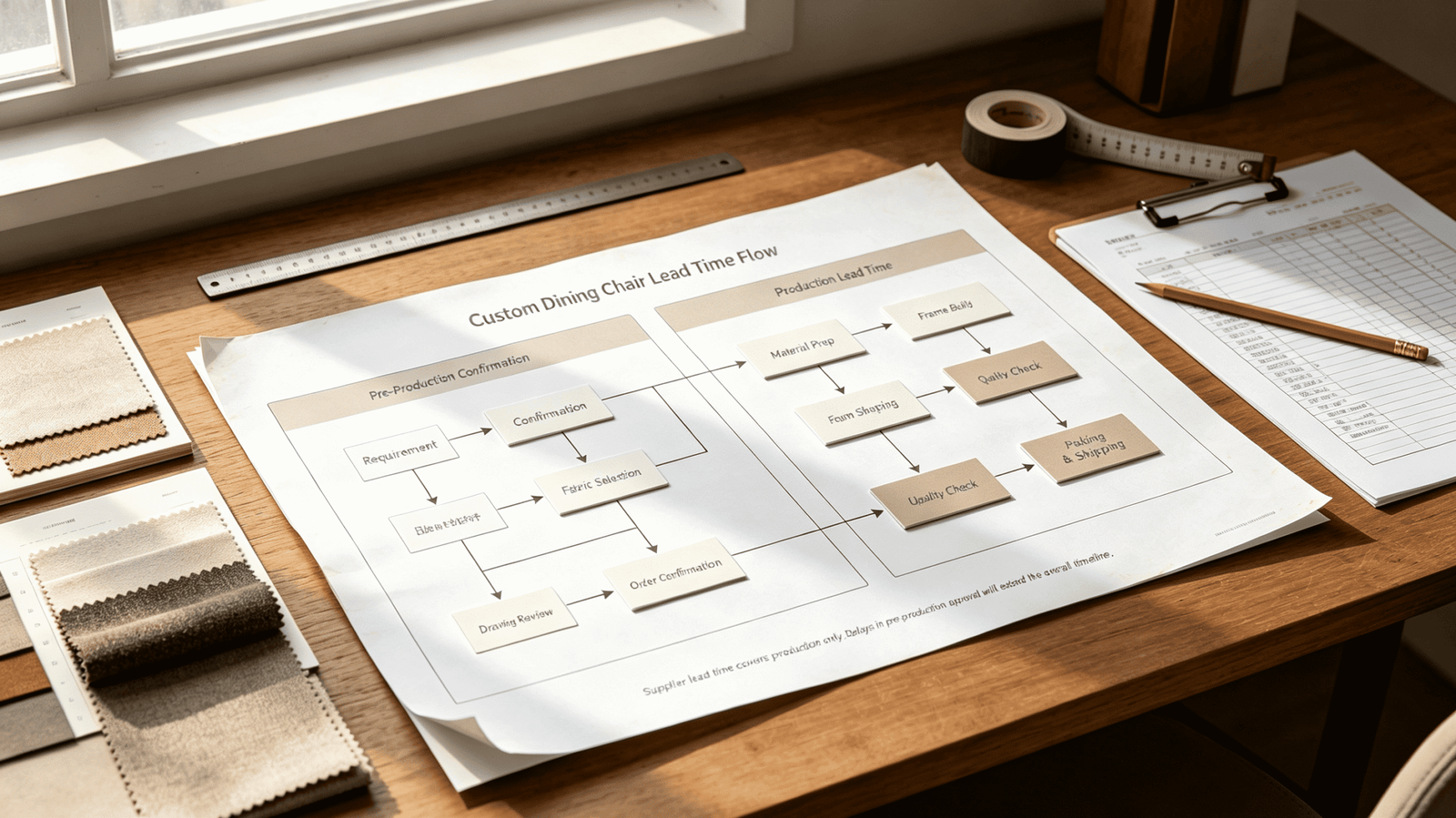
The most common project execution failure I see is a designer quoting a supplier's lead time to a client and then treating that number as the delivery window. It isn't. The lead time is the production time — and before production can start, a sequence of decisions must be completed that is entirely in the designer's hands.
Compressing or skipping any of those decisions doesn't shorten the timeline. It extends it, because problems surface later and require iteration.
What Has to Happen Before Production Can Start?
Fabric confirmation is not a formality. If you're specifying from the supplier's fabric range, confirmation means the designer has seen a physical swatch — not a digital image — under the actual lighting conditions of the installation space and signed off on it. Color rendering on screen is not reliable enough for a high-end residential specification.2 This step alone can add one to three weeks if swatch delivery and client review are sequential rather than planned in advance.
If you're supplying COM fabric, the fabric must arrive at the factory before production can begin. Lead time starts from fabric receipt, not from order placement. COM fabric arriving late is the single most common cause of missed installation dates on custom projects3 we handle.
Sampling is a decision gate, not a delay. For any meaningful custom order — non-standard dimensions, unusual upholstery configuration, bespoke leg finish — a physical sample should be approved before full production runs. This is where dimension-fit problems, fabric behavior on the specific frame, and finish inconsistencies get caught. Designers who skip sampling to save time almost always spend more time managing corrections after delivery.
The friction points in a typical custom upholstered dining chair project look like this:
- Week 1–2: Supplier receives brief, prepares fabric swatch or COM fabric is ordered and shipped
- Week 2–3: Designer receives physical swatch, reviews under site lighting, client confirmation
- Week 3–4: COM fabric ships to factory, or in-house fabric confirmed and allocated
- Week 4–5: Sample chair produced and shipped to designer for approval
- Week 5–6: Designer approves sample (or requests revision — add one to two weeks per revision round)
- Week 6 onwards: Full production begins; quoted lead time applies from this date
That sequence above represents a project that is running well, with no delays. On a project with complex COM sourcing, client-side indecision on fabric confirmation, or revision rounds on the sample, the pre-production phase alone can run eight to ten weeks.
The practical implication: when a designer tells me they need chairs delivered in 10 weeks, the first question I ask is whether fabric is confirmed and whether they need a sample. Those two answers determine whether 10 weeks is realistic — not the production capacity of the factory.
Does Chair Proportion Matter More Than Chair Style?
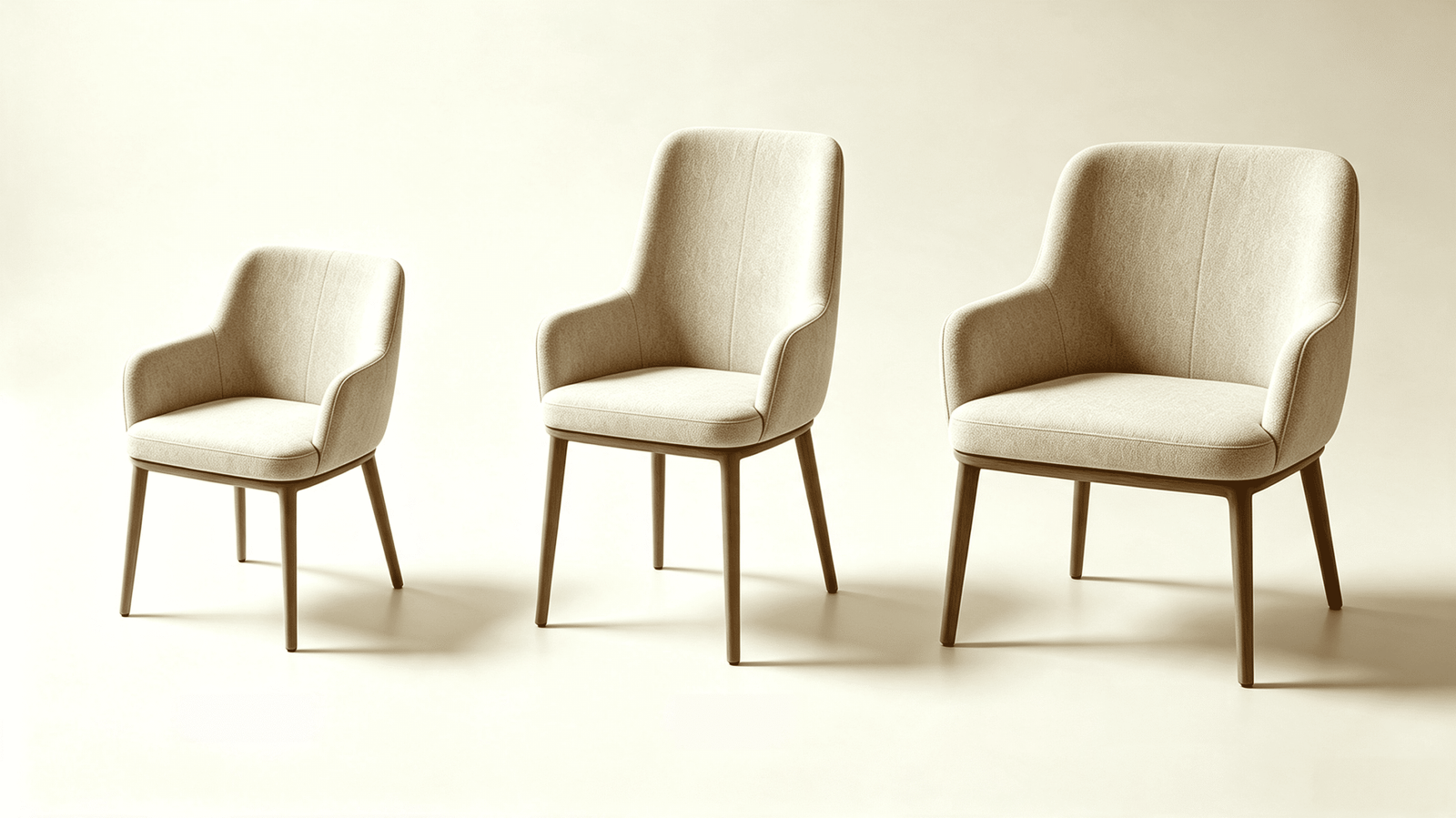
Style compatibility is what most designers focus on when specifying upholstered dining chairs alongside a table. Proportion is what actually determines whether the finished installation is ergonomically livable — and a render will not reveal a proportion problem until someone sits in the chair at the table.
The specific dimensions that require direct verification on every project are not aesthetic preferences. They are functional constraints that either work or don't.
What Dimensions Must Be Verified Against the Specific Table?
Seat height to table height clearance is the starting point. The standard working relationship is 25–30cm between the seat surface and the underside of the tabletop.4 Below 25cm, the seated position feels cramped. Above 30cm, most people can't comfortably use the table surface. This sounds obvious — but it fails regularly on custom projects when the chair seat height is calculated against the tabletop surface height rather than the underside clearance, especially on tables with thick aprons or structural crossbars.
Arm height on upholstered armchairs is a more common failure mode than most designers expect. Arms that sit above the table apron height prevent the chair from sliding in naturally and force the user to sit further from the table than intended. The correct specification is arm height below or flush with the underside of the table apron. Always confirm this measurement with the actual table spec, not an assumed standard.
Leg silhouette and visual mass relative to table base mass is a proportion problem, not a style problem. A chair with a heavy, turned leg base reads as visually cluttered against a thick pedestal table. A chair with a minimal tapered leg reads as visually floating under a heavy farmhouse table. Neither is wrong in isolation — but the visual weight relationship matters, and it's worth sketching the actual silhouettes in scale before finalizing.
A dimension checklist for any dining chair specification:
| Dimension | What to Verify | Against What Reference |
|---|---|---|
| Seat height | 45–48cm is common standard | Table underside clearance target |
| Arm height (if applicable) | Must clear table apron | Actual table apron height |
| Seat depth | 45–50cm standard | Client's typical seated depth preference |
| Overall chair width | Spacing between chairs when pulled out | Room dimension and table seating count |
| Back height | Visual relationship to table and wall | Room height and any wall feature behind |
Frequently Asked Questions
How do I evaluate whether a linen fabric will hold up in a dining room with heavy daily use?
Ask the supplier for thread density specifications and the recommended cleaning protocol, then have them confirm it's been tested on the actual production fabric — not a similar one. For a household with daily family dining, high-density Belgium pure linen with a protective finish performs meaningfully better than a loose-weave linen, though the difference isn't visible without handling both.
What's the minimum I should specify to ensure a custom upholstered dining chair order is executed correctly?
At minimum: a confirmed physical swatch, written sign-off on dimensions (including seat height and arm height if relevant), a production sample for any non-standard configuration, and clarity on whether the supplier's lead time starts from order placement or from fabric receipt or sample approval. Everything else is recoverable — those four are not.
How far in advance should I place a custom upholstered dining chair order for a project install date?
Count backwards from install date: allow the supplier's production lead time, plus add six to eight weeks for the pre-production approval sequence assuming no revisions. If COM fabric is involved, add shipping time to the factory on top. For a complex custom project with a hard install date, twelve to sixteen weeks from initial brief is a realistic minimum in my experience.
Is COM fabric always workable, or are there cases where I should use the supplier's own range?
COM is workable when the fabric's weight, stretch, and fiber content are suitable for upholstery application — not all designer fabrics are. When a client brings a fabric to us that they've sourced independently, the first questions we ask are about weight (gsm), whether it has a directional pattern requiring matching, and whether it's been tested for abrasion. If the supplier's range includes a close equivalent, that sometimes reduces both risk and total project timeline.
Can I specify different fabrics for seat and back on the same chair without structural problems?
Yes — this is standard practice in custom upholstery. The consideration is visual weight consistency between the two surfaces and whether the fabrics have different cleaning protocols. A common issue we see is clients combining a treated, easy-clean fabric on the seat with a delicate decorative fabric on the back — creating asymmetric maintenance requirements that become confusing over time.
Conclusion
Specifying upholstered dining chairs well is a four-part risk assessment: fabric category relative to lifestyle, internal construction relative to price point, customization timeline relative to project schedule, and proportion relative to the actual table. Visual evaluation alone fails on at least three of those four dimensions. The designers whose clients never call with complaints are the ones who've built a supplier interrogation checklist — and use it consistently, regardless of how good the photography looks.
If you're sourcing custom upholstered dining chairs for a high-end residential project and want to work with a factory that can walk you through fabric specs, construction standards, and realistic lead times before you commit, we'd welcome the conversation. At Linen World https://linenworld.pro, we work directly with designers across the US and Europe on made-to-order linen upholstery furniture — with 200+ fabric options, COM support, and 13 years of production experience behind every chair we make. [Reach out to start a conversation about your next project.]
"Linen Most Useful: Perspectives on Structure, Chemistry, and ... - PMC", https://pmc.ncbi.nlm.nih.gov/articles/PMC4403609/. Linen's moisture-management characteristics derive from the hygroscopic nature of flax cellulose fibers, which can absorb and release moisture vapor more readily than many synthetic alternatives; see textile fiber science literature for fiber-level moisture transport mechanisms. Evidence role: mechanism; source type: research. Supports: That linen (flax) fiber has hygroscopic and moisture-wicking properties due to its cellulosic structure.. Scope note: General textile science sources describe fiber hygroscopicity but may not specifically address performance in dining-chair upholstery applications. ↩
"Mapping Quantitative Observer Metamerism of Displays - PMC", https://pmc.ncbi.nlm.nih.gov/articles/PMC10607170/. Color science literature documents that fabric colors are subject to metamerism — appearing to match under one light source but diverging under another — and that uncalibrated digital displays introduce additional color shift, making physical swatch review under installation lighting conditions the accepted standard for accurate specification. Evidence role: mechanism; source type: research. Supports: That digital display rendering of fabric colors is subject to metamerism, monitor calibration variation, and ambient lighting effects that make it unreliable for precise material color specification.. Scope note: The degree of color inaccuracy varies by monitor calibration, ambient lighting, and fabric dye chemistry; some controlled digital workflows can reduce but not eliminate this risk. ↩
"Why Interior Designers Lose Money on Furniture Orders", https://cocotothetrade.com/why-interior-designers-lose-money-on-furniture-orders/. Project management literature on custom interior fit-out and procurement identifies material supply chain delays — including late delivery of client-specified materials — as a primary driver of schedule variance in bespoke furniture and upholstery projects; see construction and interior project management research for supply chain risk frameworks. Evidence role: general_support; source type: institution. Supports: That material procurement delays are a leading cause of schedule overruns in custom interior furnishing projects.. Scope note: No published study specifically quantifying COM fabric delay as the single leading cause of missed installation dates in residential up ↩
"Chair Size Design Based on User Height - PMC - NIH", https://pmc.ncbi.nlm.nih.gov/articles/PMC9944090/. Ergonomic and anthropometric guidelines for dining furniture, including references such as Panero and Zelnik's 'Human Dimension and Interior Space,' specify seat-to-table clearance ranges consistent with comfortable thigh clearance and forearm reach for typical adult populations. Evidence role: definition; source type: research. Supports: That a 25–30 cm differential between chair seat height and table underside represents the ergonomically recommended clearance for comfortable dining posture.. Scope note: Recommended clearance ranges vary across anthropometric references and population datasets; the 25–30 cm figure represents a commonly cited guideline rather than a single universal standard. ↩


