Choosing a headboard style feels like a design decision — but get it wrong, and you're not just looking at something you don't love. You're living with a headboard that sags, won't mount to your frame, or feels completely different against your back than it did in the showroom photo. The right choice starts with construction, not aesthetics.
An upholstered headboard style is really a set of material, structural, and installation decisions bundled inside an aesthetic label. The silhouette — arched, paneled, tufted — determines the internal frame requirements. The fabric — pure linen vs. linen blend — determines long-term wear behavior. And the mounting system determines whether the headboard actually fits your room and bed frame. Choose the style last, not first.
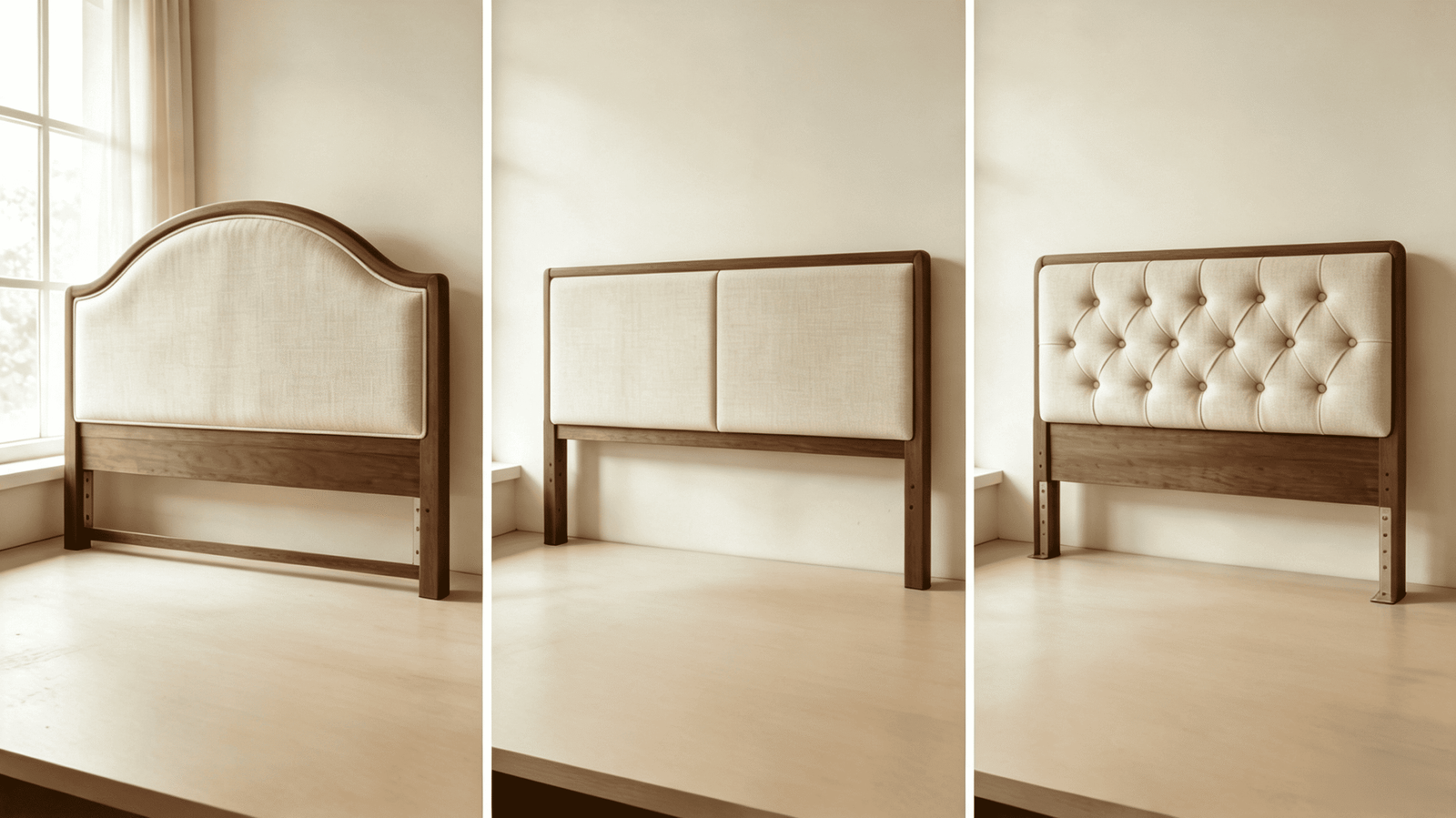
Most style guides show you pictures and tell you which looks are trending. This one works differently. I'm going to walk through headboard styles the way we work through them on the factory floor — by asking what the construction requires, what the fabric does under real use, and what buyers consistently get wrong before an order is placed.
Does headboard silhouette actually affect how the piece is built?
Many buyers treat silhouette as pure aesthetics. But every shape change — an arch, a deep tuft, a curved channel — requires a different internal frame, different fabric yardage, and different upholstery labor. Ordering the wrong silhouette for your wall or bed setup is one of the most common spec mismatches we help customers correct.
Yes — silhouette directly determines frame construction, fabric cut complexity, and mounting compatibility. An arched headboard requires a curved top rail that a standard rectangular frame doesn't have. A deeply tufted panel needs higher fill density to prevent the fabric from pulling flat over time. The visual shape and the structural requirement are inseparable.
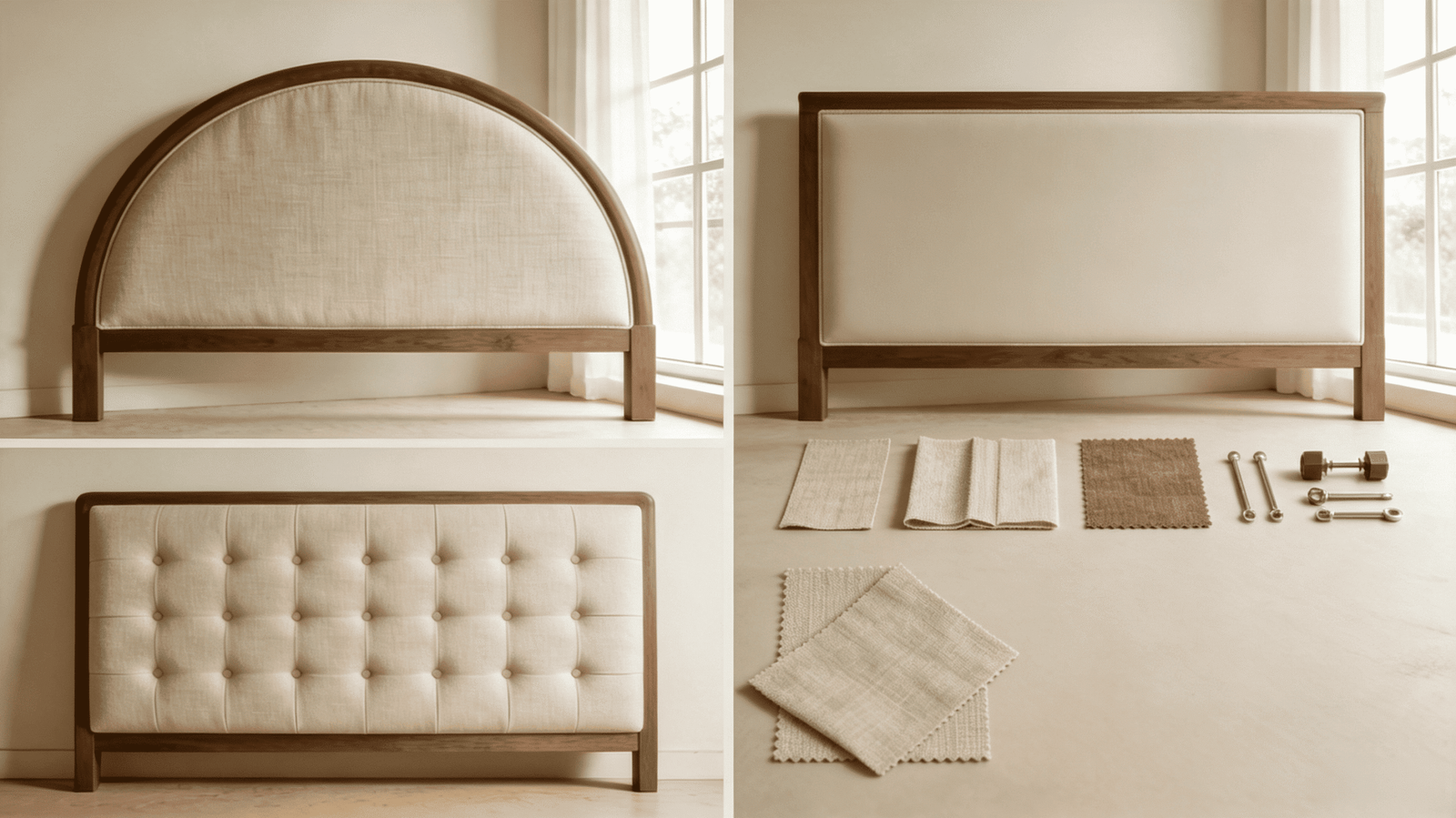
Here's how the most common silhouettes break down from a construction standpoint — not just a visual one.
Flat Panel Headboards
A flat rectangular or slightly tapered headboard is the simplest frame structure. The internal build is predictable: a rigid wooden frame, foam layer, batting, and fabric pulled taut across the front face. Because there are no curves or tufting points to work around, fabric waste is minimal and the labor process is highly consistent.
This matters for custom orders. Flat panel headboards are the most forgiving spec to get right on the first attempt, especially when a customer is ordering remotely and can't do an in-person review. The risk of a surprise at delivery is low.
Who orders flat panel, and why:
- Designers working on contemporary or Japandi-influenced interiors where clean lines are intentional
- Projects with tight lead times — fewer construction variables mean faster turnaround
- Clients who want the fabric to be the statement (texture, weave, color) rather than the shape
What to verify before ordering:
- Wall clearance: flat panels tend to be thinner in profile, which matters for rooms where the bed sits close to a wall outlet or built-in
- Fabric direction: on a linen flat panel, the weave orientation is clearly visible; confirm with your factory whether the fabric runs vertically or horizontally, as this affects how texture reads from across the room
Arched and Curved Headboards
An arched headboard is significantly more labor-intensive than it looks in a product photo. The curved top rail must be cut and shaped separately — in our production process, this typically means a laminated or steam-bent wood component rather than a simple frame cut. Upholstering around a curve requires hand-pleating or careful tension management at the top edge, which is where cheaper construction tends to show first: puckering, uneven fabric pull, or visible seaming.
The arch also creates a mounting consideration that surprises many buyers. Because the top of the headboard is curved, there is no flat horizontal surface to lean flush against a wall. If you're planning a wall-mount installation, you need to confirm that the mounting hardware attaches lower on the frame — typically on the vertical side rails — not at the top.
Room fit considerations:
- Arched headboards are proportionally tall. In rooms with low ceilings (under 9 feet), a full arch can feel imposing or visually compress the ceiling line.
- The visual width of an arch often appears narrower than the actual frame width. Order slightly wider than you think you need, especially for king or California king beds.
What to verify before ordering:
- Confirm mounting attachment points with your supplier — not just "can it be wall-mounted" but exactly where the hardware sits on the frame
- Ask whether the curved top rail is solid wood, laminated, or MDF — this affects weight, durability, and how the upholstery holds over years of use
Tufted Headboards (Button and Channel)
Button tufting and channel tufting are both construction methods, not just decorative patterns. Each one creates a fundamentally different internal build.
Button tufting pulls fabric through the fill at defined points, compressing the foam and batting to create the characteristic diamond or grid pattern. The deeper the tuft, the thicker the fill needs to be — otherwise the compressed points touch the frame backing and the cushion feels flat or hard in those spots. In our experience with custom orders, customers who request very deep button tufting sometimes expect a plush feel, but deep tufting with inadequate fill density produces the opposite: firm tufted points surrounded by soft areas, which is uncomfortable against the lower back during reading or sitting up in bed.
Channel tufting divides the headboard into vertical columns of foam, separated by stitched seams. The structure is more consistent to sit against — there are no compression points — but the seams between channels require tight internal foam alignment to look even. If the foam blocks inside the channels shift during shipping or over time, the channel lines read as wavy from across the room.
| Construction | Feel Against Back | Fabric Use | Long-Term Risk |
|---|---|---|---|
| Button tufting (shallow) | Soft, even | Higher yardage | Fabric may pucker at tuft points |
| Button tufting (deep) | Firm points, plush surround | High yardage | Requires dense fill to maintain shape |
| Channel tufting | Even, columnar | Moderate | Channel seams can shift if foam alignment is imprecise |
| Flat panel | Firm and consistent | Lowest | Lowest construction risk overall |
Does fabric type change how a headboard performs over time?
Every design-forward client eventually chooses a fabric, and for upholstered headboards in the US/EU high-end market, linen is typically the first consideration1. But "linen" covers a wide range of materials, and pure linen and linen-blend behave differently in real use — particularly in the headboard position, which takes more direct skin and oil contact than most upholstered surfaces.
Pure linen and linen-blend headboards have different durability profiles, especially in high-contact zones. Pure linen develops a soft patina with use and resists pilling, but it is less forgiving of moisture exposure. Linen-blend fabrics — typically linen with cotton or polyester — are more dimensionally stable in humid rooms and hold color more consistently, but they tend to feel less refined over time.
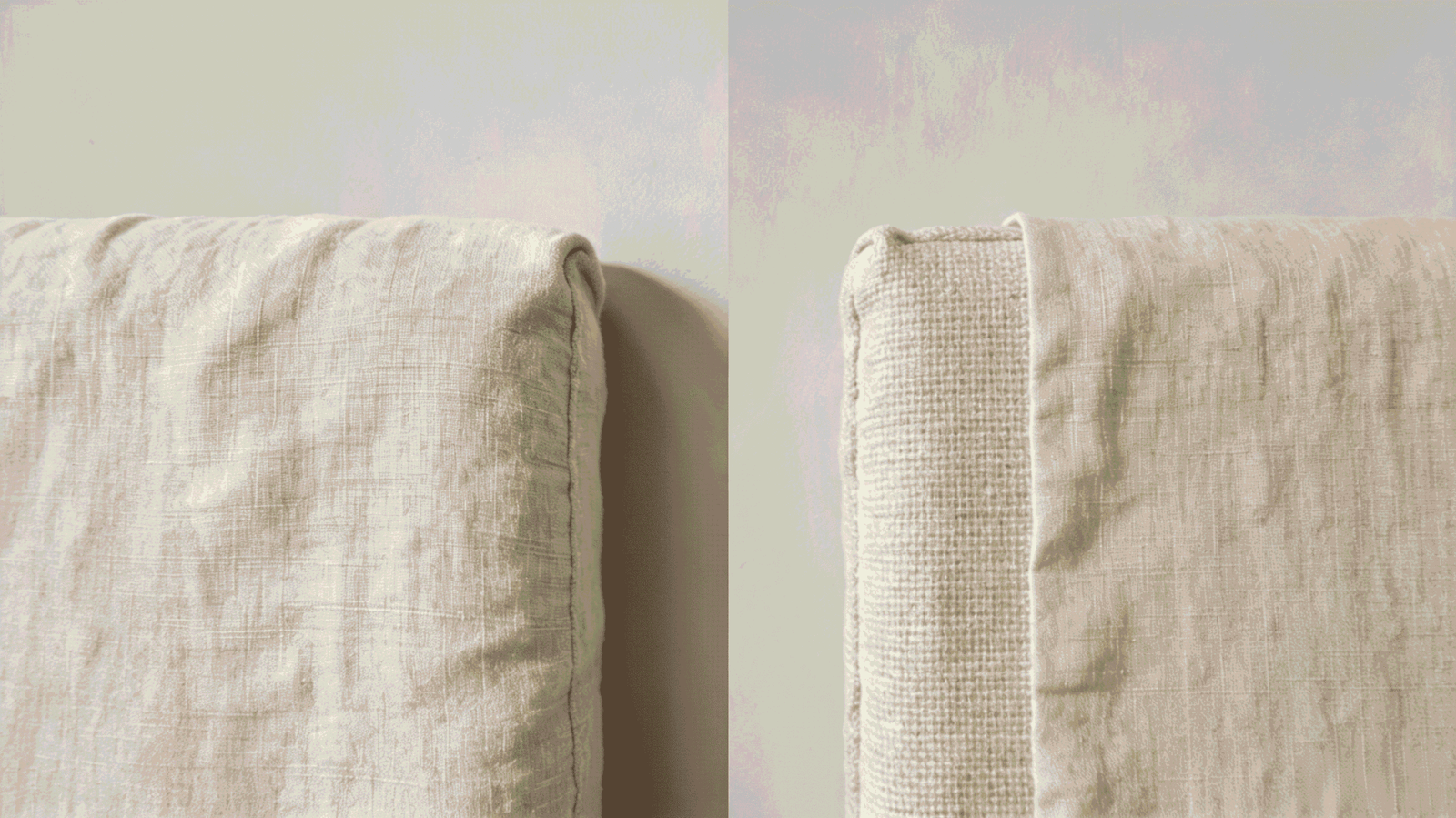
Here's what I tell customers who are comparing fabric options for a custom headboard order.
Pure Linen: What It Does Well, and Where It Struggles
Pure linen is a natural fiber with a characteristic slubbed texture, visible weave, and a hand feel that synthetic-blend alternatives don't replicate well. It breathes better than most upholstery fabrics, which is why it's popular in warmer climates and in bedrooms where the occupant sleeps warm.
However, pure linen is hygroscopic — it absorbs moisture from the environment2. In bedrooms with high humidity, near coastal areas, or in climates with seasonal humidity swings, untreated pure linen upholstery can absorb ambient moisture and develop a slightly stiff or mottled appearance over time. This isn't damage in most cases, but it's a characteristic some clients don't expect.
In our production experience:
Untreated lightweight pure linen maintains stable texture under light sleep-only contact, yet shows uneven wear with daily heavy leaning for reading; high-density pure linen finished with abrasion-resistant coating delivers comparable durability to linen blends under frequent contact conditions.
Linen Blend: The Practical Tradeoff
A linen-cotton or linen-polyester blend sacrifices some of that distinctive hand feel for dimensional stability. Blends are less likely to show wear patterning in high-contact zones, easier to spot-clean, and hold their color better under UV exposure near windows.
For a guest bedroom headboard or a vacation property — anywhere the headboard will see irregular use and potentially less careful maintenance — a quality linen blend is often the more practical specification.
A Note on COM Fabric
We support customer's own material (COM fabric) orders, which is common for designers who have already specified a fabric from another source. If you're bringing your own fabric, two things matter before the order is placed: confirm the fabric's width (most upholstery linen runs 54–60 inches3, and narrower widths affect how seams fall on large headboards) and confirm whether the material has any pattern repeat that requires matching across panels. These aren't reasons to avoid COM — they're just things to resolve before we cut.
Is installation compatibility something to decide before or after choosing a style?
Almost every headboard style question eventually becomes an installation question — and it's almost always asked too late. I've seen designers finalize a headboard spec, go to site, and discover that the existing bed frame has no headboard attachment slots, or that the wall construction can't support a wall-mount at the stud spacing the headboard requires.
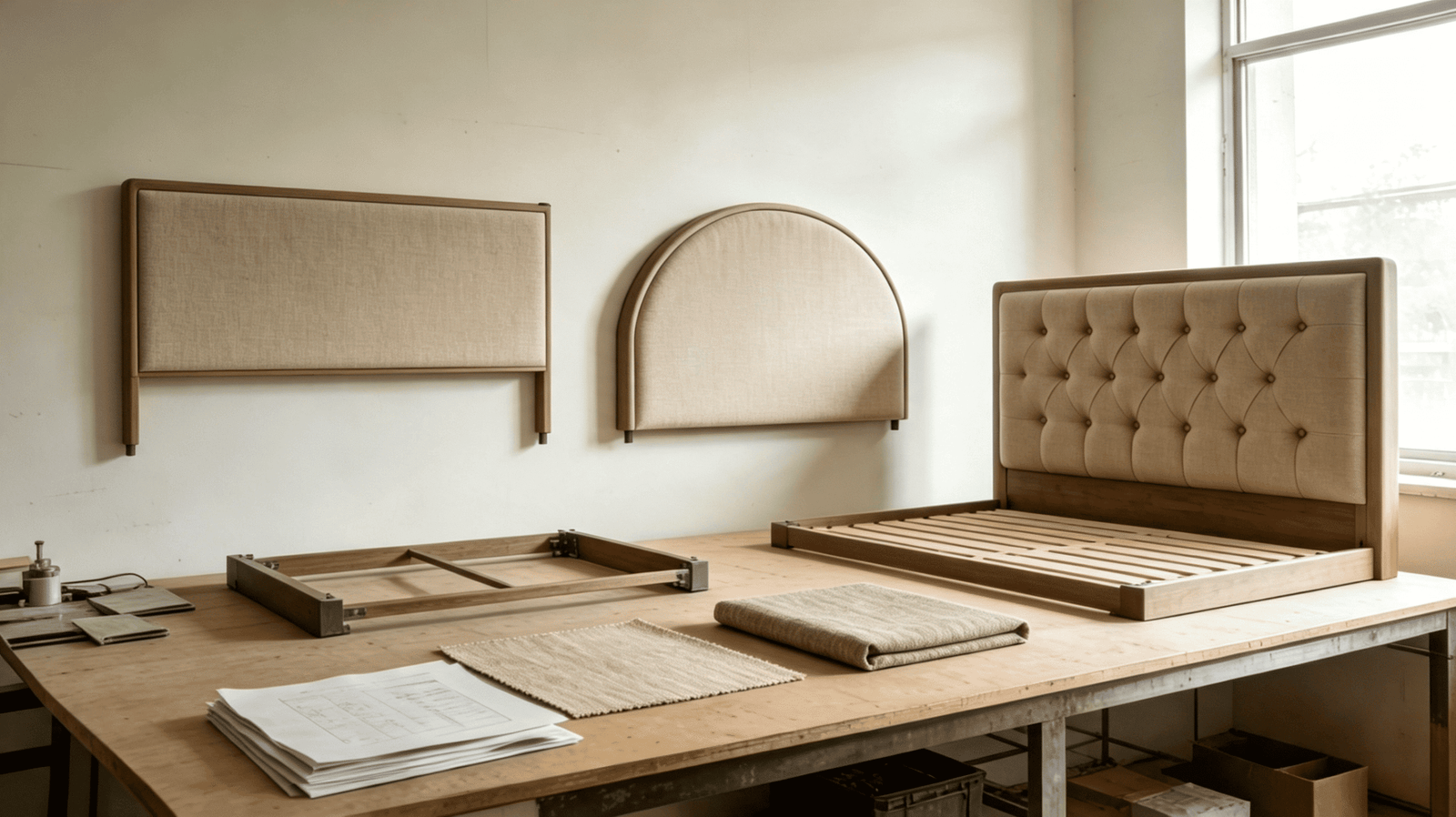
Mounting compatibility should ideally be confirmed prior to production to avoid structural rework; certain slim flat-panel headboards can be retrofitted with universal brackets for wall or frame mounting after delivery, while curved or deep tufted styles cannot be modified easily post-fabrication.
Frame-Mount (Strut Legs)
The most common mounting method in the US market. The headboard attaches to the bed frame via two vertical wooden or metal legs that bolt to the bed frame's headboard slots. This is the simplest installation, but it requires that your bed frame has compatible slot positions — typically spaced at standard intervals but not universal across all brands.
What to verify:
- Slot spacing on your bed frame (measure center-to-center)
- Maximum headboard leg height — if the headboard is taller than a standard strut allows, you'll need extended legs, which should be specified at order, not requested after
Wall-Mount
Wall-mounted headboards don't attach to the bed frame at all — they hang from the wall, typically via a French cleat or recessed bracket system. This gives more flexibility for beds without headboard slots, and it allows the bed to be pulled away from the wall for cleaning without disturbing the headboard position.
The construction requirement is that the headboard frame must include integrated hanging hardware, or at minimum, a sturdy enough internal frame to accept it without reinforcement post-production. An arched headboard with a minimal curved top rail, for example, may not have sufficient horizontal wood surface for a standard cleat. Confirm this with your supplier explicitly.
Wall considerations:
- Drywall installation requires locating studs — a heavy linen headboard (king size, deep tufted) can exceed 30 kg4; distributed weight across two or more studs is necessary
- Plaster walls in older US/EU homes require different anchor hardware — flag this to your contractor before assuming standard installation
Leaning or Free-Standing
Some clients simply lean a headboard against the wall without mounting. This works for lighter headboards in rooms where the bed is pushed against the wall, but it's only stable if the headboard has sufficient base width and the wall friction is adequate. It's also not a long-term solution for tufted or heavily padded headboards, which are top-heavy and prone to shifting.
What do you actually need to specify before placing a custom headboard order?
Custom headboard orders — from any factory, not just ours — fail most often because the buyer didn't know what information was required upfront. The revision cycle that follows costs time and sometimes requires refabrication.
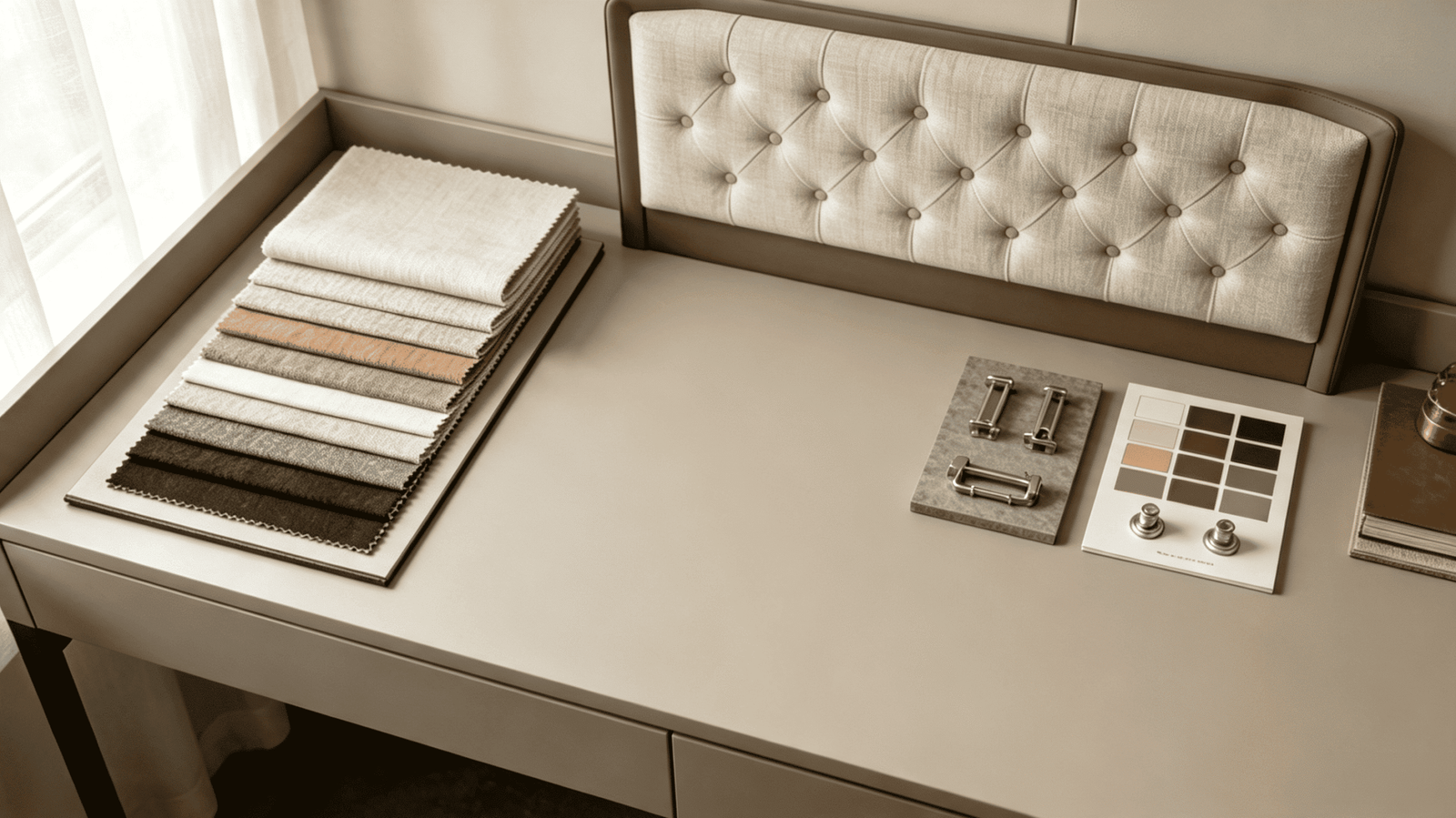
Before placing a custom upholstered headboard order, you need to confirm: finished width, finished height, mounting method, fabric selection (including colorway and any pattern repeat), fill density preference, tufting style if applicable, and whether COM fabric is being supplied. Missing any one of these creates a gap that the factory will fill with a default choice you may not want.
The Specification Checklist
Here's what we clarify before proceeding on any custom headboard order:
- Width: Finished width, not mattress width. A king mattress is 76 inches. Most king headboards run 80–86 inches to overhang the frame slightly. Specify your preferred finished measurement.
- Height: From the floor or from the top of the mattress? These produce very different visual results depending on your bed frame height. Clarify which measurement you're providing.
- Mounting type: Frame-mount (with strut leg length), wall-mount (confirm cleat or bracket preference), or free-standing. If frame-mount, provide your frame's slot spacing.
- Silhouette: Flat panel, arched (radius if known), shaped top — include a reference image if possible.
- Tufting: Button or channel, depth preference, pattern (diamond, square grid, vertical channels).
- Fabric: From our range (200+ linen colorways available), or COM. If COM, confirm width and pattern repeat.
- Fill density: Standard or upgraded. Useful context: how the headboard will primarily be used — sleep only, or regular sitting and reading.
Customers who've ordered through us and provided these details upfront move from confirmation to production without a revision cycle. Customers who don't — even experienced designers — typically need at least one clarification round that adds days to the lead time.
Frequently Asked Questions
How do I know if my bed frame is compatible with a wall-mounted headboard?
If your bed frame has no headboard attachment slots, or if you prefer the flexibility of floating the headboard above the bed independently, wall-mounting is the right method. Check that your wall has stud positions within the headboard's hanging hardware span, and confirm the headboard is built with integrated wall-mount hardware before ordering.
Can linen headboards be used in humid climates?
Pure linen is hygroscopic and can absorb ambient moisture in high-humidity environments. In coastal or tropical climates, a quality linen-blend upholstery fabric is often a more stable choice. If you prefer pure linen, ensure the room has adequate ventilation and consider a fabric treatment appropriate for upholstery use.
What is the standard lead time for a custom linen headboard from a factory in China?
In our experience with custom orders, a clearly specified headboard — with confirmed dimensions, fabric, tufting, and mounting details — typically moves from production to shipping in 3–5 weeks5. Add international freight time (typically 3–5 weeks for sea freight to the US or EU). Air freight is available for urgent projects but affects total cost significantly.
Is COM (customer's own material) fabric supported for custom headboard orders?
Yes. COM fabric orders are supported. Before submitting your fabric, confirm the width (54–60 inches is standard for upholstery linen), the total yardage required for your headboard size and tufting style (your factory should provide a yardage estimate), and whether the fabric has a pattern repeat that requires matching.
How do I choose between button tufting and channel tufting for a headboard used for reading in bed?
Channel tufting provides a more even surface with no compression points, which tends to be more comfortable for extended back support. Button tufting looks more traditional and adds visual depth but creates distinct firm and soft zones. For a headboard used regularly for sitting up and reading, channel tufting or a flat-panel upholstered surface tends to perform better over time.
Conclusion
The right headboard style isn't the one that photographs best — it's the one that's built correctly for your room, your wall, and how you actually use your bedroom. Start with mounting compatibility, then narrow your silhouette options by construction logic, then choose your fabric based on how the headboard will be used day to day. A pure linen upholstered headboard is one of the most refined choices in a high-end bedroom, but only when the spec behind it — fill density, frame construction, tufting method — is matched to real conditions, not just a reference image.
If you are a high-end residential interior designer specifying custom linen upholstered headboards for US & EU primary/guest bedroom projects, our 13-year Foshan custom furniture factory provides free moisture-resistant graded Belgian linen swatch packs and full COM fabric processing support. Our factory-direct custom pricing cuts total landed costs by 40–60% versus local Western luxury upholstery makers, with pre-production structural drawing confirmation to avoid installation failure, fabric damp deformation and tuft collapse after delivery. Message our trade design team via Email:hello@linenworld.pro to share your bedroom wall/bed frame specs & local climate for free specification consultation or request fabric sample sets.
"North America & Europe Luxury Interior Fabric Market Report 2030", https://www.grandviewresearch.com/industry-analysis/north-america-europe-luxury-interior-fabric-market. Market research reports on the global upholstered furniture sector, including analyses published by organizations such as Euromonitor International and the Business of Home trade publication, have noted sustained consumer preference for natural fiber upholstery, with linen prominently featured in the premium residential segment; however, quantitative market share data specific to headboard fabric type is not widely published. Evidence role: general_support; source type: institution. Supports: That linen is a leading fabric choice in the premium upholstered furniture segment in North American and European markets. Scope note: Publicly available market data on headboard fabric preferences by fiber type is limited; the claim reflects trade observation rather than a directly citable statistical source ↩
"The hygroscopic behavior of plant fibers: a review - PMC - NIH", https://pmc.ncbi.nlm.nih.gov/articles/PMC3982556/. Linen, derived from flax (*Linum usitatissimum*), exhibits a moisture regain of approximately 10–12% under standard atmospheric conditions, a property well-documented in textile science literature; see Morton, W.E. & Hearle, J.W.S., *Physical Properties of Textile Fibres*, 4th ed. (Woodhead Publishing, 2008), pp. 174–180. Evidence role: mechanism; source type: research. Supports: That linen (flax fiber) is hygroscopic and has a relatively high moisture regain compared to synthetic fibers. Scope note: Published moisture regain values are measured under laboratory standard conditions and may not directly predict visible aesthetic changes in upholstery applications ↩
"Width Of Upholstery Fabric - NYU Shibboleth", https://shibboleth.idm.home.nyu.edu/width-of-upholstery-fabric. Industry trade sources and textile associations, including the American Textile Manufacturers Institute, have historically documented 54-inch width as the dominant standard for upholstery-grade woven fabrics, with 60-inch widths also common in contemporary production. Evidence role: definition; source type: institution. Supports: That upholstery-weight fabrics, including linen, are conventionally woven and sold in widths of 54 to 60 inches. Scope note: Fabric width standards are not formally codified in a single binding specification and may vary by manufacturer, country of origin, and product line ↩
"Average Weight Of Common Household Furniture - OGC Library", https://ogc.rpglibrary.org/index.php?title=Average_Weight_Of_Common_Household_Furniture. Industry product specifications for king-size upholstered headboards commonly list weights ranging from 20 to 40 kg depending on fill density and frame material, supporting the recommendation that wall-mount installations distribute load across multiple studs; specific weight data should be confirmed with the manufacturer's product sheet for any given unit. Evidence role: statistic; source type: other. Supports: That large upholstered headboards can reach weights requiring multi-stud wall anchoring for safe installation. Scope note: No single authoritative published source standardizes headboard weight ranges; this figure is best verified against individual manufacturer specifications ↩
"The Effect of Furniture Imports from China on Employment in U.S. ...", https://www.usitc.gov/publications/332/working_papers/ecwp_2017-08-a-08-23-17_0.htm. Industry sourcing guides and trade association reports, including those published by the American Home Furnishings Alliance, indicate that custom upholstered furniture production in China commonly requires 4–8 weeks depending on order complexity, factory capacity, and material availability; the 3–5 week figure cited here represents an optimistic estimate for well-specified orders. Evidence role: general_support; source type: institution. Supports: That custom upholstered furniture manufactured in China typically requires several weeks of production time before shipment. Scope note: Lead times are highly variable and depend on factory workload, material sourcing, and order volume; the figure given should be treated as a baseline rather than a guarantee ↩


