
You already know what a platform bed is. The real question is whether the one you're considering — or the one your client is expecting — will hold up once it's actually in the room. Not just structurally. Aesthetically. That's the standard that matters here, and it's the one most sourcing guides never address.
For designers and high-end buyers sourcing a platform bed for a finished luxury interior, the decision rarely comes down to style or size. It comes down to one question: can a direct-from-manufacturer piece meet the aesthetic and craft standards you'd expect from a domestic custom furniture maker — at a fraction of the cost1? The answer is yes, but only under specific conditions that this guide will walk you through clearly.
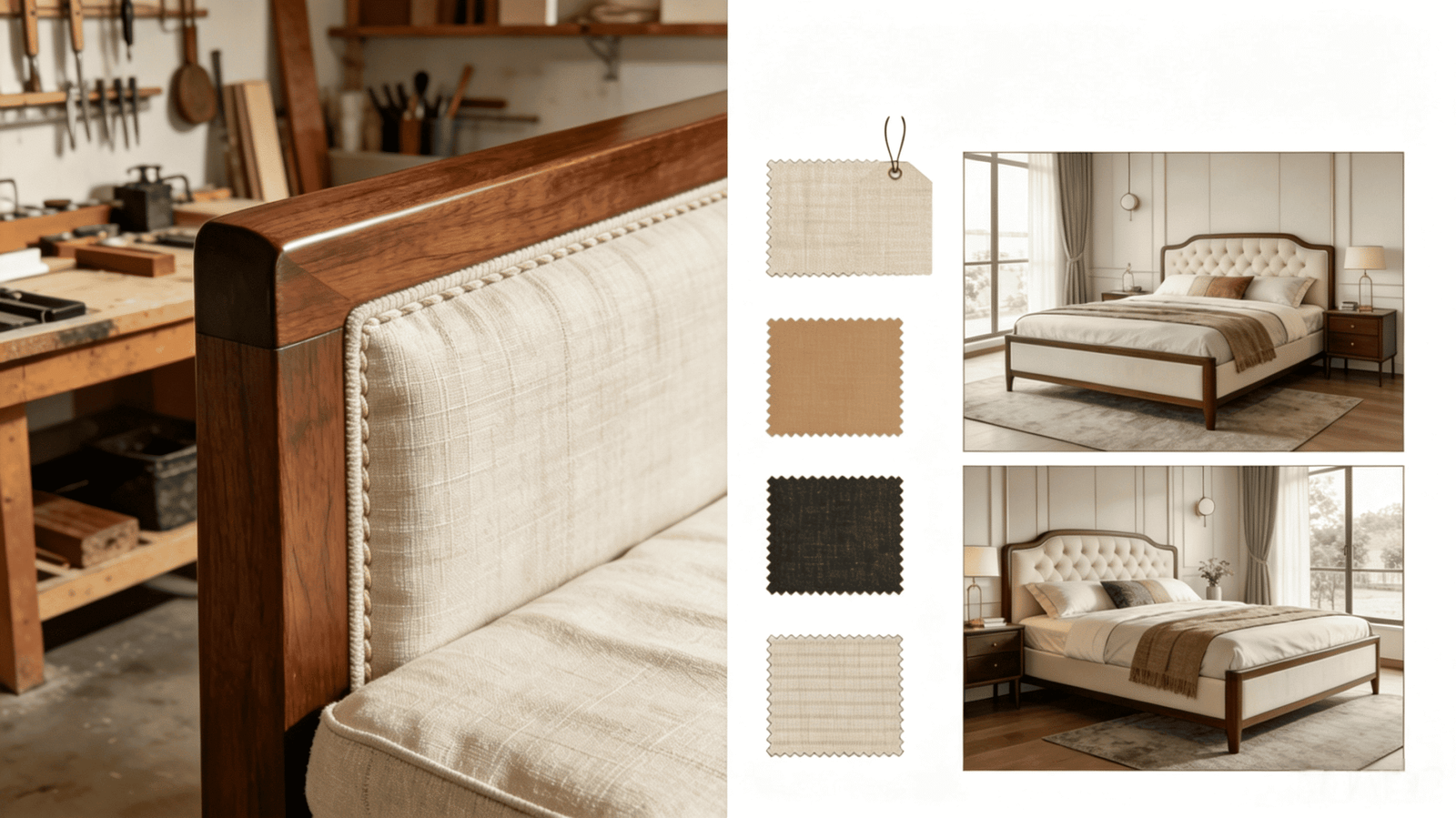
The conditions matter more than the headline number. A 40–60% cost advantage over comparable US or European custom work2 is real — but only when you're comparing equivalent specs. Once you understand how to verify quality remotely, how linen reads as a design material, and what made-to-order actually requires from you as a buyer, the decision becomes much cleaner.
How Do You Verify Quality When You Can't Walk the Factory Floor?
This is the first question every designer asks, and it's the right one. The risk in direct sourcing isn't that overseas factories produce inferior goods — it's that you have no established system for evaluating what you're buying before it ships.
The good answer to this problem isn't reassurance. It's a verifiable process. At Linen World, the evaluation happens in stages: material certification before production begins, a sample review before full-run approval, and photo documentation at key production milestones. None of this requires a factory visit to be useful — but it does require you to know what you're looking at.
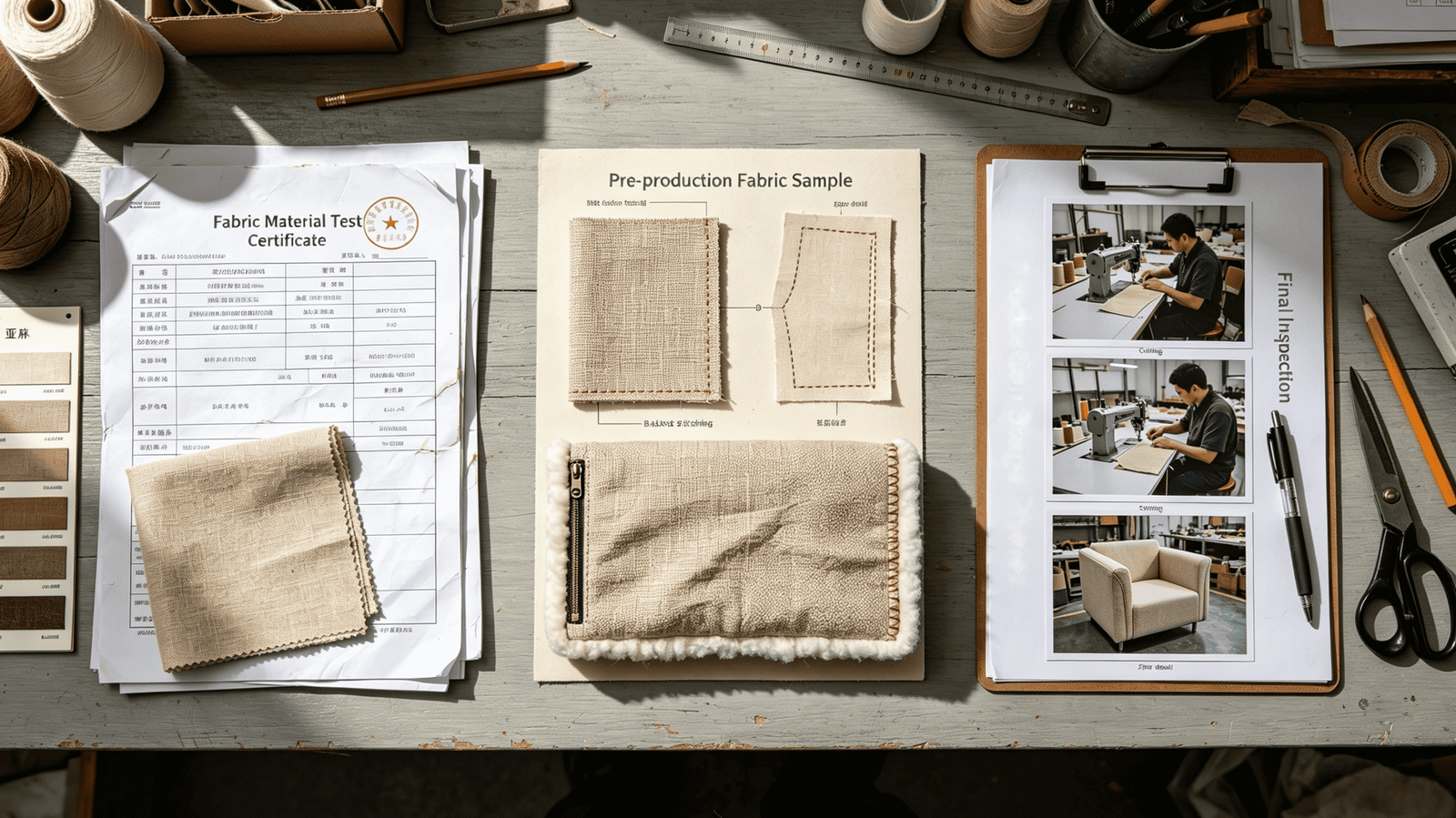
Here's what a serious quality verification process for a custom linen platform bed should include, and why each checkpoint matters in a real design context.
Material Certification: What "Belgian Linen" Actually Means in Practice
When a designer specifies Belgian linen, they're not asking for a thread count. They're asking for a particular visual register — the way the weave holds natural light, the slightly textured matte surface that reads as quiet luxury in a neutral room. Belgian linen has a recognized origin standard3, and reputable manufacturers can provide documentation confirming the fiber source.
In our experience handling US-based designer inquiries, the most common follow-up question after "what fabric do you use?" is: "Can you match a specific swatch I already have?" That question tells you everything. Designers are working backward from a finished room, not forward from a spec sheet. The fabric certification matters because it anchors the material to a known visual standard — one the designer has almost certainly seen and approved in another project.
If a supplier cannot provide material origin documentation, treat that as a signal, not just a gap. It affects the entire conversation about quality.
Joinery and Frame Construction
The visual life of an upholstered platform bed depends heavily on what's underneath the fabric. Weak joinery shows eventually — in the way cushioned panels shift, in corner seams that lose their tension, in a frame that flexes slightly when loaded.
The specific questions designers ask us here include: "What's your slat spacing?" and "Is the frame solid wood or engineered?" These aren't abstract technical queries. They come from experience with furniture that looked right in the showroom and failed in the home.
What to ask any manufacturer — domestic or overseas — before committing:
- Is the frame kiln-dried solid wood4, and what species?
- What is the corner joinery method — mortise and tenon, dowels, or hardware-dependent5?
- What is the slat spacing, and is a center support beam included for queen and king sizes?
- How is the upholstery attached at the corners and along the base rail?
A manufacturer who answers these questions with specifics — not generalities — is demonstrating process knowledge. That matters more than any single spec.
Sample Review: What It Actually Reveals
A physical sample before full production approval is the single most effective quality gate in a remote sourcing process. It answers questions that documentation cannot: how the linen color holds against your other specified materials, how the upholstery sits at the seam edge, whether the finish matches what you saw in photos.
At Linen World, we build the sample review into the standard order process for custom pieces. The sample stage is when most fit issues are caught and resolved — before production begins, not after. For designers working to a project deadline, this is also when the lead time conversation becomes real and specific.
How Does Linen Read as a Design Material in a Platform Bed?
Most sourcing guides frame upholstery fabric as a durability question. For high-end design work, that's the wrong frame entirely. The question isn't how long the linen lasts. It's how it reads.
Designers who specify linen beds are making a visual decision about a room's register. Linen has a specific quality in natural light — slightly irregular in texture, matte rather than reflective, tonally warm even in cool neutrals6. It ages without looking worn. It holds a neutral palette together without competing with it.
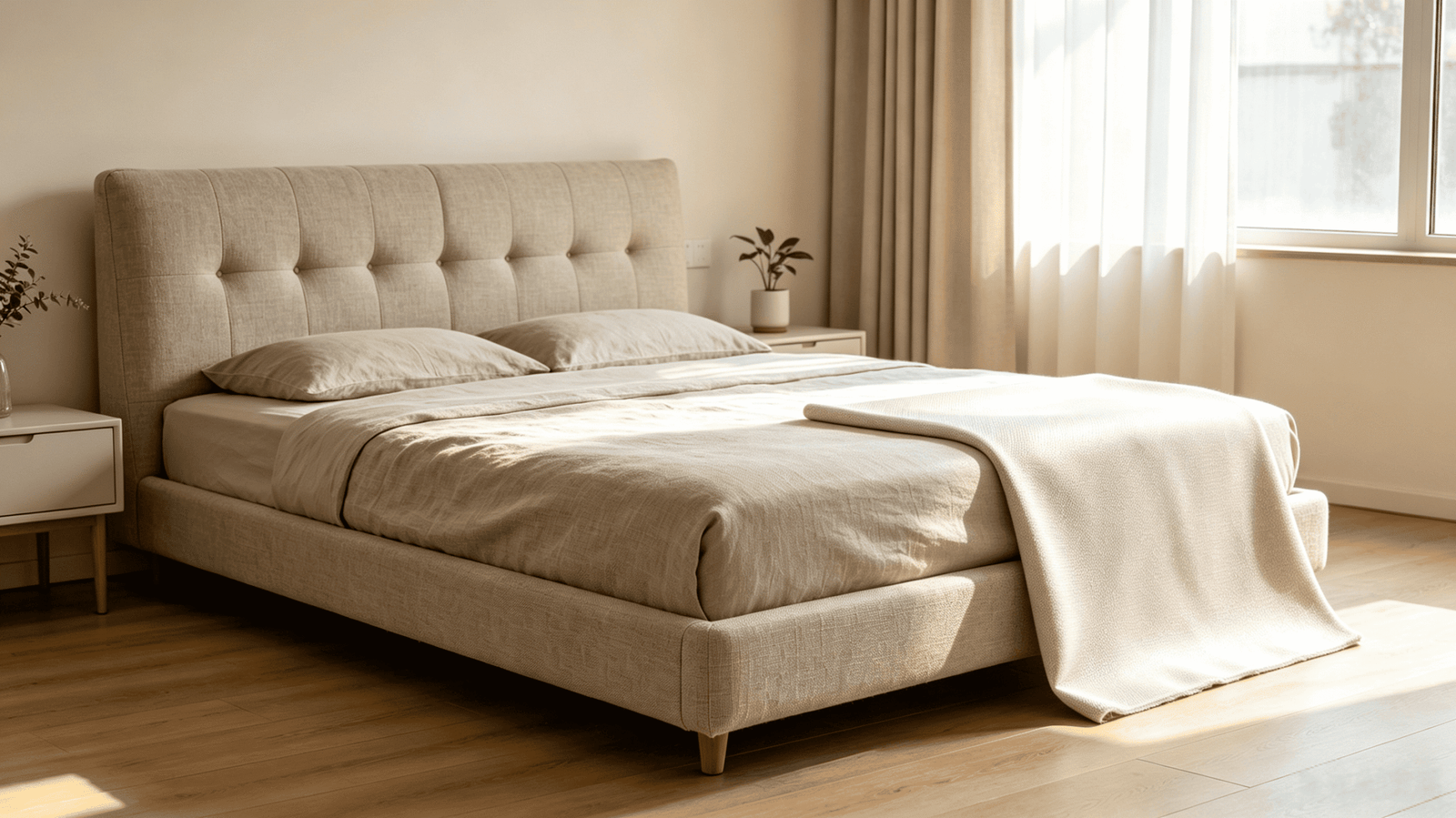
Understanding this is the difference between a manufacturer who can execute a linen bed and one who can help you specify it correctly.
Tone Consistency Across a 200-Color Range
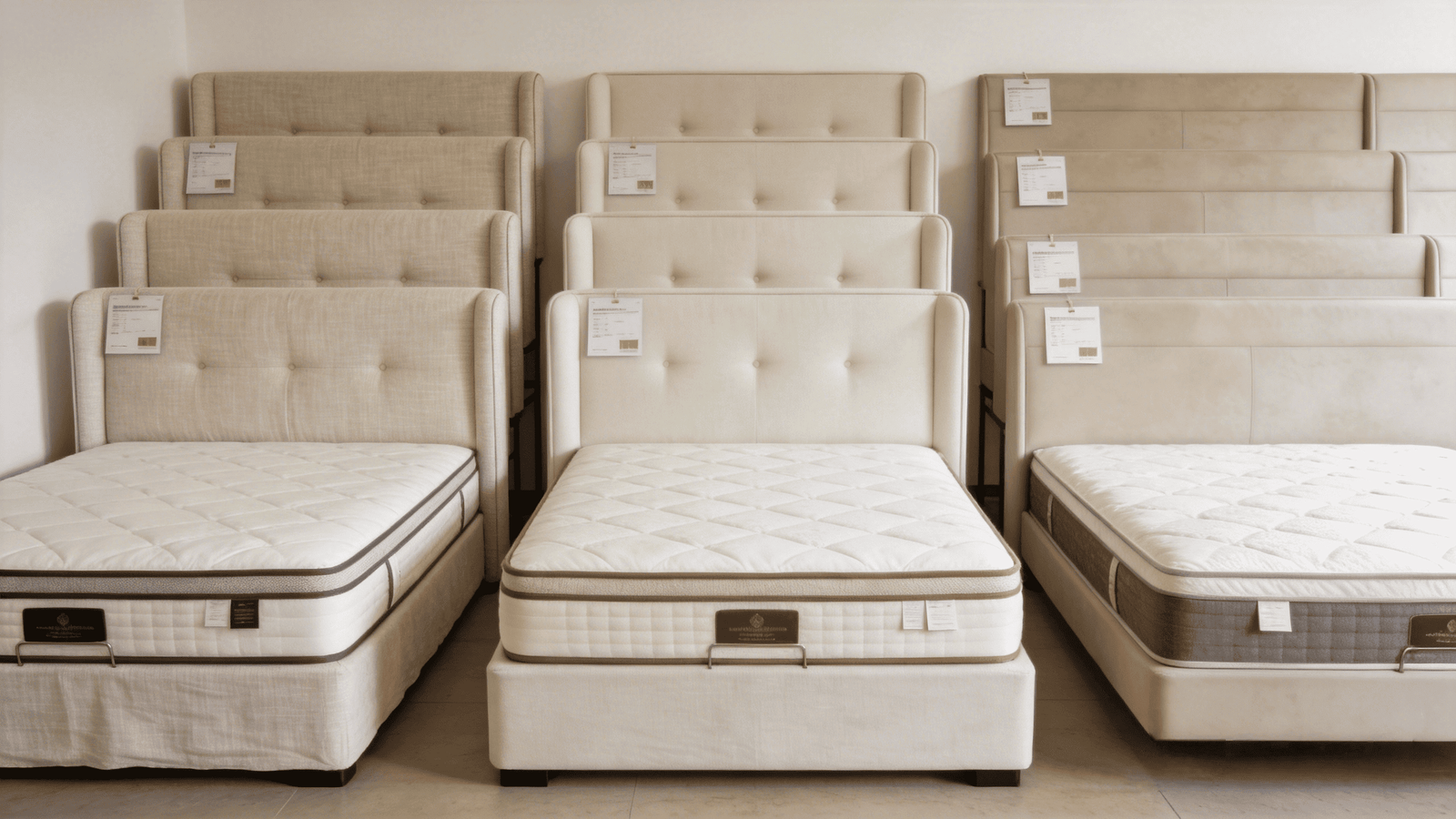
At Linen World, we offer 200+ fabric color options for made-to-order pieces, and the question we field most often from designers is not "what colors do you have?" — it's "how consistent is the color across production batches?"
That's a sophisticated question. Linen fiber takes dye differently than synthetic fabrics7, and batch-to-batch variation is a real consideration in custom upholstery work8, especially when the bed needs to coordinate with drapery, rugs, or wall finishes already in the room.
Here's how we approach this in practice:
- Physical swatch confirmation before production — the designer approves the actual dyed linen, not a digital representation.
- COM fabric support — if you have a fabric you've already specified and sourced, we can upholster to it. This is the cleanest way to guarantee exact material match.
- Lot documentation for reorders or multi-piece commissions.
How Linen Ages in a Bedroom Context
One of the reasons designers continue to specify linen for bedroom upholstery — despite it requiring more care than performance fabrics — is precisely because of how it ages. Linen develops a softer hand over time9. The slight natural slub in the weave becomes more pronounced, not less10, which most clients in the high-end residential market read as character rather than wear.
This is a judgment call that belongs in the project conversation with your client. In our experience, designers working on primary residences tend to specify linen with confidence. For high-traffic vacation homes or rental properties, the conversation usually shifts toward performance blends.
Is the 40–60% Cost Savings Real — and When Does It Apply?
The number deserves a clear frame, because floating it without context does more harm than good.
The 40–60% cost advantage applies when you are comparing equivalent custom-spec furniture: same material grade (Belgian linen or equivalent), same custom dimensions, same upholstery detail level, made-to-order from a quality manufacturer. It does not apply when comparing a custom overseas piece to a mass-market in-stock bed. That comparison doesn't have integrity.
The Real Comparison: What Does a Comparable Domestic Custom Piece Cost?
In the US and European market, a custom upholstered platform bed in Belgian linen from a recognized manufacturer — Blasco, a California custom atelier, or comparable — typically starts at significant five-figure pricing for a king size, depending on frame complexity and material specification.
At Linen World, the equivalent piece — same material grade, custom dimensions, handcrafted upholstery — comes in at a price point that consistently lands 40–60% below that benchmark. That gap holds because we are manufacturing at cost in Foshan, with 13 years of production infrastructure11, without the retail markup layer that domestic suppliers must carry.
What You Are Trading Against That Savings
The cost difference is real, but it is not free. What you are trading against it:
| Factor | Local/Domestic Custom | Direct-from-Factory (Linen World) |
|---|---|---|
| Lead time | 8–14 weeks typical | 8–12 weeks (similar range) |
| In-person quality review | Possible | Remote — sample stage + documentation |
| Communication overhead | Lower | Requires clear spec documentation upfront |
| Cost (equivalent spec) | Baseline | 40–60% lower |
| Customization | High | High — 200+ fabrics, custom dimensions, COM |
| Minimum order | Varies | Single pieces accepted |
The lead time is comparable. The real trade is in the remote process — which requires more upfront precision from the buyer on spec documentation, and more discipline in the sample-review stage. For designers who have a clear project brief, this is manageable. For buyers still in the exploration phase, a local purchase may be more practical.
What Does the Made-to-Order Process Actually Require from You?
Made-to-order is not the same decision as buying in-stock. The guide would be incomplete without naming that clearly.
When you commission a custom platform bed — overseas or domestically — you are entering a specification-and-approval process, not a transaction. The decisions you make at the front end of that process determine the outcome at the back end.
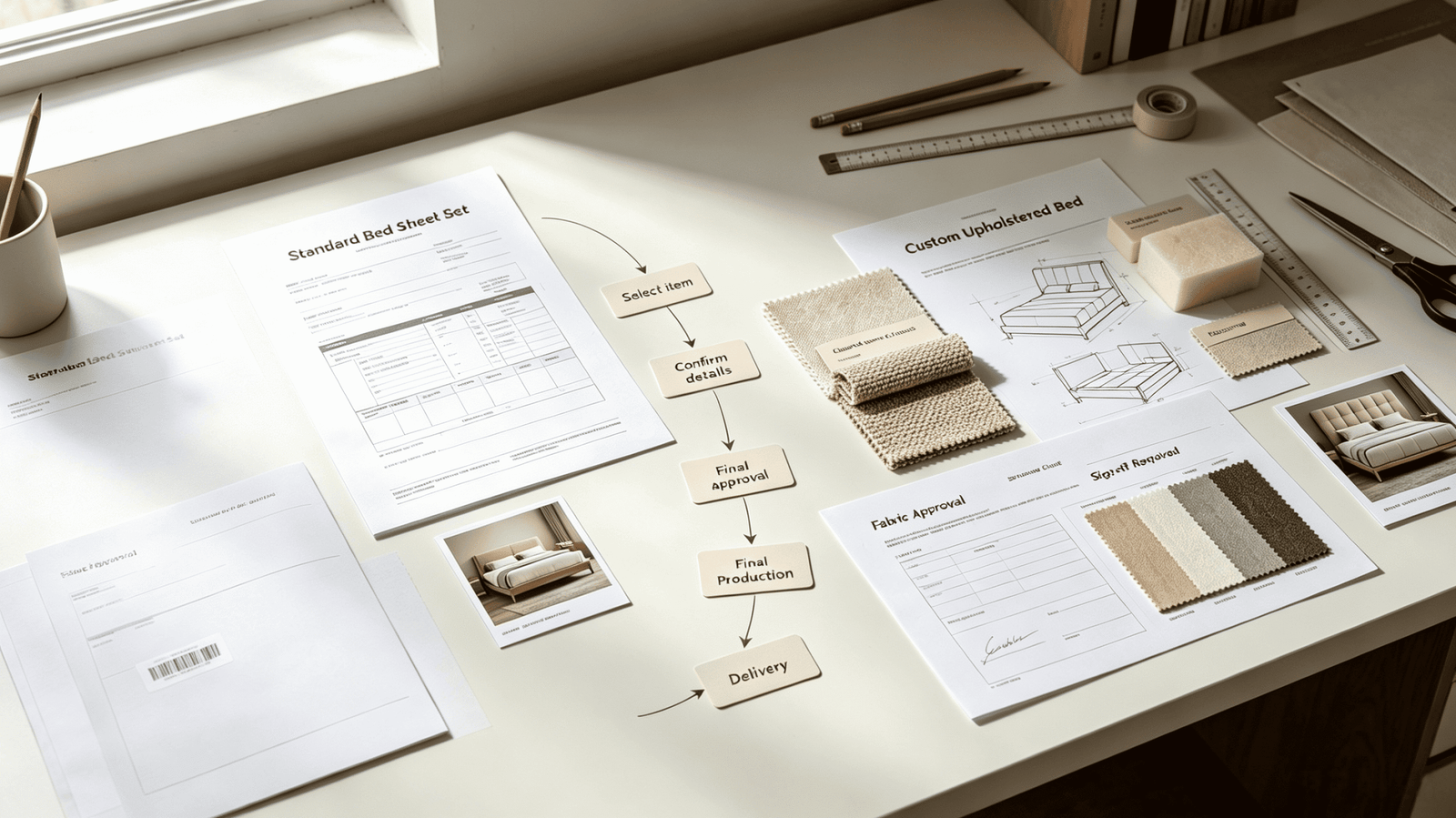
What We Need from You at the Spec Stage
In our experience handling designer and homeowner inquiries from the US, the projects that run smoothly share a common trait: the buyer came in with a clear brief. Not a complete technical drawing — a clear brief. Dimensions, fabric direction (from our range or COM), headboard profile, leg finish, any non-standard detail.
The questions that typically need resolution before we begin:
- Dimensions — standard king/queen/California king, or custom?
- Headboard height and profile — flat panel, channeled, button-tufted, or custom shape?
- Leg specification — material, height, finish (natural wood, lacquered, metal)?
- Fabric selection — from our 200+ range, or COM?
- Special details — storage drawers, integrated base, nailhead trim, piping?
None of these are difficult questions. But they need answers before production begins, not after.
Production Milestones and Communication
Our standard custom order process runs through three confirmed stages: spec sign-off, sample approval, and production completion with photo review before shipping. Each stage has a defined timeline. Designers working to an installation date need to build the sample review stage into their project schedule — typically two to three weeks, depending on shipping direction.
This is the process variable that most buyers underestimate. The lead time is not just production time. It includes the spec-to-sample cycle. Factor that into your project calendar at the outset.
Frequently Asked Questions
Can you match a specific fabric swatch I've already specified?
Yes, through two routes. If your fabric is in our 200+ linen range, we'll send a physical swatch for approval before production begins. If it's a fabric you've sourced separately, we support COM (customer's own material) — you ship the fabric to us, and we upholster to your spec. This is the most reliable way to guarantee an exact material match.
What is the typical lead time for a custom platform bed?
For a fully custom made-to-order platform bed, our standard lead time runs 8–12 weeks from spec sign-off, inclusive of the sample review stage. Projects requiring COM fabric may run slightly longer depending on when your material arrives. We provide milestone updates through the production cycle.
Do you accept single-piece orders, or do you require a minimum quantity?
We accept single-piece custom orders. A significant share of our US inquiries come from interior designers commissioning one or two pieces for a specific project. There is no minimum order requirement for custom work.
How do I verify quality if I can't visit the factory?
The verification process runs through three points: material certification at the sourcing stage, a physical sample shipped for your approval before full production, and photo documentation at key production milestones. For designers who require a pre-shipment inspection, we can accommodate third-party inspection arrangements.
What if the piece doesn't match what I approved in the sample?
The sample sign-off is the binding quality reference point for production. If a delivered piece has a material variance from the approved sample — in color, finish, or upholstery quality — that is a production error and we address it. We'd encourage every buyer to photograph and document their sample approval clearly for this reason.
Conclusion
A platform bed buying guide that's actually useful for a luxury project doesn't spend much time on basics. It spends time on the real decision: whether a direct-from-manufacturer sourcing process can deliver the material quality and craft standard your interior demands — and what it takes to make that work.
The short answer is yes, under the right conditions. Those conditions are: a manufacturer with verifiable material sourcing, a clear sample-review process built into the order timeline, and a buyer who comes in with a defined spec. When those conditions are met, the 40–60% cost advantage over comparable domestic custom work is real and well-supported.
At Linen World, we've spent 13 years building exactly this kind of process for US and European designers. If you're sourcing a custom platform bed for a high-end project, contact us to request swatches, discuss your spec, or get a project quote. The conversation starts with your brief.
"Attitudes of U.S. retailers toward China, Canada, and the United ...", https://research.fs.usda.gov/treesearch/19636. Supply chain and manufacturing research on global furniture production indicates that quality outcomes in overseas direct sourcing are strongly correlated with buyer specification rigor, supplier selection criteria, and in-process quality verification protocols rather than manufacturing geography per se. Evidence role: general_support; source type: research. Supports: Whether overseas direct-from-manufacturer furniture production can achieve quality comparable to domestic custom makers under appropriate sourcing conditions. Scope note: Published research on this topic tends to address manufacturing quality broadly rather than the specific craft standards relevant to high-end residential interior design; the claim of aesthetic parity with domestic custom makers remains difficult to verify through general literature. ↩
"The Effect of Furniture Imports from China on Employment in U.S. ...", https://www.usitc.gov/publications/332/working_papers/ecwp_2017-08-a-08-23-17_0.htm. Trade and industry research on furniture supply chains has documented substantial cost differentials between domestic custom production and direct overseas manufacturing, attributable to labor cost disparities, production scale, and the elimination of domestic retail markup layers, though specific percentage ranges vary by product category, specification level, and sourcing period. Evidence role: general_support; source type: research. Supports: The general magnitude of cost differentials between direct overseas manufacturing and domestic custom furniture production. Scope note: Published cost-differential figures are typically aggregate or category-level estimates; the 40–60% range cited in the article is specific to equivalent-spec custom upholstered pieces and cannot be verified against a single authoritative source. ↩
"Belgian Linen - Wikipedia", https://en.wikipedia.org/wiki/Belgian_Linen. Industry and trade bodies such as the Masters of Linen certification program and the European Confederation of Linen and Hemp (CELC) maintain origin-traceability standards for flax-based textiles produced in Western Europe, providing a framework against which supplier documentation can be evaluated. Evidence role: definition; source type: institution. Supports: What constitutes a recognized origin or quality standard for Belgian linen and which body administers or certifies it. Scope note: Certification schemes vary in scope and enforcement; not all suppliers claiming Belgian linen origin participate in formal third-party certification programs. ↩
"Air- and shed-drying lumber - OSU Extension Service", https://extension.oregonstate.edu/catalog/em-8612-air-shed-drying-lumber. Wood science literature establishes that kiln drying reduces lumber moisture content to equilibrium levels (typically 6–8% for interior furniture applications), minimizing post-manufacture shrinkage, warping, and joint failure that occur when green or air-dried wood continues to lose moisture after assembly. Evidence role: mechanism; source type: education. Supports: Why kiln-dried lumber is preferred for furniture frames and what moisture content standards are relevant. Scope note: Optimal moisture content targets vary by species, regional climate, and end-use environment; a single standard does not apply universally across all furniture manufacturing contexts. ↩
"The design and evaluation of three-dimensional corner joints used ...", https://bioresources.cnr.ncsu.edu/resources/the-design-and-evaluation-of-three-dimensional-corner-joints-used-in-wooden-furniture-frames-experimental-and-numerical/. Engineering studies on wood joint performance consistently find that mortise-and-tenon joints exhibit higher resistance to racking and cyclic loading than dowel joints of equivalent dimensions, though modern adhesive-reinforced dowel joints can approach comparable strength when properly executed. Evidence role: mechanism; source type: research. Supports: Comparative structural performance of mortise-and-tenon versus dowel and hardware-based furniture joints. Scope note: Joint performance is highly dependent on wood species, adhesive type, and manufacturing precision; laboratory results may not directly predict real-world furniture longevity under varied use conditions. ↩
"Linen Most Useful: Perspectives on Structure, Chemistry, and ... - PMC", https://pmc.ncbi.nlm.nih.gov/articles/PMC4403609/. The optical characteristics of linen fabric — including its relatively low surface sheen compared to silk or synthetic fibers — derive from the polygonal cross-section of flax fibers and the natural irregularity of hand or semi-mechanized spinning, which scatter incident light diffusely rather than producing specular reflection. Evidence role: mechanism; source type: research. Supports: The physical fiber and weave properties of linen that produce its characteristic matte, textured appearance in light. Scope note: Descriptions of linen's visual qualities in design contexts are partly subjective; the physical basis for matte appearance is well-established, but characterizations such as 'tonal warmth' reflect perceptual and design convention rather than measurable optical properties. ↩
"Linen World | Handcrafted Bespoke Pure Linen Sofas &Upholstery ...", https://linenworld.pro/. COM, or customer's own material, is a recognized practice in the contract and residential custom furniture industry whereby the client or specifying designer supplies fabric directly to the manufacturer for upholstery, allowing precise material control when the specified textile falls outside the manufacturer's standard offering; the practice is documented in trade association guidelines for the furniture and interior design industries. Evidence role: definition; source type: institution. Supports: COM (customer's own material) as an established practice in the custom upholstery and furniture trade. Scope note: COM arrangements vary in how shipping, yardage requirements, and liability for material defects are handled; the article does not address these logistical considerations, which are relevant to designers evaluating this option. ↩
"Advancements in Sustainable Natural Dyes for Textile Applications", https://pmc.ncbi.nlm.nih.gov/articles/PMC10458907/. Textile chemistry literature notes that natural cellulosic fibers such as flax exhibit variable dye uptake due to differences in fiber maturity, processing history, and natural impurity content, making precise color reproducibility across production batches more challenging than with synthetic fibers whose chemical composition is tightly controlled. Evidence role: mechanism; source type: research. Supports: Why natural cellulosic fibers like linen exhibit greater dye batch variability compared to synthetic fibers. Scope note: The degree of batch variation depends heavily on dyeing method, fiber preparation, and quality control protocols; modern industrial dyeing of linen can achieve high consistency when processes are well-controlled. ↩
"Linen Most Useful: Perspectives on Structure, Chemistry, and ... - PMC", https://pmc.ncbi.nlm.nih.gov/articles/PMC4403609/. Research on bast fiber textiles indicates that repeated mechanical action and moisture exposure progressively break down the pectin bonds between flax fiber bundles, reducing stiffness and increasing perceived softness without degrading tensile strength under normal use conditions. Evidence role: mechanism; source type: research. Supports: The textile-science basis for linen becoming softer with repeated use due to fiber structure changes. Scope note: Most published fiber research focuses on industrial or agricultural applications; peer-reviewed studies specifically examining consumer upholstery linen aging are limited. ↩
"Pure linen has a slightly crisp, textured, and cool hand-feel. It is ...", https://www.instagram.com/reel/DYzfK-6ISdL/. Textile science literature on flax fiber structure notes that slubs — thickened sections resulting from natural fiber bundle variation — are inherent to linen yarn and may become visually accentuated as surrounding finer fibers soften and settle with use, though the degree of change depends on weave construction and finishing treatments. Evidence role: mechanism; source type: education. Supports: How the structural irregularities in linen weave (slubs) behave as the fabric ages and is used. Scope note: Direct empirical studies on slub visibility change in upholstery-weight linen over time were not identified; this characterization is largely supported by textile craft literature rather than controlled research. ↩
"Linen World | Handcrafted Bespoke Pure Linen Sofas &Upholstery ...", https://linenworld.pro/. Foshan, located in Guangdong Province, is widely recognized as one of China's largest furniture manufacturing and export hubs, with a concentrated cluster of factories, material suppliers, and skilled labor that has developed over several decades and serves both domestic and international markets. Evidence role: historical_context; source type: institution. Supports: Foshan's established role as a major furniture manufacturing center in China and globally. Scope note: General descriptions of Foshan's manufacturing role do not validate the quality or practices of any individual manufacturer operating within the region. ↩


