
Swivel chairs are one of the most misspecified pieces in high-end residential interiors. The problem is not that designers lack taste — it is that most buying frameworks were built for office procurement, not for decorative residential pieces where construction quality, fabric grade, and long-term client satisfaction all fall on the specifier's reputation. The result: a chair that looked perfect in the mood board fails within the first year.
A swivel chair buying guide for residential design work is really a specification guide. The right evaluation sequence is: base and mechanism first, frame construction second, fabric grade and maintenance compatibility third, and visual selection last. Reversing that order — starting with color and silhouette — is the single most common source of expensive post-installation problems in high-end residential projects.

Most designers intuitively understand this hierarchy but still default to visual-first selection under client and deadline pressure. The sections below break down each decision layer with the specific questions you need to ask — and the answers that should concern you — before a swivel chair is confirmed on a project.
Swivel chair base and mechanism: why is this the first thing to evaluate?
A swivel chair base failure is not a minor inconvenience — it is a client complaint that arrives 12 months after installation, long after the project budget is closed. The base and swivel mechanism are the components that directly determine whether the chair performs quietly, smoothly, and safely over years of residential use.
In our production process, the base specification is confirmed before fabric selection begins. Not because it changes the visual outcome significantly, but because the weight and proportion of the base must match the frame load — and that relationship is fixed at the structural design stage.
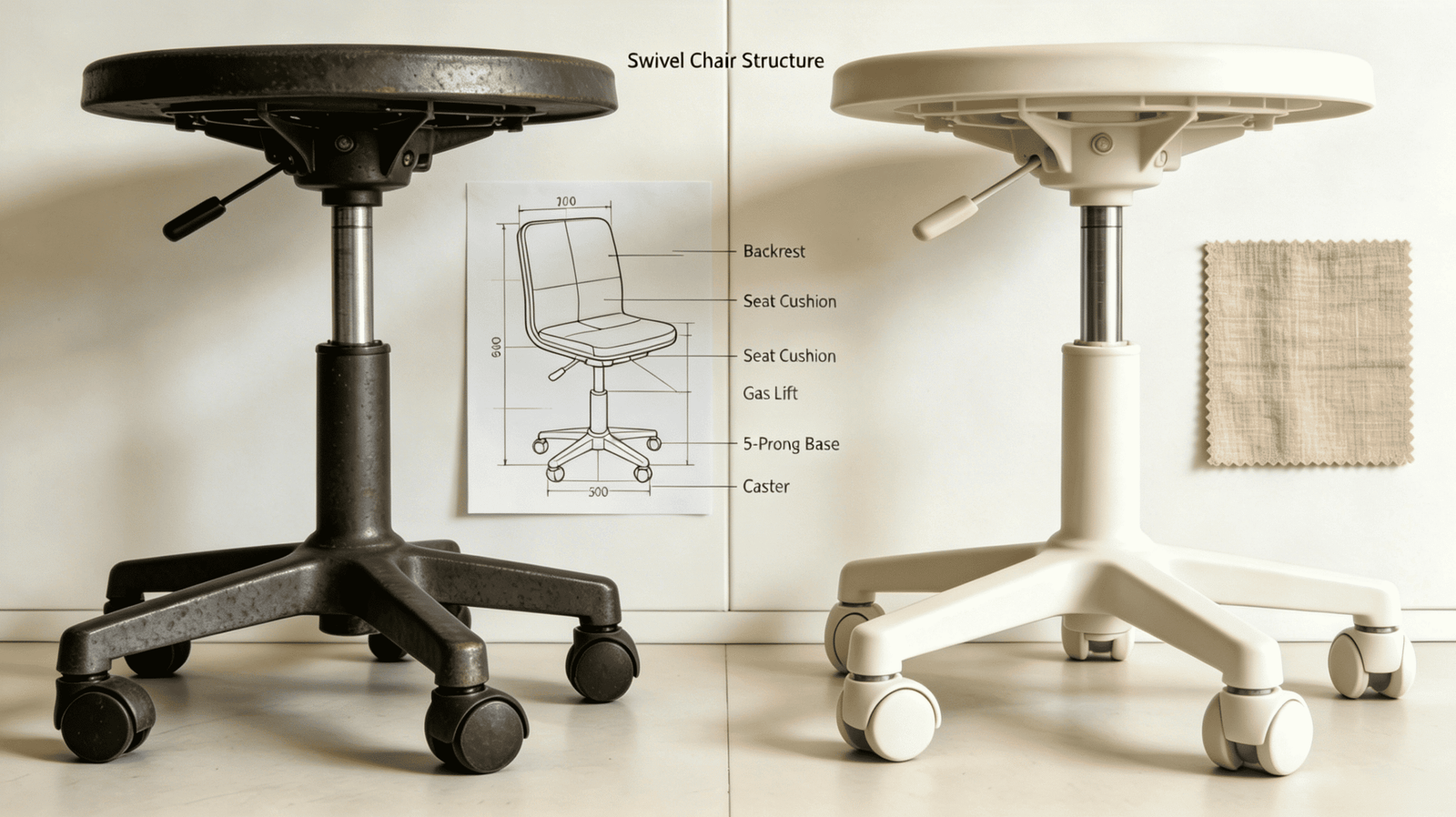
Cast iron versus plastic base: what actually matters in a residential context?
The material debate is real, but the framing usually misses the point. The question is not simply "which material is better" — it is whether the base material matches the use frequency and floor surface of the specific project.
| Base Material | Load Capacity | Noise Profile | Floor Compatibility | Lifespan (Residential) |
|---|---|---|---|---|
| Cast iron | High | Low (dense, stable) | All surfaces with correct glide | 15+ years |
| Powder-coated steel | Medium-high | Medium | Hard floors: check glide spec | 10–15 years |
| Polished aluminum | Medium | Low-medium | Best on hard floors | 10–15 years |
| Reinforced plastic | Low-medium | Higher under load | Carpeted surfaces primarily | 3–7 years |
A chair that rotates roughly, or audibly, will generate a client complaint. In our experience producing for residential projects, noise at the bearing point is one of the most consistent sources of post-delivery feedback — and it is almost entirely preventable at the specification stage by confirming the bearing grade and lubricant type used in the mechanism.
What questions should you ask about the swivel mechanism before approving a sample?
These are the questions I would ask any supplier — including our own production team — before signing off on a swivel mechanism for a high-end residential project:
- What is the bearing type? Ball bearing mechanisms rotate more smoothly and quietly than simple bushing mechanisms under residential load conditions1.
- What is the rated load capacity? For decorative residential chairs, 150–200 kg is a reasonable threshold. Anything significantly below that introduces risk.
- Is the swivel range fixed or full 360°? Some decorative pieces use a limited swivel arc — confirm this matches the room's intended traffic flow.
- How is the mechanism serviced? In a high-end project, a mechanism that requires full reupholstery to access for maintenance is a liability.
- What is the glide or foot material? For hardwood and stone floors — common in the US and European luxury residential market — felt or coated rubber glides are non-negotiable2.
The base is not the visual centerpiece of the piece. But it is the component that determines whether the chair is still performing well when the client refers you to their next project — or calls to complain.
Frame and seat construction: what should a specifier look for?
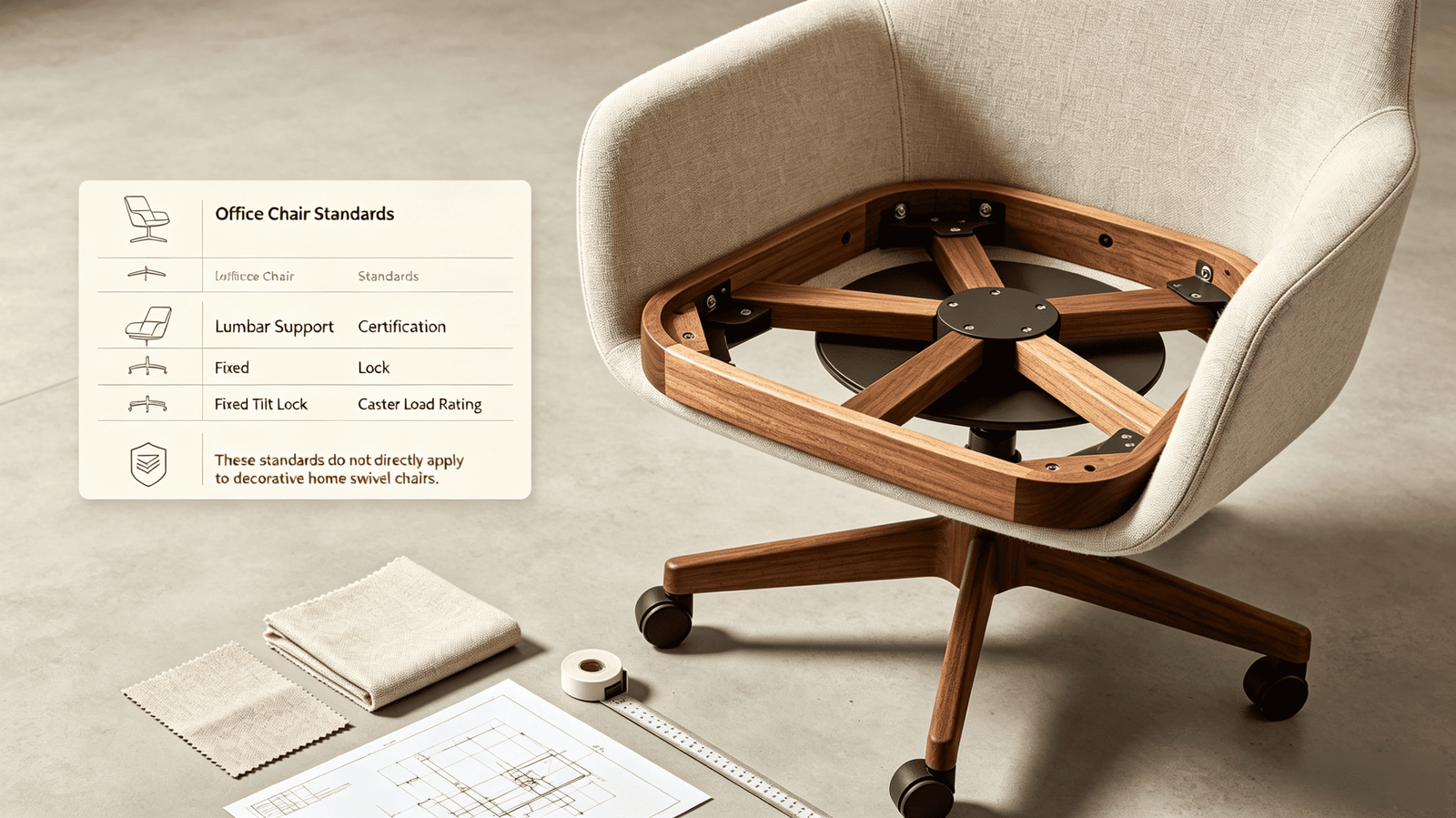
Frame quality is the variable that separates a chair that ages well from one that loses its shape and structural integrity within three to five years. For decorative swivel chairs in residential settings, the relevant evaluation criteria are not the same as office-chair standards.
Applying office ergonomic benchmarks — lumbar certification, tilt-lock specifications, caster load ratings — to a decorative residential swivel chair is the wrong filter. It leads to rejecting excellent pieces because they do not meet criteria that were never relevant, or approving structurally weak pieces because they pass certifications designed for a different product category entirely.
How should seat depth, cushion construction, and weight distribution be evaluated?
For residential decorative swivel chairs, the relevant structural questions are:
Frame material:
- Kiln-dried hardwood frames (beech, poplar, rubberwood) resist warping and hold upholstery staples and tacks far better than MDF or finger-jointed lumber composites3.
- Ask for the specific timber species. "Solid wood" is not a meaningful specification on its own.
- Corner blocking and dowel joinery are visible indicators of construction intent — a frame without corner blocks is being built to a cost, not a performance standard.
Seat construction and cushion depth:
- High-density foam (minimum 35 kg/m³ for residential use) retains its profile under regular use4. Cheaper foam compresses and loses shape, which changes the visual proportion of the chair — a problem that becomes visible in the client's home.
- Sinuous spring or eight-way hand-tied spring base? For a high-end decorative swivel chair, sinuous spring is acceptable; eight-way hand-tied adds cost but delivers a more durable and even seat feel over time5.
- Seat depth is an aesthetic and ergonomic hybrid decision. A seat that is too deep reads as casual in a formal room and also makes shorter clients sit in a posture that looks ungainly. Standard decorative swivel chair seat depth runs 48–56 cm6 — confirm this against your client profile before ordering.
Weight distribution:
- A well-constructed swivel chair should feel stable when a person shifts laterally in the seat. Pick up a sample and shift your weight to one side — there should be no perceptible flex at the arm joint or seat rail.
- In our production process, we see a direct correlation between arm-to-seat rail joinery method and the long-term stability of the piece. Mortise-and-tenon or confirmed dowel joints at that connection point are the standard we build to7.
Fabric grade and maintenance compatibility: what are the real project risks?
This is the section most often skipped in buying guides — and the one that generates the most client liability in practice. A fabric that photographs beautifully in a showroom or on a website but is incompatible with the client's household conditions is a project risk that sits entirely with the specifier.
The specification question is not "which fabric looks best?" It is: "Which fabric performs acceptably in this client's specific environment, and have the maintenance requirements been communicated clearly at the handover stage?"
How do you match fabric grade to client household conditions?
The three fabric categories most commonly specified on high-end decorative swivel chairs each carry distinct performance profiles:
Natural linen (including Belgium pure linen):
- Best suited to: low-to-medium traffic rooms, dry climates, households without pets or young children, clients who understand and accept natural fabric care protocols.
- Real-world strengths: breathability, visual texture, color depth, aging character. Belgium pure linen in particular carries a natural weight and luster that photographs and presents extremely well in high-end residential contexts8.
- Real-world limitations: linen is sensitive to prolonged moisture exposure and abrasive cleaning9. Uncoated 100% pure Belgian linen is unsuitable for high-humidity coastal homes with indoor pets due to weak moisture resistance and low abrasion tolerance; coated high-density linen-blend textiles can withstand coastal humid conditions and minor pet contact with proper routine maintenance.
- Clients who have specified our linen pieces for appropriate environments have consistently noted that the fabric wears gracefully — it develops a natural softness over time that synthetic alternatives do not replicate.
Performance velvet:
- Best suited to: medium-to-high traffic rooms, households with pets or children, clients who want visual richness without the maintenance requirements of natural fabric.
- The tradeoff: performance velvet does not age with the same character as natural linen or leather, and in very high-end projects, sophisticated clients sometimes find its surface quality less satisfying on close inspection.
Full-grain or top-grain leather:
- Best suited to: statement pieces in low-humidity environments, clients who understand leather conditioning requirements.
- Leather swivel chairs are a long-duration investment that rewards correct maintenance — and deteriorates visibly and quickly without it10. This maintenance reality must be part of the client conversation at specification, not discovery.
What does the fabric specification process look like in a made-to-order workflow?
For designers specifying made-to-order swivel chairs, the fabric selection stage is where the most specification errors occur — because it is also where visual excitement peaks and structural judgment sometimes lapses.
The decision sequence I recommend to designers working with our production team:
- Confirm the base and frame specification first — fabric cannot be selected until you know the exact construction the fabric will be applied to.
- Define the household use conditions before presenting fabric options to the client — not after.
- Request physical swatches, not digital representations — linen in particular reads differently on screen versus in natural and artificial light. Color decisions made from digital references generate color-match disputes at delivery.
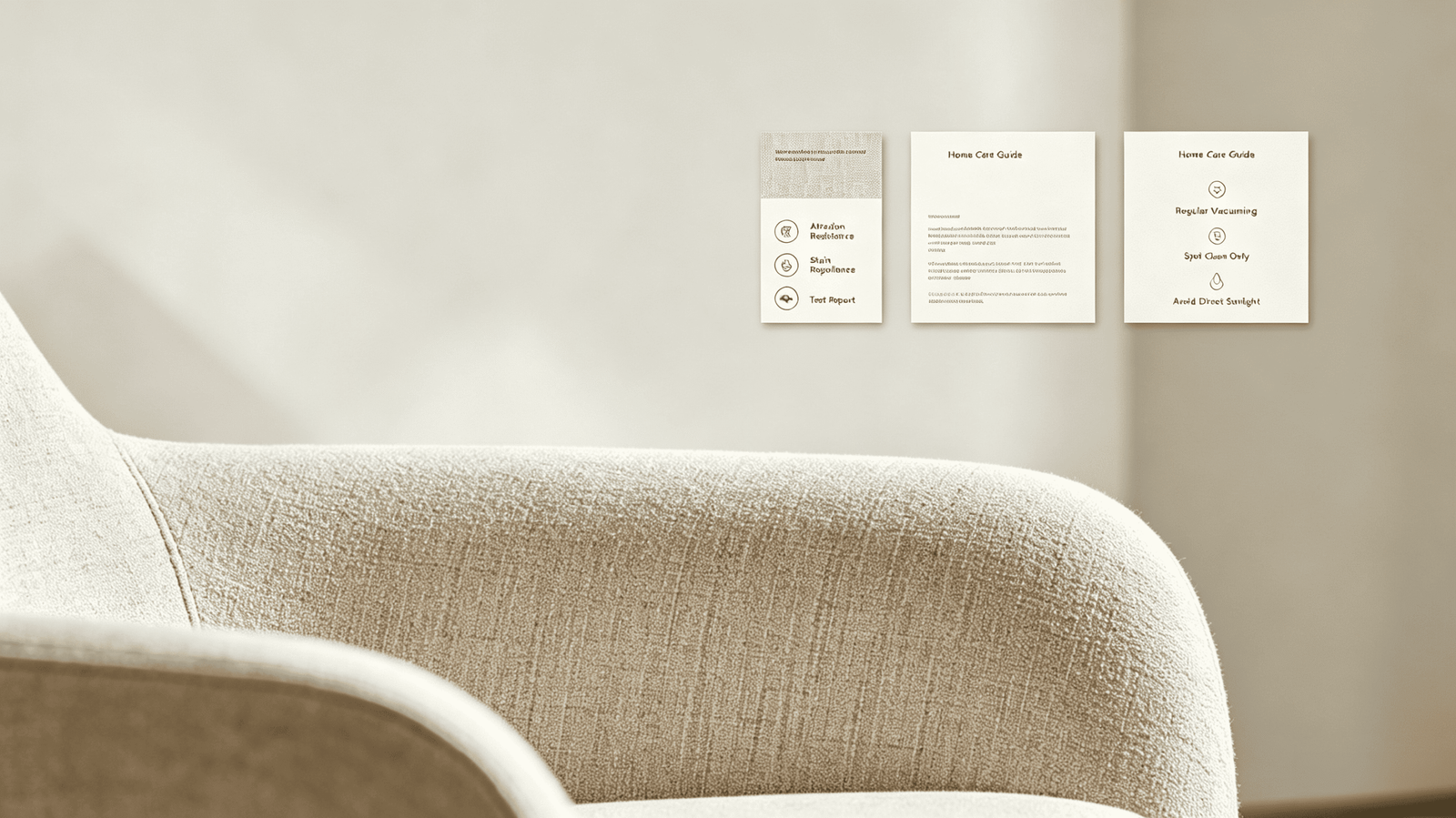
- Confirm care requirements in writing at the client handover stage — a brief care card included with the piece is a professional touch that also limits post-delivery liability.
With 200+ linen color options available in our made-to-order workflow, the selection decision is rarely constrained by range. The risk is the opposite: too many options, insufficient filtering criteria. A clear household condition brief narrows the palette to a workable shortlist before the client is ever involved in the selection conversation.
Custom specification and overseas sourcing: when does it make sense?
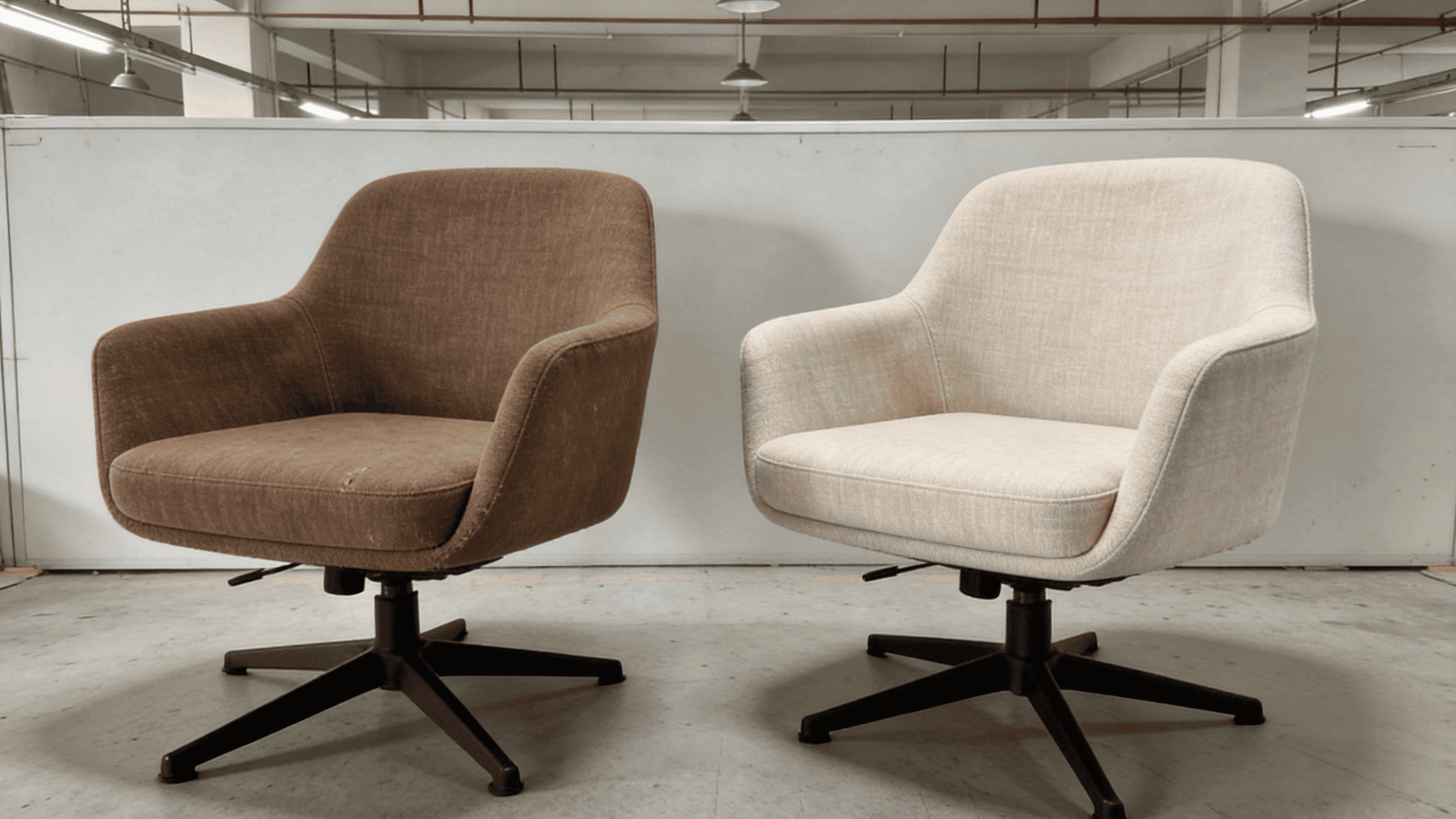
Custom specification is often positioned as a luxury — something designers add when clients have a large budget and a strong preference. In practice, for high-end residential projects, made-to-order is more accurately a risk-reduction tool.
A standard production piece that is 5 cm too wide, or available in three colors that are all slightly wrong for the room, creates a compromise. Compromises in high-end residential work are visible — to the client, to other designers who visit, and in the project photography.
What are the real specification advantages of overseas factory sourcing?
The primary advantages are not cost alone — though the landed cost for comparable specification is meaningfully lower than sourcing domestically in the US or European market11. The real advantages for a working designer are:
Specification flexibility:
- Seat width, arm height, leg finish, fabric color — these variables are fixed in standard production pieces. In a made-to-order workflow, they are specification inputs. That difference matters when you are trying to make a piece work precisely in a specific room.
COM fabric accommodation:
- Designers who work with client-supplied or architect-specified fabric (COM — Customer's Own Material) need a production partner who can apply that fabric correctly, not a supplier who only works with their own fabric library. Confirm COM acceptance, minimum yardage requirements, and application method before committing to a production partner.
Lead time reality:
- This is the variable most often underestimated. A made-to-order piece from an overseas factory typically requires 45–75 days production plus shipping time12. That timeline must be locked into the project schedule before the order is placed — not discovered when the project is in its final installation phase.
Minimum order quantity:
- For single-piece residential specifications, MOQ is a real constraint with some factories. Confirm whether single-unit orders are accepted, and at what cost differential relative to volume orders.
In our experience working with US and European designers, the projects where overseas sourcing delivers the clearest value are those where the designer has a confirmed brief, a fixed schedule with adequate lead time built in, and a clear fabric specification. Projects where those conditions are not met — where the brief is still evolving when the order needs to be placed — are better served by domestic sourcing, even at higher cost.
Frequently Asked Questions
What is the most important thing to check when buying a swivel chair for a high-end residential project?
Start with the base and swivel mechanism, not the fabric or silhouette. Confirm the bearing type, load rating, and floor compatibility before any other specification decision. A visually excellent chair with a rough or noisy swivel mechanism will generate client complaints — and that risk is fully preventable at the specification stage.
Is linen a practical fabric choice for a swivel chair in a family home?
It depends entirely on household conditions. Linen is an excellent choice for low-to-medium traffic rooms in dry environments where clients understand natural fabric care. It is not the right specification for households with pets, young children, or high humidity. Define the use conditions before presenting linen as an option.
How do I evaluate swivel chair frame quality without a manufacturer visit?
Request information on the specific timber species (not just "solid wood"), corner-blocking method, and seat spring construction. Ask for a physical sample and apply lateral body-weight pressure to the arm-seat rail joint — flex at that connection point is an indicator of joinery quality. A supplier who cannot answer these questions specifically is not building to a specification standard.
What lead time should I allow for a made-to-order swivel chair from an overseas factory?
Plan for 45–75 days production time plus international shipping. For US-based projects, add customs clearance time. The total window from confirmed order to delivery site is typically 70–100 days. That timeline needs to be in the project schedule before the order is placed — not used as a planning assumption after the fact.
What does COM mean, and should I use it for a custom swivel chair project?
COM stands for Customer's Own Material — fabric you supply to the manufacturer rather than selecting from their library. It gives you full control over fabric specification but requires confirming minimum yardage, fabric weight compatibility with the chair's construction, and the supplier's application method. It is a strong option for tightly specified high-end projects where an exact fabric match is required.
Conclusion
A swivel chair buying guide that starts with style is building the specification backwards. The decisions that determine whether a decorative swivel chair performs well over five or ten years in a high-end residential project are construction decisions: base material and mechanism quality, frame joinery and cushion grade, and fabric-to-environment compatibility. Visual selection is the final step, not the first.
For designers specifying swivel chairs for demanding residential clients, the framework is straightforward: confirm the structure, define the household conditions, then select the fabric and finish within those constraints. Made-to-order options — including COM fabric and custom dimensions — exist to remove the compromises that standard production pieces require, but only when lead time and MOQ are confirmed against the project schedule before the order is placed.
If you are working on a high-end residential project and want to discuss swivel chair specification in detail — base options, Belgium pure linen fabric selection, or COM workflow — contact our team at Linen World https://linenworld.pro. We work directly with designers from brief to delivery.
"Plain bearing - Wikipedia", https://en.wikipedia.org/wiki/Plain_bearing. Rolling-element bearings are generally characterized by lower friction coefficients than plain bearings, which contributes to quieter and smoother rotation under comparable load conditions; see, e.g., the engineering literature on bearing selection criteria. Evidence role: mechanism; source type: encyclopedia. Supports: That rolling-element (ball) bearings produce less friction and noise than plain (bushing) bearings under equivalent load conditions. Scope note: General bearing engineering principles apply broadly; residential furniture-specific load testing data is rarely published in peer-reviewed sources. ↩
"Furniture glides by Scratchnomore vs. felt glides and rubber glides",
. Flooring industry associations and hardwood floor manufacturers consistently recommend soft-material furniture glides — including felt and non-marking rubber — as a standard protective measure against scratching and surface abrasion on finished hardwood and natural stone floors. Evidence role: expert_consensus; source type: institution. Supports: That soft glide materials such as felt and rubber are recommended by flooring industry bodies to prevent surface damage on hardwood and stone floors from furniture contact. Scope note: Specific glide material recommendations vary by floor finish type and furniture weight; no single universal standard governs glide specification across all residential flooring categories. ↩"[PDF] The Shrinking and Swelling of Wood and Its Effect on Furniture", https://www.extension.purdue.edu/extmedia/fnr/fnr-163.pdf. Research on wood drying and wood mechanics supports that kiln-drying reduces equilibrium moisture content and associated warping risk, and that solid hardwood species typically demonstrate higher nail and screw withdrawal resistance than medium-density fiberboard. Evidence role: mechanism; source type: research. Supports: That kiln-drying reduces moisture content and dimensional instability in hardwood, and that solid hardwood generally exhibits superior fastener-holding capacity compared to MDF. Scope note: Published comparisons focus on structural and construction lumber; furniture-specific upholstery staple retention data is less systematically documented. ↩
"Foam Density Range: Understanding and Applying Values", https://www.foambymail.com/blog/foam-density-range-understanding-and-applying-values/?srsltid=AfmBOooziM9gSXHB1Z3wAiIeWHLKEvLDXWxXOVC7NjgjSxQqRP3akR-Y. Industry guidance from furniture testing bodies and foam manufacturers commonly references density ratings in the range of 32–40 kg/m³ as indicative of residential-grade durability for polyurethane foam cushioning. Evidence role: expert_consensus; source type: institution. Supports: That foam density thresholds around 35 kg/m³ are associated with adequate durability for residential upholstered seating. Scope note: Specific threshold values vary by standard and region; no single universally binding residential furniture foam density specification exists across all markets. ↩
"Analysis of strength, durability, stability, and fatigue parameters of ...", https://bioresources.cnr.ncsu.edu/resources/analysis-of-strength-durability-stability-and-fatigue-parameters-of-furniture-doors-and-drawers-using-engineering-design-method/. Trade literature and furniture construction references consistently describe eight-way hand-tied spring systems as a higher-labor, longer-lasting construction method relative to sinuous spring alternatives, though controlled comparative durability studies are limited in the published literature. Evidence role: general_support; source type: other. Supports: That eight-way hand-tied coil spring construction is associated with greater longevity and more even weight distribution compared to sinuous (no-sag) spring systems in upholstered seating. Scope note: The claim is widely accepted in the furniture trade but is not extensively supported by independent peer-reviewed mechanical testing. ↩
"Ergonomics of sitting - Cornell University Ergonomics Web", https://ergo.human.cornell.edu/DEA3250Flipbook/DEA3250notes/sitting.html. Ergonomic and anthropometric research on seating dimensions indicates that seat depths for lounge and accent chairs typically fall in the range of 45–60 cm to accommodate a majority of adult users, with the specific range varying by intended use posture and user population. Evidence role: definition; source type: research. Supports: That seat depths in the approximate range of 48–56 cm are consistent with ergonomic and anthropometric recommendations for residential lounge and accent seating. Scope note: The 48–56 cm figure cited in the article is a practical industry range; published ergonomic standards for residential decorative seating are less prescriptive than those for office or task seating. ↩
"Strength and stiffness analyses of standard and double mortise and ...", https://bioresources.cnr.ncsu.edu/resources/strength-and-stiffness-analyses-of-standard-and-double-mortise-and-tenon-joints/. Wood engineering and furniture construction research documents that mortise-and-tenon joints exhibit high resistance to racking and withdrawal forces, making them a structurally preferred method for load-bearing frame connections in upholstered furniture. Evidence role: mechanism; source type: research. Supports: That mortise-and-tenon and dowel joints provide superior structural strength and longevity at furniture frame connection points compared to staple or bracket-only assembly methods. Scope note: Joint performance is also dependent on adhesive type, wood species, and manufacturing precision; joint type alone does not fully determine long-term structural outcome. ↩
"Where to source 100% flax linen fabric from France or Belgium?", https://www.facebook.com/groups/374949366027023/posts/2506137219574883/. Industry certification bodies such as the European Flax and Linen confederation document that Western European flax cultivation conditions contribute to fiber fineness and tensile properties that distinguish certified European linen from other origins. Evidence role: definition; source type: institution. Supports: That linen produced from Western European flax, including Belgian-origin flax, is associated with specific fiber quality characteristics including fineness and luster. Scope note: The specific claim about photographic presentation quality is subjective and not directly addressed in fiber certification standards. ↩
"Investigation of the Properties of Linen Fibers and Dressings - PMC", https://pmc.ncbi.nlm.nih.gov/articles/PMC9501175/. Textile science literature characterizes linen (woven flax fiber) as having relatively low elasticity and susceptibility to weakening under sustained moisture and mechanical abrasion, properties that inform its suitability assessments for upholstery applications. Evidence role: mechanism; source type: research. Supports: That linen (flax) fiber exhibits reduced resistance to prolonged moisture exposure and mechanical abrasion compared to synthetic upholstery textiles. Scope note: Performance varies significantly by weave density, finishing treatment, and blend composition; blanket characterizations of linen durability may not apply uniformly to all linen upholstery grades. ↩
"Any tips for maintaining semi aniline leather seats? - Facebook", https://www.facebook.com/groups/lexusoc/posts/10159628084587334/. Leather science literature indicates that natural leather requires periodic conditioning to replenish oils lost through use and environmental exposure; without maintenance, leather undergoes desiccation and surface cracking at rates that are accelerated by low humidity and UV exposure. Evidence role: mechanism; source type: research. Supports: That untreated or poorly maintained leather upholstery undergoes accelerated surface degradation, including drying, cracking, and color loss, compared to regularly conditioned leather. Scope note: Deterioration rates vary significantly by leather grade, tanning method, and environmental conditions; the characterization of deterioration as 'quick' is relative and context-dependent. ↩
"The Effect of Furniture Imports from China on Employment in U.S. ...", https://www.usitc.gov/publications/332/working_papers/ecwp_2017-08-a-08-23-17_0.htm. US Census Bureau and UN Comtrade trade statistics document that the United States and European Union import the substantial majority of their upholstered furniture by volume from lower-cost manufacturing regions, reflecting persistent unit price differentials relative to domestic production. Evidence role: statistic; source type: government. Supports: That imported furniture, particularly from major Asian manufacturing regions, is priced significantly below comparable domestically produced furniture in the US and European markets. Scope note: Landed cost comparisons must account for tariffs, shipping, customs duties, and quality-tier matching; aggregate import statistics do not directly confirm per-unit cost differentials for high-specification residential pieces. ↩
"Product & Material Lead Times - Kimball International", https://www.kimballinternational.com/lead-times. Trade and logistics sources for the furniture import sector generally indicate that custom upholstered furniture production in major manufacturing regions requires approximately six to twelve weeks from order confirmation to factory readiness, with additional transit time dependent on shipping method and destination. Evidence role: general_support; source type: other. Supports: That custom upholstered furniture manufactured in overseas facilities commonly requires production lead times in the range of six to ten weeks before shipping. Scope note: Lead times vary substantially by factory capacity, order complexity, and supply chain conditions; the 45–75 day figure represents a general estimate rather than a documented industry-wide standard. ↩


