
Skirted sofas keep appearing on designer mood boards — and just as quickly getting pulled. The hesitation is almost always the same: will it feel too formal, too traditional, too heavy for the space? That uncertainty costs designers a genuinely useful piece of furniture, and it comes from asking the wrong question about skirted sofas from the start.
The short answer: skirted sofas work in modern and transitional spaces when you sequence the decision correctly — spatial register first, skirt construction second, fabric weight and tone third. The perception that skirted profiles feel dated or heavy comes almost entirely from mismatched fabric choices, not from the skirt itself.1 Match a tailored flat skirt or a soft knife pleat to a lightweight linen in a neutral tone, and the silhouette reads architectural, not Victorian.
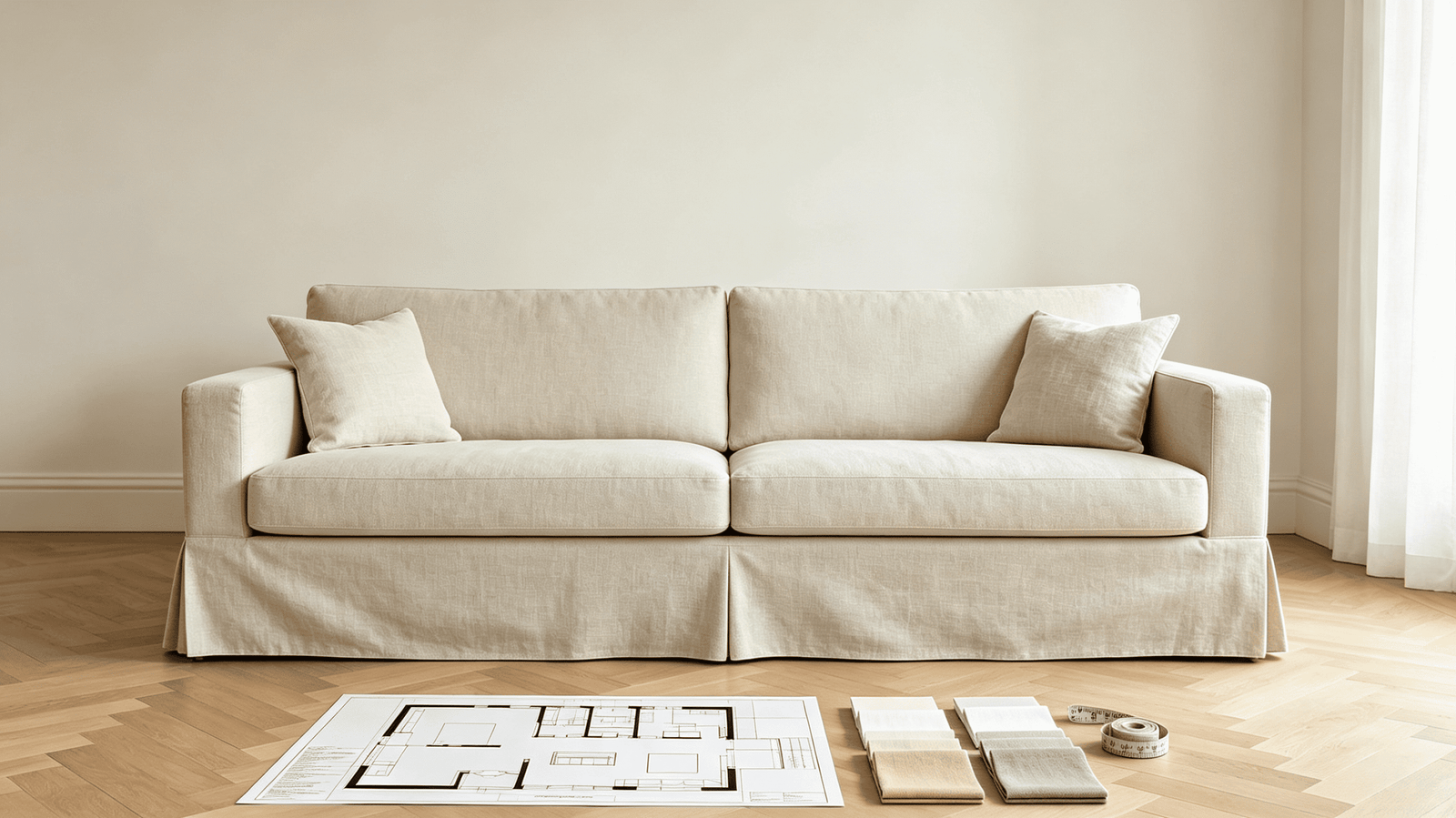
Most of the confusion around skirted sofas comes from leading with style labels — asking "is it traditional?" instead of "what should this piece do in the room?" The sections below break down the actual decision sequence: construction type, fabric weight, and the two modern spatial contexts where a skirted sofa outperforms a leg-out alternative.
What Does Skirt Construction Type Actually Do to a Room?
When designers send us a mood board, the most common instinct is to describe the sofa they want by aesthetic category — coastal, minimal, transitional. The problem is that a skirted sofa can fit almost any of those categories depending on one variable: the construction of the skirt itself.
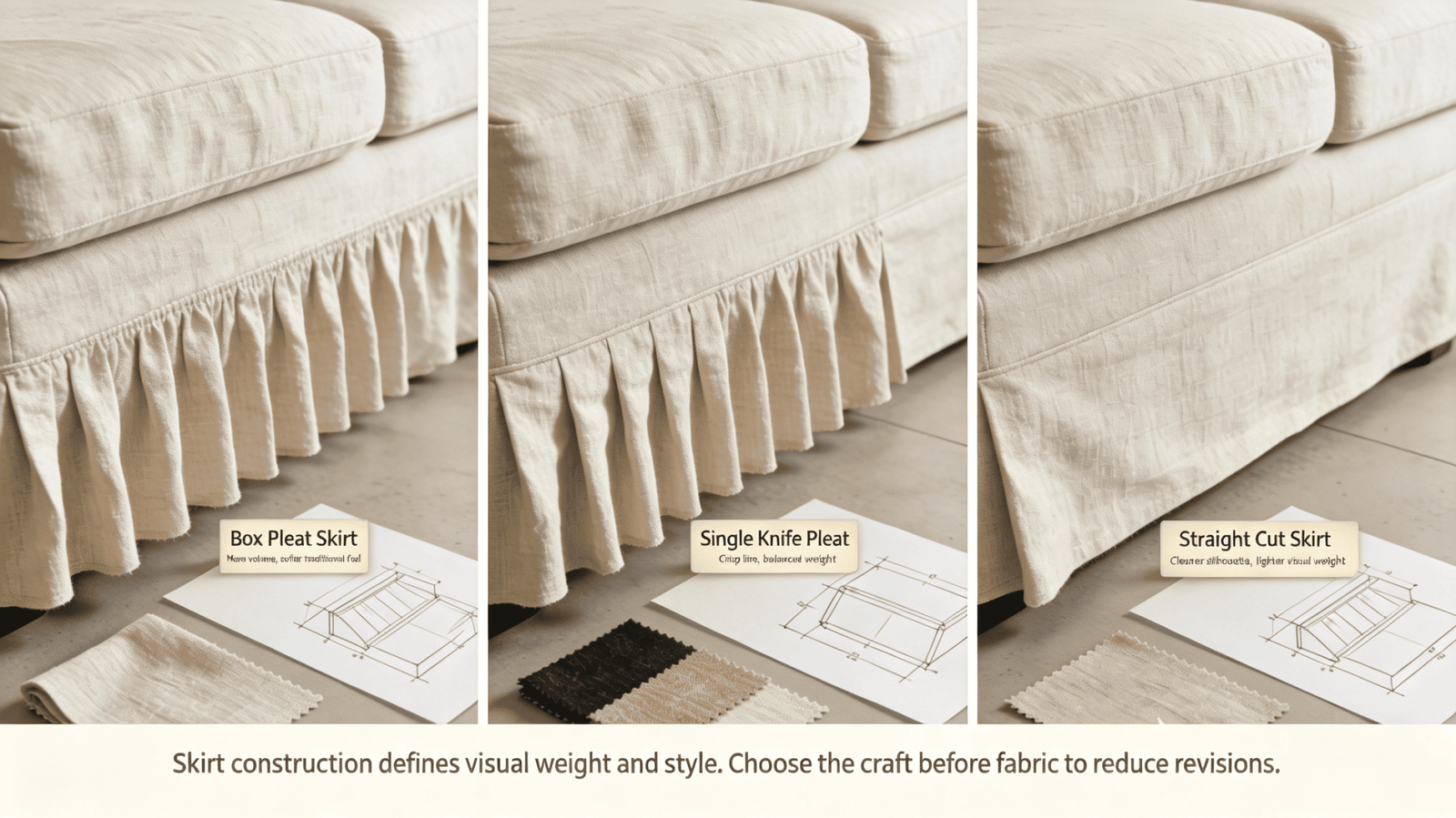
Skirt construction determines the visual weight and formal register of the piece far more directly than any style label. Box pleat reads structured and considered. Knife pleat reads softer and more fluid. A tailored straight skirt reads minimal and close to contemporary.2 Getting this decision right before choosing fabric saves significant back-and-forth on a project brief.
Box Pleat: Structured Visual Weight
A box pleat skirt has flat panels of fabric with folded pleats at regular intervals. The folds face outward and create a crisp, geometric rhythm along the base of the sofa.
- Visual effect: Clean, symmetrical, slightly formal without being ornate
- Best spatial register: Traditional-leaning transitional spaces, rooms with other geometric pattern elements
- Fabric pairing: Medium-weight linen in warm naturals — the structure of the pleat holds better with some body in the cloth
- What it does in a room: Grounds the piece with visual weight and creates a deliberate, composed quality at floor level
Box pleat is often the construction most associated with "traditional" skirted sofas — but that reading comes partly from seeing it executed in heavy damask or patterned velvet. In a plain mid-weight linen, a box pleat sofa reads less like a period piece and more like considered furniture.
Knife Pleat: Soft, Fluid Movement
Knife pleats are tight, directional folds that all face the same way. The result is a skirt that has more visual movement and a softer overall impression than a box pleat.
- Visual effect: Lighter, slightly draped, less rigid
- Best spatial register: Rooms with soft material layers — linen drapery, relaxed upholstery, organic textures
- Fabric pairing: Lighter-weight linen where the fabric can actually move; undyed or very pale tones amplify the airy quality
- What it does in a room: Reduces the visual formality of the skirted profile while keeping the floor-level coverage
If a designer is working in a California casual or coastal space and wants a skirted sofa that doesn't anchor the room too heavily, knife pleat in a light linen is often the right specification.
Tailored / Straight Skirt: Minimal Horizontal Line
A tailored skirt has no pleats. It's a flat panel that drops straight from the seat frame to the floor with seamed corners.3 It's the most contemporary of the three constructions.
- Visual effect: Crisp, architectural, horizontal
- Best spatial register: Japandi, modern minimal, low-profile room compositions
- Fabric pairing: Any weight of linen works; heavier weights sharpen the line, lighter weights soften it slightly
- What it does in a room: Eliminates the foot-and-leg interruption entirely and creates one unbroken horizontal band across the base of the piece
| Construction | Visual Weight | Formal Register | Best Linen Weight | Ideal Spatial Context |
|---|---|---|---|---|
| Box pleat | Medium–high | Transitional to traditional | Medium | Traditional-leaning rooms |
| Knife pleat | Light–medium | Casual to transitional | Light | Coastal, layered interiors |
| Tailored / straight | Low–medium | Contemporary to minimal | Light or medium | Japandi, modern minimal |
Does Fabric Weight Determine Whether a Skirted Sofa Feels Heavy?
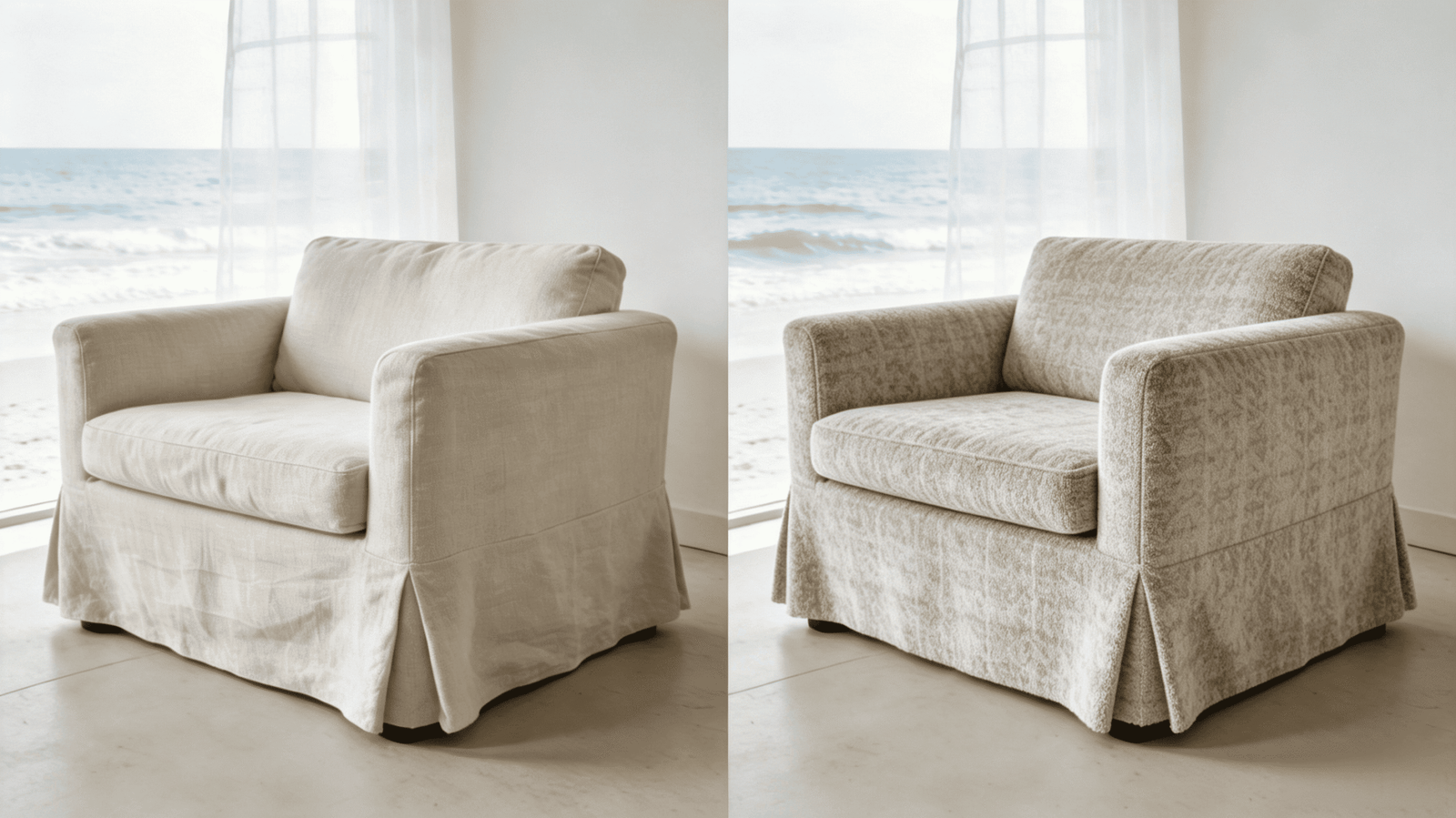
Almost every designer who hesitates over a skirted sofa is actually reacting to a fabric memory, not to the silhouette. The heavy, draped look that reads as outdated or overly formal is nearly always a product of heavy fabric — brocade, patterned velvet, thick wool blend — being used to execute a skirted profile.
When the fabric changes, the reading changes. A skirted sofa in a lightweight, undyed Belgian linen does not produce the same visual impression as the same construction in a patterned chenille. The skirt structure is identical. The room experience is completely different.
Why Linen Specifically Changes the Equation
Linen has a natural irregularity in its weave — slight variation in texture, a matte surface, and a characteristic drape that is neither stiff nor limp.4 These properties work against the "heavy and formal" reading in specific ways:
- The matte surface absorbs light rather than reflecting it, which prevents the piece from commanding attention the way a high-sheen fabric would
- The natural texture variation reads as organic and relaxed rather than precise and formal
- The drape allows even a structured pleat to settle naturally rather than standing at attention
At our factory, we work primarily with pure Belgian linen because its fiber quality produces a consistent drape across a wide range of fabric weights5. When a designer specifies a knife pleat skirt in a 180–200 gsm linen, the result has physical lightness you can see from across the room. That's a different object than a box pleat in 400 gsm wool.
Fabric Tone as a Secondary Variable
After weight, tone is the next lever. The same construction in the same fabric weight reads differently depending on color:
- Undyed / natural linen: The most airy reading — absorbs into the room rather than defining it
- Warm greiges and stone tones: Add slight definition while keeping a soft overall impression
- Deep tones (navy, charcoal, forest): Increase visual weight regardless of fabric weight — useful when you want the sofa to anchor a large room
A designer working with a low-profile knife pleat sofa in a bright, open California space will almost always get a better result with undyed or warm-natural linen than with a dark tone, even if both are the same fabric weight.
Which Modern Spatial Contexts Suit a Skirted Sofa Best?
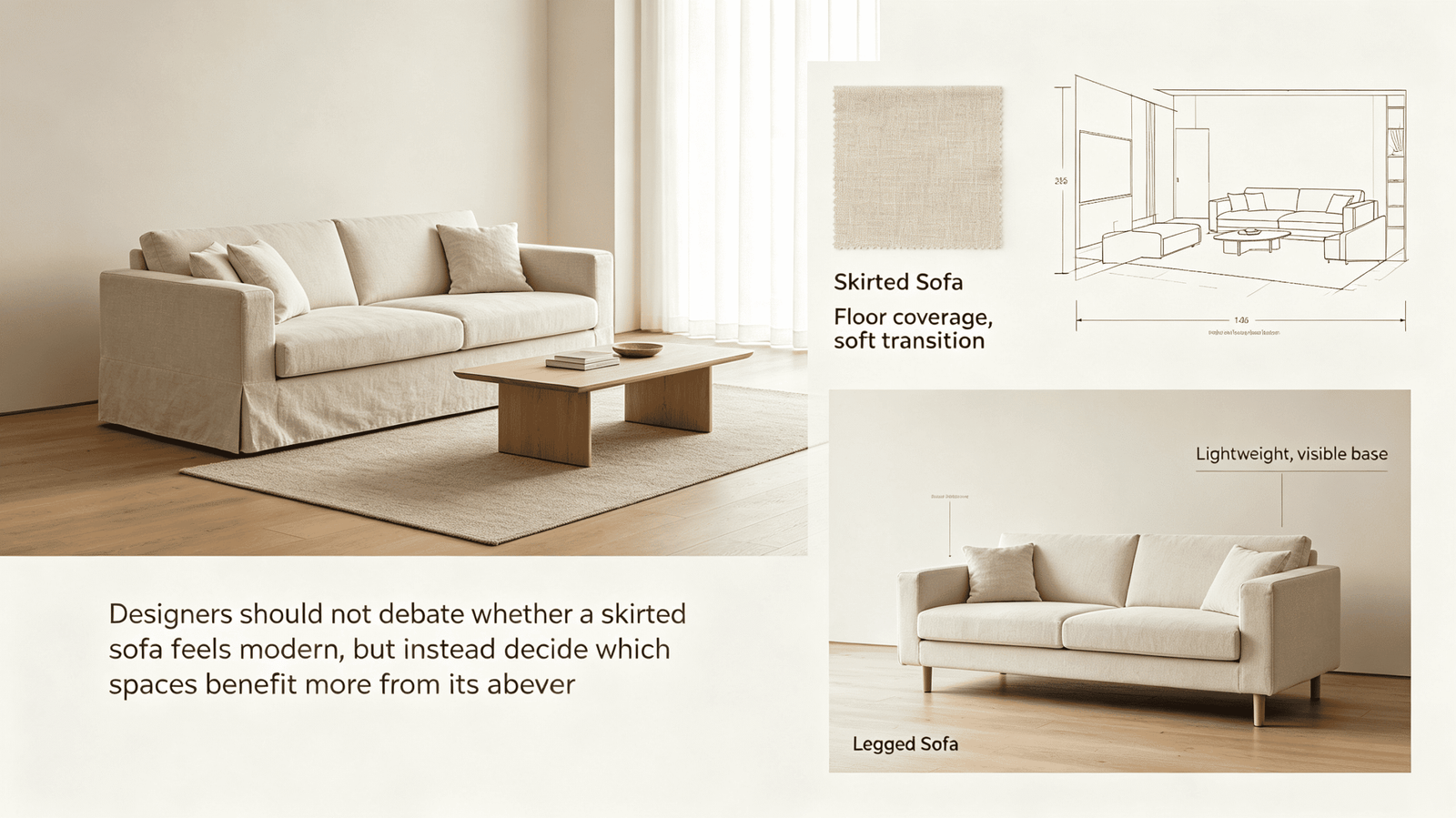
The question designers should actually be asking is not "is a skirted sofa modern?" but "in which room types does the skirted profile solve a problem that a leg-out sofa doesn't?" There are two contexts where we see this consistently in the project briefs that come to us.
Context 1: Coastal and California Casual
In a coastal or California casual interior, the design goal at floor level is usually to reduce visual noise — to keep the room feeling open and uncluttered even when it contains substantial furniture. Exposed sofa legs, especially multiple sets of legs in the same sightline, create interruptions in the horizontal plane that work against this.6
A low-profile skirted sofa in a light linen solves this by presenting a single clean horizontal band instead of four or six leg-and-foot shapes.7 The room reads as more spacious, not less, because there are fewer competing elements at floor level.
Recommended specification for this context:
- Skirt construction: Knife pleat or tailored
- Seat height: Low — 15 to 16 inches to the seat
- Fabric weight: Light, 160–200 gsm linen
- Fabric tone: Undyed natural, warm sand, or pale stone
- Pair with: Natural fiber rugs, linen or cotton drapery, unfinished wood side tables — materials that share the same informal, organic register
Context 2: Japandi and Modern Minimal
In a Japandi space, the organizing principle is usually the clarity of horizontal lines and the absence of visual interruption.8 Exposed sofa legs introduce a design element that requires its own resolution — the leg finish, the leg profile, the relationship between the leg and the floor. A tailored skirted sofa eliminates that entire decision and keeps the piece as a single horizontal form.
This is not a compromise. In a low-profile frame, a tailored flat skirt creates exactly the kind of resolved, low-visual-complexity form that Japandi compositions depend on.
Recommended specification for this context:
- Skirt construction: Tailored / straight, with clean corner seams
- Seat height: Low — 14 to 16 inches
- Fabric weight: Medium, 220–280 gsm linen for sharper line definition
- Fabric tone: Warm white, light grey, or pale taupe
- Pair with: Lacquered or natural wood furniture with simple profiles, minimal window treatments, matte ceramic or stone objects — nothing that competes with the sofa's horizontal line
What Is the Correct Decision Sequence for Specifying a Skirted Sofa?
Designers who approach a skirted sofa by asking "what style is it?" get stuck in historical categories that don't help them make a useful spec decision. The sequence that actually works in practice is this:
Define the spatial register and desired visual weight. What is this room doing? How much visual weight do you want the sofa to carry? Is the floor level currently cluttered or open?
Choose skirt construction type based on that register. Structured and considered → box pleat. Soft and layered → knife pleat. Minimal and architectural → tailored flat skirt.
Choose fabric weight and tone to calibrate the result. Light fabric lightens any construction. Dark tone adds weight regardless of construction. Match both to the visual goal from step one.
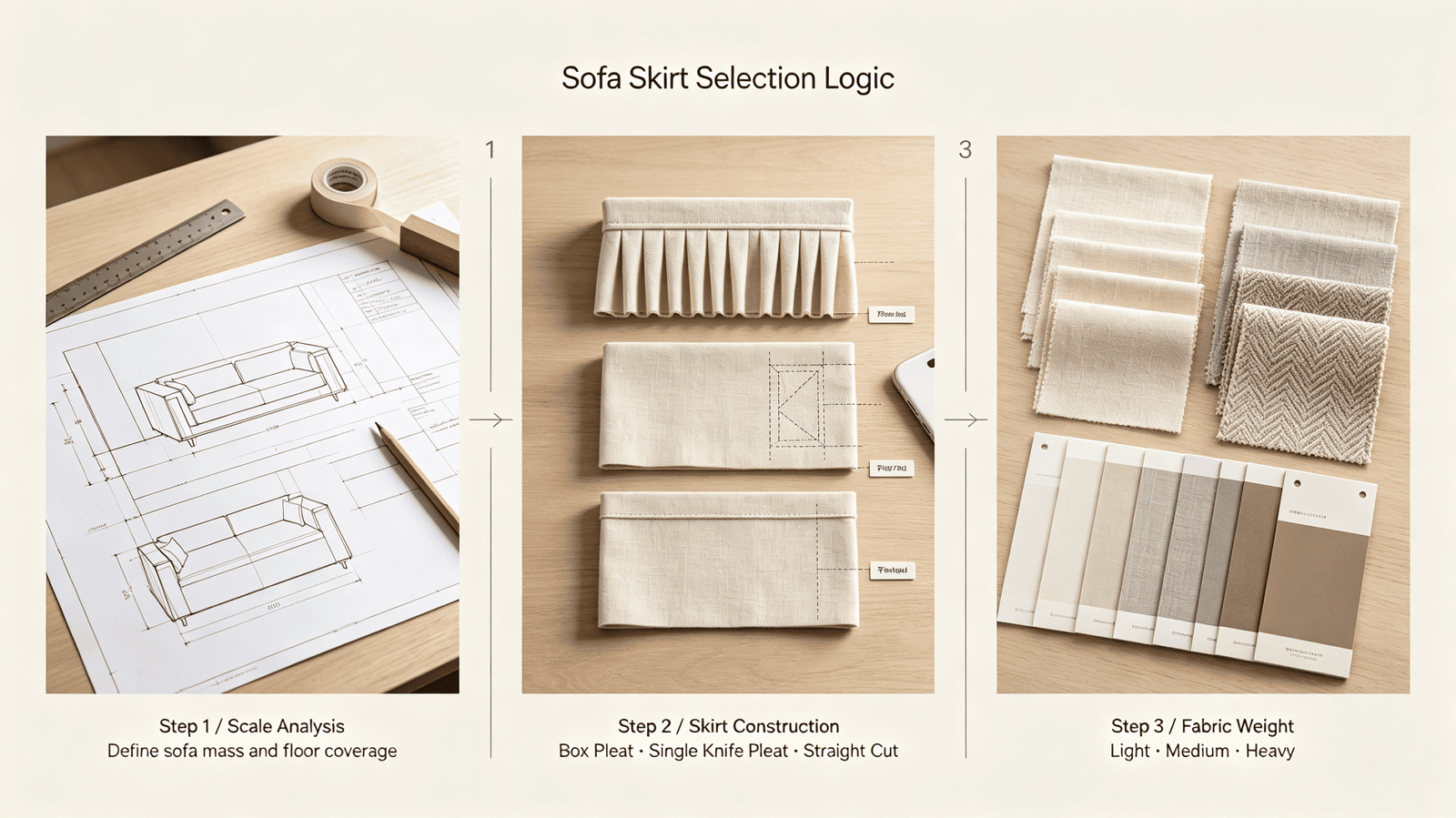
Leading with this sequence rather than with aesthetic labels means a designer can evaluate a skirted sofa against any project brief — not just the ones that already feel traditional or country-house. The sofa's job is to do something specific in a room. The construction and fabric choices are the tools for making it do that job correctly.
At Linen World, we work through this sequence with designers directly when they share a project brief or mood board. We've seen it resolve the "too formal?" hesitation almost every time — because once the decision is framed around construction and fabric weight rather than style category, the answer becomes specific rather than instinctive.
Frequently Asked Questions
Can a skirted sofa work in a minimalist interior?
Yes — specifically when the construction is a tailored flat skirt on a low-profile frame. The flat skirt eliminates the foot-leg interruption and presents the sofa as a single horizontal form, which is consistent with minimalist compositional logic. Fabric weight and tone determine whether the piece feels resolved or heavy.
What fabric weight is best for a skirted sofa in a bright, open room?
For a light-filled or open room, a linen in the 160–220 gsm range tends to produce the best result. Lighter fabric weights allow the skirt to settle naturally without adding visual bulk. Undyed or pale neutral tones reinforce the airy reading further.
Is box pleat always more formal than knife pleat?
In most fabric contexts, yes — box pleat reads more structured and considered. However, fabric choice modifies this significantly. A box pleat in a lightweight natural linen reads considerably less formal than a knife pleat in a heavy patterned fabric. Construction and fabric weight work together, not independently.
How do I specify a skirted sofa for a California casual project without it looking out of place?
The key variables are seat height and fabric tone. Keep the seat low (15–16 inches), choose a knife pleat or tailored skirt construction, and specify an undyed or warm-sand linen. Pair with other natural fiber materials in the room so the sofa sits within the same material register rather than contrasting against it.
Does a skirted sofa make a small room feel smaller?
It can, if the skirt is in a heavy fabric or a dark tone that draws the eye downward. In a lightweight linen in a pale tone, a skirted sofa can actually reduce visual noise at floor level — particularly compared to multiple sets of exposed legs — and make the room read as simpler and more open.
Conclusion
Skirted sofas are a misread category, not an outdated one. The decision to use one in a modern or transitional space comes down to three sequential choices: spatial register and visual weight, skirt construction type, and fabric weight and tone. Box pleat, knife pleat, and tailored flat skirt each do specific things in a room — and lightweight linen, more than any other fabric, keeps the skirted sofa profile from reading as heavy or formal. In coastal and California casual interiors, a knife pleat linen sofa reduces visual noise at floor level. In Japandi and modern minimal rooms, a tailored flat skirt on a low frame delivers exactly the clean horizontal line those compositions require.
If you're specifying a skirted sofa for a current project and want to work through construction type and fabric options against your brief, contact Linen World directly. We work with US and European designers on made-to-order pieces across 200+ linen colors, with custom skirt constructions available — at 40–60% below comparable domestic custom pricing.
"Perceptual imagery of soft sofa fabrics based on visual-tactile ...", https://bioresources.cnr.ncsu.edu/resources/perceptual-imagery-of-soft-sofa-fabrics-based-on-visual-tactile-evaluation/. Research in environmental psychology and interior design has documented that material surface properties — including texture, sheen, and weight — substantially affect the perceived formality of furnishings, independent of silhouette or structural form. Evidence role: mechanism; source type: research. Supports: That fabric weight and texture significantly influence the perceived formality and visual weight of upholstered furniture.. Scope note: Direct experimental studies isolating skirt construction from fabric type in sofa perception are not widely published; support is drawn from broader textile and environmental psychology literature. ↩
"Textiles Scholarships - Wilson College of Textiles - NC State University", https://textiles.ncsu.edu/scholarships/. Textile and fashion history literature documents that box pleats — characterized by outward-facing symmetrical folds — have been conventionally employed in structured, formal applications including military and tailored garments, while knife pleats, with their directional fold, appear more frequently in draped and informal contexts, establishing associations that carry into upholstery practice. Evidence role: historical_context; source type: research. Supports: That box pleats and knife pleats carry distinct historical and aesthetic associations in textile and garment construction, with box pleats conventionally associated with structured formality and knife pleats with softer, more fluid applications.. Scope note: The transfer of pleat formality associations from garment construction to upholstery is documented in trade and practitioner literature more than in peer-reviewed design research. ↩
"Upholstery - Wikipedia", https://en.wikipedia.org/wiki/Upholstery. Upholstery trade and craft literature defines a tailored skirt as a flat, unpleated panel construction in which fabric drops vertically from the seat frame to the floor, with corners finished by mitering or seaming — distinguishing it from pleated skirt variants by the absence of any folded fabric element. Evidence role: definition; source type: other. Supports: That a tailored or straight skirt in upholstery refers to a flat, unpleated panel construction attached at the seat rail and finishing at the floor with mitered or seamed corners.. Scope note: Terminology varies across upholstery traditions and regional trade practices; no single universal standard governs skirt construction nomenclature. ↩
"Effect of Weave and Weft Type on Mechanical and Comfort ... - PMC", https://pmc.ncbi.nlm.nih.gov/articles/PMC11012718/. Textile science literature describes linen as a bast fiber with inherent surface irregularity arising from the flax plant's cellular structure, producing a characteristically matte finish and moderate drape stiffness that differentiates it from cotton and synthetic upholstery fabrics. Evidence role: definition; source type: research. Supports: That linen (flax-derived) fabric exhibits characteristic low sheen, natural weave irregularity, and a drape profile distinct from synthetic or other natural fiber textiles.. Scope note: Specific drape measurements vary by weave construction and finishing treatment; general fiber properties do not fully predict performance in a given upholstery application. ↩
"Flax Fiber Has New International Standards - USDA ARS", https://www.ars.usda.gov/news-events/news/research-news/2005/flax-fiber-has-new-international-standards/. The European Flax certification program and industry bodies such as the Confédération Européenne du Lin et du Chanvre (CELC) document quality standards for Western European flax cultivation, including fiber fineness and consistency criteria associated with Belgian-origin linen. Evidence role: general_support; source type: institution. Supports: That Belgian or Western European flax linen is associated with specific fiber quality standards recognized by textile industry bodies.. Scope note: Industry certification standards describe production criteria rather than directly measuring drape consistency in finished upholstery fabric; the claim of superior drape relative to other origins is not independently verified by neutral research. ↩
"Exploring sense of spaciousness in interior settings: Screen-based ...", https://pmc.ncbi.nlm.nih.gov/articles/PMC11637840/. Environmental psychology research on visual complexity and spatial perception indicates that increased numbers of discrete visual elements within a field of view are associated with reduced perceived spaciousness, supporting the design rationale for minimizing floor-level interruptions. Evidence role: mechanism; source type: research. Supports: That increased visual complexity at floor level, such as multiple discrete furniture leg forms, reduces perceived spaciousness in interior environments.. Scope note: Published studies typically address general visual complexity rather than the specific variable of furniture leg exposure; extrapolation to sofa leg count is inferential. ↩
"What are the Gestalt Principles? — updated 2026 - IxDF", https://ixdf.org/literature/topics/gestalt-principles. Gestalt perceptual psychology, particularly the law of continuity, holds that the visual system groups elements along smooth, uninterrupted paths and perceives continuous forms as less complex than equivalent forms composed of discrete, separated elements — a principle applicable to the comparison of skirted versus legged furniture profiles. Evidence role: mechanism; source type: research. Supports: That continuous horizontal forms are perceived as visually simpler and less interruptive than equivalent forms broken into discrete elements, consistent with Gestalt principles of continuity.. Scope note: Gestalt principles were developed in general perceptual contexts; their direct application to furniture silhouette comparison in interior design settings is inferential rather than experimentally demonstrated in that specific domain. ↩
"Japandi Style: Everything You Need to Know | Architectural Digest", https://www.architecturaldigest.com/story/japandi-style-101. Japandi is documented in design literature as a hybrid aesthetic synthesizing Japanese minimalist and Scandinavian functional traditions, emphasizing low visual complexity, natural materials, and compositional restraint — principles consistent with the prioritization of uninterrupted horizontal forms. Evidence role: definition; source type: encyclopedia. Supports: That Japandi design is a recognized hybrid aesthetic combining Japanese wabi-sabi and Scandinavian hygge principles, characterized by minimalism, natural materials, and restrained visual composition.. Scope note: Japandi is a commercially popularized style category rather than a formally codified design movement; authoritative academic definitions are limited compared to practitioner and trade sources. ↩


