
Specifying a sofa with chaise is one of the most high-stakes furniture decisions in a luxury residential project. Get the orientation wrong, and the room feels blocked the moment the piece lands. Get the scale wrong, and no amount of accessorizing fixes it. This guide cuts through the surface-level advice and addresses the decisions that actually determine whether the piece works.
A sofa with chaise is not a sizing decision — it's a spatial logic decision. The chaise orientation, the room's circulation path, and the proportional relationship between sofa length and room length must be resolved before any fabric conversation happens. Designers who approach this in reverse — fabric first, footprint second — consistently end up with pieces that conflict with the room rather than anchor it.
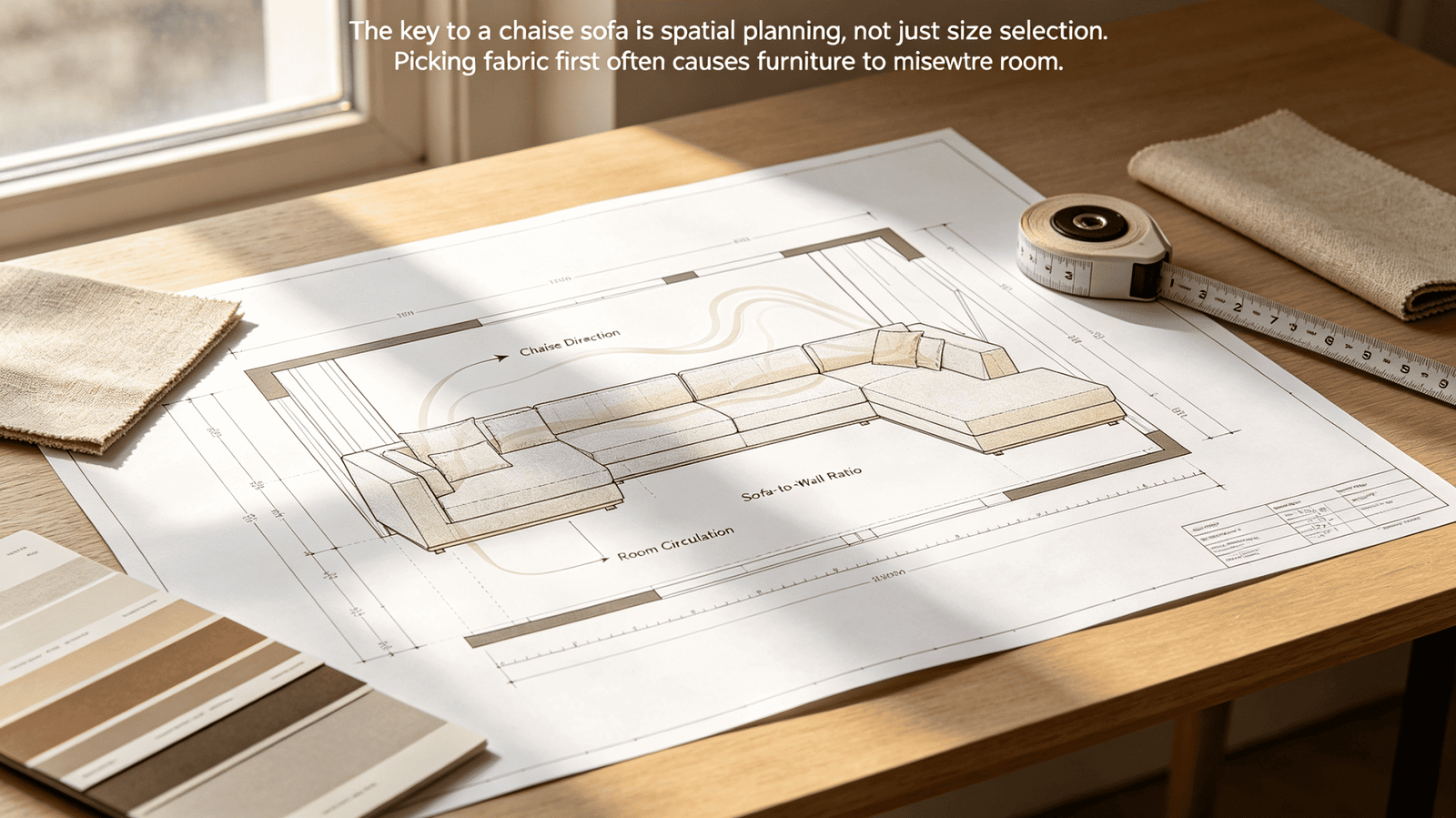
Before getting into dimensions and fabric, one definitional distinction is worth establishing — not because the reader doesn't know furniture, but because this particular conflation costs real projects real money.
Is a Sofa with Chaise the Same as a Sectional?
Most experienced designers know the difference in practice. But in client briefs and supplier conversations, the two terms get used interchangeably — and that conflation changes the entire specification conversation.
A sofa with chaise is a fixed two-piece form: a standard sofa body with an integrated terminal lounger at one end. A sectional is a modular system of connectable pieces that can be reconfigured. They may look similar in a showroom photo, but they occupy space differently, ship differently, and require fundamentally different spatial logic.
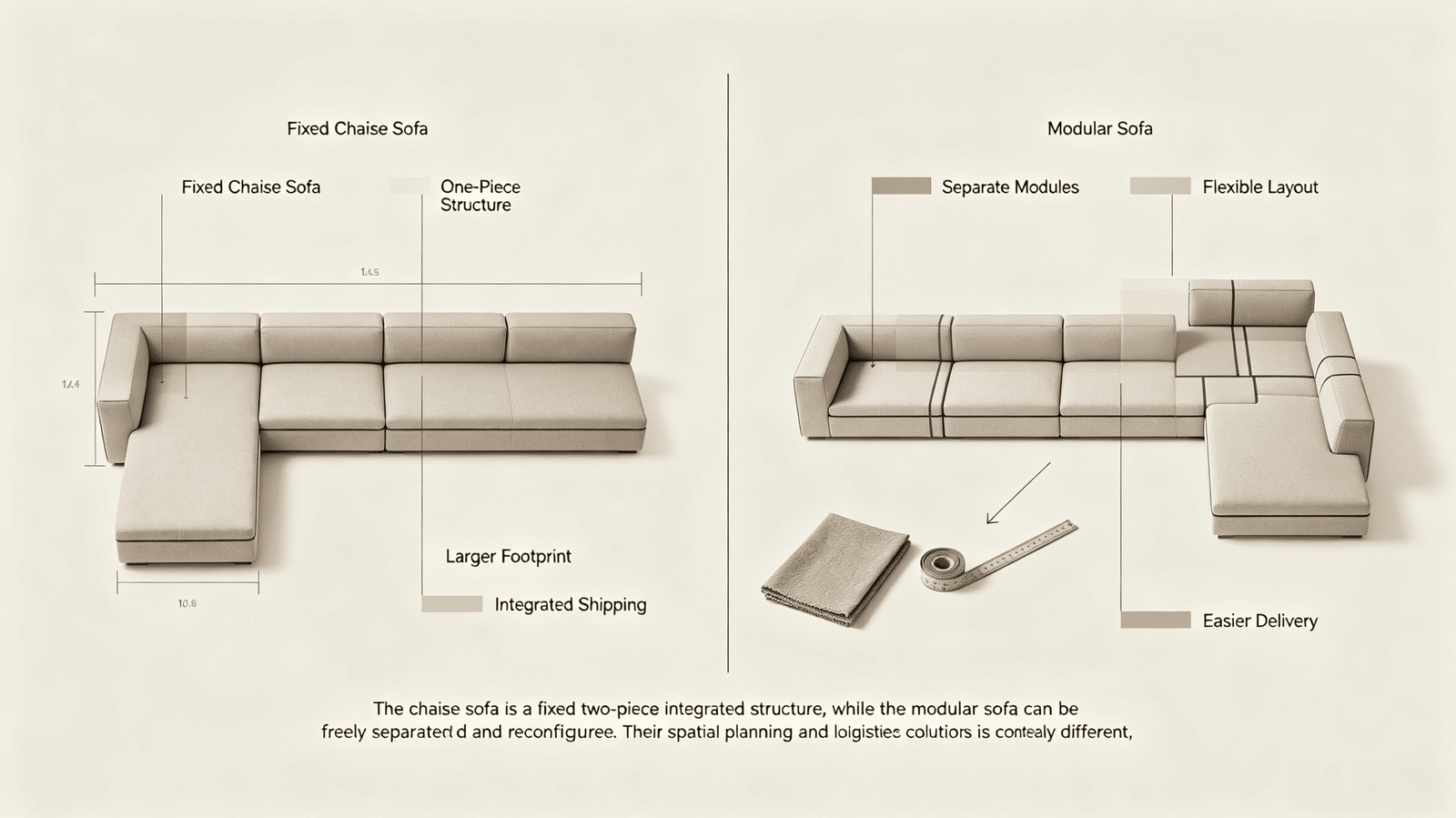
The practical consequence for specification is this: a sofa with chaise has a fixed orientation lock — once you've ordered left-hand or right-hand, that decision is permanent. A sectional can often be reorganized on-site. That distinction changes how much spatial pre-work you need to do before placing the order.
Why the Distinction Matters on the Manufacturing Side
When a brief comes to us describing a "large sectional with a lounge end," the first question we ask is: is this a two-piece fixed form, or do you need the lounger to be detachable? That question alone affects the frame joinery, the upholstery wrap at the connection point, and the seat depth continuity.
A true sofa with chaise is typically built as two structurally independent units that join cleanly at the arm — the sofa body and the chaise extension. The upholstered inner faces where they meet must be finished to a higher standard than a pure sectional connector, because in many installations, the joint is partially visible from above (think open-plan rooms with mezzanine views, or rooms with architectural lighting that rakes across the floor). We've had projects where this detail was never discussed in the brief, and the client flagged the joint finish at install. It's a specification gap, not a production failure.
Key differences to clarify with your client before placing the brief:
- Fixed vs. reconfigurable: Sofa with chaise = fixed. Sectional = modular.
- Traffic path implications: A fixed chaise creates a permanent visual terminus; a sectional can shift.
- Lead time: Custom sofa-with-chaise builds typically run 8–12 weeks from confirmed spec, depending on fabric1. Sectional builds with multiple seat units can run longer.
- Freight and entry logistics: A two-piece sofa-with-chaise is generally easier to navigate through tight entries than a multi-module sectional2. Know the room access dimensions before finalizing the total footprint.
Left-Hand vs. Right-Hand Chaise: How Do You Actually Determine Orientation?
This is the single most common — and most costly — specification error we see. Not because designers don't understand the concept, but because "left" and "right" are ambiguous without a stated reference point, and different factories, retailers, and designers use different conventions.
Left-hand chaise (LHC) and right-hand chaise (RHC) are defined from the perspective of a person sitting on the sofa and facing outward3. If the chaise extends to your left as you sit, it's a left-hand chaise. If it extends to your right, it's a right-hand chaise. This is the industry-standard convention — but always confirm it explicitly with your manufacturer, because some suppliers define it from the factory floor perspective, which is the reverse.
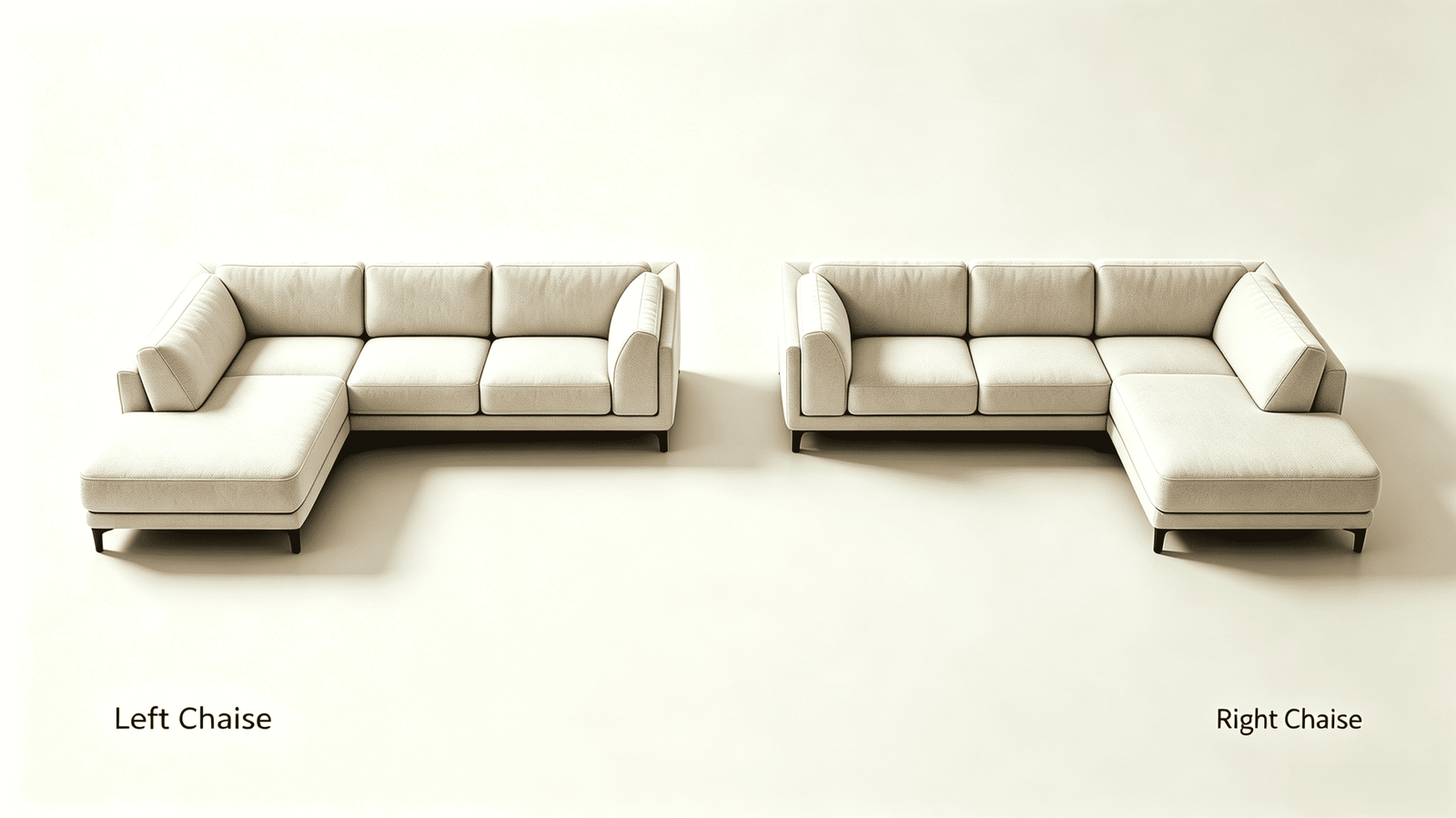
That reversal has generated real client issues. We always confirm orientation with a dimensioned sketch before cutting fabric, because a misread brief at the order stage produces a piece that's completely unusable in the intended room.
The Room Circulation Rule
Orientation is not a style preference. It's determined by the room's primary circulation path and dominant sightline. Here's a practical rule we've seen work consistently across completed projects:
Stand at the room's primary entry point. Identify the main traffic path across the room — where do people naturally walk toward? The chaise should sit opposite that path, so the lounger end faces away from circulation, not into it.
If the main path runs left to right across the room (as you enter), the chaise should extend toward the right side of the sofa body (from the seated position) — so it doesn't protrude into the movement corridor. The reverse applies for rooms where traffic runs right to left.
The Sightline Factor
Beyond traffic, consider the dominant sightline: the window, the focal wall, the TV position, or the fireplace. In most well-composed living rooms, the chaise end should face — or at minimum not block — the primary focal point. A chaise that points toward a blank side wall while the occupant has to twist to see the fireplace is a spatial failure, regardless of how well the fabric reads.
Work through both factors — circulation and sightline — before confirming orientation. In our experience, when these two factors conflict (the traffic rule suggests one orientation, the sightline suggests the other), the sightline usually wins for primary living rooms. For secondary or ancillary spaces, traffic flow takes priority.
Orientation Confirmation Checklist
Before placing the order, confirm:
- [ ] Orientation defined from seated-facing-out perspective
- [ ] Factory has confirmed their convention matches (request a sketch)
- [ ] Circulation path reviewed against the floorplan
- [ ] Dominant sightline identified and tested against orientation
- [ ] Client sign-off on a dimensioned floorplan showing the piece in position
What Size Sofa with Chaise Actually Fits the Room?
The "bigger is better" instinct is the most reliable path to a room that feels trapped rather than anchored. This is particularly acute with sofa-with-chaise configurations, where the total length — sofa body plus chaise extension — can easily reach 300–330 cm, or beyond, in standard production sizes.
The proportional rule we've found most reliable across completed projects: the sofa-with-chaise should occupy no more than 60–65% of the room's length on its primary wall axis4. Beyond that threshold, the piece stops anchoring the room and starts consuming it.
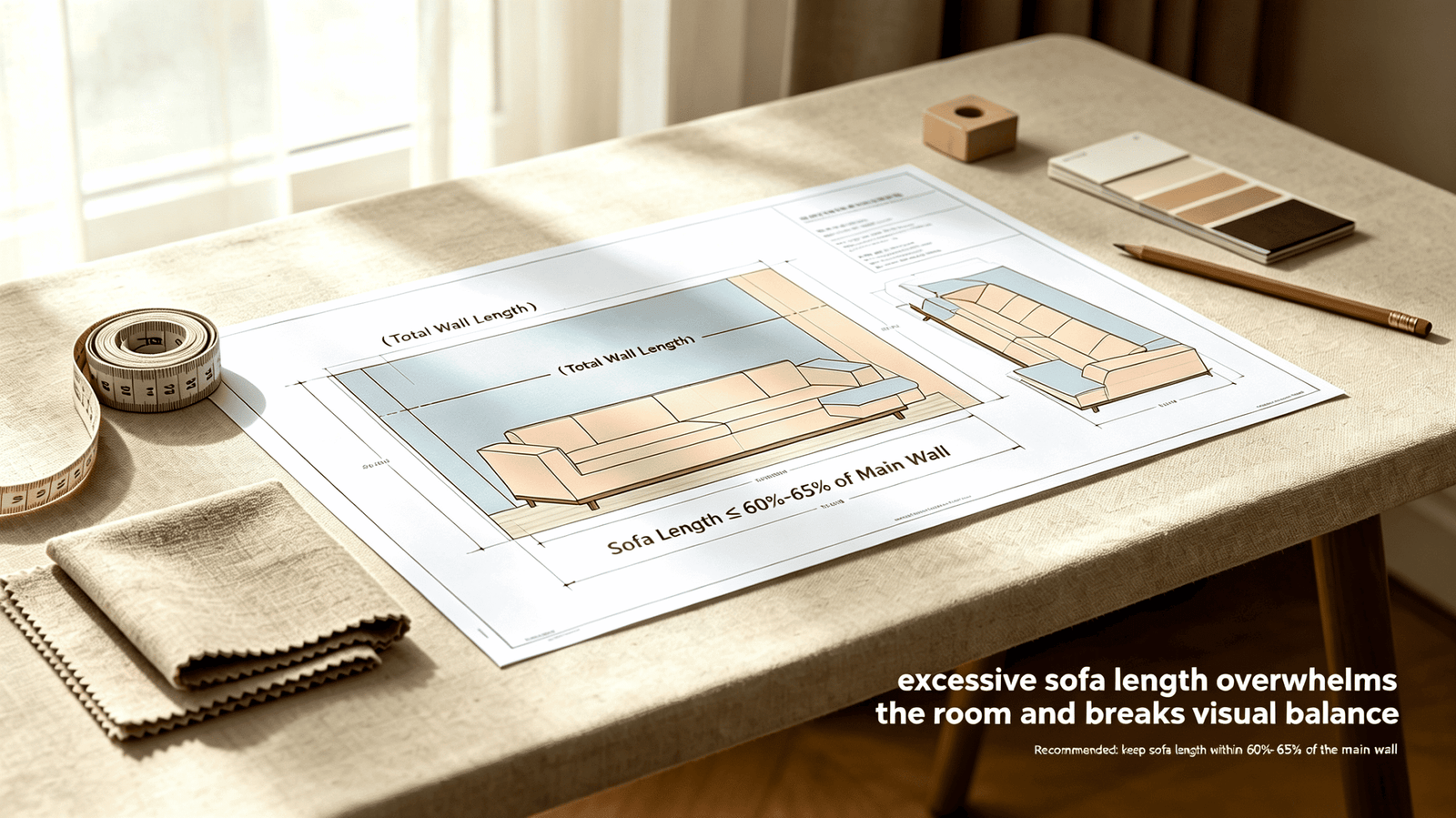
Abstract ratios are easy to state and hard to apply. Here's how that rule plays out across real room configurations we've produced for:
Completed Project Reference Data
| Room Length | Max Sofa-with-Chaise Length (at 65%) | Typical Configuration We Supplied |
|---|---|---|
| 480 cm | ~312 cm | 220 cm sofa body + 90 cm chaise = 310 cm total |
| 540 cm | ~351 cm | 240 cm sofa body + 100 cm chaise = 340 cm total |
| 600 cm | ~390 cm | 260 cm sofa body + 110 cm chaise = 370 cm total |
| 420 cm | ~273 cm | 190 cm sofa body + 85 cm chaise = 275 cm total |
These are actual completed configurations — not theoretical ideals. In every case, the brief went through a floorplan review before dimensions were confirmed.
Seat Depth and the Chaise Extension
Total length is only one axis. Seat depth is the second, and it's where a lot of custom orders go wrong.
A standard sofa seat depth runs 55–65 cm5. A chaise extension typically runs 85–110 cm in depth (the occupant's full lying length is accommodated by the chaise depth plus the sofa back). For high-end residential clients who actually use the chaise for reading or watching, 95–100 cm is the sweet spot — enough to lie with legs extended without hanging off the edge, but not so deep that the piece reads as a daybed.
For taller clients (above 185 cm), we regularly produce chaise depths of 105–110 cm6. This is worth asking about during the client consultation — it's an easy adjustment at the custom order stage, and very expensive to fix after delivery.
Clearance Requirements
Beyond the piece itself, the room needs workable clearance:
- Behind the sofa to wall: 5–10 cm minimum (for cleaning, visual breathing room)
- Front of sofa to coffee table: 40–50 cm
- Coffee table to TV wall or focal point: 120–150 cm minimum for comfortable sightlines
- Chaise end to adjacent wall or furniture: 30 cm minimum to avoid a cramped terminus
In rooms where clearance is tight, a sofa with chaise almost always performs better than a sectional — the fixed two-piece form has a cleaner perimeter, with no protruding connector rails or mismatched depth transitions.
Is Linen the Right Fabric for a Sofa with Chaise?
Belgium pure linen is the fabric we work with most at Linen World, and it's a genuinely excellent choice for chaise sofas — in the right conditions. It is not a universally appropriate choice, and presenting it as such does a disservice to the project.
Linen performs best on a sofa with chaise in rooms with controlled humidity, limited direct sunlight, and moderate-to-light use patterns: formal living rooms, primary suite sitting areas, and reading rooms. For high-traffic family rooms, pet-friendly homes, or west-facing rooms with afternoon sun exposure, the specification conversation needs to go deeper before confirming linen.
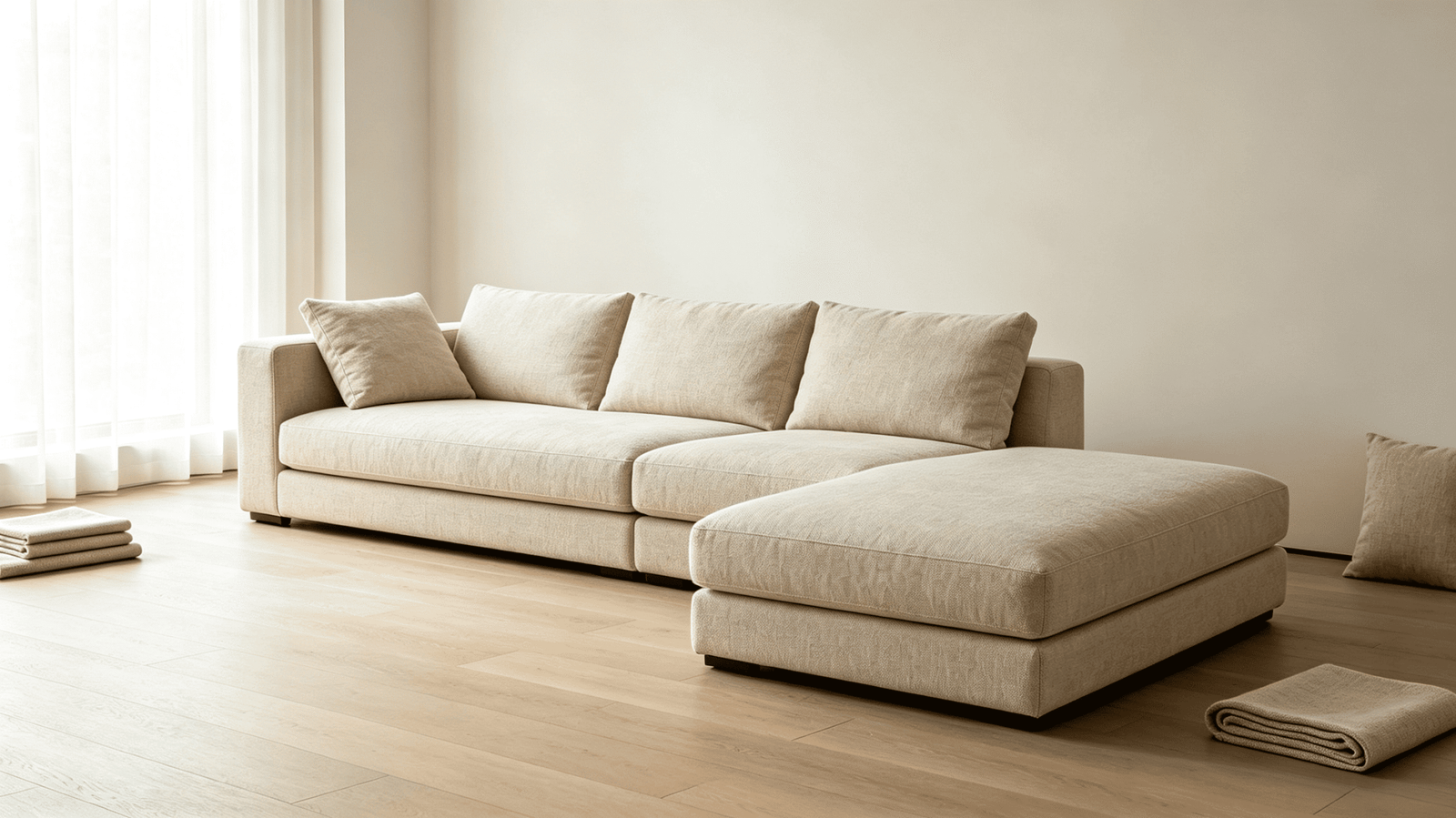
A Judgment Framework, Not a Sales Pitch
Here's how we think through fabric suitability for chaise sofa projects with designers:
Conditions where Belgium pure linen is well-suited:
- Primary living rooms in climate-controlled homes
- Formal sitting rooms with limited daily use
- Primary suite lounge areas (low foot traffic, adult-only)
- Rooms with north or east-facing light (softer, more diffuse)
- Clients who prioritize natural texture and breathability over stain resistance
Conditions that warrant a COM or alternative fabric discussion:
- Pets: Linen picks up pet hair readily and the fiber can be damaged by repeated scratching7. A tighter weave or performance blend holds up significantly better.
- High foot traffic: If the chaise is going to function as a daily nap surface for a family of four, linen will show wear patterns faster than the client expects.
- Direct sun exposure: Belgium linen will fade with sustained UV exposure. West-facing rooms with large unshaded windows accelerate this materially.
- Humid climates: High ambient humidity affects linen differently than it affects synthetic blends. In coastal or tropical environments, this is a genuine concern8 worth discussing.
The COM Flexibility
We support COM (Customer's Own Material) fabric fully. If the project conditions don't suit linen but the designer wants to use our sofa-with-chaise silhouettes and construction, we can produce in any fabric the designer specifies. This is often the right call for mixed-use spaces where the sofa-with-chaise anchors a room that also functions as a family room.
For designers working in the US market: our production in Foshan, with our current pricing structure, typically runs 40–60% below equivalent custom specifications from US-based manufacturers for comparable linen upholstery quality. That gap creates budget room to invest in a higher-spec COM fabric without exceeding a local production budget.
Our 200+ Linen Color Range
For projects where linen is the right call, we offer 200+ linen fabric colors across our made-to-order range. The color range spans natural undyed linens, warm neutrals, deep saturated tones, and muted pastels. We can send swatches for any active project — this is worth doing before finalizing the client presentation, not after.
Frequently Asked Questions
What's the minimum room size for a sofa with chaise?
In our completed projects, the smallest room that comfortably accommodates a sofa with chaise typically runs around 380–400 cm on the primary wall axis. Below that, the total footprint exceeds the 65% proportion threshold and the room starts to feel blocked. In tighter rooms, a standard sofa without chaise usually serves the brief better.
How do I confirm left-hand vs. right-hand orientation with a manufacturer?
Always request a dimensioned sketch or CAD plan from the manufacturer showing the piece in the room layout, with orientation labeled from the seated-facing-out convention. Do not rely on verbal confirmation alone. A one-line sketch takes five minutes and eliminates the most common source of costly delivery errors.
Can a sofa with chaise work in an open-plan living space?
Yes — and open-plan rooms are actually well-suited to sofa-with-chaise configurations because the chaise end can define a zone boundary without requiring a physical wall. The key is that the chaise terminus should face inward to the defined living zone, not outward toward the kitchen or dining area, which creates a visual barrier rather than a zone anchor.
How long does a custom linen sofa with chaise take to produce?
From confirmed specification — including fabric, dimensions, orientation, and leg finish — our typical lead time is 8–12 weeks. Projects requiring COM fabric have a variable additional lead time depending on the fabric's arrival at our facility. We recommend building 14–16 weeks into the project schedule to accommodate shipping to US or European destinations.
Is linen durable enough for a chaise that gets daily use?
Belgium pure linen is a strong natural fiber9, but it does show wear patterns more visibly than synthetic blends under daily, high-contact use. For chaises that function as daily loungers (multiple users, regular afternoon napping, family rooms), we recommend discussing either a performance linen blend or a COM fabric with higher abrasion resistance. The aesthetic of linen can be preserved with the right alternative — it's worth the conversation.
Conclusion
Specifying a sofa with chaise correctly comes down to three decisions made in the right order: orientation first, scale second, fabric third. Getting orientation wrong is expensive and unrecoverable at delivery. Getting scale wrong makes the room feel consumed rather than anchored. And choosing fabric without understanding the room's use conditions creates a client conversation you don't want six months after install.
At Linen World, we've spent 13 years producing custom sofa-with-chaise pieces for high-end residential projects across the US and Europe. The projects that land well are always the ones where these decisions were pressure-tested before the order was placed — not after. If you're specifying a sofa with chaise for a current project and want to work through orientation, dimensions, or fabric suitability, reach out to our team directly Email:hello@linenworld.pro. We can provide dimensioned sketches, fabric swatches, and project-specific pricing — and we're used to working at the pace and precision level that high-end residential projects demand.
"Product & Material Lead Times - Kimball International", https://www.kimballinternational.com/lead-times. Industry surveys of custom furniture manufacturers have reported production lead times for upholstered seating generally ranging from 8 to 16 weeks depending on complexity, material sourcing, and factory capacity. Evidence role: general_support; source type: institution. Supports: Typical lead times for custom upholstered furniture production in the contract and residential furniture industry. Scope note: Lead time ranges vary significantly by manufacturer scale, supply chain conditions, and order volume; a single industry figure may not reflect current market conditions. ↩
"ADA Accessibility Standards - Access-Board.gov", https://www.access-board.gov/ada/. Residential building codes in the United States and United Kingdom specify minimum corridor and doorway widths for habitable spaces, with standard interior door widths typically ranging from 80 to 91 cm; these dimensions constrain the maximum cross-section of furniture pieces that can be navigated through standard residential entries without disassembly. Evidence role: general_support; source type: government. Supports: Standard residential building access dimensions relevant to large furniture delivery logistics. Scope note: The relative ease of delivering a two-piece chaise sofa versus a multi-module sectional depends on the specific dimensions of both the furniture and the building access points; the claim is logically supported but not directly evidenced by delivery logistics research. ↩
"What Does Left-Hand vs. Right-Hand Facing Sofa Mean? 🛋️ ", https://www.homedecorindonesia.com/5-simple-steps-to-decode-left-hand-vs-right-hand-facing-sofas/?srsltid=AfmBOoosTmPl876AbP1boGkMFGnJ0jQ4Uy35KkRR4Qel2aTY18wSWFlL. Furniture trade and retail sources generally define chaise and sectional orientation from the perspective of a user seated on the piece and facing outward, though this convention is not universally codified and some manufacturers apply the reverse definition from a production or floor-plan perspective, making explicit confirmation with individual suppliers a recommended practice. Evidence role: definition; source type: institution. Supports: The convention used within the furniture industry to define left-hand and right-hand orientation for chaise sofas and sectionals. Scope note: No single binding international standard appears to govern this convention; the claim reflects common trade practice rather than a formally published specification, and supplier variation is acknowledged in the article itself. ↩
"Scale and Proportion In Interior Design | The DIY Playbook", https://thediyplaybook.com/rookie-mistake-scale-and-proportion/. Interior design spatial planning literature commonly addresses the relationship between furniture footprint and room dimensions, with guidelines for seating generally recommending that dominant pieces occupy a defined proportion of the primary wall axis to preserve circulation and visual balance. Evidence role: expert_consensus; source type: education. Supports: Proportional relationships between large furniture pieces and room dimensions as a principle of interior spatial planning. Scope note: A specific 60–65% threshold does not appear to be codified in a single authoritative standard; the figure reflects practitioner convention rather than empirically derived ergonomic research. ↩
"Chair Size Design Based on User Height - PMC - NIH", https://pmc.ncbi.nlm.nih.gov/articles/PMC9944090/. Ergonomic and anthropometric references for residential seating typically place standard seat depth in the range of 50–65 cm, with variation depending on intended user population and posture requirements. Evidence role: definition; source type: research. Supports: Standard seat depth dimensions for upholstered residential seating based on ergonomic or anthropometric guidelines. Scope note: Seat depth standards vary across national furniture standards bodies and ergonomic guidelines; the cited range reflects common production norms rather than a single binding specification. ↩
"[PDF] Anthropometric Detailed Data Tables", https://multisite.eos.ncsu.edu/www-ergocenter-ncsu-edu/wp-content/uploads/sites/18/2016/06/Anthropometric-Detailed-Data-Tables.pdf. Anthropometric databases document population distributions of stature and related body segment lengths; for recumbent or semi-recumbent seating, the required surface length to accommodate full leg extension correlates with total body height, with individuals above the 90th percentile for stature in Western populations typically exceeding 185 cm and requiring correspondingly longer support surfaces. Evidence role: mechanism; source type: research. Supports: The relationship between user stature and required recumbent surface length for comfortable full-body support on a chaise or lounge surface. Scope note: The specific 105–110 cm chaise depth recommendation reflects practitioner convention; the ergonomically required dimension depends on the combined depth of the sofa seat and chaise extension, and on whether the user's legs are fully extended or slightly bent. ↩
"Quantitative Assessment of Woven Fabric Surface Changes During ...", https://pmc.ncbi.nlm.nih.gov/articles/PMC12348827/. Textile abrasion testing using the Martindale method indicates that linen upholstery fabrics, particularly those with looser weave structures, exhibit moderate abrasion resistance compared to high-performance synthetic blends; the open fiber structure of woven linen also tends to trap particulate matter including animal hair more readily than tightly woven or smooth-surface synthetics. Evidence role: mechanism; source type: research. Supports: The abrasion resistance characteristics of linen upholstery fabric relative to synthetic alternatives, and linen's tendency to trap particulate matter such as pet hair. Scope note: Abrasion performance varies significantly with weave density, yarn twist, and finishing treatments; the claim is directionally supported for standard-weight linens but may not apply to high-density or treated linen upholstery grades. ↩
"The Role of Natural Fibers in the Building Industry—The Perspective ...", https://pmc.ncbi.nlm.nih.gov/articles/PMC12387356/. Linen is a highly hygroscopic cellulosic fiber capable of absorbing significant moisture from ambient air, a property that can affect dimensional stability, hand feel, and susceptibility to mold or mildew in sustained high-humidity environments, in contrast to hydrophobic synthetic fibers which absorb comparatively little atmospheric moisture. Evidence role: mechanism; source type: research. Supports: The hygroscopic properties of linen and their implications for fabric performance in high-humidity environments compared to synthetic alternatives. Scope note: Performance outcomes in humid climates depend on fabric finishing treatments, backing materials, and ventilation conditions; the claim is supported at the fiber level but real-world upholstery performance involves additional variables. ↩
"Linen Most Useful: Perspectives on Structure, Chemistry, and ... - PMC", https://pmc.ncbi.nlm.nih.gov/articles/PMC4403609/. Flax fiber, from which linen is produced, is among the stronger natural cellulosic fibers, with tensile strength generally exceeding that of cotton and comparable to some bast fiber alternatives; these properties contribute to linen's durability in upholstery applications under normal use conditions. Evidence role: definition; source type: research. Supports: The tensile strength and mechanical properties of linen (flax) fiber relative to other natural upholstery fibers. Scope note: Fiber strength does not directly translate to finished fabric performance, which is also determined by weave structure, yarn count, and finishing treatments; the claim is supported at the fiber level but upholstery durability involves additional variables. ↩


