
Most people describe a modern bedroom that disappointed them the same way: "It looked perfect in the renders, but something felt off after a few months." That something is almost always material — specifically, the wrong upholstery choices masquerading as a design problem. Modern bedroom design starts with what you put on the surfaces people actually touch.
A timeless, well-balanced modern bedroom relies on coordinated color schemes and clean furniture silhouettes as its visual foundation, yet its long-term livable quality is ultimately determined by carefully selected materials that age gracefully, support breathability and retain natural texture through years of daily use.
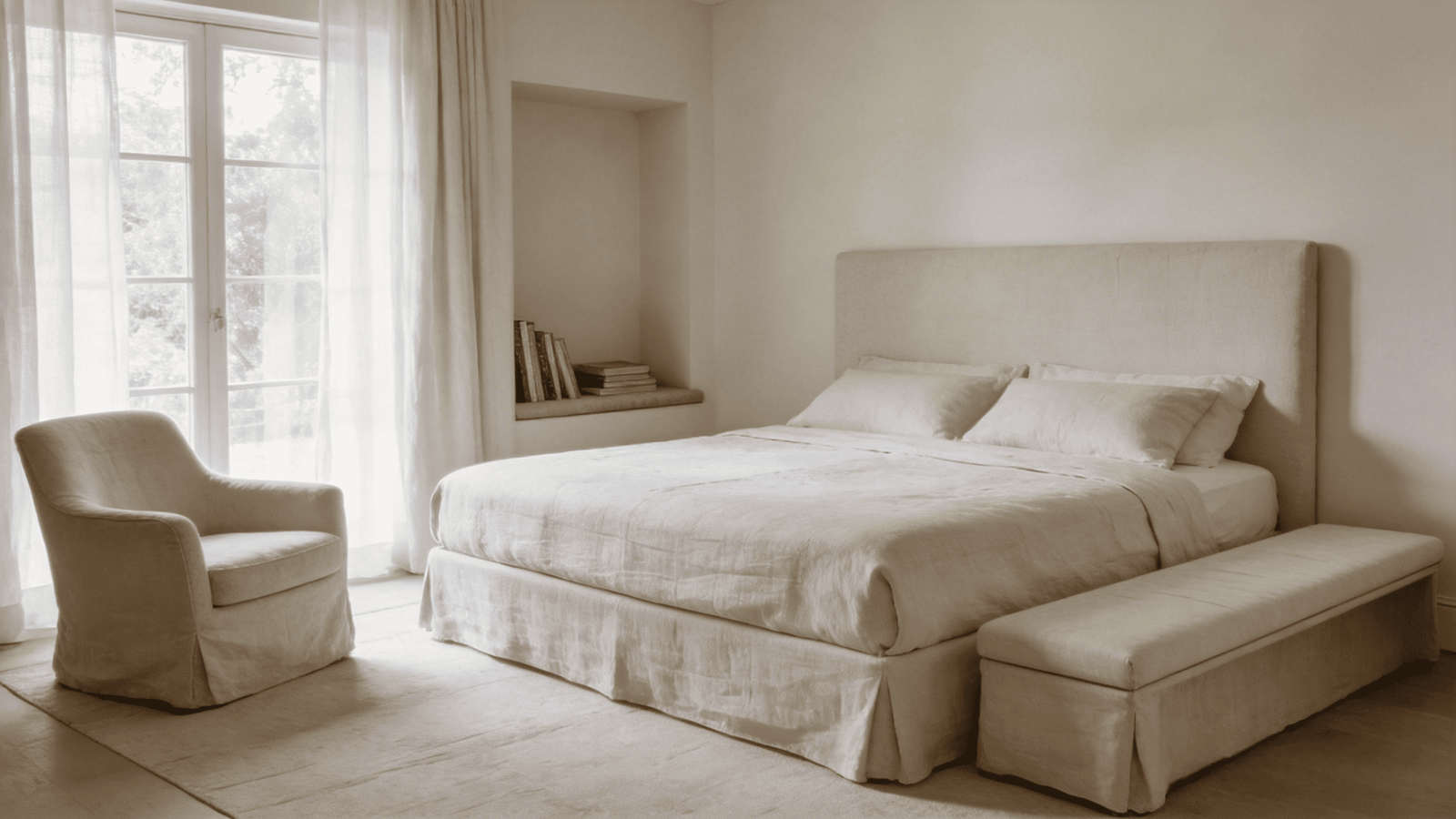
Understanding why certain materials succeed in a bedroom environment changes every sourcing decision you make. The sections below work through the decisions that actually determine whether a modern bedroom holds up — in feel, in wear, and in long-term value.
Is "Modern" a Style or a Material Logic?
Most briefs I receive from US designers describe a modern bedroom aesthetic in terms of palette — greige walls, matte black hardware, low-profile furniture. But when the finished rooms get client complaints at the six-month mark, the palette is never the problem.
"Modern" is most durably expressed as a material logic: choosing surfaces that are structurally honest, tactilely coherent, and built to wear in rather than wear out. A bedroom that reads as authentically contemporary over time is usually one where every material choice can justify itself functionally — not just visually.
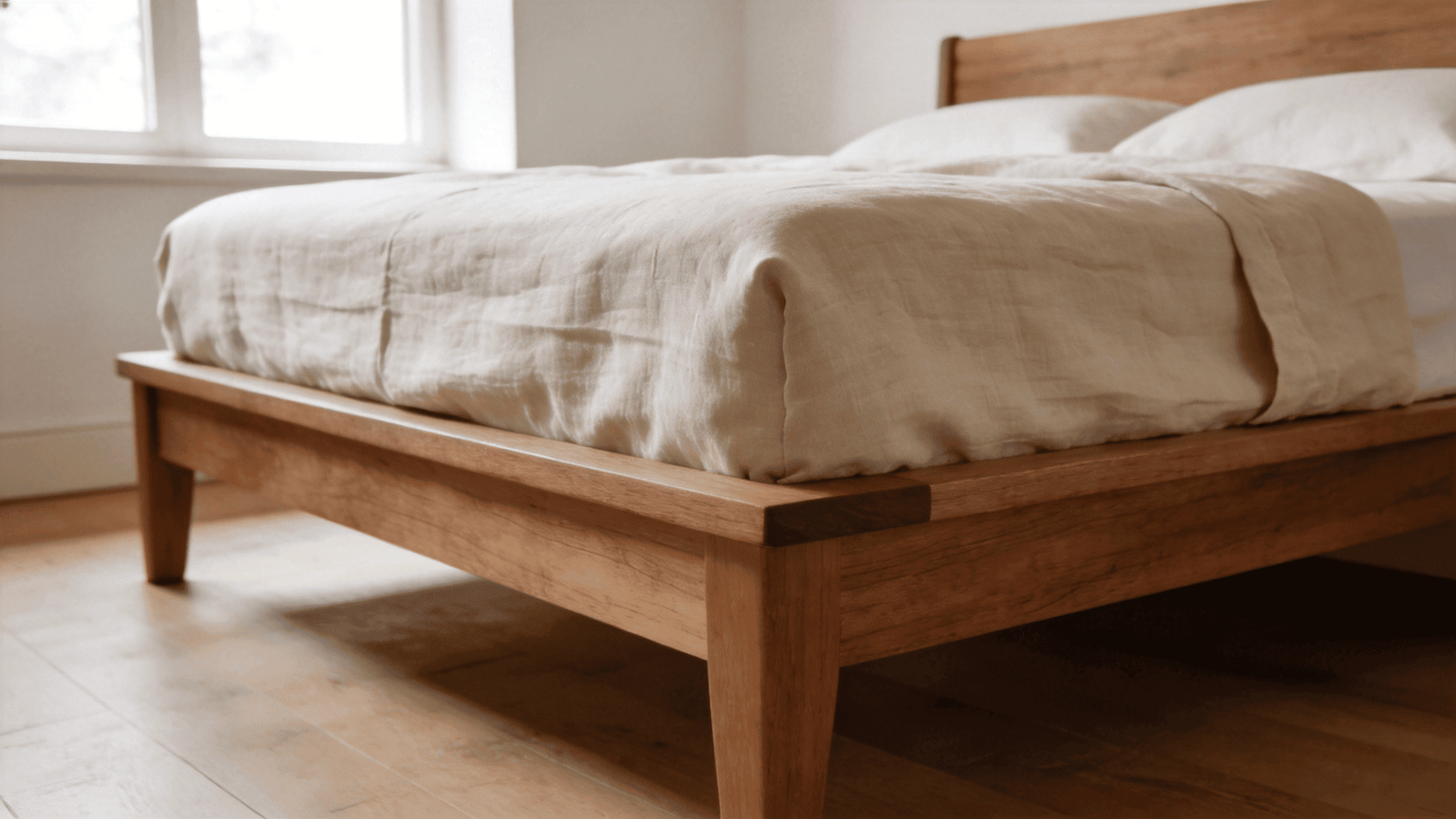
This reframe matters because it changes what you prioritize during specification. When you treat "modern" as a palette, you might accept any fabric in the right color. When you treat it as a material logic, you ask different questions — about breathability, about how a weave ages, about whether a surface will feel better or worse with use.
Why Palette-First Thinking Leads to Substitutions You Regret
In our production experience, the most common error in modern bedroom specification is selecting upholstery fabric by color swatch alone. A designer or homeowner picks a greige tone that matches the render — and may end up with a synthetic blend that visually fits but thermally and tactilely underperforms.
Here is the practical difference that material logic makes:
| Material Property | Synthetic Upholstery | Belgian Pure Linen |
|---|---|---|
| Breathability | Low — traps heat and moisture | High — wicks moisture and regulates temperature |
| Tactile character over time | Often pills, flattens | Softens and improves with use |
| Color stability | Can fade unevenly under UV | Ages to a deeper, richer tone |
| Hypoallergenic performance | Varies by fiber blend | Known for low allergen retention |
| Visual honesty | Can look "off" in natural light | Holds appearance in all lighting conditions |
The designers whose clients report long-term satisfaction are typically the ones who made synthetic vs. natural fiber a conscious decision — not an incidental one.
The "Modern Doesn't Need Texture" Myth
One brief I remember clearly came from a California-based designer specifying a master bedroom for a high-net-worth client in Marin County. Her instinct was to keep all upholstery flat and smooth because she associated texture with a "rustic or transitional" look. After extensive back-and-forth on samples, she moved to a tightly woven Belgian linen in a warm stone tone — and later told me it was the single change that made the room feel "resolved."
Texture in a modern bedroom is not decorative noise. It is the visual and tactile layer that stops a minimalist room from reading as sterile1. The constraint is perceived, not structural.
Why Does Linen Belong in a Modern Bedroom — Functionally?
Clients often ask me this as a style question. "Will linen look too natural for a contemporary scheme?" But the more important question is the functional one — and it has a clearer answer.
Linen earns its place in a bedroom because of where a bedroom sits in daily life. People spend six to eight hours in direct contact with bedroom surfaces2. A fabric that breathes, resists allergens, and softens with use is not a stylistic preference — it is a sensory and health decision that happens to also be the right aesthetic one.
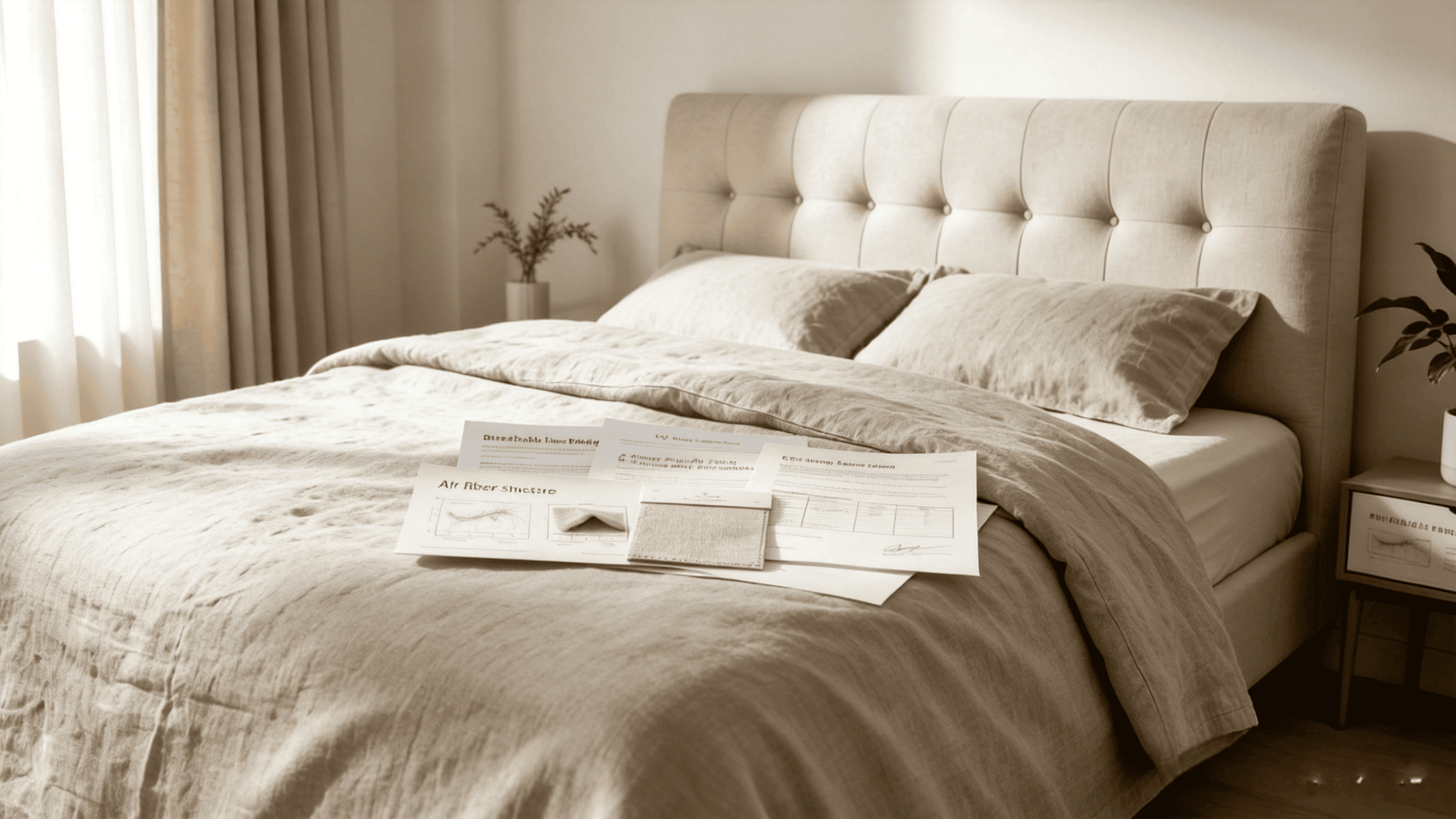
The bedroom is the one room where material performance is most directly felt. That makes it the room where upholstery selection matters most — and where substituting on fabric quality has the clearest consequences.
Breathability and Temperature Regulation
Linen is known for its ability to wick moisture and allow air circulation through the weave3. In a bedroom context — particularly for upholstered headboards and bed frames, linen armchairs, and bench seating at the foot of the bed — this means surfaces that do not trap heat or feel clammy during warm months.
This is not a minor comfort detail. Clients who have switched from velvet or polyester blends to Belgian pure linen on bedroom upholstery consistently describe the change as the room "breathing differently." I am cautious about overstating fabric performance claims, but breathability in linen's open weave structure is visible and verifiable — it is one of the reasons the fiber has a centuries-long record in warm-climate domestic use4.
Hypoallergenic Properties
Linen's low lint production and natural fiber structure are associated with lower allergen accumulation compared to synthetic or heavily processed textiles5. For clients with sensitivities — or for design briefs that specify wellness-oriented interiors — this is a functional criterion, not a marketing claim.
In our order intake, we see this come up most often in briefs for primary residences (as opposed to vacation homes), where the clients actually sleep in the room every night and have real stakes in what the upholstery does over time.
Durability and How Linen Ages
One of the most consistent pieces of feedback we hear from designers who have specified our linen upholstery is that the furniture looks better after 18 months of use than it did at delivery. This is characteristic of Belgian pure linen specifically — the fiber softens with use and body heat, and the natural slub in the weave becomes more visually interesting rather than worn-looking6.
Compare this to the common trajectory of budget synthetic upholstery in a bedroom:
- Months 1–3: Fresh, looks correct in photos
- Months 4–8: Pilling begins, especially on seat pads and armrests7
- Month 12+: Flattening, color inconsistency, tactile degradation
Linen's aging curve runs in the opposite direction. For clients making a multi-year investment in a high-end bedroom, this wear trajectory is a fundamental part of the value calculation.
Can You Mix Linen with a Contemporary Bedroom Scheme?
This is the most common stylistic objection I hear from designers considering linen upholstery for a modern bedroom project: "My client wants a clean, contemporary look — will linen read as too casual or organic?"
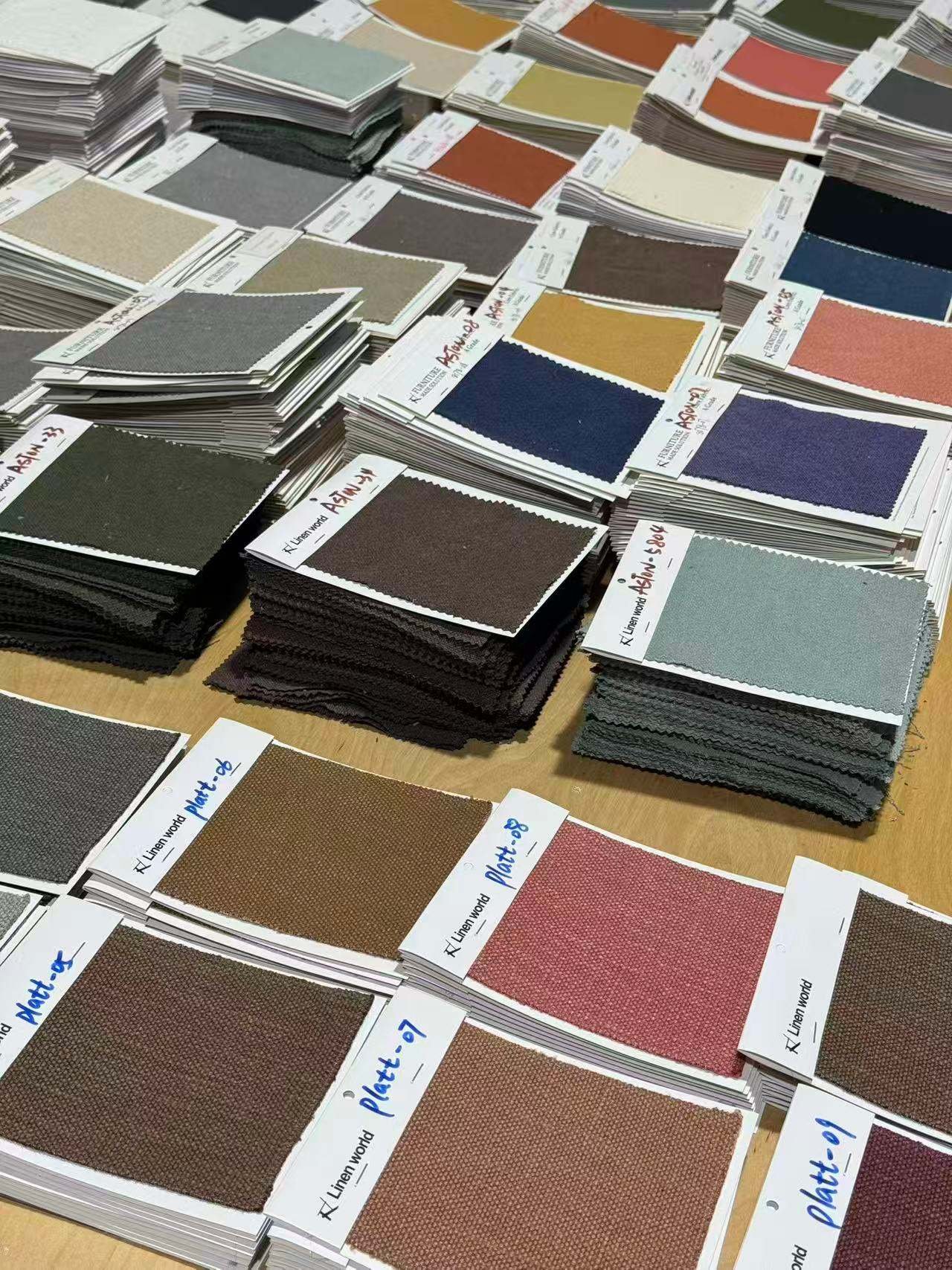
Linen's neutral natural palette — spanning warm whites, stone tones, oats, and deep slates — makes it one of the most versatile anchors for mixed-material, contemporary bedroom schemes. Its structural weave adds visual depth without decorative noise, and its color range works across warm and cool base palettes. The "too rustic" concern is a styling problem, not a material one.
The practical question is not whether linen works in a modern bedroom. It is how to specify it so that it reads as intentional — precise in proportion, correct in color weight, and coherent with the other materials in the room.
How to Anchor a Mixed-Material Bedroom with Linen
The designers I work with who do this most successfully tend to follow a consistent approach:
1. Use linen on the dominant upholstered pieces. The bed and the primary seating piece (usually a linen armchair or accent chair) carry the most visual weight. Specifying linen on both creates a material throughline that makes the room feel considered rather than assembled.
2. Let the linen color set the neutral anchor. Rather than matching the linen to the wall color, they use the linen tone to establish the room's neutral reference point — and build the rest of the palette around it. This is why our most-specified colors for bedroom projects are mid-range naturals: warm oat, pale flax, and cool stone rather than pure white or deep charcoal.
3. Contrast with matte hard materials, not competing textiles. In our experience, linen reads cleanest in modern bedrooms when it sits against matte plaster walls, honed stone surfaces, or matte powder-coated metal — not against other printed or textured soft furnishings. The contrast between linen's soft weave and hard material flatness is what creates the "resolved" quality designers describe.
4. Keep the upholstery silhouette clean. Linen works with almost any contemporary furniture form, but it reads most modern when the silhouette is architectural — tight arms, precise cushion returns, minimal decorative stitching. In our made-to-order production, we can spec the construction detail alongside the fabric choice to make sure the two reinforce each other.
200+ Color Options — Why This Matters for Real Projects
Designers specifying linen for a made-to-order bedroom often ask us how many colors we actually carry versus how many we show on a sample board. We offer over 200 vetted linen color options across our range. For high-stakes design projects — where the furniture needs to match a specific plaster tone or complement a custom window treatment — this range makes the difference between a near-match and a precise one.
We also support COM (customer's own material) for clients who have already specified a particular fabric through their trade sources and want it applied to our furniture construction. This is common in projects where the designer has an existing fabric relationship and needs a manufacturing partner who can execute to that standard.
How Do You Source High-End Linen Bedroom Furniture Without Overpaying?
Designers and homeowners sourcing for high-end bedrooms often assume that quality bespoke furniture is geography-locked — that proximity to the manufacturer is what guarantees quality8. In practice, that assumption is costing a significant portion of clients 40–60% more than the furniture is worth.
The real criteria for high-quality made-to-order linen bedroom furniture are material traceability, production transparency, customization depth, and consistent delivery standards — not factory proximity. A manufacturer with genuine Belgian pure linen sourcing, handcraft production standards, and a deep made-to-order capability competes directly with the best domestic custom studios — at a fraction of the landed cost9.
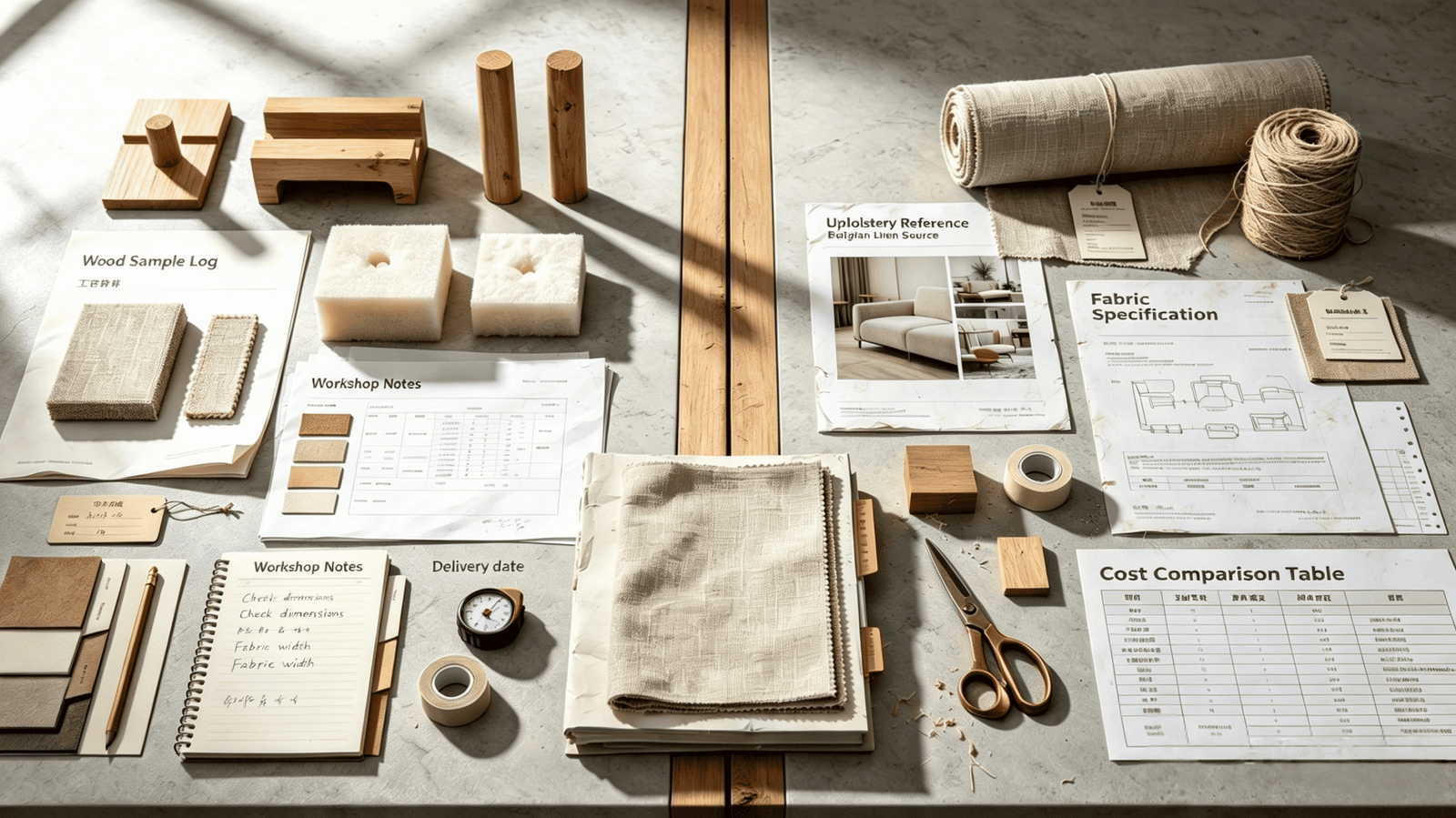
The price argument is real — but it only holds if the quality holds. That is why I want to address what actually determines quality in linen upholstery before the cost conversation begins.
What Actually Justifies the Cost of High-End Linen Upholstery
Before evaluating any supplier — domestic or overseas — these are the criteria that determine whether the product delivers on a high-end bedroom specification:
- Fiber origin and grade: Belgian pure linen is a specific designation. Not all linen labeled "European" or "natural" carries the same fiber length, weave consistency, or durability profile. Ask for material documentation.
- Construction method: Handcraft production affects cushion fill compression, seam integrity, and frame joinery in ways that machine-only production does not replicate. Especially on custom silhouettes.
- Customization range: A manufacturer who offers 200+ color options and COM support can meet a real design specification. One who offers 12 standard colors cannot.
- Sample and approval process: Reputable made-to-order manufacturers will send physical fabric samples and, where appropriate, pilot production samples before full order fulfillment. This is a non-negotiable for high-end project work.
- Delivery transparency: Lead times, logistics documentation, and communication standards should be explicit and trackable.
The Foshan Advantage — Quality First, Cost as Outcome
We are a Foshan-based linen upholstery manufacturer with 13 years of production experience, and our primary market is the US and Europe10. Our clients are primarily interior designers and design-forward homeowners who have made the decision — based on material and production criteria — that working with a specialist manufacturer abroad is the right specification choice.
The 40–60% cost saving compared to equivalent domestic custom studios is a real outcome. But the reason clients come back and refer colleagues is not the price — it is that the furniture arrives matching the specification, ages the way good linen is supposed to, and holds up in the hands of demanding clients who use the rooms every day.
Frequently Asked Questions
Is linen upholstery practical for a bedroom that gets daily use?
Yes — and the bedroom is arguably the environment where linen performs best. Its breathability and moisture-wicking properties suit a room used for extended rest. Belgian pure linen in particular is known for softening with use rather than degrading, making it a practical choice for high-contact pieces like upholstered bed frames and bedroom armchairs.
How many fabric colors are typically available for made-to-order linen bedroom furniture?
This varies significantly by manufacturer. We offer over 200 vetted linen color options across our made-to-order range — covering the full spectrum from warm naturals to cooler slate tones. For projects requiring a very specific match, we also accept COM (customer's own material) fabric submissions.
Can I specify linen upholstery if I already have a contemporary or minimalist bedroom design direction?
Yes. Linen's neutral palette and structural weave make it well-suited to contemporary and minimalist schemes. The perceived conflict between "natural texture" and "modern aesthetic" is a common misreading — in practice, linen's visual restraint and color range anchor mixed-material modern rooms more cleanly than most synthetic alternatives.
What is the lead time for custom linen bedroom furniture from a Foshan manufacturer?
Lead times vary by order complexity and production schedule, but made-to-order linen bedroom furniture typically runs 6–10 weeks for production, plus shipping time. For project-based sourcing, planning 14–16 weeks from order confirmation to delivery is a reliable working assumption. Contact us directly for current lead time estimates on specific pieces.
How does the quality of overseas-manufactured linen furniture compare to domestic custom studios?
Quality is determined by material sourcing, construction method, and customization capability — not factory location. A Foshan manufacturer using Belgian pure linen, handcraft production standards, and a rigorous made-to-order process is directly comparable to the best California or East Coast custom studios. The key is evaluating on the right criteria: request material documentation, physical samples, and clear production transparency before committing.
Conclusion
Modern bedroom design succeeds or fails at the material level — not the styling level. The rooms that hold up over time are the ones where every upholstered surface was chosen for how it performs in daily contact, not just how it photographs. Linen delivers on both — its breathability, tactile improvement with use, and neutral palette make it a rational anchor for any contemporary bedroom specification.
If you are currently sourcing for a high-end bedroom project and want to evaluate what genuinely made-to-order Belgian pure linen upholstery looks, feels, and costs, we are ready to support that conversation — with physical samples, full color range access, and transparent production documentation. Contact Linen World to request your sample pack or discuss a custom brief.
"Environmental Psychology and Interior Design: The Influence of Space", https://www.ied.edu/news/environmental-psychology-and-interior-design-the-influence-of-space. Environmental psychology research on interior space perception indicates that surface texture and material variety are significant contributors to perceived warmth and comfort, with studies finding that visually and tactilely uniform environments are more frequently rated as cold or unwelcoming compared to spaces incorporating varied surface textures. Evidence role: expert_consensus; source type: research. Supports: The role of surface texture in moderating human perception of interior environments, specifically its effect on perceived warmth and comfort in minimally furnished spaces. Scope note: Environmental psychology findings on texture perception are typically derived from controlled experimental settings or survey instruments and may not directly predict occupant response to specific upholstery material choices in residential bedrooms. ↩
"About Sleep", https://www.cdc.gov/sleep/about/index.html. The U.S. Centers for Disease Control and Prevention reports that adults require 7 or more hours of sleep per night, providing a basis for estimating the duration of contact between occupants and bedroom upholstery surfaces. Evidence role: statistic; source type: government. Supports: Average nightly sleep duration for adults, supporting the claim that bedroom surfaces are in prolonged daily contact with occupants. Scope note: CDC figures represent recommended or average sleep duration, not direct measurement of contact time with specific upholstered surfaces such as headboards or seating. ↩
"An Impact of Moisture on Thermal State of Flax and Hemp Shives ...", https://pmc.ncbi.nlm.nih.gov/articles/PMC12843176/. Textile science research on flax-derived linen identifies its hollow fiber structure and hydrophilic surface chemistry as the primary mechanisms enabling moisture absorption and wicking, with studies reporting linen's moisture regain rate as significantly higher than that of polyester and comparable to or exceeding that of cotton under standard atmospheric conditions. Evidence role: mechanism; source type: research. Supports: The physical and structural properties of linen fiber that enable moisture transport and air circulation, supporting the claim that linen is more breathable than synthetic alternatives. Scope note: Laboratory fiber property measurements are conducted on standardized fabric samples and may not directly predict performance in upholstered furniture applications where fabric is layered over padding and frame materials. ↩
"Linen - Wikipedia", https://en.wikipedia.org/wiki/Linen. Linen, derived from the flax plant, is among the oldest known textile fibers, with archaeological evidence of its use in ancient Egypt and other warm-climate civilizations dating back thousands of years, consistent with its reputation for breathability in domestic applications. Evidence role: historical_context; source type: encyclopedia. Supports: Linen's documented historical use across warm-climate civilizations, including ancient Egypt and the Mediterranean, supporting the claim of a centuries-long domestic record. Scope note: Historical use documents prevalence and longevity but does not constitute a controlled study of linen's thermal or breathability performance relative to other fibers. ↩
"The Future of Functional Clothing for an Improved Skin and Textile ...", https://pmc.ncbi.nlm.nih.gov/articles/PMC8226598/. Research on textile fiber properties indicates that natural fibers such as linen exhibit lower electrostatic charge than synthetic fibers, which is associated with reduced particulate and allergen adhesion, though direct clinical comparisons between linen and synthetic upholstery in bedroom environments remain limited. Evidence role: mechanism; source type: research. Supports: The relationship between natural fiber structure, lint production, and allergen accumulation in textiles, supporting the claim that linen retains fewer allergens than synthetic alternatives. Scope note: General textile science findings on fiber charge and allergen adhesion may not translate directly to controlled clinical outcomes for bedroom upholstery specifically. ↩
"Investigation of the Properties of Linen Fibers and Dressings - PMC", https://pmc.ncbi.nlm.nih.gov/articles/PMC9501175/. Studies on natural cellulosic fiber behavior under cyclic mechanical stress indicate that linen fibers undergo progressive surface fibrillation and inter-fiber realignment with use, a process associated with increased softness and surface texture development rather than structural degradation, distinguishing linen's aging profile from that of synthetic fibers. Evidence role: mechanism; source type: research. Supports: The structural changes in linen fiber under repeated mechanical stress and use, which produce softening and surface character development rather than degradation. Scope note: Fiber-level aging studies are typically conducted under controlled laboratory abrasion conditions and may not fully replicate the specific mechanical and environmental stresses experienced by upholstered bedroom furniture in residential use. ↩
"(PDF) Performance Evaluation of Upholstery Fabric Developed from ...", https://www.academia.edu/85325433/Performance_Evaluation_of_Upholstery_Fabric_Developed_from_Recycled_Fibres. Textile engineering literature identifies pilling as a surface defect caused by fiber entanglement under abrasion, with synthetic fibers such as polyester exhibiting higher pilling propensity than natural fibers due to their greater tensile strength, which prevents pill detachment; standardized tests including ASTM D3512 and ISO 12945 are used to measure pilling resistance across fabric types. Evidence role: mechanism; source type: research. Supports: The tendency of synthetic upholstery fibers to pill under friction and repeated use, and the role of fiber type in pilling susceptibility. Scope note: Standardized pilling tests are conducted under controlled laboratory conditions and may not precisely replicate the timeline or pattern of pilling observed in real-world upholstery use. ↩
"Interactive room design as a tool for understanding form and style ...", https://pmc.ncbi.nlm.nih.gov/articles/PMC12518833/. Research on country-of-origin effects in consumer behavior documents a persistent tendency among buyers to associate domestic or geographically proximate manufacturing with higher product quality, a heuristic that has been observed across durable goods categories including furniture. Evidence role: general_support; source type: research. Supports: Consumer and professional tendency to associate product quality with domestic or proximate manufacturing origin, a cognitive bias relevant to furniture sourcing decisions. Scope note: Country-of-origin effect research is drawn from general consumer behavior literature and may not reflect the specific decision-making processes of professional interior designers sourcing bespoke furniture. ↩
"Why does everyone assume upholstery should cost less than buying ...", https://www.facebook.com/Repinned/posts/why-does-everyone-assume-upholstery-should-cost-less-than-buying-newits-a-questi/1495019899331793/. Trade and manufacturing cost analyses indicate that labor cost differentials between US and Chinese furniture production, combined with material sourcing efficiencies, can produce substantial price gaps in custom upholstered goods, though the precise differential varies with tariff schedules, shipping costs, and product complexity. Evidence role: general_support; source type: other. Supports: The existence of significant cost differentials between domestically manufactured custom furniture and equivalent overseas production when accounting for labor, materials, and landed import costs. Scope note: General manufacturing cost comparisons do not account for project-specific variables such as current tariff rates, logistics costs, or quality-tier equivalence, making the 40–60% figure an approximation rather than a verified benchmark. ↩
"China's Furniture Manufacturing Industry: The Definitive 2026 Guide ...", https://jadeant.com/china-furniture-manufacturing-industry-2026-guide/. Foshan, Guangdong Province, is widely recognized as one of China's largest furniture manufacturing clusters, with industry data indicating that the region accounts for a substantial share of China's furniture export volume to North American and European markets. Evidence role: historical_context; source type: institution. Supports: Foshan's established role as a major furniture manufacturing and export center, providing context for the manufacturer's location and market positioning. Scope note: Industry cluster data describes the regional manufacturing ecosystem broadly and does not speak to the quality standards or export practices of individual manufacturers within Foshan. ↩


