If you've ever tried to specify custom linen upholstery for a high-end residential project and source it overseas, you already know the problem. The price looks right. The samples look right. Then the timeline conversation starts, and suddenly nothing is plannable. That uncertainty — not the cost — is what kills most first orders before they begin. This guide exists to fix that.
If you're an interior designer sourcing custom linen furniture from a Chinese factory for the first time, the process breaks into six predictable phases: inquiry and specification, fabric confirmation, sample production and approval, bulk production, quality control and shipping, and final delivery. Handled sequentially and communicated clearly, the full journey from first contact to furniture at your client's door typically runs 14 to 20 weeks, depending on complexity and shipping method.
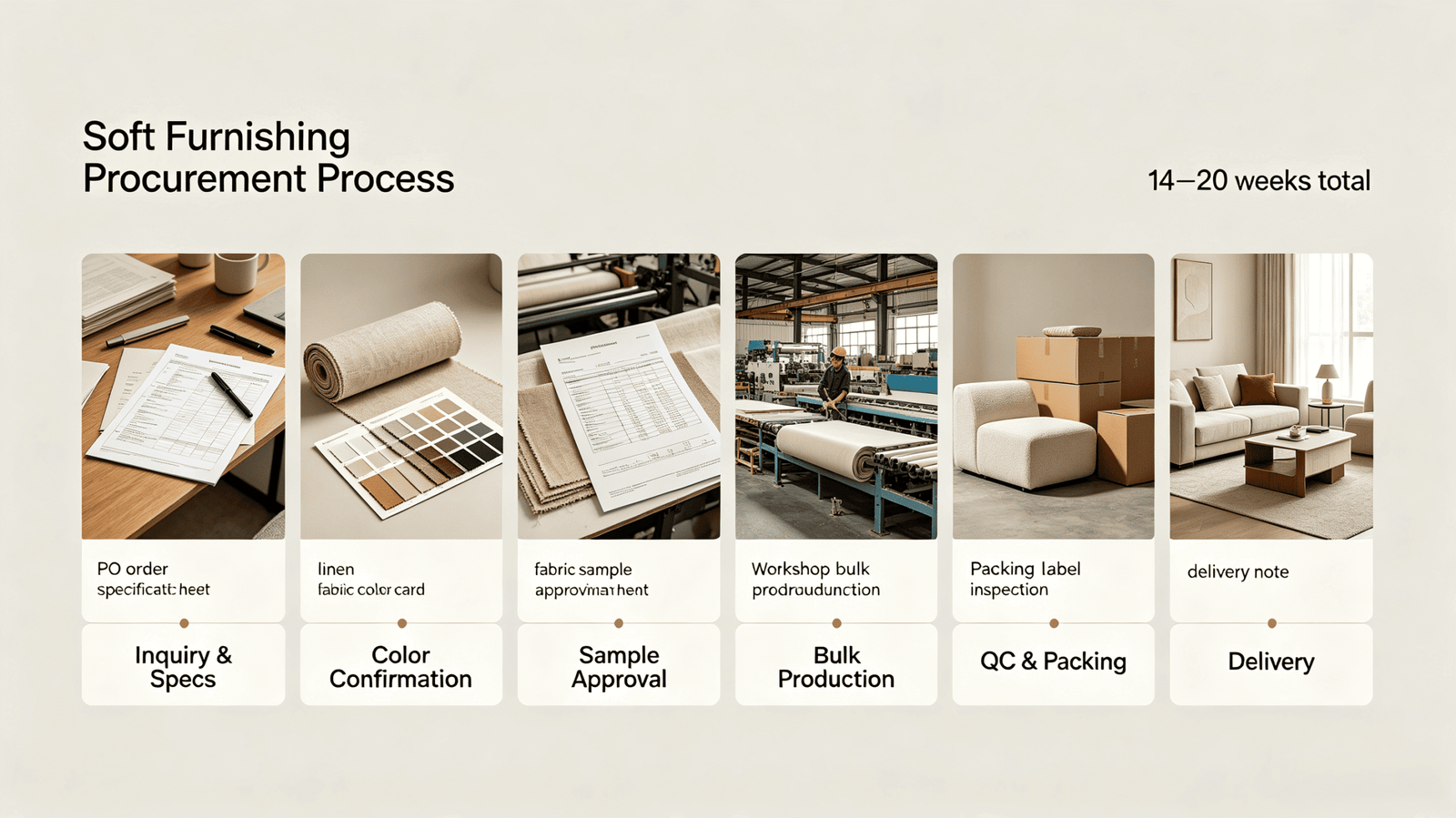
That timeline figure alone changes the conversation. When you know the structure, you can build a project schedule around it — and give your client a delivery window you can actually defend. The sections below walk through every stage in detail, including the parts most factory guides skip: landed cost, color and terminology translation, and the full COM fabric process.
What Does the Full Timeline Actually Look Like?
Most designers I speak with have been burned by vague lead-time promises. "Eight to twelve weeks" sounds reasonable until week ten arrives and nobody has confirmed production status.
In our experience handling US designer orders, the full custom linen furniture journey — from first inquiry to delivery at a US address — runs 14 to 20 weeks under normal conditions1. That range widens if sample revisions are needed, if COM fabric is involved, or if ocean freight is delayed. The timeline below treats each phase as a named, bounded slot.
Understanding each phase individually is what makes the whole schedule manageable. A delay in one phase doesn't have to cascade into all the others — but only if you know which phase you're in.
Phase Breakdown: Days and Dependencies
Here is how we typically see the full order move, expressed as realistic day ranges rather than aspirational ones:
| Phase | Description | Typical Duration |
|---|---|---|
| 1. Inquiry & Specification | Designer submits dimensions, fabric selection, configuration details | 3–7 days |
| 2. Fabric Confirmation | Swatches sent or confirmed from 200-color palette; COM fabric arrangements begin | 5–10 days |
| 3. Sample Production | Physical sample or photo sample produced for approval | 10–18 days |
| 4. Sample Approval | Designer reviews and approves or requests revision | 3–10 days |
| 5. Bulk Production | Full order manufactured after written approval | 25–35 days |
| 6. QC & Packing | Quality check, photo documentation, protective packing | 3–5 days |
| 7. Ocean Freight (US) | FCL or LCL container transit, West Coast port | 18–28 days |
| 8. Customs & Final Delivery | US customs clearance, last-mile delivery | 5–10 days |
A few honest notes on that table:
- Sample revision adds time. If a first sample requires a change — cushion height, arm width, fabric trim — expect to add 10–14 days before production approval is granted.
- COM fabric adds time at the front end. If you're sending your own fabric, Phase 2 and Phase 3 cannot start until that fabric arrives in our Foshan2 facility. I'll cover this in detail in the COM section below.
- Ocean freight is not negotiable on timing. We have no control over port congestion or customs hold times. Build a buffer of at least one week beyond the estimated transit window when communicating with your client.
- Air freight is available and compresses the shipping phase to roughly 5–7 days, but the cost differential is significant. For most residential projects, ocean freight remains the practical choice.
The most common timeline failure I see is a designer who approves a sample but delays written confirmation for two weeks while waiting for client sign-off. That two-week gap is not neutral — production scheduling moves around confirmed orders. Submit written approval as soon as your client has committed.
What Is the Real Landed Cost?
The "40–60% savings vs. local sourcing" figure is real, and it's the reason designers call us. But I've watched that figure create disappointment when a designer encounters freight costs, import duties, or revision charges they hadn't planned for. Let's put the full cost picture on the table.
The landed cost of a custom linen sofa sourced from a Chinese factory includes the product price, international freight, US import duties, and any revision or remake charges. In our experience, even after these costs, the total typically lands 35–55% below comparable US-made or European-made custom linen upholstery3 — but only if the designer has planned for all four components from the start.
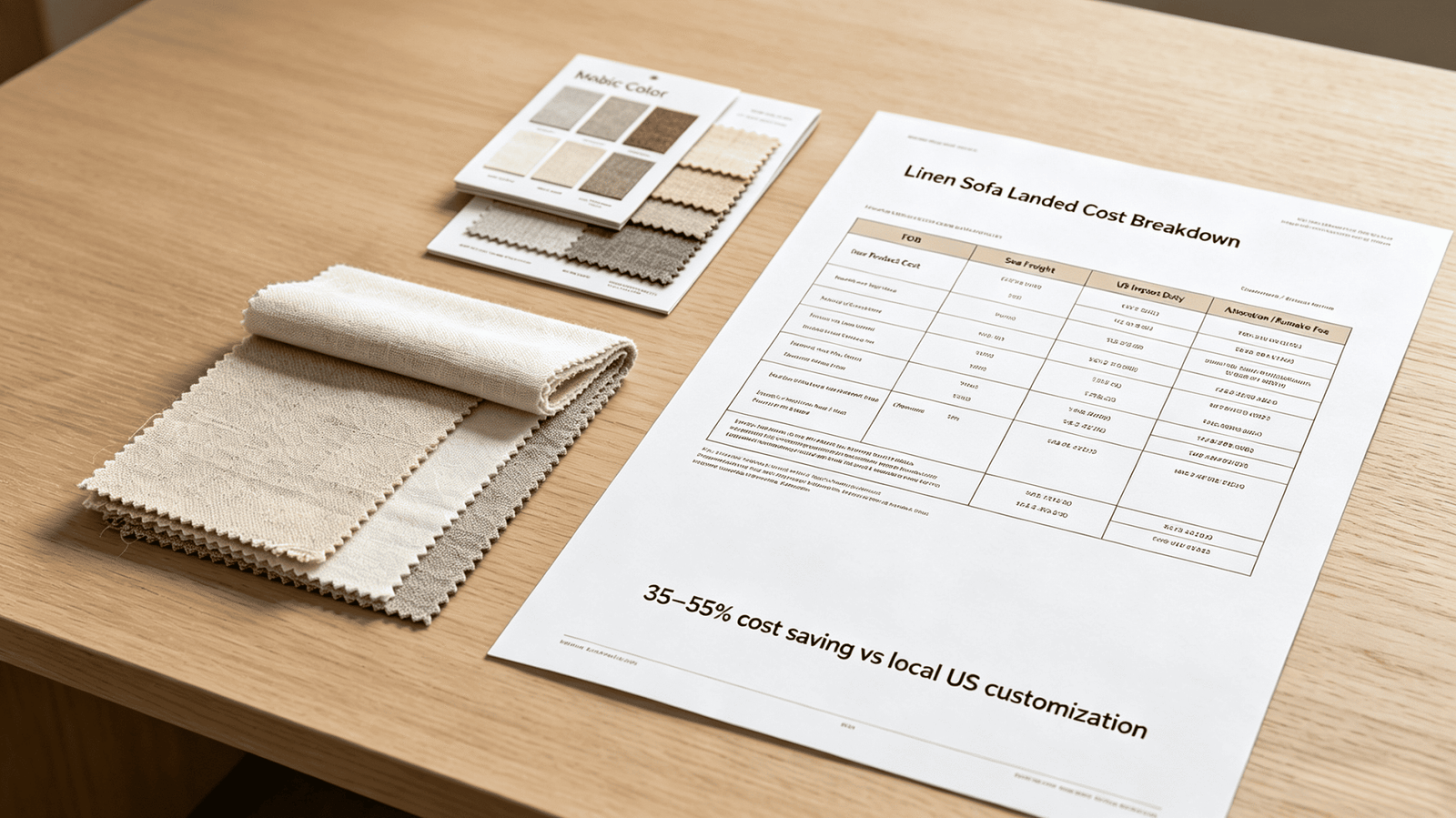
Knowing these four components up front is what separates a smooth first order from an uncomfortable conversation with your client after delivery.
The Four Cost Components Every Designer Should Plan For
1. Product Price
This is the factory price — the figure on our quote. It reflects materials, labor, and handcraft detail. For reference, our positioning is benchmarked against makers like Blasco and high-end California custom workrooms. Our product price typically represents 55–65% of the total landed cost.
2. International Freight
Ocean freight for residential furniture moves as LCL (less-than-container load) or FCL (full container). LCL is standard for single-piece or small orders. In our experience, LCL freight for a sofa to a US East Coast port currently runs roughly $300–$600 depending on CBM4, though rates fluctuate. Get a freight quote from your forwarder early — don't use our estimate as your final figure.
3. US Import Duties
This is the line item designers most often miss. Upholstered furniture imported from China is subject to US tariffs. The applicable rate has shifted in recent years due to trade policy changes.5 I am not a customs broker and cannot give you a ruling on your specific order. What I can tell you is: consult your freight forwarder or a licensed customs broker before you quote your client. Build the duty into your cost model from day one. Omitting it and discovering it at port is a project-budget problem.
4. Revision and Remake Risk
This is the cost most factory guides never mention. If a sample is approved and bulk production is completed, but there is a defect or a specification error — who absorbs the remake cost? Our policy: if the error originates from our production, we remake at no charge. If the error originates from a specification change after written approval, the designer carries the cost. This is standard. The safeguard is simple: review your specification sheet carefully before submitting written approval.
A Realistic Cost Planning Table
| Cost Component | Typical Share of Total Landed Cost |
|---|---|
| Product price (factory) | 55–65% |
| Ocean freight (LCL, US) | 8–14% |
| US import duties | 10–20% (verify with broker) |
| Local delivery / install | 3–7% |
| Revision buffer (recommended) | 3–5% |
Designers who plan with this table consistently have fewer surprises. Designers who only look at the product price consistently have more.
How Do You Communicate Specs Across the Language Gap?
Sourcing from a Chinese factory isn't just a logistics exercise — it's a communication exercise. In my day-to-day work handling designer inquiries, the most common friction I see isn't language fluency. It's terminology translation6: the moment a designer says "oyster linen, tight back, loose seat cushions with box edge, webbing suspension" and the factory's response reveals they interpreted three of those five things differently.
In our experience, the fastest way to close the communication gap is to submit a specification sheet that uses both designer-standard terminology and dimensional measurements in both metric and imperial. When combined with a fabric reference swatch or a specific color name from our 200-color palette, this approach reduces back-and-forth by roughly half compared to a verbal or general brief.
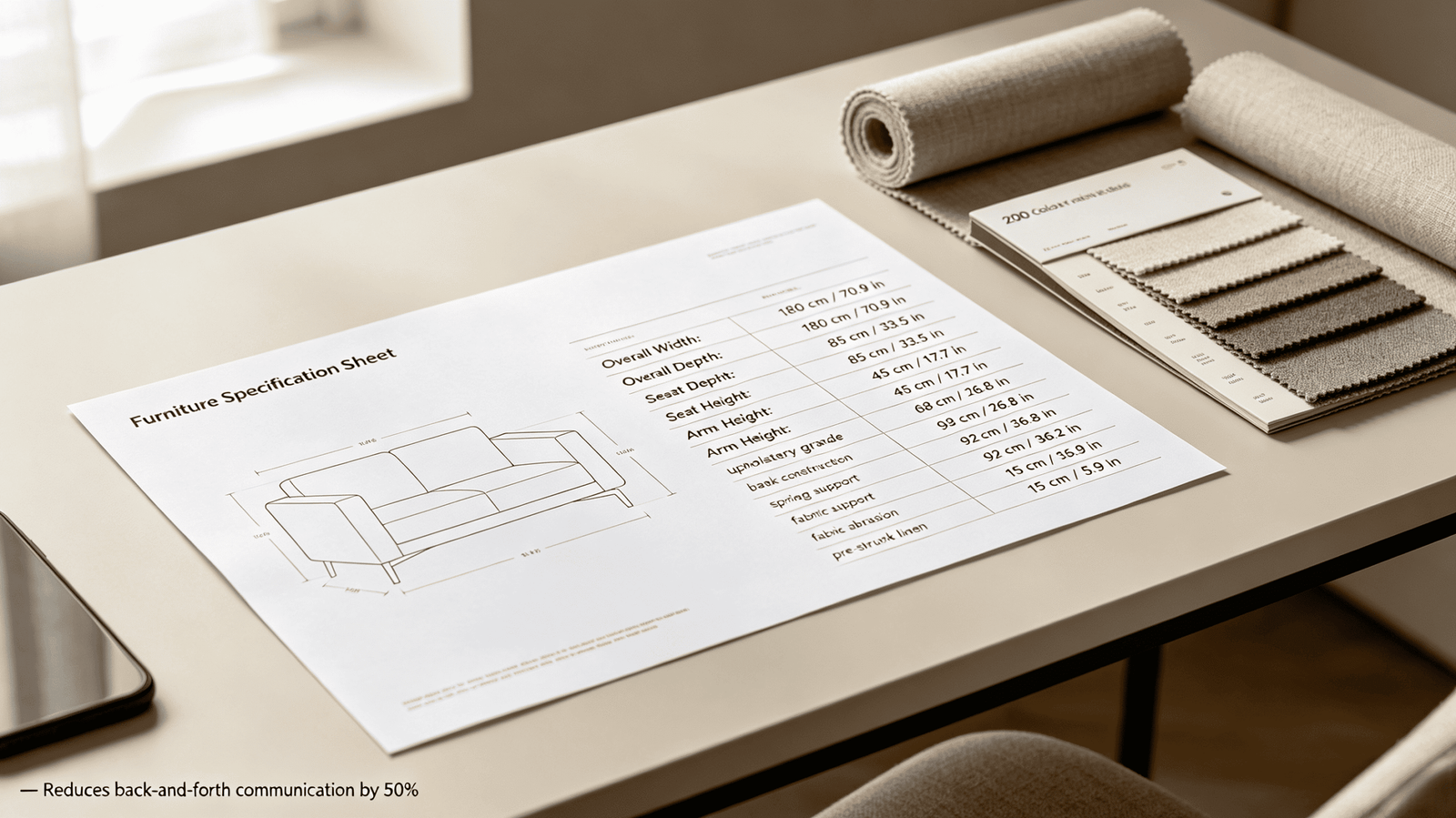
The gap is bridgeable. It just requires structure on both sides.
Linen Color Naming: What Your Words Mean in Our Palette
Our 200-color palette uses descriptive English names — names like oyster, flax, sand, oatmeal, stone, chalk, dune, and natural. These are not arbitrary. But a designer's mental image of "oyster" and our sample of "oyster" may not be identical.
The rule I always give designers: never confirm a color name without seeing a physical swatch or a high-resolution photo of the fabric in natural daylight. We send sample swatches on request. This step is non-negotiable for any project where fabric color is a client-facing specification.
Here is how a few common designer color descriptions map loosely to our palette categories:
| Designer's Term | Closest Palette Category | Note |
|---|---|---|
| Warm white / cream | Chalk, natural, ivory | Request swatch — "warm white" varies widely |
| Greige / warm grey | Stone, dune, linen grey | Multiple options in this range |
| True natural linen | Flax, oatmeal, natural | Undyed linen tones — very popular in our catalog |
| Cool grey | Slate, ash | Less common in linen; verify texture preference |
| Warm tan / sand | Sand, dune, camel | Confirm undertone — yellow vs. pink base |
Upholstery Terminology: A Short Glossary
These are the terms where translation errors most commonly occur in our order communication:
- Tight back vs. loose back cushions — Always specify which. A tight back is upholstered directly to the frame; a loose back has removable cushions. These require different fabric yardage and affect the final price.
- Box edge vs. knife edge cushions — Box edge has a gusset (structured, defined corners); knife edge tapers to a seam. Specify on both seat and back cushions.
- Webbing vs. spring base — Webbing suspension is standard in our production and provides firm, consistent support. Eight-way hand-tied spring bases are available on specified models7. Ask at inquiry stage.
- Leg material and finish — Solid wood legs are standard; specify species, stain color, and whether you want tapered, turned, or straight leg profiles.
- Arm style — Describe with a reference image whenever possible. "Slope arm," "track arm," and "English roll arm" translate cleanly; more regional terms may not.
When in doubt, send a reference image. A clear photo of the arm profile or cushion configuration you want resolves more than a paragraph of description.
How Does COM Fabric Work, Step by Step?
COM (Customer's Own Material) orders are more common in our designer business than most people expect. Designers working with a specific fabric from a trade source — a Holland & Sherry linen, a Schumacher weave, a locally sourced textile — want to use that material on our frames. The process works. But it has more steps than a standard palette order, and most factory guides compress it into a single vague paragraph. I won't do that here.
When a designer submits COM fabric for a custom linen furniture order, the process involves six specific steps: specification submission, yardage calculation, fabric shipment to our Foshan facility, receipt and inspection, sample production for approval, and bulk production. Each step has a responsible party and a timeline impact. Plan for COM orders to add 2–4 weeks to the standard timeline8.
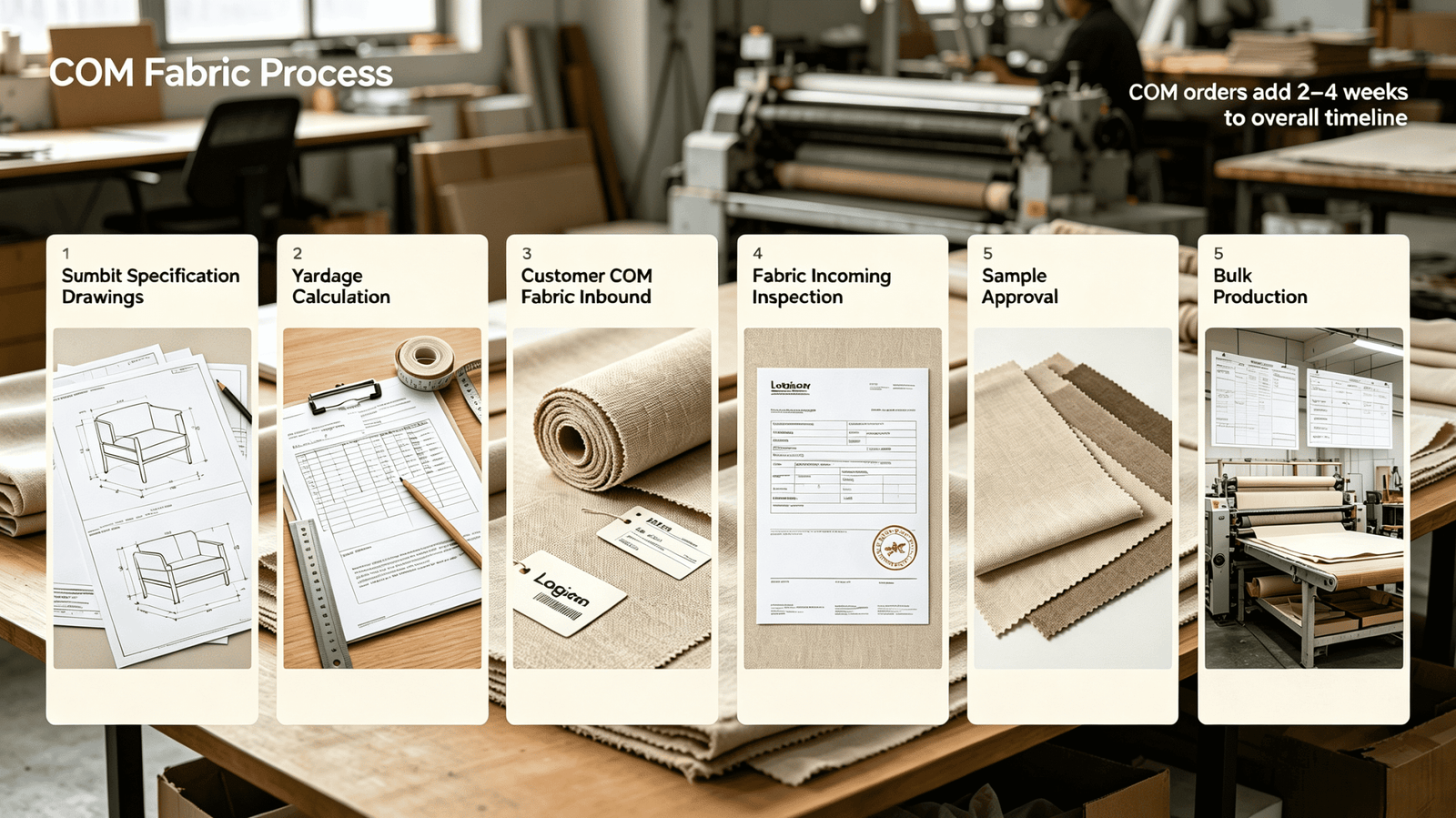
The COM Fabric Process: Step by Step
Step 1: Submit a COM Information Sheet Before Shipping Anything
Before you ship fabric, send us:
- Fabric name and supplier
- Fabric composition (fiber content, weave type)
- Fabric width (in both inches and centimeters)
- Repeat dimensions if patterned (horizontal and vertical repeat)
- Care and pressing restrictions (some fabrics cannot be steamed; we need to know)
- Which piece(s) the COM will be used on
This information determines whether the fabric is compatible with our production process. Some very open-weave or loosely structured fabrics require internal lining to upholster cleanly. We'll tell you at this stage, not after the fabric arrives.
Step 2: Confirm Yardage Requirements
We calculate required yardage based on the piece configuration and your fabric's width and repeat. Do not estimate yardage yourself unless you are an experienced upholsterer. Pattern repeats in particular can increase yardage requirements significantly9.
We will provide a confirmed yardage figure after reviewing the spec sheet. Add 10–15% overage to the confirmed figure before shipping. Why? If yardage is short — even by a fraction — bulk production cannot begin until more fabric arrives. That delay is entirely outside our control and will add weeks to your timeline.
Step 3: Ship the Fabric to Our Foshan Facility
- The designer is responsible for shipping costs from origin to our factory. This is standard in COM arrangements.
- Ship via a trackable international courier (FedEx, DHL, UPS). Do not use standard postal services for fabric valued at this level.10
- Mark the package clearly: include your order reference number, our facility address, and a commercial invoice that accurately declares the value. Incorrect customs declarations create clearance delays that can hold your fabric in Chinese customs for days or weeks.
- Share the tracking number with us immediately upon shipment.
Step 4: Receipt and Inspection
When the fabric arrives at our facility, we inspect it for the following:
- Yardage count against confirmed requirements
- Visible defects (pulls, discoloration, weave irregularities)
- Condition after transit
We photograph and document this inspection and send you a receipt confirmation. If yardage is short or a defect is identified, we notify you before any cutting begins. We do not cut into COM fabric until you have acknowledged receipt confirmation.
Step 5: Sample Production
For COM orders, we strongly recommend a physical sample before committing to bulk production. The sample confirms how your specific fabric behaves on our frames — tension, drape, seam finish. Some fabrics behave differently in production than they appear on a bolt.
Sample production for COM fabric runs 12–18 days after fabric receipt. Plan for this.
Step 6: Approval and Bulk Production
Once you approve the sample in writing, we proceed to bulk production. At this point, the production timeline mirrors a standard order: 25–35 days for manufacturing.
COM Fabric: Common Questions
Who pays if the fabric is damaged during production? If damage results from a production error on our side, we take responsibility. If the fabric arrived with pre-existing damage that was not visible at intake inspection, the situation requires case-by-case discussion. The intake inspection and documentation process exists precisely to protect both parties.
Can we use any fabric? Most trade-quality wovens and linen blends work without issue. Very sheer, very loosely woven, or paper-thin fabrics may require internal lining to upholster properly. Velvet, bouclé, and heavily textured fabrics work but require experienced handling — ask us at specification stage.
Can COM fabric be combined with our standard palette for the same piece? Yes. For example, a COM fabric on the outside back with a palette linen on the seat and inside back is a common configuration. Specify this clearly on your information sheet.
Frequently Asked Questions
How many fabric samples can I request before placing an order?
We send sample swatches on request at no charge. In our experience, most designers narrow to three to five options before requesting physical swatches. We don't limit sample requests, but we do recommend being as specific as possible about colorway and texture before requesting — it makes the selection process faster for both sides.
Do you support custom dimensions, or only catalog sizes?
We support both. Our catalog pieces have standard dimensions, but we regularly produce to custom specifications — adjusted sofa lengths, non-standard seat depths, modified arm heights. Submit your target dimensions at inquiry stage and we'll confirm feasibility and any price adjustment.
What quality documentation do you provide before shipment?
Before each shipment leaves our facility, we conduct a quality check and provide photo documentation of the finished pieces. We share these photos with the designer for review before packing. We do not ship without designer sign-off on QC photos for custom orders.
What happens if there's a production error on your side?
If finished goods arrive with manufacturing-origin defects such as uneven stitching, factory-damaged fabric or structural frame faults, we offer free remedial solutions including component replacement for sectional pieces or full item remanufacture as the most appropriate resolution, provided full photographic evidence is submitted within 7 days post delivery. We ask that you document and report the issue within 7 days of delivery with photographs.
If you are an interior designer sourcing custom Belgian linen sofas, sectionals and accent chairs from Foshan China for US & EU luxury residential projects, our 13-year factory provides full custom dimension adjustment, 200 graded linen swatch packs free of charge, complete COM fabric pre-review & yardage calculation, step-by-step written stage confirmation and pre-shipment full QC photo documentation. We support single-piece orders, compatible with your designated freight forwarder and offer clear split landed cost breakdown for client quotation. Message us via Email:hello@linenworld.pro to request fabric catalogs, full project timeline planning or COM fabric specification pre-assessment.
"U.S.-China Trade Relations - Congress.gov", https://www.congress.gov/crs-product/IF11284. Industry analyses of furniture supply chains from China to the United States generally report combined production and ocean freight lead times in the range of 12–20 weeks, depending on order complexity and shipping method, consistent with the timeline described here. Evidence role: general_support; source type: research. Supports: Typical lead times for custom furniture manufactured in China and shipped to the United States, including production and ocean freight phases. Scope note: Published benchmarks typically reflect aggregate industry data and may not capture factory-specific or product-specific variation ↩
"Foshan.furniture — №1 resource about Foshan and Guangzhou ...", https://foshan.furniture/. Foshan, located in Guangdong Province, is one of China's largest furniture manufacturing centers, hosting thousands of furniture producers and serving as a primary export hub for upholstered and case goods furniture destined for international markets. Evidence role: historical_context; source type: encyclopedia. Supports: Foshan's established role as a major furniture manufacturing and export center in China. Scope note: General descriptions of Foshan's manufacturing sector reflect aggregate industry presence and do not speak to the quality or practices of individual manufacturers operating there ↩
"The Effect of Furniture Imports from China on Employment in U.S. ...", https://www.usitc.gov/publications/332/working_papers/ecwp_2017-08-a-08-23-17_0.htm. Research on furniture manufacturing cost structures attributes the price differential between Chinese and Western production primarily to labor cost disparities, with studies noting that landed cost advantages persist even after freight and duty are incorporated, though the magnitude varies by product category and specification complexity. Evidence role: general_support; source type: research. Supports: The cost differential between custom upholstered furniture manufactured in China versus the United States or Europe, accounting for labor, materials, and import costs. Scope note: Published cost comparisons often reflect aggregate manufacturing data rather than custom or high-specification upholstery segments specifically ↩
"Shipping Rates from China to US: Complete 2025 Cost Guide", https://www.shapiro.com/shipping-rate-trends/china-to-us/. Freight rate indices and logistics industry reports indicate that LCL shipment costs from China to US East Coast ports are subject to significant fluctuation based on fuel surcharges, port congestion, and seasonal demand, with per-CBM rates varying considerably across carriers and routing. Evidence role: statistic; source type: institution. Supports: Current LCL ocean freight rate ranges from China to US East Coast ports for small furniture shipments measured in cubic meters. Scope note: Published freight rate data reflects market averages and may not correspond to rates available to individual shippers or specific trade lanes at any given time ↩
"[PDF] Section 301 Exclusion Extension FRN - USTR", https://ustr.gov/sites/default/files/Section%20301%20Exclusion%20Extension%20FRN.pdf. Under the US Harmonized Tariff Schedule, upholstered seating classified under HTS heading 9401 is subject to both standard Most Favored Nation duties and additional Section 301 tariffs applied to goods of Chinese origin, the latter having been modified through successive USTR review processes since 2018. Evidence role: mechanism; source type: government. Supports: The applicable US import duty rates for upholstered furniture from China, including Section 301 tariff additions under HTS heading 9401. Scope note: Tariff rates and exclusion lists are subject to ongoing administrative revision; designers should consult a licensed customs broker for rulings applicable to their specific goods ↩
"Cross-cultural communication - Wikipedia", https://en.wikipedia.org/wiki/Cross-cultural_communication. Research on cross-cultural business communication in international manufacturing contexts identifies domain-specific technical vocabulary as a significant source of specification errors, noting that parties with functional shared language may nonetheless diverge in their interpretation of industry-specific terms that lack standardized cross-cultural equivalents. Evidence role: expert_consensus; source type: research. Supports: That technical terminology and domain-specific vocabulary, rather than general language proficiency, are a primary source of miscommunication in international manufacturing and sourcing relationships. Scope note: Published research on this topic tends to address manufacturing communication broadly rather than furniture upholstery specifically; the claim as applied to this domain rests on practitioner experience rather than direct empirical study ↩
"8 way hand tied. The term refers to the way individual coil springs ...", https://www.facebook.com/savedbydesign.tn/posts/8-way-hand-tied-the-term-refers-to-the-way-individual-coil-springs-inside-uphols/1651080489317262/. Eight-way hand-tied spring construction is a traditional upholstery method in which individual coil springs are tied in eight directions using twine, distributing weight evenly and providing durable, resilient seating support; it is generally regarded as a labor-intensive technique associated with higher-quality furniture production. Evidence role: definition; source type: encyclopedia. Supports: The definition and construction characteristics of eight-way hand-tied spring suspension as a traditional upholstery technique. Scope note: Assessments of construction quality are partly subjective and context-dependent; the superiority of eight-way hand-tied over alternative suspension systems is debated among upholstery professionals ↩
"Sloan Bed - Linen World - Linen World", https://linenworld.pro/product/sloan-bed/. Trade upholstery industry guidance consistently identifies COM fabric orders as requiring additional lead time relative to standard material orders, with the increment reflecting international fabric transit, intake inspection, and sample production steps that do not apply to in-house material selections. Evidence role: general_support; source type: institution. Supports: The additional lead time typically associated with COM fabric orders in custom upholstery production, including shipping, inspection, and sample stages. Scope note: Published COM lead time guidance is largely practitioner-derived rather than empirically measured, and actual timelines vary by factory location, fabric origin, and shipping method ↩
"Calculating Fabric Yardage for Your Upholstery or Drapery Project", https://www.foliofabrics.com/blogs/inspo/fabric-calculator?srsltid=AfmBOoplYI7MUzGGvGRYVMgzvSdtyVjUrfR8AnOCdGd76SDxbfXgGPSz. Upholstery yardage calculations for patterned fabrics must account for pattern repeat matching across all panels, which requires cutting fabric at repeat intervals rather than continuously; large vertical or horizontal repeats can increase total yardage requirements by 15–30% or more compared to a plain fabric of identical dimensions. Evidence role: mechanism; source type: education. Supports: How fabric pattern repeats increase yardage requirements in upholstery production due to the need to align repeating motifs across seams and panels. Scope note: Yardage overage requirements vary by piece configuration, pattern scale, and upholsterer practice; published formulas provide estimates rather than exact figures ↩
"[PDF] Trends And Opportunities For The Postal Service. - USPS OIG", https://www.uspsoig.gov/sites/default/files/reports/2023-05/risc-wp-23-006_0.pdf. Customs authorities in major importing countries, including China, require commercial invoices and accurate value declarations for imported goods; international express courier services provide shipment tracking, customs brokerage support, and documented chain of custody that standard postal services typically do not offer for commercial consignments. Evidence role: general_support; source type: government. Supports: The customs documentation and tracking requirements for international commercial shipments of textiles, and the limitations of standard postal services for such shipments. Scope note: Specific customs requirements vary by country of import and shipment value thresholds; the guidance here reflects general commercial shipping practice rather than a ruling applicable to any specific shipment ↩


