
A linen sofa can look perfect online. We know it can arrive wrong, feel wrong, or age badly. That mistake can hurt the whole room.
We buy a linen sofa well when we check fabric quality, sofa structure, sitting comfort, custom details, and supplier process together. The best choice is not only “linen” or “price.” It is whether the supplier can turn the desired look, comfort, and details into a controlled finished sofa.
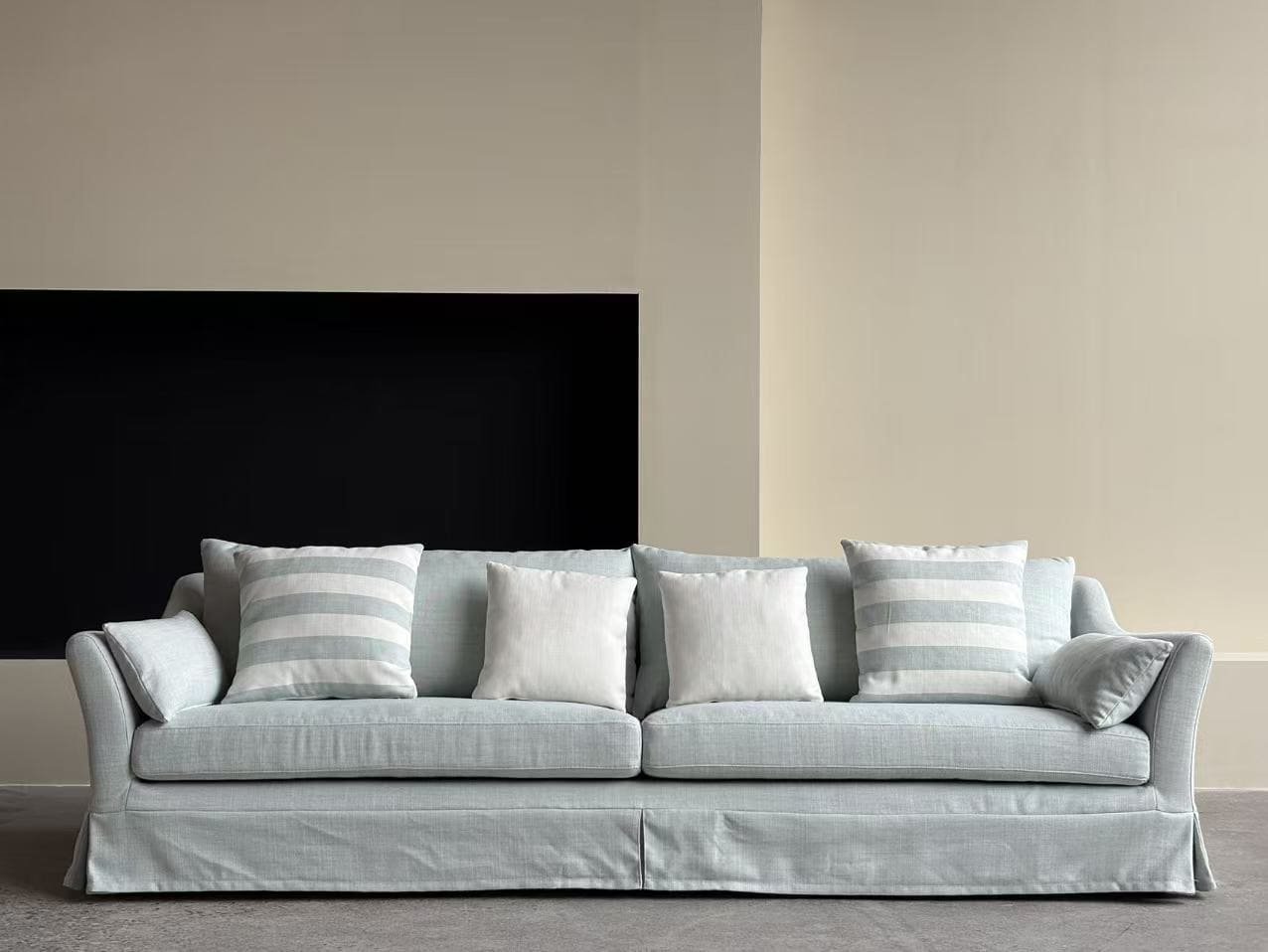
I have worked with many custom linen sofa projects from our Foshan factory. I have seen designers start with a soft mood board, a fabric tone, and a room plan. I have also seen homeowners ask for a relaxed Belgian linen look, but still need strong support, clean tailoring, and safe overseas delivery. So I do not treat a linen sofa as one single product. I treat it as a group of decisions. If you want a sofa that supports the design and the budget, I would look at the buying process step by step.
Is Linen Really the Right Fabric for My Sofa?
A linen sofa can feel natural and refined. It can also wrinkle, soften, and show daily life. I think this choice needs honesty.
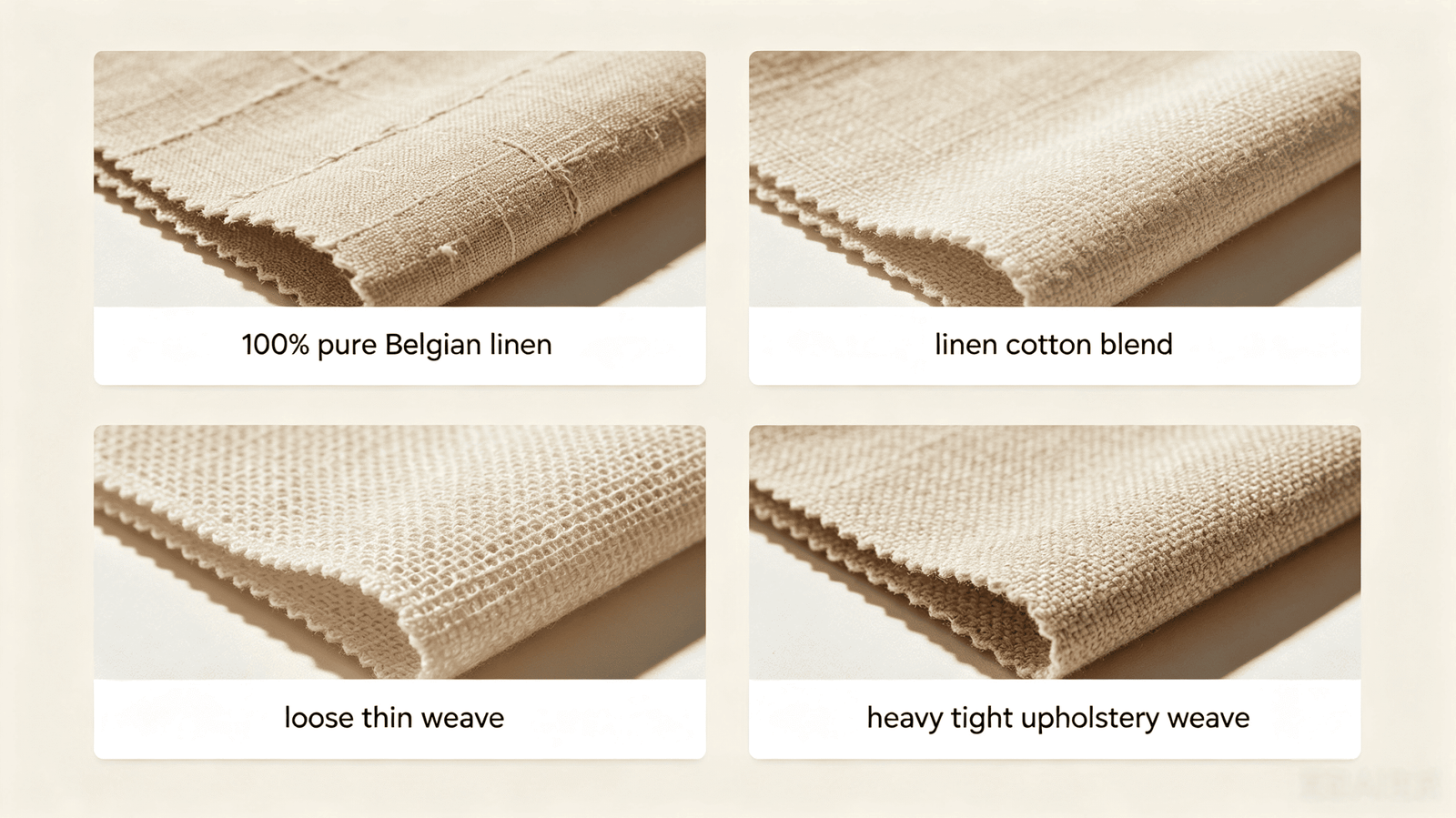
A linen sofa is right when you want texture, breathability, relaxed elegance, and a lived-in look1. It will rarely meet expectations if you hope for a fully wrinkle-free, zero-maintenance upholstery surface without special anti-wrinkle finishing treatment. I check linen content, weave, weight, color, shrinkage control, and use frequency before I recommend it.
What I Check Before I Suggest Linen
I like linen because it gives a room a calm and natural feeling. It does not look flat like many plain synthetic fabrics. It has slubs, movement, and a soft light effect. For high-end homes, that texture can make a large sofa feel less heavy. Still, I always tell clients that linen is not a magic fabric. It wrinkles. It may crease after use.2 It can absorb stains if it is not protected or maintained well.3 It also changes its look with time. Some clients love this. Some clients do not.
From a factory view, “linen sofa” can mean many things. Some fabrics are pure linen. Some are linen blends.4 Some are loose weaves. Some are heavier and more stable. I need to match the fabric with the room, the user, and the expected look.
| What I Check | Why I Check It | What It Means for You |
|---|---|---|
| Linen content | I need to know the real fiber mix | You understand texture, price, and maintenance |
| Fabric weight5 | I need to judge body and durability | You avoid fabric that feels too thin |
| Weave density6 | I need to see surface stability | You reduce sagging and loose movement |
| Color depth | I need to match the design intent | You reduce color mismatch risk |
| Shrinkage control7 | I need to plan cutting and sewing | You get better fit after production |
| Use frequency | I need to match fabric to lifestyle | You choose a fabric that fits real use |
How I Explain Linen to Designers and Homeowners
I often tell clients to touch linen before they decide. A screen cannot show the full hand feel. A photo cannot show how a beige tone shifts under warm light or daylight. I suggest fabric swatches, color cards, or physical samples when the project allows it. If the sofa is for a formal living room, a pure linen surface can be beautiful. If the sofa is for a family room with heavy use, I may discuss a stronger linen blend or a different construction. I will not blindly recommend linen for every project. I prioritize fabric suitability for lifestyle over just the aesthetic appeal of linen material.
Why Can Two Linen Sofas Be So Different?
Two sofas can both be called linen sofas. One may sit well for years. The other may lose shape fast. The label does not tell the full story.
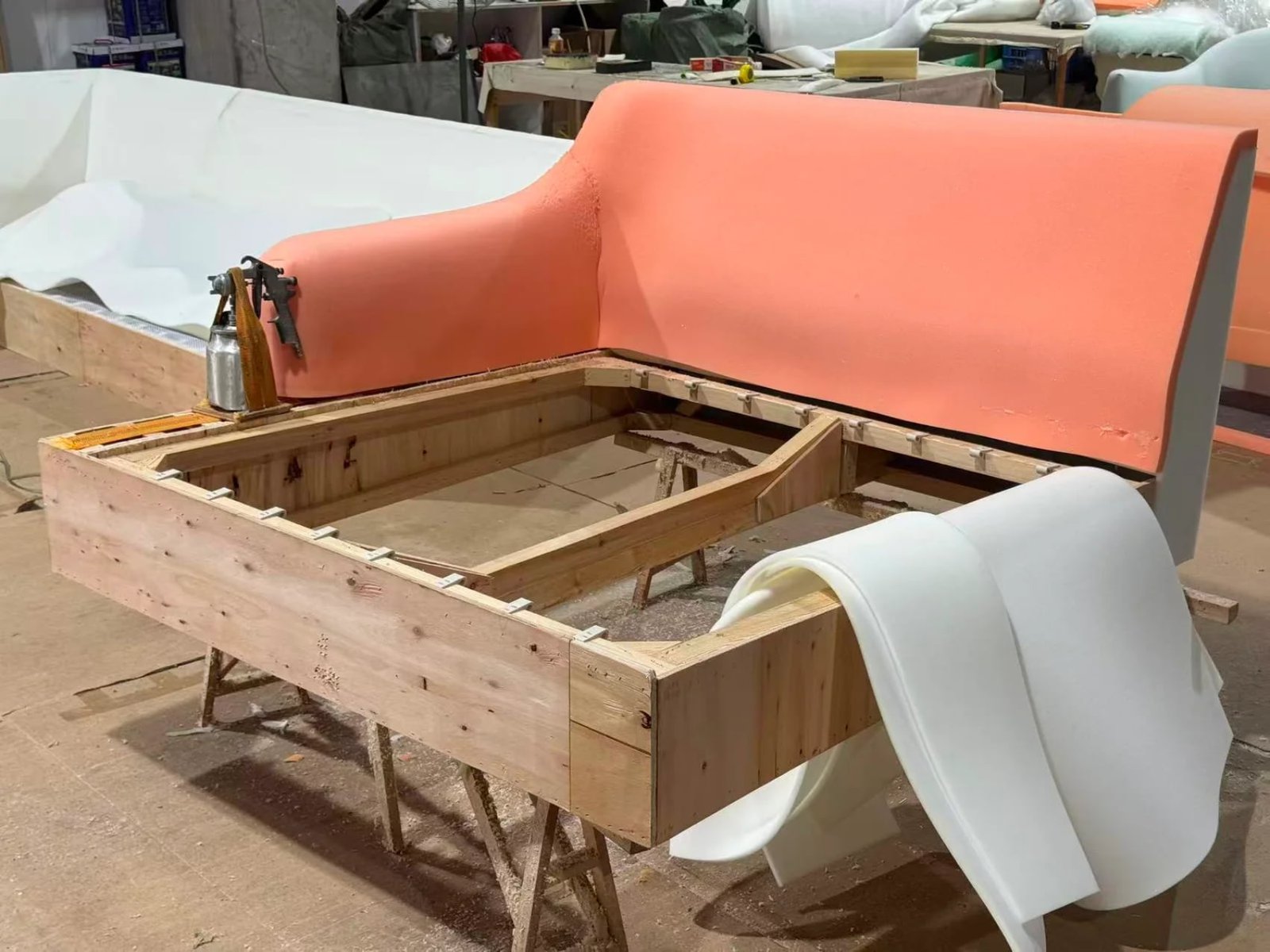
Two linen sofas differ because fabric, frame, suspension, filling, seat depth, back support, stitching, tailoring, and finishing all affect the result. I compare these details because they decide comfort, durability, appearance, maintenance, and value more than the word “linen” alone.
The Hidden Parts Change the Final Sofa
In our workshop, I see that the outside fabric is only one part of the sofa. The inside structure does a lot of work. A sofa can use a nice linen, but still feel weak if the frame is poor. It can look elegant in a photo, but sit too shallow or too soft in real life. It can have a beautiful color, but the seams may twist if cutting and tailoring are not controlled.
For high-end homes, the sofa must look right and sit right. A low, deep Belgian-style linen sofa needs a different cushion feel from a formal upright sofa. A villa living room may need larger modules, deeper seats, and better back support. A boutique hotel lounge may need a firmer seat and stronger fabric plan. I do not separate beauty from construction. I see them as one decision.
| Sofa Detail | What I Look For | Buyer Outcome |
|---|---|---|
| Frame | I check strength and shape accuracy | The sofa keeps its form better |
| Suspension | I check support under the seat | The sofa feels stable, not hollow |
| Filling | I check foam, feather, or mixed filling | The seat matches soft or firm needs |
| Seat depth | I check body size and room use | The sofa feels lounge-like or formal |
| Back height | I check support and visual balance | The sofa supports comfort and proportion |
| Stitching | I check seam line and tension | The sofa looks clean and tailored |
| Fabric cutting | I check direction and grain | The texture sits evenly on the piece |
| Finishing | I check corners, skirt, legs, and folds | The final look feels intentional |
What I Ask Before Production
I ask simple questions because simple questions prevent expensive mistakes. I ask how the sofa will be used. I ask whether the client wants a sink-in feel or a neat seat. I ask if the room needs one large sofa, a sectional, or separate pieces. I ask if the linen should look crisp or relaxed. I also ask for drawings, room plans, or reference photos when the designer has them. These details help us build a sofa that matches the project, not just a catalog image.
What Does Custom Really Mean in a Linen Sofa?
Custom should not only mean changing size or color. If that is all the supplier offers, the design may still feel unfinished.
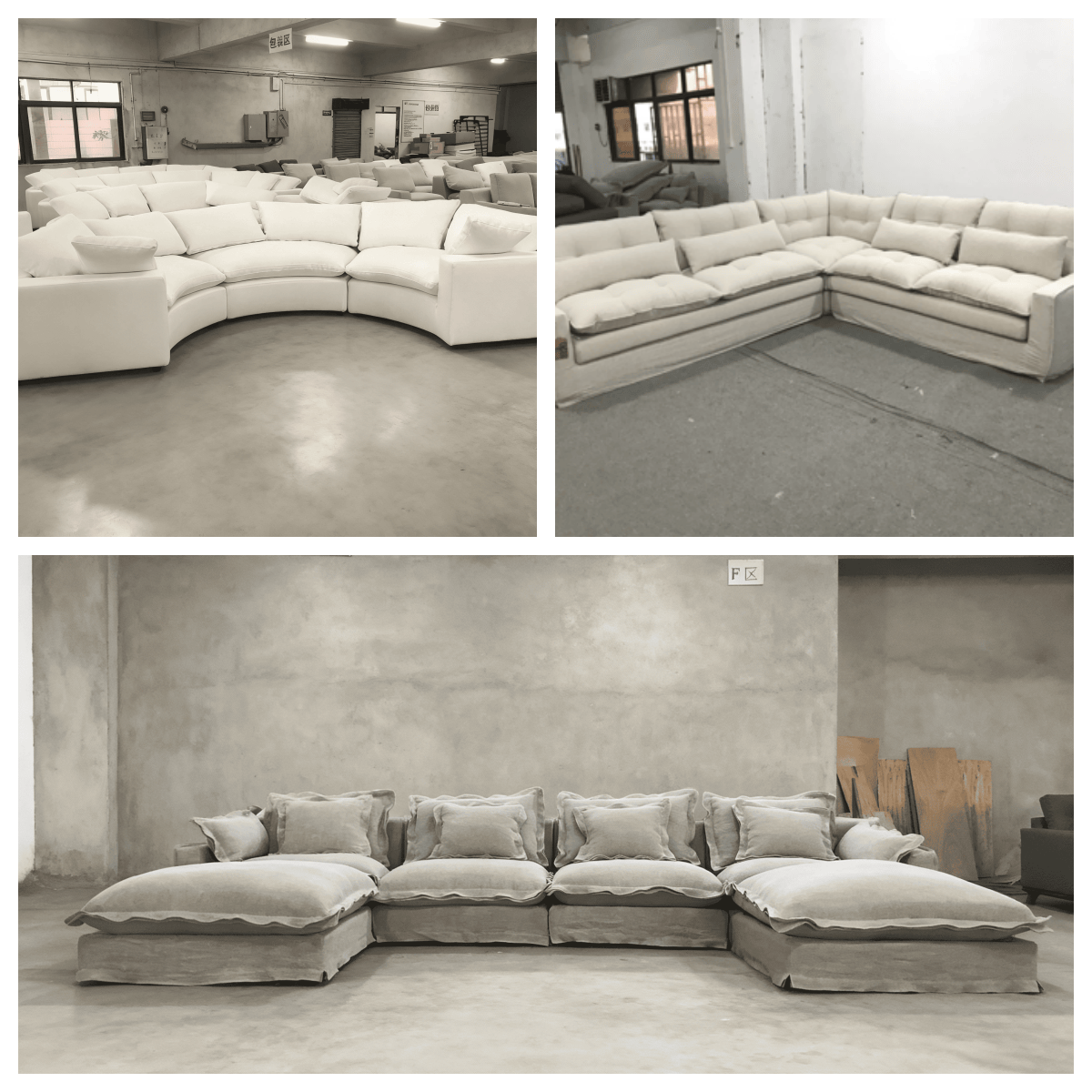
Custom linen sofa work includes proportion, module layout, seat depth, arm style, fabric direction, color matching, COM fabric support, sample confirmation, drawings, measurements, and final detail control. I use these steps to help the finished sofa support the original design intent.
Custom Is a Process, Not a Button
In many overseas projects, I see that designers do not just want a sofa. They want a certain feeling. They may need a relaxed linen slipcover look for a coastal home. They may need a tailored tight-back sofa for a quiet city apartment. They may need a large sectional for a villa with a wide living room. The sofa must hold the right proportion in the space.
Custom work starts with size, but it should not stop there. A 10 cm change in seat depth can change the way a person sits.8 A thicker arm can make the sofa feel more grounded. A lower back can make the room feel more open. A skirt can soften the look. A wood leg can make it feel lighter. Fabric direction can change the visual flow. These are not small details when the project is high-end.
| Custom Choice | What I Confirm | Why It Matters |
|---|---|---|
| Overall size | I confirm width, depth, and height | The sofa fits the room and plan |
| Module layout | I confirm left/right chaise and units | The sofa matches traffic flow |
| Seat depth | I confirm lounge or formal use | The sofa supports the right posture |
| Arm style | I confirm width, height, and shape | The sofa matches the design language |
| Back style | I confirm cushion type and height | The sofa gives correct support |
| Fabric color | I confirm swatch or sample approval | The final tone is less risky |
| Fabric direction | I confirm cutting direction | The texture looks controlled |
| COM fabric | I confirm fabric width and usability | Designer-supplied fabric can be planned |
| Drawing review | I confirm measurements before making | The factory and client read the same plan |
How I Use Samples and Drawings
I like to slow down before cutting fabric. A sofa mistake is not easy to fix after production. I prefer to confirm fabric samples, color references, and measurements before the order moves forward. If a designer sends COM fabric, I need to know the fabric width, repeat, backing, and quantity. If the fabric has a direction, I need to plan cutting more carefully. If the sofa has several modules, I need to confirm how the modules connect and how they will be packed. I do not see custom as decoration. I see it as control.
How Should I Judge Comfort Before I Order?
Comfort is hard to judge from a photo. A sofa can look deep and soft, but still feel wrong for the body.
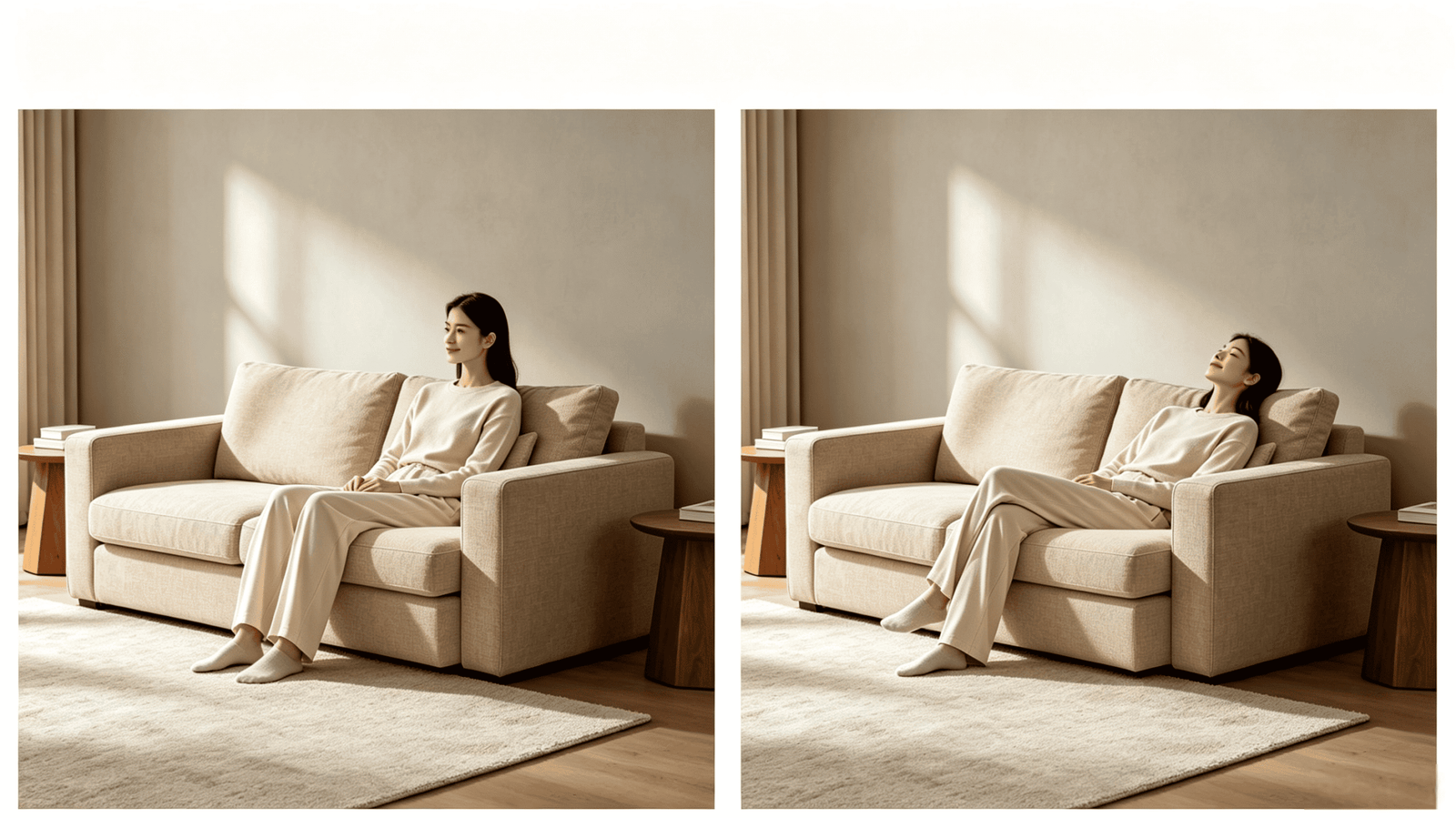
I judge comfort by seat depth, cushion filling, foam density9, back angle, back cushion height, arm height, and use scene. I also ask whether the client wants a formal sit, a relaxed lounge sit, or a soft sink-in feel.
Comfort Has Many Small Parts
When I talk with overseas clients, I notice that comfort words can be unclear. One person says “soft,” but means a cushion that lets the body sink in. Another person says “soft,” but means a smooth surface with good support. One designer asks for a relaxed Belgian sofa, but the homeowner still wants to sit upright with a glass of wine. So I try to connect comfort words with real construction choices.
Seat depth is one of the biggest comfort points. A deeper seat feels good for lounging, but it may not suit shorter users without loose back cushions. Foam and feather mixes can feel soft and casual, but they may need more fluffing. A firmer foam seat can look cleaner and need less shaping, but it may feel less relaxed. Back angle and cushion height also matter. High pricing alone cannot guarantee comfortable seating; genuine long-term comfort comes from structural and filling specifications tailored to the user’s daily habits and body type.
| Comfort Factor | Softer Choice | Firmer Choice | What I Explain |
|---|---|---|---|
| Seat depth | Deeper lounge depth | Standard formal depth | I match it with body size and use |
| Seat filling | Feather or mixed filling | High-resilience foam | I balance softness and shape holding |
| Back cushion | Loose and relaxed | Tighter and cleaner | I match look with support |
| Back angle | More reclined | More upright | I match sitting habit |
| Arm height | Lower lounge arm | Higher support arm | I match resting comfort |
| Cushion shape | Rounded soft edge | Clean boxed edge | I match casual or tailored look |
How I Reduce Comfort Risk
I cannot ask every overseas client to sit on the sample before ordering. So I use detailed questions. I ask what sofa they already like. I ask the seat depth they are used to. I ask if the sofa is for daily family use, formal hosting, or a bedroom sitting area. I ask whether they prefer a neat cushion surface or a more relaxed surface. I also use reference photos, drawings, and clear specifications. This does not remove every risk, but it reduces blind guessing. For high-end custom work, that is important.
How Can I Reduce Risk When Buying a Linen Sofa Overseas?
Overseas buying can save budget, but it can also create stress. Color, quality, packing, and communication must be controlled.
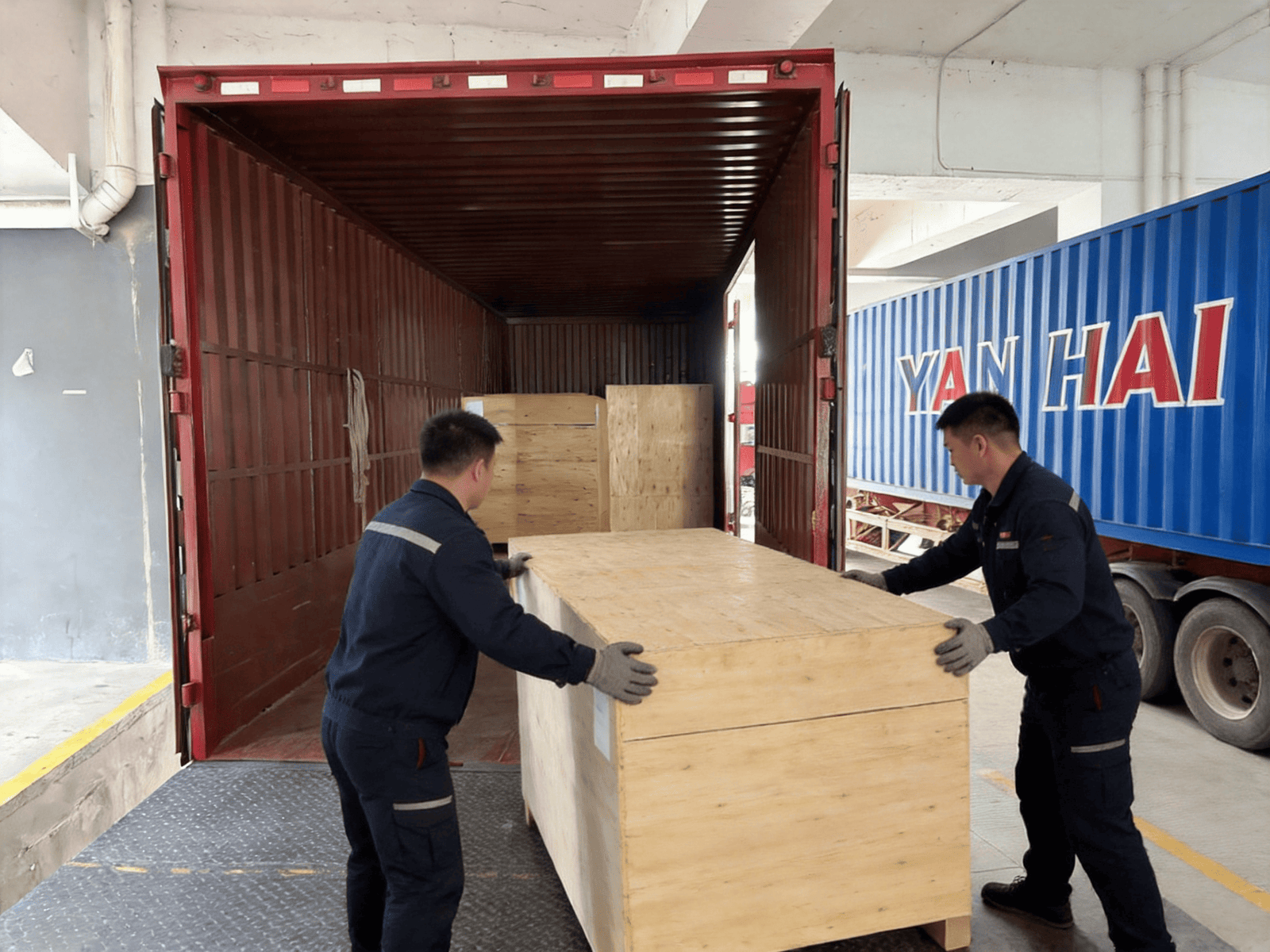
I reduce overseas buying risk by confirming fabric samples, color cards, specifications, drawings, production details, quality checks, pre-shipment photos, packing method10, shipping communication, and cost terms. A good supplier should make the process visible before you pay the final balance.
The Real Risk Is Usually Process Control
I understand why designers and homeowners worry about overseas custom furniture. A linen sofa is large, personal, and expensive to correct. If the color is wrong, the room may not work. If the seat is wrong, the client may not use it. If packing is weak, shipping damage can ruin the schedule. If communication is unclear, the final sofa may follow the factory’s habit instead of the design intent.
From our Foshan factory experience, I do not think the answer is to avoid overseas buying. I think the answer is to check the supplier’s process. A supplier should not only show nice photos. The supplier should explain what will be confirmed before production, what will be checked during production, and what will be shown before shipment. This is where many project risks become smaller.
| Supplier Check | What I Expect to See | Why It Protects the Project |
|---|---|---|
| Fabric swatches | I expect real samples when needed | The client sees texture and color better |
| Color card | I expect a clear color selection system | The designer can compare tones |
| Specification sheet | I expect size, material, and details | The team avoids memory-based decisions |
| Drawing confirmation | I expect measurements and layout review | The sofa fits the plan |
| Production photos | I expect key stage updates | The client sees progress and details |
| QC photos or video | I expect final checks before shipping | The client sees the finished sofa |
| Packing plan | I expect corner, fabric, and frame protection | The sofa has better shipping safety |
| Shipping communication | I expect clear timing and documents | The buyer can plan delivery |
| Cost transparency | I expect clear product, packing, and shipping terms | The buyer understands the real budget |
How I Think About Price and Value
Price matters. I never pretend it does not. Many overseas clients come to us because a custom linen sofa from China can cost less than buying from a local high-end custom source. In some project cases, the saving can be around 40–60% compared with local purchasing11, but this depends on configuration, quantity, shipping, duties, fabric choice, and project requirements. I always think the better question is not “What is the lowest price?” The better question is “What value is controlled at this price?”
Extremely low pricing often cuts critical production costs, which may translate to thinner low-grade fabric, simplified frame construction, budget cushion fill, rushed tailoring or insufficient shipping protective packaging in most cases. A good price should still include the details that protect the project. I prefer to explain what is included, what can be upgraded, and what affects the final cost. This helps the buyer compare offers in a fair way.
What Questions Should I Ask Before I Choose a Linen Sofa Supplier?
A supplier can sound confident, but confidence is not the same as control. I need proof in the questions they can answer.
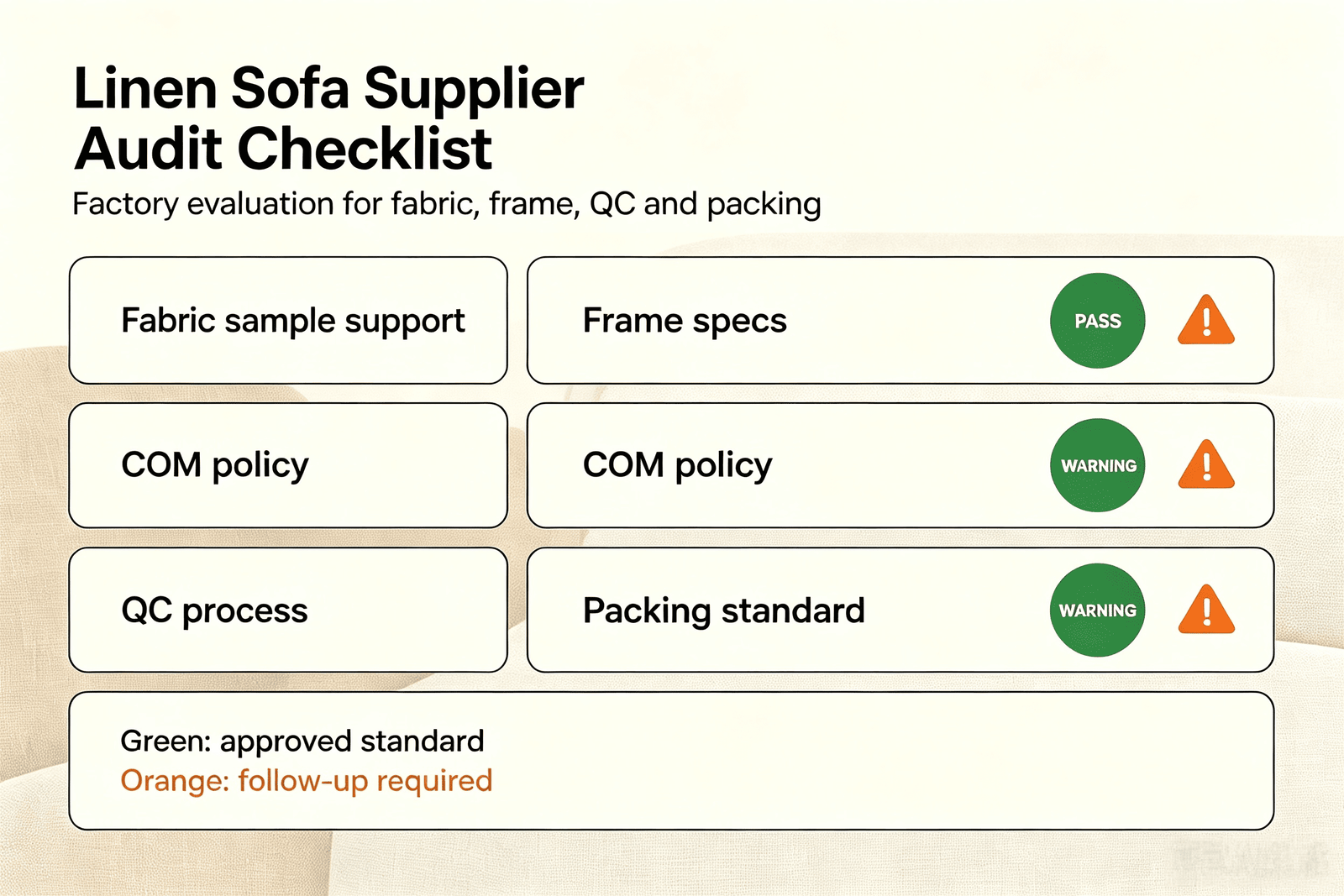
I would ask about linen fabric options, fabric samples, frame structure, cushion filling, seat depth, custom drawing support, COM fabric handling, production checks, packing, shipping terms, and past custom project experience. Clear answers show whether the supplier can manage the sofa beyond the product photo.
My Practical Supplier Checklist
When I speak as Linen World, I speak from factory work. We are based in Foshan, and we focus on linen upholstered furniture, including linen sofas, linen armchairs, linen beds, and linen dining chairs. We have spent years making made-to-order pieces for overseas projects. This does not make us an interior design firm or a testing lab. It does give us strong hands-on experience in fabric selection, upholstery production, custom details, quality checking, packing, and shipping coordination.
If I were a designer or homeowner choosing a supplier, I would ask direct questions. I would not only ask for a catalog. I would ask how the supplier handles decisions before production. I would ask what happens if I send a COM fabric. I would ask how many linen colors are available. I would ask how the supplier confirms the final drawing. I would ask for photos before shipment. I would ask how the sofa will be packed.
| Question I Would Ask | Good Sign | Warning Sign |
|---|---|---|
| Can I see linen swatches? | The supplier offers physical samples or color cards | The supplier only sends edited photos |
| Can I choose from many colors? | The supplier has a clear fabric library | The supplier has vague color names |
| Can you customize the size? | The supplier asks for drawings and use details | The supplier says yes without checking |
| Can you support COM fabric? | The supplier asks width, repeat, and quantity | The supplier accepts without review |
| What is inside the sofa? | The supplier explains frame, suspension, and filling12 | The supplier only says “high quality” |
| How do you check quality? | The supplier shows pre-shipment photos or video | The supplier gives no clear QC step |
| How do you pack it? | The supplier explains protection and carton/crate details | The supplier treats packing as an afterthought |
| What affects the final cost? | The supplier explains fabric, size, structure, and shipping | The supplier only pushes the lowest price |
Why I Prefer Clear Communication
In custom linen sofa projects, I often see that the best result comes from steady communication. A good client does not need to know every factory term. A good supplier should help translate design needs into production choices. If the designer says “clean but relaxed,” I need to ask what that means in cushion style, seam style, and fabric texture. If the homeowner says “soft but not messy,” I need to discuss filling and maintenance. This is how a sofa becomes controllable. A sofa will not automatically turn out flawless just from being labeled "custom"; ideal finished quality relies on full mutual confirmation of all specifications prior to production kickoff.
Conclusion
I buy a linen sofa best when I treat fabric, comfort, structure, custom details, supplier process, and shipping control as one complete decision.
If you’re an interior designer sourcing custom Belgian linen sofas for US & European residential, villa and boutique hotel projects, our 13-year Foshan linen furniture factory offers full pre-production specification confirmation, free fabric swatch service, COM fabric support and complete pre-shipment quality inspection. We provide a full linen sofa purchasing checklist for your client project reference. Message us via WhatsApp to request fabric color cards, factory virtual tours or customized project quotations. https://linenworld.pro
"Investigation of the Properties of Linen Fibers and Dressings - PMC", https://pmc.ncbi.nlm.nih.gov/articles/PMC9501175/. A textile reference identifies linen as a flax-derived fabric known for its textured surface, absorbency, and cool hand, supporting the article’s description of linen as a breathable, natural upholstery material. Evidence role: definition; source type: encyclopedia. Supports: A neutral textile reference should describe linen as a flax-based textile with characteristic texture, absorbency, and cool or breathable hand.. Scope note: This supports linen’s general material properties, not the performance of every linen sofa fabric. ↩
"Advances in Anti-Wrinkle Finishing Agent for Natural Fabrics - PMC", https://pmc.ncbi.nlm.nih.gov/articles/PMC12899052/. Textile research describes linen/flax fabrics as having limited elastic recovery and a tendency to retain creases, supporting the statement that linen upholstery may wrinkle with use. Evidence role: mechanism; source type: paper. Supports: A textile science source should connect linen or flax fabrics with low elastic recovery or crease susceptibility.. Scope note: The degree of wrinkling depends on weave, finishing, blends, and use conditions. ↩
"Investigation of the Properties of Linen Fibers and Dressings - PMC", https://pmc.ncbi.nlm.nih.gov/articles/PMC9501175/. Educational textile sources describe linen as an absorbent cellulosic fiber, supporting the article’s caution that unprotected linen can take up staining liquids. Evidence role: mechanism; source type: education. Supports: A textile source should explain that linen is a cellulosic, absorbent fiber, which can increase liquid uptake and make untreated fabric vulnerable to staining.. Scope note: Absorbency does not determine stain permanence by itself; finishes, soil repellents, cleaning timing, and liquid type also matter. ↩
"Threading Your Way Through the Labeling Requirements Under the ...", https://www.ftc.gov/business-guidance/resources/threading-your-way-through-labeling-requirements-under-textile-wool-acts. Textile-labeling rules require disclosure of fiber names and percentages for textile products, supporting the article’s emphasis on distinguishing pure linen from linen blends. Evidence role: definition; source type: government. Supports: A government textile-labeling source should show that fabrics are identified by fiber content and that blended textile products must disclose constituent fibers.. Scope note: Labeling rules support the need to verify fiber content, but they do not compare the comfort or durability of specific linen blends. ↩
"The Influence of the Upholstery Textiles Structure on Their ... - PMC", https://pmc.ncbi.nlm.nih.gov/articles/PMC12654245/. Textile research links fabric mass per unit area with mechanical performance measures such as abrasion resistance and strength, supporting the use of fabric weight as one indicator in upholstery assessment. Evidence role: mechanism; source type: paper. Supports: A textile study should show that fabric mass per unit area, often alongside weave and yarn parameters, relates to strength, abrasion resistance, or perceived body.. Scope note: Fabric weight is not a complete durability measure; fiber type, yarn construction, weave, finishing, and abrasion-test results are also necessary. ↩
"The effect of fabric structure parameters on dimensional stability ...", https://www.academia.edu/111358273/The_effect_of_fabric_structure_parameters_on_dimensional_stability_after_domestic_washing. Studies of woven fabrics report that thread density and cover factor influence dimensional stability and mechanical behavior, supporting the article’s attention to weave density in sofa fabrics. Evidence role: mechanism; source type: paper. Supports: A textile engineering source should connect weave density or cover factor with dimensional stability, abrasion resistance, and fabric deformation.. Scope note: The source would support the mechanism generally rather than proving that any particular linen sofa will avoid sagging. ↩
"Dimensional stability (fabric) - Wikipedia", https://en.wikipedia.org/wiki/Dimensional_stability_(fabric). Research on linen and other cellulosic fabrics documents dimensional change under moisture, finishing, or laundering conditions, supporting the article’s emphasis on shrinkage control before cutting and sewing. Evidence role: mechanism; source type: paper. Supports: A textile source should document dimensional change or shrinkage behavior in linen or cellulosic fabrics and explain why pre-production control matters.. Scope note: Actual shrinkage depends on the specific fabric, finishing process, upholstery construction, and cleaning method. ↩
"Chair Size Design Based on User Height - PMC - NIH", https://pmc.ncbi.nlm.nih.gov/articles/PMC9944090/. Ergonomics research on seated posture shows that seat depth influences thigh support, backrest contact, and comfort, supporting the article’s statement that a 10 cm depth change can affect how a person sits. Evidence role: mechanism; source type: paper. Supports: An ergonomics study should show that seat depth affects posture, thigh support, back contact, or perceived comfort.. Scope note: Most ergonomics studies examine chairs or task seating, so the evidence is contextual for sofas rather than sofa-specific. ↩
"Foam Performance - Polyurethane Foam Association", https://pfa.org/foam-performance/. Research on flexible polyurethane foams uses density and indentation-force measures to characterize seating support and performance, supporting the article’s inclusion of foam density in comfort assessment. Evidence role: mechanism; source type: paper. Supports: A materials or seating study should show that flexible polyurethane foam properties such as density and indentation force deflection are used to characterize cushion support and durability.. Scope note: Foam density alone does not determine comfort; foam formulation, firmness, cushion geometry, upholstery layers, and user preference also matter. ↩
"Test Procedures - International Safe Transit Association", https://ista.org/test_procedures.php. Distribution-packaging standards such as ISTA and ASTM protocols evaluate packages for shock, vibration, compression, and handling hazards, supporting the article’s claim that packing method is central to reducing shipping damage. Evidence role: expert_consensus; source type: institution. Supports: A packaging standards body should show that transport packaging is tested against handling, compression, vibration, and shock risks in distribution.. Scope note: Packaging standards support the risk-control principle but do not guarantee damage-free delivery for a specific shipment. ↩
"The Effect of Furniture Imports from China on Employment in U.S. ...", https://www.usitc.gov/publications/332/working_papers/ecwp_2017-08-a-08-23-17_0.htm. Government trade statistics on upholstered furniture imports can contextualize price differences between imported Chinese furniture and domestic purchasing channels, offering background for the article’s stated savings range. Evidence role: statistic; source type: government. Supports: A neutral trade or customs source should provide import values, unit values, or market data that contextualize price differences between Chinese furniture exports and local retail/custom purchasing.. Scope note: Trade statistics would provide contextual pricing evidence only; they would not directly prove a 40–60% saving for a specific custom sofa without transaction-level comparisons. ↩
"Upholstered Furniture Guide: Fabric, Foam & Wood Frames", https://mocluc.com/upholstered-furniture-guide-fabric-foam-wood-frames/. Furniture testing and design standards evaluate seating performance through structural support, cyclic loading, and cushioning behavior, supporting the article’s claim that frame, suspension, and filling affect sofa comfort and durability. Evidence role: expert_consensus; source type: institution. Supports: A furniture-testing or standards source should show that seating durability and performance depend on structural elements such as frames, suspension systems, and cushioning.. Scope note: Standards establish evaluation categories and mechanisms; they do not certify the construction quality of the article’s supplier or any named sofa. ↩


