Ordering a custom linen bed from a factory overseas sounds straightforward — until a project deadline slips because a fabric wasn't confirmed in time. Designers who've been through that once know the custom bed process is a sequence of decisions, not a passive wait. Miss one checkpoint, and the whole timeline shifts.
The custom bed process moves through five decision gates: dimensions and headboard design, fabric selection or COM submission, production scheduling, quality inspection, and shipping coordination. At each gate, the factory needs something specific from the designer before work can continue. Understanding what those requirements are — and how long each phase realistically takes — is what separates a smooth project from a painful one.
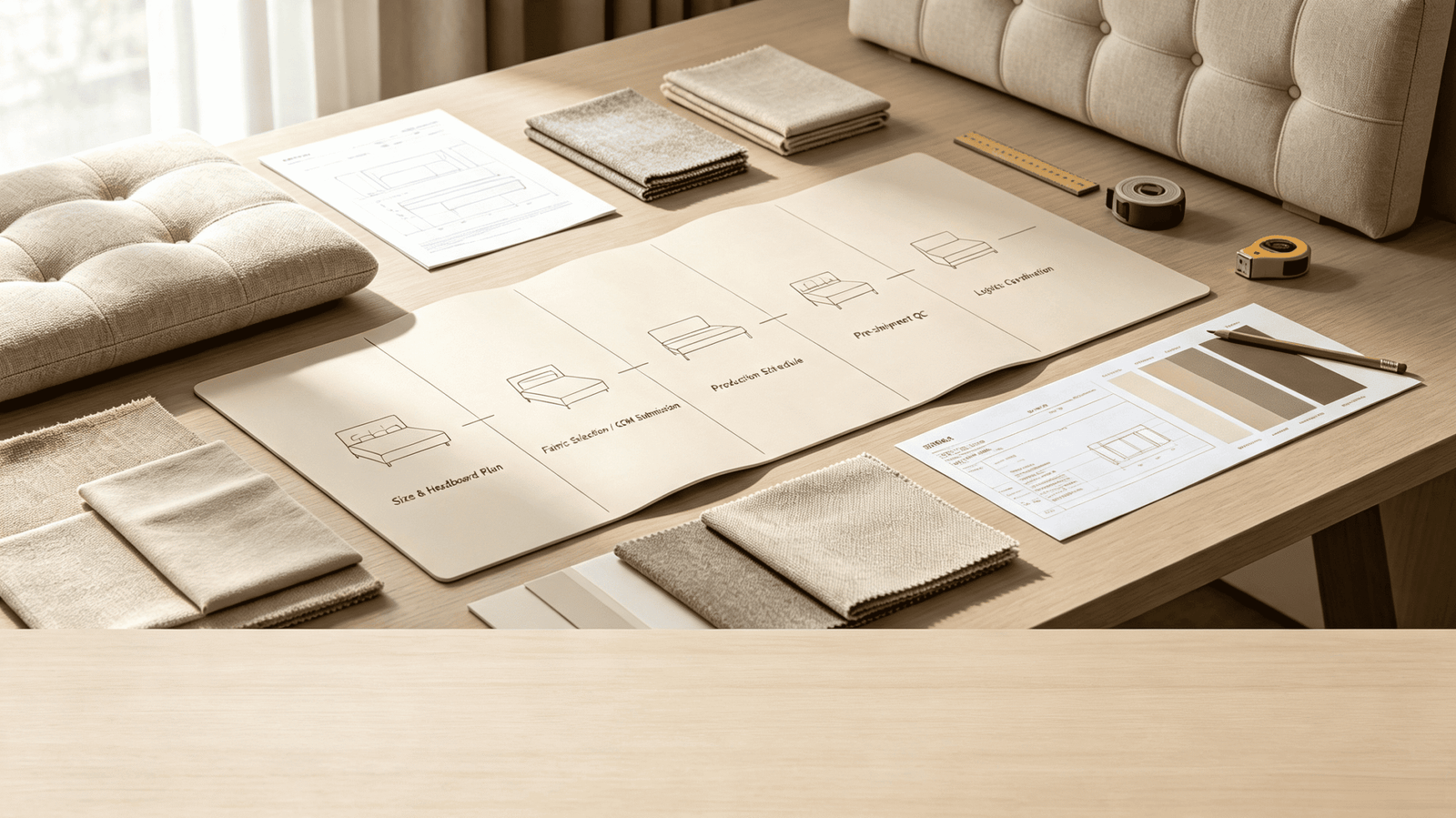
The five phases above describe a complete workflow, but the timeline variation between a 10-week delivery and a 16-week delivery almost always traces back to a single sticking point: fabric confirmation. The sections below walk through each phase in production order, with the specific designer decisions that determine whether your project stays on schedule.
What Information Does the Factory Need Before Production Begins?
Designers often send an inquiry thinking they need one number — the price. But in our workflow, pricing depends on at least four confirmed variables before we can even generate an accurate quote.
This is the phase where under-prepared inquiries stall. A designer who arrives with full specs moves to production scheduling within days. A designer who's still deciding on headboard height can add two to three weeks before a single cut is made.
The Four Variables We Need to Lock First
Before fabric and finish come into the picture, the designer needs to confirm:
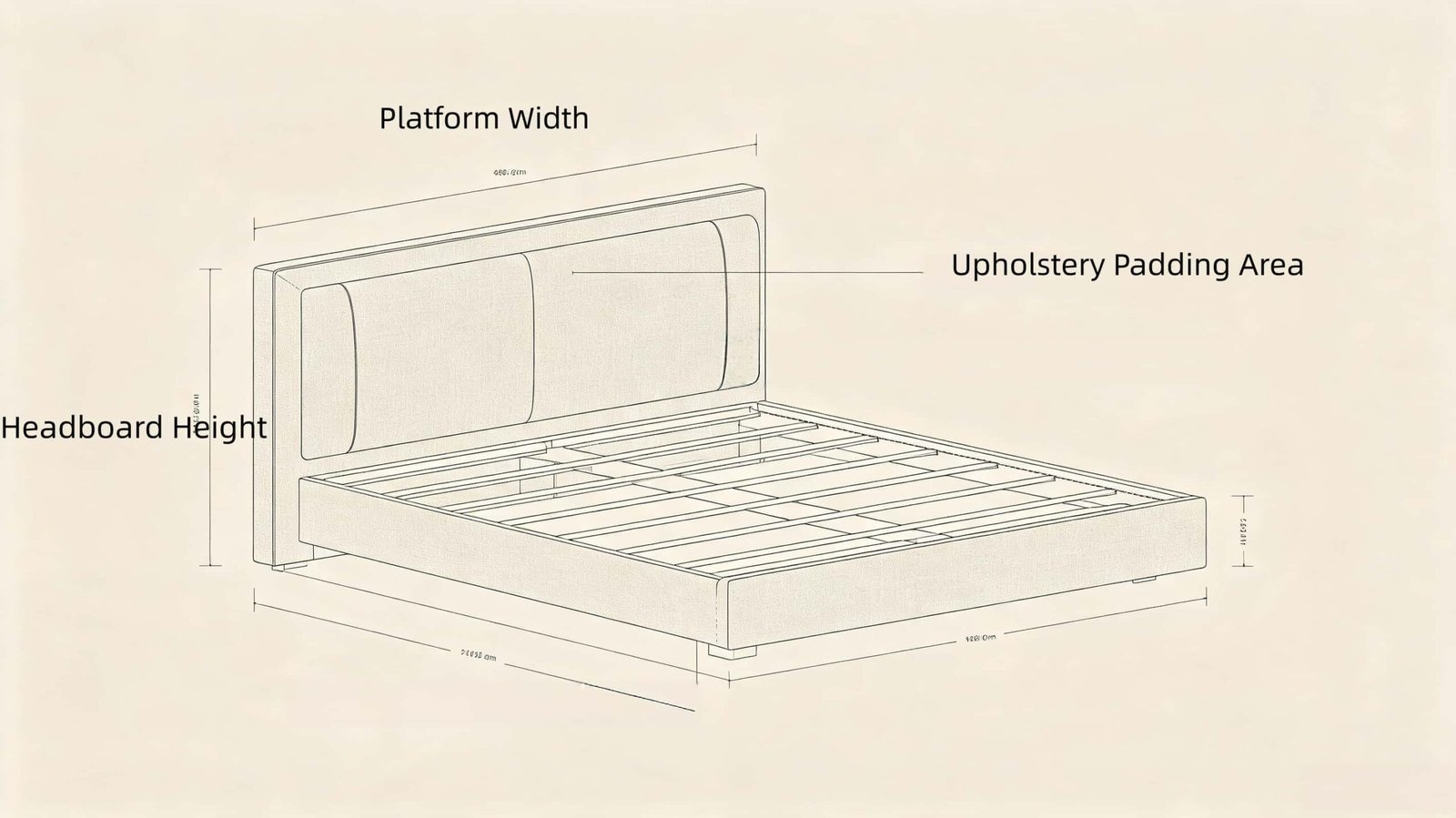
Bed size: U.S. standard (Twin, Full, Queen, King, Cal King) or custom dimensions. If the room calls for a non-standard footprint — say, a platform bed at a specific width to fit an architectural alcove — those measurements must come with a technical drawing or annotated floor plan.
Headboard style and height: This is not a minor aesthetic decision. Headboard height directly affects fabric yardage and whether hand-stitched seam centering is achievable within your design. A tall statement headboard (48"+ from the top of the mattress)1 requires more fabric and adds production time. We offer standard profiles and accept custom drawings.
Platform or base type: Upholstered platform, slat base, legs, or a combination. Each changes both material cost and production complexity.
Overall finish direction: This matters before fabric selection because some linen weaves read very differently in low-light bedroom environments versus natural light showrooms. Knowing whether the install is a dark coastal bedroom or a bright open-plan suite helps our team make useful recommendations.
What "Custom" Actually Means for Tolerances
When a designer specifies a non-standard dimension — a bed frame at 68" wide instead of 60" — we typically produce within a ±0.5 cm tolerance on frame dimensions2. On upholstered surfaces, slight variation in the linen itself can affect the visual line of a seam by 1–2 mm. We flag this upfront rather than after delivery. If your design has a specific seam placement requirement, tell us at this stage so we can factor it into the cutting pattern.
Realistic timeline for this phase: 3–7 business days if the designer arrives with full specs. Longer if revisions to drawings or dimensions are needed.
How Does Fabric Selection Work — and What Makes It the Highest-Risk Step?
Fabric confirmation is where most custom bed delays originate. In our experience, this is also the step designers most consistently underestimate.
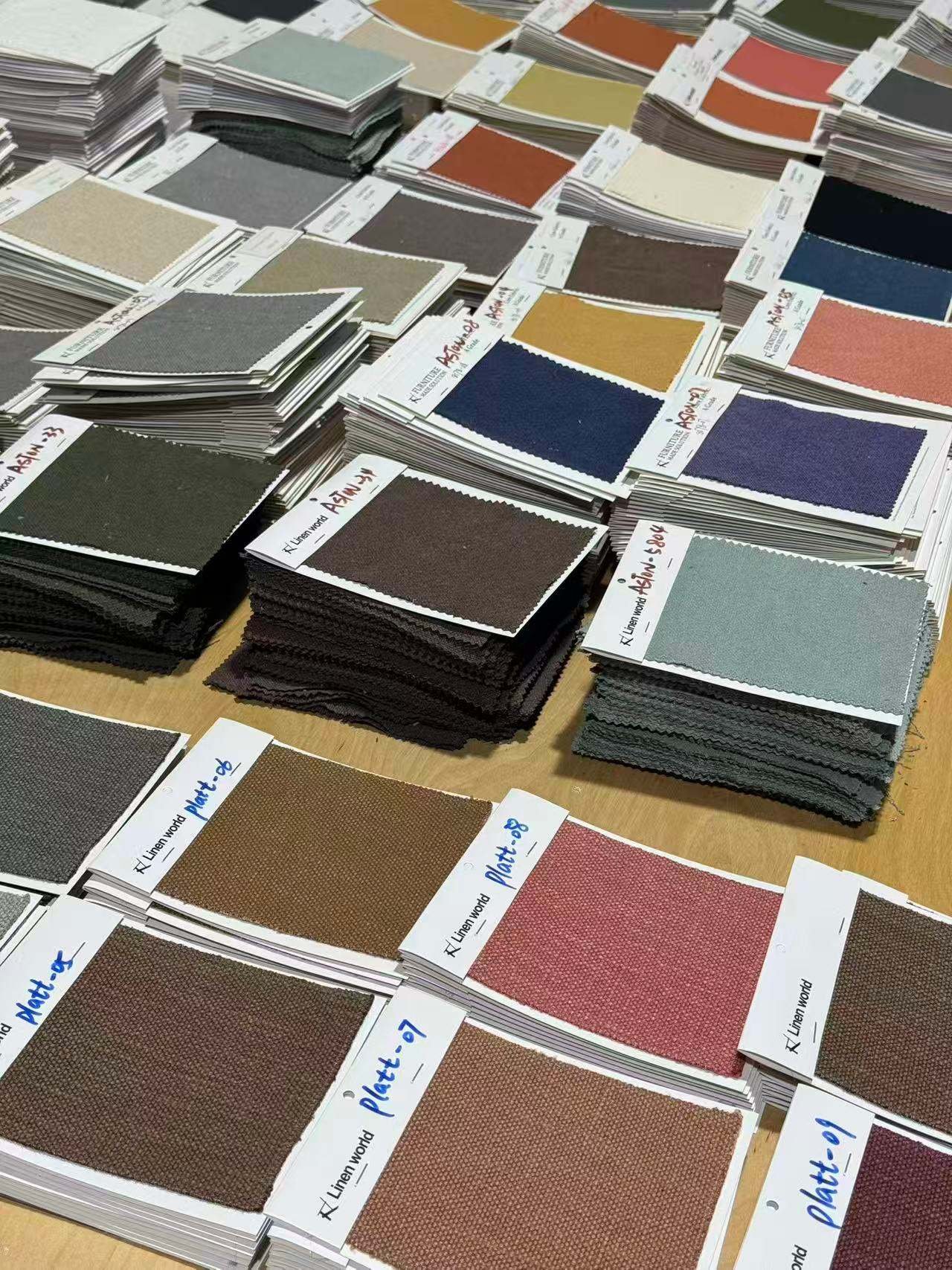
The friction isn't about having too few options. With 200+ Belgium pure linen colors available as made-to-order selections3, the problem is the opposite — confirming the right color in context, across a physical swatch, before production begins.
The Two Paths: Our Linen vs. COM
Designers working with us have two distinct options for fabric. These are not interchangeable — they have different lead times, different requirements, and different risk profiles.
Path 1: Our Belgium Pure Linen (Standard Selection)
We source Belgium pure linen directly, which is part of how we're able to offer pricing 40–60% below comparable U.S. custom workshops4 without compromising material quality. Belgium linen is the benchmark for upholstery-grade linen: consistent thread count, stable weave, low pilling tendency, and the natural slubbing that gives high-end linen furniture its characteristic texture.
The designer's responsibility at this stage:
- Request a physical swatch set (we ship these; allow 1–2 weeks for international delivery)
- Review swatches under the actual install lighting, not studio lighting
- Return written sign-off on a specific color code — not a description like "the warm greige one"
- Confirm whether a linen-cotton blend is acceptable or if pure linen is required for the project
Important: Production does not start until we receive written fabric confirmation. This is not a formality. We've seen projects delayed by four weeks because a designer's client changed their mind after an informal "that one looks fine" approval. Written sign-off protects both sides.
Path 2: COM (Customer's Own Material)
COM is a legitimate path — many designers working with trade accounts or specified fabrics from other vendors want to use their own material. We support COM, but it carries its own set of requirements that need to be treated as a parallel process, not an afterthought.
COM Requirements at Linen World
| Requirement | Detail |
|---|---|
| Fabric submission lead time | COM must arrive at our Foshan facility before production is scheduled |
| Yardage | We calculate required yardage based on confirmed bed dimensions and repeat; designer is responsible for overage |
| Care and content label | Required for correct handling and stitching tension settings |
| Pre-arrival notice | Designer should send fabric specs digitally before physical shipment so we can flag any workability concerns |
| Fabric condition on arrival | Fabric must arrive uncut, un-hemmed, and free of damage; we inspect on receipt |
One thing we see repeatedly: Designers ship COM fabric before confirming yardage with us and arrive short by half a yard. This creates a two-to-four week delay while replacement yardage is sourced and shipped. The fix is simple — send us the confirmed dimensions first, let us calculate yardage, then ship.
Realistic timeline for fabric confirmation phase:
- Our linen: 1–3 weeks from swatch shipment to written sign-off (depends on client review speed)
- COM: Add transit time for fabric to reach Foshan, plus 3–5 business days for our receipt inspection
What Happens During Production, and How Long Does It Take?
Once fabric is confirmed and deposit is received, the bed enters our production queue. This is the phase designers have the least visibility into — and where realistic expectations matter most.
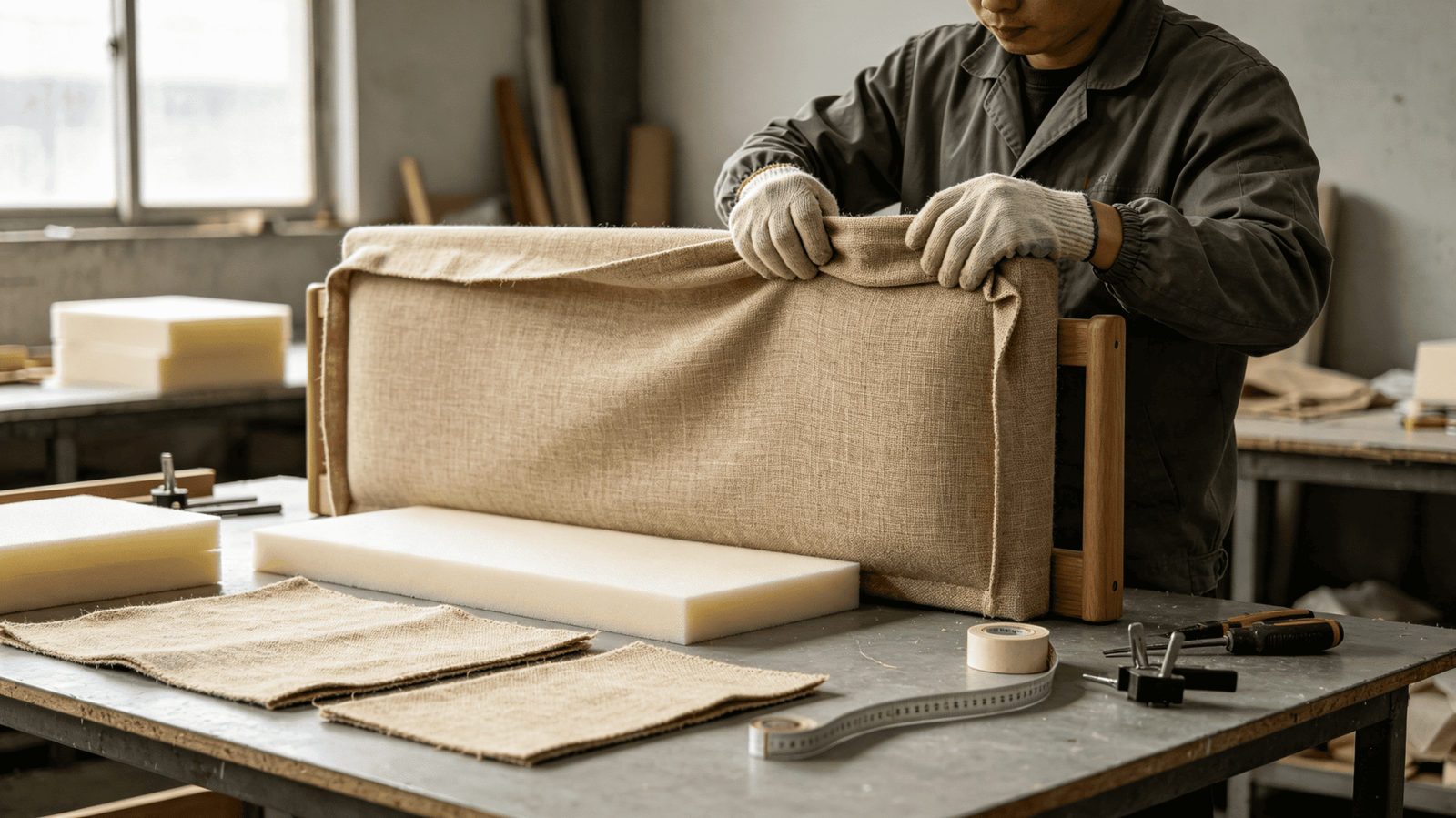
The custom bed production process at our factory involves frame construction, upholstery, hand-stitching, and final inspection before packaging. Each phase is sequential; you cannot rush upholstery onto an unfinished frame.
Production Phase Breakdown
Frame construction (typically 5–8 business days): Solid wood frame built to confirmed dimensions. At this stage, any changes to dimensions are costly and disruptive — this is why the spec lock in Phase 1 matters so much.
Upholstery and padding (typically 7–12 business days): This is where the hand-craft detail is most visible. Seams on a tall headboard are centered by hand, not by machine measurement alone, because linen's natural slub can shift a seam line slightly5. Our upholstery team adjusts tension and placement visually as well as by measurement. This process cannot be meaningfully accelerated without compromising the result.
Hand-stitching and edge work (3–5 business days): Tufting, piping, or plain-edge finish depending on the design. For tufted headboards, button placement is laid out relative to the full upholstered panel, not just measured from the frame edge — this ensures visual symmetry even when linen stretches slightly during upholstery.
What Causes Production Delays
- Peak season scheduling: We run at higher capacity from August through November (ahead of the U.S. holiday season). Orders entering the queue during peak periods may wait 2–3 weeks before frame construction begins.
- Material hold: If COM fabric arrives late, the entire production slot shifts.
- Design change requests mid-production: Any change after frame construction begins resets the timeline for that piece.
Realistic total production timeline: 6–10 weeks from deposit confirmation and fabric sign-off, under normal queue conditions. Peak season: add 2–3 weeks.
How Does Quality Inspection Work Before the Bed Ships?
Before any piece leaves our facility, it goes through a structured inspection. This step exists because shipping a custom bed internationally is expensive and logistically complex — returning a defective piece is not a viable recovery option for the designer or the client.
Our inspection process covers the following checkpoints:
Quality Inspection Checklist (Standard for All Custom Beds)
- Dimension verification: Frame measurements checked against the confirmed specification sheet
- Seam centering and alignment: Visual check on all upholstered panels for seam placement relative to design centerline
- Surface texture and fabric integrity: Linen surface checked for pulls, pilling, or tension irregularities
- Edge and corner work: Piping or plain edge checked for consistent width and clean corners
- Hardware and base: Leg attachment, slat alignment (if applicable), and structural stability
- Photographic documentation: We send the designer a photo set of the completed piece before packaging — this is the designer's final approval before shipping
Designer action required: The photo sign-off is not optional. We hold shipment until the designer reviews and approves the photo documentation. This step typically takes 1–3 business days on the designer's end. Factor this into your project schedule.
What Do Designers Need to Know About Shipping a Custom Bed?
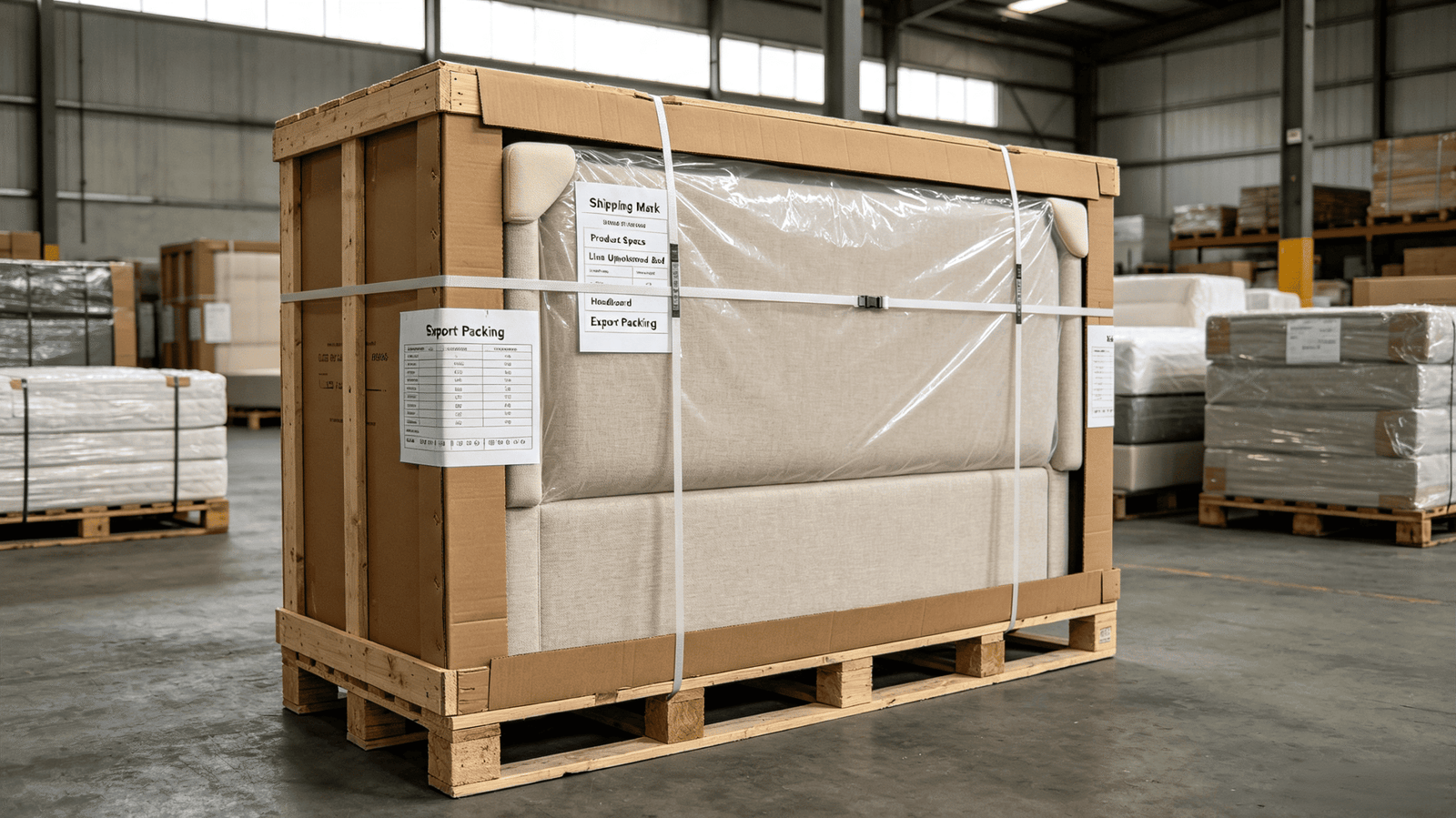
A custom linen bed from Foshan to a U.S. delivery address is an oversized freight shipment. It does not move like a small parcel, and it does not have the flexibility of a regional freight network.
Key Shipping Realities
Sea freight is the standard route. Air freight for a custom bed is cost-prohibitive in most project budgets. Standard sea freight from Foshan to a U.S. port (Los Angeles, Long Beach, or East Coast ports depending on destination) runs approximately 4–6 weeks in transit.
Customs clearance adds time. Allow 1–2 weeks for customs clearance and drayage from port to the designer's warehouse or white-glove delivery address.
The designer is responsible for last-mile coordination. We deliver to port or to a freight forwarder. White-glove installation is arranged by the designer on the U.S. side.
What to prepare at the shipping stage:
- Confirmed U.S. delivery address (warehouse or white-glove service)
- Customs broker contact if you have one (for smoother clearance)
- Site delivery constraints: elevator dimensions, stairwell width, doorway clearance — a fully assembled custom King bed does not fit through a standard 32" doorway6; headboard may need to be installed on-site
Realistic end-to-end timeline summary:
| Phase | Typical Duration |
|---|---|
| Spec confirmation | 3–7 business days |
| Fabric selection / swatch review | 1–3 weeks |
| COM submission and receipt | Variable (designer controls) |
| Production | 6–10 weeks |
| Quality inspection and photo sign-off | 1–2 weeks |
| Sea freight transit | 4–6 weeks |
| Customs and last-mile delivery | 1–2 weeks |
| Total (typical range) | 14–22 weeks |
Frequently Asked Questions
Can I request a sample before placing a full custom bed order?
Yes. We can ship a physical swatch set from our Belgium pure linen range. We strongly recommend this before confirming a color, especially for projects with specific lighting conditions. Swatch delivery to the U.S. typically takes 1–2 weeks. If you're considering COM, send us a fabric spec sheet before shipping material so we can assess workability.
What is the minimum order quantity for a custom linen bed?
We accept single-piece custom orders. There is no minimum quantity requirement. Designers ordering multiple pieces for a project may see more favorable unit pricing — this is worth discussing at the inquiry stage when you share your project scope.
How does the 40–60% cost saving compare to U.S. custom workshops?
The saving comes from three factors: we source Belgium pure linen directly rather than through distributors, our production operates at factory scale in Foshan with 13 years of workflow refinement7, and there is no middleman markup between production and the designer. A custom upholstered linen bed that retails through a U.S. custom workshop at $8,000–$12,000 typically falls in the $3,500–$6,000 range8 through us at comparable material and craft level. These are indicative ranges — exact pricing depends on your confirmed specifications.
What happens if my COM fabric arrives and has a workability issue?
We inspect COM fabric on receipt and notify the designer within 3–5 business days. If the fabric has a structural issue (too light for upholstery tension, unstable weave), we flag it before cutting and send a detailed report. At that point, the designer decides whether to source replacement material or switch to a fabric from our range. This adds time, but catching it before production is far less costly than discovering it after.
Can I make changes to the design after production starts?
Changes after frame construction begins are costly and usually require restarting affected components. Minor surface-level changes (button count, edge finish preference) may be possible before upholstery begins. We recommend treating spec confirmation as a hard lock — revisit every design detail with your client before signing off, not after.
Conclusion
The custom bed process is a sequence of decisions, and the designers who navigate it smoothly are the ones who understand that each phase has a specific input required from them — not just from the factory. Lock your dimensions and headboard design early. Treat fabric confirmation as a critical-path task, not a final detail. If you're using COM, treat it as its own parallel process with its own lead time. Build a realistic 14–22 week window into your project schedule, and communicate that window to your client before you confirm the order.
At Linen World https://linenworld.pro/ , we've supported designers through this process for 13 years, working with Belgium pure linen sourced directly and producing entirely made-to-order. If you're pricing a custom linen bed for a current project, reach out with your specs — dimensions, headboard direction, fabric path — and we'll send you a detailed quote and swatch set so you can have a real conversation with your client about what's possible.
"Custom Furniture - Linen World | Handcrafted Bespoke Pure ...", https://linenworld.pro/custom-furniture/. Interior design guidelines typically categorize headboards as standard (20-36 inches above mattress), tall (36-54 inches), or statement/grand scale (54+ inches), with proportions selected based on ceiling height and room scale to maintain visual balance. Evidence role: definition; source type: education. Supports: Standard classifications and proportions for headboard heights in furniture design. Scope note: Headboard height classifications are design conventions rather than regulated standards and vary across design traditions and regional preferences ↩
"UTD DGCS 12-00-00 Furnishings", https://facilities.utdallas.edu/download/UTD_DGCS_12-00-00_Furnishings.pdf. Custom furniture manufacturers typically work to tolerances between ±0.3 cm and ±1.0 cm depending on material, construction method, and price point, with precision woodworking operations achieving tighter tolerances than budget production. Evidence role: general_support; source type: institution. Supports: Industry-standard dimensional tolerances for custom furniture frame construction. Scope note: Tolerance standards vary by country, material type, and whether frames are machine-cut or hand-finished ↩
"INDIANSKOP - Linen World", https://linenworld.pro/fabric-swatch/indianskop/. European linen suppliers for the upholstery and home furnishings trade typically maintain color palettes ranging from 50 to 300+ options depending on manufacturer scale, with larger mills offering extensive custom dyeing services that expand available colors beyond standard collections. Evidence role: general_support; source type: research. Supports: The range of color options typically available in commercial linen fabric lines. Scope note: Color availability varies by supplier and may include both stock-dyed and special-order colors with different minimum order quantities and lead times ↩
"How Much Does It Cost to Manufacture Overseas Versus at ...", https://insight.kellogg.northwestern.edu/article/how-much-does-it-cost-to-manufacture-overseas-versus-at-home. Furniture industry analysis shows that direct-from-factory purchasing can reduce costs by 30-70% compared to traditional retail channels, with savings attributed to eliminated distributor markups, lower labor costs in manufacturing regions, and bulk material sourcing. Evidence role: general_support; source type: research. Supports: Cost differentials between overseas manufacturing and domestic custom furniture production. Scope note: Cost savings vary significantly based on material quality, shipping costs, import duties, and whether comparisons account for equivalent craftsmanship levels ↩
"Natural fibers in sustainable materials: extraction technologies ...", https://pmc.ncbi.nlm.nih.gov/articles/PMC12926875/. Linen's characteristic slubs—naturally occurring thicker sections in the yarn created by irregular flax fiber lengths—create localized variations in fabric thickness and tension response, which can shift seam alignment by 1-3mm during upholstery stretching and stapling processes. Evidence role: mechanism; source type: research. Supports: How linen's inherent fiber irregularities affect fabric behavior under upholstery tension. Scope note: The degree of slub variation depends on linen grade and processing; refined linens show less irregularity than rustic weaves ↩
"R311.2 Door Type and Size", https://up.codes/s/door-type-and-size. The International Residential Code specifies minimum interior door widths of 30 inches for habitable rooms, with 32-36 inches being the most common installed widths in modern U.S. residential construction, creating clearance challenges for furniture exceeding approximately 28-34 inches in narrowest assembled dimension. Evidence role: statistic; source type: government. Supports: Standard residential doorway dimensions in U.S. building codes. Scope note: Actual doorway dimensions vary by construction era, local codes, and whether openings have been modified; effective clearance is further reduced by door thickness and trim ↩
"Privacy Policy - Linen World | Handcrafted Bespoke Pure ...", https://linenworld.pro/privacy-policy. Foshan, located in Guangdong Province, has developed into one of China's primary furniture manufacturing centers since the 1990s, with thousands of furniture factories producing domestic and export goods, benefiting from proximity to material suppliers, skilled labor pools, and the Port of Guangzhou shipping infrastructure. Evidence role: historical_context; source type: encyclopedia. Supports: Foshan's established role as a furniture manufacturing hub. Scope note: While Foshan is a recognized manufacturing hub, individual factory capabilities vary significantly regardless of location ↩
"Linen World | Handcrafted Bespoke Pure Linen Sofas ...", https://linenworld.pro/. Market research indicates custom upholstered beds from U.S. artisan workshops and design studios range from $4,000 to $15,000+ depending on size, fabric grade, and design complexity, with natural-fiber options like linen typically positioned in the $7,000-$12,000 range for queen and king sizes. Evidence role: statistic; source type: research. Supports: Typical retail price ranges for custom upholstered beds in the U.S. luxury and custom furniture market. Scope note: Pricing varies widely based on geographic market, designer reputation, material sourcing, and whether the workshop operates on direct-to-consumer or trade-only models ↩


