Choosing the wrong upholstery fabric is one of the most expensive mistakes a designer can make. You pull a swatch that looks perfect in the showroom, specify it across a full living room, and six months after delivery the client is calling about pilling, fading, or a texture that reads cold instead of warm. The right upholstery fabric guide doesn't give you a ranking — it gives you a decision framework.
There is no single best upholstery fabric. The right choice depends on three variables: use context (how heavily and by whom the piece will be used), aesthetic intent (what mood the room needs to achieve), and project risk tolerance (how much recovery room you have if the material underperforms). This guide maps the most common upholstery fabrics — linen, velvet, performance fabric, and cotton — to specific project scenarios so you can match material to requirement, not just to preference.
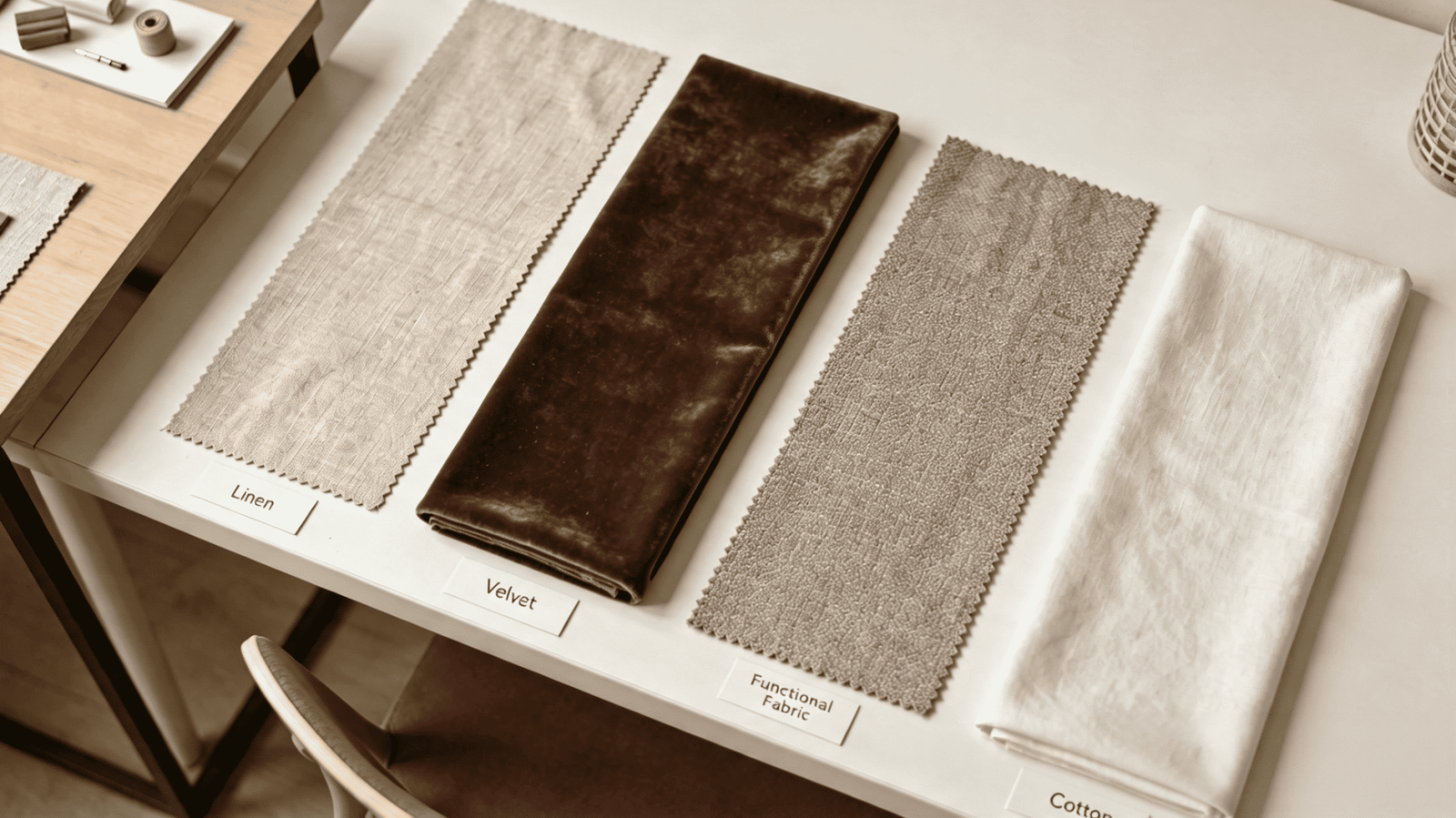
Knowing a fabric's general properties is only half the job. The other half is understanding where those properties actually matter in a real room, with real clients, under real use conditions. Let's work through each major category with that lens.
What Is Upholstery Fabric, and Why Does the Category Matter?
Most designers already know the answer — until a client asks it. Upholstery fabric refers to any textile used to cover furniture frames, including sofas, armchairs, dining chairs, and beds. But the category is not uniform.
Upholstery fabric is any woven, knitted, or bonded textile engineered or selected for use on furniture surfaces. The category spans natural fibers (linen, cotton, wool), semi-synthetics (viscose), synthetics (polyester, acrylic), and performance blends engineered for durability and stain resistance. Each subcategory carries different structural, tactile, and maintenance trade-offs.
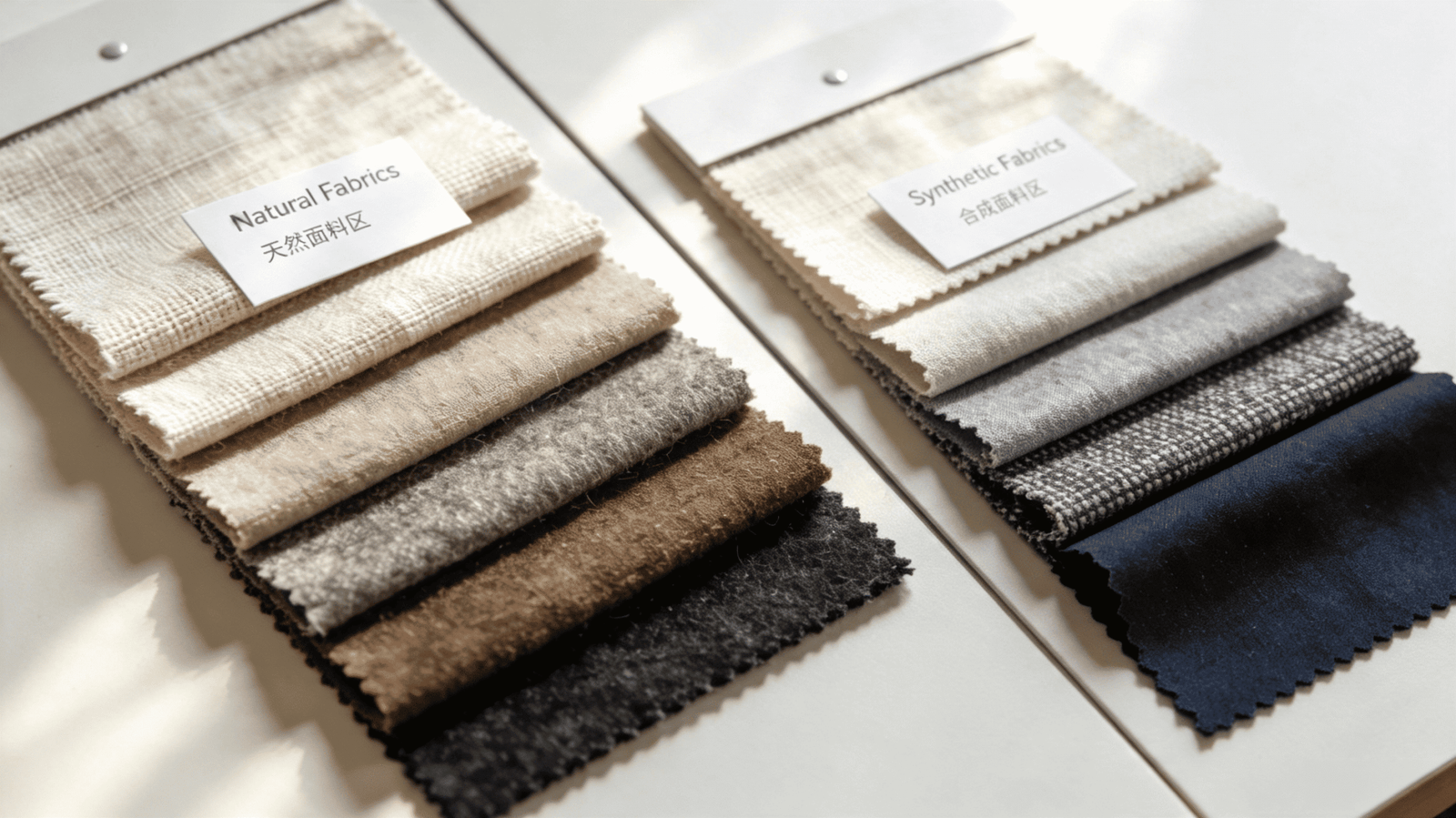
What makes this category tricky is that the same word — "fabric" — covers materials that behave almost nothing alike in real use. A Belgium pure linen sofa and a polyester performance sofa both qualify as upholstered furniture, but they serve different clients, different rooms, and different design philosophies.
Why Fabric Selection Is a Design Decision, Not a Catalog Exercise
In our work with US and European designers sourcing for high-end residential projects, the most common mistake we see is treating fabric selection as a lookup task: find the fabric that checks the most boxes and specify it. The problem is that "most boxes" depends entirely on which boxes matter for that specific project.
Consider these three scenarios:
- A primary family home with children and pets demands durability, cleanability, and resistance to abrasion. Aesthetic softness is desirable but secondary.
- A formal sitting room in a luxury residence that sees light use needs to prioritize visual texture, drapability, and how the material photographs in design presentations.
- A hospitality suite refreshed every few years needs a balance of visual impact, ease of cleaning, and cost-per-cycle economics.
Each of these projects might arrive at a completely different fabric answer — and all three answers could be correct. The guide below is structured to help you identify which scenario you're in before you specify.
When Is Linen the Right Upholstery Fabric Choice?
Linen is overused as a buzzword and underused as a studied specification. Designers reach for it because it photographs well and signals natural luxury. But the real question is whether the project context actually supports it.
Linen is the right upholstery fabric choice when the project prioritizes natural texture, breathability, a curated color palette, and a bespoke aesthetic over maximum durability or stain resistance. It performs best in lower-traffic residential spaces — formal living rooms, master bedrooms, boutique hospitality — where visual quality and material authenticity carry more weight than heavy-use endurance.
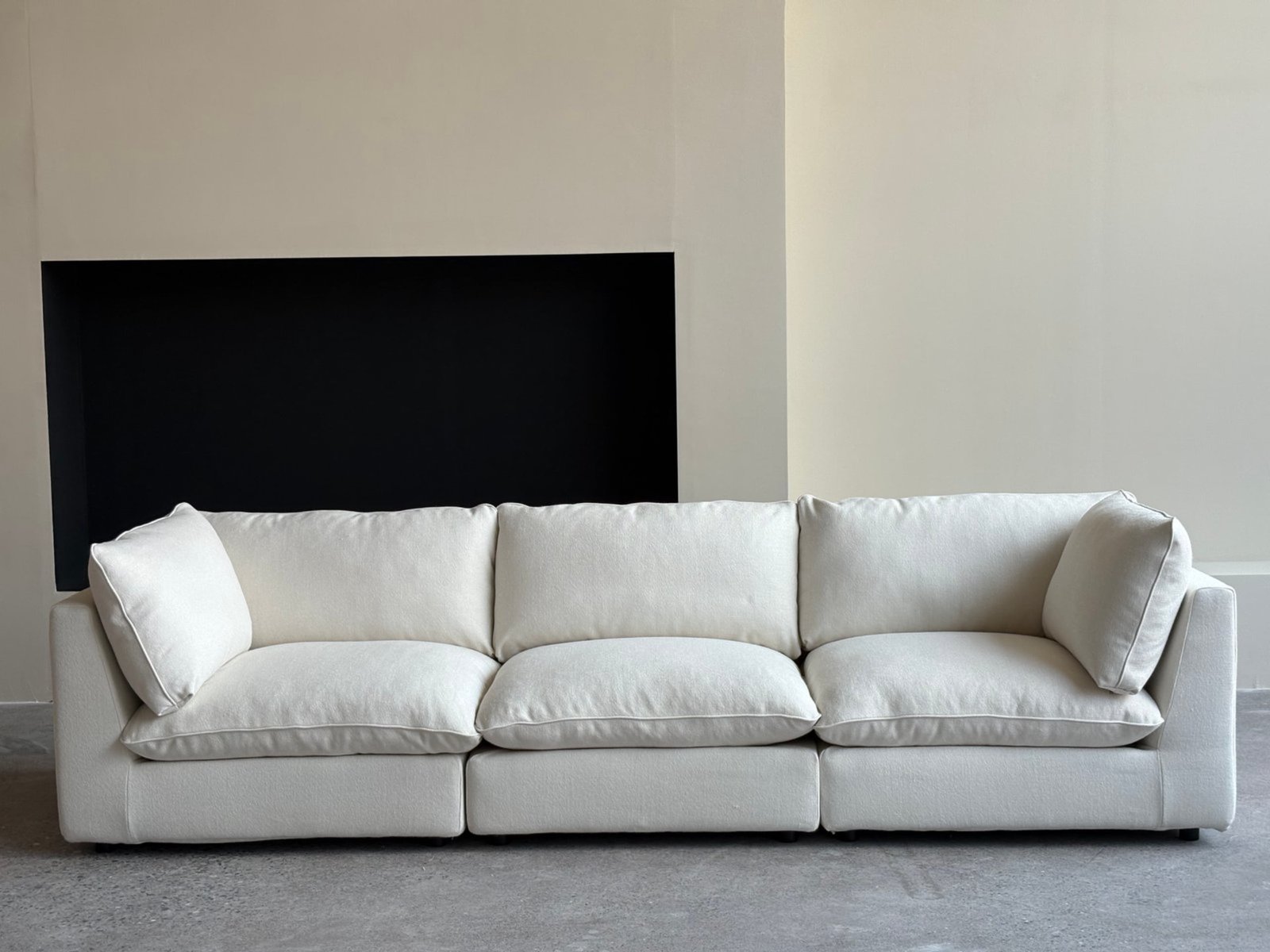
Linen's performance profile is worth unpacking carefully, because it's frequently misunderstood in both directions — oversold as universally superior and unfairly dismissed as impractical.
What Linen Actually Offers (and What It Doesn't)
Tactile and aesthetic strengths:
- Linen has a natural slub texture that reads as handcrafted and warm — impossible to replicate accurately with synthetic fibers at the same visual register.
- It drapes with a softness that improves with use. A well-made linen sofa that has been broken in over a year often looks better than it did on delivery.
- The fiber absorbs dye in a way that produces depth and variation rather than flat, uniform color. This is why high-quality linen upholstery photographs so well in editorial and design presentation contexts.
Practical trade-offs to communicate to clients:
- Linen wrinkles. This is a characteristic, not a defect — but clients who expect furniture to look showroom-perfect after daily use need to understand this upfront.
- It is not inherently stain-proof. A linen sofa in a household with young children or pets should either be treated or positioned as a considered risk.
- Pure linen — particularly Belgium pure linen, which is an industry reference point for fiber quality — performs better than blended or lower-grade alternatives, but it also commands a higher price point.
The Pure Linen vs. Blended Linen Distinction Buyers Miss
This is one of the most important sourcing questions, and most buyers don't ask it until after a problem surfaces.
Many suppliers label fabric as "linen" when it contains a significant polyester or cotton blend. The blended version is cheaper, more crease-resistant, and easier to maintain — but it does not deliver the same texture, hand-feel, or visual quality as pure linen. In custom furniture contexts, this distinction matters enormously because the entire aesthetic rationale for choosing linen breaks down if the fiber content is diluted.
A question worth asking your supplier directly: What is the exact fiber content of this fabric, and can you provide documentation? Belgium pure linen is a useful reference point — it's associated with long-staple flax, tighter weave consistency, and more predictable color behavior across dye lots.
From what we've seen in custom orders, buyers who don't ask this question often receive something that looks like linen on a swatch but behaves differently at full scale — different sheen, different drape, different aging pattern.
Linen's Color and Customization Advantage
For designers working on bespoke residential projects, the customization range available in linen upholstery is a significant practical benefit. At Linen World, we offer 200+ color options in made-to-order linen upholstery — which means a designer can align the sofa fabric precisely to a room's palette rather than adjusting the palette to what's in stock.
This level of customization changes the design workflow. Instead of specifying furniture and then building colors around it, the furniture becomes a fully controllable variable.
When Does Velvet Make More Sense Than Linen?
Velvet gets specified for the same reason linen does — it looks exceptional in presentations. But velvet and linen serve different rooms and different clients.
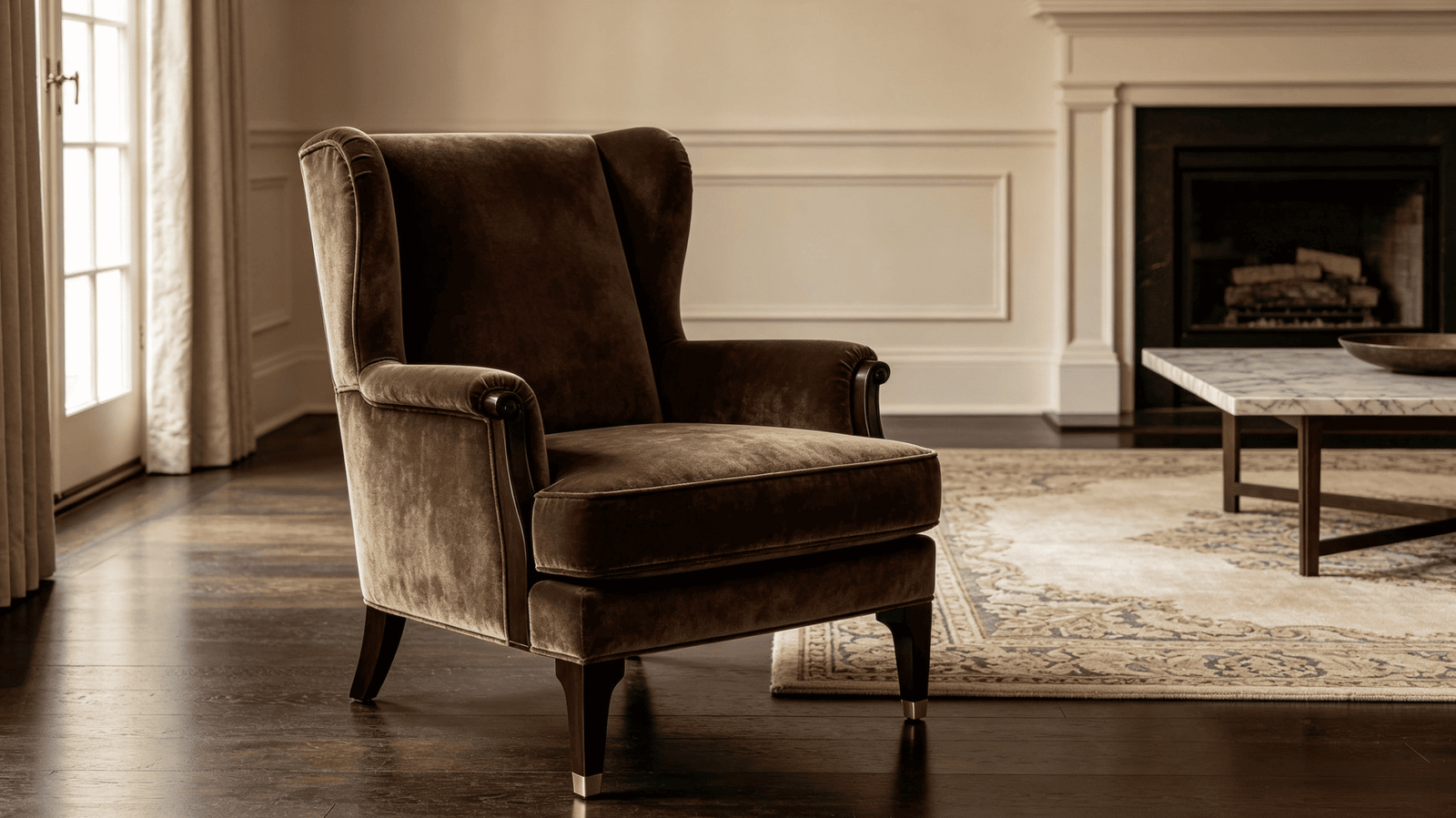
Velvet is the right upholstery choice when the project needs deep color saturation, a formal or theatrical aesthetic, and will see relatively light use. It excels in sitting rooms, reading nooks, accent chairs, and hospitality environments where visual drama is a priority and daily wear is limited. It is context-sensitive: in the wrong environment, it shows every mark and crush in the pile.
Understanding Velvet's Real Limitations
Velvet's pile structure is what makes it beautiful — and what makes it demanding. The cut loops that create velvet's characteristic sheen and color depth1 are also sensitive to:
- Crush marks from regular sitting, especially in lower-pile velvets
- Directional light variation, which can make the same piece look two different colors depending on viewing angle — something that surprises clients when the delivered piece looks different from the swatch
- Pet hair and lint, which adhere to the pile and require consistent maintenance
This doesn't make velvet a poor choice. It makes it a high-maintenance, high-reward choice appropriate for spaces where the visual payoff justifies the care requirement.
| Factor | Linen | Velvet | Performance Fabric |
|---|---|---|---|
| Natural feel | ★★★★★ | ★★★☆☆ | ★★☆☆☆ |
| Color depth | ★★★★☆ | ★★★★★ | ★★★☆☆ |
| Durability (daily use) | ★★★☆☆ | ★★☆☆☆ | ★★★★★ |
| Stain resistance | ★★☆☆☆ | ★★☆☆☆ | ★★★★★ |
| Customization range | ★★★★★ | ★★★☆☆ | ★★★☆☆ |
| Breathability | ★★★★★ | ★★★☆☆ | ★★☆☆☆ |
When Should You Specify Performance Fabric Instead?
Performance fabric carries an unfair reputation in high-end design circles as a compromise material. In the right context, it is not a compromise — it is the correct answer.
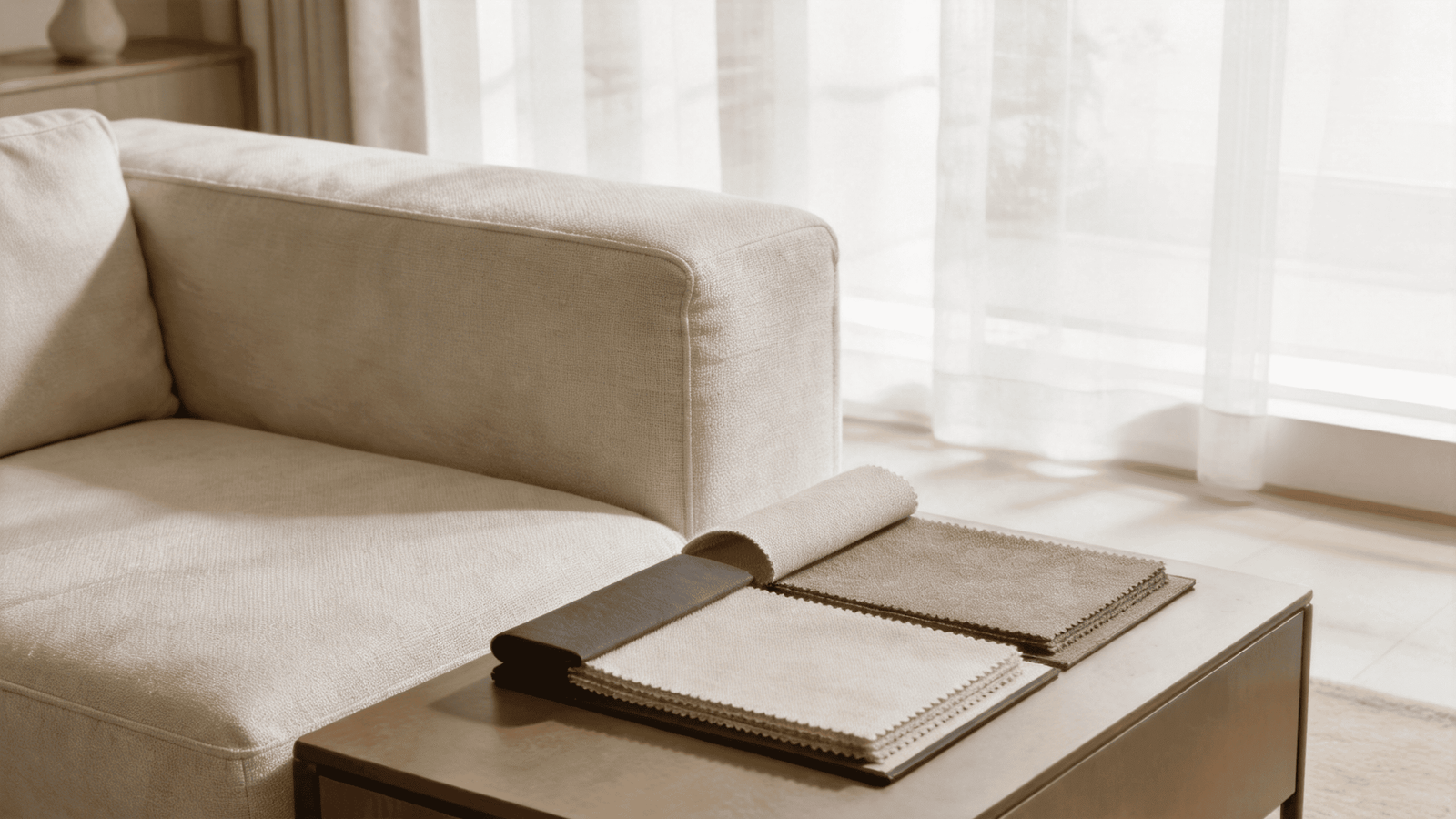
Performance fabric is the right upholstery choice when the project involves high traffic, pets, children, outdoor-adjacent spaces, or clients with low tolerance for maintenance. Engineered for durability, cleanability, and resistance to abrasion and moisture, performance fabric prioritizes function over natural feel — and in contexts where function is the primary requirement, that trade-off is entirely rational.
What Performance Fabric Does Better Than Any Natural Fiber
Designers who dismiss performance fabric haven't specified for the right client. Consider the use case: a family home with three children under ten, two dogs, and a client who wants furniture that looks good without being treated with care. In this scenario, linen or velvet are not the right choices — not because they're inferior materials, but because they're mismatched to the project's actual demands.
Performance fabric advantages in high-use residential contexts:
- Cleanability: Most performance fabrics resist water-based stains and clean up with mild soap and water2 — critical for family living.
- Abrasion resistance: Many performance weaves carry a high double-rub count, meaning they hold up under repeated friction far longer than natural fibers3.
- Colorfastness: Performance fabrics tend to resist UV fading better than natural-fiber options4, which matters in rooms with significant sun exposure.
- Consistency: Because performance fabrics are engineered, they produce fewer lot-to-lot color variations — useful in large-scale commercial or hospitality projects requiring exact color matching across many units.
The limitation is tactile and aesthetic: performance fabrics do not have the warmth, texture depth, or natural hand-feel of linen or quality velvet. For clients who value material authenticity — and many high-net-worth residential clients do — this is a meaningful gap.
How Does COM (Customer's Own Material) Change the Selection Logic?
Most upholstery fabric guides end at "pick a fabric." But for designers working with custom furniture manufacturers, the selection logic extends one step further.
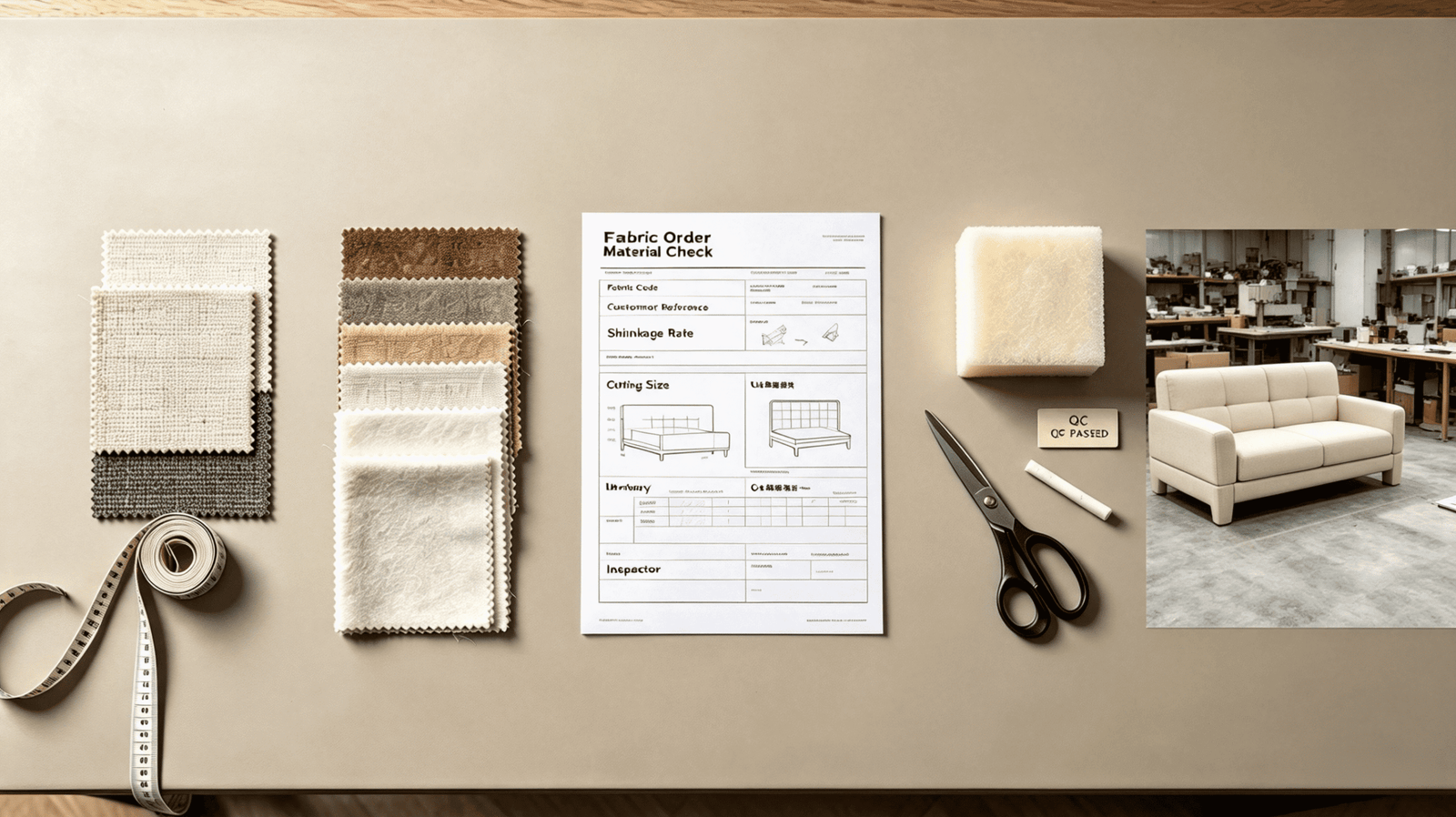
COM (Customer's Own Material) means the buyer supplies the fabric directly to the furniture manufacturer, bypassing the supplier's standard fabric inventory. This option makes sense when the designer has already specified a fabric they know, trust, and have used before — or when a client's project requires a material the manufacturer doesn't stock. COM changes the question from "which fabric?" to "which fabric, and how do I get it to the right factory?"
When COM Makes Sense and When It Doesn't
COM is the right path when:
- You have an established relationship with a fabric supplier whose quality and color consistency you trust
- The project requires a specific textile that isn't available through the furniture manufacturer's standard range
- You are replicating a fabric used elsewhere in the project (drapery, bedding, wall panels) for a unified material story
COM introduces complications when:
- The designer or client doesn't have a vetted fabric source, and the COM process adds sourcing burden without a clear quality benefit
- The furniture manufacturer has a wide enough made-to-order range that the need for COM is unnecessary
From our experience at Linen World, the majority of designers we work with use our in-house fabric range — 200+ linen color options in made-to-order — because the selection is wide enough to hit their palette requirements without the logistics of managing a separate material shipment. But we also support COM orders for clients who need it. The point is that both paths should be open, and a good manufacturer supports both.
Frequently Asked Questions
What is the most durable upholstery fabric for a sofa?
Durability depends on use context. Performance fabric and tightly woven synthetic blends offer the highest abrasion resistance for high-traffic use. Among natural fibers, pure linen with a tighter weave grade holds up reasonably well in moderate-use residential settings5. No single fabric is the most durable across all scenarios — match the material to the actual use.
Is pure linen good for upholstery, or does it wrinkle too much?
Pure linen is an excellent upholstery choice for the right project. It does wrinkle and crease with regular use — that's a characteristic of the fiber, not a manufacturing defect. In formal or lower-traffic residential spaces, most clients and designers consider this a natural, livable quality. For clients who expect furniture to look pristine after daily use, linen requires more management or a different specification.
What is the difference between Belgium linen and regular linen upholstery fabric?
Belgium linen refers to linen woven from long-staple flax grown and processed primarily in Belgium and the surrounding region6 — it's associated with finer fiber quality, tighter weave consistency, and more predictable dye behavior compared to lower-grade linen. In practical terms, it affects how the fabric ages, how colors read at scale, and how consistent the texture is across a large order. It's worth asking your supplier directly about fiber origin and content.
Can I use my own fabric for a custom upholstered sofa?
Yes — this is known as COM (Customer's Own Material). Most quality custom upholstery manufacturers support COM orders, meaning you supply the fabric and the manufacturer builds the piece around it. Check yardage requirements and lead times carefully, as COM orders typically require precise material calculations upfront with limited recovery if you're short.
How do I know if a supplier's "linen" fabric is actually pure linen?
Ask directly for fiber content documentation. A reputable supplier should be able to tell you the exact percentage of linen versus any blended fibers (polyester, cotton, viscose). If a supplier is vague about fiber content or unable to provide documentation, that's a meaningful flag. Belgium pure linen is a useful industry reference when evaluating quality claims.
Conclusion
The core takeaway from this upholstery fabric guide is that material selection is a project-specific decision, not a universal ranking. Linen excels in natural-aesthetic, bespoke residential contexts — particularly when a wide made-to-order color range is needed for precise design alignment. Velvet suits formal, lower-traffic spaces where visual drama is the priority. Performance fabric is the rational choice when durability and cleanability outweigh natural feel. Cotton and blends fill the middle ground across a range of budgets and use cases.
The second takeaway is sourcing. Knowing which upholstery fabric to specify is only useful if you can source it reliably at the quality level your project requires. If you're working on a high-end residential project and considering linen upholstery — whether a sofa, armchair, dining chairs, or bed — I'd encourage you to ask your supplier directly about fiber content, dye lot consistency, and custom-order capabilities before you commit.
If you're working on a project that needs custom linen upholstery and want to see what's possible with 200+ color options at a factory price that's typically 40–60% below US or European retail, get in touch with the team at Linen World https://linenworld.pro/. We work directly with designers and purchasing agents across the US and Europe, and we're glad to help you think through the right specification for your specific project.
"All About Textiles | Index", https://akaspar.pages.cba.mit.edu/textiles-recitation/background.html. The vertical orientation of cut pile fibers in velvet creates directional light scattering and absorption properties that enhance color saturation through reduced surface reflection and increased light trapping compared to flat-woven fabrics, while pile direction affects apparent sheen through specular reflection angles. Evidence role: mechanism; source type: research. Supports: how pile fiber orientation affects light reflection and color perception in textiles. ↩
"Stain Resistant Fabric | Upholstery Fabric", https://www.decorativefabricsdirect.com/Stain-Resistant-Home-Decor-Fabric-s/740.htm?srsltid=AfmBOoqOOVx9qORb4t1wtfbqQiyLhXRoL15Vx4aiKLABYoxrB9nRfLx_. Performance upholstery fabrics typically incorporate fluorochemical treatments, acrylic backing, or tightly woven synthetic fibers with low surface energy that reduce liquid absorption and facilitate cleaning of water-based stains with mild detergents. Evidence role: mechanism; source type: research. Supports: the chemical treatments and fiber properties that provide stain resistance in performance textiles. Scope note: Effectiveness varies by specific treatment type and stain composition ↩
"Upholstery Fabric Rub Tests Explained", https://www.americanleather.com/resource-center/fabric-rub-tests/. The double-rub test (Wyzenbeek method in North America, Martindale in Europe) measures fabric abrasion resistance by counting cycles until visible wear occurs; synthetic performance fabrics typically achieve 30,000-100,000+ cycles compared to 15,000-25,000 for many natural fiber fabrics. Evidence role: definition; source type: education. Supports: the standardized abrasion testing method used to measure upholstery fabric durability. Scope note: Test results depend on weave structure and yarn construction, not only fiber type ↩
"Effects of UV radiation on natural and synthetic materials - PMC", https://pmc.ncbi.nlm.nih.gov/articles/PMC10088630/. Synthetic fibers such as solution-dyed acrylics and UV-stabilized polyesters demonstrate greater resistance to photodegradation than cellulosic fibers like cotton and linen, which undergo oxidative breakdown of cellulose chains and chromophore formation when exposed to ultraviolet radiation. Evidence role: mechanism; source type: research. Supports: the photochemical degradation differences between synthetic and natural textile fibers under UV exposure. Scope note: UV resistance also depends on dye type and UV inhibitor treatments, which can be applied to natural fibers ↩
"Units of textile measurement", https://en.wikipedia.org/wiki/Units_of_textile_measurement. Tighter weave construction increases fabric durability by reducing yarn mobility, distributing stress across more fiber contact points, and limiting the propagation of localized damage, though excessive density can reduce flexibility and increase brittleness in some fiber types. Evidence role: mechanism; source type: research. Supports: how weave density affects the mechanical durability of woven textiles. ↩
"(PDF) Conventional or greenhouse cultivation of flax", https://www.academia.edu/124658922/Conventional_or_greenhouse_cultivation_of_flax_What_influence_on_the_number_and_quality_of_flax_fibers. European flax cultivation, concentrated in Belgium, France, and the Netherlands, benefits from maritime climate conditions that support fiber development; industry designations like 'Belgian linen' typically reference flax processed in this region, though fiber staple length varies by cultivar and growing conditions rather than geography alone. Evidence role: general_support; source type: institution. Supports: the fiber characteristics associated with European flax cultivation. Scope note: Quality depends on multiple factors including cultivar genetics, retting process, and spinning methods, not only growing region ↩


