Most people avoid linen slipcovers because they believe one wrong wash will shrink everything. That fear is real — but it's based on the wrong information.
Linen slipcover care comes down to three rules: wash in cool water, avoid sustained high heat drying, and re-fit the cover while it's still slightly damp. Follow these, and a Belgian pure linen slipcover will stay fitted, soft, and good-looking for years.
I want to be clear about what this guide covers. This is specifically about high-quality Belgian pure linen slipcovers — the kind used on handcrafted upholstery furniture. It does not apply to polyester-linen blends or printed slipcover fabrics. Those materials behave very differently, and mixing up the advice is where most care mistakes start.
At Linen World, we've made linen slipcover furniture for the US and European market for 13 years. We hear from customers after every purchase. The questions around washing, shrinkage, and re-fitting come up constantly. This guide is built from those conversations and from what we know at the production level about how Belgian pure linen actually behaves.
Does Linen Shrink in the Wash?
This is the question we get more than any other. And every time, the answer is the same: linen shrinks when it meets hot water or high-heat drying — not because it's fragile, but because heat causes the natural fibers to contract1. Remove the heat, and you remove the problem.
Linen shrinks because heat causes its cellulose fibers to tighten. Wash in cool or cold water (at or below 30°C / 86°F), and shrinkage becomes minimal. The fiber itself is not the risk — the temperature is.
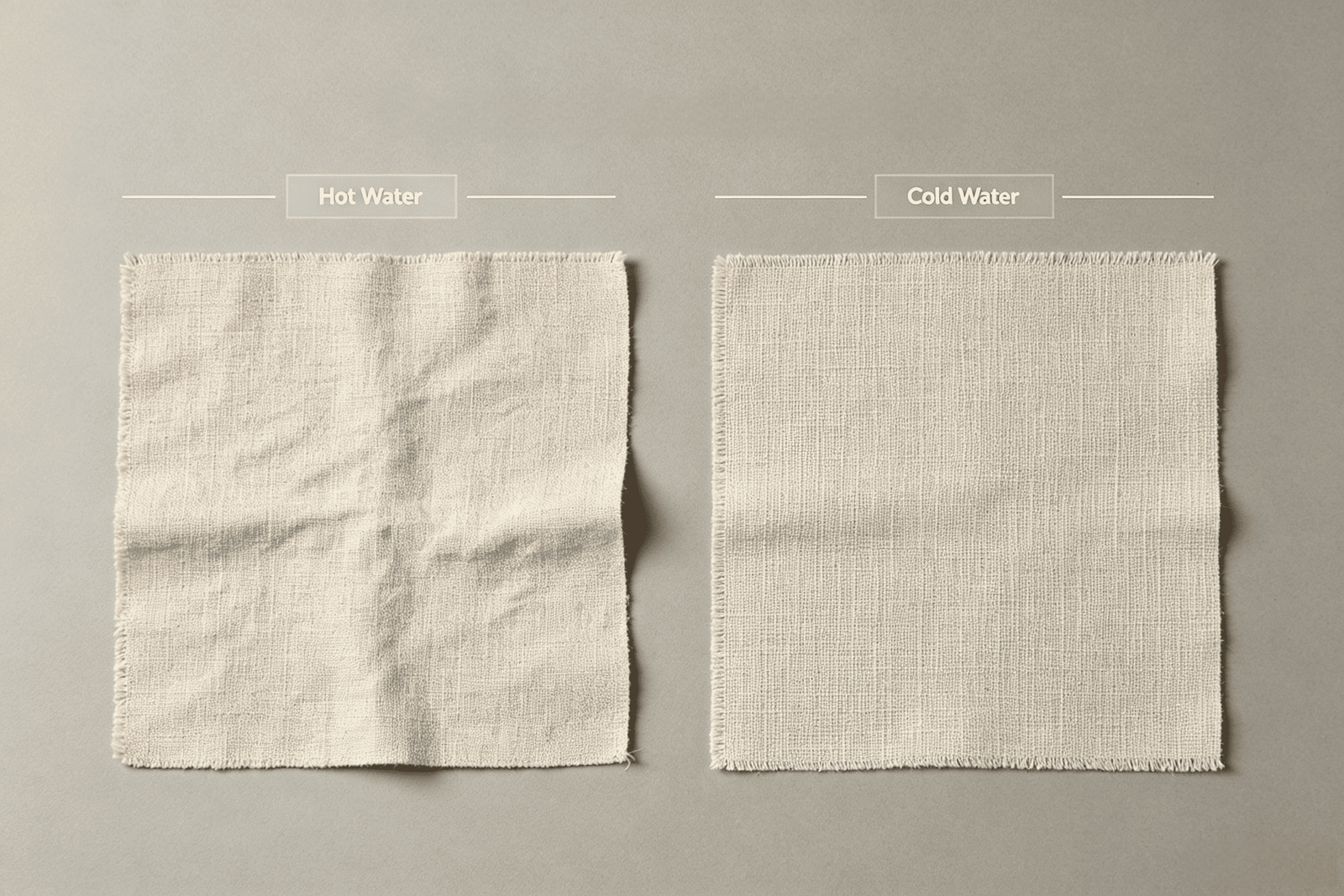
Here is what actually happens at the fiber level. Belgian pure linen is made from flax fibers. Those fibers have a natural twist structure that locks into place during weaving2. When you introduce high heat — whether from hot water or a hot dryer — that structure pulls inward. The weave tightens. The cover comes out smaller.
This is not a defect in your slipcover. It is a property of the material. And it is fully preventable.
Based on our long-term customer service experience, the covers that come back to us with shrinkage problems almost always share the same story: the customer washed on a warm or hot cycle, or tumble-dried on high. The customers who wash in cold water and air-dry report no meaningful shrinkage at all.
What to Do Instead
| Step | Recommended Practice |
|---|---|
| Water temperature | Cool or cold — 30°C (86°F) maximum |
| Wash cycle | Gentle or delicate cycle |
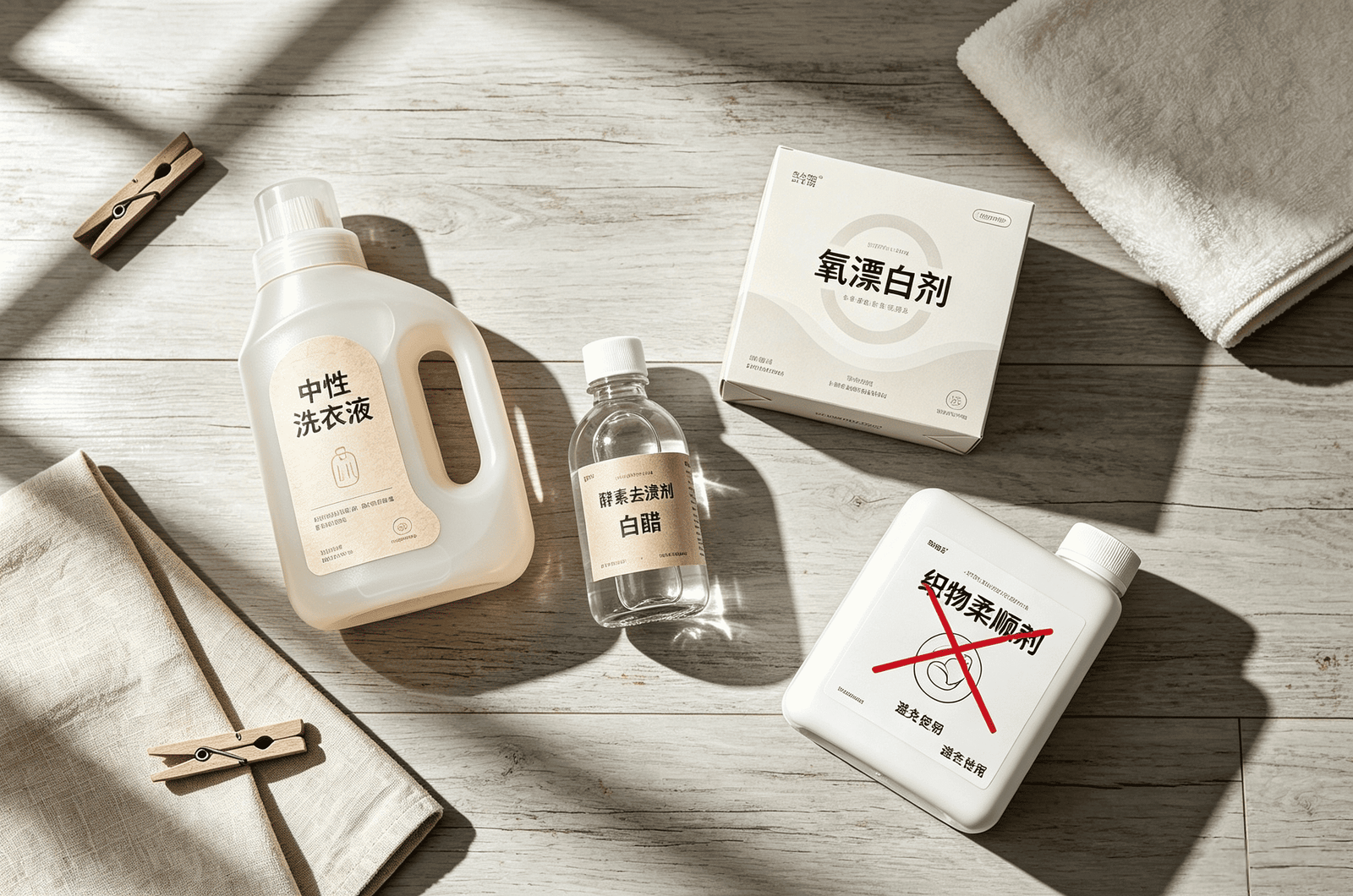
| Detergent | Mild, liquid, no bleach or optical brighteners |
| Drying method | Air dry flat or hang — not in a hot dryer |
| Dryer use | Low heat only, and remove while still slightly damp |
The logic is simple. You are not trying to sanitize a surgical cloth. You are refreshing a linen fabric. Cool water and a gentle cycle do that job well. Heat is never necessary, and it is the only thing that causes real damage.
Is Linen Care the Same as Cotton Care?
Most buyers in the US treat fabric care as one category. If it works for cotton, it should work for linen. This assumption causes more problems with linen slipcovers than anything else we see.
Linen and cotton are both natural cellulose fibers, but they behave differently in the wash3. Cotton tolerates higher temperatures and more frequent machine washing. Linen rewards cooler water, lower agitation, and less frequent washing — with better results for both texture and longevity.
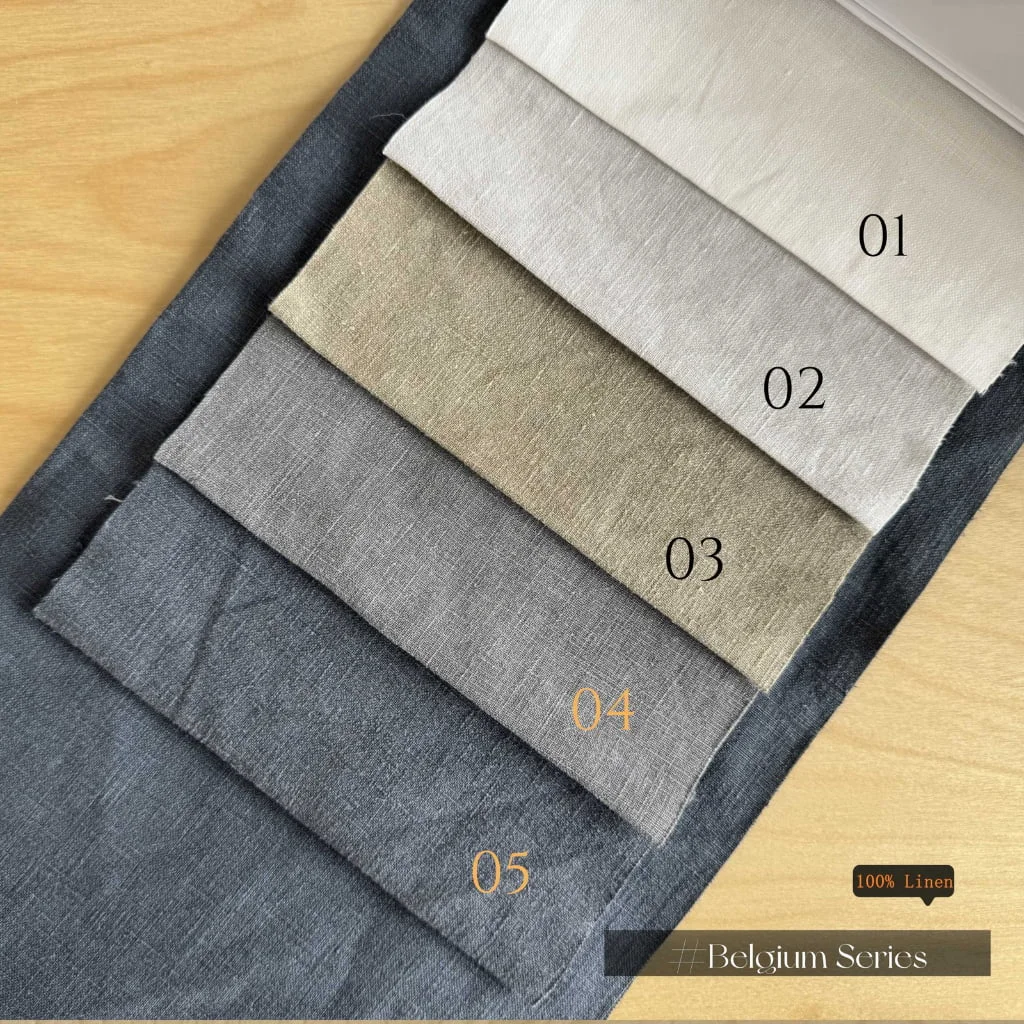
Here is why they differ. Cotton fibers are shorter and more uniform. They handle mechanical stress — the tumbling and friction inside a washing machine — without breaking down quickly. Linen fibers are longer, stronger individually, but they respond to agitation differently4. High-speed spin cycles and rough tumbling can stress the weave and cause pilling or texture changes over time.
This does not mean linen is weaker. In fact, linen is stronger than cotton by tensile strength5. But strength and wash-tolerance are not the same thing. A thicker rope can still fray if you saw it against a rough surface.
How Linen Care Actually Differs from Cotton
| Factor | Cotton | Belgian Pure Linen |
|---|---|---|
| Wash temperature | Up to 40–60°C tolerated | 30°C maximum recommended |
| Cycle type | Normal or heavy cycles fine | Gentle or delicate cycle only |
| Washing frequency | Can wash more often | Wash less often, spot clean between washes6 |
| Drying | High-heat dryer tolerated | Air dry or low heat only |
| Ironing | High heat, steam acceptable | Medium heat, iron slightly damp |
The key shift in thinking is this: with linen, frequency matters less than method. You do not need to wash a linen slipcover every two weeks. Spot cleaning handles most surface marks. A full wash every few months — done correctly — keeps the cover in better shape than frequent washes done the wrong way.
Customers who make this adjustment find that linen is actually lower maintenance than they expected7. The first correct wash removes any uncertainty, and after that, the routine becomes automatic.
How Do You Re-Fit a Linen Slipcover After Washing?
This is the section most care guides skip. They tell you how to wash. They do not tell you what to do after the cover comes out. Re-fitting a linen slipcover is a skill — a simple one, but a real one — and doing it right makes the difference between a cover that looks tailored and one that looks sloppy.
Re-fit a linen slipcover while it is still slightly damp. Start at the base of the sofa, work upward, smooth the fabric toward the seams, and tuck the hems into the frame gaps before the linen dries fully into shape. Dry-fitting a shrunken or stiff cover is harder and produces worse results.
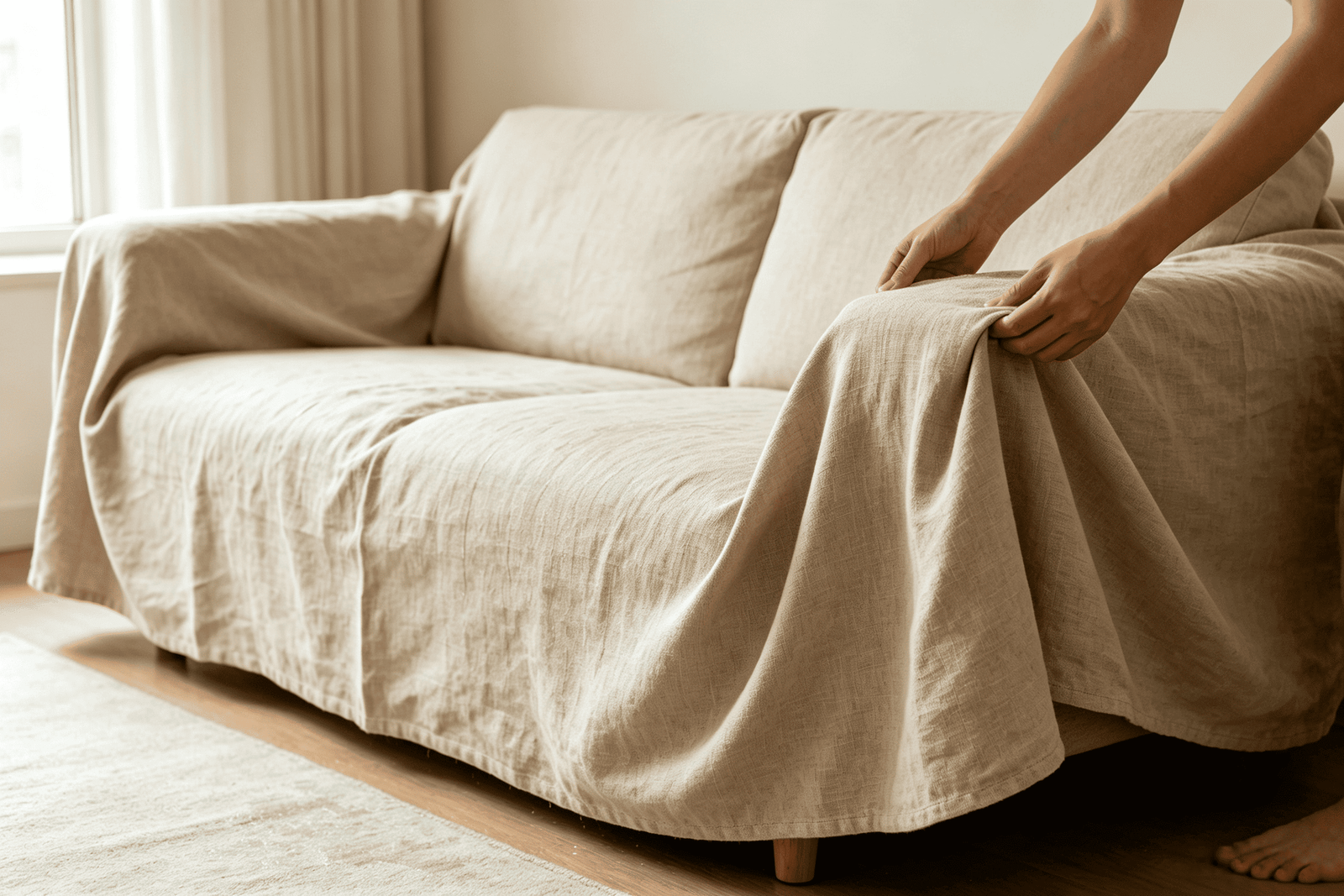
The reason damp re-fitting works is physical. When linen is slightly wet, the fibers are still relaxed. The fabric has a small amount of give. You can pull it, align it, and smooth it into the correct position. As it dries, the fibers tighten and the cover holds its shape8. If you wait until the cover is bone-dry before re-fitting, you are working against a fabric that has already locked into position — and the result shows.
Step-by-Step Re-Fitting Process
Here is the process we walk our customers through, based on how our slipcover furniture is constructed.
Step 1 — Remove excess water gently. After washing, do not wring the cover. Press it between two towels or let it spin on a low setting. You want it damp, not dripping.
Step 2 — Start at the bottom. Place the cover over the sofa frame and begin alignment at the base front. Pull the hem down evenly on both sides. An uneven base makes everything above it crooked.
Step 3 — Work upward in sections. Move from the base up the front face, then to the seat cushion area, then the back. At each section, smooth the fabric toward the nearest seam — not away from it. This removes surface tension without overstretching.
Step 4 — Align the seams to the sofa edges. The seams on a well-made slipcover are designed to sit exactly at the sofa's frame edges — the top of the arm, the inside corner of the seat back. Check that each seam is resting at the right edge. If it has drifted, pull the fabric back toward that position.
Step 5 — Tuck and secure the hems. Push the hem tuckers into the gaps between the seat cushion and the frame. These hold the cover in place as it dries. Do not skip this — they are the anchor for everything.
Step 6 — Let it air-dry on the frame. Leave the sofa in place while the cover finishes drying. The frame acts as a mold. The linen dries to the shape of the sofa, not into a flat pile on a drying rack.
This process takes about ten minutes. Customers who do it once report that the second and third times feel natural. The cover fits the same way it did when it arrived.
Will Linen Look Wrinkled or Uneven After Washing?
Yes. And this is exactly what it should look like.
This is the point where buyers who were not briefed in advance start to worry. They pull the cover off the sofa, see a slightly textured surface and soft, irregular folds, and think something went wrong. Nothing went wrong. This is what Belgian pure linen looks like — and it is one of the reasons it is valued at the level it is.
Belgian pure linen develops a natural texture and soft wrinkle pattern through use and washing. This is not damage. It is the fiber relaxing into its most natural state9. Slight tonal variation and surface texture are visual properties of real linen — they signal authenticity, not wear.
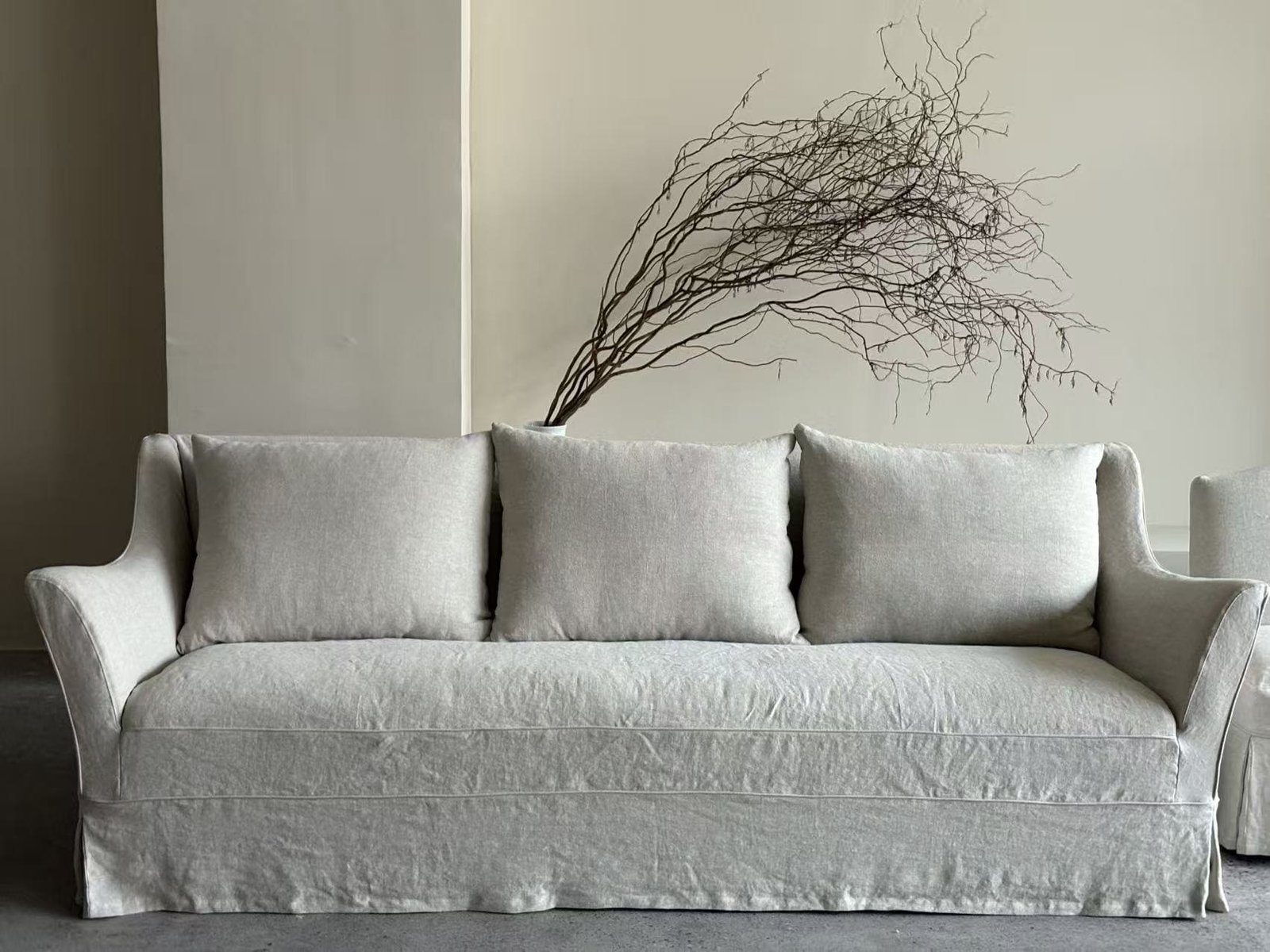
Here is the difference between real linen texture and actual damage. Real linen texture looks like soft, organic creasing — the same kind you see in high-end linen shirts or tablecloths in luxury restaurants. The wrinkles are irregular and fine. The surface has a gentle variation in tone because the flax yarns catch light differently at different angles.
Damage looks different. Actual damage is pilling (small fiber balls on the surface), puckering at the seams, or a rough, stiff patch where the fabric has broken down. These are caused by the wrong wash method — specifically by heat and aggressive mechanical agitation.
Linen Texture: Feature vs. Defect
| What You See | What It Means |
|---|---|
| Soft, irregular wrinkles across the surface | Natural linen relaxing — correct and expected |
| Subtle tonal variation in the fabric | Flax fiber light reflection — a quality indicator |
| Slight sheen variation between dry and damp areas | Temporary, resolves as the fabric fully dries |
| Small fiber balls (pilling) on the surface | Mechanical damage from high-agitation washing |
| Stiff, rough patch on the fabric | Heat damage — fiber breakdown |
| Seam puckering or warping | Possible shrinkage from hot wash — recheck care method |
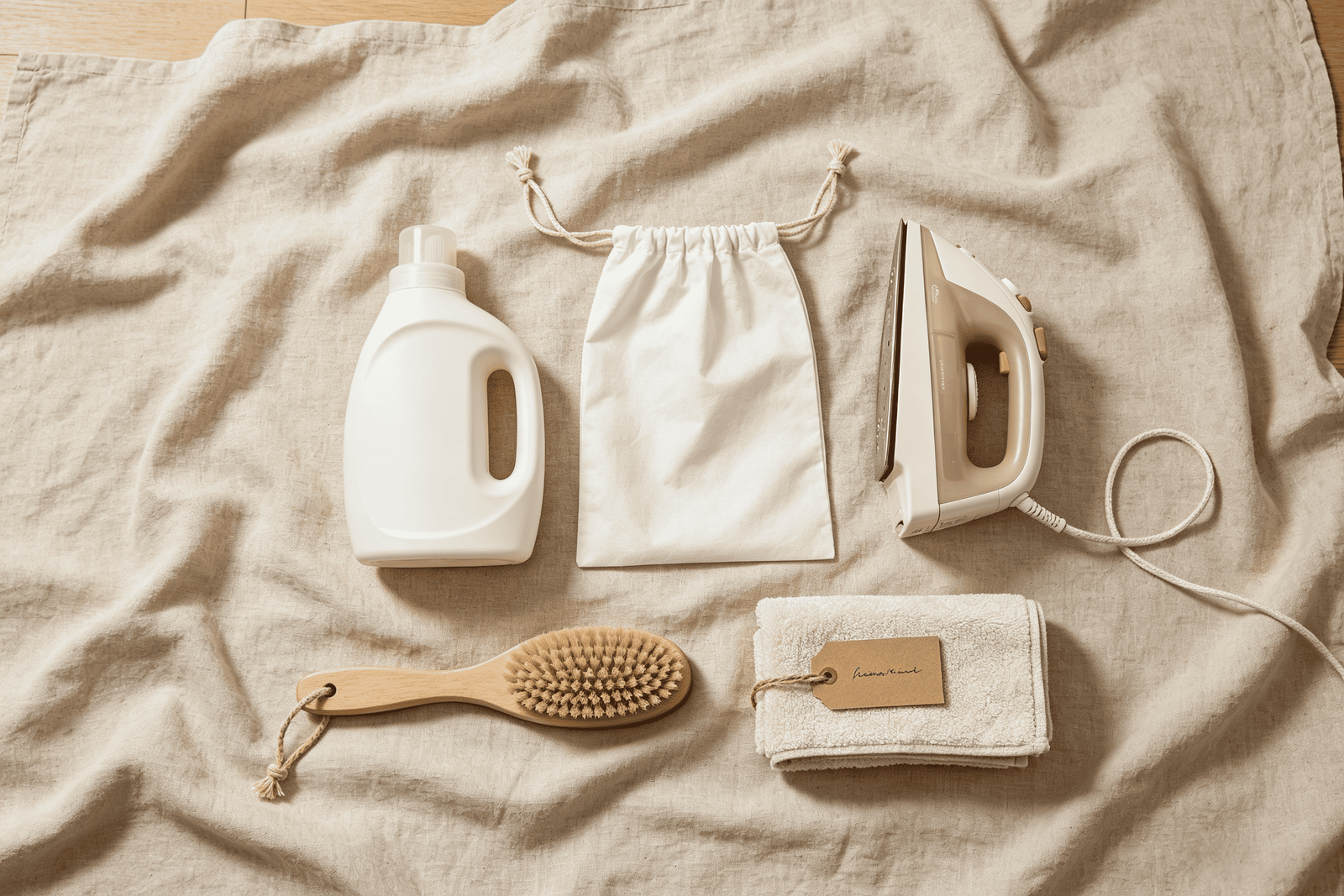
If you want to reduce wrinkles further after the cover dries, iron it on a medium heat setting while it is still slightly damp. A steam iron works well. Press along the grain of the fabric, not against it10. The surface will smooth out, but keep a softness that flat-pressed cotton does not have.
Some customers prefer the un-ironed look. The texture reads as relaxed and natural, and it suits the aesthetic that drew them to linen in the first place. Both choices are valid. The point is that neither look is damage.
Conclusion
Caring for a Belgian pure linen slipcover does not require complicated professional cleaning routines. Stick to three core rules: wash in cool low-temperature water, avoid sustained high heat drying, and re-fit the fabric while slightly damp to lock tailored shape. Embrace soft natural wrinkles as a unique premium feature of genuine flax linen, not a washing failure.
If you are an interior designer or homeowner planning custom Belgian linen sofas, slipcovers or full upholstery textiles for residential and commercial projects, reach out to the Linen World design team (Email:hello@linenworld.pro). Send your room dimensions and furniture frame specs, and we will send you a free full custom sizing proposal, exclusive printable linen care manual, and physical Belgian linen fabric swatch consultation at no extra cost.https://linenworld.pro
"Linen Most Useful: Perspectives on Structure, Chemistry, and ... - PMC", https://pmc.ncbi.nlm.nih.gov/articles/PMC4403609/. Textile science literature documents that cellulose fibers, including those derived from flax, undergo dimensional change when exposed to elevated temperatures due to hydrogen bond disruption and fiber relaxation, a process that is substantially reduced at lower wash temperatures. Evidence role: mechanism; source type: research. Supports: That heat causes cellulose-based natural fibers such as linen to contract and tighten, resulting in fabric shrinkage. Scope note: Most published research addresses cellulose shrinkage broadly; studies specific to woven linen slipcover fabric under domestic washing conditions are limited. ↩
"The Influence of the Chemical Composition of Flax and Hemp Fibers ...", https://pmc.ncbi.nlm.nih.gov/articles/PMC10935324/. Studies on bast fiber morphology describe flax fibers as exhibiting a polygonal cross-section and a fibrillar helical arrangement, properties that contribute to the dimensional behavior of linen textiles during wet processing. Evidence role: mechanism; source type: research. Supports: That flax fibers possess a characteristic helical or twisted microstructure that influences the dimensional stability of woven linen fabric. Scope note: The specific claim that this twist 'locks into place during weaving' is a simplified description; published sources address fiber microstructure rather than the weaving-lock mechanism directly. ↩
"Linen Most Useful: Perspectives on Structure, Chemistry, and ... - PMC", https://pmc.ncbi.nlm.nih.gov/articles/PMC4403609/. Standard textile references classify both cotton and linen as cellulosic fibers but distinguish them by fiber source (seed hair versus bast), crystallinity, and fiber dimensions, differences that result in distinct responses to temperature, agitation, and moisture during wet processing. Evidence role: definition; source type: encyclopedia. Supports: That linen and cotton, while both cellulosic, differ in fiber origin, length, cross-sectional shape, and crystallinity, which produce different responses to laundering conditions. ↩
"Natural fibers in sustainable materials: extraction ... - PMC - NIH", https://pmc.ncbi.nlm.nih.gov/articles/PMC12926875/. Textile reference sources describe cotton as a seed-hair fiber with relatively short, uniform staple length (typically 10–65 mm), while flax is a bast fiber with longer, coarser bundles, differences that influence yarn structure and fabric response to mechanical processing. Evidence role: definition; source type: encyclopedia. Supports: That cotton and flax fibers differ in length, uniformity, and structural characteristics, which underlie differences in their behavior during wet processing. Scope note: Published sources describe fiber morphology; the specific claim about differential agitation response in domestic washing machines is an applied inference not always directly tested in fiber science literature. ↩
"(PDF) Analysis of Flax and Cotton Fiber Fabric Blends and Recycled ...", https://www.academia.edu/26773500/Analysis_of_Flax_and_Cotton_Fiber_Fabric_Blends_and_Recycled_Polyethylene_Composites. Comparative analyses of natural textile fibers consistently report that flax fibers have higher tensile strength than cotton fibers, with flax typically cited in ranges of 345–1500 MPa versus cotton at 287–800 MPa, though values vary by testing method and fiber grade. Evidence role: statistic; source type: research. Supports: That linen (flax) fiber exhibits greater tensile strength than cotton fiber under standardized testing conditions. Scope note: Tensile strength of individual fibers does not directly translate to the strength of finished woven fabric, which depends on yarn construction, weave density, and finishing treatments. ↩
"Investigation of the Properties of Linen Fibers and Dressings - PMC", https://pmc.ncbi.nlm.nih.gov/articles/PMC9501175/. Research on textile longevity indicates that repeated laundering cycles are a primary driver of fabric degradation in natural fiber textiles, with each wash cycle contributing incremental mechanical abrasion and fiber fatigue; reducing wash frequency is therefore associated with extended fabric service life. Evidence role: general_support; source type: research. Supports: That reducing laundering frequency extends the service life of natural fiber textiles by limiting cumulative mechanical and thermal stress on the fabric. Scope note: Published studies on laundering frequency and fabric degradation most commonly address apparel textiles; direct research on upholstery slipcover fabrics under domestic laundering conditions is limited. ↩
"Investigation of the Properties of Linen Fibers and Dressings - PMC", https://pmc.ncbi.nlm.nih.gov/articles/PMC9501175/. Textile care guidelines from fiber and fabric standards bodies note that linen's high fiber strength and natural resistance to dirt can reduce required washing frequency relative to some other natural fabrics, provided temperature and agitation recommendations are observed. Evidence role: general_support; source type: institution. Supports: That linen fabric, when laundered at appropriate temperatures and with low agitation, maintains its properties over repeated wash cycles with minimal degradation. Scope note: Independent consumer studies specifically comparing perceived maintenance burden of linen versus other upholstery fabrics are not widely published; this support is contextual rather than direct proof of the claim. ↩
"Liquid Moisture Transport in Cotton Woven Fabrics with ... - PMC - NIH", https://pmc.ncbi.nlm.nih.gov/articles/PMC9504572/. Research on hygroscopic natural fibers documents that flax absorbs significant moisture (moisture regain of approximately 10–12% at standard conditions), causing fiber swelling and increased flexibility in the wet state, with dimensional recovery occurring as the fiber dries. Evidence role: mechanism; source type: research. Supports: That linen fibers absorb moisture, causing fiber swelling and increased pliability, and that dimensional stabilization occurs as moisture is released during drying. Scope note: Published studies address fiber-level moisture behavior; the specific application to slipcover re-fitting on a furniture frame has not been independently studied. ↩
"Linen Most Useful: Perspectives on Structure, Chemistry, and ... - PMC", https://pmc.ncbi.nlm.nih.gov/articles/PMC4403609/. Textile science literature attributes linen's characteristic wrinkling to the low elastic recovery of cellulose fibers, which lack the resilience to return to their original configuration after deformation; this property is intrinsic to the fiber and is not associated with structural degradation under normal use conditions. Evidence role: mechanism; source type: research. Supports: That linen's tendency to wrinkle is an inherent property of cellulose fiber structure, specifically its low elastic recovery, rather than an indicator of fabric damage. ↩
"Clothes Captioning: Complying with the Care Labeling Rule", https://www.ftc.gov/business-guidance/resources/clothes-captioning-complying-care-labeling-rule. International textile care labeling standards (ISO 3758) classify linen as suitable for ironing at up to 200°C (medium-high iron setting), with damp ironing commonly recommended in care guidance to facilitate wrinkle removal without fiber damage. Evidence role: general_support; source type: institution. Supports: That linen fabric is suitable for ironing at medium to high heat settings, particularly when the fabric is slightly damp, in accordance with standard textile care classifications. Scope note: Standard care labels address fiber type broadly; optimal ironing parameters for specific weave constructions such as slipcover-weight linen may vary and are not individually standardized. ↩


