
You've finalized the sofa. The fabric is confirmed. Then the client asks: "Should we do a footstool or an ottoman?" It sounds like a minor styling call — but I've watched this question derail spec rounds, trigger re-orders, and create pieces that look perfect in a mood board and feel completely wrong in the room. The footstool vs ottoman decision is a functional and spatial call, not a naming preference.
The short answer: a footstool is a compact, single-purpose foot-rest companion, typically low-profile and fixed in function. An ottoman is a multi-role upholstered piece designed to serve as foot rest, occasional extra seat, or surface substitute — and sometimes concealed storage. Choosing between them requires knowing the use-case, the seat-height relationship, and the structural requirements before you write the spec.
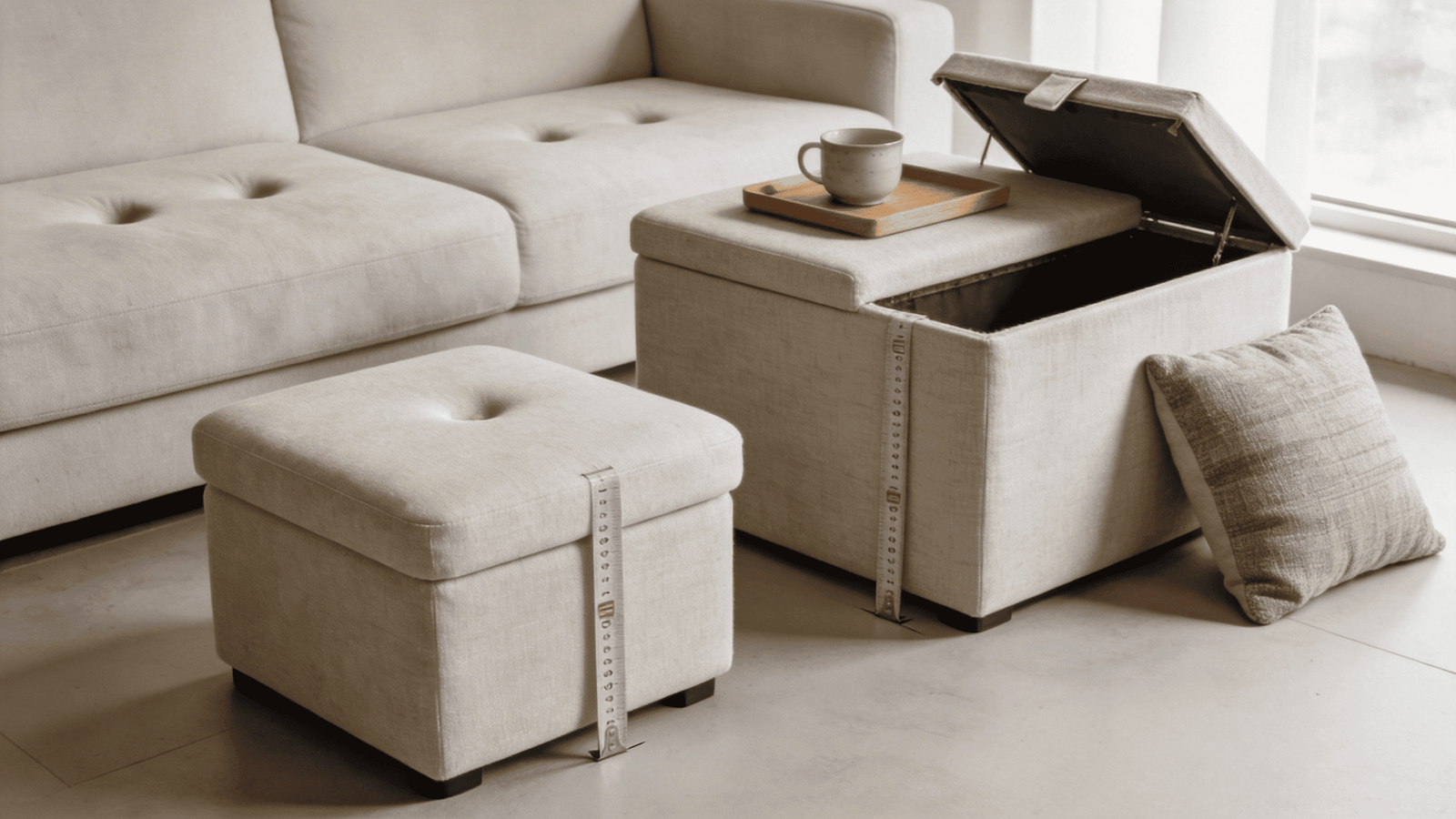
The distinction matters more than most designers expect — and the projects where it goes wrong share a recognizable pattern. Below I'll walk through each decision variable in sequence, with direct if/then guidance you can use in a client conversation or drop straight into a spec sheet.
Are a Footstool and an Ottoman Really the Same Thing?
This is the most common starting point for the confusion. Clients use the terms interchangeably, and some furniture retailers don't help by labeling the same product both ways. The "same thing, different name" assumption is where the spec mistake usually begins.
A footstool and an ottoman share an upholstered silhouette and a low profile — but they are built for different functional roles, different weight demands, and different height relationships with the sofa. Treating them as equivalent at the specification stage means you risk getting the scale, height, and internal construction wrong before a single yard of linen is cut.
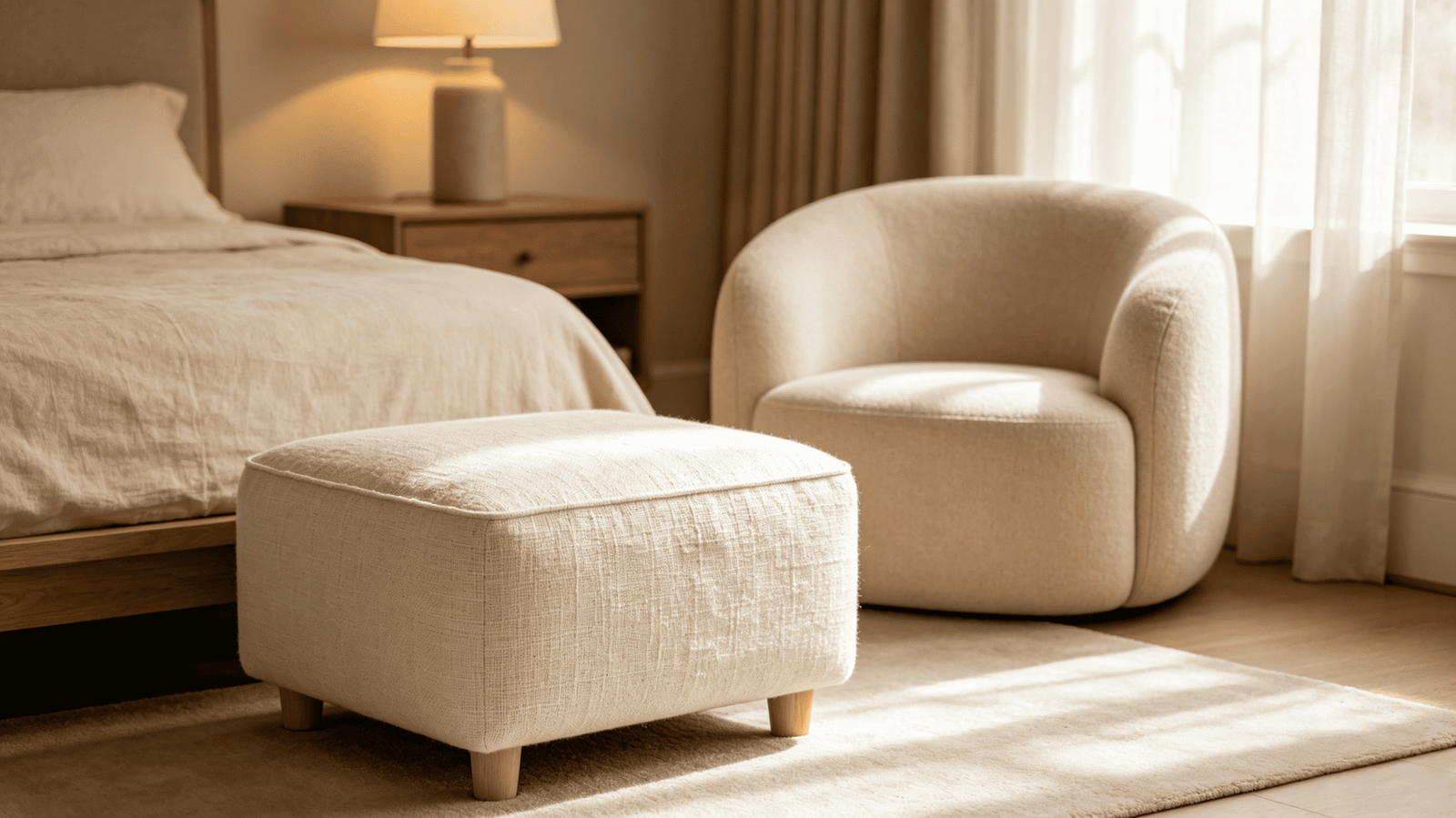
What Makes a Footstool a Footstool?
A footstool is purpose-built for one job: supporting the feet of a seated person. That singular function shapes everything about how it's made.
Defining characteristics of a footstool:
- Compact footprint — typically 18–24 inches wide, designed to sit directly in front of a single chair rather than anchor an entire seating group
- Lower profile — usually 12–16 inches in height, intentionally below seat height to allow the legs to rest at a comfortable downward angle
- Solid, simple construction — no storage cavity, no need for a firm load-bearing top surface
- Single-occupant context — a bedroom reading chair, a study armchair, a nursery glider
The footstool's value is in its restraint. It does one thing well and takes up minimal floor space doing it.
What Makes an Ottoman an Ottoman?
An ottoman carries a broader functional brief. It needs to perform across at least two roles — and in many residential projects, three.
The three roles an ottoman is typically specified to cover:
- Foot rest — same basic function as a footstool, but scaled for a full sofa rather than a single chair
- Occasional extra seat — when guests arrive and the sofa is full, a well-specified ottoman holds a seated adult without collapsing or deforming
- Surface substitute — a tray placed on top turns it into a functional coffee table replacement in open-plan or casual living spaces
That third role, in particular, has structural implications that don't exist for a footstool at all.
| Feature | Footstool | Ottoman |
|---|---|---|
| Primary role | Foot rest | Foot rest + seating + surface |
| Typical width | 18–24 in | 28–48+ in |
| Typical height | 12–16 in | 16–20 in |
| Storage option | Rarely | Commonly available |
| Seat-weight rating needed | No | Yes (if used as seat) |
| Firm top surface needed | No | If used as table/surface |
| Room context | Single chair, bedroom | Living room, open-plan lounge |
The table above shows the structural gap. It's not about style — it's about what the piece needs to withstand and deliver once it's in the room.
Does Seat Height Matter When Specifying Either Piece?
Every week we receive inquiries where the designer has confirmed the fabric and the leg finish but hasn't referenced the seat height of the sofa or chair the piece will accompany. This single omission produces more functional complaints than any other spec variable I've seen.
Seat-height matching is the most consistently skipped step in footstool and ottoman specification. A piece that sits 4–5 inches below seat height works passably as a foot rest — but it fails immediately as an occasional seat and makes tray use awkward. Getting this right requires one measurement taken before anything else is ordered.
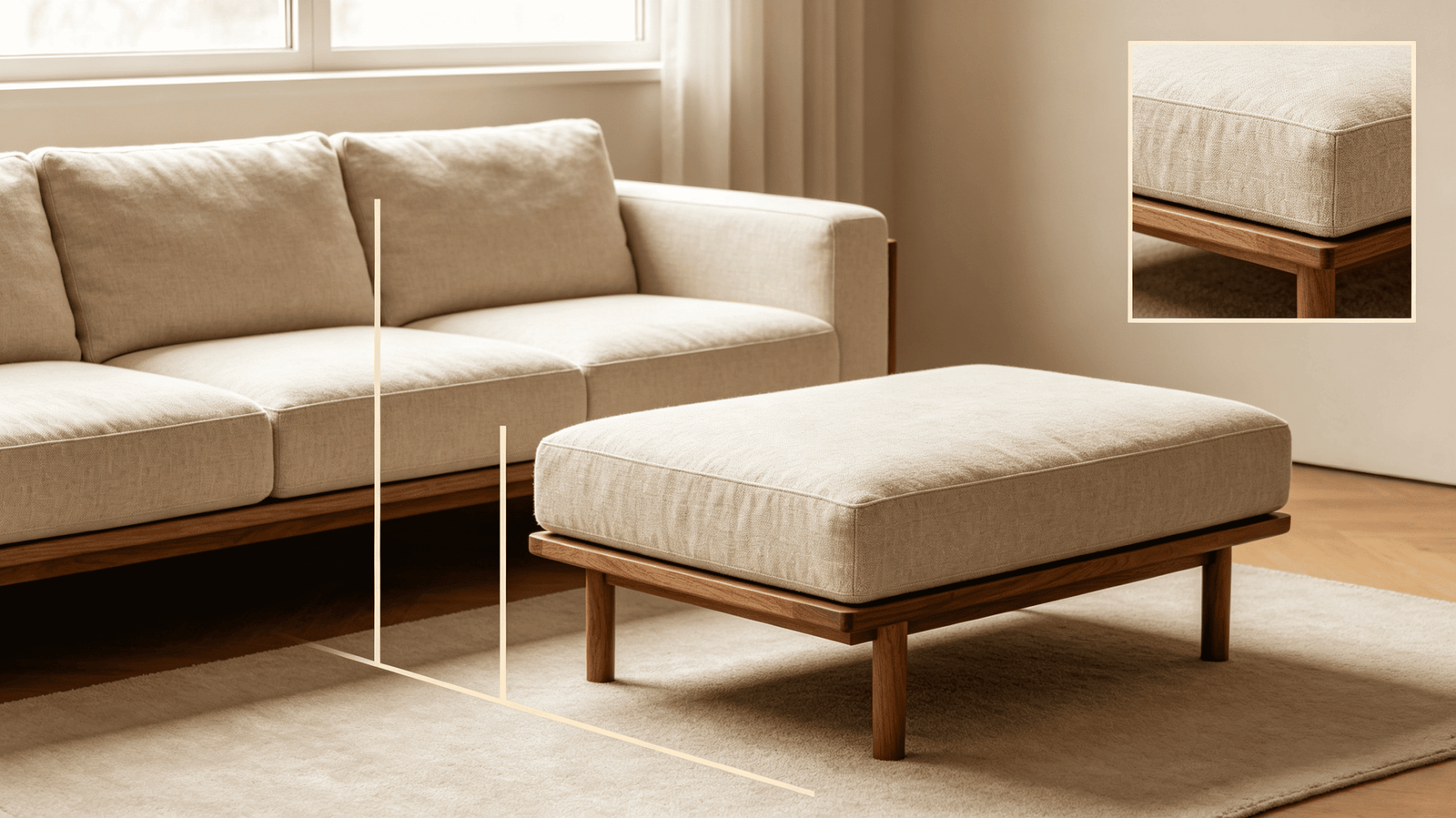
How to Match Height to Intended Use
Most upholstered sofas in the US market have a seat height between 17 and 19 inches. Use that as your reference point, not the room's visual proportions.
If the piece is foot-rest only: A footstool can sit 2–3 inches below the sofa or chair seat height. This slight downward angle is ergonomically natural for resting legs. A height of 14–16 inches works for most standard sofas.
If the piece will also serve as occasional seating: The ottoman needs to sit within 1 inch — above or below — of the sofa's seat height. Much lower and seated guests feel like they're on the floor. Much higher and the proportion looks wrong and feels unstable. For a sofa with an 18-inch seat height, target an ottoman in the 17–19 inch range.
If the piece needs to hold a tray at coffee-table height: Standard coffee table height runs 16–18 inches. If your client wants to use the ottoman as a table surface, this range aligns well with most sofa seat heights and keeps the tray at a usable reach. Confirm the sofa has a seat height above 17 inches before specifying at the lower end of this range.
The Practical Test I Recommend to Every Designer
Before finalizing the height spec, I ask designers to answer this one question:
Will anyone other than the sofa's primary occupant ever sit on this piece?
If the answer is yes — even occasionally — specify to seat-height match, not foot-rest drop. The cost difference between a footstool height and a properly scaled ottoman height is minimal at the manufacturing stage. The cost of a re-order because the piece is unusable as a seat is not.
When Does Function Determine the Build — Not Just the Size?
This is where the footstool vs ottoman decision stops being a spatial question and becomes a structural and manufacturing question. I've seen designers finalize upholstery and dimensions, then ask mid-production whether storage can be added, or whether the top can support a 20-pound loaded tray. At that point, the answer is almost always no — not without rebuilding the piece from the frame up.
Storage, surface load capacity, and multi-function intent must be locked at specification. These are not retrofit decisions.
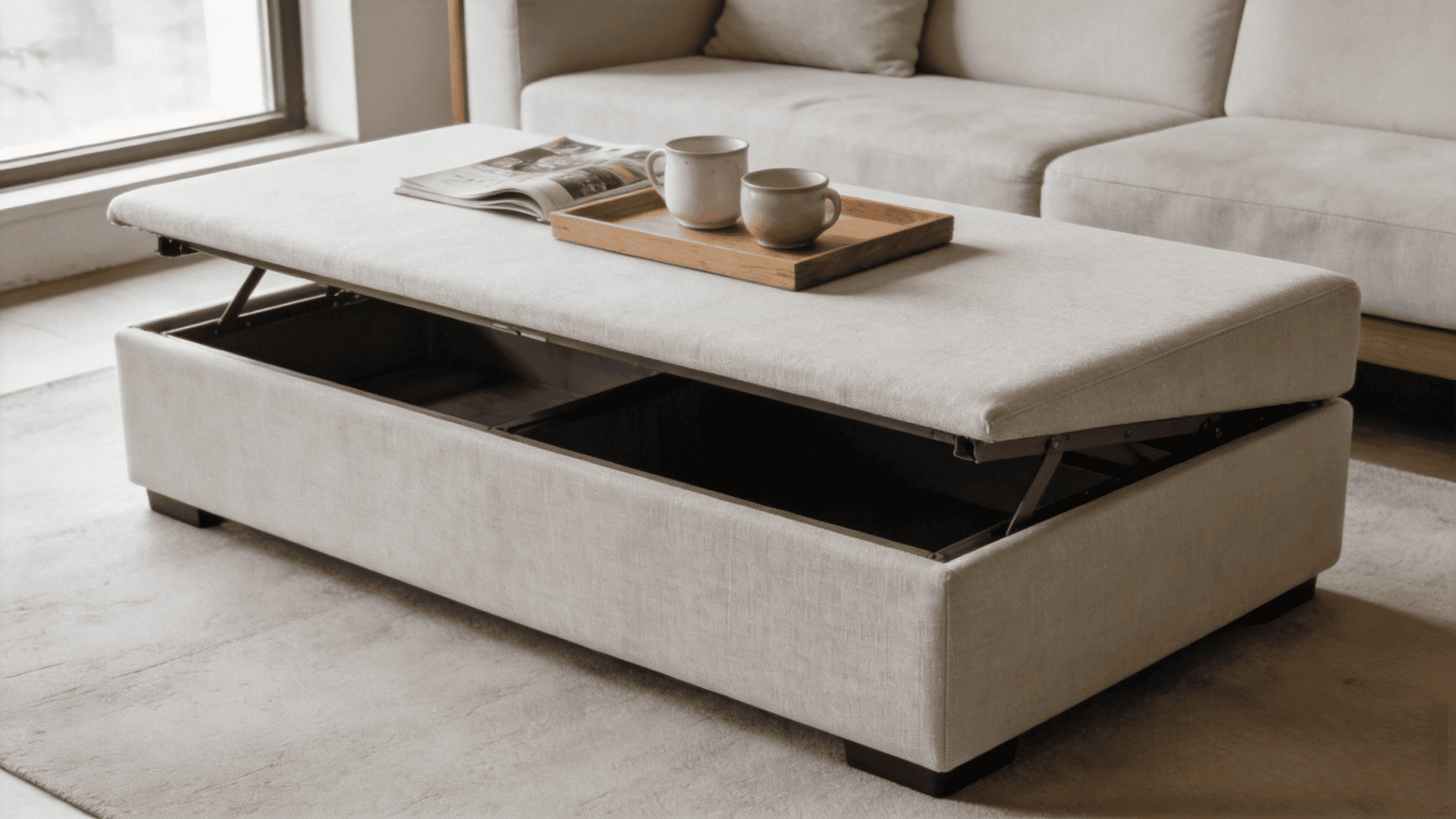
Storage: It Changes the Entire Internal Construction
A standard upholstered footstool or ottoman uses a fixed, padded top over a solid or webbed frame. A storage ottoman replaces that fixed frame with a hinged or lift-off lid and a hollow interior — which means:
- The top panel must be rigid enough to function as a lid and still support seated weight without flexing or cracking
- The hinge or lift mechanism adds hardware that must be specified for weight and frequency of use
- The internal cavity dimensions need to be confirmed if the client has a specific storage purpose (blankets, remotes, children's toys)
- The base frame must bear the full load without any support from the top panel when the lid is open
None of this is complicated to build — but none of it can be added after the frame is made. A storage ottoman is a different product from a solid-top ottoman, not a variation of the same one.
Surface Use: Firm Top vs. Soft Top
This is a smaller but equally important specification call.
Soft top — traditional padded upholstery, comfortable for resting feet, acceptable for sitting. A tray placed on a soft top will tilt and slide. Not suitable for surface use.
Firm top — a thinner layer of foam or batting over a rigid panel, wrapped in linen. Stable enough for a tray, books, or a drink. This is what you specify when the client describes their ottoman as "basically our coffee table."
The difference in top construction affects not just function but the visual profile of the piece — a firm top sits flatter and reads as more architectural. A soft, domed top reads as more relaxed and residential1. Both are valid; the choice should follow function, not aesthetic preference.
Weight Capacity for Occasional Seating
If the ottoman will be used as a seat, the frame and internal structure need to be specified accordingly. A standard residential upholstered ottoman built for foot-rest use typically handles 150–200 lbs of static load. An ottoman intended for regular seated use should be specified to 250–300 lbs minimum, with a hardwood frame and corner-blocked joints.
At our factory, this is a standard question on every ottoman inquiry. Most designers don't ask it unprompted — which is why I ask it first.
What's the Right Piece for Each Common Project Scenario?
Feature comparisons are only useful when they lead somewhere. Here's the direct if/then logic I use when designers ask me which direction to go.
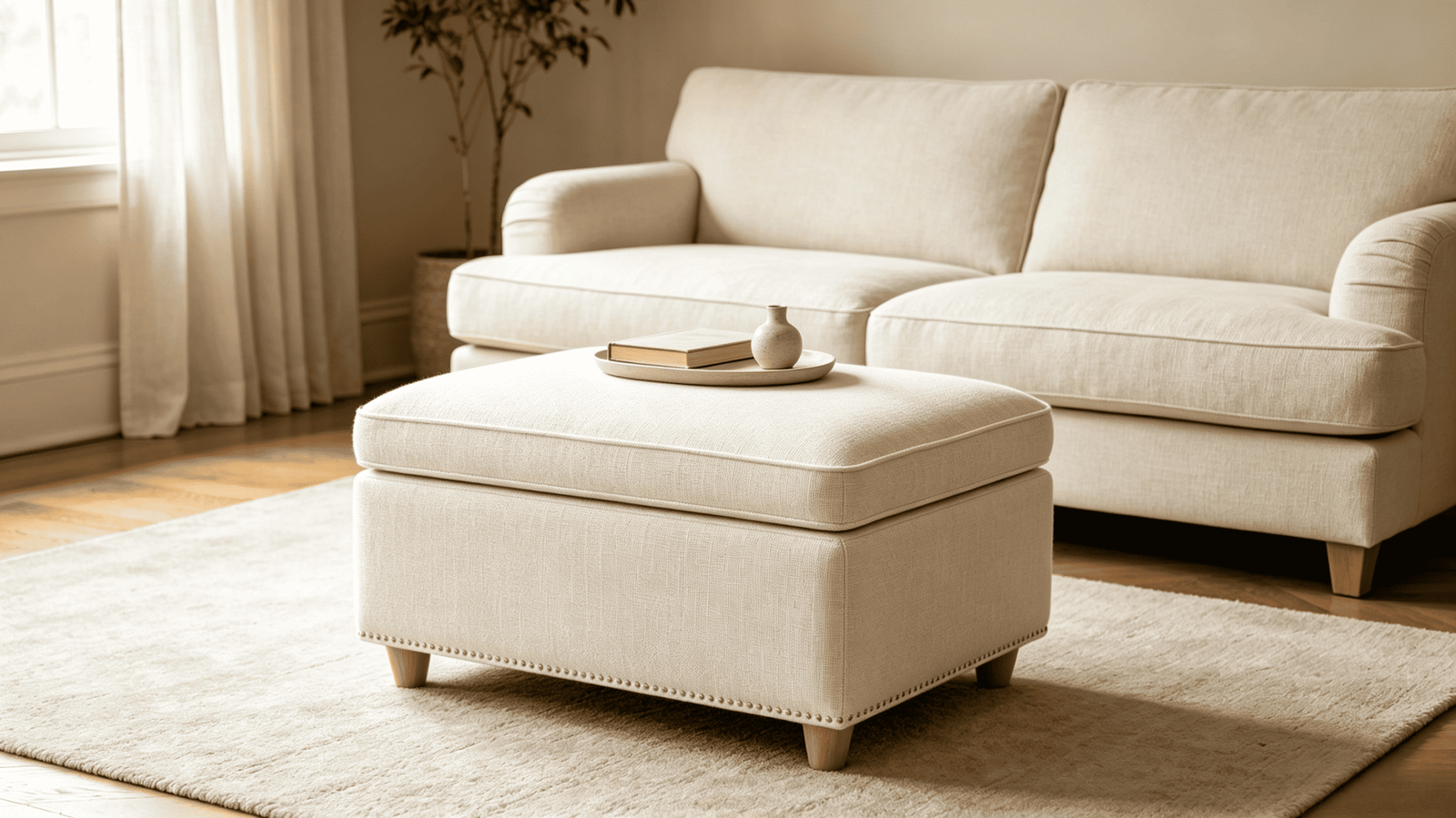
Scenario Matching: Footstool vs Ottoman by Room Context
Scenario 1: Living room anchor piece, primary sofa, occasional guests → Upholstered ottoman, firm top, specified to match sofa seat height (±1 inch), 300 lb weight capacity, 36–48 inch width to scale with a full sofa
Scenario 2: Bedroom reading chair companion → Low footstool, 14–16 inch height, small footprint (18–22 inches), soft top, no storage required — keep it simple and refined
Scenario 3: Open-plan lounge needing flexibility → Storage ottoman, firm top, lift-off or hinged lid, seat-height matched, specified in a neutral linen that reads as furniture rather than accessory
Scenario 4: Study or home office armchair → Compact footstool, no storage, lower profile acceptable since the primary use is ergonomic (feet up while reading or at a desk)
Scenario 5: Children's playroom or media room with high traffic → Storage ottoman, firm top, durable linen in a mid-tone that hides wear, reinforced frame, 300 lb+ capacity since children will use it as a jump platform regardless of what you specify2
A Note on Scale
One mistake I see repeatedly: designers specify a footstool for a living room sofa because it looks less "heavy" in the floor plan. In use, a footstool in front of a 94-inch sofa looks like a misplaced accessory. The visual weight of the piece should be proportional to the sofa it accompanies. Use the sofa's seat width as a rough guide — an ottoman or footstool should span at least one-third of the sofa's seat width to read as intentional rather than leftover3.
How Does Customization Support the Right Specification?
Once the functional decisions are made — role, height, top construction, storage or not — the specification is ready to move into materials and customization. Not before.
At Linen World, we manufacture upholstered footstools and ottomans to order from our Foshan factory, with 13 years of production experience serving US and European interior designers. Because we work directly with designers on made-to-order pieces, we can lock in every structural variable — frame construction, top firmness, storage configuration, leg height — before a single cut is made.
What this means for your project:
- Height is not a standard dimension — we build to the seat-height spec you provide, not to a catalog default
- Top construction is confirmed at order — firm top for surface use, soft top for foot-rest-only applications
- Storage is built into the frame — not retrofitted, not approximated
- 200+ linen colorways available — including Belgium pure linen options — so fabric coordination happens after the functional spec is locked
- COM fabric is fully supported — if you're working with a specified textile
Compared to sourcing from a domestic US workroom or a European custom manufacturer, our pricing typically runs 40–60% lower for equivalent quality and construction4. Lead times and minimums are project-friendly for residential designers working on individual installations rather than wholesale orders.
Frequently Asked Questions
Can a footstool be used as a coffee table?
Rarely, and only if it has a firm top and appropriate height. Most footstools are too low and have soft tops — neither works for stable surface use. If your client needs a table substitute, specify an ottoman with a firm top and confirm the height is within coffee-table range (16–18 inches).
What's the standard height difference between a footstool and an ottoman?
A footstool typically runs 12–16 inches. An ottoman is usually 16–20 inches. The key reference is always the sofa or chair seat height, not an absolute number. Specify the height relative to the seat height of the accompanying piece.
Should an ottoman match the sofa fabric exactly?
Fabric coordination is a styling decision, not a selection criterion for function. Determine the role, height, and construction first. Then confirm fabric. An exact match can work, but many designers intentionally use a tonal variation or textural contrast — particularly in linen, where weave variation adds depth.
Can I add storage to an ottoman after it's been made?
No. Storage requires a fundamentally different internal construction — a hollow cavity, a rigid lid panel, and hinge hardware. These are built into the frame from the start. Retrofitting storage into a solid-top ottoman means rebuilding the piece. Confirm storage requirements at specification, not after delivery.
How do I specify the right footstool or ottoman size for a sectional sofa?
For a sectional, scale up. A large L-shaped sectional typically warrants an ottoman in the 40–48 inch range, positioned in the interior corner of the L or anchoring the open end. A footstool will read as undersized and visually unresolved next to a sectional. Match the ottoman's width to at least one-third of the sectional's longest run.
Conclusion
The footstool vs ottoman question is a functional decision before it's anything else. A footstool is the right call when the context is a single chair, the use is foot-rest only, and spatial restraint matters. An ottoman is the right call when the piece needs to serve multiple roles — seating, surface, or storage — at the scale of a full sofa or open-plan living group. Getting the seat-height relationship right and locking in the structural requirements at specification — not at purchase — prevents the re-orders and mismatched scale problems I've seen derail otherwise well-designed rooms.
If you're currently specifying an upholstered footstool or ottoman for a high-end residential project and want a manufacturing partner who will ask the right structural questions before production begins, contact Linen World for a project inquiry. We work directly with interior designers on made-to-order linen upholstery — built to your spec, not ours.
"Interactive room design as a tool for understanding form and style ...", https://pmc.ncbi.nlm.nih.gov/articles/PMC12518833/. Interior design theory associates flatter, more geometric furniture profiles with formal or architectural character, while softer, more rounded profiles are associated with informal or residential warmth — a distinction rooted in broader principles of visual perception and form in designed environments. Evidence role: expert_consensus; source type: education. Supports: The relationship between furniture profile geometry and perceived formality or architectural character in interior design. Scope note: This characterization reflects practitioner consensus and design education conventions rather than empirical perceptual research specific to ottoman profiles. ↩
"Furniture and television tip-over injuries to children treated in United ...", https://pmc.ncbi.nlm.nih.gov/articles/PMC8394564/. Consumer product safety data and pediatric injury surveillance reports document furniture-related injuries in children frequently involving climbing and jumping behaviors, supporting the specification of higher structural tolerances for furniture in children's environments. Evidence role: general_support; source type: government. Supports: The behavioral tendency of children to use furniture for jumping and climbing, creating dynamic load demands beyond static weight ratings. Scope note: Available safety data focuses on injury outcomes rather than directly quantifying the dynamic loads generated by children jumping on upholstered furniture. ↩
"What Scale and Proportion Are in Interior Design - Expand Furniture", https://expandfurniture.com/blogs/inspire/what-scale-and-proportion-are-in-interior-design?srsltid=AfmBOorPEKQ0k1V8p5oRdmqczUi02PksEujwJcctByZJEOh-Hz5XOyrE. Interior design proportion principles, as taught in professional design curricula, recommend that accent pieces such as ottomans maintain a scale relationship to primary seating that avoids visual imbalance; a common guideline suggests the accent piece span no less than one-third of the sofa's seat width. Evidence role: expert_consensus; source type: education. Supports: Proportion guidelines for scaling accent furniture relative to primary seating pieces in interior design. Scope note: The one-third rule is a widely cited practitioner convention rather than a formally published standard; sources vary in the specific ratio recommended. ↩
"The Effect of Furniture Imports from China on Employment in U.S. ...", https://www.usitc.gov/publications/332/working_papers/ecwp_2017-08-a-08-23-17_0.htm. Trade and manufacturing research on the global furniture industry documents significant labor and production cost differentials between Chinese manufacturing centers such as Foshan and domestic US or European custom workrooms, with imported upholstered goods frequently priced substantially below domestically produced equivalents of comparable specification. Evidence role: general_support; source type: research. Supports: The cost differential between furniture manufactured in China versus domestic US or European custom production. Scope note: The specific 40–60% figure cited is a manufacturer's claim; actual cost differentials vary by product complexity, material sourcing, logistics costs, and tariff conditions, and are not validated by a single published study. ↩


