
Sofa ottoman pairing often goes wrong when we start with looks rather than use. The result is a pretty setup that feels awkward under real feet and real lifestyles. The fix is simple: define function first, then lock proportions and materials, and only then filter by style. That order consistently saves my clients time, money, and returns.
A sofa ottoman pairing works best when you lead with function, not style: decide if it is a footrest/chaise extension or mobile extra seating, size it by clear ratios (depth ≈ 60–80% of sofa seat depth1, width ≈ 70–90% of one seat width, heights nearly flush), choose durable linen specs (≥30k Martindale, 360–420 gsm, stain‑resistant, removable slipcovers), and only then match aesthetics.
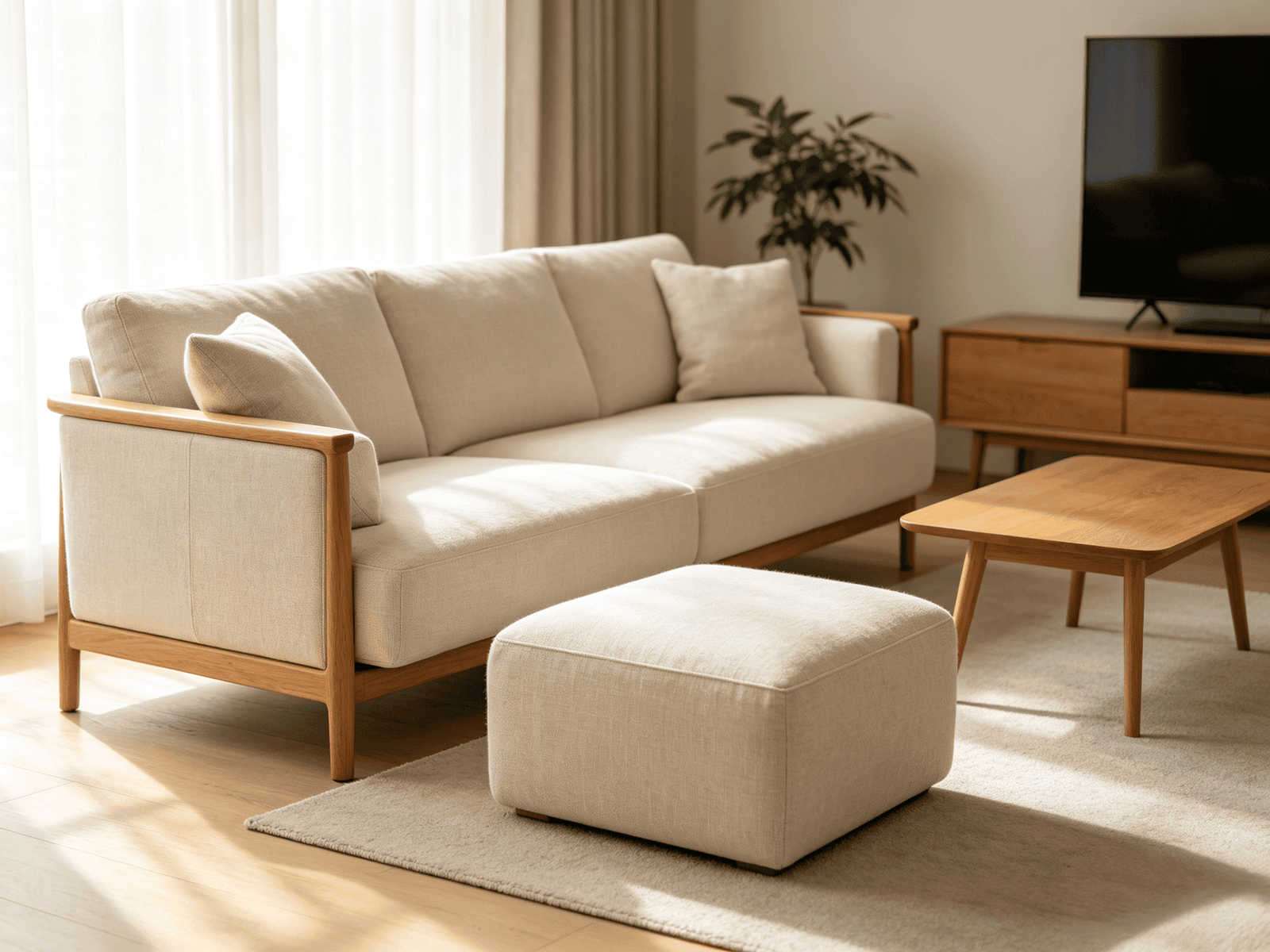
You now have the headline answer. Below, I break down the “why” and the “how” I use as a linen manufacturer working with designers: proportion bands validated in prototypes, material ranges that survive home use, and the small build decisions that avoid wear and wobble.
Should sofa ottoman pairing start with function, not style?
We all get seduced by catalog photos. Then the ottoman arrives, rocks on your floor, and scuffs your rug. The core problem is not color; it is misaligned function. Start by choosing whether the ottoman extends a seat for feet, adds mobile seating, or behaves as a coffee table with a tray. Style follows.
A sofa ottoman pairing should begin with a clear use-case. Footrest/chaise extension demands near‑flush heights and a stable top. Mobile extra seating needs light weight, non‑scratch glides, and sit‑stable upholstery. Coffee table hybrids favor firm foam and tray‑friendly tops. Define function first, then select proportions and materials. Style is the last filter.
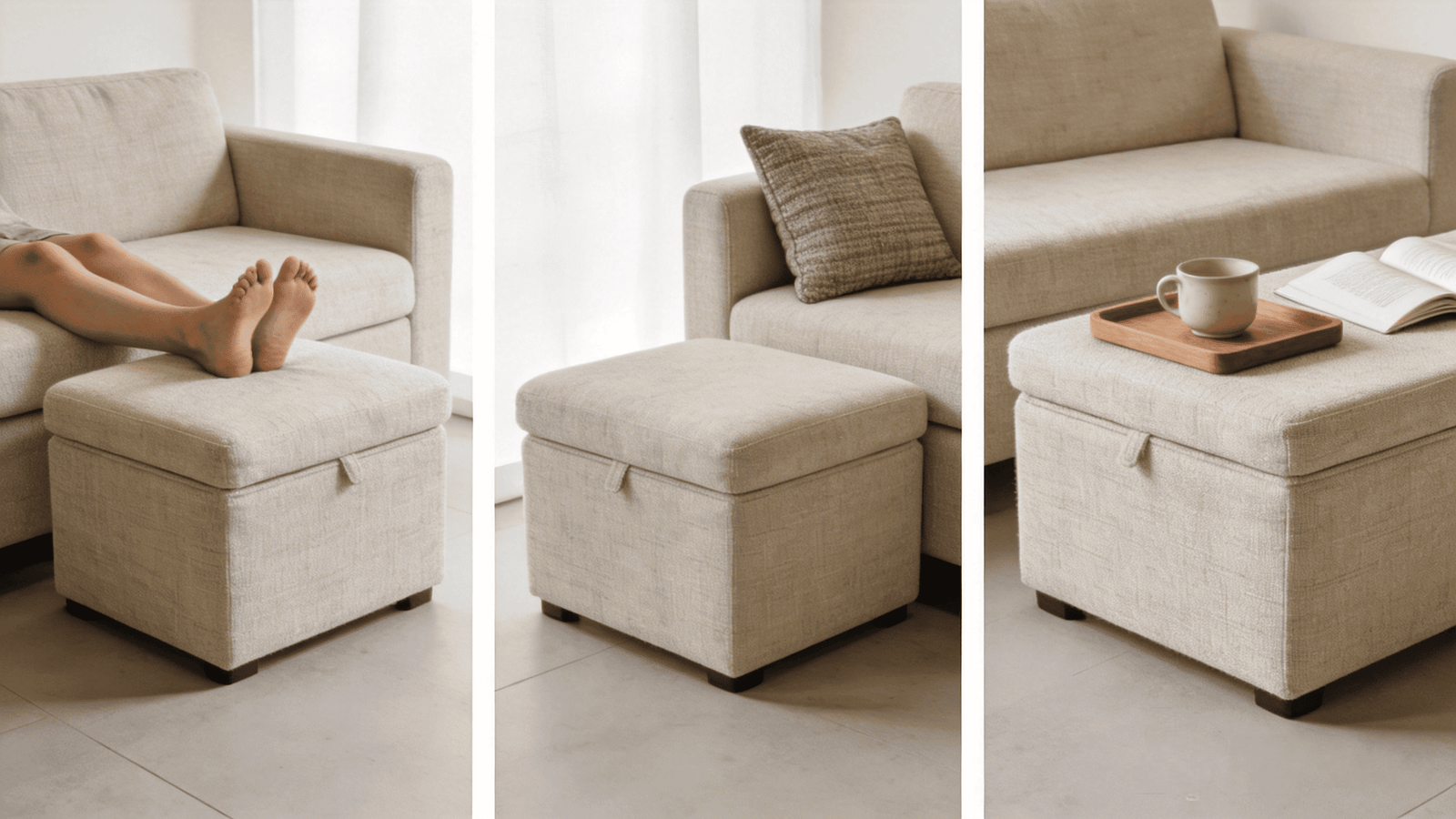
The three functions that drive the spec
- Footrest/chaise extension
- Mobile extra seating
- Coffee table hybrid (tray on top)
Each function asks for different priorities.
| Function | Height target | Top feel | Mobility | Glide/Foot | Upholstery notes |
|---|---|---|---|---|---|
| Footrest/chaise extension | Within ±0–0.5 in (0–12 mm) of seat height | Medium-soft, resilient | Low-moderate | Felt/PTFE over hardwood or wide rubber for stability | Smooth weave; avoid deep buttons to prevent pressure points |
| Mobile extra seating | Similar to lounge seat height, 16–18 in (41–46 cm) | Medium-firm for sit stability | High | Non-scratch, low-friction on rugs; rubberized on hard floors | Tight top or shallow tufting; grippy underside optional |
| Coffee table hybrid | 0.5–1.5 in (12–38 mm) below seat height | Firm, even | Moderate | Stable wide-foot; non-scratch | Firm foam wrap, flat top, tray compatible, stain-resistant finish |
From our projects, two things consistently reduce complaints:
- Non-scratch, floor-appropriate glides. Nylon or PTFE on rugs; rubberized or felted steel on wood/stone. We now default to dual-material glides for mixed surfaces.
- Sit-stable upholstery. For seating, we avoid slippery yarns or oversized slubs that feel unstable. For footrests, we avoid heavy tufting that creates ankle pressure ridges.
I learned this the hard way on a lake house project where a beautiful nubby weave “looked” perfect. The ottomans slid when used as extra seats and snagged socks as footrests. We swapped to a tighter linen blend with invisible anti-slip lining under the slipcover, and the calls stopped.
What proportions make a sofa ottoman pairing feel balanced?
Most returns I see come from “looks right, feels wrong.” Knees sit too high. Ankles hang off. Or the ottoman blocks walkways. There is a repeatable fix: size the ottoman using ratios relative to the sofa’s seat module, not stock dimensions printed online.
A balanced sofa ottoman pairing follows human-friendly ratios. Target ottoman depth (front-to-back) ≈ 60–80% of the sofa seat depth. Target ottoman width (left-to-right) ≈ 70–90% of a single seat width. Keep top height within about 0–0.5 in (0–12 mm) of the seat height2 for footrest use. Protect circulation with 14–18 in (36–46 cm) clearances.
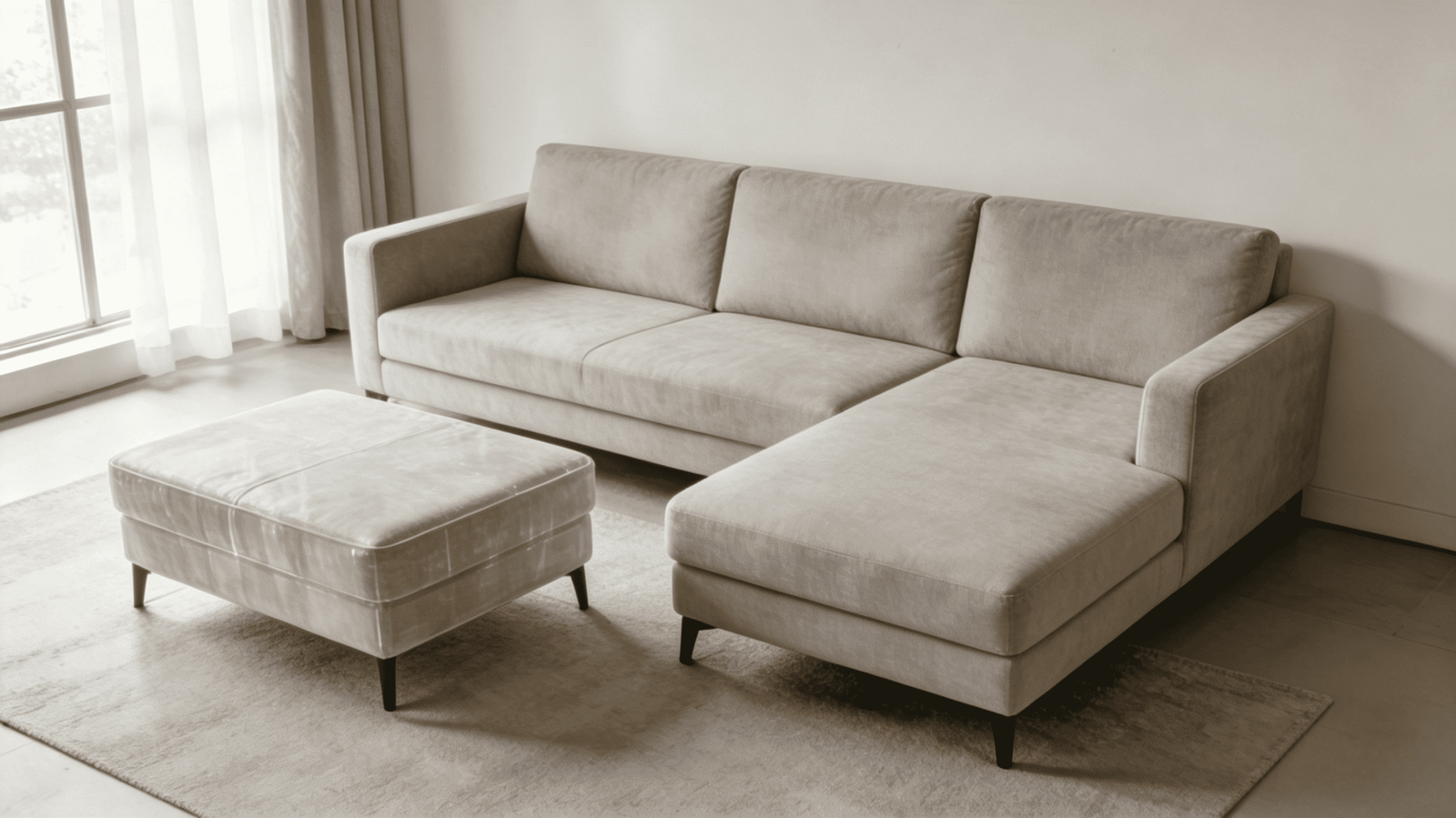
How to calculate the dimensions
First, define terms for a rectangular ottoman placed in front of one seat:
- Sofa seat depth = distance from front of seat to back cushion (typically 22–24 in / 56–61 cm3).
- Single seat width = width of one seating module or cushion (usually 22–26 in / 56–66 cm).
- Ottoman depth (front–back) and ottoman width (left–right) correspond to those axes.
Use these targets for a footrest/extension scenario:
- Ottoman depth = 60–80% of seat depth.
- Ottoman width = 70–90% of a single seat width.
- Ottoman top height = same as seat height or up to 0.5 in (12 mm) lower.
Example A: sofa with 24 in seat depth and 25 in single seat width:
- Depth target: 14.4–19.2 in (36.5–48.8 cm).
- Width target: 17.5–22.5 in (44.5–57.2 cm).
- Height: if seat height is 17.5 in (44.5 cm), aim for 17–17.5 in.
Example B: deep sectional, 26 in seat depth and 30 in seat module:
- Depth target: 15.6–20.8 in (39.6–52.8 cm).
- Width target: 21–27 in (53.3–68.6 cm).
- Height: match within 0–0.5 in.
For mobile seating ottomans:
- Height can sit at 16–18 in depending on the project’s seat heights.
- Depth and width can be tighter (e.g., 60–70% bands) to ease movement.
Clearances and circulation:
- Keep 14–18 in (36–46 cm) clear between ottoman and coffee table/TV console.4
- Maintain at least 24–30 in (61–76 cm) for main walkways around the group.5
- In front of a sectional chaise, angle the ottoman to keep a 12–16 in approach gap for feet.
Why these bands work: They come from repeated prototypes and after‑sales feedback. Clients report fewer awkward ankle angles and better visual weight. We avoid “one-size” dimensions because the body reads relative relationships, not catalog numbers.
Which linen specs make a sofa ottoman pairing durable at home?
Ottomans take shoes, snack trays, and kids’ knees. Many fabrics that look beautiful early pill, stretch, or get water rings. I design for these realities, especially because ottomans concentrate wear. You want comfort and texture without giving up cleanability and seam stability.
For a durable sofa ottoman pairing at home, specify linen or linen-blend fabric with Martindale ≥30k, weight 360–420 gsm, and a stain‑resistant finish. Choose ≥55% linen content for natural hand, blended with performance yarns for resilience. Use removable, pre‑shrunk slipcovers, zipper closures, anti‑slip lining, and consider a spare cover set to ease maintenance.
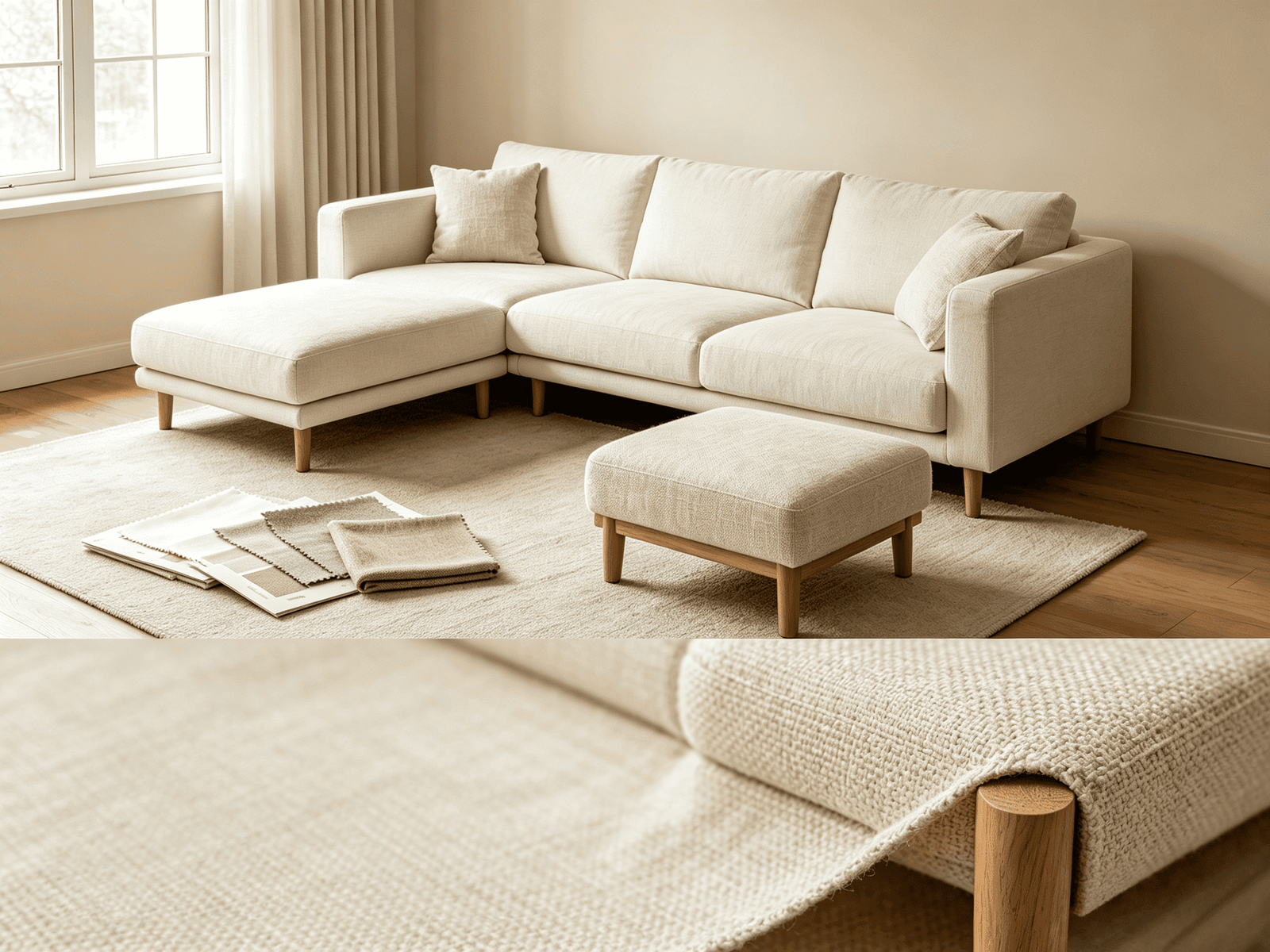
The material choices that reduce service calls
As a linen manufacturer (linen world, Foshan, 13 years) working with designers across the US and EU, these are the ranges I trust for real homes:
- Durability: Martindale ≥30,000 rubs6 or Wyzenbeek ≥30,000 double rubs.7 We do not oversell lab numbers as guarantees; these are usage‑based targets from projects, not claims of immunity to wear.
- Weight: 360–420 gsm for a tactile hand that resists seam slippage. Lighter weights can look crisp on day one but telegraph foam and stress.
- Fiber content:
- ≥55% linen with polyester or viscose blend balances hand and resilience.8
- 100% Belgian pure linen offers unmatched breathability and slub character but prefers gentler care; for heavy ottoman traffic, blends often outlast it.
- Finish: PFC‑free stain‑resistant finishing9 to reduce water marking. Always test with your chosen cleaner.
- Construction: Pre‑shrunk or pre‑washed yardage, colorfast zippers, lock‑stitch seams with bar tacks at stress points, and anti‑slip lining under slipcovers.
- Covers: Removable slipcovers with zipper closures and Velcro anchors. Order a spare cover set to extend service life; we track lower maintenance pain with this practice.
A quick comparison to guide choices:
| Spec | Pure linen (≥90%) | Linen blend (55–70% linen + poly/viscose) |
|---|---|---|
| Hand/Look | Best natural slub, breathable | Slightly smoother, consistent |
| Durability | Good if heavy; sensitive to abrasion/pilling on ottomans | Better resilience, lower pilling risk |
| Care | Prefers gentle cleaners, spot care | Wider cleaning tolerance |
| Use case | Low–moderate ottoman wear; owners who accept patina | High‑touch ottomans; family rooms; rental staging |
We also consider weave scale. Match the sofa and ottoman by weave “read” (fine vs chunky), even if the fabrics differ. A common pitfall: color matches but weave scale fights, and wear rates diverge, making the pairing age unevenly.
Compliance and limits: If your project requires flame performance (e.g., CAL TB117‑2013, TB133/ASTM E84 for public spaces, or BS 5852 in the UK10), we source or treat accordingly and verify with supplier certificates. Our guidance here is for private home scenarios; always confirm local standards.
Does a sofa ottoman pairing need to match the sofa exactly?
Many buyers assume the safest path is the matching ottoman from the same series. That can lock you into the wrong function or the wrong size. The better approach is to match performance first and style second, so the pairing works hard before it looks coordinated.
A sofa ottoman pairing does not have to match the sofa exactly. You can mix ottomans if proportions, performance specs (durability bands above), weave scale, and tone align. Aim for compatible texture and touch, consistent Martindale/weight ranges, and near‑flush heights. This avoids “color matches but texture/wear doesn’t” failures.
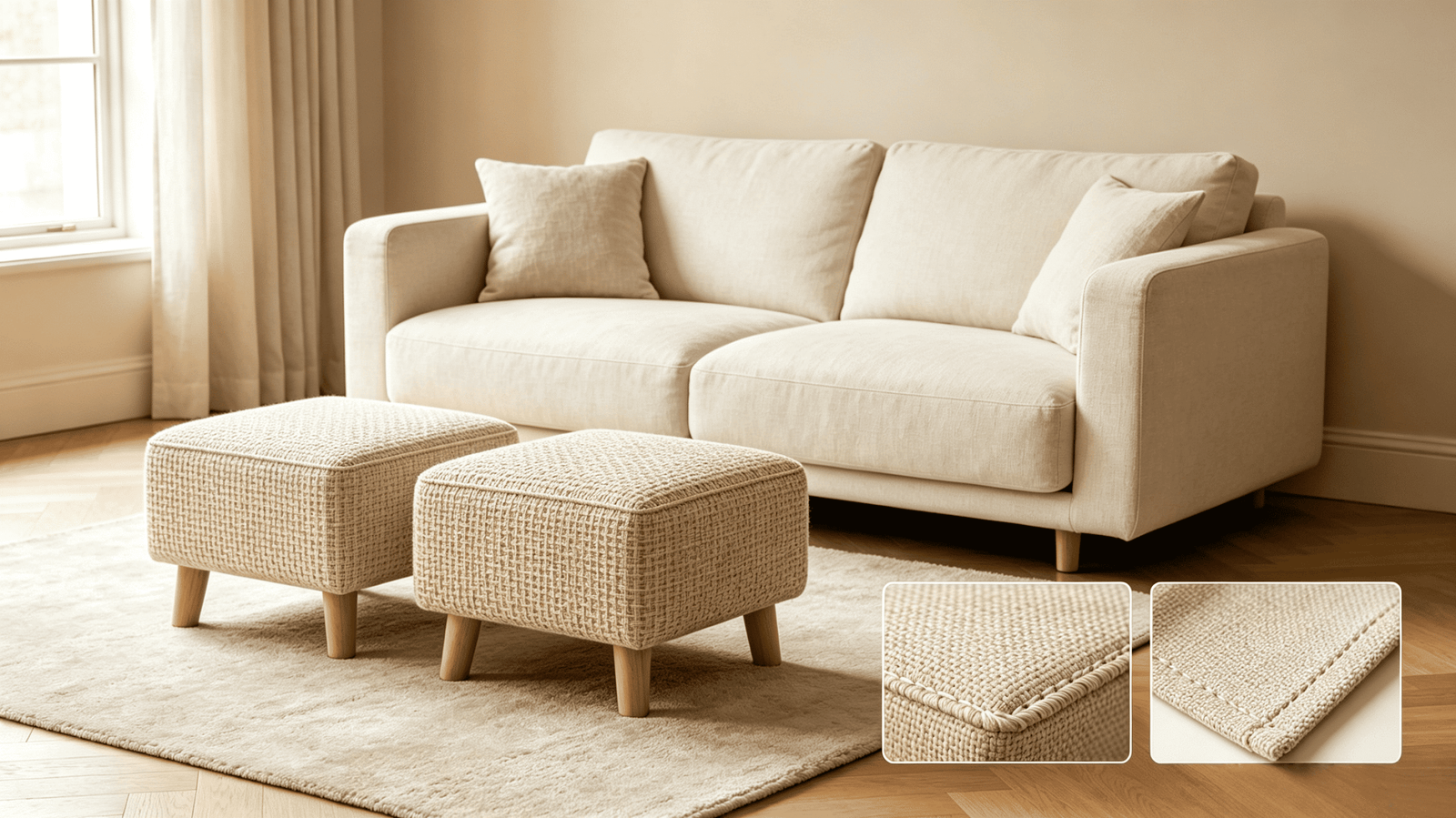
How I mix without mismatching
- Keep height and proportions consistent with function. A perfect fabric match cannot fix a height that tweaks knees.
- Match weave scale more than exact color. A fine basketweave sofa pairs better with a fine twill ottoman than with a big, chunky slub in the same color.
- Align durability. If the sofa is a 360 gsm 40k Martindale blend, keep the ottoman in the 360–420 gsm and ≥30k band.
- Calibrate tone by undertone, not just lightness. Warm greige linen and cool grey linen clash even if their brightness is identical.
Anecdote: In a Napa project, the designer wanted a dramatic contrast ottoman. We paired a warm natural Belgian pure linen sofa with a cocoa linen‑poly blend ottoman. The weave scale was identical, both at ~380 gsm with the same finish, and heights matched within 6 mm. Two years later, the sofa developed a gentle patina while the ottoman held firm—coherent aging without looking like a “set.”
If you prefer a unified look, that is fine—but only after the ottoman passes the function and proportion tests.
How should you plan circulation around a sofa ottoman pairing?
Even perfect proportions can feel wrong if the room traffic pinches. People need to slide in and out without shin collisions. The problem usually shows up in smaller living rooms, or when a sectional and coffee table already fill the space.
Plan a sofa ottoman pairing with clear walkways. Keep 14–18 in (36–46 cm) between sofa and ottoman for footrest use, at least 24–30 in (61–76 cm) for main circulation paths, and 12–16 in (30–41 cm) access gaps around chaise ends. Use light glides for quick repositioning and a rug that visually contains the group.
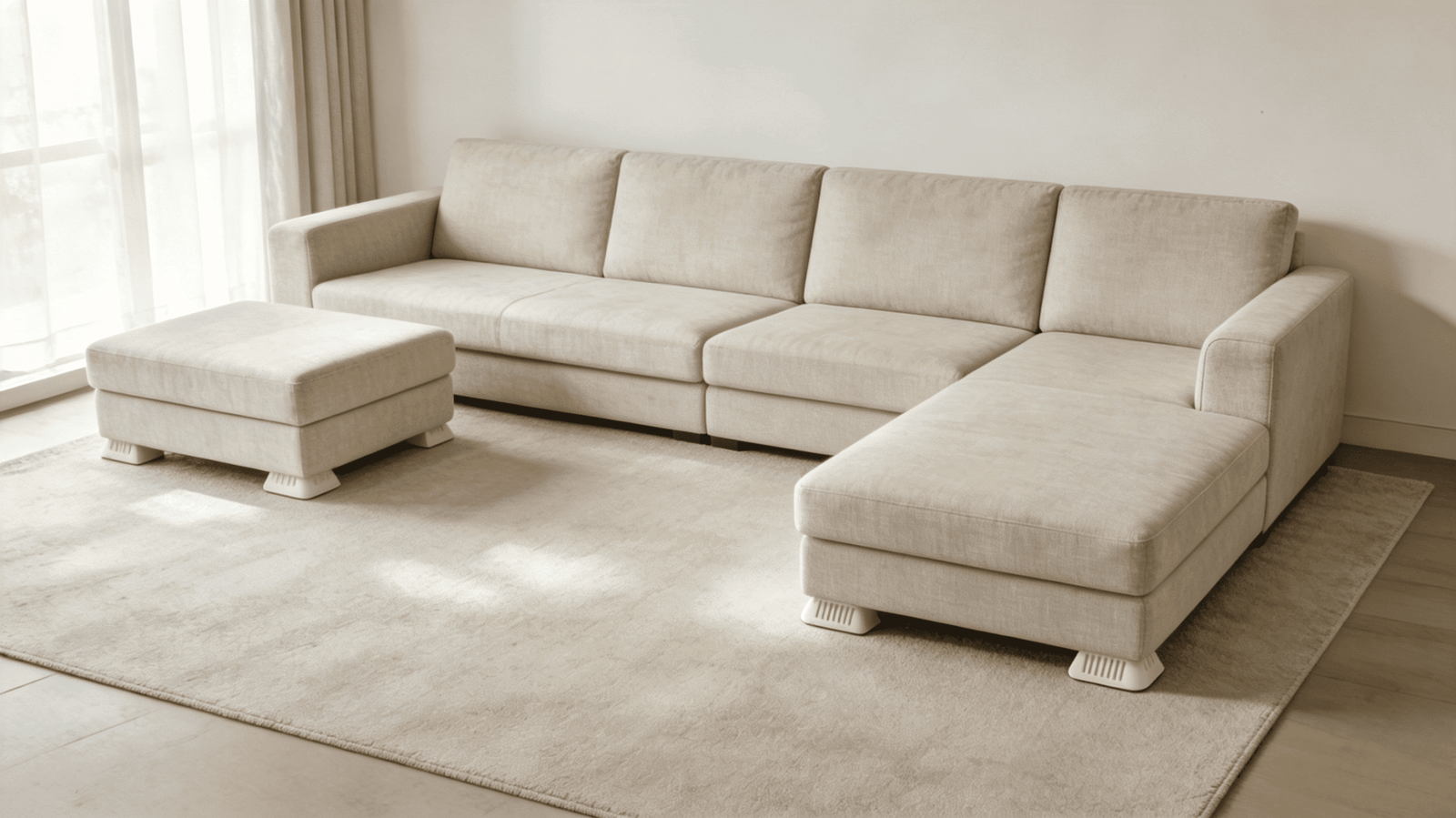
Layout rules that keep shins safe
- Primary clearance bands:
- Sofa face to ottoman face: 14–18 in for footrest comfort. For coffee table hybrid, lean to 16 in to allow a tray and cups without crowding.
- Main walkway behind or beside seating: 24–30 in minimum, 36 in if it is a through‑route.
- Sectional specifics:
- In front of a chaise, angle or offset the ottoman to create a 12–16 in step‑in zone.
- For L‑shapes, center the ottoman on the most‑used seat, not the geometric center.
- Rug sizing:
- Anchor the sofa, ottoman, and front feet of chairs on the same rug. This keeps the ottoman from drifting visually and reduces sliding.
- Leave 8–12 in of rug border as a visual frame.
Operational tips we now build into projects:
- Dual‑surface glides: PTFE caps with felt pads give easy movement on rugs and protect wood. We offer both snap‑in and screw‑in to fit different legs.
- Hidden handle tabs under slipcovers on large ottomans (≥24 in wide). They give you a grip to reposition without stretching the fabric.
- For families, firm foam topping under the slipcover prevents tray wobble and drink spills.
Circulation planning does not cost more. It just needs numbers early so proportion choices do not become obstacles.
Which customization details lock in a durable sofa ottoman pairing?
Tiny build details matter more on ottomans because people push, pull, and rest feet or sit on them from every angle. The wrong foam, flimsy glides, or loose slipcovers age the piece fast and frustrate clients.
Choose a frame with solid hardwood or marine‑grade plywood, high‑resilience foam cores (≥2.2 lb/ft³ density, ILD tuned to function), and firm topper for trays. Use removable, pre‑shrunk slipcovers with zipper closures and anti‑slip lining. Specify non‑scratch glides, corner blocks, and consider a spare cover set. These details extend the sofa ottoman pairing’s service life.
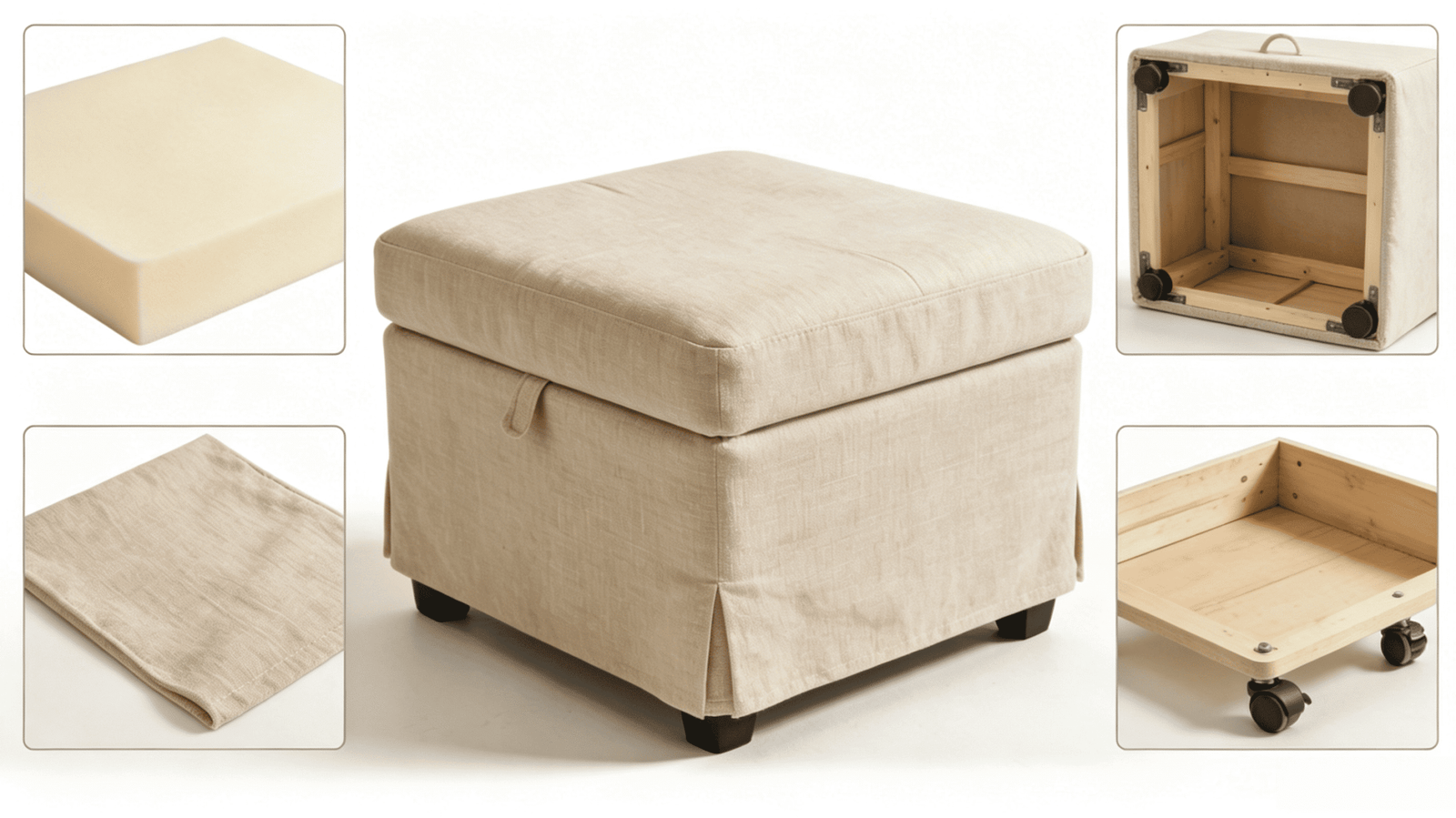
The build spec I recommend, and why
- Frame:
- Hardwood rails or 11–13 ply hardwood plywood for flat top integrity.
- Corner blocks and screw‑through leg plates; ottomans get lateral loads from every direction.
- Suspension:
- Webbing plus a hard panel top, or springs capped with panel for a flat tray‑friendly surface.
- Foam and fill:
- Core: HR foam ≥2.2 lb/ft³ (35 kg/m³) density.11 ILD 25–35 for mobile seating; 20–30 for footrests.
- Topper: 0.5–1.0 in firm foam sheet under Dacron wrap for coffee‑table hybrid use to resist tray dimpling.
- Slipcover and upholstery:
- Pre‑shrunk, removable covers; lock‑stitch seams; bar‑tacked corners.
- Zippers on two sides for easy removal; Velcro anchors hidden underneath.
- Anti‑slip lining between cover and shell; avoids “walking” covers when used as a footrest.
- Avoid deep tufting on footrest ottomans to reduce pressure ridges and crumb traps.
- Legs and glides:
- Non‑scratch glides appropriate to floor type. For mixed surfaces, we install dual‑material options.
- If rug is thick, slightly taller legs (by 0.25 in) can keep top height flush once the ottoman sinks into the pile.
COM and custom notes for designers:
- Yardage: small ottomans often consume more than expected due to all‑around exposure and pattern matching. Provide pattern repeat data; we will nest cuts to minimize waste.
- Tolerances: we cut for ±5 mm dimensional tolerance; share your seat height to the millimeter so we can match neatly.
- Regulations: if your project is in CA, UK, or hospitality, tell us upfront so we align interliners and fillings to CAL TB117‑2013 or BS 5852 where needed.
In our atelier, these choices came from post‑install reviews. The best compliments I get months later are boring ones—“It sits right. It moves easily. It still looks good.”
Frequently Asked Questions
What size ottoman fits an 84-inch sofa?
Start from the seat module, not overall length. If each seat is ~24–26 in wide and ~22–24 in deep, target an ottoman roughly 15–20 in deep and 18–24 in wide, with top height matching the seat within 0–0.5 in. Keep 14–18 in clearance to walk and stretch.
Should the ottoman be the same height as the sofa seat?
For footrest use, yes—keep the ottoman top within about 0–0.5 in (0–12 mm) of the seat height to avoid awkward ankle angles. For mobile seating, 16–18 in is comfortable across most rooms.12 For tray/cocktail use, slightly lower (0.5–1.5 in) can feel natural.
Can pure linen handle kids and dogs on an ottoman?
Yes, if you choose a heavier pure linen (≈380–420 gsm) with a stain‑resistant finish and removable, pre‑shrunk slipcovers. For very high use, a 55–70% linen blend improves abrasion and pilling resistance. Order a spare cover set to rotate and clean without stress.
Do the sofa and ottoman need to be the same fabric?
No. Match performance and weave scale first. Keep both fabrics in similar weight and durability bands (e.g., 360–420 gsm, ≥30k Martindale), align undertones, and ensure heights and proportions feel right. This approach avoids pieces aging at different rates even when colors match.
How do I keep an ottoman from sliding or scratching floors?
Specify the right glides: felt or rubberized feet for hard floors; nylon/PTFE for rugs. We use dual‑material glides for mixed surfaces. Anchoring the ottoman on a properly sized rug also reduces sliding. Anti‑slip lining under the slipcover helps stop cover “walking.”
Conclusion
A successful sofa ottoman pairing starts with function, locks in body‑friendly proportions, and only then filters by style. Use human‑tested ratios, choose linen specs that match your wear tolerance, and dial small build details that prevent wobble and wear.
If you want help, my team at linen world https://linenworld.pro in Foshan builds custom linen upholstery—with 200+ colors, COM support, and made‑to‑order precision—often saving 40–60% versus buying locally in the US. Let’s prototype your pairing and make it feel right on day one—and day 1,000.
"Chair Size Design Based on User Height - PMC - NIH", https://pmc.ncbi.nlm.nih.gov/articles/PMC9944090/. Human-factors and interior design references advise sizing support surfaces relative to seating dimensions to maintain neutral joint angles; while they do not prescribe exact ottoman ratios, scaling depth to the seat module is consistent with ergonomic practice. Evidence role: expert_consensus; source type: education. Supports: That sizing an ottoman in relation to the sofa’s seating module aligns with human-factors guidance for comfortable leg support, rather than relying on arbitrary catalog dimensions.. Scope note: The specific 60–80% band is practice-based; ergonomics sources do not provide precise ratio ranges for ottomans. ↩
"Restoring ankle dorsiflexion range of motion in athletes - PMC - NIH", https://pmc.ncbi.nlm.nih.gov/articles/PMC12585996/. Ergonomic guidance indicates that foot support set level with the seated surface helps maintain neutral ankle posture and reduces dorsiflexion/plantarflexion strain, supporting near-flush height for footrest applications. Evidence role: mechanism; source type: education. Supports: That aligning foot support with seat height helps maintain neutral ankle posture and reduces strain during seated use.. Scope note: Evidence typically derives from task seating contexts; lounge seating varies in cushion compression and posture. ↩
"Sloan Bed - Linen World - Linen World", https://linenworld.pro/product/sloan-bed/. Interior design dimension references report lounge sofa seat depths commonly in the low 20-inch range, providing context for the cited 22–24 inch values. Evidence role: expert_consensus; source type: education. Supports: That lounge sofa seat depths commonly fall in the low 20-inch range.. Scope note: Seat depth varies by style and manufacturer; there is no single global standard. ↩
"How Far Should a Coffee Table Be From the Sofa? - hernest", https://www.hernest.com/blog-detail/how-far-should-coffee-table-be-from-sofa-b-88.html?srsltid=AfmBOorj2pDydOw7fOH-eWHVOYkoo9538biytpMP1T3Pi6bwRZ-AgmOz. Residential space-planning references describe clearances of approximately 14–18 inches between seating and low tables to allow legroom and comfortable reach, supporting the stated band. Evidence role: expert_consensus; source type: education. Supports: That interior space-planning guides recommend roughly 14–18 inches between seating edges and low tables/ottomans for legroom and reach.. Scope note: These are guidelines rather than enforceable codes; room geometry and user needs can justify deviations. ↩
"ADA Standards for Accessible Design Title III Regulation 28 CFR ...", https://www.ada.gov/law-and-regs/design-standards/1991-design-standards/. Accessibility standards specify a minimum clear width of 36 inches for an accessible route, underscoring that wider walkways enhance movement; interior design guides for non-ADA residential spaces often allow narrower paths for secondary circulation, such as 24–30 inches. Evidence role: definition; source type: government. Supports: That wider clear widths improve circulation and that accessibility standards specify a minimum of 36 inches for accessible routes.. Scope note: ADA requirements apply to accessible spaces; private residences without accessibility mandates may use smaller clearances. ↩
"Abrasion Testing: Wyzenbeek & Martindale Compared | FibreGuard", https://fibreguard.com/sell/blog/abrasion-testing-for-performance-fabrics-explaining-martindale-and-wyzenbeek. The Martindale abrasion test quantifies wear by counting rub cycles; references associate higher counts (e.g., around or above 30,000 rubs) with heavy-duty applications, contextualizing the durability threshold. Evidence role: definition; source type: encyclopedia. Supports: That the Martindale test measures abrasion resistance in rub cycles and that higher rub counts correspond to heavier-use classifications.. Scope note: Rub-count thresholds vary by region and organization; lab tests do not capture all real-world wear modes. ↩
"Understanding Double Rubs: The Key to Durable Upholstery Fabric", https://revolutionfabrics.com/blogs/gotcha-covered/understanding-double-rubs-the-key-to-durable-upholstery-fabric?srsltid=AfmBOoq7nytZMp1OpMPAM66w1FzY4GCE06uxl2UIBrE_AcyRtdeQQoPI. Guidelines referencing ASTM D4157 (Wyzenbeek method) describe abrasion ratings in double rubs on cotton duck and identify results at or above 30,000 double rubs as suitable for heavy-duty upholstery. Evidence role: definition; source type: institution. Supports: That Wyzenbeek double rubs are a standard abrasion metric for upholstery and that ≥30,000 double rubs indicate heavy-duty performance per industry guidelines.. Scope note: Abrasion metrics assess one aspect of performance; fiber, yarn, weave, and finishing also affect durability. ↩
"Comparing Sensorial Comfort Properties of Cotton, Cotton/Linen ...", https://www.tandfonline.com/doi/full/10.1080/15440478.2024.2364262. Textile engineering studies show that adding synthetic fibers (e.g., polyester or viscose) to cellulosic fabrics generally increases abrasion and pilling resistance relative to pure linen, supporting the use of linen-rich blends for higher-wear ottomans. Evidence role: mechanism; source type: paper. Supports: That incorporating synthetic fibers into linen blends can increase abrasion and pilling resistance compared to pure linen while retaining tactile qualities at moderate linen contents.. Scope note: Performance depends on fiber type, yarn structure, and weave; ≥55% linen is a practical design target rather than a researched cutoff. ↩
"[PDF] Potential Alternatives to PFASs in Carpets and Rugs", https://dtsc.ca.gov/wp-content/uploads/sites/31/2022/02/Table-of-AltsFeb15CLoffice_accessible.pdf. Regulatory and public-health agencies describe the use of PFAS in stain-resistant textile finishes and outline environmental and health concerns as well as fluorine-free alternatives, supporting the preference for PFC-free finishing. Evidence role: historical_context; source type: government. Supports: That PFAS are commonly used in textile stain-repellent treatments and that agencies document associated concerns and alternatives.. Scope note: Non-fluorinated finishes vary in performance and longevity; project-specific testing is advised. ↩
"[PDF] TECHNICAL BULLETIN 117-2013", https://bhgs.dca.ca.gov/about_us/tb117_2013.pdf. Standards bodies and regulatory agencies publish flammability specifications such as California TB117‑2013 for residential upholstered furniture, BS 5852 for ignition sources in seating, and ASTM E84 for surface flame spread in interior materials, supporting the cited compliance references. Evidence role: definition; source type: institution. Supports: That CAL TB117-2013, BS 5852, and ASTM E84 are recognized flammability standards relevant to upholstered furniture and interior materials.. Scope note: ASTM E84 addresses surface building materials rather than complete upholstered assemblies; applicability varies by jurisdiction and project type. ↩
"Industry Standards - Polyurethane Foam Association", https://pfa.org/industry-standards/. Technical references for flexible polyurethane foam explain that density and resilience correlate with durability and support retention in seating applications, supporting the recommendation to specify higher-density HR foam cores for ottomans. Evidence role: mechanism; source type: institution. Supports: That higher-density, high-resilience polyurethane foam generally yields greater durability and support retention in seating than lower-density foam.. Scope note: Optimal density and ILD depend on formulation, layer design, and user preference; no single density guarantees performance. ↩
"Chair Size Design Based on User Height - PMC - NIH", https://pmc.ncbi.nlm.nih.gov/articles/PMC9944090/. Human-factors texts and interior design guides frequently cite lounge seat heights of approximately 16–18 inches as comfortable for most adults, supporting the recommended band for mobile seating ottomans. Evidence role: expert_consensus; source type: education. Supports: That lounge seating for adults often targets seat heights around 16–18 inches for comfort.. Scope note: User anthropometry, cushion firmness, and use context can shift preferred heights. ↩


