
Every season, trend reports tell designers what the bedroom should look like. But the conversations I have daily with US and EU interior designers reveal a different story. The real question behind bedroom upholstery trends isn't "what's in style?" — it's "can I actually source it, in the right color, at the right quality, without the project blowing up?"
Bedroom upholstery trends in 2024–2025 are converging on one material: natural linen. Specifically, upholstered beds and panel headboards in Belgian linen neutrals — warm sand, greige, oat, and dusty sage — are the dominant specification in high-end US residential projects right now1. The supporting cast includes linen upholstered benches, accent chairs, and dining-adjacent seating. The challenge for most designers isn't identifying the look. It's executing it precisely, at scale, without surprises.
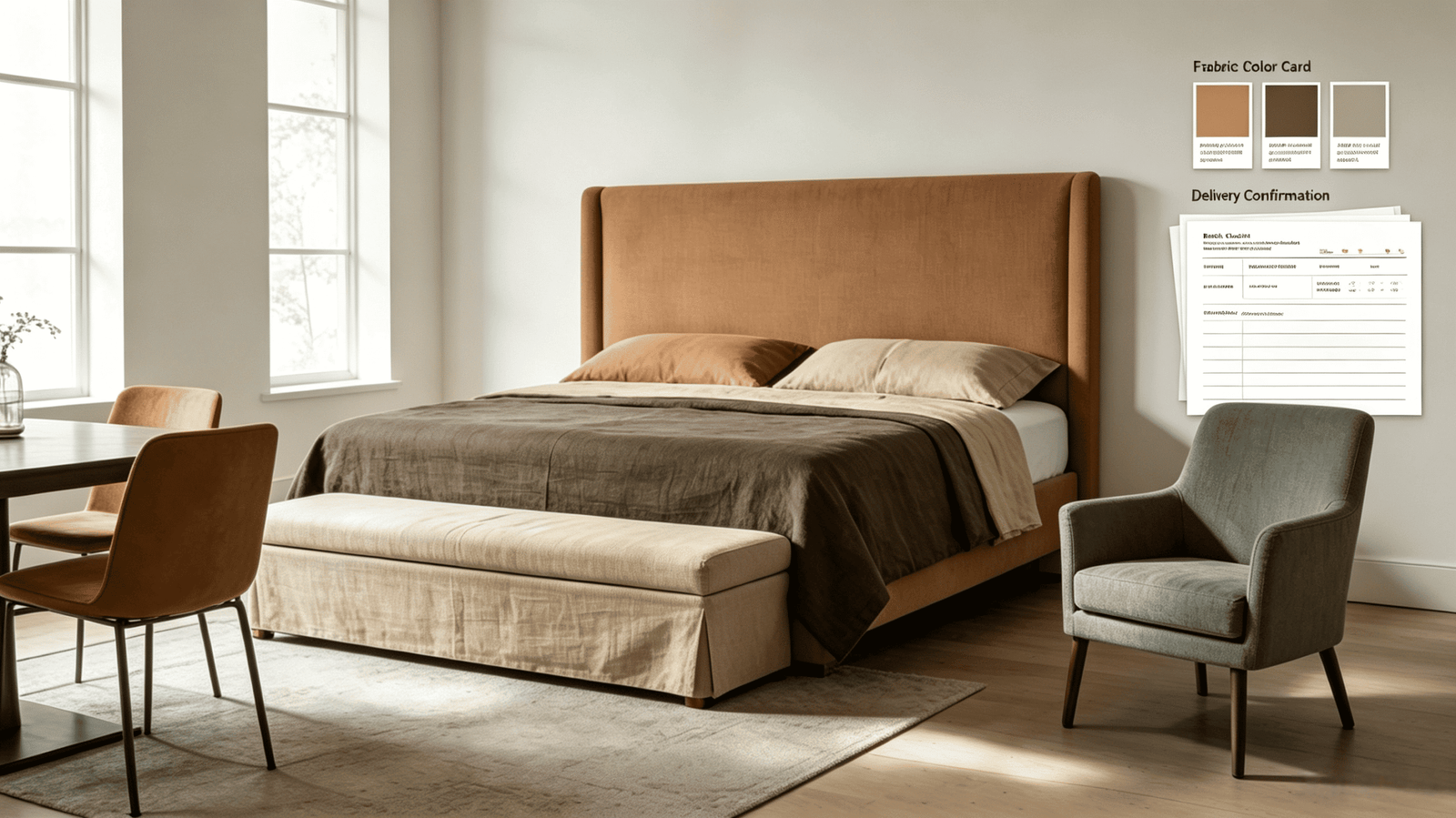
What's interesting is that knowing the trend is the easy part. Designers working on high-net-worth residential projects already know they want textural, natural, quiet. What they're actually navigating is a sourcing decision dressed up as a style question. The sections below break down how that plays out in practice — from material choice to the upholstered bed as an anchor decision, to what custom production actually needs to deliver.
Why Is Linen Dominating Bedroom Upholstery Trends Right Now?
Performance fabrics have dominated living rooms for years2. But the bedroom is a different sensory environment — and designers are starting to specify accordingly3. If you've watched client briefs shift toward the word "sanctuary," you've already seen this coming.
Linen earns its place in the bedroom not because of fiber data, but because of what it does to a room at rest. It absorbs light rather than reflecting it4. It has a surface tension that reads as calm. And it ages in a way that synthetic textures simply cannot replicate — the slight softening over time that clients describe as the room "settling in."
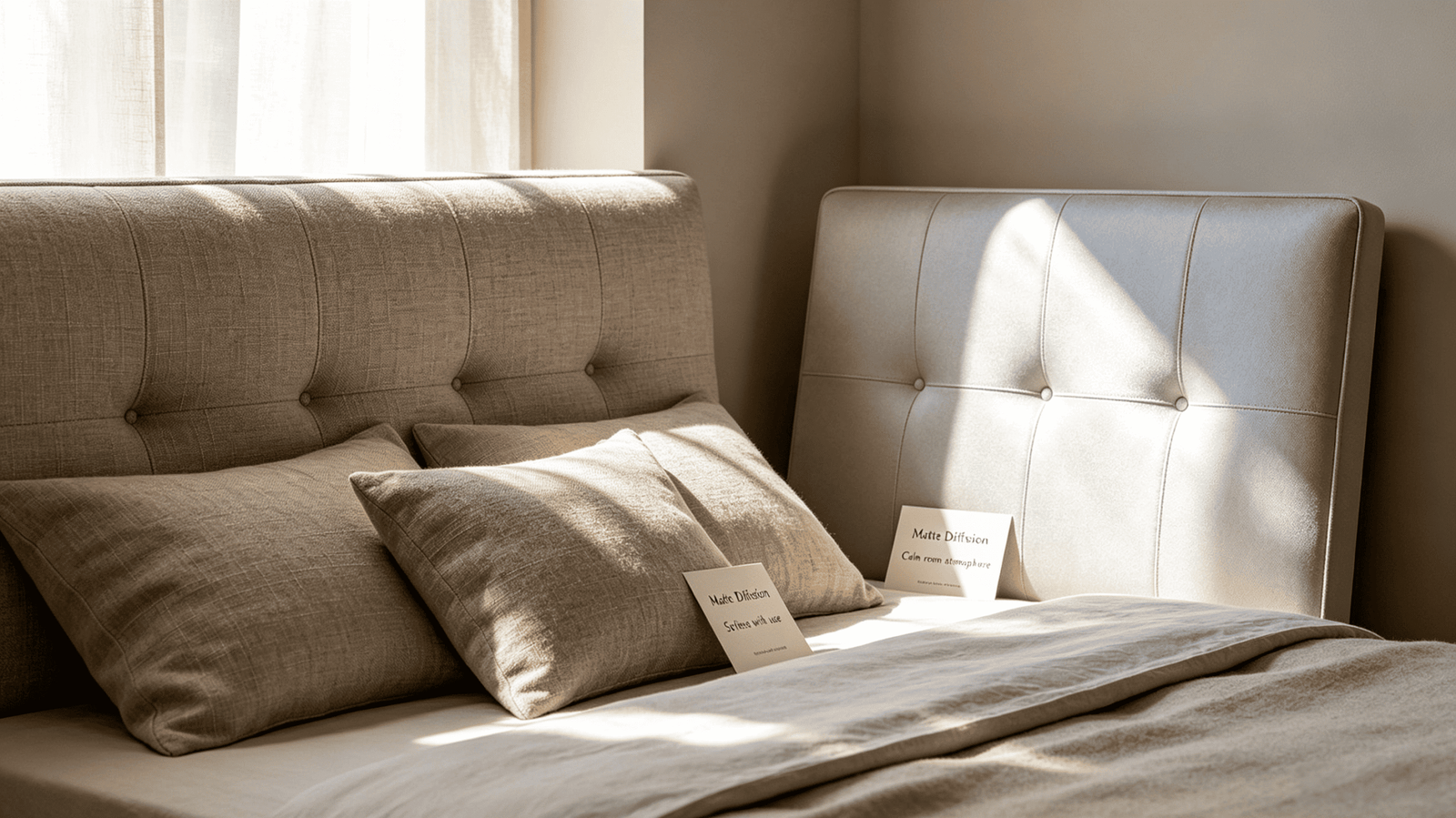
In projects we've worked on with US designers, the word that comes up most often in briefs isn't "durable" or "easy to clean." It's "quiet." Clients want a bedroom that doesn't demand attention. Natural linen — especially Belgian linen with its characteristic slub texture5 — delivers visual restraint that performance velvets and weaves struggle to match.
What Makes Linen Specifically Right for Bedroom Use?
Here's the honest version of the "linen is great" argument — grounded in how bedrooms actually function:
- Low friction use pattern. Bedroom upholstery doesn't face the daily abuse of a living room sofa. A headboard is touched, leaned against, occasionally brushed. A bench at the foot of the bed holds a folded throw. The wear patterns are gentle, which means linen's moderate abrasion resistance is entirely appropriate here.
- Light exposure is managed. In well-designed bedrooms, direct UV exposure is controlled through window treatments. Linen's natural fade characteristics — a gradual lightening that reads as patina6 — work with this environment rather than against it.
- Humidity and breathability. Linen is naturally breathable and moisture-wicking, which matters in a room where people sleep7. It doesn't trap heat against surfaces the way some performance fabrics do.
- The aging argument is real, not romantic. Designers I speak with regularly mention that their clients return after two or three years and comment that the linen "looks better now." That's not a marketing line — it's a consistent pattern in client feedback. The fabric softens and relaxes into the room.
The Colorway Question
The neutral palette driving bedroom upholstery trends right now is specific. "Neutral" doesn't mean beige. In practice, designers are specifying:
| Color Register | Description | Common Project Context |
|---|---|---|
| Warm sand | Golden-toned, not yellow | Coastal California, desert modern |
| Greige | Cool-warm balance, no undertone dominance | New York high-rise, European transitional |
| Oat | Soft, milky white with texture | Minimalist, Scandinavian-influenced |
| Dusty sage | Muted green-grey | Pacific Northwest, English country |
| Warm white | Off-white with cream or flax tones | Classic American estate |
The precision matters. A designer specifying "warm sand" for a coastal California estate isn't describing a general direction — they're describing a specific relationship between fabric tone, wall finish, and morning light. Our 200+ colorway library exists precisely because "beige" is not a specification.
Why Is the Upholstered Bed the Most Important Bedroom Upholstery Decision?
A recurring question we get from designers early in a project is: "Should I start with the headboard or the accent pieces?" The answer, based on how high-end bedroom projects actually develop, is almost always the upholstered bed.
The upholstered bed or panel headboard is the visual anchor of a bedroom. Every other soft goods decision — bench, occasional chair, throw pillows — calibrates against it. Getting this decision right unlocks the rest of the room. Getting it wrong means every subsequent piece compounds the problem.
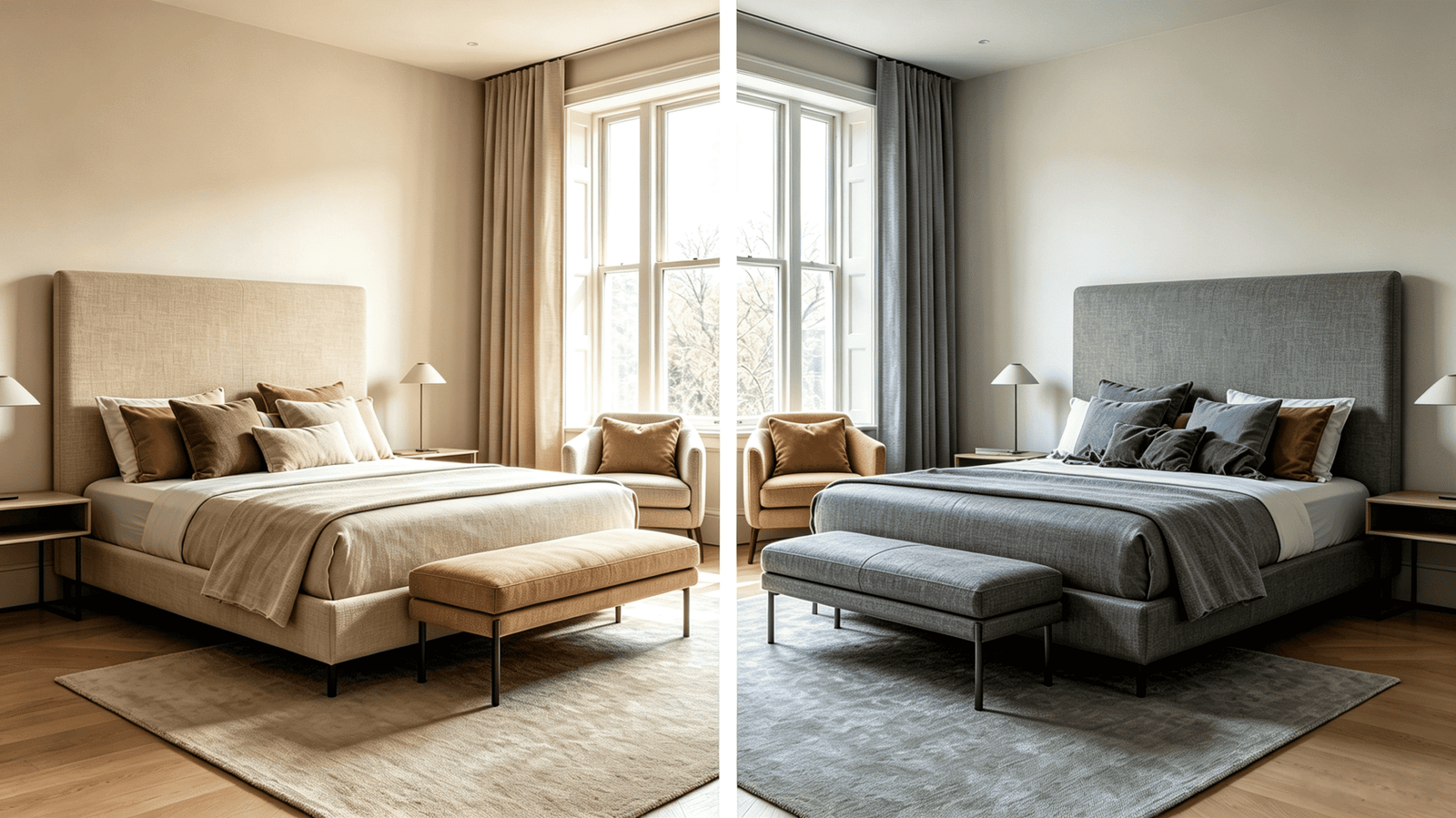
This is where a factory's ability to produce a matched suite in the same fabric run becomes genuinely valuable — not as a product catalog feature, but as a design execution capability.
The Decision Sequence That Actually Works
In practice, here's how the most successful bedroom projects we've supported tend to move:
- Designer specifies the upholstered bed — fabric, tone, scale, profile (low platform, tight panel headboard, channel-tufted, etc.)
- Fabric is selected and sampled — physical swatches reviewed in the actual room or against the wall paint
- Bench and accent chair are specified in matched or intentionally contrasted fabric from the same color family
- Soft goods align — cushions, throws, and bedding are curated around the confirmed anchor color
The risk in skipping step 2 — jumping from a digital swatch to a full production order — is where most overseas sourcing problems originate. Not from bad factories, but from an unmanaged color confirmation step.
Scale and Proportion in Headboard Design
Beyond color, scale is the second most common point of misalignment in custom bedroom upholstery:
- Panel headboard height needs to relate to ceiling height and bed frame profile, not just look good in a product photo
- Tufting grid spacing reads differently at 6 feet tall versus 4 feet — what looks refined in a showroom photo can read as busy in a low-ceilinged room
- Bed frame leg profile affects how grounded or floating the piece feels, which changes the entire room's visual weight
We routinely work with designers to provide scaled production drawings before any cutting begins. This step catches proportion mismatches before they become expensive corrections.
How Do You Execute a Custom Bedroom Upholstery Order Without It Going Wrong?
This is the question that doesn't appear in trend articles — but it's the one that determines whether a beautiful specification actually lands in a client's home as imagined. Designers who've had a bad overseas order experience know exactly what I mean. The risk isn't theoretical.
The real friction in sourcing bedroom upholstery from an overseas custom factory isn't price. It's trust — specifically, trust that what you specified is what arrives. Color drift, scale errors, unexpected production delays, and inconsistent quality across a multi-piece order are the actual fears. They're legitimate.
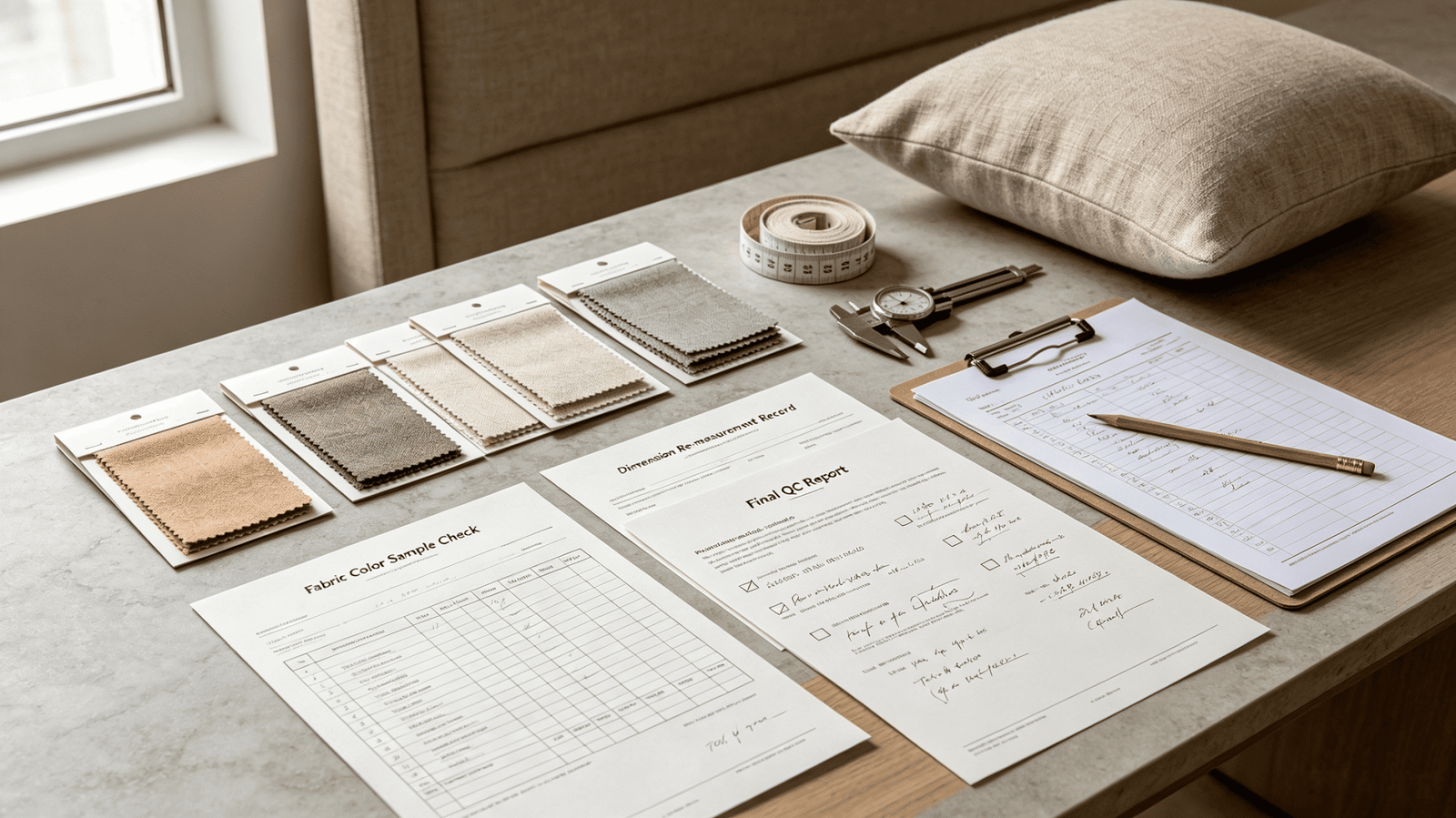
What a Reliable Custom Process Actually Looks Like
Here's what I'd look for — and what we've built our process around — when evaluating any custom upholstery factory for a high-stakes bedroom project:
Physical sample before production: No color decision should be made from a digital image. We send physical fabric swatches from the actual bolt being considered. A monitor cannot render the precise warm-versus-cool balance of a greige linen under incandescent light. A swatch can.
Signed spec sheet with dimensions: Every custom order should be confirmed against a production spec sheet that includes:
- Finished dimensions (not nominal)
- Fabric code and dye lot reference
- Construction details (padding density, leg material, frame specification)
- Delivery timeline with production milestone dates
Mid-production photography: For multi-piece orders, photographic confirmation at the fabric-cut and frame stage catches errors before they're sewn in. This is a standard step in our process — not an upsell.
Consolidated shipping for suite orders: Designers ordering a bed frame, bench, and accent chair as a matched suite should expect a single consolidated shipment, not three separate arrivals. Logistics coordination is part of the service.
COM Support and What It Actually Enables
A recurring scenario: a designer has a fabric they love — sourced from a US textile house, a European mill, or a client's estate archive — and needs it made up into a headboard or bench. COM (Customer's Own Material) support means the factory can work with the designer's fabric rather than requiring selection from the factory's own library.
This matters for designers working on projects where the fabric is already specified and non-negotiable. Our factory supports COM across the full bedroom upholstery range.
When 40–60% Cost Savings Becomes Real
I deliberately haven't led with the cost comparison — because the number only means something after you believe the quality and execution are actually equivalent. Here's the honest framing:
Comparable Belgian linen upholstered beds from US or EU-based custom studios typically land at $3,000–$6,000+ for a queen frame with panel headboard8. Our made-to-order equivalent, in the same Belgian linen, runs significantly less — with full color customization and COM support included.
The savings are real. But they're only relevant if the product that arrives matches the specification. That's the conversation to have before discussing price.
Frequently Asked Questions
How long does a custom linen upholstered bed order typically take?
Lead time for a made-to-order linen bed frame or headboard is typically 4–6 weeks from spec confirmation, plus shipping9. For US delivery, total timeline from order to arrival is generally 8–12 weeks depending on port schedules. We recommend planning 14 weeks from initial inquiry for projects with hard installation dates.
Can I order a matched suite — bed, bench, and accent chair — in the same fabric?
Yes. Producing a matched bedroom suite is actually where our factory model performs best. Running the same Belgian linen fabric across multiple pieces in a single production batch ensures dye lot consistency across the full suite — which is difficult to guarantee when pieces are sourced from different vendors.
What if the color I need isn't in your 200+ colorway library?
COM support means you can supply your own fabric. Alternatively, we work with designers on custom dye matching for Belgian linen within our production capabilities. The most reliable path for precise color matching is to request physical swatches from our closest options first — color perception varies significantly between screen and physical fabric.
How do I confirm quality before committing to a full order?
We offer sample chair or headboard commissions for new clients — a single piece produced to full spec so the designer can evaluate fabric, construction, and finish before placing a larger order. This is the step that converts a promising conversation into a trusted production relationship.
Do you work with interior designers directly, or only with trade accounts?
We work directly with interior designers, design firms, and residential developers. There is no minimum order volume for custom work, and we support both single-piece commissions and multi-unit project orders.
Conclusion
Bedroom upholstery trends are pointing clearly toward natural linen — textural, neutral, quiet, and built around the upholstered bed as the room's anchor decision. But knowing the trend is only the first step. What actually determines whether a high-end bedroom project lands the way it was designed is execution: the right colorway confirmed from a physical swatch, the right scale resolved before production, and a factory process that communicates clearly at every step.
At Linen World, we've spent 13 years building the production capability and customer communication process10 that makes custom bedroom upholstery orders predictable — not just beautiful. If you're specifying bedroom upholstery for a current project and want to see what's possible, request a physical swatch set or reach out to discuss your project brief. The conversation starts with the fabric in your hand.
"The 11 Interior Design Trends Set to Take Over 2025 - Bed Threads", https://bedthreads.com/blogs/journal/interior-design-trends-2025?srsltid=AfmBOoqaVccrFpCUUfDlLZg2cXe43ZJwafxDbwZLo2HJWTcHsfRH--Lc. Industry trend reports and designer surveys from organizations such as the American Society of Interior Designers (ASID) or comparable trade bodies document the rise of natural, textural materials in residential specification during this period. Evidence role: general_support; source type: research. Supports: That natural linen and neutral tones are a leading material trend in high-end residential bedroom design in 2024–2025. Scope note: Publicly available trend reports may not isolate bedroom upholstery specifically or distinguish high-end residential from broader market segments. ↩
"Upholstery Fabric Trends Driving Premium Furniture Sales 2026", https://gccoverseas.com/upholstery-fabric-trends/. Market research on the residential upholstery fabric sector has documented growth in performance fabric categories, driven by consumer demand for durability and ease of maintenance in high-use living spaces. Evidence role: general_support; source type: research. Supports: That performance or stain-resistant upholstery fabrics have grown significantly in residential living room specification. Scope note: Publicly available market data may aggregate residential and commercial segments and may not isolate living room specification specifically. ↩
"Healthy Dwelling: Design of Biophilic Interior Environments ... - PMC", https://pmc.ncbi.nlm.nih.gov/articles/PMC8871637/. Research from design industry organizations, including ASID's annual design trends surveys, has documented growing designer attention to wellness and sensory considerations in residential specification, with the bedroom identified as a primary focus area. Evidence role: general_support; source type: institution. Supports: That interior designers are applying sensory and wellness-oriented criteria to bedroom material specification, differentiating it from other residential spaces. Scope note: Available survey data may not isolate upholstery fabric specification specifically or quantify the degree of differentiation between room types. ↩
"Study of diffuse scattering on facial surface using ray tracing approach", https://pmc.ncbi.nlm.nih.gov/articles/PMC11993760/. Textile optics research indicates that fabrics with irregular surface textures, such as those produced by natural slub fibers, scatter incident light diffusely rather than reflecting it specularly, reducing perceived sheen and contributing to a visually matte appearance. Evidence role: mechanism; source type: research. Supports: That linen's surface texture and fiber structure result in diffuse light scattering rather than specular reflection. Scope note: The perceptual claim that this produces a 'calm' visual environment is subjective and not directly measurable by reflectance data alone. ↩
"Belgian Linen - Wikipedia", https://en.wikipedia.org/wiki/Belgian_Linen. The European Flax and Masters of Linen certification programs define quality standards for flax grown and processed in Western Europe, with natural slub variation acknowledged as an inherent characteristic of the fiber rather than a defect. Evidence role: definition; source type: institution. Supports: That Belgian or European flax linen has recognized quality and textural characteristics, including natural slub variation from the flax fiber. Scope note: The term 'Belgian linen' is used commercially and may not always correspond to certified geographic origin; slub texture is a property of linen generally, not exclusively Belgian production. ↩
"(PDF) Impact of Sunlight Exposure to different Dyed fabrics on ...", https://www.academia.edu/35461011/Impact_of_Sunlight_Exposure_to_different_Dyed_fabrics_on_Colorfastness_to_Washing. Textile light fastness testing standards, such as ISO 105-B02, measure fabric color change under xenon arc exposure; linen's natural cellulosic structure influences how it responds to UV, typically producing gradual, even lightening rather than blotchy discoloration. Evidence role: mechanism; source type: research. Supports: That linen exhibits gradual, relatively uniform lightening under UV exposure rather than uneven degradation. Scope note: The aesthetic interpretation of fading as 'patina' is subjective; actual fade behavior depends on dye type, finishing, and UV intensity, which vary by installation context. ↩
"Linen Most Useful: Perspectives on Structure, Chemistry, and ... - PMC", https://pmc.ncbi.nlm.nih.gov/articles/PMC4403609/. Research on bast fiber properties confirms that flax-derived linen exhibits hygroscopic behavior, absorbing and releasing moisture readily, and is associated with higher air permeability compared to many synthetic textiles. Evidence role: mechanism; source type: research. Supports: That linen fiber has hygroscopic and breathable properties due to its flax composition. Scope note: Performance varies by weave density and finishing treatments; general fiber properties do not automatically translate to all linen upholstery constructions. ↩
"Custom Upholstered Beds - Pepper Home", https://pepper-home.com/collections/custom-furniture-beds?srsltid=AfmBOorbpx4k68DG4uq5gzed5gDgw_enhDn2kF-yBEuN_FT_C_LkhAKW. Retail and trade pricing from established US custom furniture studios and European importers for Belgian linen upholstered queen beds with panel headboards can be used to verify the stated price range as a market benchmark. Evidence role: statistic; source type: other. Supports: That custom Belgian linen upholstered queen bed frames with panel headboards from US or European studios are priced in the $3,000–$6,000+ range. Scope note: Pricing varies significantly by studio, construction quality, fabric grade, and regional market; the stated range reflects a segment of the market and may not represent the full distribution. ↩
"How Long Does Custom Furniture Take From Order to Delivery?", https://www.furnishnc.com/blog/2026/05/19/how-long-does-custom-furniture-take-from-order-to-delivery/. Industry analyses of custom furniture supply chains indicate that production lead times for upholstered pieces from Asian manufacturing facilities typically range from four to eight weeks depending on complexity, order volume, and factory capacity. Evidence role: general_support; source type: research. Supports: That 4–6 week production lead times are consistent with industry norms for custom upholstered furniture manufactured in overseas facilities. Scope note: Lead times are highly variable and context-dependent; the stated range reflects favorable conditions and may not account for peak season delays or supply chain disruptions. ↩
"Linen World | Handcrafted Bespoke Pure Linen Sofas ...", https://linenworld.pro/. The Foshan and Guangdong region of China is documented as one of the world's largest furniture manufacturing hubs, with industry analyses noting that established factories with decade-plus operating histories represent a subset of the broader supplier base distinguished by accumulated process knowledge. Evidence role: historical_context; source type: institution. Supports: That 13 years of operation in the custom upholstery manufacturing sector represents meaningful industry experience in the context of the Foshan/Guangdong furniture manufacturing cluster. Scope note: Operational longevity alone does not verify quality standards or customer service practices; the claim functions as context rather than direct evidence of production capability. ↩


