
You've specced a beautiful linen Ottoman for a client's living room — and when it arrives, something feels off. It's not wrong exactly, but it doesn't sit right. The ottoman size looked fine on paper, yet the proportion to the sofa feels awkward, the clearance is tight, and your client is asking questions you don't have clean answers to. This happens more than designers like to admit.
Ottoman sizing is not a lookup problem. The "standard" dimensions floating around online — typically 36″–48″ wide, 16″–21″ tall — describe what factories happen to build most often, not what works in a specific space. The right Ottoman size depends on its spatial role: is it anchoring a sofa grouping, sitting at the foot of a bed, or functioning as a standalone accent piece? Each scenario has a different primary variable, and conflating them is where most specification mistakes begin.
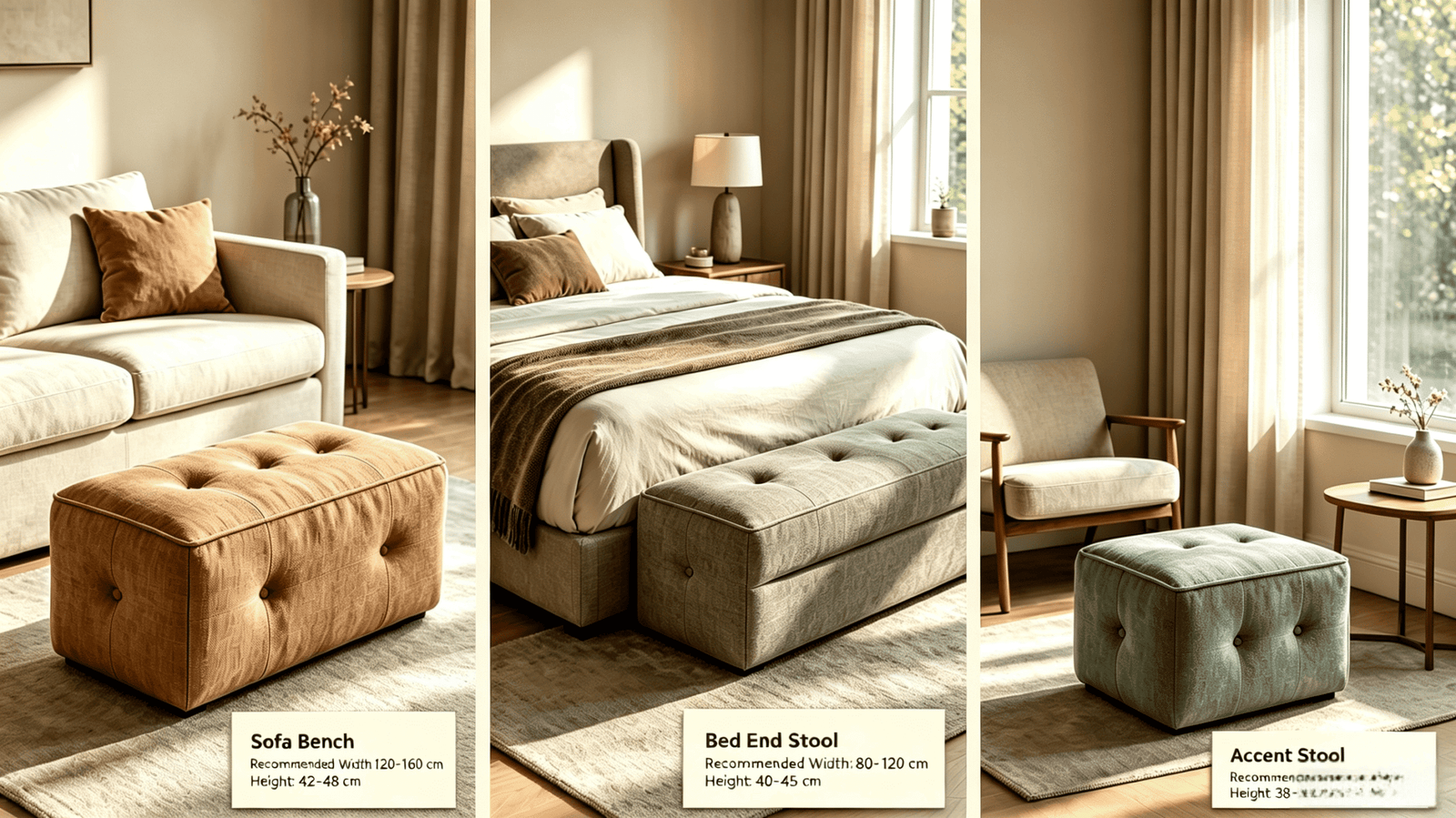
I've spent 13 years working with interior designers across the US and Europe on custom linen furniture orders. Size questions come in constantly — and the most revealing thing is how designers phrase them. The ones who ask "what's your standard Ottoman size?" usually end up needing a custom piece anyway. The ones who describe the space first get to the right answer faster. Let me show you what that process looks like.
Does Ottoman Size Actually Depend on Sofa Width?
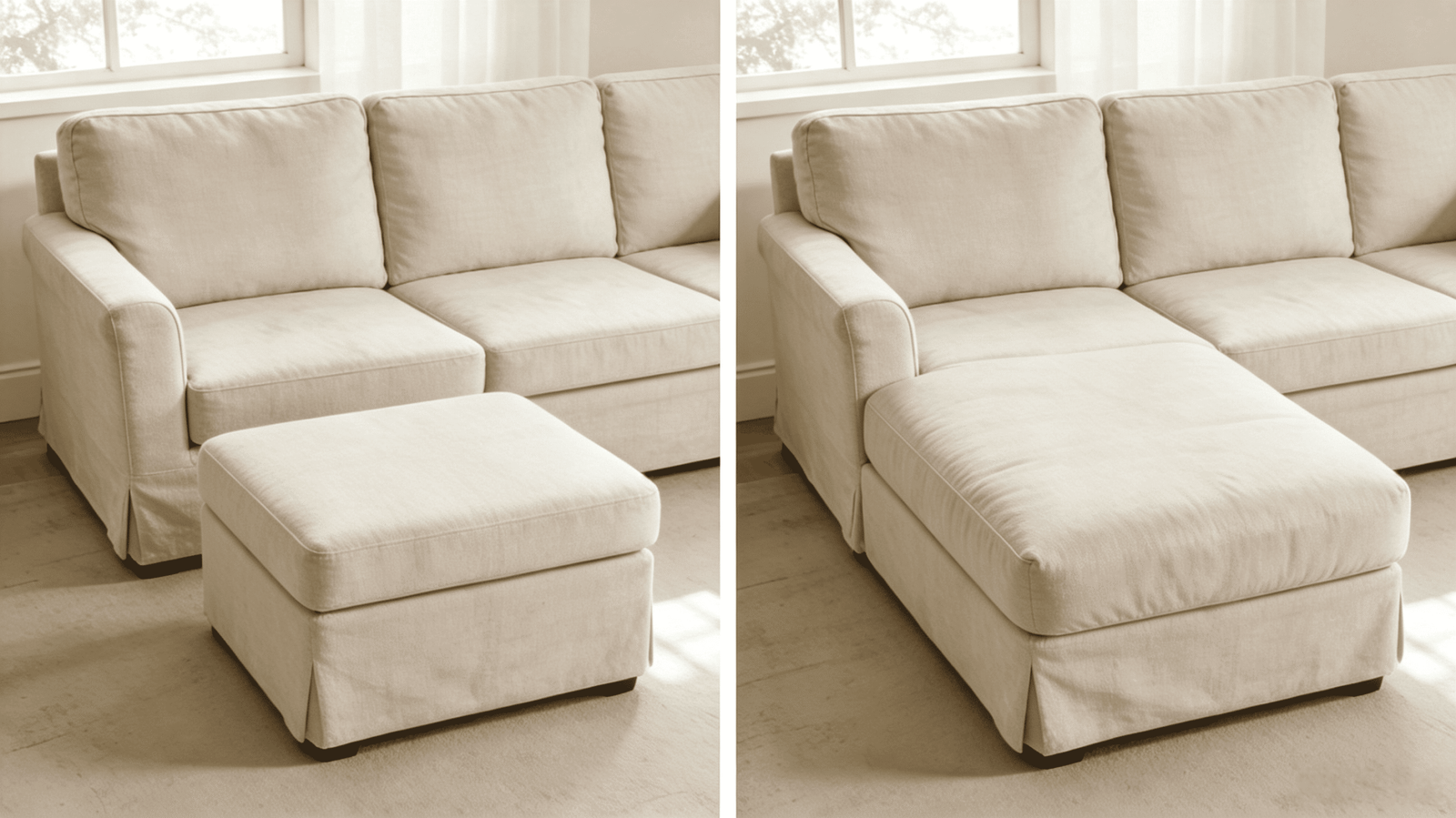
A sofa pairing is the most common Ottoman placement — and it generates the most sizing confusion. The instinct to match the Ottoman's width to the sofa's overall width sounds logical, but it almost always produces a piece that looks too wide and visually heavy.
The width of a paired Ottoman should echo the sofa's seat section, not its total frame width. For a standard 90″ three-seat sofa, the seat section typically spans 72″–78″1. An Ottoman in the 48″–54″ range sits naturally within that visual zone without competing with the sofa's arms. Going wider pushes into the sofa's frame footprint and creates a massing conflict.
The Question Designers Actually Ask Us
One of the most common inquiries we receive sounds like this: "I have a 110″ sectional — what Ottoman width do you recommend?" A 110″ sectional is a large piece, and the instinct is to go big on the Ottoman to match. But the relevant measurement isn't the sectional's total run — it's the primary seating face. On a typical L-shaped sectional, that main seating face might be 84″–96″. An Ottoman in the 54″–60″ range typically works well there.
There are two reasons width logic works this way:
1. Clearance governs usability. The gap between the sofa's front edge and the Ottoman's near edge should be 14″–18″ for comfortable leg reach and circulation.2 If the Ottoman is too wide, it crowds the side passages, and people stop using the space naturally.
2. Visual mass reads from the seat, not the frame. The eye anchors to where bodies sit, not where the arm panels end.3 An Ottoman that matches the seat zone reads as intentionally proportioned. One that matches the full frame reads as an afterthought that happened to be the same width.
What Happens When This Gets Ignored
We've seen several inquiries where a designer had already placed an order elsewhere before coming to us for a custom replacement. In one case, a 72″ Ottoman had been specified for a 90″ sofa — matching the full frame width. The client's living room was 14′ × 18′. The Ottoman dominated the seating area, left almost no circulation gap on the sides, and made the sofa look like it was being crowded from the front. The replacement order was 48″ wide, same height, different outcome entirely.
Sofa Pairing: A Practical Size Framework
| Sofa Configuration | Total Sofa Width | Typical Seat Section | Suggested Ottoman Width |
|---|---|---|---|
| Loveseat | 52″–62″ | 44″–52″ | 30″–36″ |
| 3-seat sofa | 84″–96″ | 68″–78″ | 44″–54″ |
| Large 3-seat sofa | 96″–110″ | 78″–90″ | 52″–60″ |
| L-shape sectional | 110″–130″+ | 84″–100″ (main face) | 54″–66″ |
Note: These are working ranges drawn from order patterns, not engineering specs. Treat them as a starting bracket — the specific room dimensions and clearance requirements should refine the final number.
Height for sofa pairing: The Ottoman's top surface should be level with or up to 2″ below the sofa seat cushion height.4 Most upholstered sofas sit between 17″–19″ seat height.5 An Ottoman at 17″–18″ finished height works across most pairing scenarios.
How Do You Size an Ottoman for Bed-Foot Placement?
Bed-foot Ottomans are where "standard size" fails most reliably. Designers who apply living-room sizing logic to a bedroom piece end up with something that either looks stranded in the space or blocks access to the bed entirely.
When specifying an ottoman for the foot of a bed, height matching with the mattress surface is the most critical aesthetic variable; width and depth are equally vital functional constraints in compact bedrooms with limited circulation space, as oversized horizontal dimensions can block walkways around the bed. The Ottoman's top surface needs to read as visually continuous with the mattress top, or sit slightly below it. Get this wrong and the piece looks like it belongs in a different room.

Why Height Comes First Here
A standard platform bed with a mattress sits at approximately 24″–26″ from floor to mattress top.6 A traditional bed frame with box spring typically sits at 28″–30″.7 An Ottoman at 18″ — perfectly appropriate for a sofa pairing — will look sunken and proportionally wrong at the foot of a 28″ bed.
The practical target range for bed-foot Ottomans:
- Platform bed (24″–26″ mattress top): Ottoman at 18″–20″ finished height
- Standard frame with box spring (28″–30″ mattress top): Ottoman at 20″–22″ finished height
- High-profile bed or custom frame (30″–34″): Ottoman may need to reach 22″–24″
These aren't ranges you'll find on a standard product spec sheet — which is why this placement generates more custom inquiries for us than any other.
Width Logic for Bed-Foot Ottomans
Once height is resolved, width follows a different logic than the living room scenario. The Ottoman should span roughly the width of the footboard or the visible bed frame face — not the mattress width. This is a visual anchoring principle. The mattress overhangs the frame, so matching the mattress width makes the Ottoman look too wide relative to the structural element it's sitting in front of.
Common bed frame footboard spans:
| Bed Size | Mattress Width | Typical Footboard Span | Suggested Ottoman Width |
|---|---|---|---|
| Queen | 60″ | 62″–64″ | 50″–58″ |
| King | 76″ | 78″–80″ | 60″–68″ |
| California King | 72″ | 74″–76″ | 58″–64″ |
Depth (front-to-back) for bed-foot placement is typically 18″–24″. Deeper than 24″ starts to push into the bedroom circulation path between the bed and dresser or window wall.
A Real Inquiry Example
A designer contacted us last year specifying an Ottoman for a California King bed in a primary suite. The bed frame had a high-profile custom headboard and no footboard — just a low platform rail at 24″ finished height. She initially asked for our "standard bed-foot Ottoman." We asked three questions: mattress top height, visible rail width, and the gap available between bed and the window seat on the opposite wall. Those answers — 26″, 74″, and 36″ of clearance — produced a spec of 22″H × 62″W × 20″D. Nothing standard about it, but it fit the space exactly.
When an Ottoman Stands Alone — Does Sizing Change Completely?
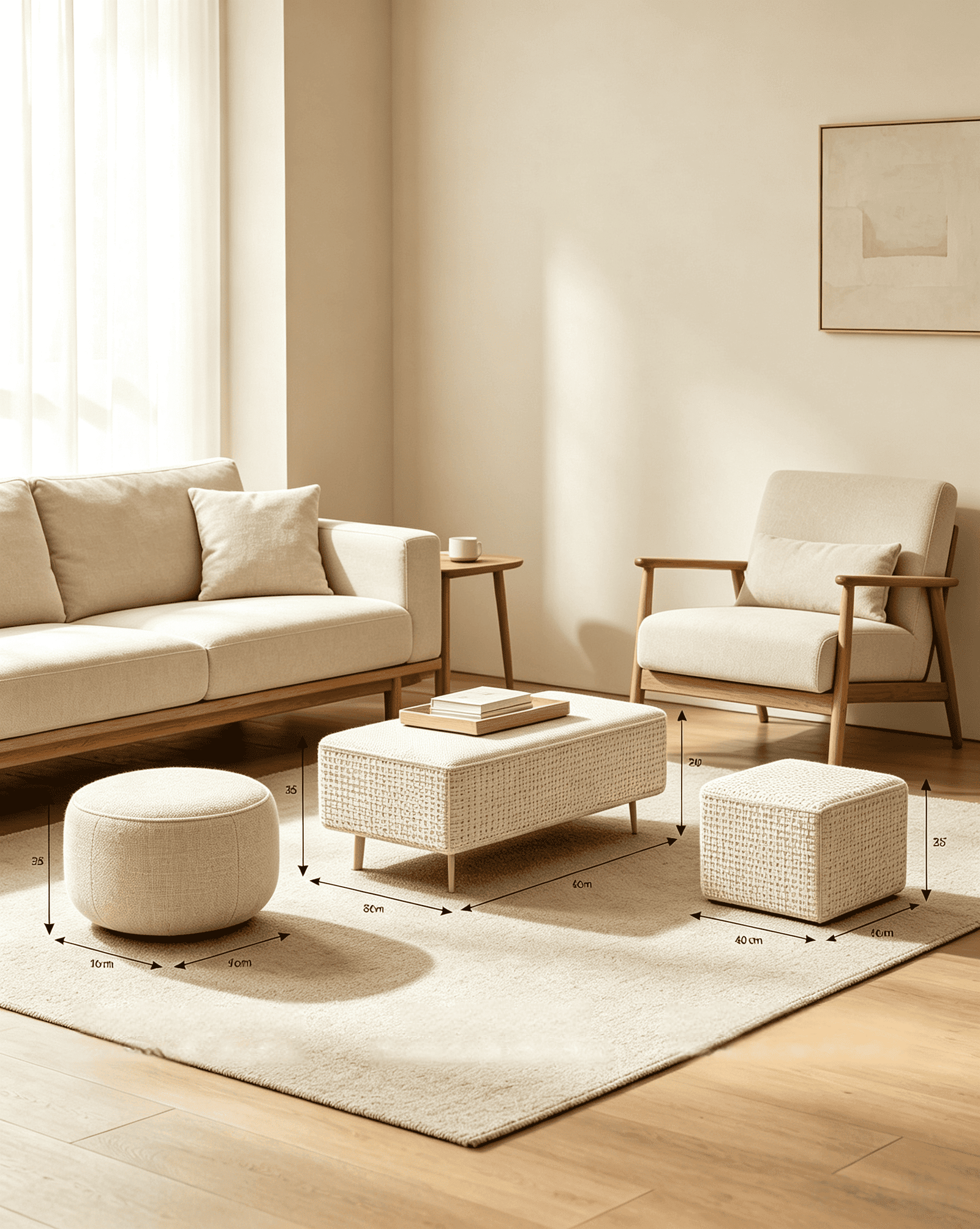
A standalone Ottoman operates without the anchoring logic of a sofa or bed frame. That makes it the most function-dependent sizing scenario of the three, and also the one where designers have the most creative range.
The critical first question isn't "how big?" — it's "what is this piece primarily doing?" A standalone Ottoman used as a seat has different dimension requirements than one used as a tray surface or a footrest-only accent in a reading corner.
Function Defines the Footprint
As a seat: Height should sit in the 17″–19″ range — the same bracket as standard chair and sofa seat heights. Width and depth should be generous enough to sit comfortably without perching: minimum 20″ × 20″ for a square piece, though 24″ × 24″ is more comfortable for adult use. Round Ottomans used as seats typically need a diameter of at least 22″–24″.8
As a tray surface / cocktail Ottoman: Height can drop slightly — 16″–17″ — to allow easy reach from a seated position. Surface area matters more than depth here. A 36″ × 24″ rectangular piece serves this role well in a smaller seating group.
As a footrest accent: This is the most forgiving scenario dimensionally. Height can range 14″–18″ depending on the chair seat height it's paired with. Width and depth can be modest — 18″ × 18″ to 24″ × 24″ — because the visual role is accent, not anchor.
Multi-Function Ottomans
Many designers ask us about pieces that need to do two or three of the above jobs. The honest answer is that a piece optimized for seating (taller, firmer cushion, wider footprint) is a compromise as a tray surface, and vice versa. In those cases, we typically recommend anchoring the spec to the primary function and accepting the secondary-use trade-offs consciously — rather than splitting the difference on height and ending up with a piece that does neither job well.
Frequently Asked Questions
What is the standard Ottoman size for a living room sofa?
There is no single standard that works across living rooms. For most three-seat sofas (84″–96″ wide), an Ottoman in the 44″–54″ wide range at 17″–18″ finished height is a practical starting bracket. The specific room dimensions, clearance requirements, and sofa seat height should all shape the final specification.
How tall should a bed-foot Ottoman be?
Match the Ottoman height to the mattress top height, or sit 4″–6″ below it. Platform beds typically call for 18″–20″ Ottoman height. Traditional frames with box springs typically call for 20″–22″. Taller custom bed frames may require an Ottoman at 22″–24″ — this is one of the most common reasons designers order custom rather than stock pieces.
Can I order a custom Ottoman size with 200+ linen color options?
Yes. At Linen World, all our Ottomans are available as made-to-order pieces with custom dimensions and over 200 linen color selections. COM fabric is also supported. Custom sizing is not a premium exception for us — it's the standard process for project work. Most designers working on client installs find that a custom spec prevents the proportion compromises that come with off-the-shelf sizes.
How much clearance should I leave between an Ottoman and the sofa?
Plan for 14″–18″ of clearance between the sofa's front edge and the Ottoman's nearest edge. This range allows comfortable leg extension from a seated position and maintains a natural circulation path around the seating group. Below 14″ starts to feel cramped; above 18″ can make the two pieces feel disconnected.
What's the difference between an Ottoman and a pouf in sizing terms?
A pouf is typically unstructured, lower (12″–15″ height), and used primarily as a footrest or casual seat.9 An upholstered Ottoman with a frame and cushion sits higher (17″–21″), holds its shape under weight, and can serve seating, tray, and footrest functions. For formal living rooms and bedroom placements, the structured Ottoman is almost always the appropriate choice.
Conclusion
Ottoman sizing comes down to spatial role, not a dimension chart. For sofa pairings, anchor the width to the seat section and keep clearance in the 14″–18″ range. For bed-foot placement, start with height — match the mattress top before you think about width. For standalone pieces, let the primary function define the footprint. In every scenario, the "standard size" gets you to the right neighborhood, but the right ottoman size for a real project almost always requires one or two custom adjustments.
In our experience at Linen World https://linenworld.pro, the designers who get installations right the first time aren't the ones who ordered the closest stock size — they're the ones who specified to the space. With made-to-order production, 200+ linen color options, and 13 years of custom upholstery experience, we're set up to hit those exact dimensions at 40–60% less than comparable US or European sources10. If you have a project with specific size requirements, reach out and we'll work through the spec together.
"Linen World | Handcrafted Bespoke Pure Linen Sofas ...", https://linenworld.pro/. Upholstered sofa arm widths commonly range from 4 to 10 inches per side depending on style, meaning that on a 90-inch sofa the interior seat section typically falls between 70 and 80 inches; this proportion is consistent with standard furniture dimension references used in space planning. Evidence role: general_support; source type: other. Supports: On a standard three-seat sofa with a total width of approximately 90 inches, the seating area between the arms typically spans 72–78 inches, with each arm consuming roughly 6–9 inches of total frame width.. Scope note: Arm width varies considerably by sofa style (track arm, rolled arm, English arm), so the seat section range is an approximation rather than a universal specification. ↩
"[PDF] Ergonomics and Design A Reference Guide", https://ehs.oregonstate.edu/sites/ehs.oregonstate.edu/files/pdf/ergo/ergonomicsanddesignreferenceguidewhitepaper.pdf. Ergonomic and space-planning guidelines for residential interiors generally recommend 12–18 inches of clearance between a primary seating piece and a coffee table or ottoman to allow comfortable leg extension and unobstructed passage; see, e.g., human factors literature on seated reach envelopes and residential furniture layout standards. Evidence role: general_support; source type: research. Supports: Recommended clearance distances between seating furniture pieces for comfortable leg extension and pedestrian circulation in residential settings.. Scope note: Published ergonomic standards typically address commercial or office seating; direct residential sofa-to-ottoman clearance specifications are less commonly codified in peer-reviewed sources. ↩
"Agents of Spatial Influence - HINDSIGHT - Parsons School of Design", https://parsons.edu/dt-2020/publication/entry/agents-of-spatial-influence/. Research in environmental psychology and Gestalt perceptual theory suggests that the human visual system prioritizes functionally salient regions — such as areas associated with human occupation or activity — when assessing spatial proportion; this principle supports the design claim that the eye anchors to the seat zone of a sofa rather than its full structural frame when evaluating the proportional relationship with an adjacent ottoman. Evidence role: mechanism; source type: research. Supports: Human visual perception tends to anchor on areas of functional activity or contrast within a scene, which in a seating context corresponds to the occupied seat zone rather than peripheral structural elements.. Scope note: This citation applies general perceptual theory to a specific interior design context; controlled empirical studies on sofa-ottoman proportion perception specifically are not available in the published literature. ↩
"Ergonomics of sitting", https://ergo.human.cornell.edu/DEA3250Flipbook/DEA3250notes/sitting.html. Ergonomic research on seated posture indicates that footrest surfaces positioned at or slightly below seat height (typically within 1–3 inches) promote neutral lower-limb posture and reduce pressure on the posterior thigh; this principle supports the design guideline that an ottoman top surface should be level with or up to 2 inches below the paired sofa seat height. Evidence role: mechanism; source type: research. Supports: A footrest or ottoman surface at or slightly below seat height supports comfortable leg positioning and reduces lower-limb fatigue when seated.. Scope note: Ergonomic footrest research is predominantly conducted in office or occupational seating contexts; direct evidence specific to residential sofa-ottoman pairings is limited. ↩
"[DOC] TECHNICAL REQUIREMENTS SECTION", https://sws.gsa.gov/sws-search/viewSolDocument.do?method=view&solNum=M1FTQS1KQi0xMDAwMDEtQg==&solRefresh=Nw==&solDoc=MDkwMDA0MmI4MTg0YmViNQ==. Industry references and ergonomic guidelines for residential seating commonly cite a seat height range of 17–19 inches for upholstered sofas, consistent with anthropometric recommendations for comfortable seated posture in adults of average stature. Evidence role: general_support; source type: institution. Supports: The typical finished seat height range for upholstered residential sofas falls between approximately 17 and 19 inches.. Scope note: Seat height norms vary by manufacturer and style category; no single authoritative standard governs residential sofa dimensions across the industry. ↩
"Current Collection - - Linen World", https://linenworld.pro/product/. Platform bed height from floor to mattress top is commonly reported in the range of 18–26 inches depending on frame design and mattress depth, with finished heights of 24–26 inches typical when a standard mattress of 10–12 inches is used on a mid-height platform. Evidence role: general_support; source type: other. Supports: The typical floor-to-mattress-top height for a platform bed is approximately 24–26 inches, depending on platform height and mattress thickness.. Scope note: Mattress thickness varies considerably (8–14+ inches), and platform rail heights differ by manufacturer, making a precise universal range difficult to establish from a single source. ↩
"Current Collection - - Linen World", https://linenworld.pro/product/. The combined height of a standard metal or wood bed frame (approximately 7–9 inches), a box spring (approximately 9 inches), and a mattress (approximately 10–12 inches) commonly yields a floor-to-mattress-top measurement in the range of 26–30 inches, consistent with ergonomic guidance on accessible bed height for adults. Evidence role: general_support; source type: other. Supports: A traditional bed frame combined with a box spring and mattress typically results in a floor-to-mattress-top height of approximately 25–30 inches.. Scope note: Actual heights vary substantially with low-profile versus standard box springs and differing mattress thicknesses; the cited range is an approximation rather than a codified standard. ↩
"Chair Size Design Based on User Height - PMC - NIH", https://pmc.ncbi.nlm.nih.gov/articles/PMC9944090/. Anthropometric data on adult hip breadth and seated posture indicate that a minimum seat width of approximately 18–20 inches is required for the 5th-percentile adult female, with 22–24 inches providing comfortable accommodation across a broader population range; these figures support the cited minimum diameter for round seating surfaces. Evidence role: mechanism; source type: research. Supports: A minimum seating surface diameter of approximately 22–24 inches is needed to accommodate adult hip breadth and provide stable, comfortable seating.. Scope note: Published anthropometric standards (e.g., from HFES or ANSI) address chair seat width rather than round ottoman diameter specifically; the application to circular seating surfaces is inferential. ↩
"Ottoman (furniture) - Wikipedia", https://en.wikipedia.org/wiki/Ottoman_(furniture). In furniture terminology, a pouf (also spelled pouffe) refers to a low, cushioned seat or footrest, typically lacking a rigid internal frame; standard heights are generally reported in the range of 12–16 inches, distinguishing the form from taller, frame-constructed ottomans. Evidence role: definition; source type: encyclopedia. Supports: A pouf is a low, typically unstructured upholstered seat or footrest, generally shorter than a framed ottoman.. Scope note: Furniture nomenclature is not uniformly standardized across manufacturers or regions, and height ranges for poufs vary in retail and design literature. ↩
"The Effect of Furniture Imports from China on Employment in U.S. ...", https://www.usitc.gov/publications/332/working_papers/ecwp_2017-08-a-08-23-17_0.htm. Research on global furniture manufacturing economics documents substantial labor and production cost differentials between Chinese and Western manufacturers, with Chinese-produced upholstered furniture commonly retailing at 30–60% below equivalent domestically produced pieces in the US market; however, direct price comparisons depend heavily on material specifications, labor content, and supply chain structure. Evidence role: general_support; source type: research. Supports: Significant price differentials exist between custom upholstered furniture manufactured in China versus comparable pieces produced in the United States or Western Europe.. Scope note: The 40–60% figure cited in the article is a supplier's own claim; independent verification would require a controlled comparison of equivalent specifications across multiple sourcing regions, which is not available in the cited context. ↩


