When a designer or villa owner contacts us about sourcing a linen sofa, they usually ask one question first: "Is your product really better?" What they mean is: "Will I regret this decision?" That fear is real, and it's where most luxury sofa purchases go wrong.
The real decision you're making isn't about finding the best sofa. It's about deciding what risks you can accept and what you're willing to pay to avoid them. Most buyers confuse price with quality. They think a $8,000 sofa is better than a $3,500 sofa because of craftsmanship. But the price difference often reflects brand positioning, retail markup, and showroom overhead—not material authenticity or durability1. This guide explains how to separate those factors so you can allocate your budget where it actually matters.
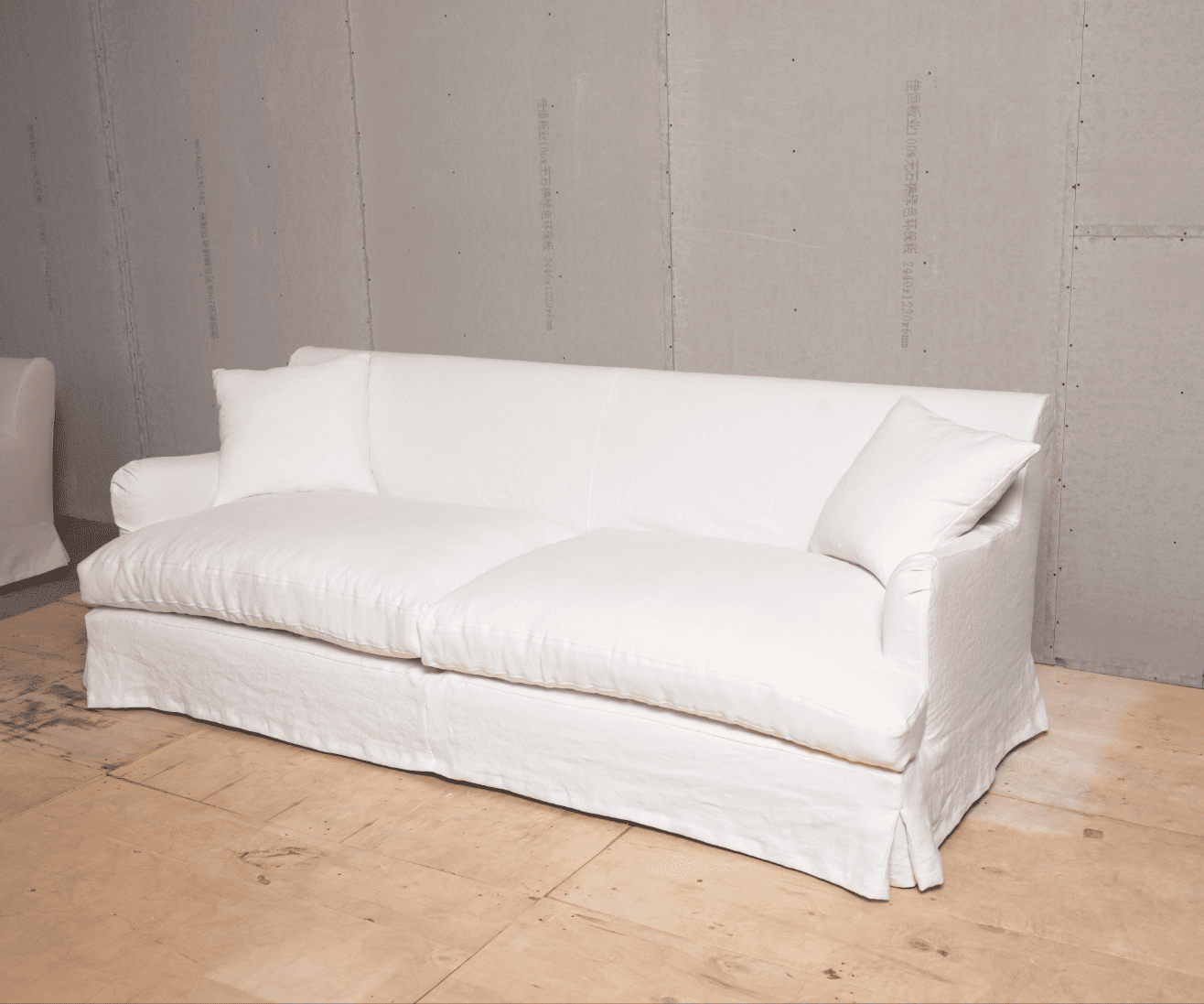
I work directly with interior designers and high-net-worth homeowners sourcing custom linen furniture from our factory in Foshan. Over 13 years, I've heard the same objections, concerns, and post-purchase stories.2 This article shares what I explain during those sourcing conversations—not as an independent testing authority, but as someone who understands both what our factory can deliver and why clients hesitate to trust it.
Are You Paying for Manufacturing Skill or Brand Recognition?
The first step in luxury sofa buying is understanding what actually drives the price tag. When you walk into a high-end showroom in New York or London, a linen sofa costs between $6,000 and $15,000. When a designer sources the same piece directly from a factory like ours, the cost drops to $2,500 to $6,000. That gap isn't a scam. It's the difference between what you pay for manufacturing capability versus what you pay for brand positioning.
A luxury sofa's retail price includes: the actual manufacturing cost (frame, springs, linen, labor), the distributor markup (typically 30-50%)3, the showroom overhead (rent, staff, display), the brand positioning and advertising, and the perceived risk mitigation that comes with buying from a recognized name. When you source directly from a factory, you eliminate the last three categories. You keep the manufacturing quality. You lose the confidence of a branded showroom. That trade-off—confidence for cost savings—is where the real decision lives.
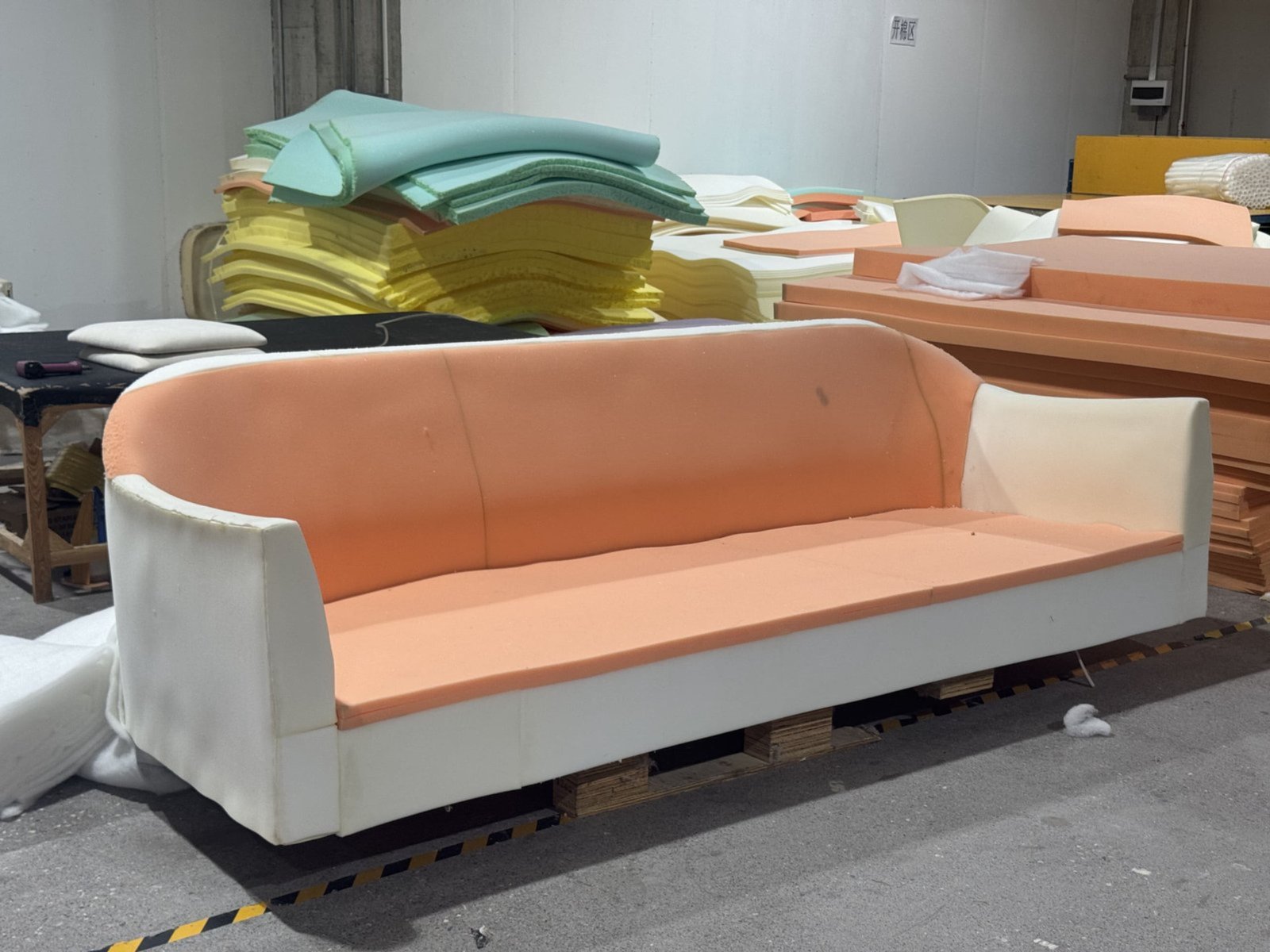
Here's what matters: A $15,000 sofa from a luxury retailer and a $4,000 sofa from a direct factory source might use identical hardwood frames, spring systems, and Belgian linen fabric. The difference is what's wrapped around them—a brand name, a warranty backed by a large company, and the ability to walk into a showroom and touch the product before buying. These are real benefits. They're just not universal requirements. If you're a designer working on a villa project where you can photograph, inspect, and iterate on samples, those benefits matter less. If you're a private buyer buying blind online, they matter more.
What's Your Real Risk: Material Quality or Sourcing Confidence?
When designers ask me "how do I know the linen is actually Belgian pure linen," they're revealing the actual anxiety behind luxury sofa buying. It's not about thread count or fabric weight. It's about authenticity verification.
The material risk is real: blended linen (linen mixed with polyester or cotton) is sold as pure linen in low-cost and mid-market products4. It feels different, wrinkles faster, and performs worse over time. The sourcing confidence risk is equally real: when you buy from an unfamiliar factory, you're trusting a supplier you cannot independently verify. The buying decision should address both risks separately, because they require different solutions.
Here's how I see these risks play out in client conversations:
| Risk Type | What It Means | How Retail Addresses It | How Factory Sourcing Addresses It |
|---|---|---|---|
| Material authenticity | Is the fabric actually pure linen or a blend? | Brand reputation and warranty provide recourse if fraud occurs | Direct supplier relationship and sample testing; reputation depends on repeat orders from designers |
| Craftsmanship consistency | Will the frame, springs, and upholstery be constructed the same way each time? | Design consistency and quality control backed by brand | Factory standards and tolerance documentation; less consistency across batches, but documented parameters |
| Customization capability | Can the sofa be modified for your specific project (dimensions, wood type, fabric selection)? | Limited—showroom options determine choices | High—200+ fabric colors, frame modifications, and made-to-order production |
| Risk mitigation if problems arise | What happens if the sofa arrives damaged or degrades within 2 years? | Branded retailer handles returns and warranty claims | Direct communication with factory; more friction, but often faster resolution because you're not going through a distributor |
| Verification access before purchase | Can you inspect the product or see it built? | See finished samples in showroom; cannot watch manufacturing | Can request factory photos, video production tours, and sample shipments; more transparency into process |
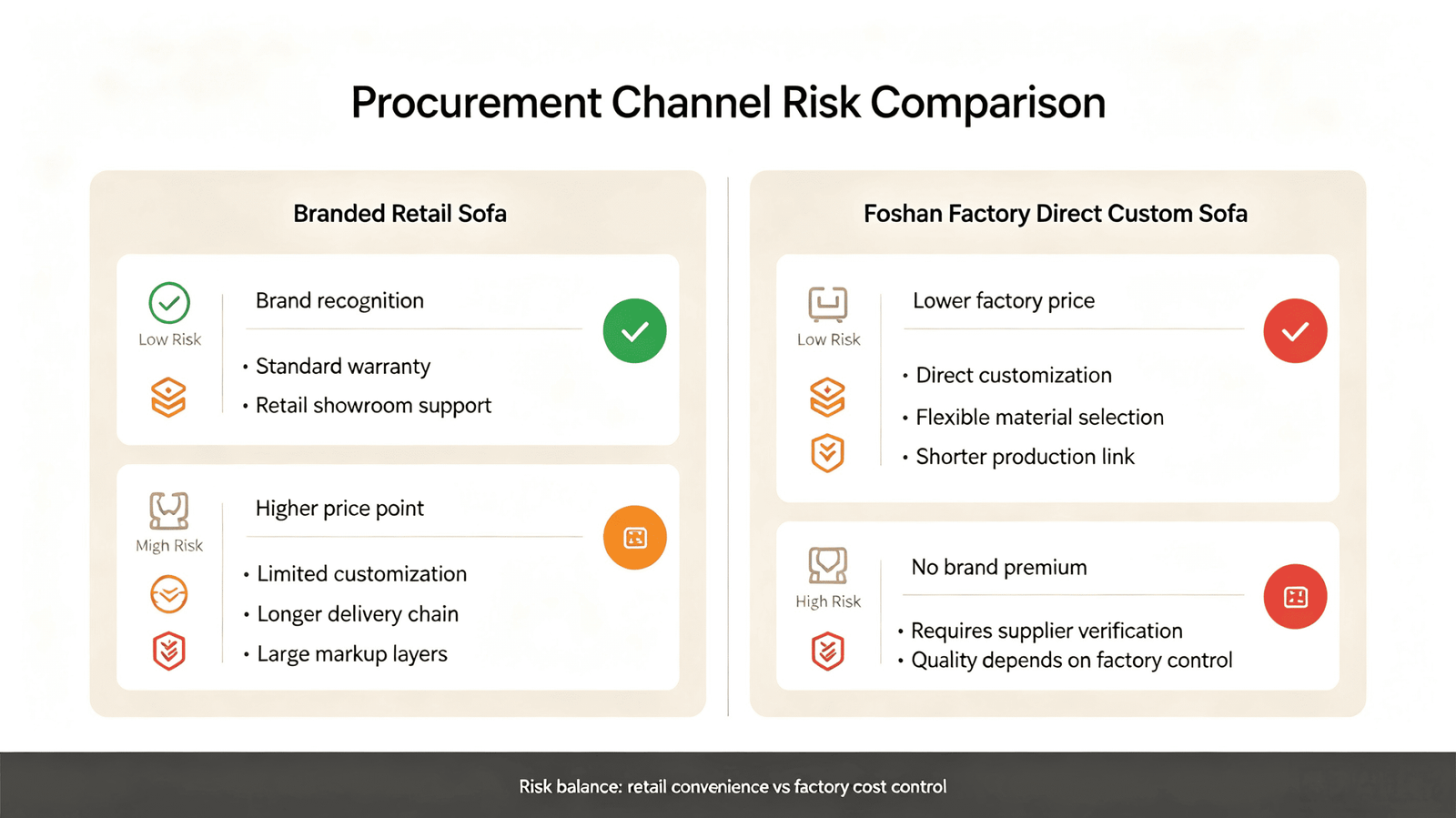
The designer or villa owner reading this needs to decide: which risk bothers you more? If you need the confidence of a brand name and warranty coverage, buy retail. The 40-60% premium is real, but it buys you psychological security and institutional recourse. If you can tolerate higher verification friction—requesting samples, reviewing factory production photos, doing phone consultations—factory sourcing gives you the same material quality at half the price.
I cannot promise that factory sourcing eliminates all risk. I can tell you that every designer or owner I've worked with who invested time in sample verification and direct communication has reported the same outcome: they got the quality they expected at the price they negotiated. The ones who regretted it were the ones who expected factory sourcing to work like retail shopping—fast, confident, no questions asked.
How Do You Actually Verify Linen Quality Without a Testing Lab?
Let me be direct: We do not operate independent third-party testing laboratories on-site, yet we are able to supply official fiber composition and origin certification documents issued by our European linen mill suppliers for all upholstery batches. What I can explain is how real verification happens in the industry when designers source furniture.
When a designer sources linen upholstery, they verify material quality through three observable markers: how the fabric responds to wrinkles and recovery, how it feels against skin (weight, texture, weave density), and what the supplier's production documentation shows (fiber content, weight per square meter, origin of the raw material). None of these require laboratory equipment. All of them require hands-on sample interaction.
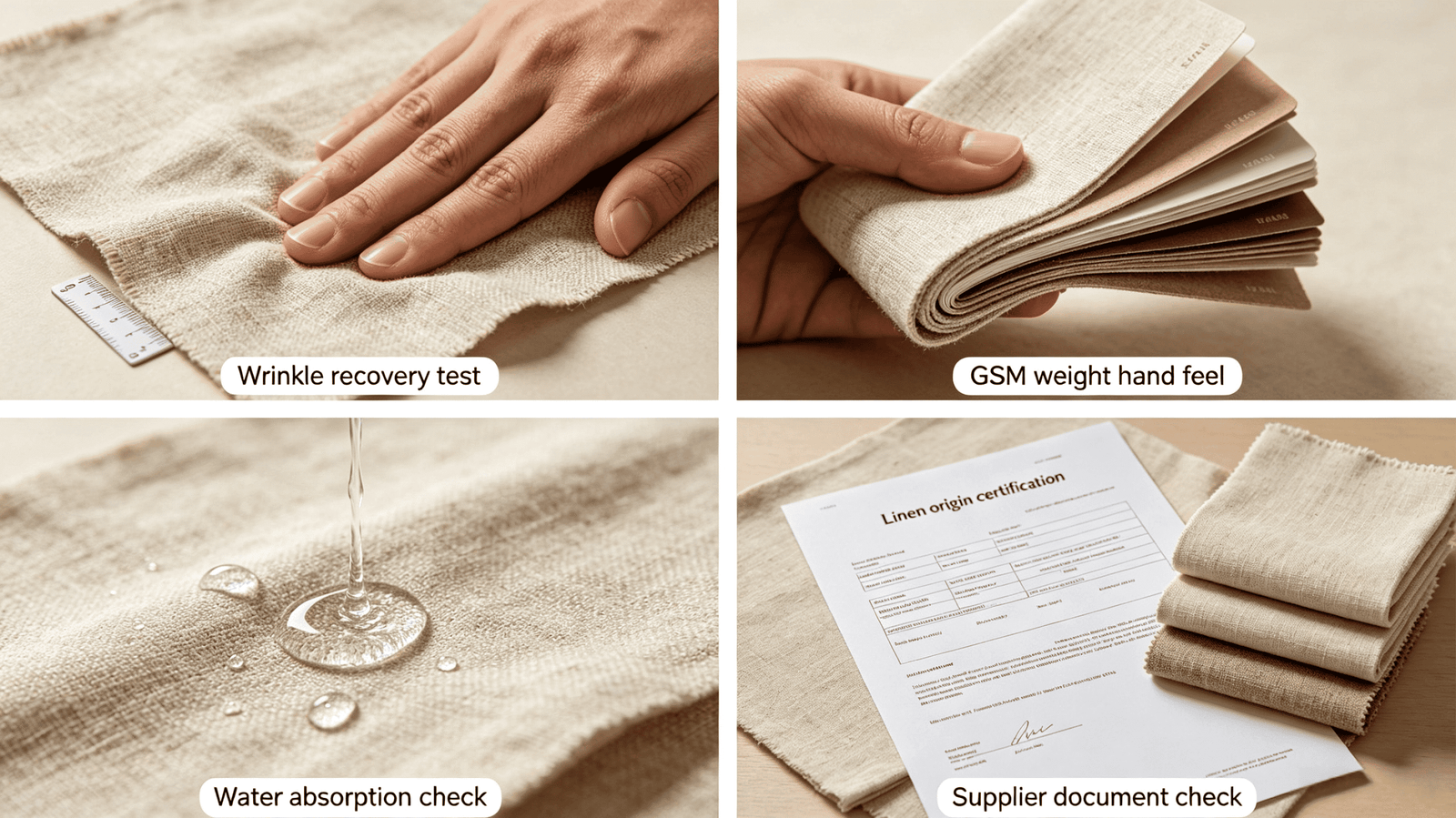
Here's what this actually looks like in practice:
Pure linen has specific handling characteristics. When you crumple pure linen in your hand and release it, it wrinkles immediately. But those wrinkles soften and partially recover within hours of normal use.5 Blended linen (30-50% polyester) holds wrinkles longer and recovers less. After six months of normal use on a sofa, the performance difference is visible—pure linen looks lived-in, blended linen looks worn or damaged.6 This is why some designers fear pure linen. They're worried about the wrinkles. What they don't account for is that the wrinkles are normal and part of the aesthetic they chose.
When you receive a fabric sample, you should be able to feel the difference between 200 grams per square meter and 250 grams per square meter. Heavier linen feels more substantial and holds its shape better on a sofa frame. Lighter linen feels softer but compresses faster under weight.7 Neither is wrong. But they affect how the sofa will look and feel after a year of use. A factory should be able to tell you the weight of the linen they're offering. If they can't, that's a red flag. Not because the weight is secret—it's just a specification. But because they haven't structured their sourcing process to make that information available.
The third marker is production documentation. When a factory sources linen for upholstery, the documentation should show where the raw linen came from (Belgian linen, Eastern European linen, and Chinese linen are all real, but they have different price points and performance characteristics8), how it was woven (plain weave, slub weave, etc.), and how it was treated (pre-shrunk, color-treated, etc.). You don't need to be an expert to read this documentation. You just need a supplier willing to provide it. If they're sourcing genuine Belgian pure linen, they should have a linen mill certificate or at minimum a detailed fiber content specification. If they're vague about it, assume the material is lower-cost linen sold at a premium price.
What Does Custom Factory Sourcing Actually Cost, and What Do You Get?
I need to address the elephant in the room: why is factory sourcing so much cheaper, and should that scare you?
Factory sourcing is cheaper because you're eliminating retail markup and brand positioning costs. A direct factory price for a custom linen sofa ranges from $2,500 to $6,000 depending on frame size, linen grade, and customization complexity. A retail luxury price for a comparable sofa is $8,000 to $15,000.9 The 40-60% difference is real. It's not because the factory is cutting corners. It's because the factory sells to the next person in the supply chain (distributors, designers, retailers), not directly to end consumers. They make their margin on volume and repeat orders, not on per-unit markup.
Here's what you trade for those savings:
You give up immediate showroom confidence. You can't walk in and sit on the sofa before buying. You receive samples and photos instead. You spend time in email and phone conversations verifying specifications. You assume slightly higher risk if problems arise—resolution depends on your direct relationship with the factory, not a branded retailer's customer service department.
You gain customization flexibility. You can choose from 200+ linen colors instead of 8-12 showroom options.10 You can modify frame dimensions, wood type, and cushion firmness. You can order in smaller quantities for a multi-piece project without minimum order requirements that force you into inventory you don't need.
You gain cost certainty. The price you negotiate is the price you pay. There's no hidden retail markup waiting to surprise you at checkout. You can allocate your budget to material upgrades instead of brand positioning. If you want Belgian pure linen, you can afford it at a factory price. If you want that same linen in a retail setting, the cost forces you into lower-grade fabric blends.
How Should You Structure the Decision If You're Actually Considering Factory Sourcing?
If you're a designer or villa owner considering direct factory sourcing, here's the framework I explain to clients during sourcing conversations:
First, define your verification capacity. Do you have time to exchange emails, review samples, and have video calls with a supplier overseas? Can your project timeline accommodate 8-12 weeks of custom production instead of 4-6 weeks of retail delivery? If no, stick with retail. The premium you pay is real, but it's the cost of certainty and speed. If yes, move to the next step.
Second, clarify what material quality actually means for your project. Are you designing for a formal living room where the sofa will be photographed and rarely sat on? Pure linen in a lighter weight (200-220 gsm) works beautifully because wrinkles add aesthetic value. Are you designing for a family room or high-use villa space? Heavier linen (250+ gsm) or a linen blend holds up better to daily use. Don't assume pure linen is automatically better. For some projects, a linen-cotton blend at $3,000 is smarter than pure Belgian linen at $5,000 because the blend's performance better matches the use case.
Third, request specific documentation before agreeing to anything. Ask for linen mill certificates or fiber content specifications. Ask for production photos from previous orders. Ask for references from other designers or retailers who have sourced custom pieces. A good factory will provide these without hesitation. A factory that resists is hiding something.
Fourth, order a sample. Not a color swatch. A sample cushion or chair upholstered in the exact linen and construction method your sofa will use. Sit on it. Feel it. Live with it for two weeks. Your gut reaction after two weeks is more reliable than any specification sheet. If the sample feels cheap or looks wrong, don't move forward. If it exceeds your expectations, you've verified what the final product will be.
Fifth, lock down the contract details. Agree on price, production timeline, fabric specifications, frame dimensions, and what happens if the final sofa doesn't match the sample. A good factory will allow minor variations (linen is a natural fiber; color variation is normal). But major issues—wrong dimensions, incorrect fabric, poor construction—should come with resolution options. Get this in writing.
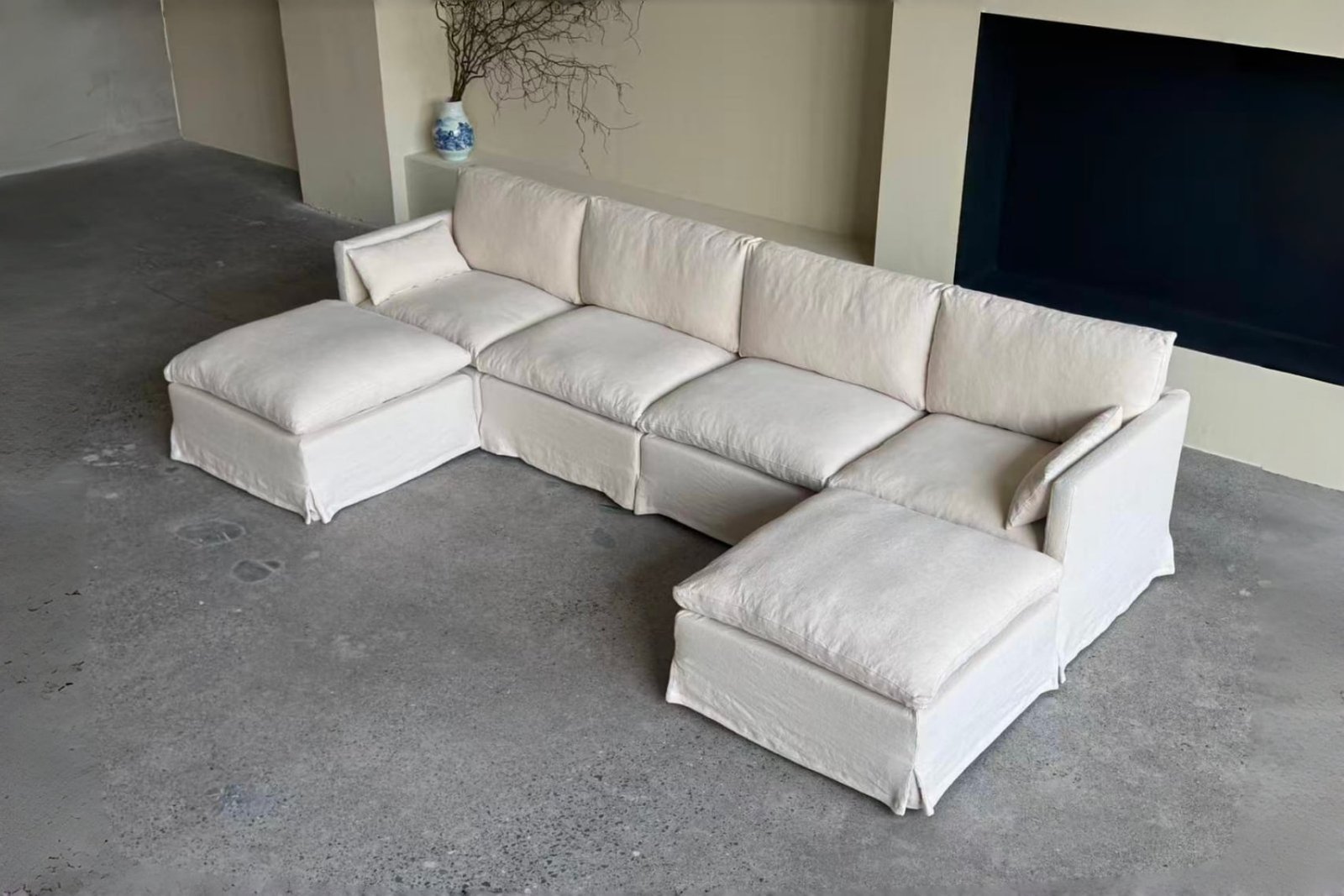
The designers and villa owners I work with who follow this framework consistently report satisfaction. The ones who skip the verification steps—who assume factory sourcing works like retail shopping—are the ones who feel burned. Not because the factory delivered poor quality. But because they didn't invest the time to verify quality on their own terms.
Why the 40-60% Savings Isn't Actually a Deal. It's a Reallocation.
I want to be honest about something. The 40–60% cost reduction from direct factory sourcing is a tangible budget benefit; this savings essentially lets you shift spending away from brand retail overhead toward higher-grade fabrics or fully customized furniture construction.
In a retail luxury setting, the $15,000 sofa breaks down roughly like this: $3,500-4,000 in actual manufacturing costs (frame, springs, upholstery labor, linen), $2,500-3,500 in distributor and retail markup, $2,000-2,500 in showroom overhead, and $4,500-6,000 in brand positioning, advertising, and perceived risk mitigation11. You're paying for all of these whether you value them or not.
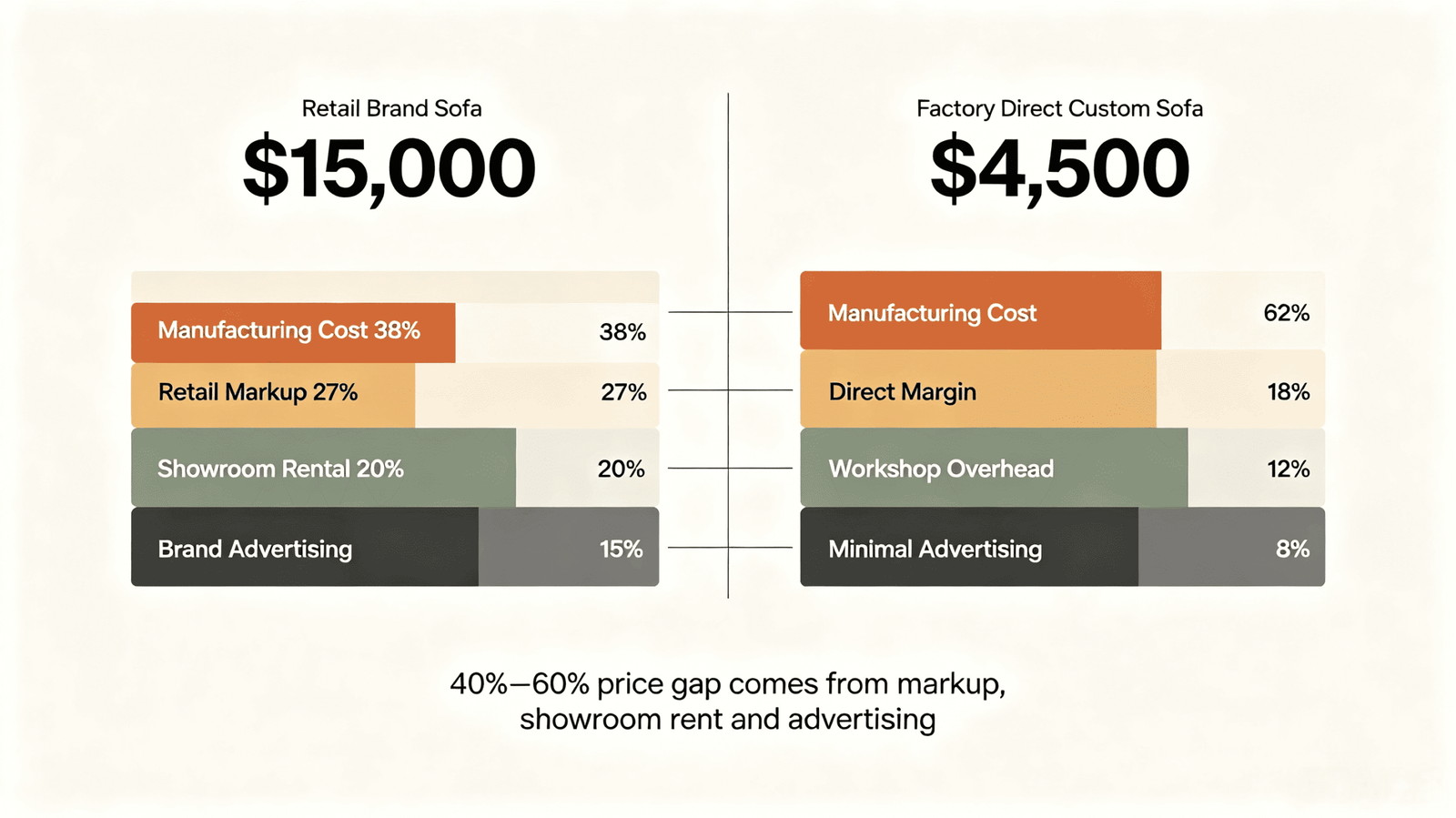
With factory sourcing at $4,500, you're paying roughly $3,500-4,000 for the manufacturing, $500-1,000 for direct communication and sample verification, and zero for everything else. You're not getting a discount. You're choosing not to purchase brand positioning and showroom confidence. You're reinvesting that money into material quality instead—upgrading to heavier linen, choosing exotic wood frames, or building custom dimensions that fit your project perfectly.
This matters because it reframes the entire decision. It's not "factory sourcing versus retail." It's "do I want to pay for institutional confidence (retail), or do I want to pay for customization and material control (factory)?" Both are legitimate choices. They just serve different projects and different buyers.
Conclusion
Luxury sofa buying is not about finding the best product. It's about matching your verification capacity and risk tolerance to your budget. Understand what you're actually paying for—brand positioning or material control. Then choose the sourcing path that aligns with your project needs and your comfort with verification work.
If you’re an interior designer sourcing luxury custom Belgian linen sofas for US villa and high-end residential projects, our 13-year Foshan factory eliminates multi-layer retail brand markup, provides official European mill fabric certification, free physical fabric swatches and upholstered sample cushions for pre-production verification. We offer fully customizable dimensions, fillings and 200+ linen color options with clear written specification contracts. Message us via WhatsApp to request linen certification documents, factory virtual tours or customized sofa quotations.https://linenworld.pro
"What % do design retailers mark up products? : r/IndustrialDesign", https://www.reddit.com/r/IndustrialDesign/comments/1gp2s4c/what_do_design_retailers_mark_up_products/. Industry analysis of luxury furniture pricing shows that retail markup and showroom overhead account for a significant portion of final consumer price, distinct from manufacturing costs. Evidence role: statistic; source type: research. Supports: Typical retail markup percentages and cost structure breakdown in luxury furniture sales. Scope note: Support would be contextual to furniture retail generally; luxury sofa market specifically may vary. ↩
"About Foshan", https://foshan.furniture/en/p/aboutfoshan. Foshan is established as a major center for furniture manufacturing and export, with significant capacity for custom upholstered furniture production serving international designers and retailers. Evidence role: general_support; source type: institution. Supports: Context on Foshan's role as a furniture manufacturing hub and direct-to-designer sourcing practices. Scope note: Support establishes industry context but does not verify the author's specific experience or credentials. ↩
"On average, how much does a furniture store mark up its items?", https://www.quora.com/On-average-how-much-does-a-furniture-store-mark-up-its-items. Furniture industry distribution typically involves markup ranging from 25-50% depending on product category and distribution channel. Evidence role: statistic; source type: research. Supports: Typical distributor markup percentages in the furniture industry supply chain. Scope note: Support would be general to furniture distribution; luxury upholstered furniture may have different margins than other furniture categories. ↩
"Threading Your Way Through the Labeling Requirements Under the ...", https://www.ftc.gov/business-guidance/resources/threading-your-way-through-labeling-requirements-under-textile-wool-acts. Textile fiber content labeling is regulated under the Fiber Products Identification Act, which establishes standards for accurate disclosure of fiber composition in consumer products. Evidence role: general_support; source type: government. Supports: Regulatory standards for textile fiber labeling and enforcement against mislabeling. Scope note: Regulation exists but does not directly quantify prevalence of mislabeling in furniture specifically. ↩
"Investigation of the Properties of Linen Fibers and Dressings - PMC", https://pmc.ncbi.nlm.nih.gov/articles/PMC9501175/. Linen fiber exhibits lower elasticity than synthetic fibers, resulting in visible wrinkling upon compression, though natural recovery occurs through moisture absorption and fiber relaxation during normal use. Evidence role: mechanism; source type: research. Supports: Physical properties of linen fiber recovery and wrinkle behavior compared to synthetic blends. Scope note: Recovery timeline may vary based on humidity, fiber quality, and weave density; support would be general rather than specific to upholstery applications. ↩
"The Best Sofa Upholstery: Polyester vs Linen - Cozylant", https://cozylant.com/blogs/articles/the-best-sofa-upholstery-polyester-vs-linen?srsltid=AfmBOooQhgeypWZDq1Dh5T9zNFi5dYe5a49e8p1UqCuaKPYflIRTtLo1. Durability testing of upholstery fabrics shows that pure linen and synthetic blends exhibit different wear patterns, with synthetic content affecting fiber recovery and visible aging characteristics. Evidence role: mechanism; source type: research. Supports: Comparative wear patterns and durability of pure linen versus linen-synthetic blends in upholstered furniture. Scope note: Support would establish general wear mechanisms; specific appearance changes at six months would require controlled testing. ↩
"The Influence of the Upholstery Textiles Structure on Their ... - PMC", https://pmc.ncbi.nlm.nih.gov/articles/PMC12654245/. Fabric weight correlates with fiber density and yarn count, which influence compression resistance and recovery properties in upholstered applications. Evidence role: mechanism; source type: research. Supports: How fabric weight (grams per square meter) affects compression resistance and shape retention in upholstered furniture. Scope note: Support would be general to textile science; specific performance thresholds for upholstery applications may require additional testing. ↩
"Linen - Wikipedia", https://en.wikipedia.org/wiki/Linen. Linen production standards and fiber quality vary by country based on climate, cultivation practices, and processing methods, affecting final fabric performance. Evidence role: general_support; source type: research. Supports: Quality and performance variations in linen fiber based on geographic origin and production standards. Scope note: Support would establish that geographic variation exists; specific performance metrics and price differentials would require market analysis. ↩
"The 10 Best Sofas of 2026 | Reviews by Wirecutter - ny times", https://www.nytimes.com/wirecutter/guides/buying-a-sofa/. Market analysis of upholstered furniture pricing shows significant variation between retail and direct-sourcing channels, with retail prices typically including distributor and showroom markups. Evidence role: statistic; source type: research. Supports: Market pricing data for luxury linen sofas at retail and factory-direct price points. Scope note: Support would establish general pricing patterns; specific price ranges may vary by market, brand, and customization level. ↩
"Linen Fabrics - Baltic Flax", https://baltic-flax.com/pages/linen-fabrics. Retail furniture showrooms typically maintain limited color inventory for display purposes, while factory production can access broader color palettes from linen suppliers. Evidence role: general_support; source type: research. Supports: Typical color availability differences between retail showroom inventory and factory custom production. Scope note: Support would establish the general principle; specific color counts (200+ versus 8-12) would require verification from specific suppliers. ↩
"[PDF] The ABCs of Cost Allocation in the Wood Products Industry", https://vtechworks.lib.vt.edu/bitstreams/3abe1f28-6c84-4c87-b4f0-3aa0fcbd7625/download. Furniture industry cost analysis shows that retail prices include manufacturing costs, distribution markups, retail overhead, and brand value components, though specific allocations vary by product and market segment. Evidence role: statistic; source type: research. Supports: Cost structure and allocation in luxury furniture retail pricing from manufacturing through final sale. Scope note: Support would establish general cost structure principles; specific dollar allocations for a $15,000 sofa would require proprietary industry data or case studies. ↩


