
If you're sourcing a custom linen sofa for a high-end residential project, you already know the stakes are higher than picking a piece off a showroom floor. Every interior designer I've worked with over the past 13 years at our Foshan factory has walked into their first custom order with the same question — and it's usually the wrong one.
Most designers ask: "Which sofa is best?" The better question is: "What space, use frequency, and maintenance conditions does this sofa serve?" Because no material or maker is universally superior. The right choice depends on how performance requirements, design fit, and delivery constraints map to a single project.
This guide exists to help you ask the questions that actually matter when buying a custom linen sofa — for your client, for your timeline, and for your reputation.
A custom linen sofa buying guide isn't about finding the "best" sofa. It's about matching a specific set of performance requirements — fabric grade, frame joinery, cushion density, and lead time — to a specific project's conditions. The right sofa for a rarely-used guest room will not be the right sofa for a family's daily living room. This guide covers the evaluation criteria, verification steps, and threshold questions every designer should run before approving a custom sofa order.

If you've ever shipped a sofa to a client only to discover the color shifted under their skylight, or the seat depth didn't match the floor plan, you know that the real cost of a wrong sofa isn't the price tag — it's the lost trust. What follows is a framework for avoiding that outcome, built from the samples we've shipped, the revisions we've managed, and the conversations we've had with designers across the US and Europe.
Does Linen Actually Hold Up Over Time?
The moment you mention "linen" to a client, someone usually objects: "But isn't it fragile? Won't it wrinkle? Doesn't it shrink?"
Those objections come from experience with cheap linen — low-thread-count, loosely woven fabric sold at a discount. From the factory floor, I can tell you that linen's reputation for fragility is a processing problem, not a material problem1.
What determines linen durability
Three factors control whether a linen sofa holds its shape over five-plus years of daily use:
| Factor | What to look for | What to avoid |
|---|---|---|
| Weave density | Tight, high-thread-count weave (160+ threads per square inch2) | Loose weave where light passes through easily |
| Fabric weight | 280–350 gsm (grams per square meter) for upholstery-grade linen3 | Sub-200 gsm fabric labeled as "linen" but closer to apparel weight |
| Pre-wash treatment | Full pre-wash that accounts for 3–5% residual shrinkage4 | No pre-wash or only steam treatment |
A proper upholstery-grade Belgian linen with tight weave and factory pre-wash will not bag out or distort. The wrinkles that remain are creases — not defects. We've seen sofas from five-year-old production runs where the fabric relaxed slightly but held its structure because the weave was dense enough and the lining construction kept tension even across the frame.
The wrinkle conversation you need to have with clients
Here's an honest truth: linen wrinkles. It always will. The question is whether those wrinkles look like "lived-in character" or "poor workmanship."
Natural creasing — the soft folds that form where you sit — is characteristic of linen fiber. Designers who love linen understand this. But there's also controlled wrinkle from proper pre-wash treatment, which reduces but doesn't eliminate creasing. And then there's defect-level distortion — uneven puckering along seams, diagonal pulling from improper grain alignment during cutting — which signals poor fabrication.
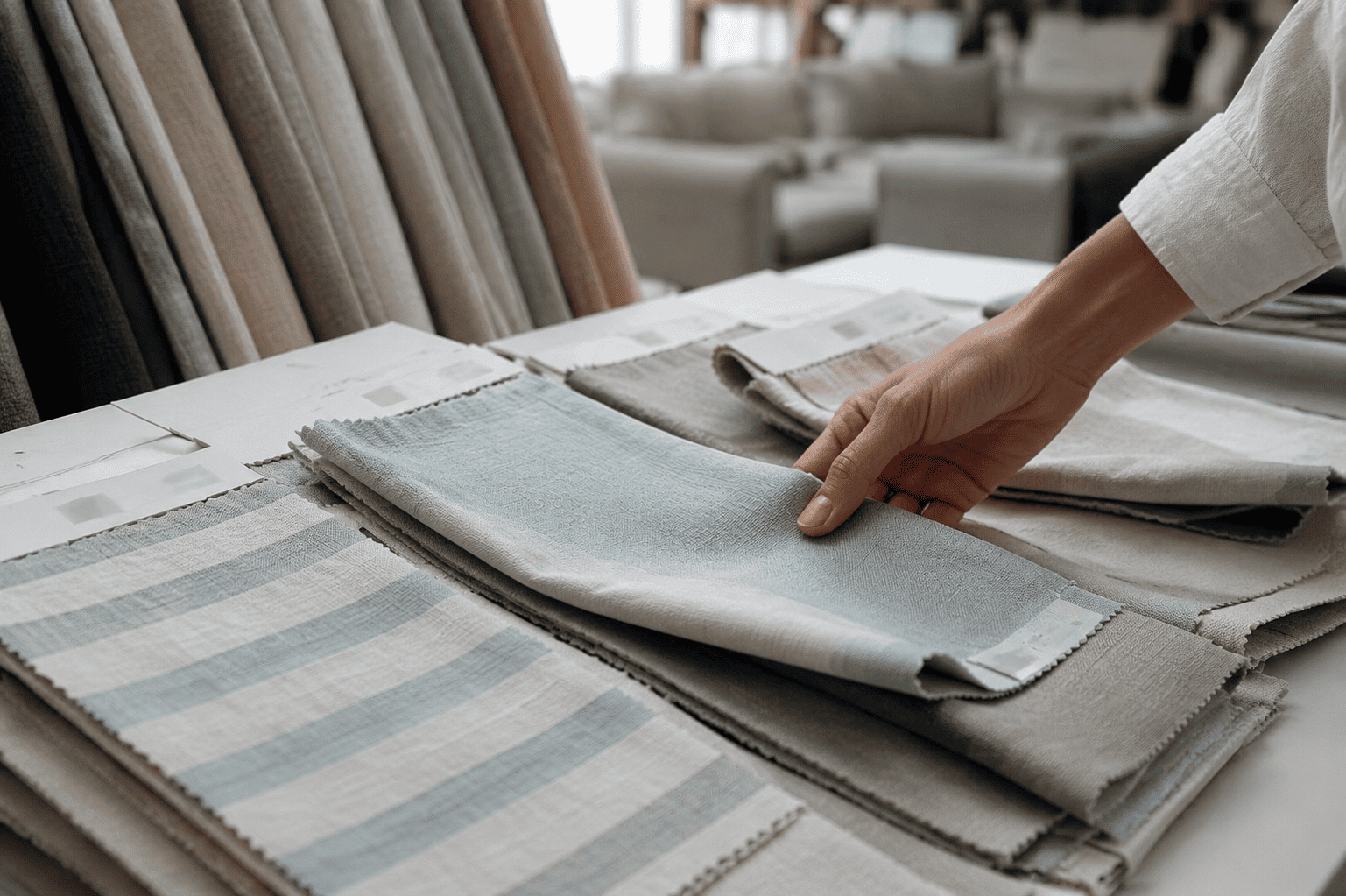
When I send a fabric swatch kit to a designer, I always include a note: "Run your hand across this sample. Bend it. This is how the finished sofa will behave." Because the swatch shouldn't lie to you.

How construction prevents structural issues
Even the best fabric fails if the structure underneath doesn't support it. The lining layer between your linen and the foam core is what prevents sagging over time.5 In our production, we use a double-layer lining system — a dense cotton drill fabric against the foam, then a lightweight stabilizing layer before the top linen. This keeps the linen from stretching unevenly against the cushion fill.
If a supplier can't tell you what's between their fabric and their foam, that's a red flag.
Why Is a Custom Linen Sofa 40-60% Less Than European Brands?
Designers often assume that lower price means lower quality. They've been burned by that assumption before. But the cost gap between a direct-from-factory custom sofa and a premium European brand isn't about cutting corners — it's about supply chain compression.
Where the savings actually come from
When you buy from a European luxury brand, you're paying for:
- Distributor markup (30-40%)6 — the brand sells to a distributor, who sells to a showroom, who sells to you
- Inventory carrying costs — pieces built for stock, sitting in warehouses, with overhead
- Marketing and branding — the showroom experience, the catalog, the trade events
- Import duties and logistics — built into retail price before you even add shipping
When you buy direct from a custom manufacturer like our factory, you're paying for:
- Fabric and materials at procurement cost — we buy in volume for production runs
- Labor and overhead — the actual build cost
- A single margin — factory to designer, no middle layers
- Made-to-order efficiency — no inventory holding, no waste from unsold stock
For equivalent fabric grade, frame joinery, and cushion density, a direct custom sofa costs 40-60% less than the European retail equivalent, excluding shipping and import duties.7 That's not a claim about being "better" — it's a structural advantage of a different business model.
How to verify equivalent specification
Don't take my word for it. Here's what you should ask any supplier — direct or branded — to compare apples to apples:
- Fabric source: Is this Belgian linen? What's the thread count and weight?
- Frame joinery: Are the joints glued and doweled, or screwed and blocked? Kiln-dried hardwood or engineered wood?
- Cushion density: What's the foam ILD (indentation load deflection) rating? Is it wrapped in a fiber layer?
- Suspension system: Eight-way hand-tied springs, sinuous wire, or webbing?
Line up these specs side by side, and the price difference becomes a question of distribution model, not quality compromise.

The one place you shouldn't cut cost
While you can save significantly on the base build, never compromise on the fabric grade or the suspension system8. These two elements determine whether the sofa performs three years in. A cheap frame can be reinforced. Cheap fabric cannot be upgraded after the piece is built.
From the samples we've sent to designers who later ordered production runs, the ones who regretted their choice almost always wished they'd gone up one grade of linen, not down.
Will Custom Furniture Disrupt My Project Timeline?
This is the fear that stops designers from even exploring custom. You've got a construction schedule, a client expecting delivery, and a deadline you cannot miss. Custom sounds like a variable you can't afford.
The lead time reality
Here's the actual timeline for a typical custom linen sofa order from our factory, assuming first-sample approval followed by a production run:
| Stage | Typical duration | Variables |
|---|---|---|
| Fabric swatch selection | 3–5 business days | Dependent on designer response time |
| First sample build | 7–10 business days | Requires approved fabric and dimension sheet |
| Sample review and revision | 3–7 business days | Dependent on courier speed and designer feedback |
| Production run (1–10 units) | 15–20 business days | Assuming no fabric backorder from mill |
| [Ocean freight (US West Coast) | 15–20 business days](https://dimerco.com/blog-post/a-guide-to-international-freight-transit-times-from-asia-to-usa/)%%%FOOTNOTE_REF_9%%% | Port congestion varies |
| Total from order to delivery | 6–9 weeks | Best case with fast approvals and no fabric issues |
The variable isn't the factory's speed — it's the designer's approval cycle. The fastest production I've ever managed was a rush order for a villa in Palm Springs: 4 weeks from sample approval to delivery. The slowest was a 4-month slog because the fabric mill ran out of a specific color, and the designer needed three rounds of re-approval with the client.
The pre-order checklist that prevents delays
Custom doesn't have to be unpredictable if you ask the right questions before placing the order. Here's the checklist I give every designer who emails us:
- Send full space dimensions, not just the sofa area. We need to know what the sofa sits next to — a low window? A tall console? This affects arm height decisions.
- Provide a use frequency profile. Is this a primary seating area (daily use), a conversation arrangement (weekly use), or a purely visual piece (rarely sat on)? This changes cushion density recommendation.
- Confirm fabric availability before sample build. Ask the factory to check mill stock for your chosen color. Nothing delays a timeline like "oh, that color is backordered 6 weeks."
- Request a physical fabric swatch in your space. Digital photos lie.10 Hold the swatch under the room's actual lighting conditions — both natural daylight and evening artificial light.
I've seen designers skip these steps to save a week, only to burn three weeks on a revision cycle because the color looked wrong in situ. The pre-order investment pays back in timeline predictability.
When custom is faster than stock
Counterintuitively, custom can be faster than waiting for a backordered stock piece. Premium European brands often run production in seasonal batches. If the sofa your client wants is out of stock through December, a custom build starting in November can deliver before the stock replenishment arrives. Custom isn't always slower — it's just a different scheduling logic.
What Questions Should I Ask Before Approving a Sofa Specification?
The most expensive mistake isn't picking the wrong sofa. It's approving a sofa without verifying against the room's actual conditions. By the time you've placed the order and the sofa arrives, the blame for any mismatch lands on you, the designer.
The three evaluation criteria that matter most
After a decade-plus of seeing what goes wrong, I've narrowed it to three questions:
1. How does the color shift under different light?
Linen absorbs and reflects light differently than synthetic blends.11 A "warm oatmeal" under showroom track lighting can read as "beige" under a client's north-facing window. We always recommend ordering a full-size swatch (not a tiny card) and placing it in the room at different times of day. Take photos. Send them to the factory. We can adjust dye lots if needed based on this feedback.
2. Will the cushion depth match actual use?
The difference between a 20-inch and a 24-inch seat depth is the difference between "comfortable for sitting upright while reading" and "sinks in for napping." We routinely get drawings where the floor plan has room for a certain depth, but the client's preferred posture requires something different. Measure an existing chair your client sits in regularly, then match that depth. It's a simple step that prevents the most common comfort complaint.
3. Does the arm height interfere with adjacent furniture?
The arm height of a linen armchair or sofa determines what fits next to it. A 26-inch arm blocks a side table's surface height. A low 18-inch arm means the table stands awkwardly above the seat. We've built sofas where the designer discovered during installation that the arm height conflicted with a window sill. That's a detail that should have been caught at the dimension-approval stage.
A checklist you can use with any supplier
| Criterion | What to verify | How to verify |
|---|---|---|
| Fabric grade | Thread count, weight, weave tightness | Request mill spec sheet or swatch |
| Color accuracy | Under natural and artificial light | Physical swatch in actual room |
| Seat depth | Matches client's sitting posture | Measure existing furniture client finds comfortable |
| Arm height | Clearance for adjacent furniture | Dimension drawing with surrounding pieces |
| Cushion fill | Foam ILD rating, fiber wrap | Ask for technical spec from supplier |
| Frame joinery | Kiln-dried hardwood, glued and screwed | Request photos of exposed joinery |
| Suspension | Eight-way hand-tied or high-grade sinuous | Confirm before production starts |
| Lining construction | Double-layer stabilizing fabric | Ask about lining spec |
| Lead time | Buffer for approval and shipping | Written timeline with conditions |

How Do I Verify a Supplier's Quality Before Ordering?
You don't need to visit a factory in person to verify quality. You just need to ask the right questions and request the right documentation.
What to ask every supplier
"Can you show me photos of your frame joinery on a current production piece?"
A good supplier will have someone walk to the production floor and take a photo. A bad supplier will send a generic render. Look for mortise-and-tenon or dowel joints with glue. Screws alone are not sufficient for a sofa that needs to last 10+ years.
"What is your process for sample matching?"
If a designer orders a sofa in a specific color, then orders a second piece six months later, will the colors match? The answer should involve dye lot tracking, retained fabric samples, and a documented check before production. We keep a physical swatch from every production run for exactly this reason.
"What happens if the finished piece doesn't match the approved sample?"
The honest answer should be: "We fix it at our cost, including freight." Not "we'll work with you on a solution." If the supplier doesn't stand behind the sample match, you're taking an unacceptable risk.
Red flags in supplier communication
- They can't or won't provide a mill spec sheet for the fabric
- Lead time estimates are always "it depends" without offering specific conditions
- They dismiss your concern about wrinkles as "it's linen, what do you expect" rather than explaining how they manage it
- They have no photo documentation of previous work for similar projects
We can speak to how our production handles these, but we'd recommend cross-checking with a local showroom for subjective feel — especially if your client wants to sit on the cushion density before committing.
Frequently Asked Questions
Is linen or cotton better for a sofa?
It depends on use conditions. Linen has superior breathability and moisture-wicking, which matters in warm or humid climates.12 Cotton is softer against skin but wears faster and holds stains more readily. For a living room sofa that gets daily use, a linen-cotton blend at roughly 55/45 offers a good balance of durability and hand feel. Pure linen works best for low-use formal spaces or dry climates.
How do I clean a linen sofa without damaging it?
The best approach is prevention — treat the fabric with a stain-resistant finish at the factory before upholstery. For maintenance, vacuum weekly with a brush attachment to prevent dust from embedding in the weave. For spot cleaning, blot (don't rub) with a mild soap solution. Professional cleaning every 2-3 years extends the fabric's life significantly. Avoid steam cleaning unless the supplier confirms pre-shrink treatment can tolerate it.
What cushion fill lasts longest in a linen sofa?
High-resilience foam with an ILD rating of 30-35 wrapped in a down-and-fiber layer strikes the best balance between longevity and comfort. Pure down cushions feel luxurious but require daily fluffing and lose shape within 3-5 years. All-foam cushions last longer but can feel too firm. The wrapped approach gives you the comfort of down with the structure retention of foam.
Can I use my own fabric for a custom sofa?
Yes — most custom manufacturers accept COM (customer's own material). However, not all fabric is suitable for upholstery. The fabric needs to be at least 280 gsm weight and have enough abrasion resistance for the intended use. We always recommend a wear test on COM fabric before committing to a full production run. We can advise on yardage requirements based on your design.
How much should a custom linen sofa cost?
For a standard 7-foot sofa in Belgian linen with kiln-dried hardwood frame and wrapped foam cushions, expect to pay $2,500-$4,500 from a direct factory, excluding shipping and duties. The same specification through a European luxury brand would run $6,000-$12,000. The range depends on fabric grade, complexity of design, and whether you need custom dimensions or standard sizes.
Conclusion
The difference between a successful linen sofa purchase and a costly mistake usually comes down to asking the right questions before the order is placed. This sofa buying guide exists to give you a repeatable framework: verify the fabric grade, confirm the frame construction, match the cushion to the use pattern, and validate color under the room's actual light.
Custom furniture from a direct factory can save 40-60% over European brand equivalents while maintaining equivalent specification — but only if you verify those specifications rather than assuming them. The factory's role is to execute your vision accurately. Your role is to provide complete context about the space, the use frequency, and the client's expectations.
If you're evaluating a supplier for your next project, I'd suggest starting with a fabric swatch kit and a conversation about your specific requirements. Every designer who has worked with us started with questions about lead time and ended up talking about weave density. That's the level of detail that separates a good sofa from one that protects your reputation.
Ready to spec your next project? Request a fabric swatch kit and we'll walk through your requirements together.
— From the production floor at Linen World, Foshan https://linenworld.pro
"Effect of Weave and Weft Type on Mechanical and Comfort ...", https://pmc.ncbi.nlm.nih.gov/articles/PMC11012718/. Textile research on flax/linen fibers describes relatively high fiber strength and emphasizes that finished fabric performance depends on yarn structure, weave, and finishing processes; this supports the claim that durability problems are often construction- or processing-related rather than inherent to linen itself. Evidence role: mechanism; source type: paper. Supports: A source should explain that linen/flax fibers have recognized mechanical strength and that fabric performance is affected by yarn, weave structure, and finishing rather than fiber identity alone.. Scope note: Such evidence supports the material mechanism generally, but it does not prove the quality of any specific sofa fabric or factory process. ↩
"Upholstery Fabric Thread Count and Weight: Your Spring ...", https://www.famcorfabrics.com/upholstery-fabric-thread-count-and-weight-your-spring-refresh-guide?srsltid=AfmBOopz5WI-7_OtN-bBt6V5IEnLJEu12y01gC_hj4V7HwRkOv31u5VL. Textile testing references commonly treat fabric construction parameters, including yarn count and thread density, as relevant variables in woven fabric strength, abrasion resistance, and dimensional behavior, providing contextual support for evaluating linen upholstery by weave density. Evidence role: general_support; source type: research. Supports: A source should support the general relationship between woven fabric density and durability or performance in upholstery applications.. Scope note: The source may not validate the article's exact 160-thread threshold for all linen upholstery fabrics. ↩
"The Strength of Heavy Linen Fabric for Upholstery and Crafts", https://www.tansilk.com/blog/the-strength-of-heavy-linen-fabric-for-upholstery-and-crafts. Textile education materials define GSM as fabric mass per unit area and note that heavier fabrics are generally selected for applications requiring greater structure and wear resistance, such as upholstery, whereas lighter weights are more common in apparel. Evidence role: definition; source type: education. Supports: A source should define fabric weight categories or explain how GSM relates to fabric suitability for apparel versus upholstery.. Scope note: This would contextualize the stated range but may not establish 280–350 gsm as a universal industry standard for linen sofas. ↩
"Linen Shrinkage: A Guide to Pre-Washing", https://www.selvane.co/blogs/knowledge/linen-shrinkage-and-pre-washing-what-to-expect-and-how-to-prepare?srsltid=AfmBOopuZdRQCaED8YLo2rkNXTuOoSmMO_fzpkUqA4NEguFgBQTKT_I_. Textile studies and dimensional-change test methods document that cellulosic woven fabrics, including linen, can undergo measurable shrinkage during wet processing and laundering, and that pre-shrinking treatments are used to reduce later dimensional change. Evidence role: mechanism; source type: paper. Supports: A source should support that linen fabrics can shrink after laundering or wet processing and that pre-treatment is used to reduce dimensional change.. Scope note: The evidence may support shrinkage control generally rather than the exact 3–5% residual figure for every upholstery linen. ↩
"A Review of Fusible Interlinings Usage in Garment Manufacture", https://pmc.ncbi.nlm.nih.gov/articles/PMC6290625/. Research and technical literature on interlinings describes their role in improving textile dimensional stability, shape retention, and stress distribution, which provides contextual support for using a stabilizing layer between upholstery fabric and cushion foam. Evidence role: mechanism; source type: research. Supports: A source should explain how interlinings or backing layers improve dimensional stability, reduce stretch, or distribute stress in upholstered textile systems.. Scope note: This supports the mechanism in general but does not directly test the specific double-layer lining system described in the article. ↩
"Linen Blend Fabric", https://linenworld.pro/fabric_type/linen-blend-fabric/. Furniture industry margin data can be used to show that intermediary distribution and retail layers commonly add significant percentage markups to manufacturer pricing, which contextualizes the article's discussion of distributor costs. Evidence role: statistic; source type: institution. Supports: A source should support typical distributor or wholesale markup ranges in furniture or comparable durable-goods retail channels.. Scope note: The cited data may vary by country, product tier, and channel and may not confirm a universal 30–40% distributor markup. ↩
"On average, how much does a furniture store mark up its ...", https://www.quora.com/On-average-how-much-does-a-furniture-store-mark-up-its-items. Industry analyses of furniture distribution document that wholesale, retail, inventory, and showroom costs can add substantial margins between manufacturing cost and final retail price, offering contextual support for why direct purchasing may be materially cheaper than branded retail channels. Evidence role: statistic; source type: institution. Supports: A source should provide neutral data on furniture retail markups, wholesale-to-retail margins, or supply-chain cost layers that could explain large price differences.. Scope note: Such data would support the pricing mechanism but may not independently verify the article's exact 40–60% savings range for European luxury sofas. ↩
"Selecting Upholstered Furniture - USU Digital Commons", https://digitalcommons.usu.edu/cgi/viewcontent.cgi?article=1515&context=extension_histall. Furniture-testing and upholstery references identify cover-fabric abrasion resistance and seating support systems as key factors in the durability and comfort retention of upholstered seating, supporting the article's emphasis on fabric grade and suspension quality. Evidence role: expert_consensus; source type: research. Supports: A source should support that upholstery fabric properties and suspension construction materially affect seating durability, comfort retention, and long-term performance.. Scope note: This supports the priority of these components generally, not the performance of a specific sofa design. ↩
"A Guide to International Freight Transit Times from Asia ...", https://dimerco.com/blog-post/a-guide-to-international-freight-transit-times-from-asia-to-usa/. International freight and port references commonly list China-to-U.S.-West-Coast container transit times in the range of roughly two to three weeks, supporting the article's use of a 15–20-business-day estimate under ordinary routing assumptions. Evidence role: general_support; source type: institution. Supports: A source should provide typical container-shipping transit times between major Chinese ports and U.S. West Coast ports.. Scope note: Transit times are context-dependent and may change with port congestion, carrier schedules, customs processing, and inland delivery requirements. ↩
"Improving color reliability of digital textile images via optimized ...", https://pmc.ncbi.nlm.nih.gov/articles/PMC12789604/. Color-science literature shows that perceived color varies with illumination, capture settings, device color management, and display calibration, supporting the practical recommendation to evaluate fabric swatches in the actual room rather than relying solely on digital photographs. Evidence role: mechanism; source type: research. Supports: A source should explain that color appearance depends on illumination, observer conditions, capture devices, and display calibration, making photographs unreliable for exact color matching.. Scope note: The evidence explains the mechanism of color variation but does not quantify error for the specific linen swatches discussed. ↩
"(PDF) Optical-related properties and characterization of ...", https://www.researchgate.net/publication/378678806_Optical-related_properties_and_characterization_of_some_textile_fibers_using_near-infrared_spectroscopy. Textile color and optical-property studies show that fiber composition, yarn structure, and surface morphology influence light absorption and reflectance, providing contextual support for the claim that linen and synthetic blends can display color differently under changing illumination. Evidence role: mechanism; source type: paper. Supports: A source should support that fiber composition and fabric structure affect light absorption, scattering, reflectance, and perceived textile color.. Scope note: This supports the principle but not a specific visual outcome for any single linen colorway. ↩
"Stay Cool: Top Fabrics to Wear to Survive the Summer Heat", https://www.gatech.edu/news/2024/07/02/stay-cool-top-fabrics-wear-survive-summer-heat. Textile research on flax and linen fabrics reports moisture-regain and air-permeability characteristics associated with thermal comfort, supporting the article's claim that linen can perform well in warm or humid interiors. Evidence role: mechanism; source type: paper. Supports: A source should support linen/flax fiber moisture-management and thermal-comfort properties relevant to warm or humid environments.. Scope note: The evidence supports linen's general textile properties but may not prove superiority over every cotton fabric or blend, since weave, finish, and fabric weight also affect breathability. ↩


