Problem: Every time you spec a sofa for a high-end residential project, you face the same question from your client: "Is this real linen?" The subtext isn't curiosity about fibers — it's anxiety about whether they're getting what they paid for. Agitation: That single question carries the weight of your entire recommendation. If you choose wrong, you'll defend it for weeks — through revisions, through client doubts, through the moment the fabric arrives and they touch it for the first time. Solution: Pure linen vs blend isn't about which is better. It's about matching the fabric to the room's role in the project. Here's the framework that lets you make that call with confidence, and explain it to any client.
The short answer: Pure linen is the right call when the piece serves as a visual anchor in a primary living space where sensory authority matters more than daily abuse. Blends are the right call when dimensional stability, maintenance ease, or budget alignment take priority — typically in high-traffic family rooms, secondary seating, or mid-tier residential projects. The wrong choice is treating this as a quality ranking rather than a project-positioning decision.
Most designers I talk to already know the basic differences between pure linen and blended fabrics. The hard part isn't the material science — it's the judgment call in front of a client who expects premium and wants proof. Let me walk you through the framework we've developed from working with hundreds of designers on exactly this decision.
The honest answer: Not if premium means "best for every situation." Think of pure linen as the right choice for a specific visual intent, not as a universal quality marker. In my experience, designers who default to pure linen for every piece often end up managing client complaints about wrinkling or pilling in high-use zones. The ones who pick blend for the right reasons get praised for their practical judgment.

What pure linen actually delivers
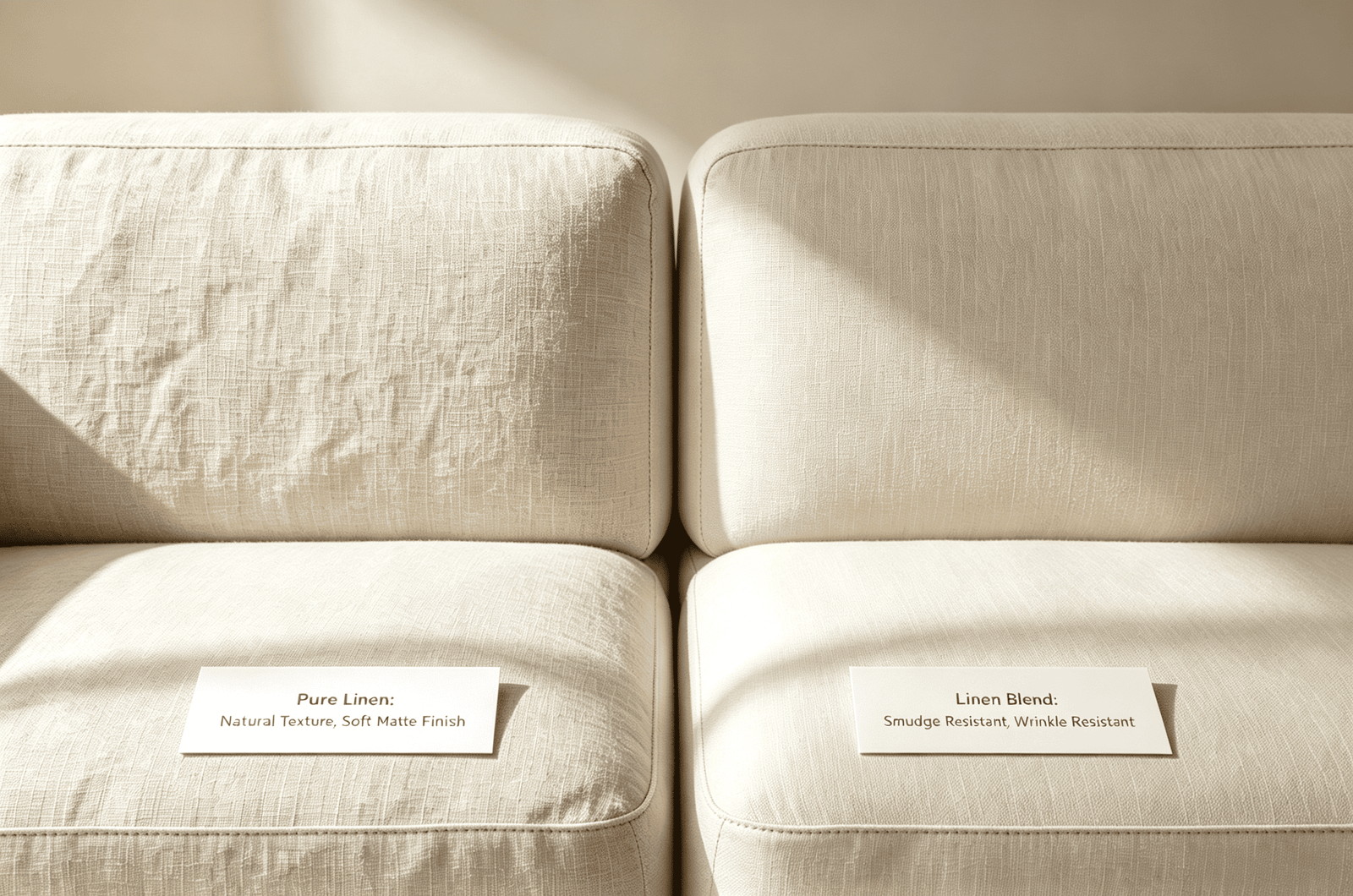
Pure linen — particularly Belgium pure linen — brings something no blend can replicate: sensory authority. High-net-worth homeowners recognize the natural slub, the irregular weave, the way light hits the fibers differently from every angle. When a client walks into a villa living room and touches a pure linen sofa, they feel the difference. They don't need to read a tag. This matters most in:
- Primary living rooms where the sofa is the room's visual anchor
- Master suites where material quality signals personal taste
- Showcase spaces where the designer needs to justify their fee through material choices
The trade-offs designers don't talk about
Here's the part that rarely makes it into fabric brochures: pure linen has real maintenance limitations. It wrinkles more. It can shrink if not handled properly.1 In direct sunlight, natural linen fibers weaken faster than blended alternatives.2 For pieces that see daily use from kids, pets, or frequent entertaining, these aren't minor issues — they're client-complaint risks.
The designers I respect most don't avoid pure linen. They deploy it deliberately, knowing exactly which pieces in the project can carry its personality and which need a more forgiving option.
When does a linen blend make more sense than pure linen?
A linen blend makes more sense whenever the piece's primary job is surviving daily life rather than making a sensory statement. Think den-like family rooms, home theater seating, breakfast nook chairs, or any upholstery in a household with young children or dogs. In those contexts, choosing a blend isn't settling — it's being smart about the project's real needs.
The functional case for blends
The most common blends we produce pair linen with cotton or a small percentage of synthetic fiber. Here's what each combination shifts:
| Attribute | Pure linen | Linen-cotton blend | Linen-poly blend |
|---|---|---|---|
| Dimensional stability | Lower — wrinkles and shifts | Moderate | Higher — holds shape3 |
| Sunlight resistance | Weaker over time | Moderate | Stronger |
| Hand feel | Crisp, textured | Softer, more pliable | Smoother, less natural |
| Maintenance ease | Dry clean recommended4 | Machine washable options | Spot-clean friendly |
| Client perception | Premium, natural | "Nice but not special" | Functional |
| Best room type | Primary living, master | Secondary living | High-traffic, contract |
The reframe that matters
The biggest mistake I see designers make is presenting a blend choice as "we had to compromise." That framing creates exactly the client doubt you're trying to avoid. Instead, the right framing sounds like this: "For the family room where the kids do homework and you host movie nights, I'd recommend a linen-cotton blend. It keeps the natural look you want but handles three times the daily use without showing wear5."
That's not compromise. That's good design judgment.
How do I decide between pure linen and blend for a specific project?
You decide based on two factors: the project tier and the room's function within that project. High-end villa statement pieces in primary living areas get pure linen. Secondary functional zones in the same project get blends. Mid-range residential projects — even primary living rooms — often work better with blends because the maintenance expectations are different.

The decision framework we use
After watching hundreds of designer-client interactions, I've noticed a pattern. The ones who make good fabric decisions share a common mental checklist. Here's what it looks like:
Step 1: Classify the project tier
- Tier 1 — Showcase villa or primary residence, high budget, client values authenticity → Pure linen for statement pieces
- Tier 2 — Mid-range residential, practical client, functional needs matter → Blends for most pieces, pure linen for one anchor piece
- Tier 3 — Vacation home, rental, or secondary property → Blends across the board
Step 2: Classify each room's function
- Primary gathering space (living room, great room) → Pure linen if Tier 1, blend if Tier 2-3
- Master suite → Pure linen for the bed or chaise, blend for seating
- Family room / den → Blend always
- Dining room → Depends on usage frequency; weekly formal dining gets pure linen, daily dining gets blend
- Home office → Blend for practicality
Step 3: Test the justification Ask yourself: "If my client asks why I chose this fabric, can I explain it in one sentence that makes me look thoughtful rather than defensive?" If you can't, you haven't matched the fabric to the room well enough.
What experienced designers actually do
In practice, the split I see most often in successful projects is roughly 70/30 blend to pure linen by piece count6. Even in high-end homes, most of the fabric in the house is blend. Pure linen gets reserved for the two or three pieces that need to carry the room's material story — the primary sofa, the master bed, the statement armchair.
One designer I work with regularly puts it bluntly: "Pure linen sells the project. Blend keeps the project from coming back to haunt me."
What should I tell my client when they ask about the fabric difference?
Tell them the truth, framed as expertise rather than apology. Most clients ask about fabric because they're afraid of being taken advantage of, not because they have strong fabric preferences. Your job is to translate material choice into project outcomes they care about.
The language that works
Here's what I've heard work consistently in designer-client conversations:
"This sofa uses a Belgium pure linen. You can see the natural slub in the weave — that's the texture high-end residential projects use to signal quality. It will age beautifully, but it needs dry cleaning and will wrinkle more than a blended fabric. For your living room, that trade-off makes sense because this is the room where you want the material to make a statement."
Versus:
"For the family room, I'm recommending a linen-cotton blend. It keeps the natural linen look you want but handles daily use much better. You can spot-clean spills, it holds its shape, and it won't fade as fast in that south-facing light. The visual difference is subtle — the practical difference is significant."
Notice what both versions do: they name the trade-off explicitly. That builds trust. When a designer acknowledges both the benefit and the limitation of a choice, the client stops questioning and starts trusting.
Frequently Asked Questions
Does pure linen wear out faster than blend?
Pure linen fibers are strong but less elastic than blended alternatives.7 In high-use upholstery, pure linen shows wear — pilling, creasing, and fiber breakage — faster than a linen-poly or linen-cotton blend8. For a primary sofa used daily, expect visible changes within 2-3 years on pure linen versus 4-5 years on a well-made blend9. The trade-off is aesthetic: many clients prefer the natural aging of pure linen, while others want the fabric to stay uniform longer.
Can I tell pure linen from blend just by looking?
A trained eye can, especially with Belgium pure linen versus standard blends. Pure linen has irregular slubs — those thicker, uneven spots in the yarn that create natural texture. Blends tend to be more uniform in appearance because the added fibers fill in the irregularities.10 The hand feel also differs: pure linen feels crisp and slightly cool, while blends feel softer and warmer to the touch. For most clients, the difference is more tactile than visual.
Is Belgium pure linen worth the premium over regular linen?
Belgium pure linen is valued for longer fiber length, more consistent processing, and a more refined hand feel compared to linen from other regions.11 For high-end residential projects where the client expects visible material quality, the premium often justifies itself. For mid-range or secondary spaces, standard pure linen or a blend typically delivers similar visual results at lower cost. The premium matters most when the fabric needs to be a talking point in the room.
What's the best blend ratio for upholstery that still looks like linen?
The blend ratios I see most often from designers who want to preserve the linen look while gaining durability are 55% linen / 45% cotton or 50% linen / 50% polyester12. At these ratios, the fabric retains linen's natural texture and matte finish while gaining significant dimensional stability and easier maintenance. Below 40% linen content, the fabric starts losing the recognizable linen character that designers and clients associate with premium residential projects.
How do I handle a client who insists on pure linen everywhere?
Start by acknowledging their instinct — pure linen signals quality, and they're right to want that. Then walk through each room and ask: "Who sits here? How often? What happens in this space?" Let them talk through the usage. Most clients, when they realize their family room will see popcorn and dog paws, will self-correct. For the clients who still insist on pure linen throughout, make sure your work order specifies maintenance instructions clearly, and document your recommendation in writing. That protects both of you.
Conclusion
Pure linen vs blend is not a question of better or worse. It's a question of for which room, for which client, for what purpose. Pure linen brings sensory authority that high-end clients recognize — the visible slub, the natural texture, the unmistakable hand feel of Belgium flax. Blends bring dimensional stability and maintenance ease that keep pieces looking good through real daily use. The designers who get this right don't pick one fabric and defend it. They match the fabric to the project tier and the room's role. For your next project, try the 70/30 split: blend for most pieces, pure linen for the two or three that need to carry the room's material story. Your clients will feel the difference in the spaces that matter most, and you'll spend less time defending your choices.
If you are an interior designer sourcing Belgian pure linen & blended linen upholstery for high-end residential projects, our 13-year custom furniture factory in Foshan offers free room traffic & sunlight fabric matching consultation, physical certified Belgian linen swatch kits, CAD furniture drawing service and COM fabric technical assessment. We supply uncoated pure Belgian linen, linen-cotton washable blends and linen-poly sun-resistant blends with hundreds of neutral & earth tone color options. Reach out via WhatsApp to request fabric samples or full project specification support.https://linenworld.pro
"Performance Properties in Fibers and Fabrics", https://d24-h.tamu.edu/files/2023/02/D2D-Performance-Properties-in-Fibers-and-Fabrics-Copy.pdf. Textile-science references attribute linen's pronounced creasing to the low elastic recovery of flax fibers and note that shrinkage can occur depending on fabric construction, finishing, and cleaning conditions. Evidence role: mechanism; source type: education. Supports: Textile references should explain linen's relatively low elastic recovery, tendency to crease, and potential for dimensional change during laundering.. Scope note: These properties vary by weave, preshrinking treatment, upholstery backing, and care method, so they do not establish identical performance for every pure-linen fabric. ↩
"Protection against ultraviolet radiation by commercial summer ...", https://pmc.ncbi.nlm.nih.gov/articles/PMC59842/. Experimental studies of textile weathering show that ultraviolet exposure can reduce the mechanical strength of cellulosic fibers such as flax, while the comparative performance of blends depends on fiber composition, dyes, finishes, and exposure conditions. Evidence role: mechanism; source type: paper. Supports: Research should document how ultraviolet radiation affects cellulose-based flax fibers and whether polyester-containing blends retain strength better under comparable exposure.. Scope note: Evidence of flax photodegradation does not by itself prove that every linen blend is more sunlight-resistant than every pure-linen upholstery fabric. ↩
"Performance Properties in Fibers and Fabrics", https://d24-h.tamu.edu/files/2023/02/D2D-Performance-Properties-in-Fibers-and-Fabrics-Copy.pdf. Studies of cellulosic–polyester blends generally report improved wrinkle recovery and dimensional stability as polyester content increases, supporting the use of such blends where shape retention is important. Evidence role: mechanism; source type: paper. Supports: Comparative textile testing should show whether adding polyester improves wrinkle recovery or reduces dimensional change relative to an otherwise comparable linen fabric.. Scope note: Performance also depends on yarn structure, weave, finishing, backing, and blend percentage; fiber content alone does not determine upholstery stability. ↩
"EC86-418 Upholstered Furniture Care : Cleaning and Stain ...", https://digitalcommons.unl.edu/cgi/viewcontent.cgi?article. Textile-care guidance indicates that cleaning instructions reflect the performance of the complete product—including dyes, finishes, backing, and construction—so fiber content alone cannot determine whether linen upholstery should be dry-cleaned, washed, or spot-cleaned. Evidence role: general_support; source type: government. Supports: Care-label guidance should establish that appropriate cleaning methods are based on the tested complete textile product, not solely on whether the face fabric is pure linen or a blend.. Scope note: This supports the need to follow the individual fabric's care specification rather than the table's broad allocation of cleaning methods. ↩
"Sustainable Flame-Retardant Flax Fabrics by Engineered ...", https://pmc.ncbi.nlm.nih.gov/articles/PMC10042673/. Comparative abrasion testing can quantify differences between pure linen and specified linen-cotton constructions, but a claim of three times greater usable wear requires results from matched fabrics tested under the same protocol. Evidence role: statistic; source type: paper. Supports: A suitable source would need to compare pure linen and a specified linen-cotton blend under the same abrasion or service-life test and report an approximately threefold difference.. Scope note: Laboratory abrasion cycles do not translate directly into a universal multiple of household daily use, and no general threefold advantage can be inferred without a directly comparable study. ↩
"Interior Design: Materials - Research Guides - The New School", https://guides.library.newschool.edu/interiordesign/materials. A documented specification survey could establish the relative frequency of pure linen and blended upholstery in residential interiors; absent such a dataset, the 70/30 split should be understood as a practice-based observation rather than an industry benchmark. Evidence role: statistic; source type: research. Supports: An independent specification survey would need to report the relative use of pure linen and linen blends across a defined sample of high-end residential projects.. Scope note: Broader textile-market data may provide context but would not directly validate a piece-count ratio within successful high-end residential projects. ↩
"Performance Properties in Fibers and Fabrics", https://d24-h.tamu.edu/files/2023/02/D2D-Performance-Properties-in-Fibers-and-Fabrics-Copy.pdf. Materials studies characterize flax as a comparatively strong and stiff natural fiber with low elongation at break, while synthetic fibers such as polyester generally provide greater extensibility and elastic recovery. Evidence role: mechanism; source type: paper. Supports: Materials research should establish that flax has substantial tensile strength but relatively low elongation and elastic recovery, particularly compared with polyester.. Scope note: The phrase 'blended alternatives' is broad: cotton does not confer the same elasticity as polyester, and finished-fabric behavior cannot be inferred from raw-fiber properties alone. ↩
"The Influence of Finishing on the Pilling Resistance of Linen ...", https://pmc.ncbi.nlm.nih.gov/articles/PMC8619160/. Textile research treats pilling, creasing, and fiber breakage as separate performance outcomes influenced by fiber properties, yarn construction, weave, and finishing; polyester may improve crease recovery, but blending does not uniformly guarantee less pilling or breakage. Evidence role: mechanism; source type: paper. Supports: Comparative testing should separately evaluate pilling, crease recovery, abrasion damage, and tensile retention for matched pure-linen and blended fabrics.. Scope note: Without matched-fabric test results, the evidence would contextualize the mechanisms rather than prove that every linen-cotton or linen-polyester blend outlasts pure linen in all three respects. ↩
"Study on the Influence of Selected Fabrics and Stitching on ...", https://pmc.ncbi.nlm.nih.gov/articles/PMC9181807/. Upholstery service life varies with abrasion resistance, construction, exposure, maintenance, and intensity of use; fixed two-to-three- and four-to-five-year wear ranges require longitudinal evidence under clearly specified conditions. Evidence role: statistic; source type: research. Supports: A longitudinal field study or service-life dataset would need to compare matched pure-linen and blended upholstery under defined residential usage conditions.. Scope note: Standard abrasion tests can indicate relative durability but cannot, without field validation, be converted reliably into a precise number of household years. ↩
"(PDF) Comparison between Tencel-Flax Blended Slub Yarn and ...", https://www.academia.edu/100109803/Comparison_between_Tencel_Flax_Blended_Slub_Yarn_and_Cotton_Flax_Blended_Slub_Yarn. Flax yarns may display characteristic irregularities arising from fiber bundles and spinning processes, but yarn evenness is also controlled by processing, and slub effects can be deliberately added to both pure and blended fabrics. Evidence role: mechanism; source type: education. Supports: A textile source should explain why flax yarn can contain characteristic thickness variations and how spinning method and blending affect yarn evenness.. Scope note: Visible slubs are not a definitive test of fiber composition; reliable identification may require labeling records, microscopy, chemical analysis, or standardized fiber testing. ↩
"Belgian Linen", https://en.wikipedia.org/wiki/Belgian_Linen. The Belgian Linen designation is associated with defined production and labeling criteria, but geographic designation alone does not establish that every Belgian fabric uses longer fibers or has a more refined hand than linen made elsewhere. Evidence role: definition; source type: institution. Supports: An authoritative source should define what the Belgian Linen designation certifies and distinguish geographic production requirements from measurable fiber-length or hand-feel superiority.. Scope note: Certification or regional-production evidence provides provenance and process context, not direct proof of universal superiority in fiber length, consistency, or tactile quality. ↩
"Thermal stability, flame retardancy and abrasion resistance of ...", https://hero.epa.gov/reference/2663032/. Research on flax blends shows that fiber proportion can influence texture, wrinkle recovery, dimensional stability, and abrasion behavior, but no single 55/45 or 50/50 ratio is universally optimal independent of yarn, weave, weight, and finishing. Evidence role: general_support; source type: paper. Supports: Comparative studies should assess how linen content affects texture, wrinkle recovery, abrasion resistance, shrinkage, and perceived appearance at specified cotton or polyester blend ratios.. Scope note: Evidence about general blend effects would not establish that these exact ratios are the most common among designers or best suited to every upholstery application. ↩


